

- Industry Size (2026)
- USD 556.4 Mn
- Forecast (2036)
- USD 1341.6 Mn
- CAGR (2026 to 2036)
- 9.2%
Environmentally Safe Road Marking Paint Additives Market Forecast and Outlook 2026 to 2036
The environmentally safe road marking paint additives market is projected to grow steadily from 2026 to 2036. In 2026, the market value is expected to be USD 556.4 million, with growth anticipated to reach USD 1,341.6 million by 2036. The compound annual growth rate (CAGR) for this market is forecasted at 9.2%, driven by the increasing demand for eco-friendly and sustainable solutions in road infrastructure. Road marking paint additives play a critical role in enhancing the visibility and durability of road markings while also addressing environmental concerns by reducing the harmful effects of conventional road marking chemicals.
The growth of the market is supported by increasing government regulations that promote the use of environmentally safe materials in public infrastructure projects. As the demand for sustainable road infrastructure rises globally, the adoption of environmentally friendly road marking paint additives will continue to grow. Innovations in paint formulations, improved performance standards, and a growing emphasis on reducing carbon footprints in construction and maintenance will further contribute to market expansion. Over the forecast period, the market is expected to see steady growth, supported by these key trends and regulatory shifts.
Quick Stats of the Environmentally Safe Road Marking Paint Additives Market
- Environmentally Safe Road Marking Paint Additives Market Value (2026): USD 556.4 million
- Environmentally Safe Road Marking Paint Additives Market Forecast Value (2036): USD 1,341.6 million
- Environmentally Safe Road Marking Paint Additives Market Global Forecast CAGR (2026 to 2036): 9.2%
- Environmentally Safe Road Marking Paint Additives Market Leading Segment: Road Marking Type (Waterborne Road Marking Paints) 34%
- Key Growth Regions in Environmentally Safe Road Marking Paint Additives Market: India
- Top Players in Environmentally Safe Road Marking Paint Additives Market: 3M, Dow Inc., Sherwin-Williams, BASF SE, PPG Industries
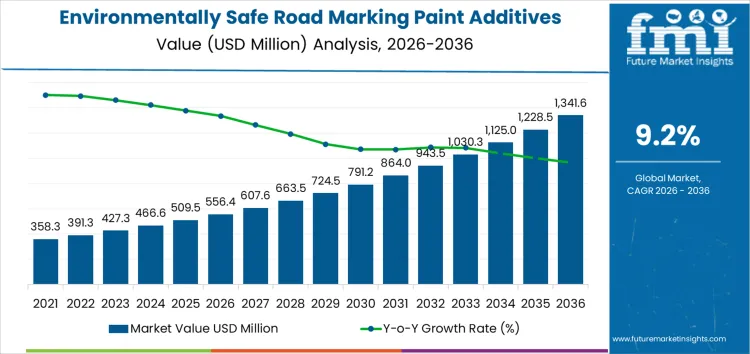
What is the Growth Forecast for the Environmentally Safe Road Marking Paint Additives Market through 2036?
The half-decade weighted growth analysis for the environmentally safe road marking paint additives market reflects a steady but increasingly significant expansion, particularly as the market progresses into the next five years. From 2026 to 2031, the market will experience a gradual growth in adoption, starting from USD 556.4 million and increasing to USD 870.2 million by 2031. The first half of the decade will see moderate but consistent gains, as municipalities and infrastructure companies begin to adopt eco-friendly alternatives.
The second half of the decade, from 2031 to 2036, will witness accelerated growth. The market will increase from USD 870.2 million in 2031 to USD 1,341.6 million by 2036. This shift in the growth rate highlights a scaling-up of adoption as the demand for sustainable materials in road construction continues to rise, alongside improvements in paint additive formulations. The growth trajectory during this period reflects a significant rise in environmental regulations and an increasing global focus on sustainability in public infrastructure projects.
Environmentally Safe Road Marking Paint Additives Market Key Takeaways
| Metric | Value |
|---|---|
| Industry Sales Value (2026) | USD 556.4 million |
| Industry Forecast Value (2036) | USD 1,341.6 million |
| Industry Forecast CAGR (2026 to 2036) | 9.2% |
What Is Driving the Demand for the Environmentally Safe Road Marking Paint Additives Market Globally?
The global demand for environmentally safe road marking paint additives is driven by increasing regulatory focus on reducing hazardous emissions, improving air and water quality, and protecting worker and public health during paint application and service life. Traditional road marking paints often rely on volatile organic compounds (VOCs), heavy metals, and other chemicals that can evaporate into the atmosphere or leach into surrounding soil and waterways. Governments and standards bodies in Europe, North America, Asia Pacific, and other regions are tightening limits on VOC content and restricting substances of concern, prompting paint manufacturers to reformulate additives that deliver durability, colour retention, and skid resistance without compromising environmental performance. Road authorities and transportation agencies are prioritising coatings that reduce toxic emissions during application and weathering, as well as additives that enhance adhesion and longevity to reduce repainting frequency, which lowers overall material use and lifecycle impact. Public awareness of air pollution and eco certification schemes for infrastructure projects further reinforce market uptake of safer, low impact additives in road surface coatings.
Future demand for environmentally safe road marking paint additives is expected to grow as sustainability criteria and performance expectations continue to influence material specification and procurement practices worldwide. Advances in green chemistry and additive technology are expanding options that deliver robust performance-such as improved UV stability, rapid curing, and enhanced visibility under varied climatic conditions-while meeting stricter environmental standards. Expansion of smart and reflective marking systems that incorporate microbeads and photoluminescent elements will further require compatible additive chemistries that balance safety with functionality. Investments in infrastructure upgrades, urban expansion, and traffic safety improvements in emerging markets will support broader adoption, as road networks increase in both volume and complexity. Regulatory frameworks that tie funding or certification to environmental performance will reinforce demand for additives that contribute to lower VOC emissions, reduced hazardous content, and improved recyclability at end of life. As agencies and contractors seek to integrate environmental, social, and governance (ESG) goals into road construction and maintenance programmes, demand for environmentally safe road marking paint additives is poised for steady global growth.
What are the Leading Segments in the Global Environmentally Safe Road Marking Paint Additives Market?
The global environmentally safe road marking paint additives market is segmented by road marking type and application area. Among road marking types, waterborne road marking paints lead the market, capturing 34% of the share, followed by thermoplastic markings, cold plastic & MMA markings, reflective glass bead coatings, and epoxy & polyurethane markings. Waterborne road marking paints are preferred due to their environmentally friendly nature and their ability to provide durable, high-quality markings. On the application area side, highways & expressways dominate the market, holding 32% of the share, followed by urban roads & municipal streets, airport runways & taxiways, parking lots & industrial zones, and cycling & pedestrian pathways. Highways & expressways are the primary application for road markings due to the high traffic volumes and the need for clear, visible markings for safety.
What Drives the Growth of Waterborne Road Marking Paints in the Environmentally Safe Road Marking Paint Additives Market?
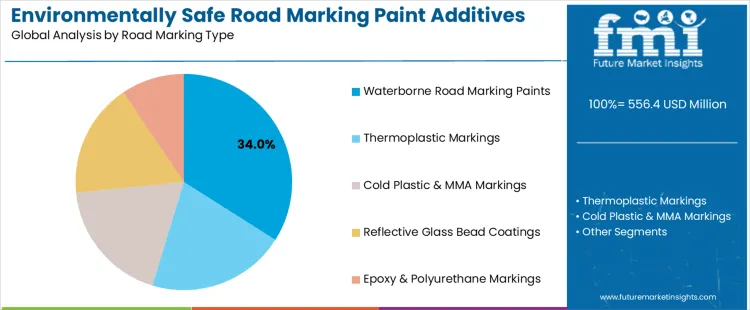
Waterborne road marking paints are the leading road marking type in the environmentally safe road marking paint additives market, holding 34% of the share. These paints are gaining popularity due to their low environmental impact, as they are free of volatile organic compounds (VOCs) and hazardous air pollutants, making them safer for both the environment and human health. Waterborne road marking paints provide excellent durability, visibility, and weather resistance, making them ideal for a variety of applications, particularly in high-traffic areas such as highways and urban roads. The growing demand for sustainable and environmentally friendly construction materials, coupled with regulatory pressures on reducing harmful chemicals in road marking products, is driving the adoption of waterborne road marking paints. As the emphasis on eco-friendly solutions continues to rise, waterborne paints are expected to maintain their dominant position in the market.
What is Driving the Demand for Highways & Expressways in the Environmentally Safe Road Marking Paint Additives Market?
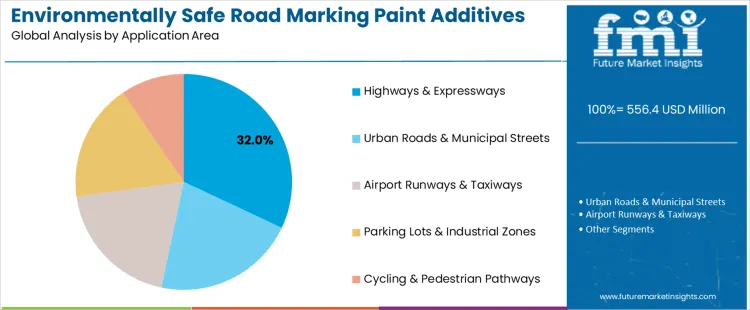
Highways & expressways are the leading application area in the environmentally safe road marking paint additives market, holding 32% of the share. This demand is driven by the essential need for durable, high-visibility road markings on major road networks that ensure traffic safety. Highways and expressways experience high traffic volumes, requiring road markings that can withstand harsh weather conditions, heavy traffic, and frequent wear. The increasing focus on road safety and the need for long-lasting, environmentally friendly solutions for road marking are fueling the demand for safe, high-performance additives in this sector. Additionally, the rising awareness of sustainability and regulations aimed at reducing harmful emissions in road marking materials contribute to the growing adoption of environmentally safe additives in highway and expressway applications. As governments and municipalities continue to prioritize safety and sustainability in infrastructure projects, highways & expressways will remain a dominant application area in the market.
What are the Key Dynamics in the Global Environmentally Safe Road Marking Paint Additives Market?
The global environmentally safe road marking paint additives market is expanding as transportation agencies and road contractors adopt formulations that improve visibility, durability and environmental performance. These additives enhance adhesion, retroreflectivity and wear resistance while reducing volatile organic compounds (VOCs), heavy metals and harmful solvents. Growth reflects stricter air quality and sustainability regulations, increased infrastructure investment, and demand for long lasting pavement markings that reduce maintenance frequency. Adoption spans highways, urban streets, airports and parking facilities, where safety, lifecycle cost and eco friendly credentials influence specification and procurement decisions worldwide.
What are the Key Drivers for the Environmentally Safe Road Marking Paint Additives Market?
Regulatory pressure to reduce VOC emissions and eliminate hazardous components in construction materials drives use of eco friendly road marking additives. Agencies and specification bodies are updating standards to prioritize low impact chemistries that support air quality and worker safety. Growing focus on sustainable infrastructure investments motivates inclusion of environmentally safe materials in public works programs. Transportation departments seek additives that deliver high retroreflectivity and durability to improve night and wet weather visibility, which enhances road safety. Technological advances in polymer binders, dispersants and pigment stabilizers enable performance gains while reducing environmental burden, encouraging broader adoption across regions.
What are the Restraints for the Environmentally Safe Road Marking Paint Additives Market?
One restraint is the challenge of balancing environmental performance with long term durability under heavy traffic and extreme climate conditions. Some eco oriented additives may require optimization to match wear resistance and color retention of traditional high VOC systems, which can extend development and testing cycles. Higher raw material costs for green additive chemistries can affect pricing, especially for budget constrained agencies or contractors. Variability in regional regulatory frameworks and approval timelines can slow market entry and broader specification of new formulations. Limited awareness of performance benefits among smaller agencies and private contractors may also delay adoption of environmentally safe alternatives.
What are the Key Trends in the Environmentally Safe Road Marking Paint Additives Market?
A key trend is innovation in low VOC, water borne and bio based additive systems that align with sustainability goals without compromising performance metrics like adhesion, retroreflectivity and quick cure time. Manufacturers are introducing engineered polymers, sustainable fillers and stabilizers that improve durability and reduce maintenance needs. Integration of smart measurement and quality tracking tools helps agencies monitor pavement marking performance and plan efficient reapplication cycles. Partnerships between additive suppliers, paint manufacturers and transportation authorities are increasing to validate field performance and support specification updates. Emphasis on circular economy principles is encouraging use of recycled content and cradle to grave impact assessment in product development and procurement.
What is the Country-Wise Analysis of the Environmentally Safe Road Marking Paint Additives Market?
The environmentally safe road marking paint additives market is expected to grow steadily, driven by increasing regulatory pressure to adopt eco-friendly alternatives to traditional road marking paints. These additives, used to improve the durability, visibility, and performance of road markings, are gaining popularity as governments and industries seek sustainable solutions to reduce environmental impact. High-growth markets such as India and China are witnessing strong demand due to their rapidly expanding infrastructure, urbanization, and growing focus on sustainable urban development. Developed markets such as the United States, Germany, and Brazil are also experiencing steady growth, supported by regulatory requirements, increasing environmental awareness, and the growing emphasis on reducing the harmful effects of conventional road marking chemicals.
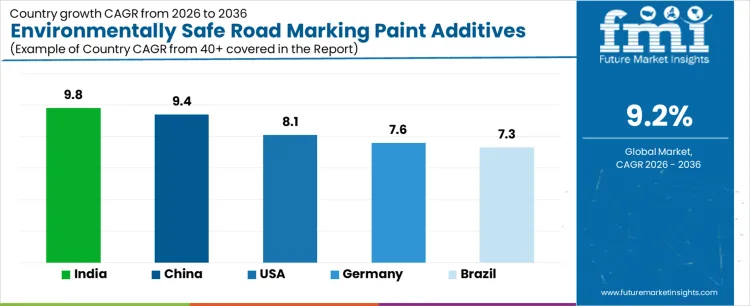
| Country | CAGR (%) |
|---|---|
| India | 9.8 |
| China | 9.4 |
| United States | 8.1 |
| Germany | 7.6 |
| Brazil | 7.3 |
What is the Growth Outlook for the Environmentally Safe Road Marking Paint Additives Market in India?
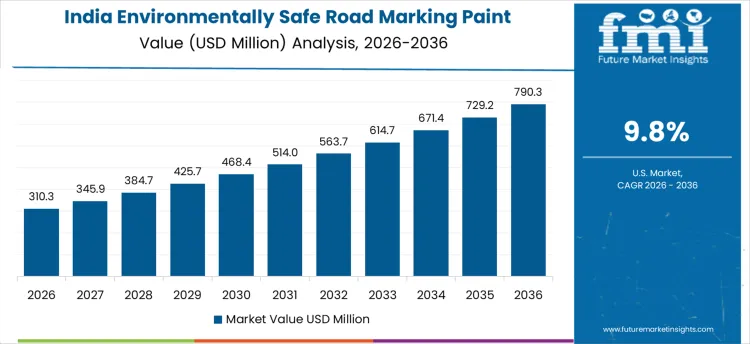
The environmentally safe road marking paint additives market in India is expected to grow at the highest rate, with a projected CAGR of 9.8%. India’s rapid urbanization, expanding road networks, and infrastructure development are key drivers of the demand for environmentally friendly road marking solutions. With growing awareness about the harmful environmental impacts of traditional road marking paints, India is increasingly turning to safer alternatives that comply with both domestic and international environmental standards. The Indian government’s push toward sustainable infrastructure development, coupled with the growing adoption of eco-friendly solutions in the construction and transportation sectors, is expected to drive strong demand for environmentally safe road marking paint additives. As the country continues to invest in smart cities and sustainable transportation infrastructure, the market for these additives is set to experience significant growth.
What is the Market Outlook for the Environmentally Safe Road Marking Paint Additives Market in China?
The environmentally safe road marking paint additives market in China is projected to grow steadily, with a projected CAGR of 9.4%. China’s large-scale infrastructure development, coupled with growing environmental awareness, is driving the demand for safer and more sustainable road marking solutions. The country’s focus on green technology and eco-friendly practices, along with stringent environmental regulations, is contributing to the increasing adoption of low-emission, non-toxic road marking paints and additives. Additionally, China’s expanding road networks and urban development are pushing the need for durable, visible, and environmentally responsible road markings. As the country works toward reducing the environmental footprint of its industrial practices, the demand for environmentally safe additives in road marking paints is expected to rise steadily in the coming years.
What is the Growth Forecast for the Environmentally Safe Road Marking Paint Additives Market in the United States?
The environmentally safe road marking paint additives market in the United States is expected to grow steadily, with a projected CAGR of 8.1%. In the USA, increasing regulatory pressure, along with rising awareness of environmental sustainability, is driving the demand for eco-friendly alternatives in road marking solutions. With stricter environmental standards governing road maintenance and construction, particularly in urban and transportation infrastructure projects, USA municipalities and construction companies are increasingly adopting environmentally safe additives. Furthermore, the growing focus on reducing toxic emissions and environmental hazards in public works is contributing to market growth. As USA cities continue to develop smart infrastructure and prioritize sustainability, the market for environmentally safe road marking paint additives is expected to grow steadily, especially with the ongoing trend toward green building materials and transportation solutions.
What is the Market Outlook for the Environmentally Safe Road Marking Paint Additives Market in Germany?
The environmentally safe road marking paint additives market in Germany is projected to grow at a steady pace, with a projected CAGR of 7.6%. Germany’s commitment to sustainability and strict environmental regulations are driving the demand for safer, non-toxic alternatives in road marking paints. As part of its effort to meet European Union standards for environmental protection and reduce the ecological impact of infrastructure projects, Germany is increasingly adopting eco-friendly additives in road marking paints. The construction and transportation sectors in Germany are focusing on sustainable practices, including the use of non-toxic, long-lasting road markings. As environmental concerns continue to shape public policies and industrial practices, the demand for environmentally safe road marking paint additives is expected to rise steadily in Germany.
What are the Growth Prospects for the Environmentally Safe Road Marking Paint Additives Market in Brazil?
The environmentally safe road marking paint additives market in Brazil is expected to grow steadily, with a projected CAGR of 7.3%. Brazil’s expanding infrastructure projects, coupled with an increasing focus on sustainability, are key factors driving the demand for environmentally friendly road marking solutions. The country’s growing awareness of environmental issues and the regulatory push toward greener alternatives in the construction and transportation sectors are contributing to market growth. Brazil’s government initiatives to improve road safety and reduce environmental harm, along with an increasing focus on reducing the use of harmful chemicals in public infrastructure projects, are expected to support the adoption of eco-friendly road marking paints and additives. As Brazil continues to prioritize infrastructure development and sustainability, the demand for environmentally safe additives in road marking paints will continue to rise steadily.
What is the Competitive Landscape for the Environmentally Safe Road Marking Paint Additives Market?
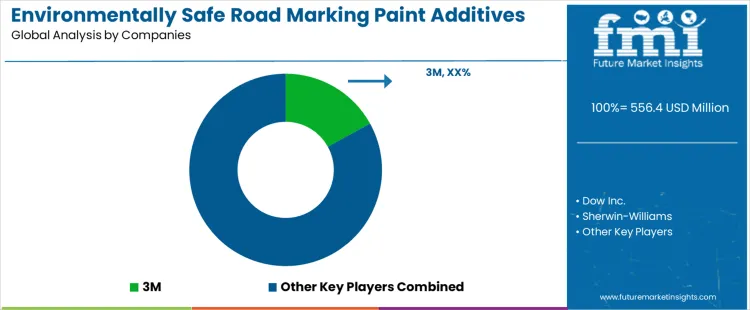
The environmentally safe road marking paint additives market is experiencing growth as governments and industries prioritize sustainable, eco-friendly solutions for road maintenance and infrastructure. 3M leads the market with its innovative additives designed for environmentally safe road marking paints, offering solutions that enhance visibility, durability, and performance while minimizing environmental impact. Their strong focus on sustainability, product innovation, and compliance with environmental regulations has positioned them as a dominant player in this sector. Dow Inc., Sherwin-Williams, and BASF SE are key competitors, each providing specialized additives that improve the functionality of road marking paints while ensuring that they are environmentally responsible. Dow Inc. offers high-performance additives that enhance the longevity of road markings, while Sherwin-Williams and BASF SE focus on creating sustainable, non-toxic additives for use in paints that meet regulatory standards and improve road safety.
PPG Industries further strengthens the competitive landscape by offering its own range of environmentally safe additives for road marking paints. PPG Industries emphasizes the importance of high-quality, long-lasting solutions that contribute to sustainability efforts in the road construction and maintenance industry. These companies compete by focusing on product innovation, sustainability, and the ability to meet the growing demand for environmentally safe, high-performance road marking paint additives. As environmental regulations continue to evolve and the demand for eco-conscious solutions increases, the market is expected to continue growing, driven by the need for safer, more sustainable infrastructure maintenance practices.
Key Players of the Environmentally Safe Road Marking Paint Additives Market
- 3M
- Dow Inc.
- Sherwin-Williams
- BASF SE
- PPG Industries
Scope of the Report
| Items | Values |
|---|---|
| Quantitative Units (2026) | USD Million |
| Additive Type | Bio-Based Binders & Resins, Low-VOC Plasticizers & Flow Additives, Glass Bead Adhesion Promoters, Anti-Fading & UV-Resistant Agents, Other Eco-Safe Performance Additives |
| Road Marking Type | Waterborne Road Marking Paints, Thermoplastic Markings, Cold Plastic & MMA Markings, Reflective Glass Bead Coatings, Epoxy & Polyurethane Markings |
| Application Area | Highways & Expressways, Urban Roads & Municipal Streets, Airport Runways & Taxiways, Parking Lots & Industrial Zones, Cycling & Pedestrian Pathways |
| Companies | 3M, Dow Inc., Sherwin-Williams, BASF SE, PPG Industries |
| Regions Covered | North America, Latin America, Western Europe, Eastern Europe, South Asia and Pacific, East Asia, Middle East & Africa |
| Countries Covered | United States, Canada, Mexico, Brazil, Argentina, Germany, France, United Kingdom, Italy, Spain, Netherlands, China, India, Japan, South Korea, ANZ, GCC Countries, South Africa |
| Additional Attributes | Dollar by sales by additive type, road marking type, application area, and region. Includes market trends in environmentally safe road marking paint additives, focusing on bio-based resins, low-VOC plasticizers, glass bead adhesion promoters, and anti-fading agents. Highlights the role of road markings in highways, urban roads, airports, parking lots, and cycling pathways. Focus on sustainability, cost-effectiveness, performance, regulatory compliance, market share, and competitive positioning of key companies in the road marking industry. |
Environmentally Safe Road Marking Paint Additives Market Segmentation
By Additive Type:
- Bio-Based Binders & Resins
- Low-VOC Plasticizers & Flow Additives
- Glass Bead Adhesion Promoters
- Anti-Fading & UV-Resistant Agents
- Other Eco-Safe Performance Additives
By Road Marking Type:
- Waterborne Road Marking Paints
- Thermoplastic Markings
- Cold Plastic & MMA Markings
- Reflective Glass Bead Coatings
- Epoxy & Polyurethane Markings
By Application Area:
- Highways & Expressways
- Urban Roads & Municipal Streets
- Airport Runways & Taxiways
- Parking Lots & Industrial Zones
- Cycling & Pedestrian Pathways
By Region:
- Asia Pacific
- China
- Japan
- South Korea
- India
- Australia & New Zealand
- ASEAN
- Rest of Asia Pacific
- Europe
- Germany
- United Kingdom
- France
- Italy
- Spain
- Nordic
- BENELUX
- Rest of Europe
- North America
- United States
- Canada
- Mexico
- Latin America
- Brazil
- Chile
- Rest of Latin America
- Middle East & Africa
- Kingdom of Saudi Arabia
- Other GCC Countries
- Turkey
- South Africa
- Other African Union
- Rest of Middle East & Africa
Frequently Asked Questions
How big is the environmentally safe road marking paint additives market in 2026?
The global environmentally safe road marking paint additives market is estimated to be valued at USD 556.4 million in 2026.
What will be the size of environmentally safe road marking paint additives market in 2036?
The market size for the environmentally safe road marking paint additives market is projected to reach USD 1,341.6 million by 2036.
How much will be the environmentally safe road marking paint additives market growth between 2026 and 2036?
The environmentally safe road marking paint additives market is expected to grow at a 9.2% CAGR between 2026 and 2036.
What are the key product types in the environmentally safe road marking paint additives market?
The key product types in environmentally safe road marking paint additives market are bio-based binders & resins, low-voc plasticizers & flow additives, glass bead adhesion promoters, anti-fading & uv-resistant agents and other eco-safe performance additives.
Which road marking type segment to contribute significant share in the environmentally safe road marking paint additives market in 2026?
In terms of road marking type, waterborne road marking paints segment to command 34.0% share in the environmentally safe road marking paint additives market in 2026.
Preview the report firsthand - request a free sample
Get SampleGet the brochure for pricing and purchase details.
Get PDFTable of Content
- Executive Summary
- Global Market Outlook
- Demand-side Trends
- Supply-side Trends
- Technology Roadmap Analysis
- Analysis and Recommendations
- Market Overview
- Market Coverage / Taxonomy
- Market Definition / Scope / Limitations
- Market Background
- Market Dynamics
- Drivers
- Restraints
- Opportunity
- Trends
- Scenario Forecast
- Demand in Optimistic Scenario
- Demand in Likely Scenario
- Demand in Conservative Scenario
- Opportunity Map Analysis
- Product Life Cycle Analysis
- Supply Chain Analysis
- Investment Feasibility Matrix
- Value Chain Analysis
- PESTLE and Porter’s Analysis
- Regulatory Landscape
- Regional Parent Market Outlook
- Production and Consumption Statistics
- Import and Export Statistics
- Market Dynamics
- Global Market Analysis 2021 to 2025 and Forecast, 2026 to 2036
- Historical Market Size Value (USD Million) Analysis, 2021 to 2025
- Current and Future Market Size Value (USD Million) Projections, 2026 to 2036
- Y-o-Y Growth Trend Analysis
- Absolute $ Opportunity Analysis
- Global Market Pricing Analysis 2021 to 2025 and Forecast 2026 to 2036
- Global Market Analysis 2021 to 2025 and Forecast 2026 to 2036, By Additive Type
- Introduction / Key Findings
- Historical Market Size Value (USD Million) Analysis By Additive Type , 2021 to 2025
- Current and Future Market Size Value (USD Million) Analysis and Forecast By Additive Type , 2026 to 2036
- Bio-Based Binders & Resins
- Low-VOC Plasticizers & Flow Additives
- Glass Bead Adhesion Promoters
- Anti-Fading & UV-Resistant Agents
- Other Eco-Safe Performance Additives
- Bio-Based Binders & Resins
- Y-o-Y Growth Trend Analysis By Additive Type , 2021 to 2025
- Absolute $ Opportunity Analysis By Additive Type , 2026 to 2036
- Global Market Analysis 2021 to 2025 and Forecast 2026 to 2036, By Road Marking Type
- Introduction / Key Findings
- Historical Market Size Value (USD Million) Analysis By Road Marking Type, 2021 to 2025
- Current and Future Market Size Value (USD Million) Analysis and Forecast By Road Marking Type, 2026 to 2036
- Waterborne Road Marking Paints
- Thermoplastic Markings
- Cold Plastic & MMA Markings
- Reflective Glass Bead Coatings
- Epoxy & Polyurethane Markings
- Waterborne Road Marking Paints
- Y-o-Y Growth Trend Analysis By Road Marking Type, 2021 to 2025
- Absolute $ Opportunity Analysis By Road Marking Type, 2026 to 2036
- Global Market Analysis 2021 to 2025 and Forecast 2026 to 2036, By Application Area
- Introduction / Key Findings
- Historical Market Size Value (USD Million) Analysis By Application Area, 2021 to 2025
- Current and Future Market Size Value (USD Million) Analysis and Forecast By Application Area, 2026 to 2036
- Highways & Expressways
- Urban Roads & Municipal Streets
- Airport Runways & Taxiways
- Parking Lots & Industrial Zones
- Cycling & Pedestrian Pathways
- Highways & Expressways
- Y-o-Y Growth Trend Analysis By Application Area, 2021 to 2025
- Absolute $ Opportunity Analysis By Application Area, 2026 to 2036
- Global Market Analysis 2021 to 2025 and Forecast 2026 to 2036, By Region
- Introduction
- Historical Market Size Value (USD Million) Analysis By Region, 2021 to 2025
- Current Market Size Value (USD Million) Analysis and Forecast By Region, 2026 to 2036
- North America
- Latin America
- Western Europe
- Eastern Europe
- East Asia
- South Asia and Pacific
- Middle East & Africa
- Market Attractiveness Analysis By Region
- North America Market Analysis 2021 to 2025 and Forecast 2026 to 2036, By Country
- Historical Market Size Value (USD Million) Trend Analysis By Market Taxonomy, 2021 to 2025
- Market Size Value (USD Million) Forecast By Market Taxonomy, 2026 to 2036
- By Country
- USA
- Canada
- Mexico
- By Additive Type
- By Road Marking Type
- By Application Area
- By Country
- Market Attractiveness Analysis
- By Country
- By Additive Type
- By Road Marking Type
- By Application Area
- Key Takeaways
- Latin America Market Analysis 2021 to 2025 and Forecast 2026 to 2036, By Country
- Historical Market Size Value (USD Million) Trend Analysis By Market Taxonomy, 2021 to 2025
- Market Size Value (USD Million) Forecast By Market Taxonomy, 2026 to 2036
- By Country
- Brazil
- Chile
- Rest of Latin America
- By Additive Type
- By Road Marking Type
- By Application Area
- By Country
- Market Attractiveness Analysis
- By Country
- By Additive Type
- By Road Marking Type
- By Application Area
- Key Takeaways
- Western Europe Market Analysis 2021 to 2025 and Forecast 2026 to 2036, By Country
- Historical Market Size Value (USD Million) Trend Analysis By Market Taxonomy, 2021 to 2025
- Market Size Value (USD Million) Forecast By Market Taxonomy, 2026 to 2036
- By Country
- Germany
- UK
- Italy
- Spain
- France
- Nordic
- BENELUX
- Rest of Western Europe
- By Additive Type
- By Road Marking Type
- By Application Area
- By Country
- Market Attractiveness Analysis
- By Country
- By Additive Type
- By Road Marking Type
- By Application Area
- Key Takeaways
- Eastern Europe Market Analysis 2021 to 2025 and Forecast 2026 to 2036, By Country
- Historical Market Size Value (USD Million) Trend Analysis By Market Taxonomy, 2021 to 2025
- Market Size Value (USD Million) Forecast By Market Taxonomy, 2026 to 2036
- By Country
- Russia
- Poland
- Hungary
- Balkan & Baltic
- Rest of Eastern Europe
- By Additive Type
- By Road Marking Type
- By Application Area
- By Country
- Market Attractiveness Analysis
- By Country
- By Additive Type
- By Road Marking Type
- By Application Area
- Key Takeaways
- East Asia Market Analysis 2021 to 2025 and Forecast 2026 to 2036, By Country
- Historical Market Size Value (USD Million) Trend Analysis By Market Taxonomy, 2021 to 2025
- Market Size Value (USD Million) Forecast By Market Taxonomy, 2026 to 2036
- By Country
- China
- Japan
- South Korea
- By Additive Type
- By Road Marking Type
- By Application Area
- By Country
- Market Attractiveness Analysis
- By Country
- By Additive Type
- By Road Marking Type
- By Application Area
- Key Takeaways
- South Asia and Pacific Market Analysis 2021 to 2025 and Forecast 2026 to 2036, By Country
- Historical Market Size Value (USD Million) Trend Analysis By Market Taxonomy, 2021 to 2025
- Market Size Value (USD Million) Forecast By Market Taxonomy, 2026 to 2036
- By Country
- India
- ASEAN
- Australia & New Zealand
- Rest of South Asia and Pacific
- By Additive Type
- By Road Marking Type
- By Application Area
- By Country
- Market Attractiveness Analysis
- By Country
- By Additive Type
- By Road Marking Type
- By Application Area
- Key Takeaways
- Middle East & Africa Market Analysis 2021 to 2025 and Forecast 2026 to 2036, By Country
- Historical Market Size Value (USD Million) Trend Analysis By Market Taxonomy, 2021 to 2025
- Market Size Value (USD Million) Forecast By Market Taxonomy, 2026 to 2036
- By Country
- Kingdom of Saudi Arabia
- Other GCC Countries
- Turkiye
- South Africa
- Other African Union
- Rest of Middle East & Africa
- By Additive Type
- By Road Marking Type
- By Application Area
- By Country
- Market Attractiveness Analysis
- By Country
- By Additive Type
- By Road Marking Type
- By Application Area
- Key Takeaways
- Key Countries Market Analysis
- USA
- Pricing Analysis
- Market Share Analysis, 2025
- By Additive Type
- By Road Marking Type
- By Application Area
- Canada
- Pricing Analysis
- Market Share Analysis, 2025
- By Additive Type
- By Road Marking Type
- By Application Area
- Mexico
- Pricing Analysis
- Market Share Analysis, 2025
- By Additive Type
- By Road Marking Type
- By Application Area
- Brazil
- Pricing Analysis
- Market Share Analysis, 2025
- By Additive Type
- By Road Marking Type
- By Application Area
- Chile
- Pricing Analysis
- Market Share Analysis, 2025
- By Additive Type
- By Road Marking Type
- By Application Area
- Germany
- Pricing Analysis
- Market Share Analysis, 2025
- By Additive Type
- By Road Marking Type
- By Application Area
- UK
- Pricing Analysis
- Market Share Analysis, 2025
- By Additive Type
- By Road Marking Type
- By Application Area
- Italy
- Pricing Analysis
- Market Share Analysis, 2025
- By Additive Type
- By Road Marking Type
- By Application Area
- Spain
- Pricing Analysis
- Market Share Analysis, 2025
- By Additive Type
- By Road Marking Type
- By Application Area
- France
- Pricing Analysis
- Market Share Analysis, 2025
- By Additive Type
- By Road Marking Type
- By Application Area
- India
- Pricing Analysis
- Market Share Analysis, 2025
- By Additive Type
- By Road Marking Type
- By Application Area
- ASEAN
- Pricing Analysis
- Market Share Analysis, 2025
- By Additive Type
- By Road Marking Type
- By Application Area
- Australia & New Zealand
- Pricing Analysis
- Market Share Analysis, 2025
- By Additive Type
- By Road Marking Type
- By Application Area
- China
- Pricing Analysis
- Market Share Analysis, 2025
- By Additive Type
- By Road Marking Type
- By Application Area
- Japan
- Pricing Analysis
- Market Share Analysis, 2025
- By Additive Type
- By Road Marking Type
- By Application Area
- South Korea
- Pricing Analysis
- Market Share Analysis, 2025
- By Additive Type
- By Road Marking Type
- By Application Area
- Russia
- Pricing Analysis
- Market Share Analysis, 2025
- By Additive Type
- By Road Marking Type
- By Application Area
- Poland
- Pricing Analysis
- Market Share Analysis, 2025
- By Additive Type
- By Road Marking Type
- By Application Area
- Hungary
- Pricing Analysis
- Market Share Analysis, 2025
- By Additive Type
- By Road Marking Type
- By Application Area
- Kingdom of Saudi Arabia
- Pricing Analysis
- Market Share Analysis, 2025
- By Additive Type
- By Road Marking Type
- By Application Area
- Turkiye
- Pricing Analysis
- Market Share Analysis, 2025
- By Additive Type
- By Road Marking Type
- By Application Area
- South Africa
- Pricing Analysis
- Market Share Analysis, 2025
- By Additive Type
- By Road Marking Type
- By Application Area
- USA
- Market Structure Analysis
- Competition Dashboard
- Competition Benchmarking
- Market Share Analysis of Top Players
- By Regional
- By Additive Type
- By Road Marking Type
- By Application Area
- Competition Analysis
- Competition Deep Dive
- 3M
- Overview
- Product Portfolio
- Profitability by Market Segments (Product/Age /Sales Channel/Region)
- Sales Footprint
- Strategy Overview
- Marketing Strategy
- Product Strategy
- Channel Strategy
- Dow Inc.
- Sherwin-Williams
- BASF SE
- PPG Industries
- 3M
- Competition Deep Dive
- Assumptions & Acronyms Used
- Research Methodology


