

- Industry Size (2026)
- USD 672 Mn
- Forecast (2036)
- USD 1105 Mn
- CAGR (2026 to 2036)
- 5.0%
Road Dust-Control Additives Market Forecast and Outlook 2026 to 2036
The road dust-control additives market is estimated at USD 672 million in 2026 and projected to reach USD 1,105 million by 2036, reflecting a CAGR of 5.0%. Growth is fueled by expanding infrastructure projects and the need to minimize airborne particulate matter on unpaved roads. Calcium chloride remains the leading chemistry due to its hygroscopic properties, while magnesium chloride, lignosulfonates, and polymer emulsions are increasingly deployed across municipal, mining, and agricultural roads.
Market adoption is guided by application frequency and road type, with seasonal programs dominating rural and mining routes, and year-round applications gaining traction in industrial zones. Concentrated brines, flakes, pellets, and emulsions are widely used delivery forms, providing flexibility for temporary, spot, or continuous treatments. End users include municipal authorities, construction companies, and agricultural operators seeking improved road safety, dust suppression, and environmental compliance, making dust-control additives essential for long-term infrastructure sustainability.
Quick Stats of the Road Dust-Control Additives Market
- Road Dust-Control Additives Market Value (2026): USD 672 million
- Road Dust-Control Additives Market Forecast Value (2036): USD 1,105 million
- Road Dust-Control Additives Market Forecast CAGR (2026 to 2036): 5.0%
- Leading Chemistry in the Market: Calcium Chloride (34%)
- Key Growth Regions in the Market: Brazil, China, USA, Germany, UK
- Top Players in the Market: OxyChem, Compass Minerals, Cargill, Borregaard, Benetech, Midwest Industrial Supply, Solenis, Nouryon, Kemira, Tetra Technologies

What is the Growth Forecast for the Road Dust-Control Additives Market through 2036?
The market grows from USD 672 million to approximately USD 853 million, representing the first five-year growth block. Growth is driven by urban infrastructure projects, unpaved road networks, and highway maintenance programs, particularly in regions with high dust emissions and regulatory requirements. Annual value additions average USD 36 million, with early adoption concentrated in North America and Europe, where environmental standards and air-quality monitoring encourage widespread deployment. Incremental uptake is influenced by product efficacy, application frequency, and integration with existing road maintenance operations.
In the second five-year block, the market expands from roughly USD 853 million to USD 1,105 million, reflecting broader deployment and stronger adoption in Asia Pacific and emerging economies. Annual increments rise to around USD 50 million, driven by increased infrastructure investment, repeat applications, and scaling across municipal and highway maintenance programs. Growth is reinforced by higher per-kilometer coverage, multi-project procurement, and regulatory mandates for dust suppression. While early growth focused on selective urban projects, later expansion reflects structural adoption and normalization of dust-control additive usage across global road networks.
Road Dust Control Additives Market Key Takeaways
| Metric | Value |
|---|---|
| Market Value (2026) | USD 672 million |
| Forecast Value (2036) | USD 1,105 million |
| Forecast CAGR (2026 to 2036) | 5.0% |
Why Are Dust Control Additives Becoming a Planning Variable Rather Than a Maintenance Tool?
Early use of road dust control additives developed from practical field constraints faced by local authorities and site operators. Unsealed roads supporting mining, agriculture, and rural transport generated persistent dust that water trucks could not manage for more than short intervals. Repeated watering increased costs, accelerated surface degradation, and strained limited water supplies. Additives were introduced to bind fine particles and extend treatment intervals, often applied selectively to problem stretches rather than entire networks. Historical demand followed traffic intensity, climate conditions, and budget availability. Decisions were operational, driven by complaints, safety incidents, or visibility loss, with limited performance tracking beyond immediate dust reduction.
Future demand reflects a different decision framework. Dust emissions are now measured, reported, and linked to public health thresholds and environmental permits. Road operators are selecting additives based on durability, runoff behaviour, and compatibility with drainage systems. Treatment is planned alongside grading cycles and surface design, not added afterward. Polymer and bio based binders are evaluated for longevity and compliance rather than short term suppression. Demand growth follows enforcement, monitoring capability, and lifecycle costing. Dust control is becoming part of infrastructure planning rather than a reactive field response.
What Factors Are Affecting the Demand for Road Dust Control Additives Market in Terms of Chemistry and End Use?
Demand for road dust control additives is segmented by chemistry and end use across resource extraction, public infrastructure, and temporary access roads. Calcium chloride accounts for about 34% of total demand, making it the leading chemistry. Magnesium chloride, lignosulfonates, and synthetic polymer emulsions represent additional chemistries without disclosed share splits. These materials differ in hygroscopic behavior, binding strength, longevity, and environmental tolerance. End use segmentation reflects traffic intensity, surface composition, and maintenance frequency. Mining haul roads account for about 32% of demand, followed by municipal and rural roads, construction sites, and agriculture or forestry roads. Together, these segments explain demand formation shaped by dust suppression effectiveness, reapplication intervals, and operating conditions rather than road length alone.
What Drives Demand by Chemistry in the Road Dust Control Additives Market?

Calcium chloride leads demand with a 34% share due to strong moisture جذب properties that maintain surface dampness under dry conditions. Its performance remains consistent across temperature ranges common in mining regions. Magnesium chloride is used where corrosion sensitivity and temperature stability are priorities. Lignosulfonates act as organic binders that agglomerate fines on low traffic surfaces. Synthetic polymer emulsions provide longer lasting suppression through surface sealing. Chemistry selection reflects balance between effectiveness duration, cost, and environmental constraints. Demand therefore aligns with predictable dust suppression performance under site specific conditions rather than novelty of formulation.
Chemistry driven demand remains stable because operators standardize products based on historical performance. Calcium chloride is embedded in mining maintenance programs. Magnesium chloride and polymers are applied selectively where conditions warrant. Lignosulfonates scale in seasonal or low speed environments. These patterns limit rapid substitution. Chemistry segmentation highlights reliance on proven suppression mechanisms. Demand therefore follows operational reliability and maintenance planning rather than short term material price movement.
How Does End Use Shape Demand for Road Dust Control Additives Market?
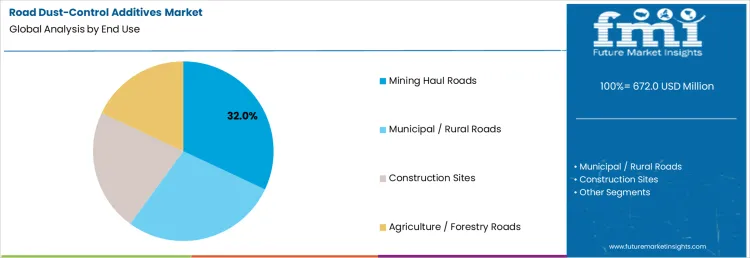
Mining haul roads account for about 32% of total demand, making them the leading end use segment. These roads experience heavy axle loads and continuous traffic that generate fine particulate matter. Municipal and rural roads adopt dust control to improve safety and visibility. Construction sites apply additives temporarily to manage exposed surfaces. Agriculture and forestry roads use dust suppressants to limit soil loss and equipment wear. End use driven demand reflects traffic intensity, regulatory oversight, and surface material rather than geographic coverage.
Mining applications maintain leadership due to constant operation and safety requirements. Public road use varies by local regulation. Construction demand fluctuates with project cycles. Agricultural applications remain seasonal. Once selected, additives are retained to maintain consistency. This stabilizes demand distribution. End use segmentation therefore reinforces concentration in high intensity industrial road environments.
How Are Road Dust Control Additives Being Applied Across Transportation and Infrastructure Operations?
Use appears in areas where unpaved roads, construction sites, and mining operations generate dust that affects air quality, worker safety, and equipment performance. Municipalities and contractors apply water-based or hygroscopic additives to suppress particulate dispersion on gravel roads. Mining and industrial sites integrate chemical stabilizers to maintain surface cohesion and reduce maintenance. Airports and logistics hubs use additives on service roads to limit airborne dust during vehicle movement. These applications reflect operational and environmental priorities rather than aesthetic objectives, with adoption driven by dust suppression, regulatory compliance, and surface stability.
What Operational and Environmental Conditions Support Adoption of Road Dust Control Additives?
Selection aligns with surfaces that experience high traffic, wind exposure, or low natural compaction. Contractors favor additives that improve particle binding, maintain traction, and resist wash-off during rain events. Municipal road maintenance teams value formulations that are easy to apply, cost-effective, and compatible with existing equipment. Environmental agencies encourage additives that reduce airborne particulate matter to meet air quality standards. These conditions arise from operational efficiency, safety, and regulatory compliance priorities in structured infrastructure management workflows.
Which Practical Considerations Limit Wider Use of Road Dust Control Additives?
Effectiveness varies depending on soil type, moisture content, and traffic load. Application frequency and dosage must be monitored to maintain performance, influencing operational planning. Cost per hectare can limit adoption in large-scale or low-budget projects. Environmental compatibility must be ensured to avoid contamination of surrounding vegetation or waterways. Some formulations require specialized equipment for uniform distribution. These factors lead to selective deployment where dust suppression, safety, and regulatory compliance justify incremental material and operational investment.
What is the Demand for Road Dust Control Additives by Country?

| Country | CAGR (%) |
|---|---|
| USA | 4.8% |
| Germany | 4.5% |
| China | 5.8% |
| UK | 4.4% |
| Brazil | 6.0% |
The demand for road dust control additives varies across countries, driven by urban infrastructure development, environmental regulations, and road maintenance practices. Brazil leads with a 6.0% CAGR, supported by expanding road networks and initiatives to reduce dust pollution. China follows at 5.8%, driven by rapid urbanization, highway expansion, and regulatory focus on air quality. The USA grows at 4.8%, reflecting adoption in municipal and state road maintenance programs. Germany records 4.5%, shaped by mature infrastructure and environmental compliance. The UK posts 4.4%, supported by road safety and air quality standards, along with steady adoption of chemical dust suppression solutions.
How Is Dust-Control Technology Driving Growth in the United States?
In the United States, revenue from the Road Dust-Control Additives Market is expanding at a CAGR of 4.8% through 2035, driven by adoption of chemical additives that reduce airborne particulate matter and improve road safety and air quality. Manufacturers are integrating dust-control additives in unpaved roads, construction sites, and mining operations. Demand is concentrated in civil engineering, municipal infrastructure, and industrial projects. Domestic suppliers provide high-performance additives compatible with soil stabilization and road maintenance processes. Regulatory compliance, environmental standards, and recurring maintenance programs are sustaining predictable procurement nationwide.
- Unpaved roads, construction sites, and mining operations drive dust-control additive adoption
- Additives reduce airborne particulate matter and improve road safety
- Domestic suppliers provide high-performance, soil-compatible additives
- Recurring maintenance programs sustain predictable procurement
How Are Environmental Standards Supporting Growth in Germany?
Germany continues to record steady growth in the Road Dust-Control Additives Market at a CAGR of 4.5% through 2035, supported by air quality regulations and infrastructure maintenance standards. Manufacturers are adopting additives for roads, industrial sites, and construction areas to minimize dust generation and improve safety. Demand is concentrated in municipal infrastructure, industrial operations, and road maintenance projects. Domestic suppliers provide additives engineered for consistent performance and compatibility with soil and aggregate materials. Compliance with environmental and safety standards, along with stable maintenance schedules, is sustaining measured adoption nationwide.
- Roads, industrial sites, and construction areas anchor demand
- Additives minimize dust generation and enhance safety
- Domestic suppliers provide consistent, soil-compatible additives
- Regulatory compliance and maintenance schedules sustain steady adoption
How Is Infrastructure Expansion Accelerating Adoption in China?
In China, revenue from the Road Dust-Control Additives Market is growing at a CAGR of 5.8% through 2035, driven by rapid urbanization, road construction, and industrial development. Manufacturers are integrating additives to reduce dust on highways, construction sites, and industrial facilities, improving environmental compliance and public health. Demand is strong across civil engineering, urban infrastructure, and mining operations. Domestic suppliers are scaling production of high-performance dust-control agents compatible with soil and aggregate materials. Large infrastructure projects and recurring maintenance programs are sustaining rapid adoption nationwide.
- Highways, construction sites, and industrial facilities drive dust-control additive adoption
- Additives reduce dust and improve environmental compliance
- Domestic suppliers scale production of high-performance agents
- Large infrastructure projects sustain consistent adoption
How Is Road Maintenance and Construction Supporting Growth in the United Kingdom?
In the United Kingdom, revenue from the Road Dust-Control Additives Market is expanding at a CAGR of 4.4% through 2035, supported by adoption of additives for improved road safety, air quality, and regulatory compliance. Manufacturers are integrating dust-control agents in unpaved roads, construction projects, and industrial sites. Demand is concentrated in municipal infrastructure, civil engineering, and industrial maintenance projects. Domestic suppliers provide additives compatible with soil stabilization and aggregate materials. Recurring maintenance, environmental compliance, and stable infrastructure activity are sustaining predictable procurement nationwide.
- Unpaved roads, construction projects, and industrial sites drive additive adoption
- Additives improve air quality and road safety
- Domestic suppliers provide soil- and aggregate-compatible dust-control agents
- Recurring maintenance sustains predictable procurement
How Is Civil and Industrial Road Infrastructure Supporting Adoption in Brazil?
Brazil is seeing strong growth in the Road Dust-Control Additives Market at a CAGR of 6.0% through 2035, supported by expansion of road construction, industrial sites, and urban infrastructure. Manufacturers are adopting additives to reduce dust, improve air quality, and enhance public safety in unpaved roads and construction areas. Demand is concentrated in civil engineering, municipal projects, and industrial operations. Domestic suppliers are expanding production of high-performance, soil-compatible dust-control additives. Growth in road infrastructure projects and recurring maintenance activities is sustaining robust procurement nationwide.
- Road construction, municipal projects, and industrial operations drive dust-control additive adoption
- Additives improve air quality and safety on unpaved roads
- Domestic suppliers expand high-performance, soil-compatible additives
- Recurring maintenance and infrastructure growth sustain robust procurement
Which Companies Are Shaping Competition in The Road Dust Control Additives Market Through Surface Performance and Application Practice?

Road dust control performance is judged in the field, where durability under traffic, wind, and variable moisture determines product choice. Chloride based solutions supplied by OxyChem, Compass Minerals, and Cargill remain widely used due to hygroscopic behavior that suppresses particulate lift on unpaved roads. These materials are favored by municipalities and industrial sites where application simplicity and predictable response matter. Borregaard approaches the market from a different angle, supplying lignin based binders that agglomerate fine particles and stabilize road surfaces. Selection is influenced by local climate, corrosion sensitivity, and maintenance cycles rather than brand differentiation.
Application focused suppliers shape competitive outcomes through service models and formulation blends. Benetech and Midwest Industrial Supply influence adoption by providing site specific dust suppression programs that combine additives with application equipment and monitoring. Solenis, Nouryon, and Kemira participate through specialty chemicals that improve binding, wetting, or longevity when blended into dust control formulations. Tetra Technologies supports niche uses through brine based solutions aligned with industrial and energy sector roads. Local contractors and distributors play a decisive role by tailoring treatments to soil composition, traffic load, and weather patterns.
Key Players in the Road Dust Control Additives Market
- OxyChem
- Compass Minerals
- Cargill
- Borregaard
- Benetech
- Midwest Industrial Supply
- Solenis
- Nouryon
- Kemira
- Tetra Technologies
Scope of the Report
| Items | Values |
|---|---|
| Quantitative Units (2026) | USD million |
| Chemistry | Calcium Chloride; Magnesium Chloride; Lignosulfonates; Synthetic Polymer Emulsions |
| End Use | Mining Haul Roads; Municipal / Rural Roads; Construction Sites; Agriculture / Forestry Roads |
| Form | Liquid Brines; Flakes / Pellets; Concentrate Emulsions; Other |
| Application Frequency | Seasonal Programs; Year-Round (Industrial); Temporary / Events; Spot Treatments |
| Region | Asia Pacific; Europe; North America; Latin America; Middle East & Africa |
| Countries Covered | China; Japan; South Korea; India; Australia & New Zealand; ASEAN; Germany; United Kingdom; France; Italy; Spain; Nordic; BENELUX; United States; Canada; Mexico; Brazil; Chile; Kingdom of Saudi Arabia; Other GCC Countries; Turkey; South Africa; Other African Union; Rest of Asia Pacific; Rest of Europe; Rest of Latin America; Rest of Middle East & Africa |
| Key Companies Profiled | OxyChem; Compass Minerals; Cargill; Borregaard; Benetech; Midwest Industrial Supply; Solenis; Nouryon; Kemira; Tetra Technologies |
| Additional Attributes | Dollar by sales across chemistry, end use, and form; Calcium chloride dominates due to hygroscopic and dust suppression properties; Magnesium chloride, lignosulfonates, and polymer emulsions applied selectively for corrosion, environmental, or longevity considerations; End use concentrated in mining, municipal, and high traffic industrial roads; Seasonal and year-round programs define application frequency and volume; Delivery forms selected based on treatment type and equipment compatibility; Adoption influenced by air quality regulations, road safety standards, and surface stabilization requirements; Regional growth shaped by infrastructure expansion, unpaved road maintenance, and recurring treatment programs; Demand formation driven by operational performance, compliance needs, and lifecycle planning rather than total road length or surface area. |
Road Dust Control Additives Market Segmentation
Chemistry:
- Calcium Chloride
- Magnesium Chloride
- Lignosulfonates
- Synthetic Polymer Emulsions
End Use:
- Mining Haul Roads
- Municipal / Rural Roads
- Construction Sites
- Agriculture / Forestry Roads
Form:
- Liquid Brines
- Flakes / Pellets
- Concentrate Emulsions
- Other
Application Frequency:
- Seasonal Programs
- Year-Round (Industrial)
- Temporary / Events
- Spot Treatments
Region
-
Asia Pacific
- China
- Japan
- South Korea
- India
- Australia & New Zealand
- ASEAN
- Rest of Asia Pacific
-
Europe
- Germany
- United Kingdom
- France
- Italy
- Spain
- Nordic
- BENELUX
- Rest of Europe
-
North America
- United States
- Canada
- Mexico
-
Latin America
- Brazil
- Chile
- Rest of Latin America
-
Middle East & Africa
- Kingdom of Saudi Arabia
- Other GCC Countries
- Turkey
- South Africa
- Other African Union
- Rest of Middle East & Africa
Frequently Asked Questions
How big is the road dust-control additives market in 2026?
The global road dust-control additives market is estimated to be valued at USD 672.0 million in 2026.
What will be the size of road dust-control additives market in 2036?
The market size for the road dust-control additives market is projected to reach USD 1,094.6 million by 2036.
How much will be the road dust-control additives market growth between 2026 and 2036?
The road dust-control additives market is expected to grow at a 5.0% CAGR between 2026 and 2036.
What are the key product types in the road dust-control additives market?
The key product types in road dust-control additives market are calcium chloride, magnesium chloride, lignosulfonates and synthetic polymer emulsions.
Which end use segment to contribute significant share in the road dust-control additives market in 2026?
In terms of end use, mining haul roads segment to command 32.0% share in the road dust-control additives market in 2026.
Preview the report firsthand - request a free sample
Get SampleGet the brochure for pricing and purchase details.
Get PDFTable of Content
- Executive Summary
- Global Market Outlook
- Demand-side Trends
- Supply-side Trends
- Technology Roadmap Analysis
- Analysis and Recommendations
- Market Overview
- Market Coverage / Taxonomy
- Market Definition / Scope / Limitations
- Market Background
- Market Dynamics
- Drivers
- Restraints
- Opportunity
- Trends
- Scenario Forecast
- Demand in Optimistic Scenario
- Demand in Likely Scenario
- Demand in Conservative Scenario
- Opportunity Map Analysis
- Product Life Cycle Analysis
- Supply Chain Analysis
- Investment Feasibility Matrix
- Value Chain Analysis
- PESTLE and Porter’s Analysis
- Regulatory Landscape
- Regional Parent Market Outlook
- Production and Consumption Statistics
- Import and Export Statistics
- Market Dynamics
- Global Market Analysis 2021 to 2025 and Forecast, 2026 to 2036
- Historical Market Size Value (USD Million) Analysis, 2021 to 2025
- Current and Future Market Size Value (USD Million) Projections, 2026 to 2036
- Y-o-Y Growth Trend Analysis
- Absolute $ Opportunity Analysis
- Global Market Pricing Analysis 2021 to 2025 and Forecast 2026 to 2036
- Global Market Analysis 2021 to 2025 and Forecast 2026 to 2036, By Chemistry
- Introduction / Key Findings
- Historical Market Size Value (USD Million) Analysis By Chemistry , 2021 to 2025
- Current and Future Market Size Value (USD Million) Analysis and Forecast By Chemistry , 2026 to 2036
- Calcium Chloride
- Magnesium Chloride
- Lignosulfonates
- Synthetic Polymer Emulsions
- Y-o-Y Growth Trend Analysis By Chemistry , 2021 to 2025
- Absolute $ Opportunity Analysis By Chemistry , 2026 to 2036
- Global Market Analysis 2021 to 2025 and Forecast 2026 to 2036, By End Use
- Introduction / Key Findings
- Historical Market Size Value (USD Million) Analysis By End Use, 2021 to 2025
- Current and Future Market Size Value (USD Million) Analysis and Forecast By End Use, 2026 to 2036
- Mining Haul Roads
- Municipal / Rural Roads
- Construction Sites
- Agriculture / Forestry Roads
- Y-o-Y Growth Trend Analysis By End Use, 2021 to 2025
- Absolute $ Opportunity Analysis By End Use, 2026 to 2036
- Global Market Analysis 2021 to 2025 and Forecast 2026 to 2036, By Form
- Introduction / Key Findings
- Historical Market Size Value (USD Million) Analysis By Form, 2021 to 2025
- Current and Future Market Size Value (USD Million) Analysis and Forecast By Form, 2026 to 2036
- Liquid Brines
- Flakes / Pellets
- Concentrate Emulsions
- Other
- Y-o-Y Growth Trend Analysis By Form, 2021 to 2025
- Absolute $ Opportunity Analysis By Form, 2026 to 2036
- Global Market Analysis 2021 to 2025 and Forecast 2026 to 2036, By Application Frequency
- Introduction / Key Findings
- Historical Market Size Value (USD Million) Analysis By Application Frequency, 2021 to 2025
- Current and Future Market Size Value (USD Million) Analysis and Forecast By Application Frequency, 2026 to 2036
- Seasonal Programs
- Year-Round (Industrial)
- Temporary / Events
- Spot Treatments
- Y-o-Y Growth Trend Analysis By Application Frequency, 2021 to 2025
- Absolute $ Opportunity Analysis By Application Frequency, 2026 to 2036
- Global Market Analysis 2021 to 2025 and Forecast 2026 to 2036, By Region
- Introduction
- Historical Market Size Value (USD Million) Analysis By Region, 2021 to 2025
- Current Market Size Value (USD Million) Analysis and Forecast By Region, 2026 to 2036
- North America
- Latin America
- Western Europe
- Eastern Europe
- East Asia
- South Asia and Pacific
- Middle East & Africa
- Market Attractiveness Analysis By Region
- North America Market Analysis 2021 to 2025 and Forecast 2026 to 2036, By Country
- Historical Market Size Value (USD Million) Trend Analysis By Market Taxonomy, 2021 to 2025
- Market Size Value (USD Million) Forecast By Market Taxonomy, 2026 to 2036
- By Country
- USA
- Canada
- Mexico
- By Chemistry
- By End Use
- By Form
- By Application Frequency
- By Country
- Market Attractiveness Analysis
- By Country
- By Chemistry
- By End Use
- By Form
- By Application Frequency
- Key Takeaways
- Latin America Market Analysis 2021 to 2025 and Forecast 2026 to 2036, By Country
- Historical Market Size Value (USD Million) Trend Analysis By Market Taxonomy, 2021 to 2025
- Market Size Value (USD Million) Forecast By Market Taxonomy, 2026 to 2036
- By Country
- Brazil
- Chile
- Rest of Latin America
- By Chemistry
- By End Use
- By Form
- By Application Frequency
- By Country
- Market Attractiveness Analysis
- By Country
- By Chemistry
- By End Use
- By Form
- By Application Frequency
- Key Takeaways
- Western Europe Market Analysis 2021 to 2025 and Forecast 2026 to 2036, By Country
- Historical Market Size Value (USD Million) Trend Analysis By Market Taxonomy, 2021 to 2025
- Market Size Value (USD Million) Forecast By Market Taxonomy, 2026 to 2036
- By Country
- Germany
- UK
- Italy
- Spain
- France
- Nordic
- BENELUX
- Rest of Western Europe
- By Chemistry
- By End Use
- By Form
- By Application Frequency
- By Country
- Market Attractiveness Analysis
- By Country
- By Chemistry
- By End Use
- By Form
- By Application Frequency
- Key Takeaways
- Eastern Europe Market Analysis 2021 to 2025 and Forecast 2026 to 2036, By Country
- Historical Market Size Value (USD Million) Trend Analysis By Market Taxonomy, 2021 to 2025
- Market Size Value (USD Million) Forecast By Market Taxonomy, 2026 to 2036
- By Country
- Russia
- Poland
- Hungary
- Balkan & Baltic
- Rest of Eastern Europe
- By Chemistry
- By End Use
- By Form
- By Application Frequency
- By Country
- Market Attractiveness Analysis
- By Country
- By Chemistry
- By End Use
- By Form
- By Application Frequency
- Key Takeaways
- East Asia Market Analysis 2021 to 2025 and Forecast 2026 to 2036, By Country
- Historical Market Size Value (USD Million) Trend Analysis By Market Taxonomy, 2021 to 2025
- Market Size Value (USD Million) Forecast By Market Taxonomy, 2026 to 2036
- By Country
- China
- Japan
- South Korea
- By Chemistry
- By End Use
- By Form
- By Application Frequency
- By Country
- Market Attractiveness Analysis
- By Country
- By Chemistry
- By End Use
- By Form
- By Application Frequency
- Key Takeaways
- South Asia and Pacific Market Analysis 2021 to 2025 and Forecast 2026 to 2036, By Country
- Historical Market Size Value (USD Million) Trend Analysis By Market Taxonomy, 2021 to 2025
- Market Size Value (USD Million) Forecast By Market Taxonomy, 2026 to 2036
- By Country
- India
- ASEAN
- Australia & New Zealand
- Rest of South Asia and Pacific
- By Chemistry
- By End Use
- By Form
- By Application Frequency
- By Country
- Market Attractiveness Analysis
- By Country
- By Chemistry
- By End Use
- By Form
- By Application Frequency
- Key Takeaways
- Middle East & Africa Market Analysis 2021 to 2025 and Forecast 2026 to 2036, By Country
- Historical Market Size Value (USD Million) Trend Analysis By Market Taxonomy, 2021 to 2025
- Market Size Value (USD Million) Forecast By Market Taxonomy, 2026 to 2036
- By Country
- Kingdom of Saudi Arabia
- Other GCC Countries
- Turkiye
- South Africa
- Other African Union
- Rest of Middle East & Africa
- By Chemistry
- By End Use
- By Form
- By Application Frequency
- By Country
- Market Attractiveness Analysis
- By Country
- By Chemistry
- By End Use
- By Form
- By Application Frequency
- Key Takeaways
- Key Countries Market Analysis
- USA
- Pricing Analysis
- Market Share Analysis, 2025
- By Chemistry
- By End Use
- By Form
- By Application Frequency
- Canada
- Pricing Analysis
- Market Share Analysis, 2025
- By Chemistry
- By End Use
- By Form
- By Application Frequency
- Mexico
- Pricing Analysis
- Market Share Analysis, 2025
- By Chemistry
- By End Use
- By Form
- By Application Frequency
- Brazil
- Pricing Analysis
- Market Share Analysis, 2025
- By Chemistry
- By End Use
- By Form
- By Application Frequency
- Chile
- Pricing Analysis
- Market Share Analysis, 2025
- By Chemistry
- By End Use
- By Form
- By Application Frequency
- Germany
- Pricing Analysis
- Market Share Analysis, 2025
- By Chemistry
- By End Use
- By Form
- By Application Frequency
- UK
- Pricing Analysis
- Market Share Analysis, 2025
- By Chemistry
- By End Use
- By Form
- By Application Frequency
- Italy
- Pricing Analysis
- Market Share Analysis, 2025
- By Chemistry
- By End Use
- By Form
- By Application Frequency
- Spain
- Pricing Analysis
- Market Share Analysis, 2025
- By Chemistry
- By End Use
- By Form
- By Application Frequency
- France
- Pricing Analysis
- Market Share Analysis, 2025
- By Chemistry
- By End Use
- By Form
- By Application Frequency
- India
- Pricing Analysis
- Market Share Analysis, 2025
- By Chemistry
- By End Use
- By Form
- By Application Frequency
- ASEAN
- Pricing Analysis
- Market Share Analysis, 2025
- By Chemistry
- By End Use
- By Form
- By Application Frequency
- Australia & New Zealand
- Pricing Analysis
- Market Share Analysis, 2025
- By Chemistry
- By End Use
- By Form
- By Application Frequency
- China
- Pricing Analysis
- Market Share Analysis, 2025
- By Chemistry
- By End Use
- By Form
- By Application Frequency
- Japan
- Pricing Analysis
- Market Share Analysis, 2025
- By Chemistry
- By End Use
- By Form
- By Application Frequency
- South Korea
- Pricing Analysis
- Market Share Analysis, 2025
- By Chemistry
- By End Use
- By Form
- By Application Frequency
- Russia
- Pricing Analysis
- Market Share Analysis, 2025
- By Chemistry
- By End Use
- By Form
- By Application Frequency
- Poland
- Pricing Analysis
- Market Share Analysis, 2025
- By Chemistry
- By End Use
- By Form
- By Application Frequency
- Hungary
- Pricing Analysis
- Market Share Analysis, 2025
- By Chemistry
- By End Use
- By Form
- By Application Frequency
- Kingdom of Saudi Arabia
- Pricing Analysis
- Market Share Analysis, 2025
- By Chemistry
- By End Use
- By Form
- By Application Frequency
- Turkiye
- Pricing Analysis
- Market Share Analysis, 2025
- By Chemistry
- By End Use
- By Form
- By Application Frequency
- South Africa
- Pricing Analysis
- Market Share Analysis, 2025
- By Chemistry
- By End Use
- By Form
- By Application Frequency
- USA
- Market Structure Analysis
- Competition Dashboard
- Competition Benchmarking
- Market Share Analysis of Top Players
- By Regional
- By Chemistry
- By End Use
- By Form
- By Application Frequency
- Competition Analysis
- Competition Deep Dive
- OxyChem
- Overview
- Product Portfolio
- Profitability by Market Segments (Product/Age /Sales Channel/Region)
- Sales Footprint
- Strategy Overview
- Marketing Strategy
- Product Strategy
- Channel Strategy
- Compass Minerals
- Cargill
- Borregaard
- Benetech
- Midwest Industrial Supply
- Solenis
- Nouryon
- Kemira
- Tetra Technologies
- OxyChem
- Competition Deep Dive
- Assumptions & Acronyms Used
- Research Methodology


