

- Industry Size (2026)
- USD 466.2 Bn
- Forecast (2036)
- USD 834.9 Bn
- CAGR (2026 to 2036)
- 6%
Road Aggregates Market Forecast and Outlook 2026 to 2036
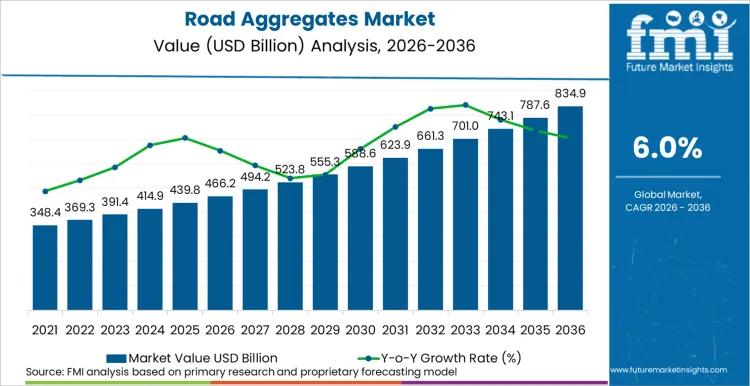
The global road aggregates market is on track to achieve a valuation of USD 834.9 Billion by 2036, accelerating from USD 466.2 Billion in 2026 at a CAGR of 6%. As per Future Market Insights, expansion is structurally underpinned by the intensification of federal infrastructure spending and a tightening supply of permitted quarry reserves that is driving strategic consolidation and recycled aggregate adoption. The United States Federal Highway Administration reported in 2025 that the Infrastructure Investment and Jobs Act has allocated over USD 350 billion for highways and bridges, confirming the public spending pipeline that drives aggregate consumption. This compels manufacturers to invest in scalable production and distribution infrastructure that can meet accelerating demand. Simultaneously the regulatory and competitive landscape is shifting from organic volume growth to acquisition-driven reserve accumulation, which forces producers to compete for permitted quarry assets and recycled feedstock capacity to secure long-term supply positions.
Ronnie Pruitt, CEO (effective 2026), Vulcan Materials, stated: 'We expect continued strength in public construction activity and an improving private nonresidential outlook, a combination that should also benefit an already healthy pricing environment.' This statement was made in the context of discussing the 2026 demand outlook for construction aggregates during the q3 earnings call.. FMI opines that this reflects a broader structural shift in the industry where established players are accelerating investment to secure competitive positioning in a market defined by rapid evolution.
The operational reality for road aggregate producers is defined by the tightening of permitted quarry reserves that is converting geological access into a durable competitive moat while recycled construction demolition feedstocks gain commercial scale. Holcim closed the acquisition of Alkern in January 2026, a French manufacturer of precast concrete and infrastructure solutions with estimated annual net sales of approximately EUR 250 million, strengthening its vertically integrated position in the European infrastructure chain. Heidelberg Materials entered into a binding agreement to acquire Walan Specialty Construction Products in November 2025, extending its low-carbon offerings into the Mid-Atlantic region of the United States. Holcim simultaneously acquired Thames Materials in November 2025, a major recycler of construction demolition materials in West London, expanding its circular aggregate footprint in Greater London where virgin aggregate supply is increasingly constrained. As per FMI, the acceleration of acquisition activity targeting both primary reserves and recycled feedstock capacity confirms that the industry's competitive dynamics are shifting from volume output to resource security. Martin Marietta reported record quarterly aggregates revenues in November 2025 and raised its full-year 2025 guidance on the basis of a 4% volume growth projection, confirming that pricing power remains strong for producers with long-life permitted reserves in high-growth corridors.
Summary of Road Aggregates Market
What Is Growth Outlook for Road Aggregates Market as per Future Market Insights Projection?
Future Market Insights projects the road aggregates market to expand at a CAGR of 6% from 2026 to 2036, increasing from USD 466.2 Billion in 2026 to USD 834.9 Billion by 2036.
FMI Research Approach: FMI proprietary forecasting model based on demand-supply correlation and end-use consumption analysis.
How Do FMI Analysts Perceive Road Aggregates Market to Evolve?
FMI analysts perceive the market evolving toward a reserve-driven competitive model where permitted quarry acquisition and recycled aggregate capacity define market positioning, while infrastructure spending programs sustain volume growth across major economies.
FMI Research Approach: Regulatory convergence analysis and competitive landscape mapping.
Which Country Holds Largest Share in Global Road Aggregates Market?
The United States holds a significant share of the global road aggregates market by value, supported by the Infrastructure Investment and Jobs Act allocation of over USD 350 billion for highways and bridges.
FMI Research Approach: FMI country-level revenue modelling by end-use consumption and trade data.
How Large Will Road Aggregates Market Be by 2036?
The global road aggregates market is projected to reach USD 834.9 Billion by 2036.
FMI Research Approach: FMI long-term revenue forecast derived from end-use demand projections and macroeconomic indicators.
What Is Definition of Road Aggregates Market?
The road aggregates market includes revenue generated from the production, sale, and distribution of crushed stone, sand, gravel, and recycled materials used in the construction and maintenance of roads, highways, and associated infrastructure.
FMI Research Approach: FMI market taxonomy and inclusion-exclusion framework.
What Are Globally Unique Trends Shaping Road Aggregates Market?
Globally unique trends include the acquisition of recycled construction demolition feedstock capacity to expand circular aggregate supply, the strategic divestiture of non-core geographies to concentrate capital on high-margin domestic markets, and the tightening of permitted reserve supply that is driving premium asset valuations.
FMI Research Approach: Competitive intelligence and regulatory directive tracking.
Road Aggregates Market Key Takeaways
| Metric | Details |
|---|---|
| Industry Size (2026) | USD 466.2 Billion |
| Industry Value (2036) | USD 834.9 Billion |
| CAGR (2026 to 2036) | 6% |
Source: Future Market Insights (FMI) analysis, based on proprietary forecasting model and primary research
Semi-annual update
The table below presents the annual growth rates of the global road aggregates market from 2026 to 2036. With a base year of 2024 extending to 2025, the report examines how the market's growth trajectory progresses from the first half of the year (January to June, H1) to the second half (July to December, H2). This analysis provides stakeholders with a detailed understanding of the industry's performance, emphasizing key trends and developments influencing the market’s expansion.
The market is expected to grow at a CAGR of 6.0% from 2026 to 2036. In H2, the growth rate is projected to rise slightly.
| Particular | Value CAGR |
|---|---|
| H1 2024 | 5.7% (2024 to 2034) |
| H2 2024 | 5.9% (2024 to 2034) |
| H1 2025 | 6.0% (2026 to 2036) |
| H2 2025 | 6.2% (2026 to 2036) |
From H1 2025 to H2 2025, the CAGR is anticipated to see a gradual increase, moving from 6.0% in the first half to 6.2% in the second half. In H1, the sector is expected to grow by 30 BPS, with an additional 30 BPS rise in the latter half. This semi-annual update highlights the growth potential of the road aggregates market, driven by increasing infrastructure projects, urbanization, and advancements in sustainable aggregate solutions.
Category-Wise Insights
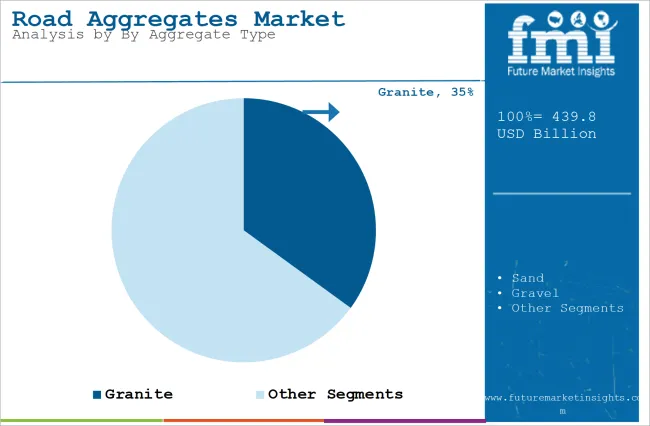
The section explains the growth of the leading segments in the industry. In terms of aggregate type, granite will likely dominate and generate a share of around 35% in 2026.
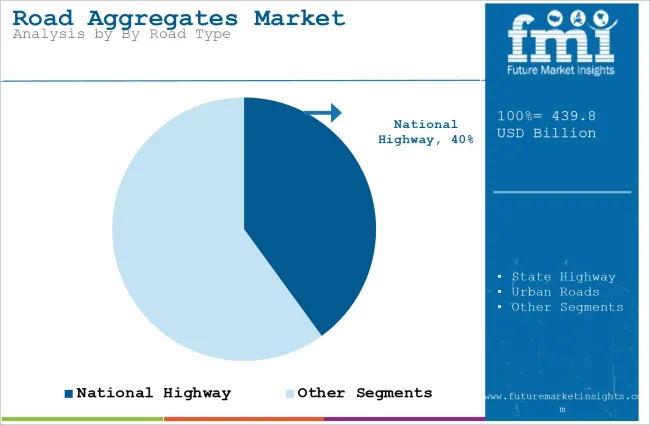
Based on the road type, national highway is projected to hold a major share of 40% in 2026. The analysis would enable potential clients to make effective business decisions for investment purposes.
Enhanced Road Longevity Drives Demand for Granite Aggregates in Infrastructure Projects
| Segment | Value Share (2026) |
|---|---|
| Granite (Aggregate Type) | 35% |
Roads constructed using granite aggregates are long-lasting, making these aggregates highly attractive for building road. The hardness of granite allows for suitable paving of roads without breaking down under heavy traffic loads or extreme weather conditions. Such a durable nature of these roads results in lesser repairs and maintenance, leading to a drop in the overall maintenance costs.
Longer life of granite roads also leads to smoother traffic flow, safety, and reduced disruptions due to ongoing roadworks and most important is that it prevented unwanted spending of money. Such factors have made granite very ideal for expressways, highways, thereby increasing the demand in the market for road aggregate.
Moreover, since further growth will orient itself towards bigger and more complex infrastructure projects, granite infuses this durability into the roads in meeting the rising demand for enduring and reliable transportation networks.
Long-Distance Connectivity Drives Demand for High-Performance Aggregates in National Highways
| Segment | Value Share (2026) |
|---|---|
| National Highway (Road Type) | 40% |
National highways provide a critical link between the major cities. They are very important for long-distance travel. They demand high-performance aggregate materials to withstand severe traffic loads under varying climatic conditions over a long time period. The aggregates provides resistance against constant wear and exercise pressure from vehicles, as well as the differential effects of heat, rain, and snow.
This would ensure that national highways remain safe, smooth, and functional for long-term usage. High-quality materials such as granite or high-strength concrete are called for to meet such requirements and ensure road resilience and durability. The ongoing expansion and upgrading these corridors, the specification requests for such robust materials have increased because these roads are key transportation arteries that facilitate regional connectivity and economic development throughout the country.
As per the IBEF, In FY24 approximately 12,349 km of National Highways have been constructed. This shows that aggregates is required in bulk quantity for construction of high quality roads, which can be used for long time.
Key Industry Highlight
Growing Need for Highways and Connectivity Drives Road Aggregates Demand
Road aggregates are driven by the increasing demand for better transport infrastructure. Governments are making efforts to expand and improve their networks of roads to provide better connectivity to reduce travel times. Developing economies like India and Brazil, along with certain areas of Southeast Asia, experience enormous demand for such developments because there is surely an emerging need for absolutely great infrastructure in these areas due to rapid urbanization and industrial growth.
Very large amounts of aggregates are consumed during highway building, urban road widening, and rural connectivity projects for base layers, surfacing, and drainage systems. Governments are creating a conducive environment for such developments through public-private partnerships, higher budget allocations, and long-term infrastructure plans.
In other instances, the push for sustainable and durable materials is further driving the adoption of advanced aggregates in road construction, providing long-lasting and cost-effective solutions there.
Government Investments in Public Infrastructure Drive Surge in Aggregate Demand
Government investments in public infrastructure are driving growth in the market for road aggregates. Governments are providing substantial funds to stimulate the improvement and expansion of road networks. This will improve transportation systems, reduction in congestion, and stimulation of economic development. Consequently, demand for aggregates, which are a very crucial material in road construction, is accelerating.
The rising emphasis on durable and high-quality roads only intensifies demand for such materials. With an increased number of governments placing high priority on infrastructure projects, particularly in emerging economies, the road aggregates market will continue expanding in meeting the demand for aggregates crucial to these large-scale public infrastructure projects.
Rising Need for Road Maintenance Boosts Road Aggregate Demand
The increase in road maintenance is massively boosting the demand for road aggregates. With road materials exhibiting aging and wear effects from the passage of time, as well as from external road conditions, maintenance becomes essential for ensuring friendly interfacing, security, and efficiency.
Governments and private companies are putting a lot of focus on road preservation, diverting funds for resurfacing, pothole repairs, and structural upgrades. This continuous maintenance creates stable demand for the aggregates that go toward resurfacing and improving the road bed.
Several issues drive the ever-growing interest in road maintenance, such as the necessity to lessen accidents due to road problems, ensure traffic flow, and improve the general driving experience. Moreover, the old-age infrastructure in many developed nations calls for more frequent repairs and emergent economies invest in the maintenance of their rapidly-expanding road networks.
Increase in Freight and Logistics Activity Drives Demand for Durable Road Aggregates
Freight and logistics activity is driving the demand for road aggregates. As e-commerce and industry grows, more goods are being moved by road and there is the need of well-maintained and durable roads to support the increased traffic. This demand for efficient transport networks means new roads to be built and existing ones upgraded so that it can be used for long time, and it is smooth enough, so as to avoid any accident.
With industries focused on time delivery and reducing road congestion, investing in durable roads is a priority. So the road aggregates market is benefiting from the growing need for construction materials to meet the demands of modern freight and logistics, to make roads last longer and withstand more usage over time.
Also contributing to the need for stronger infrastructure is the increasing distribution networks and urbanization. The road aggregates market, therefore, is benefiting from increasing demand for construction materials to meet advanced demands of freight and logistics operations in ensuring roads are capable of withstanding higher loads as usage evolves.
2021 to 2025 Global Road Aggregates Sales outlook Compared to Demand Forecast from 2026 to 2036
From 2021 to 2025, the global road aggregates market experienced steady growth, driven by increasing investments in infrastructure development and the rising demand for durable, high-performance materials in road construction. The growing need for upgraded transportation networks, especially in emerging economies, fueled the demand for aggregates used in the construction of highways, expressways, and urban roads.
Additionally, the emphasis on sustainability led to a rise in the use of recycled aggregates, supporting environmentally-friendly road projects. The shift toward green construction practices and innovative materials, such as high-strength concrete and advanced asphalt mixtures, further boosted the demand for quality aggregates.
Looking ahead to 2025 to 2035, the road aggregates market is expected to experience rapid growth, driven by continued infrastructure expansion, rising urbanization, and government investments in public works. As the demand for better road quality increases, particularly with the need for high-durability roads in high-traffic areas, the demand for specialized aggregates is set to grow.
Technological advancements in road construction techniques and the increasing focus on long-term sustainability in infrastructure projects will further contribute to the market's expansion. Additionally, the rising need for road maintenance and the growing freight and logistics sector will continue to drive the demand for aggregates, particularly in developing regions with expanding road networks.
Market Concentration
Tier-1 companies account for around 20-25% of the overall market with a product revenue from the road aggregates market of more than USD 800 million. CRH Americas Materials, Inc, Vulcan Materials Co., Martin Marietta Materials, Inc., Heidelberg Materials, and other players.
Tier-2 and other companies such as Summit Materials, LLC, Granite Construction, Inc., Arcosa, Inc.and other players are projected to account for 75-80% of the overall market with the estimated revenue under the range of USD 800 million through the sales of road aggregates.
Country-Wise Insights
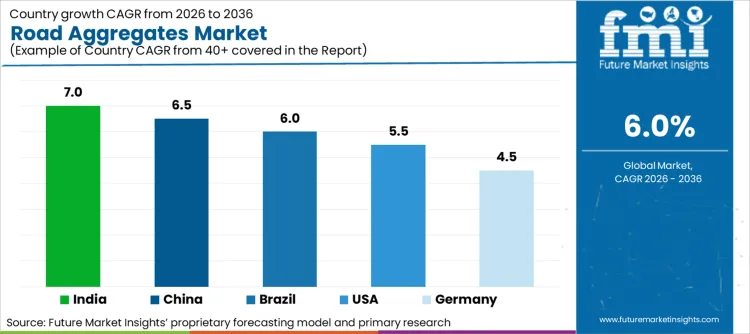
The section below covers the industry analysis for road aggregates in different countries. The demand analysis on key countries in several regions of the globe, including North America, Latin America, East Asia, South Asia Pacific, Western Europe, Eastern Europe, Middle East and Africa is provided. This data helps investors to keenly observe and go through the recent trends and examine them in an ordered manner.
| Countries | Value CAGR (2025 to 2035) |
|---|---|
| China | 6.5% |
| India | 7.0% |
| The USA | 5.5% |
| Germany | 4.5% |
| Brazil | 6.0% |
Rising vehicle Ownership drives Road Aggregates demand in China
The increased vehicle ownership in China has created a very high requirement for road aggregates demand. As more and more people is purchasing vehicles, the necessity to have well-functioning road networks becomes all the more important.
The increase in vehicles subsequently causes traffic congestion and wearing out the other infrastructures; therefore, more needs arise to cater to the recurring maintenance activities on roads or other roadway construction. Adding to traffic volume, there will be a sure shot need for the modernization and creation of highways, expressways, and urban roads-all of which rely heavily on quality aggregates.
Also, the increasing ownership of vehicles will inevitably call for creation of better and robust roads in the interest of safety during traffic jams. The rapidly urbanizing society in China will meanwhile constitute a unique demand situation that will further stimulate the search for reliable long-lasting road infrastructure-the further increase in the quarrying of aggregates.
Thus, this emerging trend of road network expansion directly driven by vehicle ownership generation creates a continuous demand for procurements of high-quality materials for supporting the rapidly growing road networks.
Rapid Urbanization Drives Increased Demand for Road Aggregates in India
The rapid urbanization is boosting demand for road aggregates. As people are shifting from rural area to urban areas, there need to have proper connectivity. This is helping significantly to drive the road aggregate demand in India. This urban expansion will require new construction of roads, highways, and expressways to facilitate smooth connectivity between urban and rural areas.
Also, many existing urban roads are congested, making widening or reconstruction a priority. The construction of urban transport infrastructure elements, including metro stations, bridges, and flyovers, will also increase demand for aggregates. Cities are starting to design systems that will be more durable and efficient at handling increased traffic as the focus shifts towards more efficient and durable road systems that also support economic activity.
This trend of urbanization, together with an increased emphasis on improvement of infrastructure, ensures a steady demand for high-quality road aggregates that are the foundation of a sturdy road network needed for India’s developmental and economic pursuits.
According to IBEF, India has the second-largest road network in the world, spanning a total of ~6.7 million kilometres (kms). This road network transports 64.5% of all goods in the country and 90% of India’s total passenger traffic uses road network to commute.
Road transportation has gradually increased over the years with improvement in connectivity between cities, towns and villages in the country. In order to have better road connectivity aggregate is used in huge amount for providing good network from one place to other.
Growing Freight and Logistics Sector Boosts Demand for Road Aggregates in USA
The USA freight and logistics sector continues to grow, thus creating demand within the parameters of road aggregates. With the rapid growth of e-commerce and increased demand for faster and more efficient transportation by industries, such improvement continues to rise in importance.
The highways, interstates, and logistics corridors must improve in quality to handle the increasing volume of cargo being shipped across the country. This, in turn, has led to the building of roads and the maintenance of existing ones, both resulting in significant quantities of aggregates.
The road situation accompanies the demand for aggregates that constitute stronger and more durable roads capable of long-term use under heavy loads. The growth of the logistics and freight sectors will bring along demands that can be met only with reliable road infrastructure and a robust supply of aggregates.
Competitive Landscape
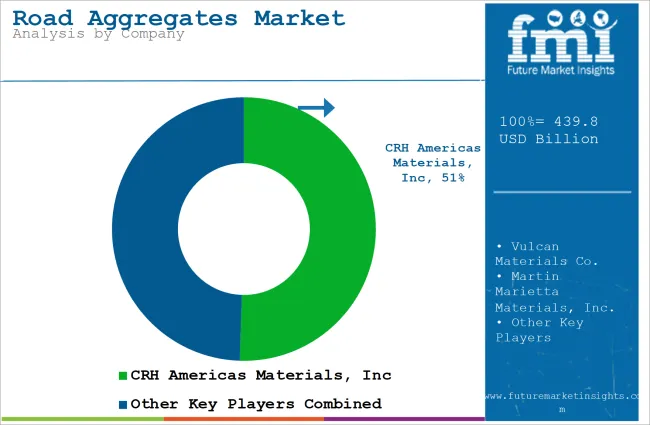
Technological developments in road aggregates improve their quality, efficiency, and sustainability. The development of new crushing and screening technologies for road aggregates has begun to enhance the precision and consistency of the aggregates used, thus allowing improved performance on construction projects.
Polymer-modified asphalt or rubberized concrete are on demand as road authorities are focusing on building road which have longer life. Advancement in the techniques of quality control relating to testing methods for particle size distribution and shape is ensuring that aggregates meet rigid engineering standards.
The shift towards automation in aggregate production also enhances operational efficiency and decreases production costs even as it speeds up production processes. Such technological advances make road construction less damaging to the environment and more economically feasible, assuring the durability and better performance of the infrastructure.
Recent Developments:
- In January 2024, Heidelberg Materials launched EvoBuild, its new global brand for low-carbon and circular building materials. This initiative focuses on recycled aggregates and sustainable solutions to reduce carbon emissions in road and infrastructure construction.
- In July 2024, Cemex USA announced the formation of a Joint Venture with Couch Aggregates and Premier Holdings. This partnership focuses on the production and distribution of aggregates across the Mid-South and Gulf Coast regions, significantly expanding their vertical integration in the US infrastructure market.
- In April 2024, Rogers Group officially joined 'The Road Forward' initiative, an industry-wide collaboration aimed at advancing sustainable asphalt production and paving practices for highway and road construction.
- In July 2025, Heidelberg Materials completed a strategic acquisition of BURNCO Rock Products in Canada. The deal included six aggregate sites and two asphalt plants, strengthening the company's footprint in the high-growth North American road infrastructure market.
Key Players
- CRH Americas Materials, Inc
- Vulcan Materials Co.
- Martin Marietta Materials, Inc.
- Heidelberg Materials
- Knife River Corp.
- Holcim US
- CEMEX USA
- Summit Materials, LLC
- Granite Construction, Inc.
- Arcosa, Inc.
Market Definition
The road aggregates market represents revenue generated from the production, sale, and distribution of crushed stone, sand, gravel, and recycled materials used in the construction and maintenance of roads, highways, and associated infrastructure. The market measures the value of aggregates sold to road construction contractors, government agencies, and ready-mix concrete producers for road applications.
Inclusions cover crushed stone (limestone, granite, trap rock), natural sand and gravel, recycled concrete aggregates, recycled asphalt pavement (RAP), and slag aggregates. It includes aggregates used as road base, sub-base, surface course, and asphalt mix components. Aggregates sourced from both primary quarry extraction and secondary recycled feedstocks are included.
Exclusions include aggregates used exclusively in building construction (foundations, structural concrete), decorative and landscaping aggregates, mining overburden, and industrial minerals (calcium carbonate, silica sand) sold for non-construction applications. Aggregate production equipment (crushers, screens) and hauling services are outside the scope.
Key Segmentation
By Aggregate Type:
The aggregate type is further categorized into granite, sand, gravel, limestone, crushed rock and others.
By Road Type:
The road type is classified into national highway, state highway, urban roads and others.
By Application:
The application is classified into road base & sub-base, bituminous mixing, concrete, railroad ballast and others.
By Region:
Regions considered in the study include North America, Latin America, Western Europe, Eastern Europe, East Asia, South Asia & Pacific, and the Middle East and Africa.
Bibliography
- Holcim. (2026, January). Holcim closed the acquisition of Alkern, a French manufacturer of precast concre. Holcim corporate disclosure.
- Heidelberg Materials. (2025, November). The company entered into a binding agreement to acquire Walan Specialty Construc. Heidelberg Materials corporate disclosure.
- Holcim. (2025, November). Holcim acquired Thames Materials, a major recycler of construction demolition ma. Holcim corporate disclosure.
- Vulcan Materials. (2026, January). Ronnie Pruitt officially assumed the role of CEO, succeeding Tom Hill to lead th. Vulcan Materials corporate disclosure.
- United States Geological Survey. (2025). Mineral commodity summaries: crushed stone and sand and gravel. USGS.
- United States Federal Highway Administration. (2025). Infrastructure Investment and Jobs Act obligation summary. FHWA.
Frequently Asked Questions
What is the current global market size for the Road Aggregates Market?
The market is valued at USD 466.2 Billion in 2026, driven by intensifying federal infrastructure spending and the tightening supply of permitted quarry reserves.
What is the projected Compound Annual Growth Rate (CAGR) for the market over the next 10 years?
The market is projected to grow at a CAGR of 6% from 2026 to 2036.
Which regions are experiencing the fastest expansion?
Asia Pacific leads with the highest growth rate, driven by infrastructure investment and rising consumption, followed by North America and Europe.
What are the primary market drivers?
Strategic investment from players such as Holcim and Heidelberg Materials, combined with regulatory mandates and evolving end-user demand, are the primary drivers of adoption.
Who are the leading companies in the industry?
Holcim, Heidelberg Materials, Vulcan Materials, Martin Marietta are key players, differentiating through strategic investment, product innovation, and regional expansion.
Preview the report firsthand - request a free sample
Get SampleGet the brochure for pricing and purchase details.
Get PDFTable of Content
- Executive Summary
- Global Market Outlook
- Demand-side Trends
- Supply-side Trends
- Technology Roadmap Analysis
- Analysis and Recommendations
- Market Overview
- Market Coverage / Taxonomy
- Market Definition / Scope / Limitations
- Research Methodology
- Chapter Orientation
- Analytical Lens and Working Hypotheses
- Market Structure, Signals, and Trend Drivers
- Benchmarking and Cross-market Comparability
- Market Sizing, Forecasting, and Opportunity Mapping
- Research Design and Evidence Framework
- Desk Research Programme (Secondary Evidence)
- Company Annual and Sustainability Reports
- Peer-reviewed Journals and Academic Literature
- Corporate Websites, Product Literature, and Technical Notes
- Earnings Decks and Investor Briefings
- Statutory Filings and Regulatory Disclosures
- Technical White Papers and Standards Notes
- Trade Journals, Industry Magazines, and Analyst Briefs
- Conference Proceedings, Webinars, and Seminar Materials
- Government Statistics Portals and Public Data Releases
- Press Releases and Reputable Media Coverage
- Specialist Newsletters and Curated Briefings
- Sector Databases and Reference Repositories
- FMI Internal Proprietary Databases and Historical Market Datasets
- Subscription Datasets and Paid Sources
- Social Channels, Communities, and Digital Listening Inputs
- Additional Desk Sources
- Expert Input and Fieldwork (Primary Evidence)
- Primary Modes
- Qualitative Interviews and Expert Elicitation
- Quantitative Surveys and Structured Data Capture
- Blended Approach
- Why Primary Evidence is Used
- Field Techniques
- Interviews
- Surveys
- Focus Groups
- Observational and In-context Research
- Social and Community Interactions
- Stakeholder Universe Engaged
- C-suite Leaders
- Board Members
- Presidents and Vice Presidents
- R&D and Innovation Heads
- Technical Specialists
- Domain Subject-matter Experts
- Scientists
- Physicians and Other Healthcare Professionals
- Governance, Ethics, and Data Stewardship
- Research Ethics
- Data Integrity and Handling
- Primary Modes
- Tooling, Models, and Reference Databases
- Desk Research Programme (Secondary Evidence)
- Data Engineering and Model Build
- Data Acquisition and Ingestion
- Cleaning, Normalisation, and Verification
- Synthesis, Triangulation, and Analysis
- Quality Assurance and Audit Trail
- Market Background
- Market Dynamics
- Drivers
- Restraints
- Opportunity
- Trends
- Scenario Forecast
- Demand in Optimistic Scenario
- Demand in Likely Scenario
- Demand in Conservative Scenario
- Opportunity Map Analysis
- Product Life Cycle Analysis
- Supply Chain Analysis
- Investment Feasibility Matrix
- Value Chain Analysis
- PESTLE and Porter’s Analysis
- Regulatory Landscape
- Regional Parent Market Outlook
- Production and Consumption Statistics
- Import and Export Statistics
- Market Dynamics
- Global Market Analysis 2021 to 2025 and Forecast, 2026 to 2036
- Historical Market Size Value (USD Million) Analysis, 2021 to 2025
- Current and Future Market Size Value (USD Million) Projections, 2026 to 2036
- Y-o-Y Growth Trend Analysis
- Absolute $ Opportunity Analysis
- Global Market Pricing Analysis 2021 to 2025 and Forecast 2026 to 2036
- Global Market Analysis 2021 to 2025 and Forecast 2026 to 2036, By Aggregate Type
- Introduction / Key Findings
- Historical Market Size Value (USD Million) Analysis By Aggregate Type , 2021 to 2025
- Current and Future Market Size Value (USD Million) Analysis and Forecast By Aggregate Type , 2026 to 2036
- Granite
- Sand
- Gravel
- Limestone
- Crushed Rock
- Others
- Granite
- Y-o-Y Growth Trend Analysis By Aggregate Type , 2021 to 2025
- Absolute $ Opportunity Analysis By Aggregate Type , 2026 to 2036
- Global Market Analysis 2021 to 2025 and Forecast 2026 to 2036, By Road Type
- Introduction / Key Findings
- Historical Market Size Value (USD Million) Analysis By Road Type, 2021 to 2025
- Current and Future Market Size Value (USD Million) Analysis and Forecast By Road Type, 2026 to 2036
- National Highway
- State Highway
- Urban Roads
- Others
- National Highway
- Y-o-Y Growth Trend Analysis By Road Type, 2021 to 2025
- Absolute $ Opportunity Analysis By Road Type, 2026 to 2036
- Global Market Analysis 2021 to 2025 and Forecast 2026 to 2036, By Application
- Introduction / Key Findings
- Historical Market Size Value (USD Million) Analysis By Application, 2021 to 2025
- Current and Future Market Size Value (USD Million) Analysis and Forecast By Application, 2026 to 2036
- Road Base & Sub-base
- Bituminous Mixing
- Concrete
- Railroad Ballast
- Others
- Road Base & Sub-base
- Y-o-Y Growth Trend Analysis By Application, 2021 to 2025
- Absolute $ Opportunity Analysis By Application, 2026 to 2036
- Global Market Analysis 2021 to 2025 and Forecast 2026 to 2036, By Region
- Introduction
- Historical Market Size Value (USD Million) Analysis By Region, 2021 to 2025
- Current Market Size Value (USD Million) Analysis and Forecast By Region, 2026 to 2036
- North America
- Latin America
- Western Europe
- Eastern Europe
- East Asia
- South Asia and Pacific
- Middle East & Africa
- Market Attractiveness Analysis By Region
- North America Market Analysis 2021 to 2025 and Forecast 2026 to 2036, By Country
- Historical Market Size Value (USD Million) Trend Analysis By Market Taxonomy, 2021 to 2025
- Market Size Value (USD Million) Forecast By Market Taxonomy, 2026 to 2036
- By Country
- USA
- Canada
- Mexico
- By Aggregate Type
- By Road Type
- By Application
- By Country
- Market Attractiveness Analysis
- By Country
- By Aggregate Type
- By Road Type
- By Application
- Key Takeaways
- Latin America Market Analysis 2021 to 2025 and Forecast 2026 to 2036, By Country
- Historical Market Size Value (USD Million) Trend Analysis By Market Taxonomy, 2021 to 2025
- Market Size Value (USD Million) Forecast By Market Taxonomy, 2026 to 2036
- By Country
- Brazil
- Chile
- Rest of Latin America
- By Aggregate Type
- By Road Type
- By Application
- By Country
- Market Attractiveness Analysis
- By Country
- By Aggregate Type
- By Road Type
- By Application
- Key Takeaways
- Western Europe Market Analysis 2021 to 2025 and Forecast 2026 to 2036, By Country
- Historical Market Size Value (USD Million) Trend Analysis By Market Taxonomy, 2021 to 2025
- Market Size Value (USD Million) Forecast By Market Taxonomy, 2026 to 2036
- By Country
- Germany
- UK
- Italy
- Spain
- France
- Nordic
- BENELUX
- Rest of Western Europe
- By Aggregate Type
- By Road Type
- By Application
- By Country
- Market Attractiveness Analysis
- By Country
- By Aggregate Type
- By Road Type
- By Application
- Key Takeaways
- Eastern Europe Market Analysis 2021 to 2025 and Forecast 2026 to 2036, By Country
- Historical Market Size Value (USD Million) Trend Analysis By Market Taxonomy, 2021 to 2025
- Market Size Value (USD Million) Forecast By Market Taxonomy, 2026 to 2036
- By Country
- Russia
- Poland
- Hungary
- Balkan & Baltic
- Rest of Eastern Europe
- By Aggregate Type
- By Road Type
- By Application
- By Country
- Market Attractiveness Analysis
- By Country
- By Aggregate Type
- By Road Type
- By Application
- Key Takeaways
- East Asia Market Analysis 2021 to 2025 and Forecast 2026 to 2036, By Country
- Historical Market Size Value (USD Million) Trend Analysis By Market Taxonomy, 2021 to 2025
- Market Size Value (USD Million) Forecast By Market Taxonomy, 2026 to 2036
- By Country
- China
- Japan
- South Korea
- By Aggregate Type
- By Road Type
- By Application
- By Country
- Market Attractiveness Analysis
- By Country
- By Aggregate Type
- By Road Type
- By Application
- Key Takeaways
- South Asia and Pacific Market Analysis 2021 to 2025 and Forecast 2026 to 2036, By Country
- Historical Market Size Value (USD Million) Trend Analysis By Market Taxonomy, 2021 to 2025
- Market Size Value (USD Million) Forecast By Market Taxonomy, 2026 to 2036
- By Country
- India
- ASEAN
- Australia & New Zealand
- Rest of South Asia and Pacific
- By Aggregate Type
- By Road Type
- By Application
- By Country
- Market Attractiveness Analysis
- By Country
- By Aggregate Type
- By Road Type
- By Application
- Key Takeaways
- Middle East & Africa Market Analysis 2021 to 2025 and Forecast 2026 to 2036, By Country
- Historical Market Size Value (USD Million) Trend Analysis By Market Taxonomy, 2021 to 2025
- Market Size Value (USD Million) Forecast By Market Taxonomy, 2026 to 2036
- By Country
- Kingdom of Saudi Arabia
- Other GCC Countries
- Turkiye
- South Africa
- Other African Union
- Rest of Middle East & Africa
- By Aggregate Type
- By Road Type
- By Application
- By Country
- Market Attractiveness Analysis
- By Country
- By Aggregate Type
- By Road Type
- By Application
- Key Takeaways
- Key Countries Market Analysis
- USA
- Pricing Analysis
- Market Share Analysis, 2025
- By Aggregate Type
- By Road Type
- By Application
- Canada
- Pricing Analysis
- Market Share Analysis, 2025
- By Aggregate Type
- By Road Type
- By Application
- Mexico
- Pricing Analysis
- Market Share Analysis, 2025
- By Aggregate Type
- By Road Type
- By Application
- Brazil
- Pricing Analysis
- Market Share Analysis, 2025
- By Aggregate Type
- By Road Type
- By Application
- Chile
- Pricing Analysis
- Market Share Analysis, 2025
- By Aggregate Type
- By Road Type
- By Application
- Germany
- Pricing Analysis
- Market Share Analysis, 2025
- By Aggregate Type
- By Road Type
- By Application
- UK
- Pricing Analysis
- Market Share Analysis, 2025
- By Aggregate Type
- By Road Type
- By Application
- Italy
- Pricing Analysis
- Market Share Analysis, 2025
- By Aggregate Type
- By Road Type
- By Application
- Spain
- Pricing Analysis
- Market Share Analysis, 2025
- By Aggregate Type
- By Road Type
- By Application
- France
- Pricing Analysis
- Market Share Analysis, 2025
- By Aggregate Type
- By Road Type
- By Application
- India
- Pricing Analysis
- Market Share Analysis, 2025
- By Aggregate Type
- By Road Type
- By Application
- ASEAN
- Pricing Analysis
- Market Share Analysis, 2025
- By Aggregate Type
- By Road Type
- By Application
- Australia & New Zealand
- Pricing Analysis
- Market Share Analysis, 2025
- By Aggregate Type
- By Road Type
- By Application
- China
- Pricing Analysis
- Market Share Analysis, 2025
- By Aggregate Type
- By Road Type
- By Application
- Japan
- Pricing Analysis
- Market Share Analysis, 2025
- By Aggregate Type
- By Road Type
- By Application
- South Korea
- Pricing Analysis
- Market Share Analysis, 2025
- By Aggregate Type
- By Road Type
- By Application
- Russia
- Pricing Analysis
- Market Share Analysis, 2025
- By Aggregate Type
- By Road Type
- By Application
- Poland
- Pricing Analysis
- Market Share Analysis, 2025
- By Aggregate Type
- By Road Type
- By Application
- Hungary
- Pricing Analysis
- Market Share Analysis, 2025
- By Aggregate Type
- By Road Type
- By Application
- Kingdom of Saudi Arabia
- Pricing Analysis
- Market Share Analysis, 2025
- By Aggregate Type
- By Road Type
- By Application
- Turkiye
- Pricing Analysis
- Market Share Analysis, 2025
- By Aggregate Type
- By Road Type
- By Application
- South Africa
- Pricing Analysis
- Market Share Analysis, 2025
- By Aggregate Type
- By Road Type
- By Application
- USA
- Market Structure Analysis
- Competition Dashboard
- Competition Benchmarking
- Market Share Analysis of Top Players
- By Regional
- By Aggregate Type
- By Road Type
- By Application
- Competition Analysis
- Competition Deep Dive
- CRH Americas Materials, Inc
- Overview
- Product Portfolio
- Profitability by Market Segments (Product/Age /Sales Channel/Region)
- Sales Footprint
- Strategy Overview
- Marketing Strategy
- Product Strategy
- Channel Strategy
- Vulcan Materials Co.
- Martin Marietta Materials, Inc.
- Heidelberg Materials
- Knife River Corp.
- Holcim US
- CEMEX USA
- Summit Materials, LLC
- Granite Construction, Inc.
- Arcosa, Inc.
- CRH Americas Materials, Inc
- Competition Deep Dive
- Assumptions & Acronyms Used


