

- Industry Size (2025)
- USD 2.8 Bn
- Forecast (2035)
- USD 5.3 Bn
- CAGR (2025 to 2035)
- 6.5%
Weather Forecasting Services Market Outlook from 2025 to 2035
The Weather Forecasting Services Market is witnessing steady expansion supported by increasing reliance on real-time meteorological insights across transportation, energy, agriculture, and aviation sectors. Rising frequency of extreme weather events and climate variability has intensified the demand for precise and timely forecasting solutions. The future outlook for the market is shaped by technological advancements in artificial intelligence, data analytics, and satellite-based observation systems that enhance predictive accuracy.
Growing integration of forecasting models with digital platforms is enabling proactive decision-making for industries dependent on weather-sensitive operations. The adoption of automation and big data analytics in meteorological modeling is improving forecast reliability, while the expansion of IoT-enabled infrastructure supports seamless data collection and transmission.
Government investments in climate monitoring and the increasing commercial application of weather data are also driving market growth As industries emphasize safety, operational efficiency, and risk mitigation, the Weather Forecasting Services Market is anticipated to witness continued adoption across developed and emerging economies.
Quick Stats for Weather Forecasting Services Market
- Weather Forecasting Services Market Industry Value (2025): USD 2.8 billion
- Weather Forecasting Services Market Forecast Value (2035): USD 5.3 billion
- Weather Forecasting Services Market Forecast CAGR: 6.5%
- Leading Segment in Weather Forecasting Services Market in 2025: Medium-range Weather Forecasting Services (34.5%)
- Key Growth Region in Weather Forecasting Services Market: North America, Asia-Pacific, Europe
- Top Key Players in Weather Forecasting Services Market: The Weather Company (IBM), AccuWeather, Inc., DTN, Earth Networks, Fugro, Met Office, Precision Weather Service, Spire Global, StormGeo, The Tomorrow Companies Inc.
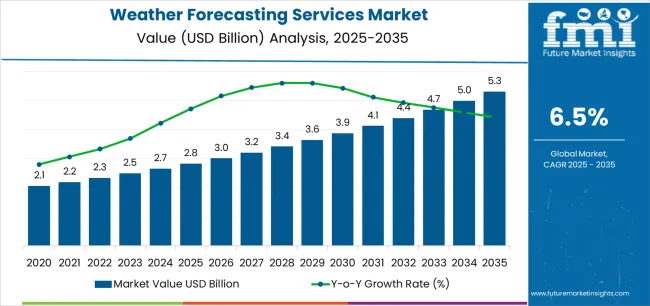
| Metric | Value |
|---|---|
| Weather Forecasting Services Market Estimated Value in (2025E) | USD 2.8 billion |
| Weather Forecasting Services Market Forecast Value in (2035F) | USD 5.3 billion |
| Forecast CAGR (2025 to 2035) | 6.5% |
Segmental Analysis
The market is segmented by Services, Enterprise Size, and Industry and region. By Services, the market is divided into Medium-range Weather Forecasting Services, Short-range Weather Forecasting Services, Nowcasting Weather Forecasting Services, and Long-range Weather Forecasting Services. In terms of Enterprise Size, the market is classified into Very Large Enterprises (1,000+ employees), Small Offices (1-9 employees), Small Enterprises (10-99 employees), Medium-sized Enterprise (100-499 employees), and Large Enterprises (500-999 employees). Based on Industry, the market is segmented into Aviation, Energy & Utilities, Agriculture, Retail, Manufacturing, Media, Marine Industry, Logistics & Transportation, and Others. Regionally, the market is classified into North America, Latin America, Western Europe, Eastern Europe, Balkan & Baltic Countries, Russia & Belarus, Central Asia, East Asia, South Asia & Pacific, and the Middle East & Africa.
Insights into the Medium-range Weather Forecasting Services Segment
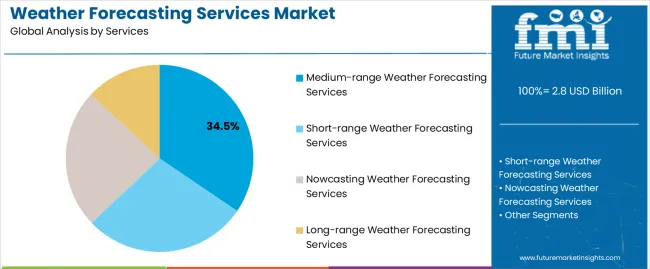
The medium-range weather forecasting services segment is projected to hold 34.50% of the Weather Forecasting Services Market revenue share in 2025, establishing it as the leading service category. Growth in this segment has been driven by the increasing need for accurate forecasts spanning several days, which are critical for planning logistics, energy generation, and agricultural operations. The enhancement of computational models and access to high-resolution satellite imagery have improved the precision of medium-range forecasts, enabling organizations to make informed operational decisions.
Businesses are increasingly relying on these forecasts to optimize resource allocation and minimize weather-related disruptions. The segment’s dominance is also influenced by expanding applications across disaster preparedness, maritime navigation, and supply chain management.
Furthermore, government and private weather agencies are investing in software-defined platforms that integrate real-time analytics with predictive modeling to strengthen medium-range forecasting capabilities These advancements have reinforced the prominence of this segment in driving data-based weather intelligence.
Insights into the Very Large Enterprises Segment
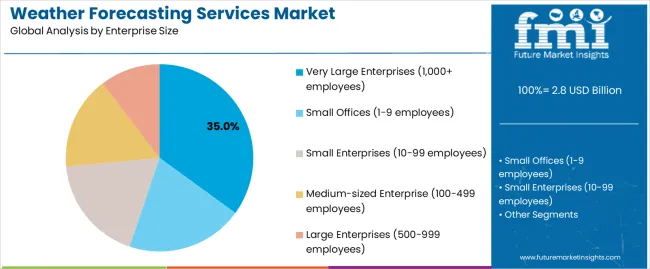
The very large enterprises segment is expected to account for 35.00% of the Weather Forecasting Services Market revenue share in 2025, making it the leading enterprise size category. The segment’s growth has been influenced by the growing dependence of large-scale industries on advanced weather data to ensure operational continuity and risk management. Enterprises with global operations are adopting weather forecasting services to optimize logistics, manage energy distribution, and enhance safety measures.
The implementation of integrated weather monitoring systems allows organizations to align forecasting insights with business strategies, improving response times during adverse conditions. These enterprises are also leveraging customized forecasting services that combine predictive modeling with AI-driven analytics for higher accuracy and strategic planning.
Increased investment in sustainability initiatives and climate risk assessment has further contributed to the expansion of this segment As multinational corporations continue to enhance digital resilience, the adoption of weather forecasting services among very large enterprises is expected to maintain a strong upward trajectory.
Insights into the Aviation Industry Segment
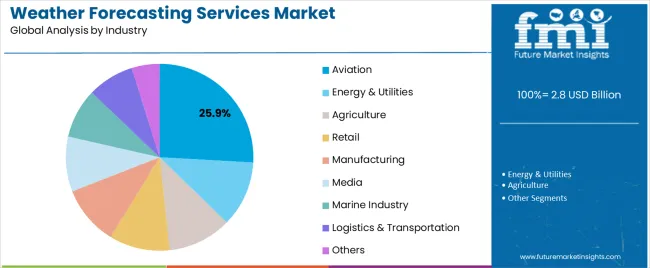
The aviation industry segment is anticipated to capture 25.90% of the Weather Forecasting Services Market revenue share in 2025, solidifying its position as the leading industry user. The segment’s growth has been driven by the crucial role of accurate weather forecasts in flight planning, air traffic management, and passenger safety. Airlines and airports depend on reliable forecasting data to mitigate disruptions caused by turbulence, storms, and low visibility conditions.
Continuous innovation in predictive technologies, coupled with real-time satellite monitoring, has enhanced the precision and responsiveness of aviation weather services. The integration of advanced meteorological data into flight management systems allows for efficient route optimization and fuel savings. Increasing regulatory focus on safety compliance and operational efficiency has also accelerated service adoption in this segment.
Furthermore, the growing number of commercial flights and the expansion of global air traffic networks are reinforcing the need for high-accuracy weather intelligence These factors collectively sustain the aviation industry’s leading position in the Weather Forecasting Services Market.
Semi Annual Market Update
This below table presents the expected CAGR for the Global weather forecasting services market over several semi-annual periods spanning from 2025 to 2035. In the first half (H1) of the year from 2025 to 2035, the industry is predicted to surge at a CAGR of 6.7%, followed by a slightly lower growth rate of 6.5% in the second half (H2) of the same year.
| Particular | Value CAGR |
|---|---|
| H1, 2025 | 6.7% (2025 to 2035) |
| H2, 2025 | 6.5% (2025 to 2035) |
| H1, 2025 | 6.9% (2025 to 2035) |
| H2, 2025 | 6.2% (2025 to 2035) |
Moving into the subsequent period, from H1 2025 to H2 2035, the CAGR is projected to hold at 6.9% in the first half from 2025 to 2035 and considerably decrease at 6.2% in the second half 2025 to 2035. In the first half (H1) 2025 to 2035 the market witnessed an increase of 20 BPS while in the second half (H2) 2025 to 2035 the market witnessed a decrease of 30 BPS.
Key Industry Highlights
Rising Demand of Weather-related Risk Management
Many industries are feeling a growing pressure to reduce losses and boost operational frequency when the weather turns unpredictable. Industries like agriculture, energy, transportation, and aviation can take a hit when bad weather strikes, which can cost them a lot of cash.
For instance, the farming industry depends a lot on exact weather predictions to make planting schedules, watering, and pest control better, which boosts crop output and cuts down on losses from unexpected weather. In 2025, farms used 15% more medium-range forecasts showing how weather forecasting plays a key role in planning and day-to-day choices.
In the same way, the power sector, including utilities and sustainability is relying more on weather forecasts to improve production and distribution. Duke Energy, for example, reported a 15% drop in running costs thanks to more accurate forecasts.
Also, the aviation sector has gained from improvements in weather prediction tech leading to fewer flight delays due to bad weather, which used to cause 20% of delays. These sectors show how crucial weather forecasting is to cut risk and boost effectiveness, which fuels market demand for these services.
Increased Frequency of Extreme Weather Events
The rising tough weather instances like hurricanes, floods, droughts, and wildfires are required better weather forecasting services to reduce risks, shield infrastructure, and keep people safe.
Different types of storms and tornadoes affected USA economically in 2025. The National Centers for Environmental Information (NCEI) recorded these events, which shows how readiness to face these disasters is quite necessary. At the same time, S&P Global discovered that 74% of USA citizens experienced extreme weather conditions in the same year, showcasing the need for accurate weather forecasts.
Companies in different industries, like agriculture, shipping, and insurance now depend more on weather info to cut losses and run better. Weather has hit the insurance business hard, with higher prices and payouts because of big storms and such making them want better ways to figure out risks.
The World Economic Forum's Global Risk Report 2025 even puts extreme weather at the top of what worries global business showing how it shapes the market for weather prediction services.
Data Accuracy and Reliability Challenges
With advancements in AI and high resolution satellite data, weather forecasts still have problems that face accuracy limitations. For example, there's not enough data from oceans and less-developed regions, which leads to incomplete models and affects how precise the forecasts are. These mistakes are problematic for agriculture and disaster management, where having spot-on forecasts is key for decision-making.
Recent events show these problems. In 2025 bad storms and tornadoes across the USA showed the limits of forecasting accuracy where unexpected strong storms caused billions in damage. Also, the gap in forecast quality between developed and less-developed regions is still a big issue.
In wealthier areas, detailed models and extensive sensor networks allow for pretty accurate short-term forecasts. But less developed countries often don't have the needed equipment leading to less reliable predictions. This can hurt farm planning and disaster management. Efforts are being made to fix these issues by adding more data sources and making better computer models, but problems still exist especially in getting reliable forecasts in different parts of the world.
Development of Mobile and On-demand Services
As companies and people depend more on smartphones and other mobile devices, getting precise and up-to-date weather reports is becoming more crucial to decision-making. This also applies to everyday tasks and key business operations.
Mobile apps bring convenience and speed, letting users get local weather updates, warnings, and forecasts that fit their exact needs. This matters a lot in industries like farming, aviation, and logistics, where exact weather info can straight up affect operations and security. The use of technologies like AI and ML in weather models are making the forecasts more accurate. This is key for industries that need reliable weather data to run.
Companies like AccuWeather and Tomorrow.io (Climacell) are at the forefront of providing advanced mobile and on-demand weather services that meet the needs of both big businesses and smaller firms. These services enable companies to streamline operations, cut costs, and boost service dependability. This is crucial in energy industry where weather patterns have a major impact on production and distribution.
2020 to 2024 Global Weather Forecasting Services Sales Outlook Compared to Demand Forecasts from 2025 to 2035
The weather forecasting services market went through notable fluctuations and technological advancements in the historical period. The industry was valued at a valuation of USD 4,902.7 million in 2020 to reach USD 7,101.2 million in 2025 with a CAGR of 9.7 % from 2020 to 2025.
During pandemic, the demand of weather forecasting services went down due to worldwide restrictions and pause in various industries. These demands started to rise from 2025, with the continuation of businesses in the normal manner.
Weather forecasting services market witnessed a considerable growth during the forecasting period between 2025 and 2035. The market reached the valuation of USD 24,322.8 million in 2035 from USD 7,830.3 million in 2025 with the CAGR of 12.0%.
With rise in uncertainties towards sudden weather changes, the demand of weather forecasting services is expected to rise further. The vendors in the market are using emerging technologies in order to provide as much as reliable forecasts.
Market Concentration
Tier 1 companies in the market are major vendors with partnerships with governments and associations to provide needed forecasting services. These vendors provide wide range of weather forecasting services equipped with modern technologies. The vendors in bracket hold market share around 40%-45% globally. These vendors include AccuWeather, Inc., DTN, Earth Networks among more.
Tier 2 vendors in the global weather forecasting services market hold decent amount of market share, but lesser in comparison with tier-1 vendors. These vendors focus on research and development to innovate technologies to increase their market share. These vendors include Precision Weather Service, Met Office, Fugro among others and hold around 25%-30% market share.
Tier 3 companies represent 30% to 35% of share of total weather forecasting services industry. These vendors focus on providing industry specific or personalized weather forecasting services. The vendors in the tier include Spire Global, StormGeo among others.
Country-wise Insights
The below country-wise market analysis of the weather forecasting services explains the recent developments and different government approaches in the market. The analysis also gives an idea of the country’s expected progress in the market landscape.
The data describes key highlights, growth factors, and CAGRs of these countries.
| Countries | CAGR from 2025 to 2035 |
|---|---|
| India | 8.7% |
| China | 8.2% |
| USA | 7.4% |
| Germany | 6.8% |
Rising Investments in Weather Forecasting Technologies Pushes the Market in India
Huge investments are being made in advanced weather forecasting technology, such as Doppler Weather Radars and satellite-based observations, which is highly improving the accuracy of short to medium-range weather forecasts. These upgrades are important for dealing with climate change and extreme weather events.
The IMD has been issuing specific regional forecasts, like the orange alerts for heavy rainfall in states such as Uttarakhand, West Bengal, and Kerala in August 2025. These alerts are part of IMD's wider efforts to give early warnings and reduce the risks from severe weather, showing how well their upgraded systems work.
The market has seen a big growth in private companies getting involved. Firms like Skymet Weather and IBM's The Weather Company now offer special services for industries such as farming and green energy. These businesses use data crunching and smart tech to give super-local weather forecasts. This is helpful for farmers, allowing them to make better choices. As a result, they can grow more crops and cut down on losses.
China’s Move Robust Meteorological Infrastructure
Large investments are being made in China's meteorological infrastructure by the government. This includes launching new weather satellites and using complex models to predict the weather. For instance, FENGYUN-3F satellite was launched from Jiuquan Satellite Launch Center on August 3, 2025.
Companies like Skymet Weather Services are also growing their business in China offering custom weather info for farming and energy companies.
China's push for renewable energy means there's a bigger need for accurate weather forecasts. This helps in optimizing the operations solar and wind farms. To fulfill the need for accuracy, local and foreign companies are teaming up to make weather predictions even better.
Government Investments and Collaborations Drive the Market Growth in USA
The National Oceanic and Atmospheric Administration (NOAA) has signed contracts worth USD 8 million to buy GPS radio occultation weather data. This data makes weather models used for forecasting much more accurate. Also, NOAA is looking at proposals for new projects under a funding program that could give up to USD 2 million each year to improve weather forecasting tech and methods.
Technologies like AI and hyper-localized forecasting has become more common. Companies are teaming up with digital platforms like The Trade Desk to use up-to-the-minute weather data for more exact digital ads. This shows how these new developments can be used in business also.
Category-wise Insights
The below section provides the category wise insights in the market with recent developments and future projections.
Medium-range Weather Forecasting Services Lead in the Market
Medium-range weather forecasting services typically covers a period of three to ten days. These give businesses and governments enough time to prepare for bad weather and lessen its effects, while still being quite accurate.
| Segment | Medium-range Weather Forecasting Services (Services) |
|---|---|
| Value Share (2025) | 34.5% |
Take China's weather service as an example. In 2025, they made their medium-range forecasts better by using new statistical models and high-performance computers. This upgrade has made their predictions more reliable. This matters a lot for farmers, who need to know what the weather will be like a week or so ahead. It helps them decide when to plant crops or water them, which means they lose fewer crops to surprise weather changes.
Flight Planning and Route Optimization Accelerate the Aviation Industry
Precise weather predictions play a key role in flight planning, route optimization, and reducing weather risks. These risks include turbulence, lightning strikes, and big storms that can delay or cancel flights causing big money losses.
| Segment | Aviation (Industry) |
|---|---|
| Value Share (2025) | 25.9% |
To illustrate, Supernal LLC, a part of Hyundai Motor Group, put money into TruWeather Solutions in 2025. The goal was to use smart weather data in their electric aircraft that can take off and land straight up and down. This team-up aims to make urban air travel - a fast-growing part of flying - safer and more efficient.
Competition Outlook
In the weather forecasting services market, there is competition from big global companies, specialized regional providers, and new startups. The big companies have a strong hold with their advanced technology and wide-ranging forecasting solutions for different industries.
These vendors often use cutting-edge tech like AI, machine learning, and satellite data to stay ahead of the game. On the other hand, specialized regional providers emphasize niche markets or local needs offering custom services that meet specific geographic or industry demands. Startups bring fresh ideas and quick changes bringing in new tech and methods often shaking up old-school models with super-local forecasts and all-in-one digital solutions.
Recent Market Developments
- In February 2025, Honeywell Aerospace Technologies and NOAA’s national weather services signed a two year agreement for the deployment of a high-altitude LiDAR Atmospheric Sensing (HALAS) ground system. This will determine its ability to help in weather forecasting by evaluating gathered upper-air data.
- In February 2025, Indian Space Research Organization launched INSAT-3DS satellite for ministry of earth sciences for observing climate in order to improve weather forecasting. The space organization launched the satellite through its launch vehicle, Geosynchronous Launch Vehicle (GSLV-F14).
- In January 2025, AccuWeather announced the acquisition of Plume Labs for an undisclosed amount. The former company integrated the services of Plume Labs in January 2025.
- In May 2025, Fasal signed a MoU (memorandum of understanding) with IMD for research purposes. As per agreement, the companies would work together to work on precipitation forecasting and weather forecasting models validation.
Key Players in the Weather Forecasting Services Industry
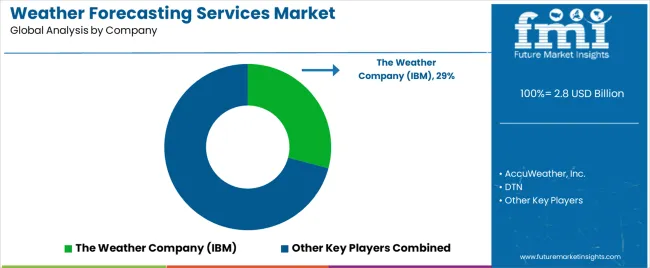
- AccuWeather, Inc.
- DTN
- Earth Networks
- Fugro
- Met Office
- Precision Weather Service
- Spire Global
- StormGeo
- The Tomorrow Companies Inc.
- The Weather Company (IBM)
Weather Forecasting Services Market Segmentation
By Services:
The industry includes Nowcasting Weather Forecasting Services, Short-range Weather Forecasting Services, Medium-range Weather Forecasting Services and Long-range Weather Forecasting Services.
By Enterprise Size:
Small Offices (1-9 employees), Small Enterprises (10-99 employees), Medium-sized Enterprise (100-499 employees), Large Enterprises (500-999 employees) and Very Large Enterprises (1,000+ employees) are segmented in this category.
By Industry:
Agriculture, Aviation, Energy & Utilities, Retail, Manufacturing, Media, Marine Industry, Logistics & Transportation and Others are segmented in this category.
By Region:
A regional analysis has been carried out in key countries of North America, Latin America, East Asia, South Asia & Pacific Western Europe, Eastern Europe and Middle East and Africa (MEA).
Frequently Asked Questions
How big is the weather forecasting services market in 2025?
The global weather forecasting services market is estimated to be valued at USD 2.8 billion in 2025.
What will be the size of weather forecasting services market in 2035?
The market size for the weather forecasting services market is projected to reach USD 5.3 billion by 2035.
How much will be the weather forecasting services market growth between 2025 and 2035?
The weather forecasting services market is expected to grow at a 6.5% CAGR between 2025 and 2035.
What are the key product types in the weather forecasting services market?
The key product types in weather forecasting services market are medium-range weather forecasting services, short-range weather forecasting services, nowcasting weather forecasting services and long-range weather forecasting services.
Which enterprise size segment to contribute significant share in the weather forecasting services market in 2025?
In terms of enterprise size, very large enterprises (1,000+ employees) segment to command 35.0% share in the weather forecasting services market in 2025.
Preview the report firsthand - request a free sample
Get SampleGet the brochure for pricing and purchase details.
Get PDFTable of Content
- Executive Summary
- Global Market Outlook
- Demand-side Trends
- Supply-side Trends
- Technology Roadmap Analysis
- Analysis and Recommendations
- Market Overview
- Market Coverage / Taxonomy
- Market Definition / Scope / Limitations
- Market Background
- Market Dynamics
- Drivers
- Restraints
- Opportunity
- Trends
- Scenario Forecast
- Demand in Optimistic Scenario
- Demand in Likely Scenario
- Demand in Conservative Scenario
- Opportunity Map Analysis
- Product Life Cycle Analysis
- Supply Chain Analysis
- Investment Feasibility Matrix
- Value Chain Analysis
- PESTLE and Porter’s Analysis
- Regulatory Landscape
- Regional Parent Market Outlook
- Production and Consumption Statistics
- Import and Export Statistics
- Market Dynamics
- Global Market Analysis 2020 to 2025 and Forecast, 2025 to 2035
- Historical Market Size Value (USD Million) Analysis, 2020 to 2025
- Current and Future Market Size Value (USD Million) Projections, 2025 to 2035
- Y-o-Y Growth Trend Analysis
- Absolute $ Opportunity Analysis
- Global Market Pricing Analysis 2020 to 2025 and Forecast 2025 to 2035
- Global Market Analysis 2020 to 2025 and Forecast 2025 to 2035, By Services
- Introduction / Key Findings
- Historical Market Size Value (USD Million) Analysis By Services , 2020 to 2025
- Current and Future Market Size Value (USD Million) Analysis and Forecast By Services , 2025 to 2035
- Medium-range Weather Forecasting Services
- Short-range Weather Forecasting Services
- Nowcasting Weather Forecasting Services
- Long-range Weather Forecasting Services
- Y-o-Y Growth Trend Analysis By Services , 2020 to 2025
- Absolute $ Opportunity Analysis By Services , 2025 to 2035
- Global Market Analysis 2020 to 2025 and Forecast 2025 to 2035, By Enterprise Size
- Introduction / Key Findings
- Historical Market Size Value (USD Million) Analysis By Enterprise Size, 2020 to 2025
- Current and Future Market Size Value (USD Million) Analysis and Forecast By Enterprise Size, 2025 to 2035
- Very Large Enterprises (1,000+ employees)
- Small Offices (1-9 employees)
- Small Enterprises (10-99 employees)
- Medium-sized Enterprise (100-499 employees)
- Large Enterprises (500-999 employees)
- Y-o-Y Growth Trend Analysis By Enterprise Size, 2020 to 2025
- Absolute $ Opportunity Analysis By Enterprise Size, 2025 to 2035
- Global Market Analysis 2020 to 2025 and Forecast 2025 to 2035, By Industry
- Introduction / Key Findings
- Historical Market Size Value (USD Million) Analysis By Industry, 2020 to 2025
- Current and Future Market Size Value (USD Million) Analysis and Forecast By Industry, 2025 to 2035
- Aviation
- Energy & Utilities
- Agriculture
- Retail
- Manufacturing
- Media
- Marine Industry
- Logistics & Transportation
- Others
- Y-o-Y Growth Trend Analysis By Industry, 2020 to 2025
- Absolute $ Opportunity Analysis By Industry, 2025 to 2035
- Global Market Analysis 2020 to 2025 and Forecast 2025 to 2035, By Region
- Introduction
- Historical Market Size Value (USD Million) Analysis By Region, 2020 to 2025
- Current Market Size Value (USD Million) Analysis and Forecast By Region, 2025 to 2035
- North America
- Latin America
- Western Europe
- Eastern Europe
- East Asia
- South Asia and Pacific
- Middle East & Africa
- Market Attractiveness Analysis By Region
- North America Market Analysis 2020 to 2025 and Forecast 2025 to 2035, By Country
- Historical Market Size Value (USD Million) Trend Analysis By Market Taxonomy, 2020 to 2025
- Market Size Value (USD Million) Forecast By Market Taxonomy, 2025 to 2035
- By Country
- USA
- Canada
- Mexico
- By Services
- By Enterprise Size
- By Industry
- By Country
- Market Attractiveness Analysis
- By Country
- By Services
- By Enterprise Size
- By Industry
- Key Takeaways
- Latin America Market Analysis 2020 to 2025 and Forecast 2025 to 2035, By Country
- Historical Market Size Value (USD Million) Trend Analysis By Market Taxonomy, 2020 to 2025
- Market Size Value (USD Million) Forecast By Market Taxonomy, 2025 to 2035
- By Country
- Brazil
- Chile
- Rest of Latin America
- By Services
- By Enterprise Size
- By Industry
- By Country
- Market Attractiveness Analysis
- By Country
- By Services
- By Enterprise Size
- By Industry
- Key Takeaways
- Western Europe Market Analysis 2020 to 2025 and Forecast 2025 to 2035, By Country
- Historical Market Size Value (USD Million) Trend Analysis By Market Taxonomy, 2020 to 2025
- Market Size Value (USD Million) Forecast By Market Taxonomy, 2025 to 2035
- By Country
- Germany
- UK
- Italy
- Spain
- France
- Nordic
- BENELUX
- Rest of Western Europe
- By Services
- By Enterprise Size
- By Industry
- By Country
- Market Attractiveness Analysis
- By Country
- By Services
- By Enterprise Size
- By Industry
- Key Takeaways
- Eastern Europe Market Analysis 2020 to 2025 and Forecast 2025 to 2035, By Country
- Historical Market Size Value (USD Million) Trend Analysis By Market Taxonomy, 2020 to 2025
- Market Size Value (USD Million) Forecast By Market Taxonomy, 2025 to 2035
- By Country
- Russia
- Poland
- Hungary
- Balkan & Baltic
- Rest of Eastern Europe
- By Services
- By Enterprise Size
- By Industry
- By Country
- Market Attractiveness Analysis
- By Country
- By Services
- By Enterprise Size
- By Industry
- Key Takeaways
- East Asia Market Analysis 2020 to 2025 and Forecast 2025 to 2035, By Country
- Historical Market Size Value (USD Million) Trend Analysis By Market Taxonomy, 2020 to 2025
- Market Size Value (USD Million) Forecast By Market Taxonomy, 2025 to 2035
- By Country
- China
- Japan
- South Korea
- By Services
- By Enterprise Size
- By Industry
- By Country
- Market Attractiveness Analysis
- By Country
- By Services
- By Enterprise Size
- By Industry
- Key Takeaways
- South Asia and Pacific Market Analysis 2020 to 2025 and Forecast 2025 to 2035, By Country
- Historical Market Size Value (USD Million) Trend Analysis By Market Taxonomy, 2020 to 2025
- Market Size Value (USD Million) Forecast By Market Taxonomy, 2025 to 2035
- By Country
- India
- ASEAN
- Australia & New Zealand
- Rest of South Asia and Pacific
- By Services
- By Enterprise Size
- By Industry
- By Country
- Market Attractiveness Analysis
- By Country
- By Services
- By Enterprise Size
- By Industry
- Key Takeaways
- Middle East & Africa Market Analysis 2020 to 2025 and Forecast 2025 to 2035, By Country
- Historical Market Size Value (USD Million) Trend Analysis By Market Taxonomy, 2020 to 2025
- Market Size Value (USD Million) Forecast By Market Taxonomy, 2025 to 2035
- By Country
- Kingdom of Saudi Arabia
- Other GCC Countries
- Turkiye
- South Africa
- Other African Union
- Rest of Middle East & Africa
- By Services
- By Enterprise Size
- By Industry
- By Country
- Market Attractiveness Analysis
- By Country
- By Services
- By Enterprise Size
- By Industry
- Key Takeaways
- Key Countries Market Analysis
- USA
- Pricing Analysis
- Market Share Analysis, 2025
- By Services
- By Enterprise Size
- By Industry
- Canada
- Pricing Analysis
- Market Share Analysis, 2025
- By Services
- By Enterprise Size
- By Industry
- Mexico
- Pricing Analysis
- Market Share Analysis, 2025
- By Services
- By Enterprise Size
- By Industry
- Brazil
- Pricing Analysis
- Market Share Analysis, 2025
- By Services
- By Enterprise Size
- By Industry
- Chile
- Pricing Analysis
- Market Share Analysis, 2025
- By Services
- By Enterprise Size
- By Industry
- Germany
- Pricing Analysis
- Market Share Analysis, 2025
- By Services
- By Enterprise Size
- By Industry
- UK
- Pricing Analysis
- Market Share Analysis, 2025
- By Services
- By Enterprise Size
- By Industry
- Italy
- Pricing Analysis
- Market Share Analysis, 2025
- By Services
- By Enterprise Size
- By Industry
- Spain
- Pricing Analysis
- Market Share Analysis, 2025
- By Services
- By Enterprise Size
- By Industry
- France
- Pricing Analysis
- Market Share Analysis, 2025
- By Services
- By Enterprise Size
- By Industry
- India
- Pricing Analysis
- Market Share Analysis, 2025
- By Services
- By Enterprise Size
- By Industry
- ASEAN
- Pricing Analysis
- Market Share Analysis, 2025
- By Services
- By Enterprise Size
- By Industry
- Australia & New Zealand
- Pricing Analysis
- Market Share Analysis, 2025
- By Services
- By Enterprise Size
- By Industry
- China
- Pricing Analysis
- Market Share Analysis, 2025
- By Services
- By Enterprise Size
- By Industry
- Japan
- Pricing Analysis
- Market Share Analysis, 2025
- By Services
- By Enterprise Size
- By Industry
- South Korea
- Pricing Analysis
- Market Share Analysis, 2025
- By Services
- By Enterprise Size
- By Industry
- Russia
- Pricing Analysis
- Market Share Analysis, 2025
- By Services
- By Enterprise Size
- By Industry
- Poland
- Pricing Analysis
- Market Share Analysis, 2025
- By Services
- By Enterprise Size
- By Industry
- Hungary
- Pricing Analysis
- Market Share Analysis, 2025
- By Services
- By Enterprise Size
- By Industry
- Kingdom of Saudi Arabia
- Pricing Analysis
- Market Share Analysis, 2025
- By Services
- By Enterprise Size
- By Industry
- Turkiye
- Pricing Analysis
- Market Share Analysis, 2025
- By Services
- By Enterprise Size
- By Industry
- South Africa
- Pricing Analysis
- Market Share Analysis, 2025
- By Services
- By Enterprise Size
- By Industry
- USA
- Market Structure Analysis
- Competition Dashboard
- Competition Benchmarking
- Market Share Analysis of Top Players
- By Regional
- By Services
- By Enterprise Size
- By Industry
- Competition Analysis
- Competition Deep Dive
- The Weather Company (IBM)
- Overview
- Product Portfolio
- Profitability by Market Segments (Product/Age /Sales Channel/Region)
- Sales Footprint
- Strategy Overview
- Marketing Strategy
- Product Strategy
- Channel Strategy
- AccuWeather, Inc.
- DTN
- Earth Networks
- Fugro
- Met Office
- Precision Weather Service
- Spire Global
- StormGeo
- The Tomorrow Companies Inc.
- The Weather Company (IBM)
- Competition Deep Dive
- Assumptions & Acronyms Used
- Research Methodology


