

- Industry Size (2026)
- USD 16.4 Bn
- Forecast (2036)
- USD 24.3 Bn
- CAGR (2026 to 2036)
- 4.0%
North and Latin America Weatherization Services Market Forecast and Outlook 2026 to 2036
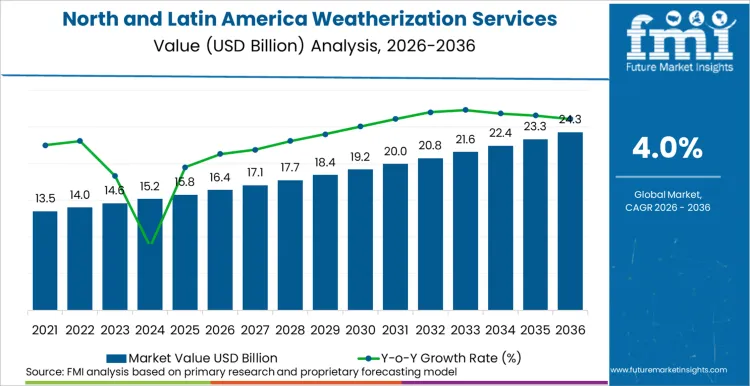
In 2025, the North and Latin America weatherization services market was valued at USD 15.8 billion. Based on Future Market Insights' analysis, demand for weatherization services is estimated to grow to USD 16.4 billion in 2026 and USD 24.3 billion by 2036. FMI projects a CAGR of 4.0% during the forecast period.
Absolute dollar growth of USD 7.9 billion over the decade reflects steady, policy-backed expansion rather than cyclical upside. In the United States, the Weatherization Assistance Program (WAP) and Inflation Reduction Act incentives continue to channel federal funding toward low-income household retrofits, while Latin American markets are entering their first generation of nationally funded industrial energy-efficiency programmes. Spray foam insulation now holds approximately 36% of the insulation material market share within weatherization projects, driven by its dual sealing-insulating properties.
As Alexandre Silveira, Minister of Mines and Energy of Brazil, noted regarding the national expansion of the PotencializEE programme, the government is 'scaling industrial energy efficiency nationwide' with a R$ 75 million investment to bring the programme to all Brazilian states.
The United States (4.2% CAGR) leads regional demand through federal weatherization funding and state-level building energy codes. Canada (3.8% CAGR) benefits from provincial retrofit incentive programmes and extreme climate-driven insulation demand. Brazil (4.5% CAGR) is the fastest-growing Latin American market, supported by the PotencializEE industrial efficiency programme. Mexico (3.5% CAGR) and Chile (3.3% CAGR) grow through commercial building energy-efficiency standards.
North and Latin America Weatherization Services Market Market Definition
The North and Latin America weatherization services market covers the provision of energy-efficiency improvement services for buildings, including insulation installation, air sealing, HVAC system optimization, and window and door replacement. Services are delivered to residential, commercial, and industrial buildings, targeting both new construction and retrofit projects.
North and Latin America Weatherization Services Market Market Inclusions
The report covers regional market sizes by revenue for the 2026 to 2036 forecast period across North and Latin America. It includes segmental breakdowns by service type, end use, and building type. Country-level analysis covers the United States, Canada, Mexico, Brazil, Argentina, Chile, Peru, Colombia, and other Latin American markets.
North and Latin America Weatherization Services Market Market Exclusions
The scope excludes full building demolition and reconstruction, renewable energy installation unless bundled with weatherization services, and HVAC equipment manufacturing. It also omits European and Asia Pacific weatherization markets.
North and Latin America Weatherization Services Market Research Methodology
- Primary Research: Interviews were conducted with weatherization contractors, building material distributors, federal and state programme administrators, and industrial energy auditors across the United States, Canada, Brazil, and Mexico.
- Desk Research: USA Department of Energy WAP allocation data, Brazilian Ministry of Mines and Energy programme filings, provincial retrofit incentive databases, and building permit statistics supported demand benchmarking.
- Market-Sizing and Forecasting: A hybrid model combined top-down federal and state funding allocation analysis with bottom-up contractor revenue and building retrofit volume data, validated against insulation material shipment statistics.
- Data Validation and Update Cycle: Outputs undergo anomaly screening, variance checks across funding allocation and retrofit completion datasets, and structured peer review prior to release.
Summary of North and Latin America Weatherization Services Market
- Power in the North and Latin America weatherization value chain is concentrated among building material distributors and federal programme administrators. In the United States, ABC Supply Co. and L&W Supply control distribution of insulation, roofing, and air-sealing materials to contractors, dictating material availability and pricing at the local level. Federal WAP administrators control the flow of retrofit funding to state agencies. As per FMI, contractors without diversified revenue across both public-subsidy and private-market channels face income volatility tied to annual federal appropriations.
- Pricing asymmetry in weatherization services reflects the gap between subsidized and unsubsidized work. Government-funded WAP projects carry fixed per-household cost ceilings that compress contractor margins, while private-market whole-home energy retrofits command premium pricing at two to three times WAP rates. FMI analysts note that contractors who serve both channels use subsidized projects to maintain workforce utilization and private-market projects to generate margin.
- Sourcing fragility centres on skilled labour availability and spray-foam chemical supply. Certified weatherization technicians in the United States are in short supply, with training programme capacity lagging behind WAP funding expansion. MDI-based spray foam insulation depends on isocyanate supply from a limited number of global chemical producers.
- Brand and compliance risks are tied to energy-audit accuracy and retrofit performance guarantees. In Latin America, the PotencializEE programme in Brazil requires verified industrial energy savings. FMI opines that quality certification and verified performance records will become the primary competitive differentiator in both North and Latin American markets.
- Geographic leverage differs across the region. The USA Northeast generates the highest per-building retrofit spend due to aging housing stock and severe winters. Brazil leads Latin America through federal industrial efficiency funding. Canada's prairie provinces drive demand through extreme cold-weather insulation requirements. Mexico's commercial building sector is growing as national energy-efficiency codes tighten.
- For C-suite executives, the weatherization market through 2036 rewards companies that build dual-channel revenue streams across government-funded and private-market retrofits, invest in technician training, and secure reliable supply chains for high-performance insulation materials.
Category-wise Insights
The section contains information about the leading segments in the industry. By service type, Attic Insulation segment is estimated to grow at a CAGR of 3.3% throughout 2036. Additionally, residential is projected to expand at 6.7% by 2036.
Attic Insulation’s Dominance in the North and Latin American Weatherization Market
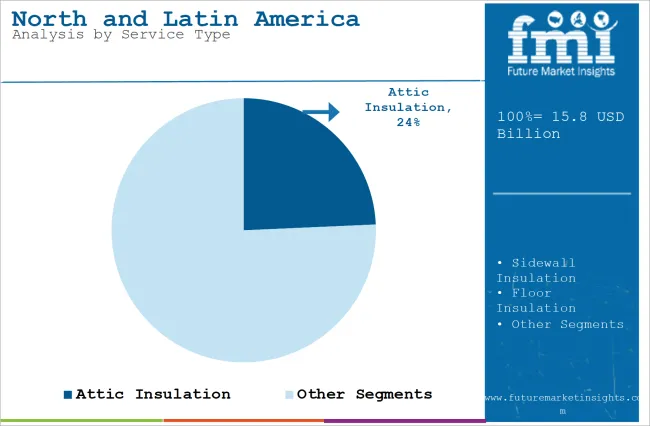
| Service Type | Attic Insulation |
|---|---|
| Value Share (2036) | 24.3% |
Attic insulation will lead the way in North and Latin American weatherization services market owing to its unbeatable energy saving and cost-saving ability. Attic insulation, for instance, will save energy costs by up to 50%. According to the USA Department of Energy, it could save homeowners about USD 200 to USD 500 in annual savings for every home. Other services like sidewall insulation or floor insulation have other kinds of less direct and, hence, relatively lesser impacts on energy consumption; for instance, attic insulation seems to have the most direct influence in regions of extreme seasonal change.
Sidewall insulation and floor insulation sometimes provide some forms of energy savings but require rather complex installation, thus having greater upfront costs. The USA weatherization services market stood at around USD 7 billion in 2023. Among the different types, attic insulation leads the segment and constituted more than 30% of the total market share.
For example, the average cost of upgrading an HVAC system ranges from USD 5,000 to USD 10,000, whereas attic insulation is around USD 1,500 to USD 3,000, and immediate results in terms of energy efficiency are obtained. Therefore, attic insulation is a more accessible and attractive option for homeowners and businesses looking for affordable and effective weatherization solutions.
Role of Government Programs in Residential Weatherization Success
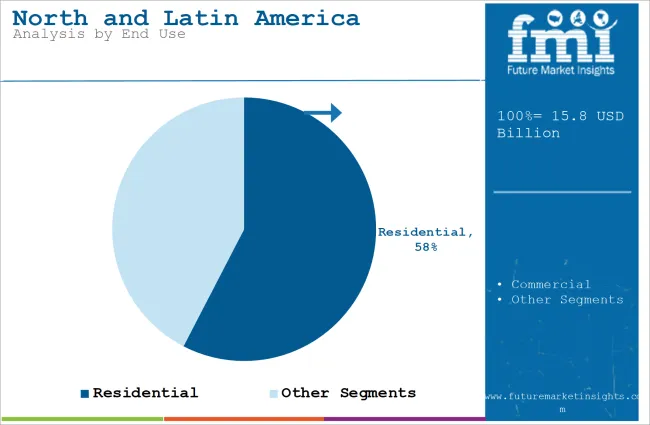
| End Use | Residential |
|---|---|
| Value Share (2036) | 57.6% |
Residential accounts for the large share in North and Latin America, according to several country-level market observations. In the USA, the home performance with ENERGY STAR program completed retrofitting more than 200,000 homes in 2021, which consisted mainly of insulation work. On the other hand, fewer commercial projects exist as it involves larger structures, thus costlier, and complex work.
In Canada, EnerGuide allocates 60% of energy efficiency funding to residential customers, reflecting the sector's huge role in weatherization. Similarly, Chile's Programa de Eficiencia Energética has seen a 7% increase in residential demand, with commercial adoption remaining slower.
Residential markets have also been very strong in Latin America, particularly in Colombia and Brazil. Energía Sostenible in Colombia and Casa Eficiente in Brazil are examples of residential retrofit programs that have been gaining momentum, thanks to the quicker payback periods and government support.
Key Industry Highlights
Extreme weather patterns, including hot summers and harsh winters, are pushing homeowners and businesses to invest in weatherization services
Extreme weather patterns, such as prolonged heatwaves and severe winters, are increasingly driving demand for weatherization services. In regions like the USA Northeast, where winters can bring freezing temperatures and heavy snow, homeowners are turning to insulation, air sealing, and HVAC upgrades to maintain indoor comfort and reduce heating costs. For instance, the snowy states of Minnesota and New York have also witnessed a hike in weatherization services due to intense requests from the residents to minimize energy consumption and seal the rifts to prevent heat leakage.
Regions with severely hot summers such as Texas register increased demand on weatherization. Because summer heat regularly reaches well above 100°F, more and more people are investing in high-efficiency insulation and low-consumption windows to prevent total dependence on cooling devices. Therefore, these hot climatic conditions directly force every house owner as well as firms into weatherization service to meet energy consumption on the right way.
Expanding Market Opportunities through Weatherization Programs for Lower-Income Households in the USA
A significant market opportunity exists in providing weatherization services to lower-income households through government-backed programs such as the USA Weatherization Assistance Program (WAP). WAP has retrofitted over 7 million homes since its inception, focusing on low-income families who otherwise couldn't afford energy-efficient upgrades.
This is not only enabling the reduction in energy costs to the underserved households but is also expanding service penetration in areas where the need for weatherization is the greatest; this provides large growth opportunities to service providers.
In Latin America, similar programs, such as Mexico's Proyectos de Eficiencia Energética, are also promoting the take-up of weatherization services for low-income households. With government incentives and subsidies, weatherization services can be made more accessible to families in need, offering a large, underserved market in both residential and public sectors.
Challenges in Weatherization Service Adoption Due to Initial Investment Barriers
The main restrain for the market of weatherization services is that their comprehensive retrofits are costly for the front. Although long-run energy savings with weatherization have been considerable, the front-loaded investment could make it inaccessible or unaffordable for low-income and middle-income homeowners. For instance, the average USA costs of a complete home weatherization retrofit can easily fall between 2,000 and 5,000. For some home owners, those amounts are likely unaffordable even with various government incentives- such as one through the WAP.
In Canada, while the Greener Homes grant provides financial support, the substantial out-of-pocket expenses that homeowners must bear remain a significant challenge. These upfront costs put off the consumption of weatherization services, with the most acute cases being among older homes to be upgraded or renovated to suit the present standards.
Rise in adoption of green building standards to increase demand weatherization services in new and retrofitted buildings
As urbanization accelerates, cities in North and Latin America are experiencing increasing demand for green building practices that have led to the adoption of energy-efficient weatherization services. In cities such as New York and São Paulo, building codes increasingly align with sustainability standards that demand energy-efficient retrofitting for both new and existing buildings. For instance, New York's Local Law 97 requires that buildings reduce their greenhouse gas emissions.
It's also prevalent in commercial development as large projects like Toronto's The Well is using LEED certification and many other forms, which enforce efficient systems and meet the desired environmental conditions, to provide comfort inside energy-efficient structures. Such examples exemplify the effect of urbanization and a better understanding of the importance of building green and set forth ample scopes for weatherization services both within residential and commercial markets.
2021 to 2025 North and Latin America Weatherization Services Sales Outlook Compared to Demand Forecast from 2026 to 2036
This trend is mainly backed by government-backed initiatives, like the USA Weatherization Assistance Program (WAP) and energy efficiency programs in Latin America, and increasing energy prices that encourage home and business owners to invest in energy-saving solutions.
From 2025 to 2035, the market is expected to grow at a faster rate. Some of the reasons for this growth include stringent energy efficiency regulations, such as California's Title 24 standards, which will require retrofitting services, especially for residential properties. In addition, technological innovations in smart HVAC systems, advanced insulation materials, and AI-driven energy management solutions will make weatherization services more efficient, cost-effective, and attractive. With rising energy prices and continued government incentives, the adoption of energy-efficient solutions will continue to rise.
Climate change and sustainability issues will further boost market growth as both residential and commercial sectors take on weatherization services to achieve carbon reduction targets. The combination of these regulatory measures, technological advancements, and market demand will ensure that the North and Latin American weatherization services market continues to grow in the coming decade.
Market Concentration
Tier 1 companies comprise market leaders with a market revenue of above USD 300 million capturing a significant market share of 25-30% in the North and Latin America market. These market leaders are characterized by high production capacity and a wide product portfolio.
These market leaders are distinguished by their extensive expertise in manufacturing across multiple packaging formats and a broad geographical reach, underpinned by a robust consumer base.
They provide a wide range of series including recycling, and manufacturing utilizing the latest technology meeting regulatory standards providing the highest quality. Prominent companies within Tier 1 include Green Home Inspections & Energy Audits, Inc., Home Insulation Company, Go Green Squads, American AWS, and M&M Weatherization Company and others.
Tier 2 and other includes the majority of small-scale companies operating at the local presence and serving niche markets having revenue below USD 300 million. These companies are notably oriented towards fulfilling local market demands and are consequently classified within the tier 2 share segment.
They are small-scale players and have limited geographical reach. Tier 2, within this context, is recognized as an unorganized market, denoting a sector characterized by a lack of extensive structure and formalization when compared to organized competitors.
Country-wise insights
The section below covers the industry analysis for the weatherization services market for different countries. Market demand analysis on key countries is provided. The USA is anticipated to remain at the forefront in North America, with a value share of 64.6% through 2035. In Latin America, Brazil is projected to witness a CAGR of 4.8% by 2035.
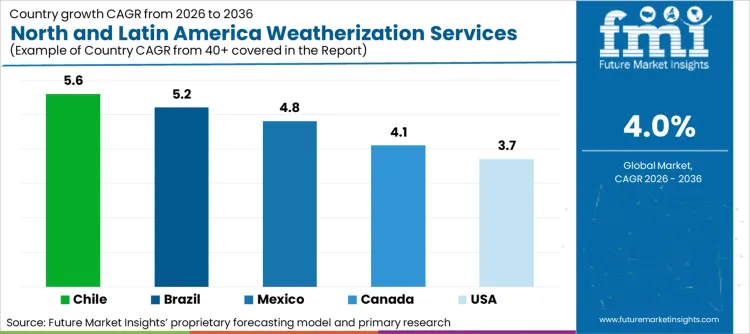
| Country | Value CAGR (2025 to 2035) |
|---|---|
| USA | 3.7% |
| Canada | 4.1% |
| Mexico | 4.8% |
| Brazil | 5.2% |
| Chile | 5.6% |
The Impact of Aging Housing Stock and Climate on USA Weatherization Service Market
The highest clients in the market for weatherization services belong to the USA, with comprehensive government initiatives, aged infrastructure, and diverse climate contributing to its status. The WAP, funded through Department of Energy, has weatherized over 7 million homes since 1976, with a budget amounting to USD 3.5 billion in 2021 through the Infrastructure Investment and Jobs Act.
These and other factors boost energy-efficient enhancements in residences under California's Title 24 energy standards and federal tax incentives, including the annual Energy Efficient Home Improvement Tax Credit of USD 3,200. A multibillion-dollar market is fueling retrofitting services, including attic insulation, that grows more than 8% CAGR in the USA
In the USA, 80 percent of the housing stock was built before 1990 and needs upgrades to meet current standards of efficiency. For instance, northern states such as Minnesota require higher attic and wall insulation levels during extremely cold winter days. In contrast, southern states such as Texas experience a sharp peak in HVAC upgrades, especially during times when the mercury soars over 100°F. This climate-specific requirement, along with the increasing cost of energy, with average residential utility bills up by 10% since 2020, ensures constant demand across all regions.
Energy Efficiency and Government Incentives Propel Weatherization Service in Canada
The severe climate and energy efficiency-driven policies set Canada apart in the weatherization services market. Winters plummet to as low as -20°C (-4°F) in provinces like Alberta and Saskatchewan; therefore, the need for weatherization services like insulation and air sealing becomes critical to keep the house warm and energy-efficient. About 60% of Canada's housing stock was constructed before 2000, necessitating retrofits to meet current energy efficiency standards. Programs such as the federal Canada Greener Homes Grant offer up to CAD 5,000 for each household toward energy efficiency improvements, creating considerable demand for weatherization services nationwide.
Canada's varied geography also results in geographically specific demand. Northern provinces are Arctic-like conditions, which demands more high-end insulation solutions. Coastal regions such as British Columbia, with high rainfall, require sealing to keep moisture at bay. Energy prices increased more than 8% from 2021, so the next step is energy efficiency, and homeowners and businesses want efficient use of energy.
The private sector responded by introducing innovative solutions, including energy-efficient HVAC systems and eco-friendly insulation materials. Supported by a combination of stringent policies, financial incentives, and regional needs, Canada is solidifying its position as a growing hub for weatherization services in North America.
Urbanization and Climate Diversity Fuelling Brazil’s Weatherization Demand
Brazil is the largest market for weatherization services in Latin America, because of its climatic diversity, urbanization, and government-backed energy efficiency programs. The country experiences a wide range of climatic conditions, from humid tropical weather in the Amazon to colder winters in southern regions like Rio Grande do Sul, which calls for specific weatherization solutions.
Cities like São Paulo, Rio de Janeiro, and Brasília, with 87.79% of its population residing in urban areas, are key demand centers, thus needing retrofitting for aging buildings and energy-efficient solutions for new construction. Electricity costs are relatively high, at USD 0.18 per kWh, and the adoption of energy-saving weatherization measures will be further motivated by this factor.
Demand is also boosted by government initiatives. The Energy Efficiency Program (PEE), which is under the regulation of ANEEL, requires utility companies to invest 0.5% of their net operating revenue in energy efficiency projects. Since 1998, more than 4,800 projects have been implemented under this program, focusing on insulation, HVAC upgrades, and energy audits. Moreover, Brazil's National Energy Efficiency Plan (PNEf) aims to reduce energy consumption by 10% by 2030, thus opening up vast opportunities for weatherization service providers.
Competitive Landscape
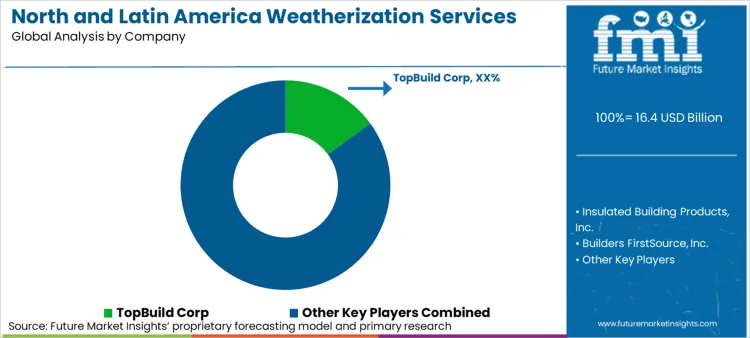
The section provides comprehensive assessments and insights that highlight current opportunities and emerging trends for companies in developed and developing countries. It analyses advancements in manufacturing and identifies the latest trends poised to drive new applications in the market.
The key players in the market are actively enhancing their market presence and competitiveness through different strategies by incorporating advanced technologies like variable-speed compressors, intelligent controls, and integration with renewable energy sources to improve energy efficiency and environmental sustainability.
Significant players are further introducing new products to address the increasing need for cutting-edge solutions in various end-use sectors. Geographic expansion is another important strategy that is being embraced by reputed companies. Start-ups are likely to emerge in the sector through 2035, thereby making it more competitive.
Recent Developments:
- The report includes full coverage of key trends from competitive benchmarking. Some of the recent developments covered in the report:
- In February 2026, SPX Technologies completed the USD 300 million acquisition of Crawford United's commercial air-handling businesses. [1]
- In February 2026, the Government of Brazil launched national expansion of PotencializEE with a R$ 75 million investment. [2]
- In January 2026, L&W Supply opened a new branch in Springfield, Missouri, its third location in the state. [3]
- In January 2026, SPX Technologies announced the acquisition of Thermolec for engineered heating solutions. [4]
- In November 2025, ABC Supply Co. expanded its Texas footprint by acquiring Roofing Supply Houston, Inc. [5]
Key Players of the Weatherization Services Industry
- TopBuild Corp
- Insulated Building Products, Inc.
- Builders FirstSource, Inc.
- Dyson Energy Services Ltd
- HomeWorks Energy, Inc.
- USA Insulation
- Banker Insulation
- Anderson Insulation
- Tripolymer Inc.
- Takashima & Co., Ltd.
Scope of the Report
| Items | Values |
|---|---|
| Quantitative Units | USD 16.4 billion (2026) to USD 24.3 billion (2036), at a CAGR of 4.0% |
| Market Definition | Covers energy-efficiency improvement services for buildings across North and Latin America. |
| Service Type Segmentation | Insulation, Air Sealing, HVAC Optimization, Window and Door Replacement, Others |
| End Use Segmentation | Residential, Commercial, Industrial |
| Regions Covered | North America and Latin America |
| Countries Covered | United States, Canada, Mexico, Brazil, Argentina, Chile, Peru, Colombia and Rest of Latin America |
| Key Companies Profiled | ABC Supply Co., L&W Supply, SPX Technologies, Owens Corning, Johns Manville, CertainTeed, Knauf Insulation, Thermolec, Crawford United, Aeroseal |
| Forecast Period | 2026 to 2036 |
| Approach | Hybrid top-down and bottom-up market modeling validated through primary interviews with weatherization contractors and federal programme administrators |
Key segments of the Weatherization Services industry
By Service Type:
In terms of service type, the industry is divided into attic insulation, sidewall insulation, floor insulation, HVAC, doors & windows frame and others.
By Construction Type:
In terms of construction type, the industry is divided retrofit and new construction.
By End Use:
In terms of end use, the industry is divided into residential and commercial.
By Region:
Key regions of North America and Latin America have been covered in the report.
Bibliography
- SPX Technologies. (2026). Acquisition of Crawford United. February 2026.
- Mitigation Action Facility. (2026). Brazil Industrial Energy Efficiency Project
- L&W Supply. (2026). Springfield Branch Opening.
- SPX Technologies. (2026). Thermolec Acquisition. January 2026.
- ABC Supply Co. (2025). Texas Footprint Expansion. November 2025.
- USA DOE. (2025). WAP Program Year 2025 Grantee Allocations.
- USA DOE. (2025). Weatherization Assistance Program Overview.
- Brazil Ministry of Mines and Energy. (2026). PotencializEE Programme Filing.
- Natural Resources Canada. (2025). Home Energy Retrofit Programmes.
- GIZ. (2026). Brazil Industrial Energy Efficiency Programme.
This Report Addresses
- Market intelligence across residential, commercial, and industrial weatherization in North and Latin America
- Market size estimation and 10-year revenue forecasts from 2026 to 2036
- Growth opportunity mapping across insulation, air sealing, HVAC optimization, and fenestration replacement
- Country-level forecasts covering the United States, Canada, Mexico, Brazil, Argentina, Chile
- Competition strategy assessment including dual-channel revenue models and technician certification
- Policy and funding tracking including WAP allocations and Latin American efficiency programmes
- Regulatory impact analysis covering building energy codes and emission reduction mandates
- Market report delivery in PDF, Excel, PPT, and interactive dashboard formats
Frequently Asked Questions
How large is the N&LA weatherization services market in 2026?
The market is estimated at USD 16.4 billion in 2026.
What will the market size be by 2036?
The market is projected to reach USD 24.3 billion by 2036.
What is the expected CAGR between 2026 and 2036?
Demand is expected to grow at a CAGR of 4.0%.
Which country leads the regional market?
The United States leads, driven by federal WAP funding and state-level building energy codes.
Which Latin American market is growing fastest?
Brazil at 4.5% CAGR, supported by PotencializEE.
What insulation type holds the largest share?
Spray foam insulation holds approximately 36% of market share.
Preview the report firsthand - request a free sample
Get SampleGet the brochure for pricing and purchase details.
Get PDFTable of Content
- Executive Summary
- Global Market Outlook
- Demand-side Trends
- Supply-side Trends
- Technology Roadmap Analysis
- Analysis and Recommendations
- Market Overview
- Market Coverage / Taxonomy
- Market Definition / Scope / Limitations
- Research Methodology
- Chapter Orientation
- Analytical Lens and Working Hypotheses
- Market Structure, Signals, and Trend Drivers
- Benchmarking and Cross-market Comparability
- Market Sizing, Forecasting, and Opportunity Mapping
- Research Design and Evidence Framework
- Desk Research Programme (Secondary Evidence)
- Company Annual and Sustainability Reports
- Peer-reviewed Journals and Academic Literature
- Corporate Websites, Product Literature, and Technical Notes
- Earnings Decks and Investor Briefings
- Statutory Filings and Regulatory Disclosures
- Technical White Papers and Standards Notes
- Trade Journals, Industry Magazines, and Analyst Briefs
- Conference Proceedings, Webinars, and Seminar Materials
- Government Statistics Portals and Public Data Releases
- Press Releases and Reputable Media Coverage
- Specialist Newsletters and Curated Briefings
- Sector Databases and Reference Repositories
- FMI Internal Proprietary Databases and Historical Market Datasets
- Subscription Datasets and Paid Sources
- Social Channels, Communities, and Digital Listening Inputs
- Additional Desk Sources
- Expert Input and Fieldwork (Primary Evidence)
- Primary Modes
- Qualitative Interviews and Expert Elicitation
- Quantitative Surveys and Structured Data Capture
- Blended Approach
- Why Primary Evidence is Used
- Field Techniques
- Interviews
- Surveys
- Focus Groups
- Observational and In-context Research
- Social and Community Interactions
- Stakeholder Universe Engaged
- C-suite Leaders
- Board Members
- Presidents and Vice Presidents
- R&D and Innovation Heads
- Technical Specialists
- Domain Subject-matter Experts
- Scientists
- Physicians and Other Healthcare Professionals
- Governance, Ethics, and Data Stewardship
- Research Ethics
- Data Integrity and Handling
- Primary Modes
- Tooling, Models, and Reference Databases
- Desk Research Programme (Secondary Evidence)
- Data Engineering and Model Build
- Data Acquisition and Ingestion
- Cleaning, Normalisation, and Verification
- Synthesis, Triangulation, and Analysis
- Quality Assurance and Audit Trail
- Market Background
- Market Dynamics
- Drivers
- Restraints
- Opportunity
- Trends
- Scenario Forecast
- Demand in Optimistic Scenario
- Demand in Likely Scenario
- Demand in Conservative Scenario
- Opportunity Map Analysis
- Product Life Cycle Analysis
- Supply Chain Analysis
- Investment Feasibility Matrix
- Value Chain Analysis
- PESTLE and Porter’s Analysis
- Regulatory Landscape
- Regional Parent Market Outlook
- Production and Consumption Statistics
- Import and Export Statistics
- Market Dynamics
- Global Market Analysis 2021 to 2025 and Forecast, 2026 to 2036
- Historical Market Size Value (USD Million) Analysis, 2021 to 2025
- Current and Future Market Size Value (USD Million) Projections, 2026 to 2036
- Y-o-Y Growth Trend Analysis
- Absolute $ Opportunity Analysis
- Global Market Pricing Analysis 2021 to 2025 and Forecast 2026 to 2036
- Global Market Analysis 2021 to 2025 and Forecast 2026 to 2036, By Service Type
- Introduction / Key Findings
- Historical Market Size Value (USD Million) Analysis By Service Type , 2021 to 2025
- Current and Future Market Size Value (USD Million) Analysis and Forecast By Service Type , 2026 to 2036
- Attic Insulation
- Sidewall Insulation
- Floor Insulation
- HVAC
- Attic Insulation
- Y-o-Y Growth Trend Analysis By Service Type , 2021 to 2025
- Absolute $ Opportunity Analysis By Service Type , 2026 to 2036
- Global Market Analysis 2021 to 2025 and Forecast 2026 to 2036, By End Use
- Introduction / Key Findings
- Historical Market Size Value (USD Million) Analysis By End Use, 2021 to 2025
- Current and Future Market Size Value (USD Million) Analysis and Forecast By End Use, 2026 to 2036
- Residential
- Commercial
- Residential
- Y-o-Y Growth Trend Analysis By End Use, 2021 to 2025
- Absolute $ Opportunity Analysis By End Use, 2026 to 2036
- Global Market Analysis 2021 to 2025 and Forecast 2026 to 2036, By Region
- Introduction
- Historical Market Size Value (USD Million) Analysis By Region, 2021 to 2025
- Current Market Size Value (USD Million) Analysis and Forecast By Region, 2026 to 2036
- North America
- Latin America
- Western Europe
- Eastern Europe
- East Asia
- South Asia and Pacific
- Middle East & Africa
- Market Attractiveness Analysis By Region
- North America Market Analysis 2021 to 2025 and Forecast 2026 to 2036, By Country
- Historical Market Size Value (USD Million) Trend Analysis By Market Taxonomy, 2021 to 2025
- Market Size Value (USD Million) Forecast By Market Taxonomy, 2026 to 2036
- By Country
- USA
- Canada
- Mexico
- By Service Type
- By End Use
- By Country
- Market Attractiveness Analysis
- By Country
- By Service Type
- By End Use
- Key Takeaways
- Latin America Market Analysis 2021 to 2025 and Forecast 2026 to 2036, By Country
- Historical Market Size Value (USD Million) Trend Analysis By Market Taxonomy, 2021 to 2025
- Market Size Value (USD Million) Forecast By Market Taxonomy, 2026 to 2036
- By Country
- Brazil
- Chile
- Rest of Latin America
- By Service Type
- By End Use
- By Country
- Market Attractiveness Analysis
- By Country
- By Service Type
- By End Use
- Key Takeaways
- Western Europe Market Analysis 2021 to 2025 and Forecast 2026 to 2036, By Country
- Historical Market Size Value (USD Million) Trend Analysis By Market Taxonomy, 2021 to 2025
- Market Size Value (USD Million) Forecast By Market Taxonomy, 2026 to 2036
- By Country
- Germany
- UK
- Italy
- Spain
- France
- Nordic
- BENELUX
- Rest of Western Europe
- By Service Type
- By End Use
- By Country
- Market Attractiveness Analysis
- By Country
- By Service Type
- By End Use
- Key Takeaways
- Eastern Europe Market Analysis 2021 to 2025 and Forecast 2026 to 2036, By Country
- Historical Market Size Value (USD Million) Trend Analysis By Market Taxonomy, 2021 to 2025
- Market Size Value (USD Million) Forecast By Market Taxonomy, 2026 to 2036
- By Country
- Russia
- Poland
- Hungary
- Balkan & Baltic
- Rest of Eastern Europe
- By Service Type
- By End Use
- By Country
- Market Attractiveness Analysis
- By Country
- By Service Type
- By End Use
- Key Takeaways
- East Asia Market Analysis 2021 to 2025 and Forecast 2026 to 2036, By Country
- Historical Market Size Value (USD Million) Trend Analysis By Market Taxonomy, 2021 to 2025
- Market Size Value (USD Million) Forecast By Market Taxonomy, 2026 to 2036
- By Country
- China
- Japan
- South Korea
- By Service Type
- By End Use
- By Country
- Market Attractiveness Analysis
- By Country
- By Service Type
- By End Use
- Key Takeaways
- South Asia and Pacific Market Analysis 2021 to 2025 and Forecast 2026 to 2036, By Country
- Historical Market Size Value (USD Million) Trend Analysis By Market Taxonomy, 2021 to 2025
- Market Size Value (USD Million) Forecast By Market Taxonomy, 2026 to 2036
- By Country
- India
- ASEAN
- Australia & New Zealand
- Rest of South Asia and Pacific
- By Service Type
- By End Use
- By Country
- Market Attractiveness Analysis
- By Country
- By Service Type
- By End Use
- Key Takeaways
- Middle East & Africa Market Analysis 2021 to 2025 and Forecast 2026 to 2036, By Country
- Historical Market Size Value (USD Million) Trend Analysis By Market Taxonomy, 2021 to 2025
- Market Size Value (USD Million) Forecast By Market Taxonomy, 2026 to 2036
- By Country
- Kingdom of Saudi Arabia
- Other GCC Countries
- Turkiye
- South Africa
- Other African Union
- Rest of Middle East & Africa
- By Service Type
- By End Use
- By Country
- Market Attractiveness Analysis
- By Country
- By Service Type
- By End Use
- Key Takeaways
- Key Countries Market Analysis
- USA
- Pricing Analysis
- Market Share Analysis, 2025
- By Service Type
- By End Use
- Canada
- Pricing Analysis
- Market Share Analysis, 2025
- By Service Type
- By End Use
- Mexico
- Pricing Analysis
- Market Share Analysis, 2025
- By Service Type
- By End Use
- Brazil
- Pricing Analysis
- Market Share Analysis, 2025
- By Service Type
- By End Use
- Chile
- Pricing Analysis
- Market Share Analysis, 2025
- By Service Type
- By End Use
- Germany
- Pricing Analysis
- Market Share Analysis, 2025
- By Service Type
- By End Use
- UK
- Pricing Analysis
- Market Share Analysis, 2025
- By Service Type
- By End Use
- Italy
- Pricing Analysis
- Market Share Analysis, 2025
- By Service Type
- By End Use
- Spain
- Pricing Analysis
- Market Share Analysis, 2025
- By Service Type
- By End Use
- France
- Pricing Analysis
- Market Share Analysis, 2025
- By Service Type
- By End Use
- India
- Pricing Analysis
- Market Share Analysis, 2025
- By Service Type
- By End Use
- ASEAN
- Pricing Analysis
- Market Share Analysis, 2025
- By Service Type
- By End Use
- Australia & New Zealand
- Pricing Analysis
- Market Share Analysis, 2025
- By Service Type
- By End Use
- China
- Pricing Analysis
- Market Share Analysis, 2025
- By Service Type
- By End Use
- Japan
- Pricing Analysis
- Market Share Analysis, 2025
- By Service Type
- By End Use
- South Korea
- Pricing Analysis
- Market Share Analysis, 2025
- By Service Type
- By End Use
- Russia
- Pricing Analysis
- Market Share Analysis, 2025
- By Service Type
- By End Use
- Poland
- Pricing Analysis
- Market Share Analysis, 2025
- By Service Type
- By End Use
- Hungary
- Pricing Analysis
- Market Share Analysis, 2025
- By Service Type
- By End Use
- Kingdom of Saudi Arabia
- Pricing Analysis
- Market Share Analysis, 2025
- By Service Type
- By End Use
- Turkiye
- Pricing Analysis
- Market Share Analysis, 2025
- By Service Type
- By End Use
- South Africa
- Pricing Analysis
- Market Share Analysis, 2025
- By Service Type
- By End Use
- USA
- Market Structure Analysis
- Competition Dashboard
- Competition Benchmarking
- Market Share Analysis of Top Players
- By Regional
- By Service Type
- By End Use
- Competition Analysis
- Competition Deep Dive
- TopBuild Corp
- Overview
- Product Portfolio
- Profitability by Market Segments (Product/Age /Sales Channel/Region)
- Sales Footprint
- Strategy Overview
- Marketing Strategy
- Product Strategy
- Channel Strategy
- Insulated Building Products, Inc.
- Builders FirstSource, Inc.
- Dyson Energy Services Ltd
- HomeWorks Energy, Inc.
- USA Insulation
- Banker Insulation
- TopBuild Corp
- Competition Deep Dive
- Assumptions & Acronyms Used


