

- Industry Size (2026)
- USD 4061.3 Mn
- Forecast (2036)
- USD 5361 Mn
- CAGR (2026 to 2036)
- 2.8%
North America Packer Bottles Market Forecast and Outlook By FMI
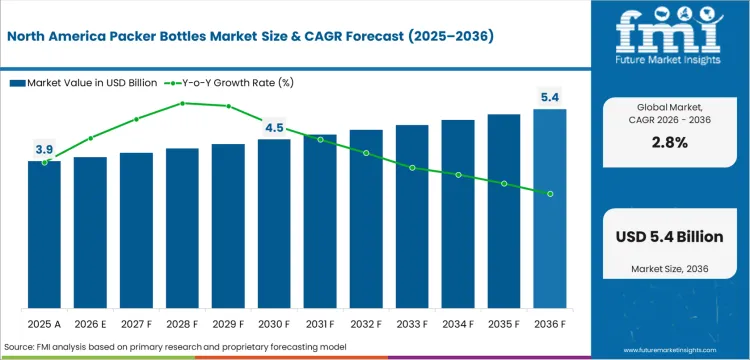
In 2025, the North America packer bottles market was valued at USD 3,948.9 million. Based on Future Market Insights' analysis, demand for packer bottles is estimated to grow to USD 4,061.3 million in 2026 and USD 5,361 million by 2036. FMI projects a CAGR of 2.8% during the forecast period.
The market is expected to generate an absolute dollar growth of USD 1,299.7 million between 2026 and 2036. This reflects steady, replacement-driven expansion rather than rapid structural acceleration, as packer bottles are already well penetrated across pharmaceutical and nutraceutical applications. Growth is supported by continued demand for solid oral dosage packaging, rising supplement consumption, and increasing adoption of PCR-based packaging to meet sustainability targets. However, regulatory compliance costs, resin price volatility, and competition from alternative container formats moderate overall growth momentum.
“Tackling plastic waste is one of my top priorities and I take this challenge personally,” said by PepsiCo Chairman and CEO Ramon Laguarta. “As one of the world’s leading food and beverage companies, we recognize the significant role PepsiCo can play in helping to change the way society makes, uses, and disposes of plastics. We are doing our part to address the issue head on by reducing, recycling and reinventing our packaging to make it more sustainable, and we won’t stop until we live in a world where plastics are renewed and reused.”
Summary of North America Packer Bottles Market
-
North America Packer Bottles Market Definition
- The North America packer bottles market includes rigid plastic containers primarily used for pharmaceuticals, nutraceuticals, supplements, and specialty chemical storage requiring durability and moisture protection.
- Demand Drivers in the Market
- Growing consumption of vitamins, minerals, and dietary supplements is driving steady demand for PET and HDPE packer bottles across the United States and Canada.
- Expansion of OTC drug production and private-label nutraceutical brands is supporting increased bottle capacity requirements across retail channels.
- Rising sustainability commitments are encouraging adoption of PCR-based packer bottles to meet retailer and regulatory expectations.
- Key Segments Analyzed in FMI Report
- By Material: PET and HDPE dominate due to clarity, impact resistance, chemical compatibility, and cost efficiency.
- By Capacity: 100 cc and 150 cc bottles represent leading formats as they align with common supplement and OTC tablet counts.
- By Geography: The United States accounts for the largest regional share supported by strong pharmaceutical and nutraceutical manufacturing infrastructure.
- Analyst Opinion at FMI
- Ismail Sutaria, Principal Consultant for Packaging Industry at Future Market Insights, opines, ‘CXOs will find in this report strategic insight into how sustainability mandates, supplement growth, and private-label expansion are shaping competitive positioning in the North American packer bottles market.’
- Strategic Implications / Executive Takeaways
- Invest in lightweighting and PCR integration to align with retailer sustainability requirements.
- Expand customization capabilities for private-label nutraceutical brands.
- Strengthen domestic manufacturing to mitigate cross-border supply chain risks.
- Methodology
- Market estimates were validated through interviews with bottle manufacturers and nutraceutical brand owners.
- Secondary research included production statistics and trade data analysis.
- Forecasts were developed using supplement consumption and OTC sales modeling.
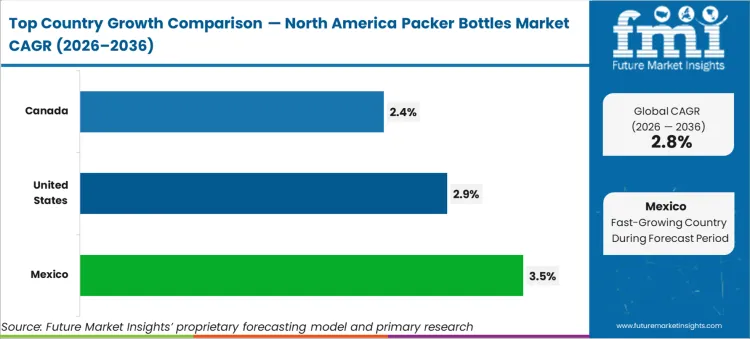
Mexico (3.5%) is projected to register the fastest growth, supported by expanding pharmaceutical manufacturing and export activity. The United States (2.9%) follows, driven by stable prescription and OTC drug demand along with nutraceutical consumption. Canada (2.4%) represents a mature and stable market where growth is largely replacement-driven, constrained by high packaging penetration and incremental capacity additions rather than large-scale volume expansion.
North America Packer Bottles Market Definition
The North America packer bottles market refers to the production and supply of wide-mouth rigid plastic bottles primarily used for packaging solid and semi-solid products. These bottles are typically made from PET, HDPE, LDPE, polypropylene, and post-consumer recycled materials. Packer bottles are designed to provide durability, chemical resistance, and secure closure compatibility for tablets, capsules, powders, and other bulk contents. Their primary function is to protect products from moisture, contamination, and physical damage during storage and distribution. Key end users include pharmaceutical manufacturers, nutraceutical brands, veterinary product companies, homeopathic producers, and selected industrial and agricultural chemical suppliers.
North America Packer Bottles Market Inclusions
The report provides North America market size estimates for 2025 and 2026, with forecasts through 2036 and CAGR analysis. It includes segmentation by bottle capacity, material type, shape, end use industry, and country. The study covers value-based sizing, material substitution trends, sustainability developments including PCR adoption, regulatory influence assessment, and demand patterns across pharmaceutical and nutraceutical applications.
North America Packer Bottles Market Exclusions
The scope excludes narrow-neck beverage bottles, glass containers, metal cans, and flexible packaging formats. It does not include caps and closures unless integrated as part of bottle systems. Finished pharmaceutical, nutraceutical, or chemical products are excluded, as the analysis focuses strictly on packer bottle manufacturing, material selection, and supply dynamics within North America.
North America Packer Bottles Market Research Methodology
- Primary Research: Interviews were conducted with bottle manufacturers, resin suppliers, pharmaceutical packagers, nutraceutical brands, and contract packaging organizations across the United States, Canada, and Mexico. Resin suppliers clarified PET and HDPE pricing cycles, while pharmaceutical packagers validated demand stability across prescription and OTC segments.
- Desk Research: Usa FDA packaging regulations, North American trade statistics, plastics association data, and company annual reports were reviewed to benchmark production volumes and regional demand.
- Market-Sizing and Forecasting: A hybrid top-down and bottom-up approach was applied. Demand was reconstructed from pharmaceutical and supplement production volumes and validated against bottle manufacturing capacities.
- Data Validation and Update Cycle: Data was cross-verified across trade datasets, regulatory disclosures, and stakeholder interviews, followed by structured expert review before publication.
Segment Analysis
North America Packer Bottles Market Analysis by Material
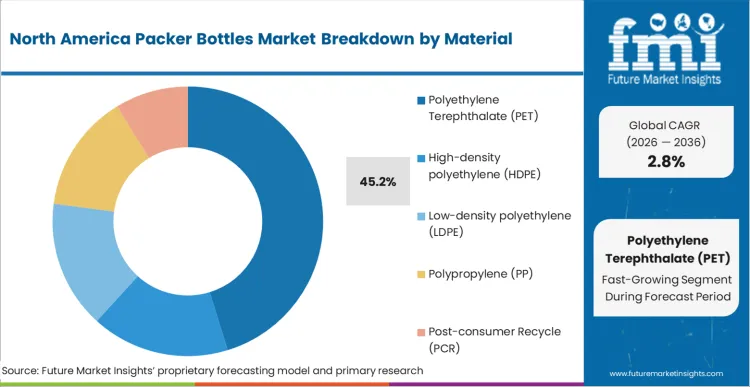
Based on FMI's North America Packer Bottles market report, consumption of Polyethylene Terephthalate (PET) is estimated to hold 45.2% share in 2026. PET dominates due to its clarity, lightweight profile, strong impact resistance, and compatibility with solid oral dose and nutraceutical packaging. It addresses manufacturer requirements for product visibility, moisture resistance, and high-speed blow molding efficiency. PET packer bottles are widely used for tablets, capsules, gummies, and supplements where shelf appeal and durability during distribution are essential.
- Clarity Advantage: PET provides glass-like transparency, supporting consumer trust and product differentiation in pharmaceutical and supplement packaging.
- Moisture Barrier Performance: PET offers reliable protection against moisture ingress, helping maintain stability of hygroscopic formulations.
- Recyclability Momentum: Growing sustainability commitments across North America are encouraging the integration of recycled PET content into packer bottle production.
North America Packer Bottles Market Analysis by End Use
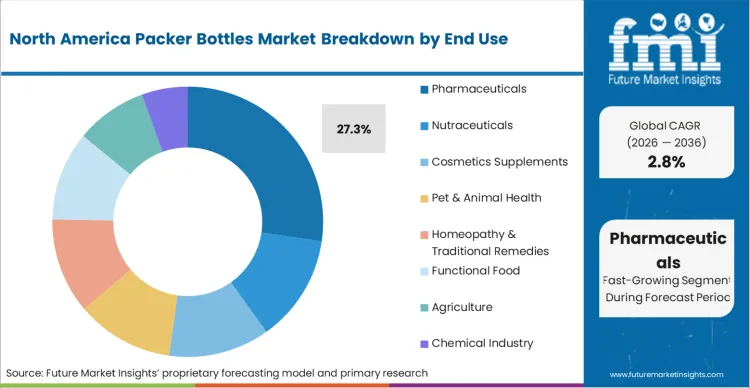
Based on FMI's North America Packer Bottles market report, consumption of Pharmaceuticals is estimated to hold 27.3% share in 2026. The pharmaceutical segment leads due to high demand for secure, compliant, and tamper-evident packaging for prescription and over-the-counter medications. Packer bottles address industry requirements related to child-resistant closures, moisture control, and serialization compatibility.
- Regulatory Compliance: Pharmaceutical packaging must meet FDA and USP standards, reinforcing demand for validated packer bottle materials.
- Chronic Disease Prevalence: Rising consumption of long-term medications supports sustained demand for durable and lightweight bottle formats.
- Supply Chain Security: Integration with track-and-trace systems strengthens the role of packer bottles in regulated pharmaceutical distribution networks.
North America Packer Bottles Market: Drivers, Restraints, and Opportunities
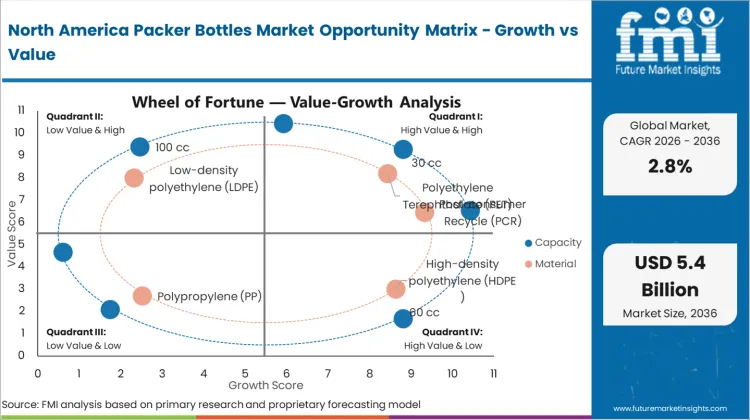
Future Market Insights analysis indicates that the North America packer bottles market is structurally anchored to pharmaceutical, nutraceutical, and personal care manufacturing across the United States and Canada. The market exists at its current scale because packer bottles—typically wide-mouth HDPE and PET containers—offer moisture resistance, durability, and compatibility with solid oral dose products such as tablets, capsules, gummies, and powders. Demand has historically followed growth in dietary supplements and over-the-counter healthcare products, reinforcing packer bottles as a standard primary packaging format within regulated supply chains.
FMI analysts observe a transition from conventional opaque HDPE bottles toward clarified PET and recycled-content formats. While HDPE continues to dominate in pharmaceutical applications due to chemical stability and cost efficiency, nutraceutical and wellness brands are increasingly adopting transparent PET bottles to enhance shelf visibility and premium positioning. These enhanced formats often involve higher material and certification costs, particularly when incorporating post-consumer recycled resin. However, stronger brand differentiation and sustainability alignment offset incremental cost pressures, supporting steady value growth even where unit volumes expand moderately.
- Supplement Industry Expansion:Rising consumption of vitamins, probiotics, and sports nutrition products across North America continues to drive demand for packer bottles with induction-sealed closures and desiccant integration.
- Regulatory Compliance Standards:Packaging used for pharmaceuticals and dietary supplements must comply with FDA 21 CFR requirements and cGMP guidelines, reinforcing demand for certified food- and drug-contact resins.
- Recycled Content Integration:Increasing adoption of PCR-based PET and HDPE in the United States and Canada reflects brand-level sustainability commitments, supporting higher-value bottle formats despite added material complexity.
Regional Analysis
.webp "Top Country Growth Comparison North America Packer Bottles Market Cagr (2026 2036)")
The North America packer bottles market is segmented across the United States, Canada, and Mexico. Regional growth varies based on pharmaceutical production, nutraceutical consumption, regulatory compliance, and domestic plastic packaging manufacturing capacity. The full report provides detailed country-level market attractiveness analysis.
| Country | CAGR (%) |
|---|---|
| United States | 2.9% |
| Canada | 2.4% |
| Mexico | 3.5% |
Source: Future Market Insights (FMI) analysis, based on proprietary forecasting model and primary research
United States – The Mature Pharmaceutical and Nutraceutical Hub
The United States serves as the mature pharmaceutical and nutraceutical hub of the North American packer bottles market. Demand is supported by over-the-counter medicines, dietary supplements, and prescription drug packaging. Key companies operating in the region include Amcor Plc, Silgan Holdings Inc., and Graham Packaging Company, all of which maintain strong blow molding and pharmaceutical packaging operations.
United States
Demand for packer bottles in the United States is projected to rise at 2.9% CAGR through 2036. Growth is closely linked to steady pharmaceutical and supplement consumption. In 2024, the USA Food and Drug Administration continued enforcement of Current Good Manufacturing Practice requirements for finished pharmaceuticals and dietary supplements, reinforcing packaging integrity and material compliance standards. Implementation of serialization and labeling compliance under federal pharmaceutical traceability frameworks continues to increase demand for reliable HDPE and PET packer bottles. Expansion in nutraceutical product launches and private-label supplement manufacturing further supports bottle demand. Sustainability commitments by major consumer health brands in 2024 have also encouraged adoption of lightweight and recyclable resin packaging formats. While the market remains mature, stable healthcare demand sustains incremental growth.
FMI's analysis of North America packer bottles market consists of country-wise assessment that includes the United States. Readers can find insights on pharmaceutical compliance trends, nutraceutical expansion, and sustainable resin adoption.
Canada - Regulatory Stability and Healthcare Packaging Market
Canada represents a stable and compliance-driven market for packer bottles, supported by public healthcare procurement and pharmaceutical manufacturing. Companies such as CCL Industries and Pretium Packaging maintain manufacturing and supply capabilities serving healthcare and supplement brands.
Canada
Demand for packer bottles in Canada is projected to rise at 2.4% CAGR through 2036. Growth is influenced by regulatory oversight from Health Canada, which continues to enforce packaging and labeling standards for pharmaceutical and natural health products. In 2024, updates to compliance guidance for natural health product labeling reinforced packaging accuracy and traceability requirements. Canada’s publicly funded healthcare system sustains consistent demand for prescription and over-the-counter medicines packaged in HDPE bottles. Growth in domestic nutraceutical brands and cross-border trade with the United States also supports stable bottle demand. While population growth remains moderate, healthcare consumption stability underpins steady packaging expansion.
FMI's analysis of North America packer bottles market consists of country-wise assessment that includes Canada. Readers can find insights on regulatory compliance impact, public healthcare procurement influence, and supplement packaging trends.
Mexico - Expanding Pharmaceutical Manufacturing Base
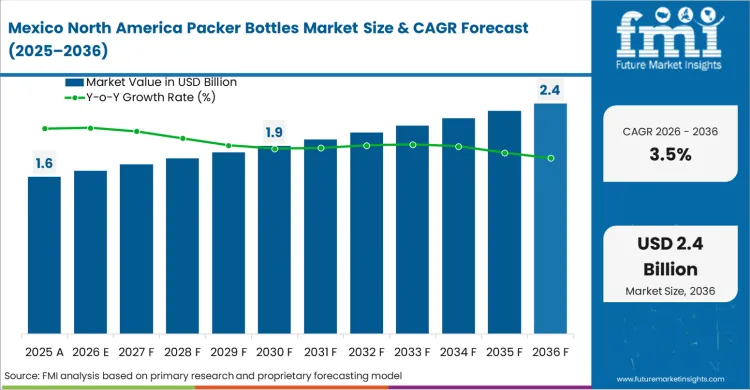
Mexico functions as an expanding pharmaceutical and consumer healthcare manufacturing base within North America. Competitive positioning is supported by cost-effective production and export-oriented manufacturing facilities.
Mexico
Demand for packer bottles in Mexico is projected to rise at 3.5% CAGR through 2036. Growth is driven by expanding domestic pharmaceutical production and export activity. In 2024, Mexico’s Federal Commission for the Protection against Sanitary Risk continued enforcement of pharmaceutical manufacturing compliance standards, reinforcing packaging quality and traceability requirements. Investment in pharmaceutical manufacturing facilities has increased demand for compliant HDPE and PET bottles used in solid-dose drug packaging. Mexico’s role in supplying medicines to both domestic and export markets strengthens packaging demand. Additionally, rising consumer health and vitamin product penetration supports growth in nutraceutical packaging. While regulatory compliance costs influence operations, expanding pharmaceutical capacity sustains above-average regional growth.
FMI's analysis of North America packer bottles market consists of country-wise assessment that includes Mexico. Readers can find insights on pharmaceutical export growth, regulatory oversight, and healthcare packaging expansion.
Competitive Aligners for Market Players
The North America packer bottles market is moderately concentrated, led by large rigid plastic packaging manufacturers with multi-plant networks across the United States and Canada. Companies such as Amcor Plc, ALPLA Group, Silgan Holdings Inc., Plastipak Holdings, Gerresheimer AG, Graham Packaging, Pretium Packaging, and Altium Packaging account for a significant share of production capacity, particularly in pharmaceutical, nutraceutical, and personal care applications. Mid-sized and specialized players including Comar LLC, Resilux NV, Greiner Packaging, Silver Spur Corporation, Aptar Group, and CCL Industries compete through customization, specialty resins, and value-added closure integration. The primary competitive variables in this market are regulatory compliance (FDA, cGMP), production scale, resin efficiency, and the ability to incorporate post-consumer recycled (PCR) content without compromising product integrity.
Structural advantages are strongest among companies with vertically integrated extrusion blow molding, injection molding, and resin procurement capabilities. Firms such as Amcor, ALPLA, Silgan, Plastipak, and Graham Packaging benefit from nationwide manufacturing footprints and long-term supply contracts with pharmaceutical and nutraceutical brands. Companies offering in-house tooling design, lightweighting expertise, and closure integration (e.g., Aptar) strengthen customer retention through system-based packaging solutions. Advanced cleanroom manufacturing and validated pharmaceutical-grade production lines create additional barriers to entry and reduce supplier substitution risk.
Buyer leverage in the North American packer bottles market is balanced. Large pharmaceutical and supplement companies negotiate multi-year contracts and often dual-source to mitigate supply disruptions and manage pricing tied to resin indices. However, once a bottle design, resin grade, and regulatory validation are approved, switching suppliers requires requalification, increasing switching costs. Sustainability mandates and retailer pressure are also shifting procurement toward suppliers capable of delivering high-PCR or recyclable mono-material bottles, reinforcing the competitive positioning of technologically advanced producers.
Recent Developments
- In April 2025, Amcor completed its all-stock combination with Berry Global, significantly expanding its global packaging portfolio and enhancing its capabilities in consumer, healthcare, and specialty packaging solutions. The merged entity aims to leverage combined scale, innovation, and material science expertise to drive long-term value creation.
- In November 2025, Plastipak Packaging Inc. announced a US$53.8 million expansion of its Rapides Parish, Louisiana manufacturing facility, adding warehouse space, up to five new production lines, and increasing production and recycling capabilities. The project is expected to be completed by late 2026.
Key Players
- Amcor Plc
- Comar LLC
- ALPLA Group
- Gerresheimer AG
- Resilux NV
- Silgan Holdings Inc.
- Plastipak Holdings, Inc.
- Aptar Group
- Graham Packaging Company
- CCL Industries
- Greiner Packaging
- Pretium Packaging
Scope of Report
| Metric | Value |
|---|---|
| Quantitative Units | USD 3,948.9 million (2025); USD 4,061.3 million (2026) to USD 5,361 million (2036), at a CAGR of 2.8% |
| Market Definition | The North America packer bottles market comprises the production and supply of wide-mouth rigid plastic bottles primarily used for solid-dose pharmaceuticals, nutraceuticals, supplements, and specialty consumer products, offering moisture protection, product stability, and compatibility with child-resistant and tamper-evident closures. |
| Form Segmentation | Capacity-Based Segmentation (30 cc to >250 cc); Shape Segmentation (Round; Square; Oval) |
| End Use Segmentation | Pharmaceuticals; Nutraceuticals; Cosmetics Supplements; Pet & Animal Health; Homeopathy & Traditional Remedies; Functional Food; Agriculture; Chemical Industry |
| Application Coverage | Prescription & OTC Drugs; Vitamins & Minerals; Herbal & Sports Nutrition Supplements; Probiotics; Hair, Skin & Nails Formulations; Pet Supplements; Meal Replacement Tablets; Industrial & Construction Chemicals |
| Regions Covered | North America |
| Countries Covered | United States; Canada; Mexico |
| Key Companies Profiled | Amcor Plc; ALPLA Group; Gerresheimer AG; Silgan Holdings Inc.; Plastipak Holdings, Inc.; Others |
| Forecast Period | 2026 to 2036 |
| Approach | Hybrid top-down and bottom-up market modeling validated through primary interviews with bottle manufacturers, pharmaceutical packagers, and nutraceutical brands, supported by resin consumption analysis, production capacity benchmarking, regulatory compliance assessment (FDA & Health Canada), and trade flow evaluation across North American packaging supply chains. |
North America Packer Bottles Market by Segments
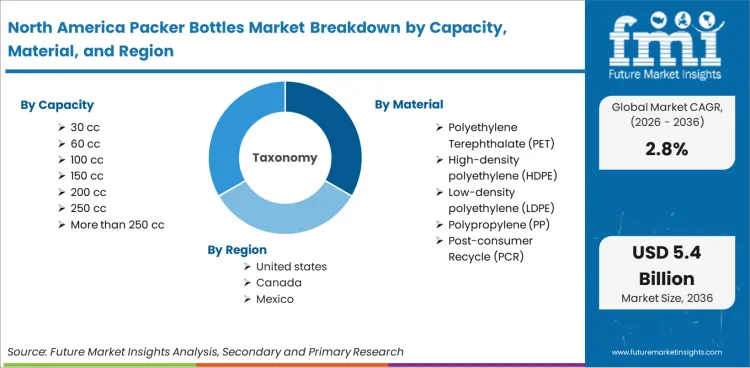
By Capacity
- 30 cc
- 60 cc
- 100 cc
- 150 cc
- 200 cc
- 250 cc
- More than 250 cc
By Material
- Polyethylene Terephthalate (PET)
- High-density polyethylene (HDPE)
- Low-density polyethylene (LDPE)
- Polypropylene (PP)
- Post-consumer Recycle (PCR)
By Shape
- Round Shape
- Square Shape
- Oval Shape
By End Use
- Pharmaceuticals
- Prescription Drugs
- Over-the-Counter (OTC) Drugs
- Veterinary Pharmaceuticals
- Nutraceuticals
- Vitamins & Minerals
- Herbal Supplements
- Sports Nutrition
- Weight Management Supplements
- Probiotics & Gut Health
- Cosmetics Supplements
- Hair, Skin & Nails
- Anti-aging Supplements
- Detox & Glow Supplements
- Pet & Animal Health
- Pet Supplements
- Joint & Bone Support for Animals
- Digestive & Coat Care
- Homeopathy & Traditional Remedies
- Homeopathic Tablets & Pellets
- Ayurvedic Formulations
- Functional Food
- Meal Replacement Tablets
- Chewable Functional Snacks
- Nutrient-Enhanced Mints or Lozenges
- Agriculture
- Plant Nutrients
- Seeds & Soil Additives
- Chemical Industry
- Industrial Chemicals
- Construction Chemicals
By Country
- United States
- Canada
- Mexico
Bibliography
- USA Food and Drug Administration (FDA), Container Closure Systems for Packaging Human Drugs and Biologics - Guidance for Industry, Updated February 2024.
- USA Food and Drug Administration (FDA), Indirect Food Additives: Polymers (21 CFR Part 177), January 2024.
- United States Pharmacopeial Convention (USP), USP–NF General Chapter <661.2> Plastic Packaging Systems for Pharmaceutical Use, Official Edition 2023.
- ASTM International, ASTM D4976-23 - Standard Specification for Polyethylene Plastics Molding and Extrusion Materials, April 2023.
- ASTM International, ASTM D4101-23 - Standard Specification for Polypropylene Injection and Extrusion Materials, April 2023.
- Plastics Industry Association (PLASTICS), 2024 Size & Impact Report - The Plastics Industry in North America, September 2024.
- USA Environmental Protection Agency (EPA), Advancing Sustainable Materials Management: Plastics Material-Specific Data, December 2023.
Frequently Asked Questions
How large is the North America Packer Bottles Market in 2026?
The North America Packer Bottles Market is valued at 4,061.3 Million in 2026
What was the market size of the North America Packer Bottles Market in 2025?
The market was valued at 3,948.9 Million in 2025.
What will the market size be for the North America Packer Bottles Market by 2036?
The market is projected to reach 5,361 Million by 2036.
What is the expected CAGR of the North America Packer Bottles Market during the forecast period?
The market is expected to grow at a CAGR of 2.8% between 2026 and 2036.
Which end-use segment drives the majority of demand for packer bottles?
Pharmaceuticals and nutraceuticals represent the primary demand drivers, including prescription drugs, OTC medicines, vitamins, minerals, and sports nutrition supplements.
Which materials are commonly used in North America packer bottles?
Key materials include PET, HDPE, LDPE, PP, and post-consumer recycled (PCR) plastics.
Which capacities are widely used in the market?
Common capacity formats range from 30 cc and 60 cc bottles up to more than 250 cc, supporting diverse pharmaceutical and supplement applications.
Which countries are covered under the North America Packer Bottles Market?
The regional analysis includes the United States, Canada, and Mexico.
Who are the major companies operating in the North America Packer Bottles Market?
Key companies include Amcor Plc, Comar LLC, ALPLA Group, Gerresheimer AG, Silgan Holdings Inc., Plastipak Holdings, Aptar Group, Graham Packaging Company, CCL Industries, and Altium Packaging.
Preview the report firsthand - request a free sample
Get SampleGet the brochure for pricing and purchase details.
Get PDFTable of Content
- Executive Summary
- Global Market Outlook
- Demand-side Trends
- Supply-side Trends
- Technology Roadmap Analysis
- Analysis and Recommendations
- Market Overview
- Market Coverage / Taxonomy
- Market Definition / Scope / Limitations
- Research Methodology
- Chapter Orientation
- Analytical Lens and Working Hypotheses
- Market Structure, Signals, and Trend Drivers
- Benchmarking and Cross-market Comparability
- Market Sizing, Forecasting, and Opportunity Mapping
- Research Design and Evidence Framework
- Desk Research Programme (Secondary Evidence)
- Company Annual and Sustainability Reports
- Peer-reviewed Journals and Academic Literature
- Corporate Websites, Product Literature, and Technical Notes
- Earnings Decks and Investor Briefings
- Statutory Filings and Regulatory Disclosures
- Technical White Papers and Standards Notes
- Trade Journals, Industry Magazines, and Analyst Briefs
- Conference Proceedings, Webinars, and Seminar Materials
- Government Statistics Portals and Public Data Releases
- Press Releases and Reputable Media Coverage
- Specialist Newsletters and Curated Briefings
- Sector Databases and Reference Repositories
- FMI Internal Proprietary Databases and Historical Market Datasets
- Subscription Datasets and Paid Sources
- Social Channels, Communities, and Digital Listening Inputs
- Additional Desk Sources
- Expert Input and Fieldwork (Primary Evidence)
- Primary Modes
- Qualitative Interviews and Expert Elicitation
- Quantitative Surveys and Structured Data Capture
- Blended Approach
- Why Primary Evidence is Used
- Field Techniques
- Interviews
- Surveys
- Focus Groups
- Observational and In-context Research
- Social and Community Interactions
- Stakeholder Universe Engaged
- C-suite Leaders
- Board Members
- Presidents and Vice Presidents
- R&D and Innovation Heads
- Technical Specialists
- Domain Subject-matter Experts
- Scientists
- Physicians and Other Healthcare Professionals
- Governance, Ethics, and Data Stewardship
- Research Ethics
- Data Integrity and Handling
- Primary Modes
- Tooling, Models, and Reference Databases
- Desk Research Programme (Secondary Evidence)
- Data Engineering and Model Build
- Data Acquisition and Ingestion
- Cleaning, Normalisation, and Verification
- Synthesis, Triangulation, and Analysis
- Quality Assurance and Audit Trail
- Market Background
- Market Dynamics
- Drivers
- Restraints
- Opportunity
- Trends
- Scenario Forecast
- Demand in Optimistic Scenario
- Demand in Likely Scenario
- Demand in Conservative Scenario
- Opportunity Map Analysis
- Product Life Cycle Analysis
- Supply Chain Analysis
- Investment Feasibility Matrix
- Value Chain Analysis
- PESTLE and Porter’s Analysis
- Regulatory Landscape
- Regional Parent Market Outlook
- Production and Consumption Statistics
- Import and Export Statistics
- Market Dynamics
- Global Market Analysis 2021 to 2025 and Forecast, 2026 to 2036
- Historical Market Size Value (USD Million) Analysis, 2021 to 2025
- Current and Future Market Size Value (USD Million) Projections, 2026 to 2036
- Y-o-Y Growth Trend Analysis
- Absolute $ Opportunity Analysis
- Global Market Pricing Analysis 2021 to 2025 and Forecast 2026 to 2036
- Global Market Analysis 2021 to 2025 and Forecast 2026 to 2036, By Capacity
- Introduction / Key Findings
- Historical Market Size Value (USD Million) Analysis By Capacity , 2021 to 2025
- Current and Future Market Size Value (USD Million) Analysis and Forecast By Capacity , 2026 to 2036
- 30 cc
- 60 cc
- 100 cc
- 150 cc
- 200 cc
- 250 cc
- More than 250 cc
- 30 cc
- Y-o-Y Growth Trend Analysis By Capacity , 2021 to 2025
- Absolute $ Opportunity Analysis By Capacity , 2026 to 2036
- Global Market Analysis 2021 to 2025 and Forecast 2026 to 2036, By Material
- Introduction / Key Findings
- Historical Market Size Value (USD Million) Analysis By Material, 2021 to 2025
- Current and Future Market Size Value (USD Million) Analysis and Forecast By Material, 2026 to 2036
- Polyethylene Terephthalate (PET)
- High-density polyethylene (HDPE)
- Low-density polyethylene (LDPE)
- Polypropylene (PP)
- Post-consumer Recycle (PCR)
- Polyethylene Terephthalate (PET)
- Y-o-Y Growth Trend Analysis By Material, 2021 to 2025
- Absolute $ Opportunity Analysis By Material, 2026 to 2036
- Global Market Analysis 2021 to 2025 and Forecast 2026 to 2036, By End Use
- Introduction / Key Findings
- Historical Market Size Value (USD Million) Analysis By End Use, 2021 to 2025
- Current and Future Market Size Value (USD Million) Analysis and Forecast By End Use, 2026 to 2036
- Pharmaceuticals
- Nutraceuticals
- Cosmetics Supplements
- Pet & Animal Health
- Homeopathy & Traditional Remedies
- Functional Food
- Agriculture
- Chemical Industry
- Pharmaceuticals
- Y-o-Y Growth Trend Analysis By End Use, 2021 to 2025
- Absolute $ Opportunity Analysis By End Use, 2026 to 2036
- Global Market Analysis 2021 to 2025 and Forecast 2026 to 2036, By Region
- Introduction
- Historical Market Size Value (USD Million) Analysis By Region, 2021 to 2025
- Current Market Size Value (USD Million) Analysis and Forecast By Region, 2026 to 2036
- North America
- Latin America
- Western Europe
- Eastern Europe
- East Asia
- South Asia and Pacific
- Middle East & Africa
- Market Attractiveness Analysis By Region
- North America Market Analysis 2021 to 2025 and Forecast 2026 to 2036, By Country
- Historical Market Size Value (USD Million) Trend Analysis By Market Taxonomy, 2021 to 2025
- Market Size Value (USD Million) Forecast By Market Taxonomy, 2026 to 2036
- By Country
- USA
- Canada
- Mexico
- By Capacity
- By Material
- By End Use
- By Country
- Market Attractiveness Analysis
- By Country
- By Capacity
- By Material
- By End Use
- Key Takeaways
- Latin America Market Analysis 2021 to 2025 and Forecast 2026 to 2036, By Country
- Historical Market Size Value (USD Million) Trend Analysis By Market Taxonomy, 2021 to 2025
- Market Size Value (USD Million) Forecast By Market Taxonomy, 2026 to 2036
- By Country
- Brazil
- Chile
- Rest of Latin America
- By Capacity
- By Material
- By End Use
- By Country
- Market Attractiveness Analysis
- By Country
- By Capacity
- By Material
- By End Use
- Key Takeaways
- Western Europe Market Analysis 2021 to 2025 and Forecast 2026 to 2036, By Country
- Historical Market Size Value (USD Million) Trend Analysis By Market Taxonomy, 2021 to 2025
- Market Size Value (USD Million) Forecast By Market Taxonomy, 2026 to 2036
- By Country
- Germany
- UK
- Italy
- Spain
- France
- Nordic
- BENELUX
- Rest of Western Europe
- By Capacity
- By Material
- By End Use
- By Country
- Market Attractiveness Analysis
- By Country
- By Capacity
- By Material
- By End Use
- Key Takeaways
- Eastern Europe Market Analysis 2021 to 2025 and Forecast 2026 to 2036, By Country
- Historical Market Size Value (USD Million) Trend Analysis By Market Taxonomy, 2021 to 2025
- Market Size Value (USD Million) Forecast By Market Taxonomy, 2026 to 2036
- By Country
- Russia
- Poland
- Hungary
- Balkan & Baltic
- Rest of Eastern Europe
- By Capacity
- By Material
- By End Use
- By Country
- Market Attractiveness Analysis
- By Country
- By Capacity
- By Material
- By End Use
- Key Takeaways
- East Asia Market Analysis 2021 to 2025 and Forecast 2026 to 2036, By Country
- Historical Market Size Value (USD Million) Trend Analysis By Market Taxonomy, 2021 to 2025
- Market Size Value (USD Million) Forecast By Market Taxonomy, 2026 to 2036
- By Country
- China
- Japan
- South Korea
- By Capacity
- By Material
- By End Use
- By Country
- Market Attractiveness Analysis
- By Country
- By Capacity
- By Material
- By End Use
- Key Takeaways
- South Asia and Pacific Market Analysis 2021 to 2025 and Forecast 2026 to 2036, By Country
- Historical Market Size Value (USD Million) Trend Analysis By Market Taxonomy, 2021 to 2025
- Market Size Value (USD Million) Forecast By Market Taxonomy, 2026 to 2036
- By Country
- India
- ASEAN
- Australia & New Zealand
- Rest of South Asia and Pacific
- By Capacity
- By Material
- By End Use
- By Country
- Market Attractiveness Analysis
- By Country
- By Capacity
- By Material
- By End Use
- Key Takeaways
- Middle East & Africa Market Analysis 2021 to 2025 and Forecast 2026 to 2036, By Country
- Historical Market Size Value (USD Million) Trend Analysis By Market Taxonomy, 2021 to 2025
- Market Size Value (USD Million) Forecast By Market Taxonomy, 2026 to 2036
- By Country
- Kingdom of Saudi Arabia
- Other GCC Countries
- Turkiye
- South Africa
- Other African Union
- Rest of Middle East & Africa
- By Capacity
- By Material
- By End Use
- By Country
- Market Attractiveness Analysis
- By Country
- By Capacity
- By Material
- By End Use
- Key Takeaways
- Key Countries Market Analysis
- USA
- Pricing Analysis
- Market Share Analysis, 2025
- By Capacity
- By Material
- By End Use
- Canada
- Pricing Analysis
- Market Share Analysis, 2025
- By Capacity
- By Material
- By End Use
- Mexico
- Pricing Analysis
- Market Share Analysis, 2025
- By Capacity
- By Material
- By End Use
- Brazil
- Pricing Analysis
- Market Share Analysis, 2025
- By Capacity
- By Material
- By End Use
- Chile
- Pricing Analysis
- Market Share Analysis, 2025
- By Capacity
- By Material
- By End Use
- Germany
- Pricing Analysis
- Market Share Analysis, 2025
- By Capacity
- By Material
- By End Use
- UK
- Pricing Analysis
- Market Share Analysis, 2025
- By Capacity
- By Material
- By End Use
- Italy
- Pricing Analysis
- Market Share Analysis, 2025
- By Capacity
- By Material
- By End Use
- Spain
- Pricing Analysis
- Market Share Analysis, 2025
- By Capacity
- By Material
- By End Use
- France
- Pricing Analysis
- Market Share Analysis, 2025
- By Capacity
- By Material
- By End Use
- India
- Pricing Analysis
- Market Share Analysis, 2025
- By Capacity
- By Material
- By End Use
- ASEAN
- Pricing Analysis
- Market Share Analysis, 2025
- By Capacity
- By Material
- By End Use
- Australia & New Zealand
- Pricing Analysis
- Market Share Analysis, 2025
- By Capacity
- By Material
- By End Use
- China
- Pricing Analysis
- Market Share Analysis, 2025
- By Capacity
- By Material
- By End Use
- Japan
- Pricing Analysis
- Market Share Analysis, 2025
- By Capacity
- By Material
- By End Use
- South Korea
- Pricing Analysis
- Market Share Analysis, 2025
- By Capacity
- By Material
- By End Use
- Russia
- Pricing Analysis
- Market Share Analysis, 2025
- By Capacity
- By Material
- By End Use
- Poland
- Pricing Analysis
- Market Share Analysis, 2025
- By Capacity
- By Material
- By End Use
- Hungary
- Pricing Analysis
- Market Share Analysis, 2025
- By Capacity
- By Material
- By End Use
- Kingdom of Saudi Arabia
- Pricing Analysis
- Market Share Analysis, 2025
- By Capacity
- By Material
- By End Use
- Turkiye
- Pricing Analysis
- Market Share Analysis, 2025
- By Capacity
- By Material
- By End Use
- South Africa
- Pricing Analysis
- Market Share Analysis, 2025
- By Capacity
- By Material
- By End Use
- USA
- Market Structure Analysis
- Competition Dashboard
- Competition Benchmarking
- Market Share Analysis of Top Players
- By Regional
- By Capacity
- By Material
- By End Use
- Competition Analysis
- Competition Deep Dive
- Amcor Plc
- Overview
- Product Portfolio
- Profitability by Market Segments (Product/Age /Sales Channel/Region)
- Sales Footprint
- Strategy Overview
- Marketing Strategy
- Product Strategy
- Channel Strategy
- Comar LLC
- ALPLA Group
- Gerresheimer AG
- Resilux NV
- Amcor Plc
- Competition Deep Dive
- Assumptions & Acronyms Used


