

- Industry Size (2026)
- USD 2.5 Bn
- Forecast (2036)
- USD 5.9 Bn
- CAGR (2026 to 2036)
- 9%
High-Voltage Cable Non-Fluorinated Sheathing Market Forecast and Outlook 2026 to 2036
The global high-voltage cable non-fluorinated sheathing market is valued at USD 2.5 billion in 2026 and is expected to reach USD 5.9 billion by 2036, growing at a CAGR of 9%. These figures signal a market shift toward renewability and regulatory compliance, as industries increasingly demand eco-friendly and cost-effective alternatives to traditional fluorinated materials. The steady growth trajectory reflects rising confidence among suppliers in meeting evolving environmental standards and the expanding adoption of renewable energy solutions, particularly in power transmission and EV infrastructure. The projected market expansion also indicates heightened buyer commitment to durable, high-performance materials that align with long-term renewability goals. This upward trend is driven by regulatory pressures and a growing preference for green technologies in the energy sector, signifying a robust demand for non-fluorinated solutions that can support future-proof energy and industrial infrastructures.
Quick Stats for High-Voltage Cable Non-Fluorinated Sheathing Market
- High-Voltage Cable Non-Fluorinated Sheathing Market Value (2026): USD 2.5 Billion
- High-Voltage Cable Non-Fluorinated Sheathing Market Forecast Value (2036): USD 5.9 Billion
- High-Voltage Cable Non-Fluorinated Sheathing Market Forecast CAGR 2026 to 2036: 9%
- Leading Material Type in High-Voltage Cable Non-Fluorinated Sheathing Market: XLPE (Non-Fluorinated)
- Key Growth Regions in High-Voltage Cable Non-Fluorinated Sheathing Market: Asia Pacific, North America
- Top Key Players in High-Voltage Cable Non-Fluorinated Sheathing Market: Nexans, Prysmian Group, Sumitomo Electric Industries, LS Cable & System, General Cable (PPC)
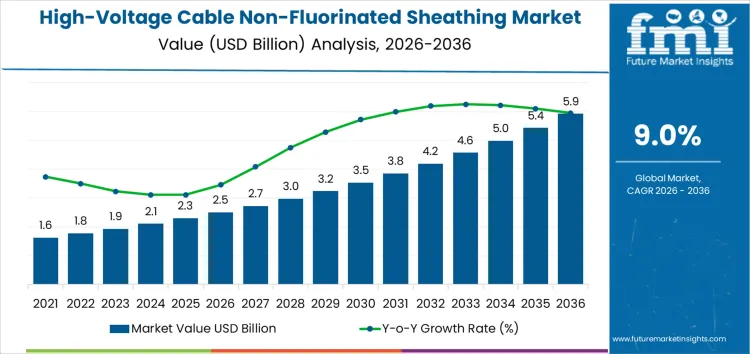
High-Voltage Cable Non-Fluorinated Sheathing Market Key Takeaways
| Metric | Value |
|---|---|
| Industry Value (2026) | USD 2.5 Billion |
| Forecast Value (2036) | USD 5.9 Billion |
| Forecast CAGR 2026 to 2036 | 9% |
How is the Global High-Voltage Cable Non-Fluorinated Sheathing Market Advancing?
The global high-voltage cable non-fluorinated sheathing market is experiencing strong growth, driven by increasing demand for more environmentally friendly and cost-effective materials in the cable industry. Non-fluorinated sheathing materials are being increasingly adopted in high-voltage cables as an alternative to traditional fluorinated materials, which have been associated with higher environmental impact and greater cost. These non-fluorinated alternatives offer similar performance in terms of insulation, durability, and resistance to heat and chemicals, making them an attractive option in various industrial and infrastructure applications.
A major driver of the market is the growing emphasis on renewability in the energy and electrical sectors. As governments and industries worldwide seek to reduce the environmental impact of cable production and installation, non-fluorinated sheathing materials are becoming more desirable. These materials are free from harmful fluorine-based chemicals, which are typically persistent in the environment and contribute to global warming. The adoption of non-fluorinated materials aligns with the broader push toward using greener, eco-friendlier solutions in energy infrastructure development.
Technological advancements in polymer chemistry and sheathing technology are also supporting market growth. The development of non-fluorinated materials with enhanced thermal stability, mechanical strength, and flame resistance is expanding the application range for high-voltage cables, particularly in the renewable energy sector, where high-performance cables are crucial for transmitting electricity from solar, wind, and other sources. As the demand for cleaner, more efficient energy solutions continues to rise, the high-voltage cable non-fluorinated sheathing market is expected to expand, offering an eco-friendly solution to the growing needs of modern electrical infrastructure.
What Is the Segment-Wise Analysis for the High-Voltage Cable Non-Fluorinated Sheathing Market?
The high-voltage cable non-fluorinated sheathing market is segmented by material type and application. XLPE (Non-Fluorinated) leads the material type segment with a 32% share, followed by elastomeric polymers, thermoplastic polyolefins, bio-based resin systems, and other materials. XLPE is widely used for high-voltage cable sheathing due to its excellent electrical insulation properties, durability, and heat resistance. In terms of application, power transmission holds the largest share at 37%, followed by renewable energy farms, industrial power distribution, EV charging infrastructure, and other applications.
Why Does XLPE (Non-Fluorinated) Lead the High-Voltage Cable Non-Fluorinated Sheathing Market?
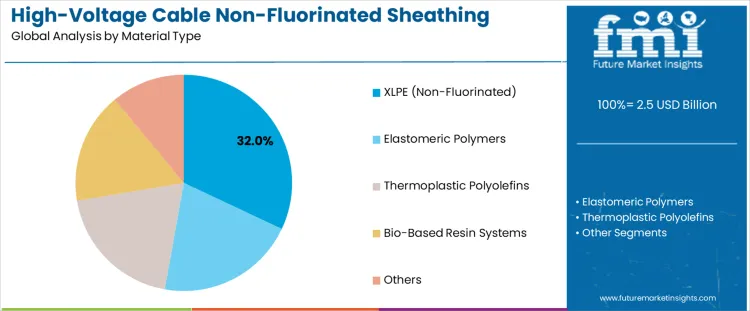
XLPE (Non-Fluorinated) leads the high-voltage cable non-fluorinated sheathing market with a 32% share due to its exceptional electrical insulation, thermal resistance, and mechanical strength. XLPE is widely used in high-voltage power cables for its ability to perform under both normal and extreme conditions. Its resistance to moisture, high temperatures, and UV radiation makes it highly durable for long-term use in power transmission systems. As the demand for reliable, high-performance, and eco-friendly solutions grows in the energy sector, XLPE continues to be the material of choice for non-fluorinated sheathing in high-voltage cables, maintaining its dominant position in the market.
How Does the Power Transmission Sector Contribute to the High-Voltage Cable Non-Fluorinated Sheathing Market?
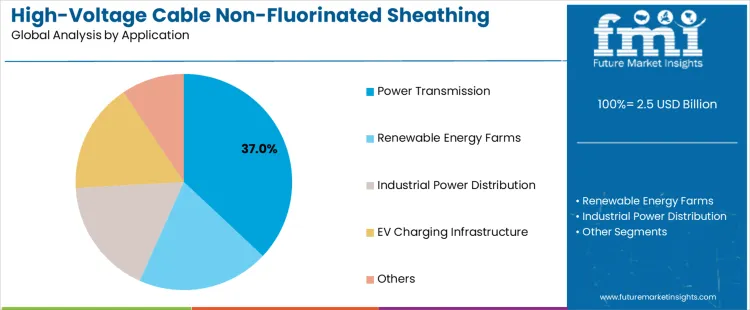
The power transmission sector accounts for 37% of the application segment in the high-voltage cable non-fluorinated sheathing market. This sector is critical for ensuring the efficient and reliable distribution of electricity over long distances, and the demand for high-quality, durable cable sheathing is essential for maintaining system reliability. Non-fluorinated sheathing materials like XLPE provide excellent insulation and resistance to electrical faults, making them ideal for high-voltage transmission cables. As global energy infrastructure continues to expand and modernize, particularly in regions investing in renewable energy and smart grids, the power transmission sector remains a significant driver of demand for non-fluorinated sheathing materials in the market.
What Are the Key Dynamics for the High-Voltage Cable Non-Fluorinated Sheathing Market?
The high-voltage cable non-fluorinated sheathing market is driven by the increasing demand for eco-friendly, high-performance materials in the power transmission and distribution sectors. Non-fluorinated sheathing materials offer an eco-friendlier alternative to traditional fluoropolymer-based sheaths, which are used to protect high-voltage cables. With growing concerns about environmental pollution and regulatory pressure to reduce the use of harmful fluorinated compounds, the market is seeing a shift towards non-fluorinated options. These materials provide excellent electrical insulation, high resistance to heat, and enhanced durability, making them ideal for high-voltage cable applications.
Why Is the High-Voltage Cable Non-Fluorinated Sheathing Market Growing?
The market for high-voltage cable non-fluorinated sheathing is growing due to the increasing emphasis on renewability and regulatory requirements to reduce the environmental impact of power infrastructure. Non-fluorinated materials, which offer comparable or superior properties to traditional fluoropolymer sheaths, are being adopted in response to stricter environmental regulations and growing consumer demand for eco-friendly alternatives. The expanding energy sector, driven by renewable energy projects, urbanization, and infrastructure development, is pushing the demand for high-voltage cables that use non-fluorinated sheathing materials, as they provide durability, efficiency, and lower environmental risks.
How Are the Key Drivers Shaping the High-Voltage Cable Non-Fluorinated Sheathing Market?
Key drivers shaping the high-voltage cable non-fluorinated sheathing market include rising environmental awareness, stricter regulations on the use of fluoropolymers, and the increasing adoption of renewable energy. As governments and organizations seek to reduce the environmental footprint of infrastructure projects, non-fluorinated materials offer a viable, eco-friendly alternative for high-voltage cable applications. The growing need for robust and efficient power transmission systems to support global energy demands is pushing the adoption of non-fluorinated sheathing materials, as they meet the performance criteria for high-temperature and high-voltage environments while being eco-friendlier.
What is the Growth Outlook for the High-Voltage Cable Non-Fluorinated Sheathing Market by Country?
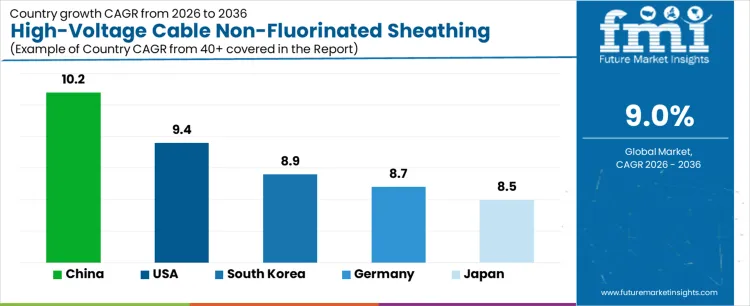
| Country | CAGR (%) |
|---|---|
| China | 10.2% |
| USA | 9.4% |
| South Korea | 8.9% |
| Germany | 8.7% |
| Japan | 8.5% |
The high-voltage cable non-fluorinated sheathing market is expanding across key regions. China leads at 10.2%, driven by rapid industrial growth, infrastructure development, and a focus on renewability. The United States follows at 9.4%, supported by increasing demand for eco-friendly materials in the energy and EV sectors. South Korea grows at 8.9%, fueled by investments in renewable energy and green technologies. Germany’s market expands at 8.7%, supported by its commitment to energy efficiency and renewable energy adoption. Japan grows at 8.5%, driven by its push for renewability in energy infrastructure and electric vehicle adoption.
What is Driving the Growth of the High-Voltage Cable Non-Fluorinated Sheathing Market in China?
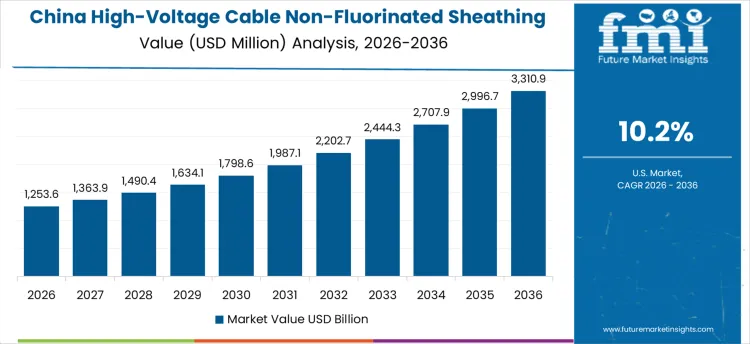
China’s high-voltage cable non-fluorinated sheathing market is growing at 10.2%, driven by the country’s rapid industrial expansion and infrastructure development. The increasing demand for high-voltage power transmission, coupled with a strong focus on energy efficiency and renewability, is contributing to the adoption of non-fluorinated materials for cable sheathing. These materials, which offer improved environmental performance compared to traditional fluorinated alternatives, are becoming increasingly popular in China as the government pushes for greener, eco-friendlier technologies in industrial and energy applications. The growth of renewable energy sources and a rising demand for electric vehicles (EVs), which require extensive high-voltage cable infrastructure, are further driving the market. As China continues its push for clean energy and renewability, non-fluorinated sheathing materials are expected to play a key role in meeting the growing demand for reliable and environmentally friendly high-voltage power solutions.
How is the High-Voltage Cable Non-Fluorinated Sheathing Market Expanding in the United States?
The high-voltage cable non-fluorinated sheathing market in the United States is growing at 9.4%, supported by the increasing demand for high-performance materials in the energy, telecommunications, and electric vehicle (EV) sectors. The USA’s focus on renewability and reducing environmental impact is driving the transition to non-fluorinated sheathing materials, which offer a safer, eco-friendlier alternative to traditional fluorinated options. With the growing adoption of renewable energy sources and the expansion of electric grid infrastructure, particularly for EV charging networks, there is a rising need for high-voltage cables that use non-toxic, non-fluorinated materials. Regulatory standards encouraging the use of safer, eco-friendlier materials further contribute to market growth. As the USA works toward energy modernization and carbon reduction goals, non-fluorinated sheathing will continue to be a preferred solution in high-voltage cable production.
How is the High-Voltage Cable Non-Fluorinated Sheathing Market Expanding in South Korea?
South Korea’s high-voltage cable non-fluorinated sheathing market is growing at 8.9%, driven by the country’s focus on green technologies and eco-friendly energy solutions. South Korea is making significant investments in renewable energy, electric vehicles (EVs), and smart grid infrastructure, all of which require high-voltage cables that incorporate non-fluorinated sheathing materials. The government’s emphasis on reducing carbon emissions and promoting eco-friendly technologies is accelerating the adoption of non-fluorinated materials in the energy and industrial sectors. As South Korea continues to expand its energy grid to accommodate renewable energy sources and EV infrastructure, the demand for high-performance, environmentally friendly materials in high-voltage cables will increase. This shift toward non-fluorinated sheathing materials reflects the country’s commitment to renewability and energy innovation.
What is Driving the Growth of the High-Voltage Cable Non-Fluorinated Sheathing Market in Germany?
Germany’s high-voltage cable non-fluorinated sheathing market is growing at 8.7%, driven by the country’s leadership in energy efficiency, renewability, and renewable energy adoption. As a key player in the European Union’s push for carbon neutrality and renewable energy integration, Germany is investing heavily in the infrastructure required for energy transition, including high-voltage cables for smart grids and renewable energy projects. Non-fluorinated sheathing materials are gaining popularity in Germany due to their lower environmental impact and ability to meet stringent European Union regulations on safety and renewability. The growth of electric vehicle adoption and the expansion of EV charging infrastructure are also contributing to market demand. With Germany’s strong commitment to innovation, clean energy, and eco-friendly practices, non-fluorinated sheathing materials will continue to play a significant role in the country’s energy landscape.
How is the High-Voltage Cable Non-Fluorinated Sheathing Market Expanding in Japan?
Japan’s high-voltage cable non-fluorinated sheathing market is growing at 8.5%, supported by the country’s push for an eco-friendlier energy infrastructure and a commitment to reducing carbon emissions. As Japan continues to invest in renewable energy sources, including solar and wind power, the demand for high-voltage cables with environmentally friendly non-fluorinated sheathing materials is rising. The growth of electric vehicle adoption and the need for upgraded power grids for EV charging infrastructure are further fueling the market. Japan’s stringent regulations regarding environmental impact and the push for advanced, non-toxic materials in manufacturing are contributing to the market’s expansion. As Japan works towards meeting its renewability goals, the adoption of non-fluorinated sheathing for high-voltage cables will continue to grow, driven by both regulatory and consumer demand for safer, greener alternatives in the energy sector.
How Are Companies Competing in the High-Voltage Cable Non-Fluorinated Sheathing Market?
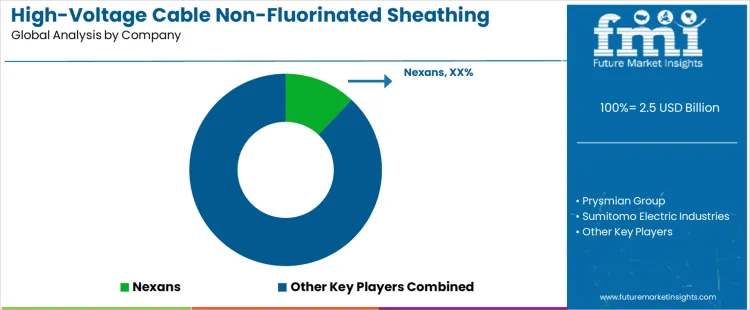
Competition in the high-voltage cable non-fluorinated sheathing market is driven by material performance (thermal stability and electrical insulation), environmental regulations, manufacturability, long-term reliability, and cost-effectiveness for power transmission and industrial applications. Nexans positions its non-fluorinated sheathing solutions with a focus on robust electrical performance and compliance with evolving eco-friendly standards, and its product materials highlight consistent dielectric strength and mechanical resilience that help utilities and EPCs meet grid modernization goals. Prysmian Group competes with a broad portfolio of non-halogen, high-performance sheath compounds designed for high-voltage cables; collateral emphasizes supply reliability, process compatibility, and lifecycle performance across diverse operating conditions.
Sumitomo Electric Industries differentiates through engineered polymer sheathing systems that deliver excellent heat aging and crack resistance, with documentation stressing tight quality control and suitability for long-distance transmission networks. LS Cable & System brings value-driven sheathing solutions that balance thermal stability with ease of extrusion, and its product materials underscore efficient production and reliable in-service behavior. General Cable (PPC) competes by offering versatile non-fluorinated sheathing compounds that support both high-voltage insulation and rugged mechanical protection, with brochures highlighting application flexibility and robust testing data.
Others in the market add value with specialty non-fluorinated formulations and regional supply support, aimed at specific cable grades or regulatory ecosystems. Across all vendors, product literature emphasizes electrical performance, thermal stability, regulatory compliance, manufacturability, and field durability as key differentiators that help power system developers and manufacturers choose the right sheathing for high-voltage cable infrastructures.
Key Players in High-Voltage Cable Non-Fluorinated Sheathing Market
- Nexans
- Prysmian Group
- Sumitomo Electric Industries
- LS Cable & System
- General Cable (PPC)
- Others
Scope of Report
| Attributes | Description |
|---|---|
| Quantitative Unit (2026) | USD Billion |
| Material Type | XLPE (Non-Fluorinated), Elastomeric Polymers, Thermoplastic Polyolefins, Bio-Based Resin Systems, Others |
| Application | Power Transmission, Renewable Energy Farms, Industrial Power Distribution, EV Charging Infrastructure, Others |
| Regions Covered | Asia Pacific, Europe, North America, Latin America, Middle East & Africa |
| Countries Covered | China, Japan, South Korea, India, Australia & New Zealand, ASEAN, Germany, United Kingdom, France, Italy, Spain, Nordic, BENELUX, United States, Canada, Mexico, Brazil, Chile, Turkey, South Africa, Other GCC Countries |
| Key Companies Profiled | Nexans, Prysmian Group, Sumitomo Electric Industries, LS Cable & System, General Cable (PPC), Others |
| Additional Attributes | Dollar sales by material type, application, and region; regional CAGR and growth outlook for high-voltage cable non-fluorinated sheathing market. |
High-Voltage Cable Non-Fluorinated Sheathing Market by Key Segments
Material Type
- XLPE (Non‑Fluorinated)
- Elastomeric Polymers
- Thermoplastic Polyolefins
- Bio‑Based Resin Systems
- Others
Application
- Power Transmission
- Renewable Energy Farms
- Industrial Power Distribution
- EV Charging Infrastructure
- Others
Region
- Asia Pacific
- China
- Japan
- South Korea
- India
- Australia & New Zealand
- ASEAN
- Rest of Asia Pacific
- Europe
- Germany
- United Kingdom
- France
- Italy
- Spain
- Nordic
- BENELUX
- Rest of Europe
- North America
- United States
- Canada
- Mexico
- Latin America
- Brazil
- Chile
- Rest of Latin America
- Middle East & Africa
- Kingdom of Saudi Arabia
- Other GCC Countries
- Turkey
- South Africa
- Other African Union
- Rest of Middle East & Africa
Bibliography
- International Energy Agency (IEA). (2024). Electricity grids and sustainable cable materials for energy transition. International Energy Agency.
- European Commission – Joint Research Centre (JRC). (2024). Non‑fluorinated polymer materials for power transmission and electrical insulation applications. Publications Office of the European Union.
- International Electrotechnical Commission (IEC). (2024). Environmental considerations for insulation and sheathing materials in high‑voltage power cables. IEC Technical Committee on Power Cables.
- Organization for Economic Co‑operation and Development (OECD). (2024). Restrictions on fluorinated polymers and implications for industrial cable materials. OECD Environment, Health and Safety Programme.
- International Renewable Energy Agency (IRENA). (2025). Power transmission infrastructure requirements for renewable energy integration. International Renewable Energy Agency.
Frequently Asked Questions
How big is the high-voltage cable non-fluorinated sheathing market in 2026?
The global high-voltage cable non-fluorinated sheathing market is estimated to be valued at USD 2.5 billion in 2026.
What will be the size of high-voltage cable non-fluorinated sheathing market in 2036?
The market size for the high-voltage cable non-fluorinated sheathing market is projected to reach USD 5.9 billion by 2036.
How much will be the high-voltage cable non-fluorinated sheathing market growth between 2026 and 2036?
The high-voltage cable non-fluorinated sheathing market is expected to grow at a 9.0% CAGR between 2026 and 2036.
What are the key product types in the high-voltage cable non-fluorinated sheathing market?
The key product types in high-voltage cable non-fluorinated sheathing market are xlpe (non‑fluorinated), elastomeric polymers, thermoplastic polyolefins, bio‑based resin systems and others.
Which application segment to contribute significant share in the high-voltage cable non-fluorinated sheathing market in 2026?
In terms of application, power transmission segment to command 37.0% share in the high-voltage cable non-fluorinated sheathing market in 2026.
Preview the report firsthand - request a free sample
Get SampleGet the brochure for pricing and purchase details.
Get PDFTable of Content
- Executive Summary
- Global Market Outlook
- Demand-side Trends
- Supply-side Trends
- Technology Roadmap Analysis
- Analysis and Recommendations
- Market Overview
- Market Coverage / Taxonomy
- Market Definition / Scope / Limitations
- Market Background
- Market Dynamics
- Drivers
- Restraints
- Opportunity
- Trends
- Scenario Forecast
- Demand in Optimistic Scenario
- Demand in Likely Scenario
- Demand in Conservative Scenario
- Opportunity Map Analysis
- Product Life Cycle Analysis
- Supply Chain Analysis
- Investment Feasibility Matrix
- Value Chain Analysis
- PESTLE and Porter’s Analysis
- Regulatory Landscape
- Regional Parent Market Outlook
- Production and Consumption Statistics
- Import and Export Statistics
- Market Dynamics
- Global Market Analysis 2021 to 2025 and Forecast, 2026 to 2036
- Historical Market Size Value (USD Million) Analysis, 2021 to 2025
- Current and Future Market Size Value (USD Million) Projections, 2026 to 2036
- Y-o-Y Growth Trend Analysis
- Absolute $ Opportunity Analysis
- Global Market Pricing Analysis 2021 to 2025 and Forecast 2026 to 2036
- Global Market Analysis 2021 to 2025 and Forecast 2026 to 2036, By Material Type
- Introduction / Key Findings
- Historical Market Size Value (USD Million) Analysis By Material Type , 2021 to 2025
- Current and Future Market Size Value (USD Million) Analysis and Forecast By Material Type , 2026 to 2036
- XLPE (Non‑Fluorinated)
- Elastomeric Polymers
- Thermoplastic Polyolefins
- Bio‑Based Resin Systems
- Others
- XLPE (Non‑Fluorinated)
- Y-o-Y Growth Trend Analysis By Material Type , 2021 to 2025
- Absolute $ Opportunity Analysis By Material Type , 2026 to 2036
- Global Market Analysis 2021 to 2025 and Forecast 2026 to 2036, By Application
- Introduction / Key Findings
- Historical Market Size Value (USD Million) Analysis By Application, 2021 to 2025
- Current and Future Market Size Value (USD Million) Analysis and Forecast By Application, 2026 to 2036
- Power Transmission
- Renewable Energy Farms
- Industrial Power Distribution
- EV Charging Infrastructure
- Others
- Power Transmission
- Y-o-Y Growth Trend Analysis By Application, 2021 to 2025
- Absolute $ Opportunity Analysis By Application, 2026 to 2036
- Global Market Analysis 2021 to 2025 and Forecast 2026 to 2036, By Region
- Introduction
- Historical Market Size Value (USD Million) Analysis By Region, 2021 to 2025
- Current Market Size Value (USD Million) Analysis and Forecast By Region, 2026 to 2036
- North America
- Latin America
- Western Europe
- Eastern Europe
- East Asia
- South Asia and Pacific
- Middle East & Africa
- Market Attractiveness Analysis By Region
- North America Market Analysis 2021 to 2025 and Forecast 2026 to 2036, By Country
- Historical Market Size Value (USD Million) Trend Analysis By Market Taxonomy, 2021 to 2025
- Market Size Value (USD Million) Forecast By Market Taxonomy, 2026 to 2036
- By Country
- USA
- Canada
- Mexico
- By Material Type
- By Application
- By Country
- Market Attractiveness Analysis
- By Country
- By Material Type
- By Application
- Key Takeaways
- Latin America Market Analysis 2021 to 2025 and Forecast 2026 to 2036, By Country
- Historical Market Size Value (USD Million) Trend Analysis By Market Taxonomy, 2021 to 2025
- Market Size Value (USD Million) Forecast By Market Taxonomy, 2026 to 2036
- By Country
- Brazil
- Chile
- Rest of Latin America
- By Material Type
- By Application
- By Country
- Market Attractiveness Analysis
- By Country
- By Material Type
- By Application
- Key Takeaways
- Western Europe Market Analysis 2021 to 2025 and Forecast 2026 to 2036, By Country
- Historical Market Size Value (USD Million) Trend Analysis By Market Taxonomy, 2021 to 2025
- Market Size Value (USD Million) Forecast By Market Taxonomy, 2026 to 2036
- By Country
- Germany
- UK
- Italy
- Spain
- France
- Nordic
- BENELUX
- Rest of Western Europe
- By Material Type
- By Application
- By Country
- Market Attractiveness Analysis
- By Country
- By Material Type
- By Application
- Key Takeaways
- Eastern Europe Market Analysis 2021 to 2025 and Forecast 2026 to 2036, By Country
- Historical Market Size Value (USD Million) Trend Analysis By Market Taxonomy, 2021 to 2025
- Market Size Value (USD Million) Forecast By Market Taxonomy, 2026 to 2036
- By Country
- Russia
- Poland
- Hungary
- Balkan & Baltic
- Rest of Eastern Europe
- By Material Type
- By Application
- By Country
- Market Attractiveness Analysis
- By Country
- By Material Type
- By Application
- Key Takeaways
- East Asia Market Analysis 2021 to 2025 and Forecast 2026 to 2036, By Country
- Historical Market Size Value (USD Million) Trend Analysis By Market Taxonomy, 2021 to 2025
- Market Size Value (USD Million) Forecast By Market Taxonomy, 2026 to 2036
- By Country
- China
- Japan
- South Korea
- By Material Type
- By Application
- By Country
- Market Attractiveness Analysis
- By Country
- By Material Type
- By Application
- Key Takeaways
- South Asia and Pacific Market Analysis 2021 to 2025 and Forecast 2026 to 2036, By Country
- Historical Market Size Value (USD Million) Trend Analysis By Market Taxonomy, 2021 to 2025
- Market Size Value (USD Million) Forecast By Market Taxonomy, 2026 to 2036
- By Country
- India
- ASEAN
- Australia & New Zealand
- Rest of South Asia and Pacific
- By Material Type
- By Application
- By Country
- Market Attractiveness Analysis
- By Country
- By Material Type
- By Application
- Key Takeaways
- Middle East & Africa Market Analysis 2021 to 2025 and Forecast 2026 to 2036, By Country
- Historical Market Size Value (USD Million) Trend Analysis By Market Taxonomy, 2021 to 2025
- Market Size Value (USD Million) Forecast By Market Taxonomy, 2026 to 2036
- By Country
- Kingdom of Saudi Arabia
- Other GCC Countries
- Turkiye
- South Africa
- Other African Union
- Rest of Middle East & Africa
- By Material Type
- By Application
- By Country
- Market Attractiveness Analysis
- By Country
- By Material Type
- By Application
- Key Takeaways
- Key Countries Market Analysis
- USA
- Pricing Analysis
- Market Share Analysis, 2025
- By Material Type
- By Application
- Canada
- Pricing Analysis
- Market Share Analysis, 2025
- By Material Type
- By Application
- Mexico
- Pricing Analysis
- Market Share Analysis, 2025
- By Material Type
- By Application
- Brazil
- Pricing Analysis
- Market Share Analysis, 2025
- By Material Type
- By Application
- Chile
- Pricing Analysis
- Market Share Analysis, 2025
- By Material Type
- By Application
- Germany
- Pricing Analysis
- Market Share Analysis, 2025
- By Material Type
- By Application
- UK
- Pricing Analysis
- Market Share Analysis, 2025
- By Material Type
- By Application
- Italy
- Pricing Analysis
- Market Share Analysis, 2025
- By Material Type
- By Application
- Spain
- Pricing Analysis
- Market Share Analysis, 2025
- By Material Type
- By Application
- France
- Pricing Analysis
- Market Share Analysis, 2025
- By Material Type
- By Application
- India
- Pricing Analysis
- Market Share Analysis, 2025
- By Material Type
- By Application
- ASEAN
- Pricing Analysis
- Market Share Analysis, 2025
- By Material Type
- By Application
- Australia & New Zealand
- Pricing Analysis
- Market Share Analysis, 2025
- By Material Type
- By Application
- China
- Pricing Analysis
- Market Share Analysis, 2025
- By Material Type
- By Application
- Japan
- Pricing Analysis
- Market Share Analysis, 2025
- By Material Type
- By Application
- South Korea
- Pricing Analysis
- Market Share Analysis, 2025
- By Material Type
- By Application
- Russia
- Pricing Analysis
- Market Share Analysis, 2025
- By Material Type
- By Application
- Poland
- Pricing Analysis
- Market Share Analysis, 2025
- By Material Type
- By Application
- Hungary
- Pricing Analysis
- Market Share Analysis, 2025
- By Material Type
- By Application
- Kingdom of Saudi Arabia
- Pricing Analysis
- Market Share Analysis, 2025
- By Material Type
- By Application
- Turkiye
- Pricing Analysis
- Market Share Analysis, 2025
- By Material Type
- By Application
- South Africa
- Pricing Analysis
- Market Share Analysis, 2025
- By Material Type
- By Application
- USA
- Market Structure Analysis
- Competition Dashboard
- Competition Benchmarking
- Market Share Analysis of Top Players
- By Regional
- By Material Type
- By Application
- Competition Analysis
- Competition Deep Dive
- Nexans
- Overview
- Product Portfolio
- Profitability by Market Segments (Product/Age /Sales Channel/Region)
- Sales Footprint
- Strategy Overview
- Marketing Strategy
- Product Strategy
- Channel Strategy
- Prysmian Group
- Sumitomo Electric Industries
- LS Cable & System
- General Cable (PPC)
- Others
- Nexans
- Competition Deep Dive
- Assumptions & Acronyms Used
- Research Methodology


