

- Industry Size (2026)
- USD 14.2 Bn
- Forecast (2036)
- USD 50.0 Bn
- CAGR (2026 to 2036)
- 13.4%
APAC Biocomposites Market Forecast and Outlook 2026 to 2036
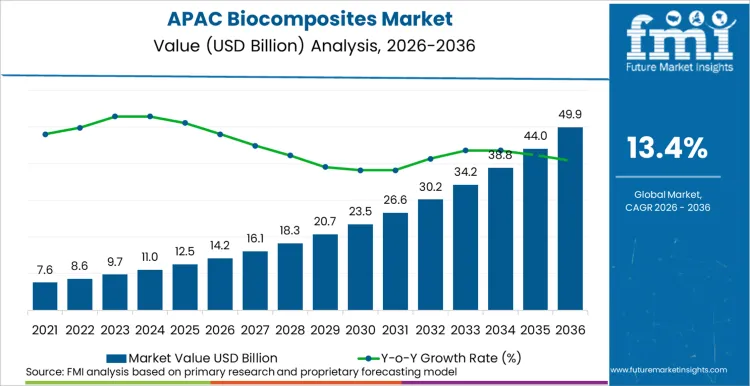
The APAC biocomposites sector is on track to achieve a valuation of USD 50.0 billion by 2036, accelerating from USD 14.2 billion in 2026 at a CAGR of 13.4%. As per Future Market Insights, expansion is structurally underpinned by the region's manufacturing scale advantage in both petrochemical-derived and bio-based polymer production, combined with aggressive government mandates for sustainable materials in automotive, construction, and packaging. The Japan Ministry of Economy, Trade and Industry (METI) confirmed support for the decarbonisation of ethylene production in western Japan through a multi-company collaboration involving Mitsubishi Chemical, Asahi Kasei, and Mitsui Chemicals in January 2026, validating the government commitment to bio-based feedstock transition.
This METI support compels chemical manufacturers to invest in plant-derived engineering plastics and carbon fibre composite capacity expansion. Simultaneously India's Green Mobility investment programme, backed by Japan's strategic pledge of JPY 10 trillion (USD 68 billion) in Indian investments over the next decade, is creating a new production corridor for biocomposite materials in the South Asian subcontinent.
In December 2025, Mitsubishi Chemical decided to approximately double its high-performance carbon fibre and composite production capacity at its Tokai Plant in Aichi, Japan, targeting the 2026 aerospace and automotive sectors. FMI opines that Japan's carbon fibre capacity expansion will position the country to supply 35 to 40% of Asia Pacific's aerospace-grade composite demand by 2030, while India emerges as the regional hub for cost-effective natural fibre biocomposite production for automotive interiors and construction panels.
The competitive landscape in 2025 and 2026 is defined by capacity expansion, bio-based polymer adoption, and cross-border investment. Mitsubishi Chemical, Asahi Kasei, and Mitsui Chemicals entered a basic agreement in January 2026 to promote decarbonisation of ethylene production in western Japan under METI support. Dongfeng Nissan adopted Mitsubishi's DURABIO plant-derived bioengineering plastic for the crystal-shade AI speaker in the Teana model in January 2026. Biocomposites Ltd secured CDSCO expanded approval in India in November 2025 for STIMULAN Rapid Cure to be mixed with antifungals.
Toray Industries announced carbon and glass fibre composite capacity expansion in Japan in March 2025 for aerospace and EV applications. Owens Corning finalised acquisition of a glass fibre manufacturing facility in India in January 2025. Nanjing Jufeng and A B Composites scaled non-wood fibre processing lines for hemp, flax, and rice husk composites throughout 2025. As per FMI, this convergence of Japanese carbon fibre doubling, METI-backed bio-feedstock transition, and India's Green Mobility manufacturing corridor confirms that the APAC biocomposites market is entering a decade of capacity-led growth where Japan provides the technology leadership and India provides the production scale.
Summary of APAC Biocomposites Market
What Is Growth Outlook for APAC Biocomposites Market as per Future Market Insights Projection?
Future Market Insights projects the APAC biocomposites industry to expand at a CAGR of 13.4% from 2026 to 2036, increasing from USD 14.2 Billion in 2026 to USD 50.0 Billion by 2036.
FMI Research Approach: FMI proprietary forecasting model based on METI biocomposite programme funding, APAC automotive lightweighting mandates, and regional composite production capacity tracking.
How Do FMI Analysts Perceive APAC Biocomposites Market to Evolve?
FMI analysts perceive the market evolving toward a dual-tier structure where Japan leads aerospace-grade carbon fibre composite innovation while India and Southeast Asia scale cost-effective natural fibre biocomposite production for automotive and construction applications.
FMI Research Approach: Mitsubishi Chemical Tokai Plant expansion analysis and India Green Mobility investment tracking.
Which Country Holds Largest Share in APAC Biocomposites Market?
China holds a significant share of the APAC biocomposites market by value which is supported by its Green Manufacturing initiatives integrating biocomposites into the automotive sector to meet 2026 weight-reduction standards and its scale of polymer production infrastructure.
FMI Research Approach: FMI country-level revenue modeling by automotive lightweighting mandates and composite production capacity data.
How Large Will APAC Biocomposites Market Be by 2036?
The APAC biocomposites market is projected to reach USD 50.0 Billion by 2036.
FMI Research Approach: FMI long-term revenue forecast derived from METI and DPIIT biocomposite programme funding projections.
What Is Definition of APAC Biocomposites Market?
The APAC biocomposites market includes composite materials combining bio-based polymer matrices or natural fibre reinforcements with synthetic or bio-based resins, covering wood-plastic composites, natural fibre composites, bio-based carbon fibre, and plant-derived engineering plastics used across automotive, aerospace, construction, and packaging applications in the Asia Pacific region.
FMI Research Approach: FMI market taxonomy aligned with METI composite material classification and APAC automotive OEM material specification standards.
What Are Globally Unique Trends Shaping APAC Biocomposites Market?
Globally unique trends include Mitsubishi Chemical doubling carbon fibre capacity at Tokai Plant, the METI-backed tri-company ethylene decarbonisation agreement, and the adoption of DURABIO plant-derived bioengineering plastic in Dongfeng Nissan vehicles.
FMI Research Approach: Mitsubishi Chemical and METI programme announcements and Dongfeng Nissan DURABIO adoption tracking.
APAC Biocomposites Market Key Takeaways
| Metric | Details |
|---|---|
| Industry Size (2026) | USD 14.2 Billion |
| Industry Value (2036) | USD 50.0 Billion |
| CAGR (2026 to 2036) | 13.4% |
Source: Future Market Insights (FMI) analysis, based on proprietary forecasting model and primary research
Category-wise Insights
The section explains the market value of the leading segments in the industry. In terms of product type, the green bio composites category will likely dominate and generate a share of around 67.4% in 2025.
Based on polymer type, the synthetic polymer segment is projected to hold a share of 72.1% in 2025. The analysis would enable potential clients to make effective business decisions for investment purposes.
Green Bio Composites Meet Eco-Friendly Demand across Multiple Industries
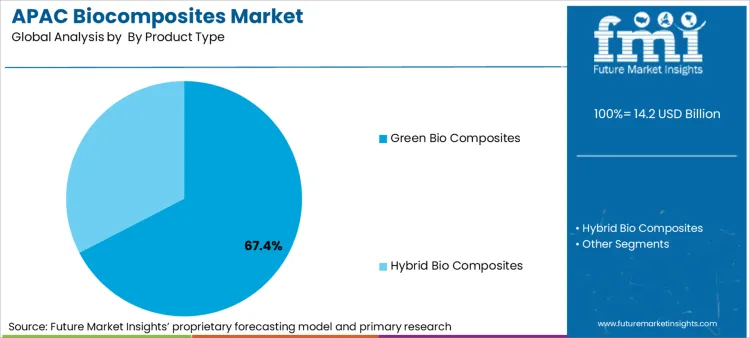
| Segment | Value Share (2025) |
|---|---|
| Green Bio Composites (Product Type) | 67.4% |
Green bio composites, made entirely from renewable and natural materials, dominate the biocomposite market due to the rising demand for sustainable and eco-friendly products. Green bio composites are increasingly being adopted by industries such as construction, automotive, and packaging in an effort to reduce their carbon footprint and dependence on non-renewable resources.
This is due to the fact that consumption is shifting towards environmental-friendly alternatives thus, it has a high market share based on increasing consumption that tends to reduce environmental impact. Green biocomposites are useful for manufacturers that aim for sustainability because of the fact that they are biodegradable and recyclable with less toxicity.
Green bio composites are highly versatile, used in sectors like automotive (for interior parts), construction (for eco-friendly building materials), and consumer goods (for sustainable packaging). Their ability to replace traditional materials while offering comparable or superior performance in many cases has driven their increased adoption. This wide range of applications supports their dominant market position, reinforcing their growing presence in the biocomposite industry.
Synthetic Polymers Lead Biocomposite Market Share Due to Cost-Effectiveness and Availability
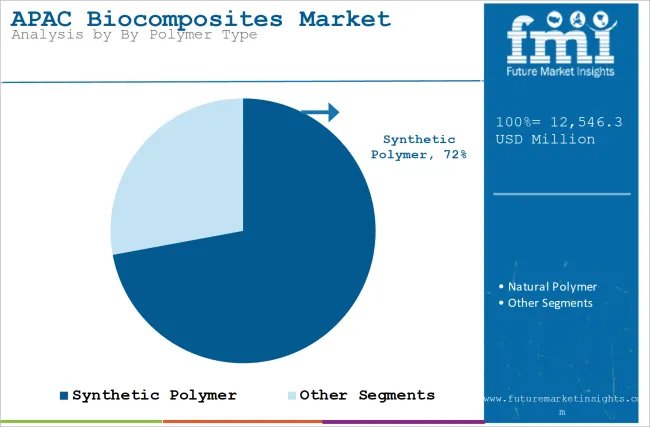
| Segment | Value Share (2025) |
|---|---|
| Synthetic Polymer (Polymer Type) | 72.1% |
Synthetic polymers, such as polypropylene and polyethylene, hold the largest share in the biocomposites market due to lower cost and availability. Because these polymers are easier and plentiful to source, they thereby tend to become more economical for use by manufacturers against their natural counterparts.
Their low production cost and very good processing properties make them among the favored choices for biocomposites in automotive, construction, and packaging applications. Their ability to be molded into complex shapes by synthetic polymers further adds to their versatility and wide use.
Synthetic polymers possess superior mechanical properties like strength, durability, and stability under environmental factors such as moisture, heat, and UV light exposure. They thus find applications that need long-term, high-performance material requirements.
Because of these characteristics, biocomposites based on synthetic polymers have wide usage in industries requiring strong materials-from automotive industries to construct lightweight parts to construction industries, finding applications where weather resistance is needed, up to consumer goods. The supremacy of performance drives them to dominate the market.
Semi-annual Market Update
The table below presents a comparative assessment of the variation in CAGR over six months for the base year (2024) and current year (2025) for the Asia Pacific biocomposites market. This analysis reveals crucial shifts in market performance and indicates revenue realization patterns, thus providing stakeholders with a better vision of the market growth trajectory over the year. The first half of the year, or H1, spans from January to June. The second half, H2, includes the months from July to December.
In the first half (H1) from 2024 to 2034, the business is predicted to surge at a CAGR of 13.3% followed by a slightly higher growth rate of 13.4% in the second half (H2).
| Particular | Value CAGR |
|---|---|
| H1 2024 | 13.3% (2024 to 2034) |
| H2 2024 | 13.4% (2024 to 2034) |
| H1 2025 | 13.5% (2025 to 2035) |
| H2 2025 | 13.6% (2025 to 2035) |
Moving into the subsequent period, from H1 2025 to H2 2035, the CAGR is projected to increase slightly to 13.5% in the first half and remain relatively moderate 13.6% in the second half. In the first half (H1) the market witnessed an increase of 20 BPS while in the second half (H2), the market witnessed slightly increase of 20 BPS.
Key Industry Highlights
Growing Demand for Eco-Friendly Materials in Construction, and Consumer Goods Sectors
The increasing demand from the construction and automotive industries for eco-friendly materials is one of the key factors driving the biocomposite market. With growing environmental concerns, companies are looking to come up with sustainable alternatives for traditional building materials and automotive parts.
Biocomposites, which are manufactured using natural fibers such as hemp, flax, and bamboo, have lower carbon footprints than conventional materials such as plastics and metals. Application areas for biocomposites include uses in construction: insulation, panels, and flooring.
Applications involving replacing heavy components can be found in both the interior and exterior of automobiles. This demand has consequently been driven by strict government regulations that favor renewable resources and usage of materials with minimal environmental impact.
Biocomposites have their increasing uses in consumer goods and packaging due to consumer preferences for environmentally responsible products. In such cases, biocomposites come as a sustainable option for packaging, electronics, furniture, and many other things. Since consumers are going green, brands from such sectors include biocomposites in their productions to cater to the market demands and pressures created by regulations and therefore boost the market's growth.
Light weighting in Automotive: Reducing Vehicle Weight to Improve Efficiency and Lower Carbon Emissions Using Biocomposites
Among the growing industries in the APAC region, automotive has taken a serious outlook on light weighting for greater fuel efficiency and reduced carbon emissions. Biocomposites, comprising natural fibers such as hemp, flax, and bamboo, assure sustainability for traditional material replacement.
Their lightweight properties enable vehicle manufacturers to reduce overall weight without compromising strength or durability. This weight reduction leads to fuel efficiency and lower greenhouse gas emissions, thus combining to meet the growing demand by consumers for eco-friendly vehicles. Biocomposites are just about to become vital components as automakers increase production with sustainability in mind.
The cost benefits accruable from biocomposites are another key factor in driving the interest of the automotive sector in them. As more raw materials-natural fibers-continue to be available and as the production process becomes better, the price of biocomposites continues to go down. Indeed, manufacturers in APAC are increasingly looking at using biocomposites for lightweight automotive parts, where the long-term fuel savings derived from reduced vehicle weight helps balance out lower material costs.
Biocomposites Gaining Popularity in Building Materials Due to Rapid Urbanization and Growing Infrastructure Projects
The APAC is experiencing rapid urbanization, wherein cities are growing at rates never seen before. This has raised the demand for sustainable and eco-friendly building materials as populations continue to grow in urban areas. Ecological composites manufactured from renewable natural fibers and polymers are increasingly being adopted for construction due to their green characteristics.
They are being used in residential and commercial buildings for flooring, wall panels, insulation, and roofing applications. Biocomposites replace conventional materials and help reduce the carbon footprint within construction. Due to fast expansion in urbanization across APAC, the adoption of biocomposites in the building sector drives market growth.
Other factors contributing toward the demand for biocomposites in APAC include an increasing number of infrastructure projects such as roads, bridges, and public buildings. Biocomposites offer a lightweight, durable, and greener alternative for such projects, thus helping to continue the growth of the market. The construction industry is moving toward sustainable materials, thereby supporting the emergence of biocomposites in the region.
High Production Costs: Elevated Manufacturing and Raw Material Expenses Hindering the Widespread Adoption of Biocomposites in Industries
High production cost will act as the growth restrainer factor towards the broad consideration of these biocomposites within the APAC area. Most raw materials for biocomposites comprise natural fibers and bio-based polymers that are high-cost materials since production is lower or special processing techniques may need to be granted.
One of the drawbacks for biocomposites to enter mainstream industries such as construction, automotive, and consumer goods, where the cost of production is a big factor in large-scale manufacturing for countries like India and China.
The high cost of production concerning biocomposites, particularly in India, acts as a barrier in the face of increasing awareness and demand for sustainable solutions. Due to the non-availability of infrastructure in sourcing and processing natural fibers at scale, added with expensive production technologies, biocomposites are not that cost-effective in front of traditional materials. This has been an issue for manufacturers in India to adopt it widely, thereby reducing the growth potentiality of the market.
Limited Availability of Raw Materials: Inconsistent Supply of Natural Fibers and Plant-Based Resources Affecting Biocomposite Production Scalability
There are difficulties in sourcing the APAC region for consistent supplies of natural fibers or vegetal resources that feed into biocomposites. As a matter of fact, resources like hemp, flax, and bamboo are usually not produced consistently because regional variability in climate, farming systems, and harvest cycles makes it difficult. This discourages scaling up, jacks up costs, and therefore delays use of the same in key end-user sectors such as construction, automobiles, and packaging.
In China, the shortage of natural fibers is very inconsistent, hence badly affecting the development of the biocomposite market. While agriculture is the leading sector of the country and the supply of some kinds of plant-based material cannot catch up with demand. Moreover, appropriate infrastructure is not developed in the country to process these fibres. The given context perhaps does not support a mainstream application of fully utilizing the ability of biocomposites at industrial or consumer levels.
2021 to 2025 APAC Biocomposites Sales Outlook Compared to Future Projections from 2026 to 2036
The Asia Pacific biocomposites industry recorded a CAGR of 11.1% during the historical period between 2021 and 2025. The growth of biocomposites industry was positive as it reached a value of USD 11,063.7 million in 2025 from USD 6,799.5 million in 2021.
The Asia Pacific biocomposite market has recorded remarkable growth in the recent past. Rising demand for eco-friendly material from construction, automotive, and consumer goods industries is a key driving factor. Due to increasing environmental concerns, manufacturers and consumers alike turn to sustainable alternatives to traditional materials.
Besides this, the rapid urbanization in APAC, especially in countries such as China and India, has caused increased demand for construction materials and thus drives the application of biocomposites.
The other most influential factor is the light weighting trend of the automotive industry where biocomposites help to achieve fuel efficiency and reduction of emissions. Increased awareness among consumers, and support for sustainability by government regulations on packaging and products, are factors that have accelerated the acceptance of biocomposites in the region.
Market Concentration
The biocomposites market is concentrated with key participants accounting for 40% to 45% of market share. Some technologies are really capital intensive, demanding high expertise and practical usages in order to attain wide acceptance among end customers.
Such firms are leveraging this capability for customized solutions to reinforce their positions within regional high-demand markets of India, China, and Japan. These companies are referred as Tier-I players in the assessment. Examples of such players include Flexform Technologies, Technaro GmbH, Procotex, S.A. Corporation, NV.
The second level of players account for 20% to 30% of the market in total. These companies are regional players and their product offerings are either technology-specific or specification-specific. These players have been termed as Tier-II players in the report. Companies such as Greengran B.V., Stemergy, Bast Fibers LLC, are a few examples of this category.
The remaining chunk of the market share is enjoyed by small and niche players, which target particular technologies or localized markets, generally smaller industrial set-ups or captive power generation. They often try to compete with bigger firms on the basis of flexibility and competitive pricing. Such firms are termed as Tier-III players in this market assessment. Examples include Crailar, NetComposites, and many few small players.
Country-wise Insights
The countries that lead in adopting biocomposites include China, India, Japan, and South Korea driven by due to growing environmental awareness, and industrial demand for sustainable materials.
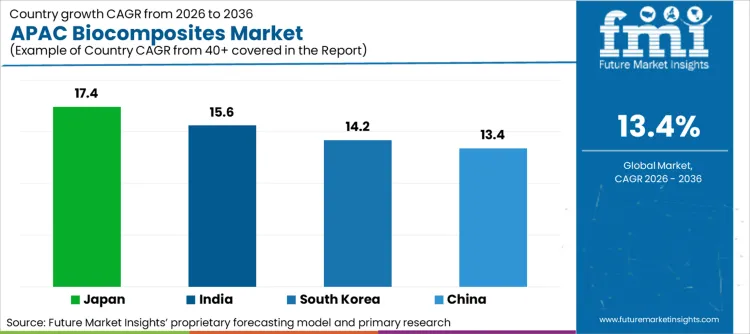
| Countries | Value CAGR (2025 to 2035) |
|---|---|
| China | 13.4% |
| India | 15.6% |
| Japan | 17.4% |
| South Korea | 14.2% |
Sustainable Urbanization and Eco-Friendly Building Projects Drive Biocomposites in China's Construction Industry
With the rate of urbanization in China, there is an increased need to find green and eco-friendly construction materials. Biocomposites are new replacement materials that are derived from natural fibers and bio-based polymers. Characteristics such as excellent durability, being light in weight, and causing less harm to the environment put this construction material on par with energy-efficient and ecologically friendly infrastructure in countries all over the world.
Biocomposites are finding greater applications in the construction industry for wall cladding, insulation panels, and roofing materials as a means of attaining sustainability objectives and improving building performance.
Large-scale projects in urban development, including residential complexes, commercial spaces, and civic infrastructure, have created a demand for biocomposites in China. The material has shown great potential for sustainable urban expansion because it can provide structural strength while reducing the carbon footprint.
Biocomposites meet the aesthetic needs of modern construction and are thus applicable to a wide range of architectural designs. As the construction sector represents one of the largest consumers of materials, especially with functional and ecological demands for rapidly growing cities, biocomposites are a favored choice.
Ban on Single-Use Plastics Spurs Biocomposite Packaging Demand in India’s Packaging Sector
Demand for eco-friendly alternatives is rising fast in India's packaging industry due to increasing awareness of environmental sustainability among consumers. Biocomposites, being fabricated from natural fibers and biodegradable polymers, fall in line with this growing preference for sustainable packaging.
This has found application in industries like food and beverages, cosmetics, and e-commerce, as biocomposite packaging is increasingly demanded by consumers. The material being compostable and recyclable provides the least environmental impact and addresses growing concerns regarding waste management and pollution.
With the rapid development of e-commerce and retail in India, there has been an ever-growing requirement for durable and sustainable packaging solutions. The lightweight structure and durability of the biocomposite make it very apt for maintaining the integrity of a product during transport.
Their applications range from food packaging, where protection is most required, to consumer goods packaging, where aesthetics are most alluring. As companies try to clean up their acts on sustainability, biocomposites are finding more and more favor over conventional materials, thus encouraging their wider dispersion within India's packaging industry.
Automotive Lightweighting for Efficiency Boosts Biocomposite Adoption in South Korea's Auto Sector
The South Korean automotive industry increasingly uses biocomposites to reduce vehicle weight, which directly contributes to fuel efficiency and reduction of carbon emissions. Light weighting is of prime importance to the automotive manufacturers in order to meet the increasing demand for fuel economy and environmental concerns.
Biocomposites replace metals and plastics in certain applications, helping original equipment manufacturers to make lighter vehicles without compromising strength and safety. Besides giving the vehicle more performance, the application will ensure the vehicle's life cycle causes less harm to the environment. Increased demand for environmentally friendly substitutes within the automotive sector favors the tendency towards biocomposites, making it one of the preferred materials for use in manufacturing parts like car interior panels, door trim, and dashboard elements.
The increasing shift towards electric vehicles within the country makes South Korea a greater user of biocomposites. Electric vehicles necessitate materials of low weight to allow improved efficiency by the batteries in increasing the car's driving range.
Biocomposites meet ideal solutions for the manufacture of EVs because these materials, with their strength and toughness, reduce vehicle weight. With this focus, continued by the nation on high-target EVs to reach mass production, it goes without saying that the roles of biocomposites will be highly valued in auto design, toward South Korea's ambition of assuming electric mobility leadership, while feeding further into the South Korean automotive section of the growing market in biocomposites.
Competitive Landscape
The section provides comprehensive assessments and insights that highlight current opportunities and emerging trends for companies in developed and developing countries. It analyzes advancements in manufacturing and identifies the latest trends poised to drive new applications in the market.
A few key players in the biocomposites industry are actively enhancing capabilities and resources to cater to the growing demand for the compound across diverse applications. Leading companies also leverage partnership and joint venture strategies to co-develop innovative products and bolster resource base.
Significant players are further introducing new products to address the increasing need for cutting-edge solutions in various end-use sectors. Geographic expansion is another important strategy that is being embraced by reputed companies. Start-ups are likely to emerge in the sector through 2035, thereby making it more competitive.
Recent Developments
- In December 2025, Mitsubishi Chemical decided to approximately double its high-performance carbon fibre and composite production capacity at its Tokai Plant in Aichi, Japan, targeting the aerospace and EV automotive sectors.
- In January 2026, Mitsubishi Chemical, Asahi Kasei, and Mitsui Chemicals entered a basic agreement to promote decarbonisation of ethylene production in western Japan under METI government support.
- In January 2026, Dongfeng Nissan adopted Mitsubishi's DURABIO plant-derived bioengineering plastic for the crystal-shade AI speaker in the Teana model.
Key Players of Biochar Industry
- Flexform Technologies
- Technaro GmbH
- Procotex
- Kraton Polymers
- NV
- Greengran B.V.
- Stemergy
- Bast Fibers, LLC
- Crailar
- NetComposites
Market Definition
The APAC biocomposites market represents revenue generated from the manufacture and sale of composite materials that incorporate bio-based polymers, natural fibre reinforcements, or plant-derived engineering plastics within the Asia Pacific region. The market measures the value of wood-plastic composites, natural fibre composites (hemp, flax, jute, rice husk), bio-based carbon fibre composites, and plant-derived engineering plastics sold to automotive, aerospace, construction, and packaging manufacturers.
Inclusions cover wood-plastic composites (WPC), natural fibre reinforced polymers (NFRP), bio-based carbon fibre and glass fibre composites, plant-derived engineering plastics (DURABIO, PLA-based), bio-based thermoset and thermoplastic resins, and biocomposite panels for construction and automotive interiors. Applications in automotive lightweighting, aerospace structures, building panels, and sustainable packaging are included.
Exclusions include conventional petroleum-based composites without bio-based content, standalone bio-based polymers sold as raw resins without composite reinforcement, and biomedical composites for surgical implants (covered separately). Composite recycling services without manufacturing are outside the scope.
Scope of Report
| Items | Values |
|---|---|
| Quantitative Units (2026) | USD 14.2 Billion |
| Product Type | Wood-Plastic Composites, Natural Fibre Composites, Bio-Based Carbon/Glass Fibre, Plant-Derived Engineering Plastics |
| Application | Automotive, Aerospace, Construction, Packaging, Consumer Goods |
| Countries Covered | China, Japan, India, South Korea, Australia, ASEAN |
| Key Companies Profiled | Mitsubishi Chemical, Toray Industries, Owens Corning, Nanjing Jufeng, A B Composites, Biocomposites Ltd |
Key Segments of Biochar Industry
By Product Type:
In terms of product type, the industry is divided Hybrid Bio Composites, and Green Bio Composites
By Fiber Type:
In terms of fiber type, the industry is divided into Wood Fiber, and Non Wood Fiber
By Polymer Type:
In terms of polymer type, the industry is divided into Synthetic Polymer, and Natural Polymer
By End Use Industry:
In terms of end use industry, the industry is divided into Construction & Building, Transportation, Consumer Goods, and Others
By Countries:
Key countries of India, China, Japan, South Korea, Australia, Indonesia, Thailand, Singapore, Malaysia, Vietnam, and Rest of Asia Pacific, have been covered in the report.
Bibliography
- Ministry of Economy, Trade and Industry, Japan. (2026, January). METI support for decarbonisation of ethylene production in western Japan. METI.
- Mitsubishi Chemical Group. (2025, December). Carbon fibre and composite capacity doubling at Tokai Plant. MCGC Newsroom.
- Toray Industries. (2025, March). Carbon and glass fibre composite capacity expansion announcement. Toray Industries.
- Owens Corning. (2025, January). Glass fibre manufacturing facility acquisition in India. Owens Corning.
Frequently Asked Questions
What is the current APAC market size for Biocomposites?
The APAC market is valued at USD 14.2 Billion in 2026, driven by China's Green Manufacturing mandates, Japan's carbon fibre capacity doubling, and India's Green Mobility investment corridor.
What is the projected CAGR for the market over the next 10 years?
The market is projected to grow at a CAGR of 13.4% from 2026 to 2036.
Which countries are experiencing the fastest expansion?
China leads by value through automotive biocomposite integration mandates, while India is the fastest-growing production hub driven by JPY 10 trillion Japanese investment and natural fibre processing scale.
What are the primary market drivers?
Automotive lightweighting mandates, METI-backed ethylene decarbonisation, non-wood natural fibre processing scaling, and plant-derived engineering plastic adoption are the primary growth catalysts.
Who are the leading suppliers in the region?
Mitsubishi Chemical, Toray Industries, Owens Corning, and Nanjing Jufeng are key players, differentiating through carbon fibre capacity, plant-derived polymer technology, and natural fibre processing expertise.
Preview the report firsthand - request a free sample
Get SampleGet the brochure for pricing and purchase details.
Get PDFTable of Content
- Executive Summary
- Industry Introduction, including Taxonomy and Market Definition
- Biocomposites Market Trends and Success Factors, including Macro-economic Factors, Market Dynamics, and Recent Industry Developments
- APAC Market Demand Analysis 2020 to 2024 and Forecast 2025 to 2035, including Historical Analysis and Future Projections
- Pricing Analysis
- APAC Market Analysis 2020 to 2024 and Forecast 2025 to 2035
- Product Type
- Fiber Type
- Polymer Type
- End Use Industry
- APAC Market Analysis 2020 to 2024 and Forecast 2025 to 2035, By Product Type
- Hybrid Bio Composites
- Green Bio Composites
- APAC Market Analysis 2020 to 2024 and Forecast 2025 to 2035, By Fiber Type
- Wood Fiber
- Non Wood Fiber
- APAC Market Analysis 2020 to 2024 and Forecast 2025 to 2035, By Polymer Type
- Synthetic Polymer
- Natural Polymer
- APAC Market Analysis 2020 to 2024 and Forecast 2025 to 2035, By End Use Industry
- Construction & Building
- Transportation
- Consumer Goods
- Others (Electrical & Electronics, etc.)
- APAC Market Analysis 2020 to 2024 and Forecast 2025 to 2035, By Region
- India
- China
- Japan
- South Korea
- Australia
- Indonesia
- Thailand
- Singapore
- Malaysia
- Vietnam
- Rest of Asia Pacific
- India Sales Analysis 2020 to 2024 and Forecast 2025 to 2035, by Key Segments and Countries
- China Sales Analysis 2020 to 2024 and Forecast 2025 to 2035, by Key Segments and Countries
- Japan Sales Analysis 2020 to 2024 and Forecast 2025 to 2035, by Key Segments and Countries
- South Korea Sales Analysis 2020 to 2024 and Forecast 2025 to 2035, by Key Segments and Countries
- Australia Sales Analysis 2020 to 2024 and Forecast 2025 to 2035, by Key Segments and Countries
- Indonesia Sales Analysis 2020 to 2024 and Forecast 2025 to 2035, by Key Segments and Countries
- Thailand Sales Analysis 2020 to 2024 and Forecast 2025 to 2035, by Key Segments and Countries
- Singapore Sales Analysis 2020 to 2024 and Forecast 2025 to 2035, by Key Segments and Countries
- Malaysia Sales Analysis 2020 to 2024 and Forecast 2025 to 2035, by Key Segments and Countries
- Vietnam Sales Analysis 2020 to 2024 and Forecast 2025 to 2035, by Key Segments and Countries
- Sales Forecast 2025 to 2035 by Product Type, Fiber Type, Polymer Type, and End Use Industry for 30 Countries
- Competition Outlook, including Market Structure Analysis, Company Share Analysis by Key Players, and Competition Dashboard
- Company Profile
- Flexform Technologies
- Technaro GmbH
- Procotex
- Kraton Polymers
- NV
- Greengran B.V.
- Stemergy
- Bast Fibers, LLC
- Crailar
- NetComposites


