

- Industry Size (2026)
- USD 3.42 Bn
- Forecast (2036)
- USD 7.11 Bn
- CAGR (2026 to 2036)
- 31.0%
Harness-Level EMI and Shielding Component Systems Market Size, Market Forecast and Outlook By FMI
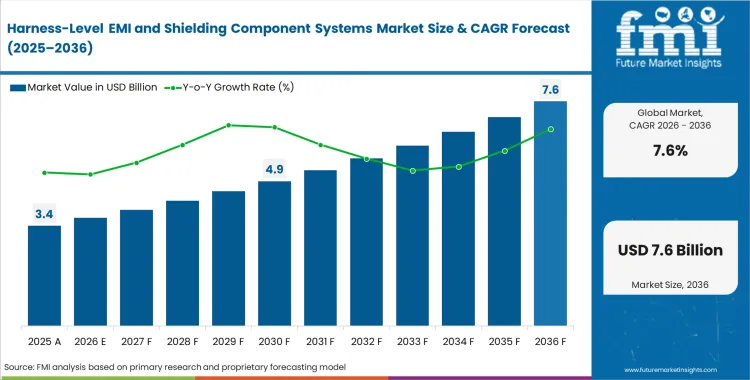
The Harness-Level EMI and Shielding Component Systems market stood at USD 3.18 billion in 2025. Industry valuation is expected to reach USD 3.42 billion in 2026 and is projected to advance at a 7.60% CAGR through 2036. This trajectory would take the market to USD 7.11 billion by 2036, as electrified vehicle platforms continue to compress high-current propulsion lines and sensitive sensor pathways into tighter packaging envelopes.
Tier-1 procurement teams are working within severe space limitations, and material selection at the high-voltage harness level now has direct implications for vehicle safety homologation. Dense battery-pack layouts place signal routes extremely close to inverter power outputs, creating interference conditions that conventional automotive wiring architectures cannot manage reliably. Engineers are being pushed toward multi-layer metallic foils and more refined shielding formats early in the design cycle, because delays at the qualification stage can disrupt platform timing. Small gains in routing efficiency also matter commercially, since tighter geometry can reduce weight and support better range performance.
Summary of Harness-Level EMI and Shielding Component Systems Market
- Harness-Level EMI and Shielding Component Systems Market Snapshot
- The Harness-Level EMI and Shielding Component Systems market is valued at USD 2.62 billion in 2025 and is projected to reach USD 6.22 billion by 2036.
- The industry is expected to advance at an 8.2% CAGR from 2026 to 2036, creating an incremental opportunity of USD 3.39 billion over the period.
- The market is a compliance-led automotive electronics category where EMC qualification, packaging density, weight control, and signal integrity carry more commercial importance than simple component pricing.
- The category remains closely tied to vehicle electrification, high-speed in-vehicle data transport, and zonal E/E architectures, all of which increase the need for cable screening and localized shielding inside the harness.
- Harness-Level EMI and Shielding Component Systems Market Demand and Growth Drivers
- The industry outlook is rising as electric car volumes moved beyond 17 million units in 2024 and exceeded 20% of total car sales, increasing shielding requirements across battery, inverter, charging, and power-distribution circuits.
- Shielded cables and connector systems are also seeing broader use across camera, radar, infotainment, and automotive Ethernet links, where data speed and EMI control must be managed together.
- Vehicle production staying above 92.5 million units in 2024 keeps the installation base broad across both ICE and electrified platforms.
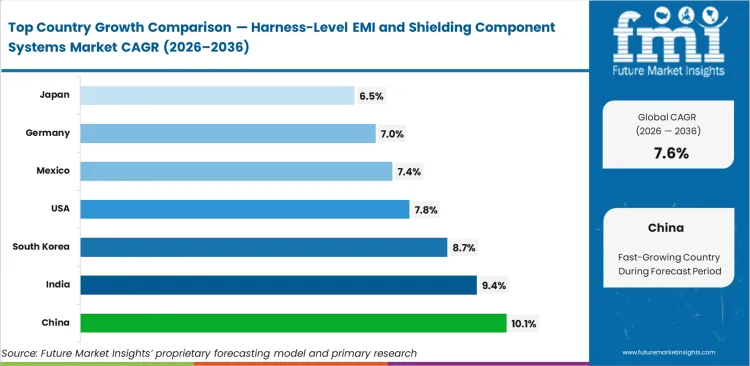
- China remains on a positive trend at an expected 10.1% CAGR, followed by India at 9.4%, South Korea at 8.7%, the United States at 7.8%, Mexico at 7.4%, Germany at 7.0%, and Japan at 6.5% .
- Copper-cost volatility, long qualification cycles, routing limitations, and the need to balance shielding effectiveness with weight and assembly complexity continue to moderate the industry outlook.
- Market Product and Segment View
- The market covers shielded cables, tapes, braided sleeves, connector backshells, ferrites, and grounding parts produced mainly from aluminum, copper, nickel-based materials, and conductive composites for harness-level EMC control.
- These systems are used across battery lines, inverter links, camera and radar networks, infotainment pathways, and sensor circuits that must meet automotive EMC validation standards.
- The market is expected to see shielded cables account for 34% share in 2026, reflecting their central role in both high-voltage power transfer and sensitive data paths.
- Aluminum is projected to secure 38% share in 2026 within the material segment, supported by vehicle lightweighting priorities and the shift away from heavier copper-intensive configurations in electrified platforms.
- In the circuit class category, high-voltage circuits are anticipated to represent 44% share in 2026, as EV battery and power-distribution paths require more systematic shielding than legacy low-voltage lines.
- Battery electric vehicles are likely to account for 41% share in 2026 because fully electric platforms carry the highest shielding intensity per vehicle.
- The market is expected to see OEM account for 89% share in 2026, since shielding is specified into harness layouts during vehicle development and validation.
- The scope includes harness-integrated EMC hardware and materials, while excluding standalone EMC test chambers, board-level chip shielding, and non-automotive cable shielding systems.
- Geography and Competitive Outlook
- China, India, and South Korea remain the fastest-rising markets, while the United States and Germany continue as high-value demand centers because premium vehicle architectures and stringent OEM validation requirements keep shielding content per vehicle elevated.
- Competitive activity is being shaped by electrification programs, high-speed connectivity upgrades, cable lightweighting efforts, and plant-network expansion, with Yazaki, Sumitomo Wiring Systems, Lear, TE Connectivity, Aptiv, Amphenol, and LEONI WSD among the key participants.
- The market remains moderately concentrated, with leading harness and interconnect suppliers benefiting from design-in advantages, while tape, sleeve, and localized shielding specialists compete in subassemblies and material layers.
Harness-Level EMI and Shielding Component Systems Market Key Takeaways
| Metric | Details |
|---|---|
| Industry Size (2026) | USD 3.42 billion |
| Industry Value (2036) | USD 7.11 billion |
| CAGR (2026 to 2036) | 7.60% |
Source: Future Market Insights (FMI) analysis, based on proprietary forecasting model and primary research
Electromagnetic compliance is becoming a fixed production requirement as regulators place greater emphasis on sensor-data integrity in increasingly automated vehicles. Vehicle manufacturers are responding by specifying integrated automotive harness shielding systems across the full electrical layout rather than relying on localized add-on solutions. That shift is raising baseline component content per vehicle and strengthening the long-term industry outlook.
During the forecast period, China is expected to rise at 10.1% CAGR as accelerated passenger EV programs and centralized vehicle computing designs increase shielding requirements. India is on a positive trend at 9.4% CAGR, supported by domestic electric two-wheeler manufacturing and the need for cost-efficient braided suppression solutions. South Korea is projected to expand at 8.7% CAGR, backed by battery platform exports and advanced electronics integration. The United States is likely to record 7.8% CAGR as autonomous sensing systems require cleaner signal transmission across vehicle networks. Mexico is anticipated to post 7.4% CAGR, helped by nearshoring in vehicle assembly and supplier localization. Germany is set to see 7.0% CAGR as premium OEMs move toward multi-gigabit sensor networks. Japan is expected to register 6.5% CAGR, reflecting strict quality thresholds in hybrid powertrain development.
Segmental Analysis
Harness-Level EMI and Shielding Component Systems Market Analysis by Component type
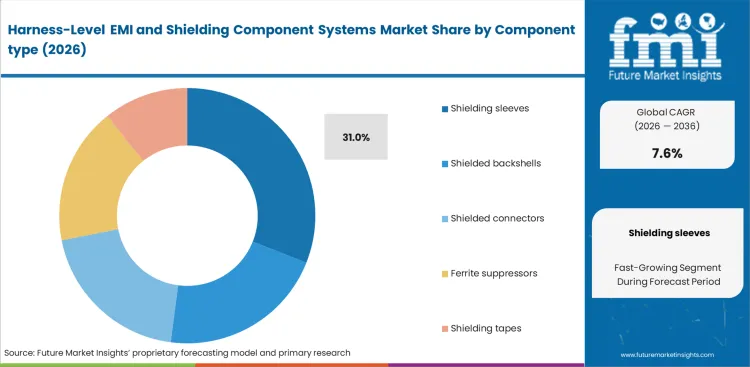
Heavy conventional braided covers no longer fit current routing and weight targets, pushing OEMs toward lighter and more adaptable protection formats. EMI shielding sleeves for wire harnesses are anticipated to account for 31.0% share of the component type segment in 2026, largely because they give engineers flexibility late in the vehicle development cycle. Wiring paths are often revised close to production, and tubular sleeves let manufacturing teams add shielding over completed branches without reopening connector terminations or redesigning the full harness. Engineers that rely too heavily on sleeve-based fixes instead of integrating backshell and termination-level solutions early in the design process may face higher warranty exposure when vibration and signal loss begin to affect sensor performance in service.
- Baseline cost origins: Procurement teams often see an immediate cost advantage in ordering continuous sleeve spools and basic wire harness tape instead of custom-molded enclosures. That upfront saving can be misleading, because factory installation usually requires more manual handling time, which raises assembly labor costs and reduces the expected purchasing benefit.
- Hidden operational penalties: Assembly technicians struggle routing expandable sleeves over sharply angled branches, creating microscopic gaps. Quality control managers spend thousands reworking failed emissions tests caused by simple installation inconsistencies.
- Lifecycle replacement reality: Maintenance engineers replacing damaged harness sections often find that factory-installed heat-shrink sleeves cannot be removed without full connector teardown. That repair requirement increases service time and pushes labor costs higher for fleet operators trying to restore the original protection level.
Harness-Level EMI and Shielding Component Systems Market Analysis by Material
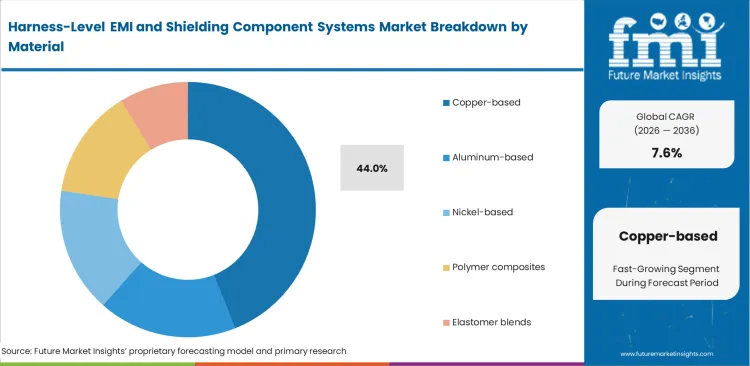
Signal-loss risk in safety-critical circuits keeps design teams cautious about moving too aggressively from metal-based shielding to lighter polymer alternatives. Copper-based materials are anticipated to account for 44.0% share of the material category in 2026, supported by strong low-frequency magnetic field attenuation and well-established grounding performance in demanding vehicle applications. Powertrain engineers working on 800-volt EV platforms still rely on materials with enough conductive mass to manage inverter switching noise across tightly packaged electrical layouts. FMI analysts note that nickel-plated copper variants also help reduce galvanic-corrosion risk when harness grounding and shielding elements interface with dissimilar chassis metals. Material performance in service remains an important constraint, since tinned-copper braids can work-harden under repeated flexing and develop stress fractures that weaken shielding effectiveness over time. Manufacturers trying to lower material cost through pure aluminum substitution can also run into continuity issues at critical junctions, as oxide formation interferes with reliable grounding at non-magnetic connectors terminations.
- Catastrophic field failures: Un-plated copper oxidizes rapidly in marine or high-humidity applications. Fleet maintenance managers discover total failure only after autonomous sensors inexplicably shut down during rainstorms.
- Residual corrosion risks: Even premium plated variations leave cut ends exposed during assembly. Wiring technicians trap moisture against these raw edges, initiating slow internal decay.
- Optimization requirements: Design engineers must specify exact plating thicknesses matched to expected environmental exposure. Skimping on nickel flashing ensures ground path degradation long before vehicle end-of-life.
Harness-Level EMI and Shielding Component Systems Market Analysis by Harness class
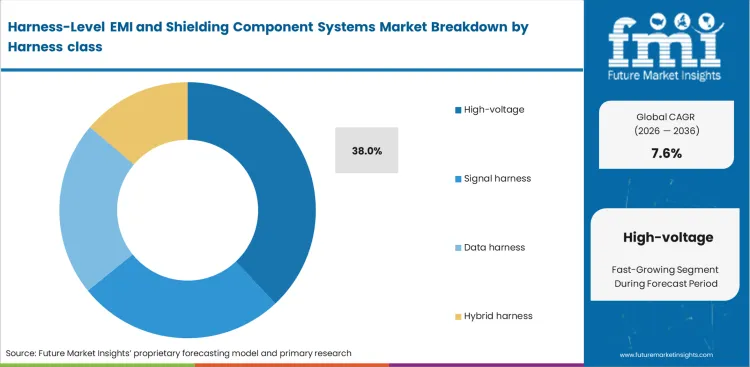
Battery system architects often face packaging conflicts when routing multi-kilowatt power cables alongside sensitive controller networks. The high-voltage class is anticipated to account for 38.0% segment share in 2026, reflecting the rising electrical complexity of electrified vehicle platforms. Inverter switching frequencies create demanding noise conditions that require stronger physical containment than conventional low-voltage circuits. The high-voltage isolation typically depends on thicker multi-layer shielding formats, which raises material usage per meter compared with standard datalinks. Component sourcing teams are also under pressure to secure specialized orange-jacketed EV battery harness shielding that meets strict visual safety requirements. Capacity constraints add another layer of difficulty, since only a limited number of regional extrusion facilities can apply continuous metallic braid over heavy-gauge cable assemblies without reducing core flexibility. Assembly plants waiting for offshore energy storage high voltage connector deliveries can also face production disruption, which is pushing OEMs and suppliers to strengthen localized sourcing despite higher initial tooling costs.
- Production tier dominance: Only elite tier-1 manufacturers possess capital equipment necessary for high-speed continuous over-braiding. Purchasing teams find themselves locked into restrictive contracts with minimal alternative sourcing options.
- Raw material bottlenecks: Surging EV production drains global specialized fine-wire copper reserves. Supply chain managers scramble securing long-term commitments just to maintain current factory output levels.
- Future supply landscape: Incumbents establishing dedicated regional extrusion facilities will monopolize local vehicle assembly demand. Smaller competitors lacking capital for localized heavy machinery face permanent exclusion from next-generation platforms.
Harness-Level EMI and Shielding Component Systems Market Analysis by End use
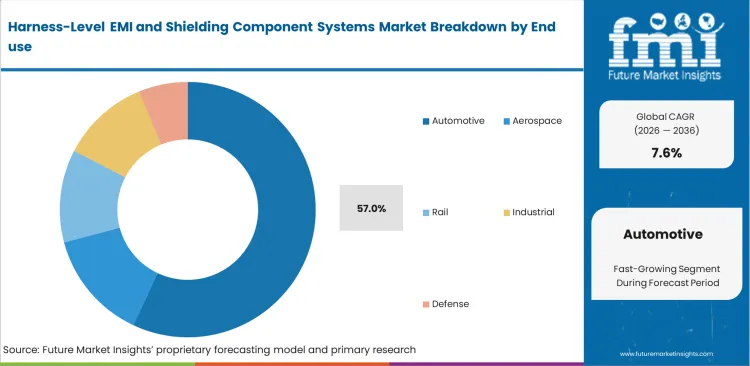
Weight reduction requirements continue to compete with electromagnetic containment needs across mobility applications. Automotive is anticipated to account for 57.0% of end-use share in 2026, supported by the scale of global vehicle production and the rising electrical complexity of passenger platforms. Millions of vehicles now incorporate ADAS-related harness shielding where stable data transmission is essential to system performance. Safety teams specify broader shielding coverage because interference from auxiliary electrical components can disrupt sensor reliability in critical functions. Government homologation requirements also push OEMs toward higher-grade automotive wires cable materials, as the cost of over-specification is often lower than the risk of field failure or recall exposure.
- Performance baseline delivery: Commercial braided shields easily block standard FM radio band interference. Infotainment engineers rely on these simple components ensuring basic consumer audio clarity.
- Edge condition vulnerability: High-frequency 5G network integration exposes severe gaps in legacy woven designs. Connectivity directors discover standard braids leak catastrophic amounts of microwave-band noise into primary vehicle networking antennae.
- Qualification standard evolution: Autonomous driving legislation pushes automakers toward aviation-grade testing protocols. Homologation managers discard legacy materials demanding suppliers deliver multi-layer foils passing severe multi-gigahertz interference sweeps.
Harness-Level EMI and Shielding Component Systems Market Analysis by Installation
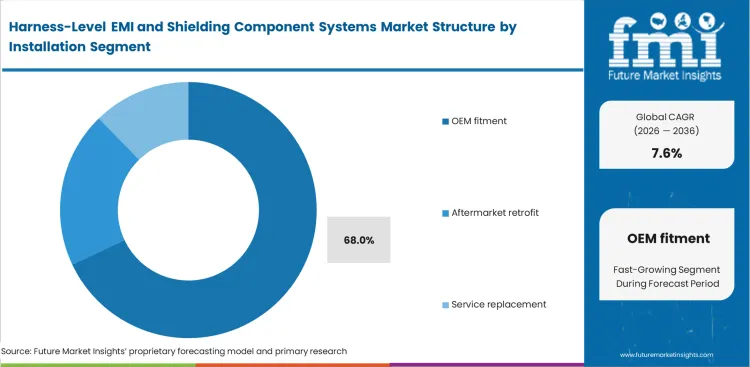
Factory assembly sequencing plays a direct role in how protection layers are applied across complex wiring layouts. OEM fitment controls 68.0% share of installation demand, rooted in the necessity of establishing solid ground connections during initial connector termination. Automated factory crimping presses seamlessly bond continuous shielding braids to heavy metal back-shells, creating impenetrable Faraday cages. It has been observed that retrofitting comparable protection in the field requires manual soldering or messy conductive elastomer adhesives, processes prone to severe human error. What aftermarket suppliers ignore is that modern sealed architectures physically prevent post-production shield integration without voiding primary waterproofing warranties. Service center technicians attempting aftermarket interference fixes by wrapping split-loom covers over existing wiring merely create floating antennas that often amplify surrounding noise rather than suppress it.
- Initial integration wave: Premium vehicle architects adopt full-coverage OEM fitment first. Factory managers absorb initial tooling costs, integrating heavy crimping presses directly into primary assembly lines.
- Secondary tier adoption: Mid-market manufacturers follow, replacing heavy continuous braids with targeted foil wraps. Assembly supervisors discover localized application satisfies basic compliance while saving significant copper weight.
- Final conversion phase: Low-cost vehicle producers eventually transition under strict regulatory duress. Value engineering teams eliminate aftermarket fixes completely, accepting factory integration costs to prevent devastating regional sales bans.
Harness-Level EMI and Shielding Component Systems Market Drivers, Restraints, and Opportunities
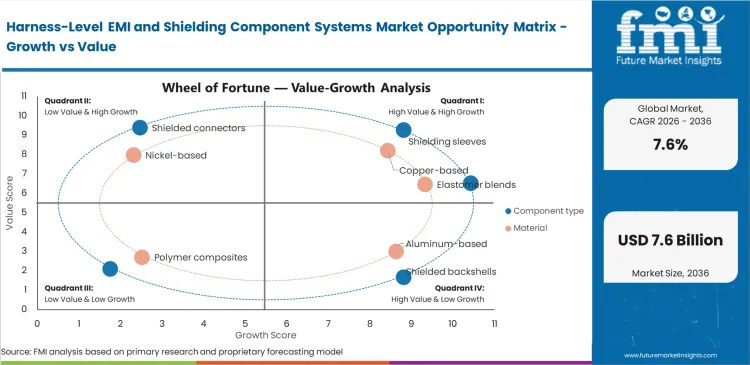
Safety homologation requirements are pushing electronics architects to specify higher-performance electromagnetic protection even on mainstream vehicle platforms. Poor suppression of inverter noise can interfere with autonomous braking sensors, which raises both compliance risk and warranty exposure. Component engineering teams cannot rely on future material advances when current programs still need validated solutions, so multi-layer foil and braided shielding remain necessary in today’s designs. Delays in qualifying lighter EMI shielding sleeves can also weigh on vehicle efficiency targets by limiting how far manufacturers can reduce harness mass. High-density battery packaging leaves zero physical space for legacy bulky separation tactics, forcing reliance on advanced integrated automotive wires protection along with specialized high voltage cable isolation.
Manual connector termination complexity severely restricts factory throughput even when procurement secures sufficient raw shielding material. Automated crimping machines struggle handling delicate multi-layer foil and braid combinations without tearing the conductive substrate. Manufacturing supervisors find that establishing perfect EMI boots for harness terminations requires slow, specialized manual assembly labor. This mechanical bottleneck persists because varying wire harness geometries prevent standardized automated processing across different vehicle platforms. Emerging laser-ablation wire stripping offers partial relief, yet high capital equipment costs limit deployment to only elite tier-1 assembly facilities.
Opportunities in the Harness-Level EMI and Shielding Component Systems Market
- Conductive polymer extrusion: Material scientists replacing heavy copper braids with carbon-loaded polymers. Aerospace weight engineers gain massive payload capacity while maintaining regulatory interference compliance.
- Integrated connector back-shells: Tooling designers developing one-piece shielded enclosures. Assembly plant managers eliminate slow secondary crimping operations, doubling wire-to-board connector production speed.
- High-frequency foil laminates: R&D directors combining aluminum layers with specialized absorbing dielectrics. Connectivity teams deploying Automotive Ethernet shielding secure gigabit in-vehicle ethernet system data transmission against severe surrounding electrical noise.
Regional Analysis
.webp "Top Country Growth Comparison Harness Level Emi And Shielding Component Systems Market Cagr (2026 2036)")
Based on regional analysis, Harness-Level EMI and Shielding Component Systems is segmented into North America, Latin America, Europe, East Asia, South Asia & Pacific, and Middle East & Africa across 40 plus countries.
| Country | CAGR (2026 to 2036) |
|---|---|
| India | 9.4% |
| China | 10.1% |
| South Korea | 8.7% |
| United States | 7.8% |
| Mexico | 7.4% |
| Germany | 7.0% |
| Japan | 6.5% |
Source: Future Market Insights (FMI) analysis, based on proprietary forecasting model and primary research
Asia-Pacific Harness-Level EMI and Shielding Component Systems Market Analysis
Vehicle electrification across Asia-Pacific continues to lift requirements for specialized high-voltage shielding components. Assembly hubs across the region are building more local extrusion, braiding, and termination capacity to support battery-platform programs and reduce dependence on imported specialty materials. OEMs and Tier-1 suppliers are also putting greater emphasis on automated termination methods, as factory throughput depends on applying shielding layers accurately without creating manual bottlenecks. Domestic EMC requirements are becoming more demanding as vehicle electronics density rises, which is pushing baseline harness specifications toward higher-grade protection formats. Regional sourcing strategies are changing with that shift, as suppliers able to integrate automotive harness shielding systems directly into primary wiring layouts are gaining stronger positions in new platform awards.
- China: Demand for harness-level EMI and shielding component systems in China is expected to rise at 10.1% CAGR by 2036. Faster passenger EV model cycles and the move toward centralized vehicle computing are increasing the requirement for braided materials and conductive shielding coatings across domestic programs. Large automakers are also deepening relationships with local extrusion and braiding suppliers to protect production continuity and shorten lead times. Engineering teams remain focused on automated termination methods, especially where metallic foils must be handled at high line speed without compromising consistency. Vendors with strong domestic process capability are likely to remain in a favorable position for Tier-1 sourcing programs.
- South Korea: Export-oriented battery platform development is keeping EMI specifications tight in South Korea. The market for harness-level EMI and shielding component systems in the country is anticipated to expand at 8.7% CAGR during the forecast period, supported by quality expectations across multiple destination markets. Engineers are leaning on multi-layer foil formats and precise connector termination practices to reduce the risk of data corruption in advanced vehicle systems. Suppliers that can maintain consistent shielding performance across export programs are likely to see stronger traction. This keeps material quality and process control central to supplier selection.
- Japan: Strict quality requirements in hybrid powertrain development continue to support the use of proven nickel-plated copper components in Japan. Design teams remain cautious on large-scale substitution toward lighter alternatives until longer-term vibration and durability evidence becomes more established. That preference keeps metallic braiding and other established shielding formats relevant across current programs. harness-level EMI and shielding component systems adoption in Japan is likely to advance at a 6.5% CAGR through 2036. The pace is moderate, but the market remains shaped by reliability-first engineering decisions.
- India: Government localization policies and the expansion of electric mobility programs are reshaping sourcing decisions in India. Domestic startups and established manufacturers are looking for local supply of interference-suppression sleeves and braided solutions to manage tariff exposure and improve availability. Budget discipline also keeps material selection focused on practical, cost-aware shielding formats rather than premium imported alternatives. The Harness-Level EMI and Shielding Component Systems market in India is poised to grow at a 9.4% CAGR through 2036. Local supply reliability will remain an important competitive factor as vehicle programs scale.
FMI’s report also covers Australia, New Zealand, and ASEAN markets, where localization of EV supply chains, rising electronics content, and tighter quality requirements are gradually lifting the need for higher-specification harness shielding components.
North America Harness-Level EMI and Shielding Component Systems Market Analysis
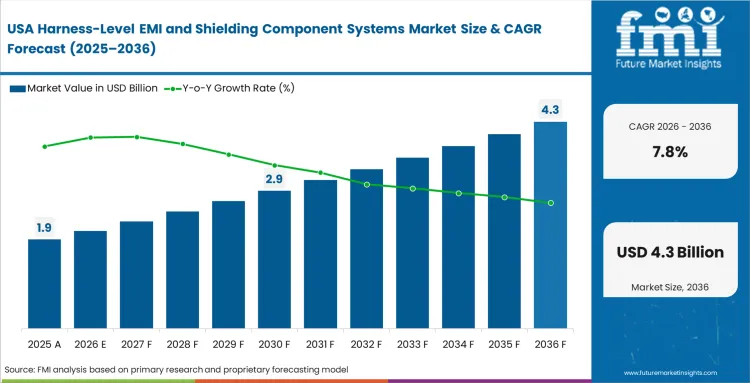
North American demand is being shaped by autonomous driving development, stricter validation requirements, and the need for dependable regional supply. High-voltage platforms, advanced driver-assistance functions, and commercial fleet electronics are all increasing the value of shielding performance in final vehicle programs. OEMs and Tier-1 suppliers are paying closer attention to domestic supply options for advanced materials and connector-related shielding parts, particularly where offshore delays can disrupt production schedules. Material selection in this region is less about nominal specification and more about maintaining consistent electrical performance under demanding operating conditions. That gives suppliers with strong process control and reliable local support a clearer advantage.
- Mexico: Nearshoring continues to support Mexico’s role in North America harness assembly. The country is forecast to record 7.4% CAGR in the harness-level EMI and shielding component systems market through 2036, helped by rising volumes of complex harness work tied to regional automotive production. Assembly plants are investing in cutting, crimping, and shield-termination capability so advanced materials can be processed with greater consistency. As more programs move closer to end markets, local facilities with dependable throughput are becoming more important to regional supply chains.
- United States: Autonomous sensing, high-speed data transmission, and dense electronic environments are keeping shielding specifications demanding in the United States. Systems teams are evaluating higher-performance isolation materials where standard metallic braids are no longer sufficient for newer signal requirements. Regulatory scrutiny and fleet-level validation needs are also influencing material choices across commercial and passenger vehicle programs. Industry outlook for harness-level EMI and shielding component systems in the United States is expected to increase at a 7.8% CAGR over the forecast period. That outlook reflects both technology intensity and the need for compliance-ready vehicle electronics.
FMI’s report covers the United States, Canada, and Mexico. Regional procurement trends are being shaped by nearshoring, higher vehicle-electronics density, and the need for dependable shielding performance across increasingly complex wiring programs.
Europe Harness-Level EMI and Shielding Component Systems Market Analysis
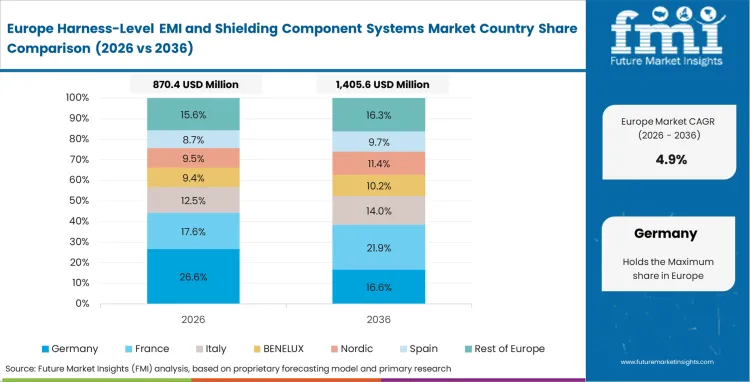
European vehicle programs continue to balance lightweighting targets with increasingly demanding data and EMC requirements. Premium platforms, high-speed sensor networks, and tighter emissions-driven packaging decisions are pushing suppliers toward more advanced shielding materials and coating technologies. OEMs across the region are asking for better integration of protection layers within the main wiring layout rather than relying on secondary add-on formats. This is reshaping vendor positioning, particularly for suppliers that can combine lighter material systems with dependable long-term electrical performance. Regional demand also favors companies able to support both premium passenger vehicles and next-generation electrified platforms with the same process discipline.
- Germany: The harness-level EMI and shielding component systems market in Germany is expected to grow at a 7.0% CAGR through 2036. This keeps Germany positioned as a technically demanding but commercially important market for advanced shielding suppliers. Premium OEM programs in Germany are moving further toward multi-gigabit sensor networks, which raises the need for more reliable data-line isolation. Automotive electrical teams are specifying protection deeper into the main wiring layout so performance risks are addressed earlier in the design cycle. Nickel-plated copper braid remains relevant where long-term vibration durability and grounding stability carry greater weight than material-lightweighting targets alone.
FMI's report includes France, United Kingdom, and Brazil. Emerging regulatory frameworks in these supplementary regions push local assembly operations to upgrade legacy unshielded wiring, escalating baseline component requirements beyond primary global manufacturing hubs.
Competitive Aligners for Market Players
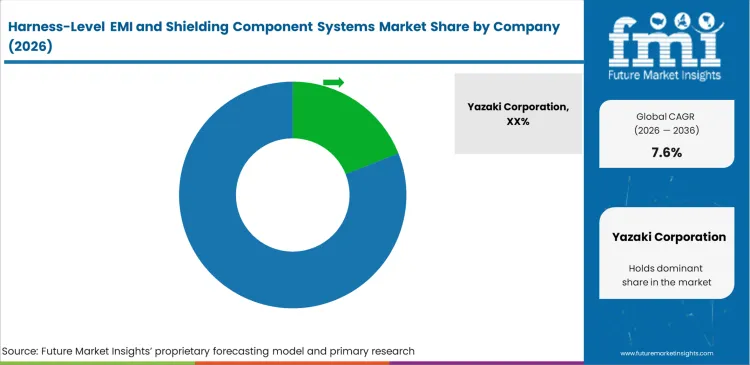
High-volume continuous braiding remains concentrated among a limited group of established Tier-1 suppliers because the capital required for extrusion, braiding, and shielding-line automation is difficult for new entrants to absorb. Yazaki Corporation, Aptiv PLC, and LEONI AG remain well positioned in bulk OEM supply through large manufacturing footprints located close to major vehicle assembly hubs. For procurement teams, localized high-volume delivery often carries more weight than small differences in material performance, especially when program timing and line continuity are under pressure. Transporting heavy copper-braiding spools across long distances also weakens cost efficiency, which makes regional production capability a basic qualification for automotive platform sourcing.
Established suppliers also benefit from proprietary high-speed crimping systems that can terminate emc shielding and test equipment verified backshells with limited manual intervention. That factory-level integration is difficult to reproduce quickly, particularly for smaller challengers without comparable tooling depth. Incumbent automotive EMI shielding component manufacturers also bring large libraries of pre-validated electromagnetic compatibility test data across multiple vehicle geometries. When launch windows tighten, engineering teams tend to prefer components that already fit existing validation pathways, which makes entry harder for newer suppliers without comparable certification depth.
Large automotive and aerospace OEMs still work to limit supplier dependence by specifying modular connector interfaces that can accept jacket variants from more than one vendor. Engineering teams also resist proprietary termination formats by standardizing around mil-spec or ISO connector dimensions across broader platform families. That approach keeps room open for alternative material suppliers, particularly those developing conductive polymer composites and spray-on coatings that reduce reliance on traditional braiding processes. Challengers are more likely to gain traction by focusing on localized lightweight polymer solutions where weight reduction matters more than scale in bulk wire manufacturing.
Key Players in Harness-Level EMI and Shielding Component Systems Market
- Yazaki Corporation
- Aptiv PLC
- Sumitomo Electric Industries, Ltd.
- TE Connectivity Ltd.
- Amphenol Corporation
- LEONI AG
- HellermannTyton Group PLC
Scope of the Report
| Metric | Value |
|---|---|
| Quantitative Units | USD 3.42 billion to USD 7.11 billion, at a CAGR of 7.60% |
| Market Definition | Harness-level electromagnetic interference shielding comprises specialized physical jackets, conductive overlays, and termination hardware engineered specifically to contain radio-frequency emissions radiating from electrical wiring. This functional boundary separates localized board-level isolation from macro-scale power distribution protection. |
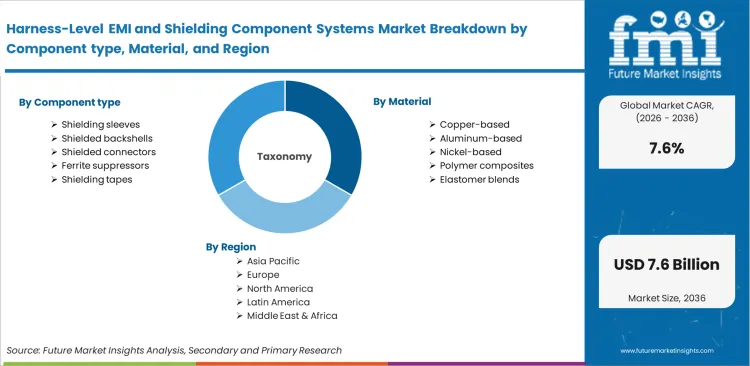
| Segmentation | By Component type, By Material, By Harness class, By End use, By Installation, By Region |
| Regions Covered | North America, Latin America, Europe, East Asia, South Asia & Pacific, Middle East & Africa |
| Countries Covered | United States, Canada, Germany, United Kingdom, France, Italy, Spain, Russia, China, Japan, South Korea, India, ASEAN, Brazil, Mexico, GCC, South Africa |
| Key Companies Profiled | Yazaki Corporation, Aptiv PLC, Sumitomo Electric Industries, Ltd., TE Connectivity Ltd., Amphenol Corporation, LEONI AG, HellermannTyton Group PLC |
| Forecast Period | 2026 to 2036 |
| Approach | Global vehicle production volume data multiplied by penetration rates per electrical architecture generation |
Source: Future Market Insights (FMI) analysis, based on proprietary forecasting model and primary research
Harness-Level EMI and Shielding Component Systems Market Analysis by Segments
By Component type
- Shielding sleeves
- Shielded backshells
- Shielded connectors
- Ferrite suppressors
- Shielding tapes
By Material
- Copper-based
- Aluminum-based
- Nickel-based
- Polymer composites
- Elastomer blends
By Harness class
- High-voltage
- Signal harness
- Data harness
- Hybrid harness
By End use
- Automotive
- Aerospace
- Rail
- Industrial
- Defense
By Installation
- OEM fitment
- Aftermarket retrofit
- Service replacement
By Region
- North America
- Latin America
- Europe
- East Asia
- South Asia & Pacific
- Middle East & Africa
Bibliography
- International Energy Agency. (2025, May). Global EV Outlook 2025. IEA.
- United Nations Economic Commission for Europe. (2025, December). ECE/TRANS/WP.29/2026/29. UNECE.
- TE Connectivity. (2025). EMI Shielding for Automotive Application Solution Guide.
- Amphenol Corporation. (2026, January 28). Amphenol Reports Record Fourth Quarter and Full Year 2025 Results.
- Aptiv PLC. (2026, February 2). Aptiv Reports Fourth Quarter 2025 Financial Results.
This bibliography is provided for reader reference. The full FMI report contains the complete reference list with primary source documentation.
This Report Addresses
- Automotive engineering requirements for high-voltage shielding systems.
- Procurement strategies mitigating copper material price fluctuations.
- Homologation impacts on autonomous vehicle sensor data clarity.
- Factory tooling demands for 360-degree connector crimping.
- Weight reduction benefits of conductive polymer extrusion.
- Localization pressures across Indian two-wheeler supply chains.
- Hidden warranty costs associated with aftermarket retrofits.
- Material differences between copper and aluminum attenuation profiles.
Frequently Asked Questions
What is the expected valuation in 2036?
Total valuation reaches USD 7.11 billion by 2036, driven by global electric vehicle platform expansion.
What specific factor drives copper material dominance?
Copper absorbs intense low-frequency magnetic fields generated by high-voltage EV inverter switching noise effectively.
Why do shielding sleeves hold significant share?
Sleeves provide late-stage layout flexibility, allowing technicians to protect completed branches without dismantling factory connectors.
How does autonomous driving influence shielding design?
Lidar and radar networks require military-grade interference protection to ensure pristine safety sensor data clarity.
What structural constraint limits automated factory installation?
Delicate metallic foils tear easily inside standard crimping machinery, forcing slow manual assembly labor intervention.
Why is India expanding rapidly at 9.4%?
Rigid government localization mandates force electric two-wheeler startups to source heavy-gauge braided stock domestically.
How does Mexico support North American production?
Massive wire harness nearshoring concentrates raw material consumption, prompting factory managers to invest in automated stripping.
What manufacturing advantage belongs to incumbent companies?
Massive proprietary extrusion machinery sits directly adjacent to major vehicle plants, enabling localized heavy spool delivery.
How do automotive OEMs resist supplier lock-in?
Architects enforce standardized connector shell geometries and split component contracts across multiple qualified regional vendors.
Why is China tracking at an 10.1% growth rate?
Centralized vehicle computing designs require heavy data link protection, dominated by domestic continuous-braiding machinery suppliers.
What drives demand for shielded backshells?
Backshells provide physical mechanical strength while completing the Faraday cage during automated factory crimping processes.
How does vibration impact long-term compliance?
Constant highway rattling work-hardens standard tinned-copper wires, creating micro-fractures that leak high-frequency interference prematurely.
Why do hybrid powertrains sustain Japanese demand?
Quality engineers maintain legacy nickel-plated specifications to ensure proven multi-decade durability against combustion vibration.
What limits aerospace composite adoption in vehicles?
Prohibitive costs restrict composite usage strictly to premium luxury autonomous sensor arrays, avoiding mass-market deployment.
How do service replacement parts differ from OEM fitment?
Replacement parts rely on secondary adhesives that compromise the original water resistance of sealed waterproof connectors.
What forces industrial applications to adopt harness shielding?
Plant engineers shield moving robotic arms to prevent heavy machinery noise from corrupting delicate encoder positioning data.
Why do EV harnesses need shielding?
High-voltage propulsion cables run close to low-voltage sensors, creating electromagnetic interference that disrupts vital vehicle operations.
What are EMI boots for harness terminations?
Conductive elastomer boots seal connector junctions, ensuring continuous electromagnetic protection where braided cable jackets end.
Preview the report firsthand - request a free sample
Get SampleGet the brochure for pricing and purchase details.
Get PDFTable of Content
- Executive Summary
- Global Market Outlook
- Demand-side Trends
- Supply-side Trends
- Technology Roadmap Analysis
- Analysis and Recommendations
- Market Overview
- Market Coverage / Taxonomy
- Market Definition / Scope / Limitations
- Research Methodology
- Chapter Orientation
- Analytical Lens and Working Hypotheses
- Market Structure, Signals, and Trend Drivers
- Benchmarking and Cross-market Comparability
- Market Sizing, Forecasting, and Opportunity Mapping
- Research Design and Evidence Framework
- Desk Research Programme (Secondary Evidence)
- Company Annual and Sustainability Reports
- Peer-reviewed Journals and Academic Literature
- Corporate Websites, Product Literature, and Technical Notes
- Earnings Decks and Investor Briefings
- Statutory Filings and Regulatory Disclosures
- Technical White Papers and Standards Notes
- Trade Journals, Industry Magazines, and Analyst Briefs
- Conference Proceedings, Webinars, and Seminar Materials
- Government Statistics Portals and Public Data Releases
- Press Releases and Reputable Media Coverage
- Specialist Newsletters and Curated Briefings
- Sector Databases and Reference Repositories
- FMI Internal Proprietary Databases and Historical Market Datasets
- Subscription Datasets and Paid Sources
- Social Channels, Communities, and Digital Listening Inputs
- Additional Desk Sources
- Expert Input and Fieldwork (Primary Evidence)
- Primary Modes
- Qualitative Interviews and Expert Elicitation
- Quantitative Surveys and Structured Data Capture
- Blended Approach
- Why Primary Evidence is Used
- Field Techniques
- Interviews
- Surveys
- Focus Groups
- Observational and In-context Research
- Social and Community Interactions
- Stakeholder Universe Engaged
- C-suite Leaders
- Board Members
- Presidents and Vice Presidents
- R&D and Innovation Heads
- Technical Specialists
- Domain Subject-matter Experts
- Scientists
- Physicians and Other Healthcare Professionals
- Governance, Ethics, and Data Stewardship
- Research Ethics
- Data Integrity and Handling
- Primary Modes
- Tooling, Models, and Reference Databases
- Desk Research Programme (Secondary Evidence)
- Data Engineering and Model Build
- Data Acquisition and Ingestion
- Cleaning, Normalisation, and Verification
- Synthesis, Triangulation, and Analysis
- Quality Assurance and Audit Trail
- Market Background
- Market Dynamics
- Drivers
- Restraints
- Opportunity
- Trends
- Scenario Forecast
- Demand in Optimistic Scenario
- Demand in Likely Scenario
- Demand in Conservative Scenario
- Opportunity Map Analysis
- Product Life Cycle Analysis
- Supply Chain Analysis
- Investment Feasibility Matrix
- Value Chain Analysis
- PESTLE and Porter’s Analysis
- Regulatory Landscape
- Regional Parent Market Outlook
- Production and Consumption Statistics
- Import and Export Statistics
- Market Dynamics
- Global Market Analysis 2021 to 2025 and Forecast, 2026 to 2036
- Historical Market Size Value (USD Million) Analysis, 2021 to 2025
- Current and Future Market Size Value (USD Million) Projections, 2026 to 2036
- Y-o-Y Growth Trend Analysis
- Absolute $ Opportunity Analysis
- Global Market Pricing Analysis 2021 to 2025 and Forecast 2026 to 2036
- Global Market Analysis 2021 to 2025 and Forecast 2026 to 2036, By Component type
- Introduction / Key Findings
- Historical Market Size Value (USD Million) Analysis By Component type , 2021 to 2025
- Current and Future Market Size Value (USD Million) Analysis and Forecast By Component type , 2026 to 2036
- Shielding sleeves
- Shielded backshells
- Shielded connectors
- Ferrite suppressors
- Shielding tapes
- Shielding sleeves
- Y-o-Y Growth Trend Analysis By Component type , 2021 to 2025
- Absolute $ Opportunity Analysis By Component type , 2026 to 2036
- Global Market Analysis 2021 to 2025 and Forecast 2026 to 2036, By Material
- Introduction / Key Findings
- Historical Market Size Value (USD Million) Analysis By Material, 2021 to 2025
- Current and Future Market Size Value (USD Million) Analysis and Forecast By Material, 2026 to 2036
- Copper-based
- Aluminum-based
- Nickel-based
- Polymer composites
- Elastomer blends
- Copper-based
- Y-o-Y Growth Trend Analysis By Material, 2021 to 2025
- Absolute $ Opportunity Analysis By Material, 2026 to 2036
- Global Market Analysis 2021 to 2025 and Forecast 2026 to 2036, By Harness class
- Introduction / Key Findings
- Historical Market Size Value (USD Million) Analysis By Harness class, 2021 to 2025
- Current and Future Market Size Value (USD Million) Analysis and Forecast By Harness class, 2026 to 2036
- High-voltage
- Signal harness
- Data harness
- Hybrid harness
- High-voltage
- Y-o-Y Growth Trend Analysis By Harness class, 2021 to 2025
- Absolute $ Opportunity Analysis By Harness class, 2026 to 2036
- Global Market Analysis 2021 to 2025 and Forecast 2026 to 2036, By End use
- Introduction / Key Findings
- Historical Market Size Value (USD Million) Analysis By End use, 2021 to 2025
- Current and Future Market Size Value (USD Million) Analysis and Forecast By End use, 2026 to 2036
- Automotive
- Aerospace
- Rail
- Industrial
- Defense
- Automotive
- Y-o-Y Growth Trend Analysis By End use, 2021 to 2025
- Absolute $ Opportunity Analysis By End use, 2026 to 2036
- Global Market Analysis 2021 to 2025 and Forecast 2026 to 2036, By Installation
- Introduction / Key Findings
- Historical Market Size Value (USD Million) Analysis By Installation, 2021 to 2025
- Current and Future Market Size Value (USD Million) Analysis and Forecast By Installation, 2026 to 2036
- OEM fitment
- Aftermarket retrofit
- Service replacement
- OEM fitment
- Y-o-Y Growth Trend Analysis By Installation, 2021 to 2025
- Absolute $ Opportunity Analysis By Installation, 2026 to 2036
- Global Market Analysis 2021 to 2025 and Forecast 2026 to 2036, By Region
- Introduction
- Historical Market Size Value (USD Million) Analysis By Region, 2021 to 2025
- Current Market Size Value (USD Million) Analysis and Forecast By Region, 2026 to 2036
- North America
- Latin America
- Western Europe
- Eastern Europe
- East Asia
- South Asia and Pacific
- Middle East & Africa
- Market Attractiveness Analysis By Region
- North America Market Analysis 2021 to 2025 and Forecast 2026 to 2036, By Country
- Historical Market Size Value (USD Million) Trend Analysis By Market Taxonomy, 2021 to 2025
- Market Size Value (USD Million) Forecast By Market Taxonomy, 2026 to 2036
- By Country
- USA
- Canada
- Mexico
- By Component type
- By Material
- By Harness class
- By End use
- By Installation
- By Country
- Market Attractiveness Analysis
- By Country
- By Component type
- By Material
- By Harness class
- By End use
- By Installation
- Key Takeaways
- Latin America Market Analysis 2021 to 2025 and Forecast 2026 to 2036, By Country
- Historical Market Size Value (USD Million) Trend Analysis By Market Taxonomy, 2021 to 2025
- Market Size Value (USD Million) Forecast By Market Taxonomy, 2026 to 2036
- By Country
- Brazil
- Chile
- Rest of Latin America
- By Component type
- By Material
- By Harness class
- By End use
- By Installation
- By Country
- Market Attractiveness Analysis
- By Country
- By Component type
- By Material
- By Harness class
- By End use
- By Installation
- Key Takeaways
- Western Europe Market Analysis 2021 to 2025 and Forecast 2026 to 2036, By Country
- Historical Market Size Value (USD Million) Trend Analysis By Market Taxonomy, 2021 to 2025
- Market Size Value (USD Million) Forecast By Market Taxonomy, 2026 to 2036
- By Country
- Germany
- UK
- Italy
- Spain
- France
- Nordic
- BENELUX
- Rest of Western Europe
- By Component type
- By Material
- By Harness class
- By End use
- By Installation
- By Country
- Market Attractiveness Analysis
- By Country
- By Component type
- By Material
- By Harness class
- By End use
- By Installation
- Key Takeaways
- Eastern Europe Market Analysis 2021 to 2025 and Forecast 2026 to 2036, By Country
- Historical Market Size Value (USD Million) Trend Analysis By Market Taxonomy, 2021 to 2025
- Market Size Value (USD Million) Forecast By Market Taxonomy, 2026 to 2036
- By Country
- Russia
- Poland
- Hungary
- Balkan & Baltic
- Rest of Eastern Europe
- By Component type
- By Material
- By Harness class
- By End use
- By Installation
- By Country
- Market Attractiveness Analysis
- By Country
- By Component type
- By Material
- By Harness class
- By End use
- By Installation
- Key Takeaways
- East Asia Market Analysis 2021 to 2025 and Forecast 2026 to 2036, By Country
- Historical Market Size Value (USD Million) Trend Analysis By Market Taxonomy, 2021 to 2025
- Market Size Value (USD Million) Forecast By Market Taxonomy, 2026 to 2036
- By Country
- China
- Japan
- South Korea
- By Component type
- By Material
- By Harness class
- By End use
- By Installation
- By Country
- Market Attractiveness Analysis
- By Country
- By Component type
- By Material
- By Harness class
- By End use
- By Installation
- Key Takeaways
- South Asia and Pacific Market Analysis 2021 to 2025 and Forecast 2026 to 2036, By Country
- Historical Market Size Value (USD Million) Trend Analysis By Market Taxonomy, 2021 to 2025
- Market Size Value (USD Million) Forecast By Market Taxonomy, 2026 to 2036
- By Country
- India
- ASEAN
- Australia & New Zealand
- Rest of South Asia and Pacific
- By Component type
- By Material
- By Harness class
- By End use
- By Installation
- By Country
- Market Attractiveness Analysis
- By Country
- By Component type
- By Material
- By Harness class
- By End use
- By Installation
- Key Takeaways
- Middle East & Africa Market Analysis 2021 to 2025 and Forecast 2026 to 2036, By Country
- Historical Market Size Value (USD Million) Trend Analysis By Market Taxonomy, 2021 to 2025
- Market Size Value (USD Million) Forecast By Market Taxonomy, 2026 to 2036
- By Country
- Kingdom of Saudi Arabia
- Other GCC Countries
- Turkiye
- South Africa
- Other African Union
- Rest of Middle East & Africa
- By Component type
- By Material
- By Harness class
- By End use
- By Installation
- By Country
- Market Attractiveness Analysis
- By Country
- By Component type
- By Material
- By Harness class
- By End use
- By Installation
- Key Takeaways
- Key Countries Market Analysis
- USA
- Pricing Analysis
- Market Share Analysis, 2025
- By Component type
- By Material
- By Harness class
- By End use
- By Installation
- Canada
- Pricing Analysis
- Market Share Analysis, 2025
- By Component type
- By Material
- By Harness class
- By End use
- By Installation
- Mexico
- Pricing Analysis
- Market Share Analysis, 2025
- By Component type
- By Material
- By Harness class
- By End use
- By Installation
- Brazil
- Pricing Analysis
- Market Share Analysis, 2025
- By Component type
- By Material
- By Harness class
- By End use
- By Installation
- Chile
- Pricing Analysis
- Market Share Analysis, 2025
- By Component type
- By Material
- By Harness class
- By End use
- By Installation
- Germany
- Pricing Analysis
- Market Share Analysis, 2025
- By Component type
- By Material
- By Harness class
- By End use
- By Installation
- UK
- Pricing Analysis
- Market Share Analysis, 2025
- By Component type
- By Material
- By Harness class
- By End use
- By Installation
- Italy
- Pricing Analysis
- Market Share Analysis, 2025
- By Component type
- By Material
- By Harness class
- By End use
- By Installation
- Spain
- Pricing Analysis
- Market Share Analysis, 2025
- By Component type
- By Material
- By Harness class
- By End use
- By Installation
- France
- Pricing Analysis
- Market Share Analysis, 2025
- By Component type
- By Material
- By Harness class
- By End use
- By Installation
- India
- Pricing Analysis
- Market Share Analysis, 2025
- By Component type
- By Material
- By Harness class
- By End use
- By Installation
- ASEAN
- Pricing Analysis
- Market Share Analysis, 2025
- By Component type
- By Material
- By Harness class
- By End use
- By Installation
- Australia & New Zealand
- Pricing Analysis
- Market Share Analysis, 2025
- By Component type
- By Material
- By Harness class
- By End use
- By Installation
- China
- Pricing Analysis
- Market Share Analysis, 2025
- By Component type
- By Material
- By Harness class
- By End use
- By Installation
- Japan
- Pricing Analysis
- Market Share Analysis, 2025
- By Component type
- By Material
- By Harness class
- By End use
- By Installation
- South Korea
- Pricing Analysis
- Market Share Analysis, 2025
- By Component type
- By Material
- By Harness class
- By End use
- By Installation
- Russia
- Pricing Analysis
- Market Share Analysis, 2025
- By Component type
- By Material
- By Harness class
- By End use
- By Installation
- Poland
- Pricing Analysis
- Market Share Analysis, 2025
- By Component type
- By Material
- By Harness class
- By End use
- By Installation
- Hungary
- Pricing Analysis
- Market Share Analysis, 2025
- By Component type
- By Material
- By Harness class
- By End use
- By Installation
- Kingdom of Saudi Arabia
- Pricing Analysis
- Market Share Analysis, 2025
- By Component type
- By Material
- By Harness class
- By End use
- By Installation
- Turkiye
- Pricing Analysis
- Market Share Analysis, 2025
- By Component type
- By Material
- By Harness class
- By End use
- By Installation
- South Africa
- Pricing Analysis
- Market Share Analysis, 2025
- By Component type
- By Material
- By Harness class
- By End use
- By Installation
- USA
- Market Structure Analysis
- Competition Dashboard
- Competition Benchmarking
- Market Share Analysis of Top Players
- By Regional
- By Component type
- By Material
- By Harness class
- By End use
- By Installation
- Competition Analysis
- Competition Deep Dive
- Yazaki Corporation
- Overview
- Product Portfolio
- Profitability by Market Segments (Product/Age /Sales Channel/Region)
- Sales Footprint
- Strategy Overview
- Marketing Strategy
- Product Strategy
- Channel Strategy
- Aptiv PLC
- Sumitomo Electric Industries, Ltd.
- TE Connectivity Ltd.
- Amphenol Corporation
- LEONI AG
- HellermannTyton Group PLC
- Yazaki Corporation
- Competition Deep Dive
- Assumptions & Acronyms Used


