

- Industry Size (2026)
- USD 5.4 Bn
- Forecast (2036)
- USD 24.0 Bn
- CAGR (2026 to 2036)
- 16.10%
Zonal E E Architecture Market Size, Market Forecast and Outlook By FMI
In 2025, the zonal E/E architecture market exceeded USD 4.9 billion and is forecast to rise to USD 5.4 billion in 2026, ultimately reaching USD 24.0 billion by 2036. This growth trajectory reflects a 16.10% CAGR. As Tier‑1 manufacturers expand production, they are transitioning away from traditional domain‑based systems toward unified software‑defined vehicle (SDV) computing platforms.
To accelerate deployment, procurement teams are skipping extended qualification cycles for distributed ECUs and moving straight into commercial-scale sourcing of high‑bandwidth computing solutions. Operators maximize software abstraction as global vehicle architectures transition away from hardware-defined constraints, expanding feedstock pools for downstream smart vehicle architecture integration. Capital allocation decisions are reshaping vendor qualification timelines across the mobility sector. Plant managers interpret this capital signal as proof that hardware consolidation reduces wire harness weight and assembly complexity.
Manuel Alves, SVP & GM, Automotive Microcontrollers at NXP, opined, "The new S32K5 family pushes the boundaries of MCU performance without sacrificing the safety, efficiency and isolation that are essential for zonal solutions. The NXP CoreRide platform featuring S32K5 will help automakers and Tier-1s accelerate the development of zonal architectures, providing a scalable foundation for software-driven innovation." [2] This commitment resets automotive OEM expectations for localized processing capabilities across the connected vehicle category. Suppliers entering 2027 tender cycles without hardware-agnostic, scalable controller solutions face a disqualification window they cannot close after shortlisting begins.
Summary of Zonal E E Architecture Market
- Zonal E E Architecture Market Definition
- A centralized automotive computing framework utilizing high-speed Ethernet and consolidated zonal controllers to replace distributed ECUs, isolating hardware from software for advanced mobility applications.
- Demand Drivers in the Market
- Over-the-air (OTA) update mandates force manufacturers away from siloed hardware components toward centralized computing hubs.
- The rapid electrification of vehicle fleets expands the requisite power and data bandwidth requirements needed for advanced driver assistance systems.
- Advancements in system-on-chip (SoC) technology improve processing speeds and enable localized sensor data aggregation.
- Key Segments Analyzed in the FMI Report
- Zonal Architecture: 55% share, reflecting the structural push toward bulk data handling and reduced wiring complexity.
- Passenger Vehicles: 62% share, driven by aggressive consumer demand for connected infotainment and autonomous driving features.
- India: Expanding rapidly due to value-focused engineering fortification and the modernization of domestic supply chains.
- Analyst Opinion at FMI
- Nikhil Kaitwade, Principal Consultant for Automotive, opines, “Procurement leaders are moving beyond evaluating individual microcontroller prices and are instead prioritizing the overall performance and scalability of the complete system. Automakers that lock in partnerships with end‑to‑end SoC providers gain insulation from the volatility and operational risks affecting companies still dependent on outdated, piecemeal electronic architectures.”
- Strategic Implications / Executive Takeaways
- Secure long-term SoC supply contracts to insulate against semiconductor price shocks and manufacturing delays.
- Prioritize cybersecurity standard compliance to capture high-value SDV and autonomous vehicle application contracts.
- Build software-first engineering teams near major automotive manufacturing hubs to accelerate platform commercialization.
- Methodology
- Direct interviews with Tier-1 component suppliers, semiconductor fabrication managers, and automotive software engineers provided baseline capability metrics.
- Custom import/export datasets, corporate capacity announcements, and verified patent filings substantiated regional adoption models.
- Analysts developed a bottom-up adoption model starting from regional vehicle production volumes to project component demand.
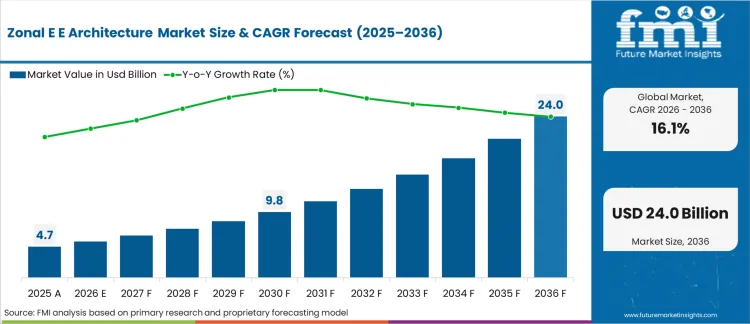
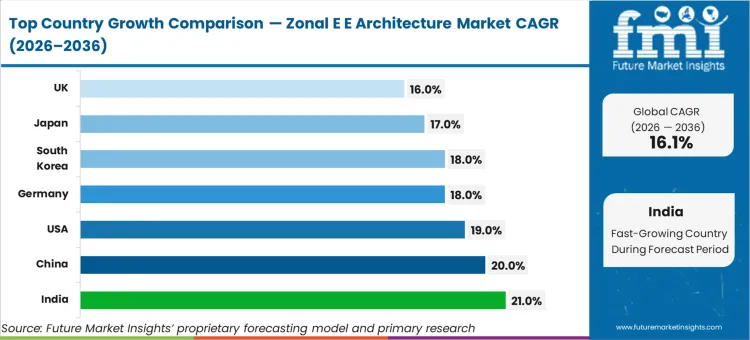
Regional electronics ecosystems dictate adoption curves across major automotive hubs. India leads with a projected 21.0% CAGR through 2036, driven by a phased migration starting in premium trims and electric vehicles. China follows closely at a 20.0% CAGR as local supply-chain investments prioritize rapid software-defined vehicle scale-up. The United States advances at a 19.0% CAGR, heavily concentrated around OTA-first redesigns and software stack partnerships. Germany and South Korea both track at an 18.0% CAGR, supported by Tier-1 engineering industrialization and rapid infotainment feature cycles, respectively. Japan and the UK round out the landscape with 17.0% and 16.0% CAGRs, focusing on functional safety, custom SoC roadmaps, and connected software platforms over pure manufacturing scale.
Zonal E E Architecture Market Definition
The Zonal E E Architecture market represents a centralized framework that organizes automotive electronics into physical zones rather than functional domains. It utilizes high-performance zonal controllers and central compute units connected via high-speed Ethernet to manage power distribution, sensor data, and actuation. This structure drastically reduces wiring harness length and weight while facilitating continuous software updates. Regulatory mandates regarding cybersecurity and emissions tracking directly shape the operational parameters of these networks.
Zonal E E Architecture Market Inclusions
The category covers hardware components including zonal controllers, central compute units, and related SoCs designed specifically for vehicular network consolidation. It includes the foundational software stacks, hypervisors, and real-time operating systems required to decouple hardware from vehicle functions. Integrated solutions deployed in passenger cars, commercial transport, and advanced two-wheelers are fully within scope.
Zonal E E Architecture Market Exclusions
The scope excludes legacy, standalone Electronic Control Units (ECUs) deployed in traditional, fully distributed vehicle architectures. Basic, unmanaged wiring harnesses that do not interface with high-speed data networks or zonal aggregation points are excluded. Furthermore, purely consumer-facing infotainment applications that do not integrate with the vehicle's core safety, power, or control networks fall outside this market boundary.
Zonal E E Architecture Market Research Methodology
- Primary Research: Direct interviews with Tier-1 automotive integrators, semiconductor executives, and software platform architects across North America, Europe, and Asia Pacific.
- Desk Research: Evaluated official transportation agency reports, verified corporate product launch announcements, and open-source foundation data tracking SDV adoption.
- Market-Sizing and Forecasting: Analysts applied a bottom-up adoption model leveraging EV sales penetration and autonomous feature attach rates to project zonal component shipments.
- Data Validation and Update Cycle: Findings underwent cross-verification against semiconductor fabrication outputs and major automotive platform tender cycles before final integration.
Segmental Analysis
Zonal E E Architecture Market Analysis by Architecture type
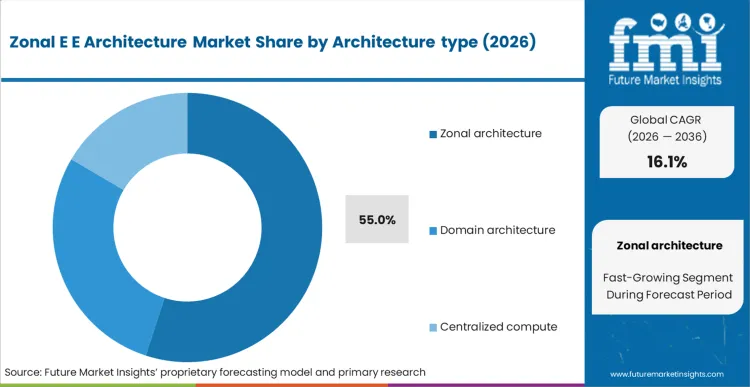
Automotive manufacturers are actively reformulating product platforms, driving stronger adoption of centralized frameworks that help remove legacy wiring constraints while improving processing latency. Zonal architecture captures a 55% share in 2026, reflecting the logistical and manufacturing logic of centralized data aggregation. The engineering facilities increasingly prioritize multi-gigabit Ethernet capabilities to secure competitive contracts within the autonomous driving segment. As reformulation momentum accelerates, procurement departments source advanced automotive electronics to align with retail partner guidelines governing intelligent mobility.
- Technical Validation: High-performance microcontrollers manage complex data routing efficiently in fluid SDV environments.
- Logistics Advantage: Reduced physical wiring minimizes assembly weights and prevents manufacturing bottlenecks during long vehicle production runs.
- Product Innovation: Joint ventures linking silicon developers with vehicle architects accelerate commercialization timelines for next-generation fleets.
Zonal E E Architecture Market Analysis by Component
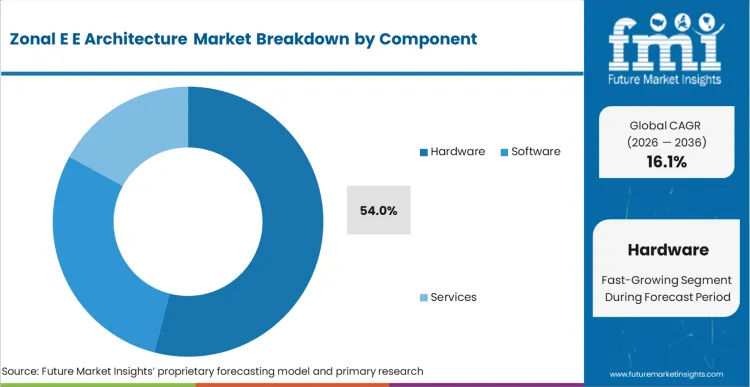
Physical components eliminate processing bottlenecks, extending functional limits and reducing complex temperature-controlled cooling requirements for central units. The structural push toward bulk silicon handling aligns with industry demands for localized sensor fusion. Hardware formats capture a 54% share in 2026, reflecting the foundational necessity of silicon and circuitry in global vehicle design. FMI analysts opine that processing rates and thermal management remain critical quality parameters for industrial buyers seeking drop-in replacements for legacy automotive connectivity control unit deployments.
- Process Compatibility: Factory setups designed for traditional ECUs must readily adapt to installing centralized hardware units.
- Shelf Stability: Extended silicon lifecycles allow procurement teams to execute bulk purchasing strategies when semiconductor commodity prices dip.
- Volume Concentration: Narrows to major Tier-1 suppliers capable of delivering fully validated, safety-certified hardware arrays.
Zonal E E Architecture Market Analysis by Controller Type
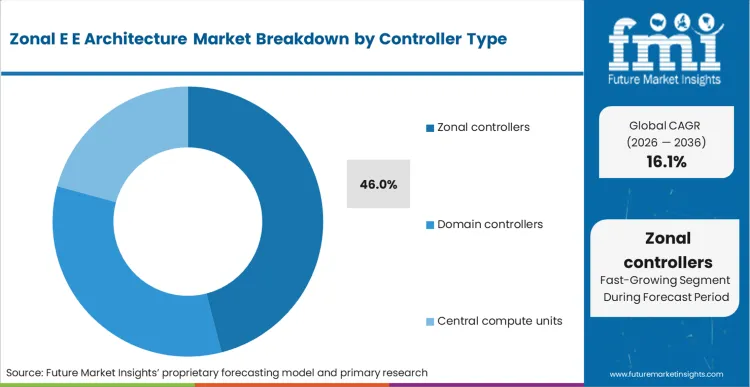
The automotive network testing protocols now rigorously evaluate these controllers for fault tolerance. Suppliers investing in application-specific stress trials will secure stronger positioning in future alternative mobility pipelines. While central compute units command significant processing power, zonal controllers capture a leading 46% segment share as the critical intermediaries managing localized vehicle functions. These edge nodes aggregate sensor inputs and distribute power, significantly reducing the data load transmitted to the central brain.
- Procurement Shifts: Automakers require standardized gateways to handle diverse sensor inputs without rewriting core software.
- Adoption Acceleration: Vehicle designs incorporate advanced driver assistance systems requiring immediate, localized actuation.
- Supplier Positioning: Component makers deliver pre-certified controllers compliant with stringent automotive safety integrity levels.
Zonal E E Architecture Market Analysis by Vehicle Type
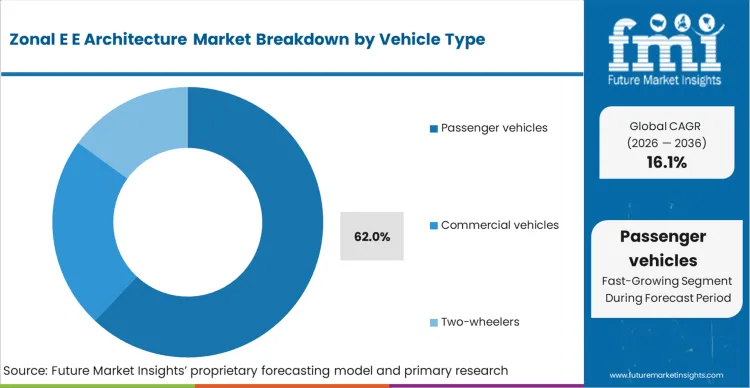
Commercial fleets, while scaling, prioritize ruggedness over immediate infotainment upgrades. Passenger vehicles dominate adoption curves, commanding 62% of the market as consumer expectations for seamless digital experiences force rapid architectural changes. The International Energy Agency reported that global electric car sales exceeded 17 million in 2024 [5], creating a massive installed base structurally primed for advanced electronic architectures. The automakers specify these advanced software-defined vehicle frameworks to avoid hardware obsolescence in consumer product lines. The transition away from decentralized modules directly accelerates this shift, providing the requisite volume for mass industrial adoption.
- Dietary Compliance: Emissions and efficiency mandates force a transition away from heavy copper wiring harnesses.
- Requalification Cycles: Lengthen as safety-critical passenger transport systems undergo more rigorous cybersecurity penetration testing.
- Cost Structures: Tighten when competing baseline vehicle models flood the zone without offering over-the-air update capabilities.
Zonal E E Architecture Market Drivers, Restraints, and Opportunities
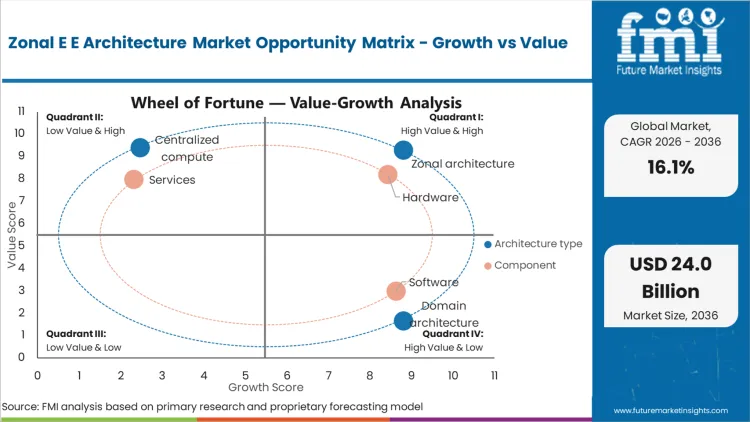
Data bandwidth requirements force widespread platform reformulations across the fast-moving automotive sector. Vehicle architects replace legacy CAN-bus networks with high-speed Ethernet derivatives to capture expanding data generated by LiDAR and high-resolution cameras. Improved semiconductor stability directly accelerates this transition, providing the requisite processing volume for mass industrial adoption. The Eclipse Foundation reported in April 2025 that 79% of automotive respondents use open-source tools [6], reflecting a massive shift toward collaborative software ecosystems. FMI analysts opine that production lines adapt to these novel architectures to eliminate physical complexity, encouraging long-term procurement commitments for unified compute platforms.
Validation costs and cybersecurity vulnerabilities restrict rapid capacity scaling for fully centralized networks. Software engineering protocols demand significant capital and testing inputs, compressing margins for emerging manufacturers competing against entrenched Tier-1 supply chains. The margin pressure intensifies when misconfigurations expose vehicle networks; OWASP reported an average security misconfiguration incidence rate of 3.00% across tested applications in 2025 [7]. Producers refine isolation methods to lower unit costs and differentiate their platform security applications to justify slight premiums.
- Ecosystem Standardization: The Linux Foundation reported open-source automotive adoption at 55% in 2025 [8]. Consortia inject capital into standardized operating systems to bypass early commercialization bottlenecks.
- Intelligent Driving Integration: Valeo announced a strategic partnership to co-develop intelligent assisted driving products in September 2025 [9]. Processors holding advanced ADAS integration capabilities capture early market share in high-value passenger vehicle applications.
- Localized Fleet Infrastructure: The USDOT selected three connected vehicle pilot recipients for a combined USD 45 million in federal funding [10]. Building connected architectures near municipal fleet hubs reduces deployment friction and secures direct government procurement access.
Regional Analysis
.webp "Top Country Growth Comparison Zonal E E Architecture Market Cagr (2026 2036)")
Based on the regional analysis, the Zonal E E Architecture market is segmented into North America, Latin America, Europe, East Asia, South Asia, Oceania and Middle East & Africa across 40+ countries. The full report also offers market attractiveness analysis based on regional trends.
| Country | CAGR (2026 to 2036) |
|---|---|
| India | 21.0% |
| China | 20.0% |
| USA | 19.0% |
| Germany | 18.0% |
| South Korea | 18.0% |
| Japan | 17.0% |
| UK | 16.0% |
Source: Future Market Insights (FMI) analysis, based on proprietary forecasting model and primary research
Asia Pacific Zonal E E Architecture Market Analysis
Asia Pacific’s commercialization pace is increasingly defined by how quickly regional manufacturers convert legacy assembly lines into software-centric production hubs. Instead of relying solely on imported control units, domestic tech operators are upgrading their own semiconductor and software integration systems to capture better margins from the smart mobility shift. This structural shift reflects a broader opportunity: replacing volatile siloed electronics with scalable, regionally developed compute platforms. As one regional trade body noted, local engineering depth determines long-term automotive profitability, underscoring why modernization is accelerating. Supply chain localization shields processors from freight volatility and currency swings, creating an upstream bottleneck that converts localized SoC availability into the primary determinant of production scale.
- India: Cost sensitivity dictates architectural migration, forcing domestic automakers to adopt value-focused, phased zonal rollouts starting exclusively in premium EV trims. The zonal architecture market in India to expand at 21.0% annually through 2036. Infineon's announcement of a Zone Controller Development Kit [1] provides the reference architecture local integrators require to bypass costly ground-up development. Procurement directors must secure partnerships with validated platform providers before local consumer demand for connected features outpaces domestic engineering capacity.
- China: China's zonal architecture sector is poised to expand at a CAGR of 20.0% through 2036. China remains the fastest scale-up zone for centralized architectures due to aggressive EV penetration and massive localized supply-chain investments. The International Energy Agency noted that electric cars surpassed 20% of global new car sales in 2024 [11], disproportionately driven by Asian fleet expansions. Suppliers without certified high-bandwidth zonal controllers face immediate exclusion from the next generation of domestic hyper-connected vehicle tenders.
- Japan: Japanese OEMs emphasize functional safety and quality, tightly coupling zonal adoption with proprietary, in-house system-on-chip roadmaps. DENSO's joint development agreement with MediaTek for custom mobility SoCs [4] highlights the region's refusal to rely entirely on off-the-shelf silicon for critical control networks. Buyers that fail to integrate these custom-silicon architectures before the 2028 model year lock-ins cannot compete on advanced safety feature latency, a competitive reality driving Japan to see its sector grow at 17.0% annually over the forecast period.
- South Korea: High-speed cockpit and ADAS upgrades define the South Korean trajectory, heavily supported by a robust domestic consumer electronics ecosystem. Hyundai introduced its mobility software brand “Pleos” at a developer conference in March 2025 [12], actively transitioning its entire brand platform toward software-defined operational models. Demand for connected frameworks in South Korea is estimated to expand at a CAGR of 18.0% over the forecast period. Software integrators must align API compatibility with these dominant national platforms to remain viable vendors in the regional supply chain.
FMI's report includes comprehensive tracking of the Asia Pacific processing landscape, connecting hardware output to finished software integration capacity. Markets such as Indonesia and Thailand serve as vital production zones, leveraging expanding electronics manufacturing networks to supply regional automotive plants. Rising foreign direct investment in ASEAN automotive hubs shapes continuous procurement demand for standardized wiring and network testing infrastructure.
North America Zonal E E Architecture Market Analysis
North America’s mobility landscape is undergoing recalibration as domestic legislative funding aligns with downstream technology investment. Rebounding electric vehicle output reduces dependence on imported control systems, while public-private consortiums channel funding into commercial-scale connected infrastructure. A 2025 industry executive noted that bridging pilot success to industrial throughput is the real unlock for zonal systems, reflecting how capital inflows are translating into infrastructure expansion. Functionality-led substitution away from distributed ECUs continues to influence formulation, as brands seek lighter vehicles without compromising data processing performance. This establishes OTA certification as the de facto entry requirement rather than a differentiating feature before the next sourcing cycle.
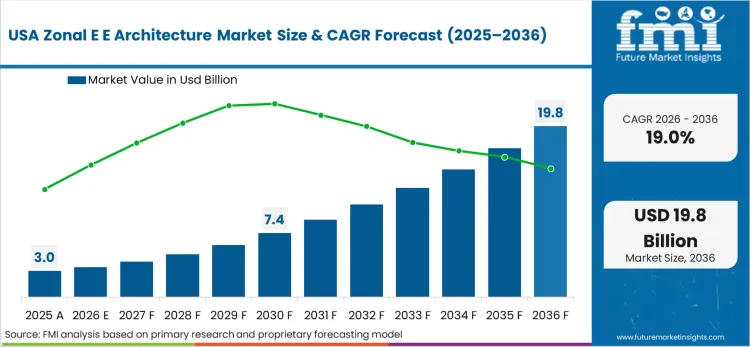
- United States: A CAGR of 19.0% is projected for centralized architectures in the United States through 2036. Adoption concentrates around software-defined vehicle compute stacks and supplier-led reference platforms designed to manage complex OTA updates. The USDOT NYCDOT pilot outfitted approximately 3,000 city fleet vehicles with connected-vehicle technology [13], proving that institutional buyers are already mandating interconnected architectures. Tier-1 integrators must establish native cybersecurity frameworks to win federal and municipal fleet contracts over the coming decade.
FMI's report includes comprehensive tracking of the North American processing landscape, connecting silicon engineering to finished vehicle capacity. Canada and Mexico operate as integrated supply nodes, enabling cross-border hardware movement and automotive assembly optimization. Shifting trade policies regarding semiconductor origins directly influence the procurement strategies that dictate regional platform architecture choices.
Europe Zonal E E Architecture Market Analysis
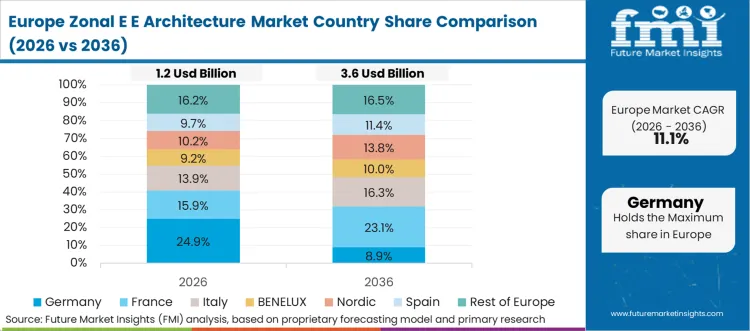
Europe functions as a technical proving ground for advanced isolation methods under strict functional safety and cybersecurity rules. Regulatory scrutiny compels manufacturers to source secure, low-latency architectures while minimizing exposure to volatile external software supply chains. The region heavily prioritizes standardizing operating systems to manage the complex interplay between autonomous driving functions and passenger safety systems. This dynamic reinforces strategic pivoting toward domestically engineered central compute units and tightly controlled developer ecosystems. Collaborative research initiatives between universities and automakers accelerate software validation innovation, compressing the window for compliance testing as enforcement accelerates.
- Germany: Germany leads Tier-1 engineering industrialization, forcing OEM-level standardization on zone control and central compute units. ZF stated a high-performance version of its ProAI went into series production at the end of 2024 [14], transitioning theoretical architectures into mass-market deployment. Over the forecast period, zonal architecture in Germany is set for a CAGR of 18.0%. Competitors lacking validated, series-production-ready compute units cannot participate in the European procurement cycles opening for 2027 vehicle architectures.
- United Kingdom: Software stacks and connected experience dominate the UK sector, prioritizing test automation and OTA capability over sheer manufacturing scale. The CVE Program reported 12,009 CVE Records in Q1 2025 [15], underscoring the severe cybersecurity risks inherent in poorly managed connected software ecosystems. Developers must embed automated threat detection directly into the zonal hypervisors to pass stringent safety homologation processes, supporting the United Kingdom's forecast to advance at a 16.0% CAGR.
FMI's report includes comprehensive tracking of the European processing landscape, connecting regulatory mandates to finished integration capacity. France and Italy benefit from strong industrial bases that support specialized ADAS and structural architecture innovation. Stringent data privacy regulations unique to the EU dictate how vehicle telemetry is processed and stored locally at the zonal level.
Competitive Aligners for Market Players
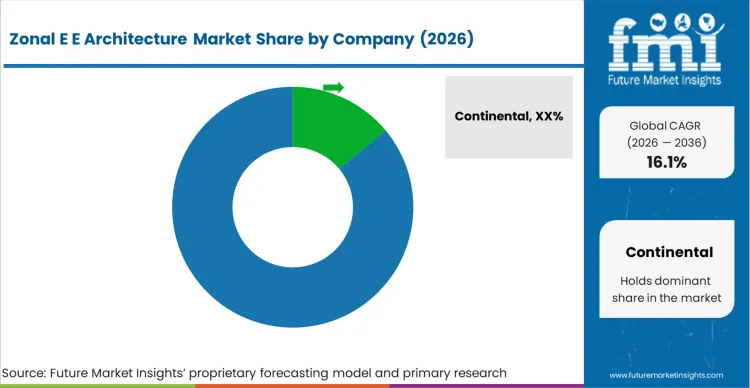
Market structure relies heavily on access to consistent, low-latency silicon and validated software stacks. Companies holding intellectual property for specific hypervisor isolation techniques command higher margins by delivering platforms with superior security profiles. Magna announced a collaboration with NVIDIA to unveil a working demo platform in March 2025 [16], allowing automakers to bypass early-stage hardware testing. Integrated processors secure multi-year procurement contracts to stabilize operations across volatile automotive production cycles.
Technological capability differentiates premium suppliers from bulk component manufacturers. Facilities positioned near major automotive design hubs maintain a structural advantage over competitors reliant on distant engineering support. Continental highlighted its server-zone architectures in 2026 [17], shifting negotiating leverage from legacy wiring harness suppliers to those offering integrated compute solutions. Automotive brands without co-development access face extended lead times when modifying core vehicle functions.
Strategic partnerships and joint ventures accelerate commercialization timelines for emerging connectivity players. Co-investment programs offset the massive capital requirements associated with validating safety-critical automotive electronics. Bosch announced an initiative to integrate NVIDIA DRIVE AGX Thor into future compute architectures in September 2025 [18], standardizing high-end processing power across multiple vehicle platforms. Regional OEMs must align their internal software teams with these Tier-1 compute standards or risk stranding their development investments.
Recent Developments
The report includes full coverage of key trends from competitive benchmarking. Some of the recent developments covered in the reports:
- In June 2025, NXP announced the co-development of a centralized vehicle architecture for zonal control in partnership with Rimac Technology. [19]
- In August 2025, Valeo announced it opened a new production facility in China to actively support the software-defined vehicle shift. [20]
Key Players in Zonal E E Architecture Market
- Continental
- Bosch
- Denso
- Aptiv
- Valeo
- NXP Semiconductors
- Infineon Technologies
- Magna International
- ZF Friedrichshafen
- Hyundai Mobis
Scope of the Report
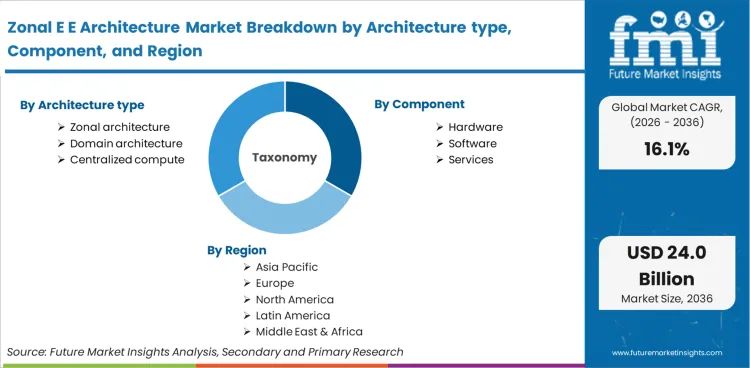
| Metric | Value |
|---|---|
| Quantitative Units | USD 5.4 billion to USD 24.0 billion, at a CAGR of 16.10% |
| Market Definition | A centralized automotive computing framework utilizing high-speed Ethernet and consolidated zonal controllers to replace distributed ECUs. |
| Architecture type Segmentation | Zonal architecture, Domain architecture, Centralized compute |
| Component Segmentation | Hardware, Software, Services |
| Controller type Segmentation | Zonal controllers, Domain controllers, Central compute units |
| Vehicle type Segmentation | Passenger vehicles, Commercial vehicles, Two-wheelers |
| Regions Covered | North America, Latin America, Europe, East Asia, South Asia, Oceania, Middle East and Africa |
| Countries Covered | United States, Canada, Mexico, Brazil, Argentina, Germany, France, United Kingdom, Italy, Spain, China, India, Japan, South Korea, Indonesia, Australia and 40 plus countries |
| Key Companies Profiled | Continental, Bosch, Denso, Aptiv, Valeo, NXP Semiconductors, Infineon Technologies |
| Forecast Period | 2026 to 2036 |
| Approach | Hybrid top-down and bottom-up market modeling validated through primary interviews with automotive integrators, supported by trade data benchmarking |
Source: Future Market Insights (FMI) analysis, based on proprietary forecasting model and primary research
Segmental Analysis
Architecture Type:
- Zonal architecture
- Domain architecture
- Centralized compute
Component:
- Hardware
- Software
- Services
Controller Type:
- Zonal controllers
- Domain controllers
- Central compute units
Vehicle Type:
- Passenger vehicles
- Commercial vehicles
- Two-wheelers
Region:
- Asia Pacific
- India
- China
- Japan
- South Korea
- Indonesia
- Australia & New Zealand
- ASEAN
- Rest of Asia Pacific
- Europe
- Germany
- Italy
- France
- United Kingdom
- Spain
- Benelux
- Nordics
- Central & Eastern Europe
- Rest of Europe
- North America
- United States
- Canada
- Mexico
- Latin America
- Brazil
- Argentina
- Chile
- Rest of Latin America
- Middle East & Africa
- Kingdom of Saudi Arabia
- United Arab Emirates
- South Africa
- Turkey
- Rest of Middle East & Africa
Bibliography
- [1] Infineon Technologies. (2026, January 02). Infineon and Flex launch Zone Controller Development Kit for software-defined vehicles at CES 2026 (Market news).
- [2] NXP Semiconductors. (2025, March 11). New S32K5 Microcontroller Family Advances Zonal SDV Architectures and Extends the NXP CoreRide Platform (Press release).
- [4] DENSO Corporation. (2025, December 26). DENSO and MediaTek Collaborate on Automotive SoCs for Advanced Driver-Assistance Systems (Company news release).
- [5] International Energy Agency (IEA). (2025). Global EV Outlook 2025: Trends in Electric Car Markets (Government report).
- [6] Eclipse Foundation. (2025, April). 2025 State of Automotive Software Development (Industry report).
- [7] OWASP Foundation. (2025). OWASP Top 10 for 2025: Security Misconfiguration (Industry report).
- [8] Linux Foundation. (2025). The State of Global Open Source 2025 (Industry report).
- [9] Valeo. (2025, September 05). Valeo and Momenta Enter Strategic Partnership for Intelligent Assisted Driving Products (Press release).
- [10] U.S. Department of Transportation (USDOT). (2025, May). Connected Vehicle Pilot Program Update (Government report).
- [11] International Energy Agency (IEA). (2025). Global EV Outlook 2025: Trends in Electric Car Markets (Government report).
- [12] Hyundai Motor Company. (2025, March 27). Hyundai Introduces Mobility Software Brand Pleos (Press release).
- [13] U.S. Department of Transportation (USDOT). (2025, May). Connected Vehicle Pilot Program Update (Government report).
- [14] ZF Friedrichshafen AG. (2025, June 17). High-Performance Version of ZF ProAI Enters Series Production (Press release).
- [15] CVE Program. (2025, May 28). CVE Program Report for Quarter 1 Calendar Year (Q1 CY) 2025 (Statistical database entry).
- [16] Magna International. (2025, March 18). Magna and NVIDIA Team Up to Advance Next-Gen Automated Driving Technologies (Press release).
- [17] Continental AG. (2026). Technology Highlights: Server-Zone Architectures for Software-Defined Vehicles (Company news release).
- [18] Bosch. (2025, September 30). Bosch Integrates NVIDIA DRIVE AGX Thor into Future Vehicle Architectures (Press release).
- [19] NXP Semiconductors. (2025, June 12). NXP and Rimac Technology Announce Co-Development of Centralized Vehicle Architecture for Zonal Control (Press release).
- [20] Valeo. (2025, August 29). Valeo Opens New Production Facility in China to Support the Software-Defined Vehicle Revolution (Press release).
This bibliography is provided for reader reference and is not exhaustive. The full report contains the complete reference list and detailed citations.
This Report Addresses
- Market size estimation and revenue forecasts from 2026 to 2036, supported by validated capacity and trade benchmarks across major automotive manufacturing hubs.
- Growth opportunity mapping across zonal and domain architecture formats with emphasis on software-defined vehicle supply chain transitions.
- Segment and regional revenue forecasts covering critical components like hardware microcontrollers, system-on-chips, and foundational software services.
- Competition strategy assessment including hardware-software integration models, cost survivability positioning, and cybersecurity testing capability benchmarking.
- Product reformulation tracking covering key metrics such as data processing latency, thermal management limits, and over-the-air update frequencies.
- Regulatory impact analysis evaluating strict vehicle emissions mandates, autonomous driving safety protocols, and connected vehicle cybersecurity guidelines.
- Market report delivery in PDF, Excel, PPT, and interactive dashboard formats for executive and operational automotive planning use.
Frequently Asked Questions
How large is the demand for Zonal E E Architecture in the global market in 2026?
Demand for Zonal E E Architecture in the global market is estimated to be valued at USD 5.4 billion in 2026.
What will be the market size of Zonal E E Architecture in the global market by 2036?
Market size for Zonal E E Architecture is projected to reach USD 24.0 billion by 2036.
What is the expected demand growth for Zonal E E Architecture in the global market between 2026 and 2036?
Demand for Zonal E E Architecture is expected to grow at a CAGR of 16.10% between 2026 and 2036.
Which Architecture type is poised to lead global sales by 2026?
Zonal architecture commands 55% in 2026 as manufacturers prioritize bulk data aggregation and reduced wiring weight.
How significant is the role of Passenger vehicles in driving Zonal E E Architecture adoption in 2026?
Passenger vehicles represent 62% of segment share as brands replace siloed ECUs to enable advanced autonomous features.
What is driving demand in India?
Value-driven engineering fortification and localization of domestic automotive assembly streams drive functional architecture adoption in India.
What compliance standards or regulations are referenced for India?
Functional safety guidelines and clean-label software certification mandates directly influence domestic procurement behavior.
What is the India growth outlook in this report?
India is projected to grow at a CAGR of 21.0% during 2026 to 2036.
Why is North America described as a priority region in this report?
Rebounding domestic EV production and strong government-backed infrastructure funding accelerate connected architecture capacity.
What type of demand dominates in North America?
Software-first switching and ADAS-led substitution dominate regional formulation demand.
What is China's growth outlook in this report?
China is projected to expand at a CAGR of 20.0% during 2026 to 2036.
Does the report cover United States in its regional analysis?
Yes, the United States is included within North America under the regional scope of analysis.
What are the sources referred to for analyzing United States?
Official transportation deployment data from the USDOT and corporate capacity announcements form the analytical basis.
What is the main demand theme linked to United States in its region coverage?
Functionality-led formulation switching to replace legacy domain controllers shapes continuous procurement demand.
Does the report cover United Kingdom in its regional analysis?
Yes, the United Kingdom is included within Europe under the regional coverage framework.
What is the main United Kingdom related demand theme in its region coverage?
Automated threat detection and the strategic management of connected software ecosystems dominate regional buyer behavior.
Which product formats or configurations are strategically important for Asia Pacific supply chains?
High-performance zonal controllers generated from localized semiconductor development roadmaps hold immense strategic importance.
What is Zonal E E Architecture and what is it mainly used for?
It is a centralized automotive computing framework utilized primarily to aggregate sensor data, distribute power, and enable software-defined vehicle operations.
What does Zonal E E Architecture mean in this report?
The market refers to the global production, trade, and industrial consumption of zonal hardware and software controllers in modern vehicles.
What is included in the scope of this Zonal E E Architecture report?
Scope includes high-speed Ethernet gateways, central compute units, and related software platforms designated for mobility networks.
What is excluded from the scope of this report?
Legacy standalone ECUs, basic non-managed wiring harnesses, and purely consumer-facing infotainment systems are strictly excluded.
What does market forecast mean on this page?
The market forecast represents a model-based projection built on defined technological and automotive capacity assumptions for strategic planning purposes.
How does FMI build and validate the Zonal E E Architecture forecast?
Forecasts combine top-down vehicle production data with bottom-up silicon attachment yields, validated by primary Tier-1 integrator interviews.
What does zero reliance on speculative third-party market research mean here?
Primary interviews, verified patent filings, and official transportation datasets are used exclusively instead of unverified syndicated estimates.
Preview the report firsthand - request a free sample
Get SampleGet the brochure for pricing and purchase details.
Get PDFTable of Content
- Executive Summary
- Global Market Outlook
- Demand-side Trends
- Supply-side Trends
- Technology Roadmap Analysis
- Analysis and Recommendations
- Market Overview
- Market Coverage / Taxonomy
- Market Definition / Scope / Limitations
- Research Methodology
- Chapter Orientation
- Analytical Lens and Working Hypotheses
- Market Structure, Signals, and Trend Drivers
- Benchmarking and Cross-market Comparability
- Market Sizing, Forecasting, and Opportunity Mapping
- Research Design and Evidence Framework
- Desk Research Programme (Secondary Evidence)
- Company Annual and Sustainability Reports
- Peer-reviewed Journals and Academic Literature
- Corporate Websites, Product Literature, and Technical Notes
- Earnings Decks and Investor Briefings
- Statutory Filings and Regulatory Disclosures
- Technical White Papers and Standards Notes
- Trade Journals, Industry Magazines, and Analyst Briefs
- Conference Proceedings, Webinars, and Seminar Materials
- Government Statistics Portals and Public Data Releases
- Press Releases and Reputable Media Coverage
- Specialist Newsletters and Curated Briefings
- Sector Databases and Reference Repositories
- FMI Internal Proprietary Databases and Historical Market Datasets
- Subscription Datasets and Paid Sources
- Social Channels, Communities, and Digital Listening Inputs
- Additional Desk Sources
- Expert Input and Fieldwork (Primary Evidence)
- Primary Modes
- Qualitative Interviews and Expert Elicitation
- Quantitative Surveys and Structured Data Capture
- Blended Approach
- Why Primary Evidence is Used
- Field Techniques
- Interviews
- Surveys
- Focus Groups
- Observational and In-context Research
- Social and Community Interactions
- Stakeholder Universe Engaged
- C-suite Leaders
- Board Members
- Presidents and Vice Presidents
- R&D and Innovation Heads
- Technical Specialists
- Domain Subject-matter Experts
- Scientists
- Physicians and Other Healthcare Professionals
- Governance, Ethics, and Data Stewardship
- Research Ethics
- Data Integrity and Handling
- Primary Modes
- Tooling, Models, and Reference Databases
- Desk Research Programme (Secondary Evidence)
- Data Engineering and Model Build
- Data Acquisition and Ingestion
- Cleaning, Normalisation, and Verification
- Synthesis, Triangulation, and Analysis
- Quality Assurance and Audit Trail
- Market Background
- Market Dynamics
- Drivers
- Restraints
- Opportunity
- Trends
- Scenario Forecast
- Demand in Optimistic Scenario
- Demand in Likely Scenario
- Demand in Conservative Scenario
- Opportunity Map Analysis
- Product Life Cycle Analysis
- Supply Chain Analysis
- Investment Feasibility Matrix
- Value Chain Analysis
- PESTLE and Porter’s Analysis
- Regulatory Landscape
- Regional Parent Market Outlook
- Production and Consumption Statistics
- Import and Export Statistics
- Market Dynamics
- Global Market Analysis 2021 to 2025 and Forecast, 2026 to 2036
- Historical Market Size Value (USD Million) Analysis, 2021 to 2025
- Current and Future Market Size Value (USD Million) Projections, 2026 to 2036
- Y-o-Y Growth Trend Analysis
- Absolute $ Opportunity Analysis
- Global Market Pricing Analysis 2021 to 2025 and Forecast 2026 to 2036
- Global Market Analysis 2021 to 2025 and Forecast 2026 to 2036, By Architecture type
- Introduction / Key Findings
- Historical Market Size Value (USD Million) Analysis By Architecture type , 2021 to 2025
- Current and Future Market Size Value (USD Million) Analysis and Forecast By Architecture type , 2026 to 2036
- Zonal architecture
- Domain architecture
- Centralized compute
- Zonal architecture
- Y-o-Y Growth Trend Analysis By Architecture type , 2021 to 2025
- Absolute $ Opportunity Analysis By Architecture type , 2026 to 2036
- Global Market Analysis 2021 to 2025 and Forecast 2026 to 2036, By Component
- Introduction / Key Findings
- Historical Market Size Value (USD Million) Analysis By Component, 2021 to 2025
- Current and Future Market Size Value (USD Million) Analysis and Forecast By Component, 2026 to 2036
- Hardware
- Software
- Services
- Hardware
- Y-o-Y Growth Trend Analysis By Component, 2021 to 2025
- Absolute $ Opportunity Analysis By Component, 2026 to 2036
- Global Market Analysis 2021 to 2025 and Forecast 2026 to 2036, By Controller Type
- Introduction / Key Findings
- Historical Market Size Value (USD Million) Analysis By Controller Type, 2021 to 2025
- Current and Future Market Size Value (USD Million) Analysis and Forecast By Controller Type, 2026 to 2036
- Zonal controllers
- Domain controllers
- Central compute units
- Zonal controllers
- Y-o-Y Growth Trend Analysis By Controller Type, 2021 to 2025
- Absolute $ Opportunity Analysis By Controller Type, 2026 to 2036
- Global Market Analysis 2021 to 2025 and Forecast 2026 to 2036, By Vehicle Type
- Introduction / Key Findings
- Historical Market Size Value (USD Million) Analysis By Vehicle Type, 2021 to 2025
- Current and Future Market Size Value (USD Million) Analysis and Forecast By Vehicle Type, 2026 to 2036
- Passenger vehicles
- Commercial vehicles
- Two-wheelers
- Passenger vehicles
- Y-o-Y Growth Trend Analysis By Vehicle Type, 2021 to 2025
- Absolute $ Opportunity Analysis By Vehicle Type, 2026 to 2036
- Global Market Analysis 2021 to 2025 and Forecast 2026 to 2036, By Region
- Introduction
- Historical Market Size Value (USD Million) Analysis By Region, 2021 to 2025
- Current Market Size Value (USD Million) Analysis and Forecast By Region, 2026 to 2036
- North America
- Latin America
- Western Europe
- Eastern Europe
- East Asia
- South Asia and Pacific
- Middle East & Africa
- Market Attractiveness Analysis By Region
- North America Market Analysis 2021 to 2025 and Forecast 2026 to 2036, By Country
- Historical Market Size Value (USD Million) Trend Analysis By Market Taxonomy, 2021 to 2025
- Market Size Value (USD Million) Forecast By Market Taxonomy, 2026 to 2036
- By Country
- USA
- Canada
- Mexico
- By Architecture type
- By Component
- By Controller Type
- By Vehicle Type
- By Country
- Market Attractiveness Analysis
- By Country
- By Architecture type
- By Component
- By Controller Type
- By Vehicle Type
- Key Takeaways
- Latin America Market Analysis 2021 to 2025 and Forecast 2026 to 2036, By Country
- Historical Market Size Value (USD Million) Trend Analysis By Market Taxonomy, 2021 to 2025
- Market Size Value (USD Million) Forecast By Market Taxonomy, 2026 to 2036
- By Country
- Brazil
- Chile
- Rest of Latin America
- By Architecture type
- By Component
- By Controller Type
- By Vehicle Type
- By Country
- Market Attractiveness Analysis
- By Country
- By Architecture type
- By Component
- By Controller Type
- By Vehicle Type
- Key Takeaways
- Western Europe Market Analysis 2021 to 2025 and Forecast 2026 to 2036, By Country
- Historical Market Size Value (USD Million) Trend Analysis By Market Taxonomy, 2021 to 2025
- Market Size Value (USD Million) Forecast By Market Taxonomy, 2026 to 2036
- By Country
- Germany
- UK
- Italy
- Spain
- France
- Nordic
- BENELUX
- Rest of Western Europe
- By Architecture type
- By Component
- By Controller Type
- By Vehicle Type
- By Country
- Market Attractiveness Analysis
- By Country
- By Architecture type
- By Component
- By Controller Type
- By Vehicle Type
- Key Takeaways
- Eastern Europe Market Analysis 2021 to 2025 and Forecast 2026 to 2036, By Country
- Historical Market Size Value (USD Million) Trend Analysis By Market Taxonomy, 2021 to 2025
- Market Size Value (USD Million) Forecast By Market Taxonomy, 2026 to 2036
- By Country
- Russia
- Poland
- Hungary
- Balkan & Baltic
- Rest of Eastern Europe
- By Architecture type
- By Component
- By Controller Type
- By Vehicle Type
- By Country
- Market Attractiveness Analysis
- By Country
- By Architecture type
- By Component
- By Controller Type
- By Vehicle Type
- Key Takeaways
- East Asia Market Analysis 2021 to 2025 and Forecast 2026 to 2036, By Country
- Historical Market Size Value (USD Million) Trend Analysis By Market Taxonomy, 2021 to 2025
- Market Size Value (USD Million) Forecast By Market Taxonomy, 2026 to 2036
- By Country
- China
- Japan
- South Korea
- By Architecture type
- By Component
- By Controller Type
- By Vehicle Type
- By Country
- Market Attractiveness Analysis
- By Country
- By Architecture type
- By Component
- By Controller Type
- By Vehicle Type
- Key Takeaways
- South Asia and Pacific Market Analysis 2021 to 2025 and Forecast 2026 to 2036, By Country
- Historical Market Size Value (USD Million) Trend Analysis By Market Taxonomy, 2021 to 2025
- Market Size Value (USD Million) Forecast By Market Taxonomy, 2026 to 2036
- By Country
- India
- ASEAN
- Australia & New Zealand
- Rest of South Asia and Pacific
- By Architecture type
- By Component
- By Controller Type
- By Vehicle Type
- By Country
- Market Attractiveness Analysis
- By Country
- By Architecture type
- By Component
- By Controller Type
- By Vehicle Type
- Key Takeaways
- Middle East & Africa Market Analysis 2021 to 2025 and Forecast 2026 to 2036, By Country
- Historical Market Size Value (USD Million) Trend Analysis By Market Taxonomy, 2021 to 2025
- Market Size Value (USD Million) Forecast By Market Taxonomy, 2026 to 2036
- By Country
- Kingdom of Saudi Arabia
- Other GCC Countries
- Turkiye
- South Africa
- Other African Union
- Rest of Middle East & Africa
- By Architecture type
- By Component
- By Controller Type
- By Vehicle Type
- By Country
- Market Attractiveness Analysis
- By Country
- By Architecture type
- By Component
- By Controller Type
- By Vehicle Type
- Key Takeaways
- Key Countries Market Analysis
- USA
- Pricing Analysis
- Market Share Analysis, 2025
- By Architecture type
- By Component
- By Controller Type
- By Vehicle Type
- Canada
- Pricing Analysis
- Market Share Analysis, 2025
- By Architecture type
- By Component
- By Controller Type
- By Vehicle Type
- Mexico
- Pricing Analysis
- Market Share Analysis, 2025
- By Architecture type
- By Component
- By Controller Type
- By Vehicle Type
- Brazil
- Pricing Analysis
- Market Share Analysis, 2025
- By Architecture type
- By Component
- By Controller Type
- By Vehicle Type
- Chile
- Pricing Analysis
- Market Share Analysis, 2025
- By Architecture type
- By Component
- By Controller Type
- By Vehicle Type
- Germany
- Pricing Analysis
- Market Share Analysis, 2025
- By Architecture type
- By Component
- By Controller Type
- By Vehicle Type
- UK
- Pricing Analysis
- Market Share Analysis, 2025
- By Architecture type
- By Component
- By Controller Type
- By Vehicle Type
- Italy
- Pricing Analysis
- Market Share Analysis, 2025
- By Architecture type
- By Component
- By Controller Type
- By Vehicle Type
- Spain
- Pricing Analysis
- Market Share Analysis, 2025
- By Architecture type
- By Component
- By Controller Type
- By Vehicle Type
- France
- Pricing Analysis
- Market Share Analysis, 2025
- By Architecture type
- By Component
- By Controller Type
- By Vehicle Type
- India
- Pricing Analysis
- Market Share Analysis, 2025
- By Architecture type
- By Component
- By Controller Type
- By Vehicle Type
- ASEAN
- Pricing Analysis
- Market Share Analysis, 2025
- By Architecture type
- By Component
- By Controller Type
- By Vehicle Type
- Australia & New Zealand
- Pricing Analysis
- Market Share Analysis, 2025
- By Architecture type
- By Component
- By Controller Type
- By Vehicle Type
- China
- Pricing Analysis
- Market Share Analysis, 2025
- By Architecture type
- By Component
- By Controller Type
- By Vehicle Type
- Japan
- Pricing Analysis
- Market Share Analysis, 2025
- By Architecture type
- By Component
- By Controller Type
- By Vehicle Type
- South Korea
- Pricing Analysis
- Market Share Analysis, 2025
- By Architecture type
- By Component
- By Controller Type
- By Vehicle Type
- Russia
- Pricing Analysis
- Market Share Analysis, 2025
- By Architecture type
- By Component
- By Controller Type
- By Vehicle Type
- Poland
- Pricing Analysis
- Market Share Analysis, 2025
- By Architecture type
- By Component
- By Controller Type
- By Vehicle Type
- Hungary
- Pricing Analysis
- Market Share Analysis, 2025
- By Architecture type
- By Component
- By Controller Type
- By Vehicle Type
- Kingdom of Saudi Arabia
- Pricing Analysis
- Market Share Analysis, 2025
- By Architecture type
- By Component
- By Controller Type
- By Vehicle Type
- Turkiye
- Pricing Analysis
- Market Share Analysis, 2025
- By Architecture type
- By Component
- By Controller Type
- By Vehicle Type
- South Africa
- Pricing Analysis
- Market Share Analysis, 2025
- By Architecture type
- By Component
- By Controller Type
- By Vehicle Type
- USA
- Market Structure Analysis
- Competition Dashboard
- Competition Benchmarking
- Market Share Analysis of Top Players
- By Regional
- By Architecture type
- By Component
- By Controller Type
- By Vehicle Type
- Competition Analysis
- Competition Deep Dive
- Continental
- Overview
- Product Portfolio
- Profitability by Market Segments (Product/Age /Sales Channel/Region)
- Sales Footprint
- Strategy Overview
- Marketing Strategy
- Product Strategy
- Channel Strategy
- Bosch
- Denso
- Aptiv
- Valeo
- NXP Semiconductors
- Infineon Technologies
- Continental
- Competition Deep Dive
- Assumptions & Acronyms Used


