

- Industry Size (2026)
- USD 28.7 Bn
- Forecast (2036)
- USD 93.2 Bn
- CAGR (2026 to 2036)
- 12.5%
Digital Signage System Market Forecast and Outlook (2026 to 2036)
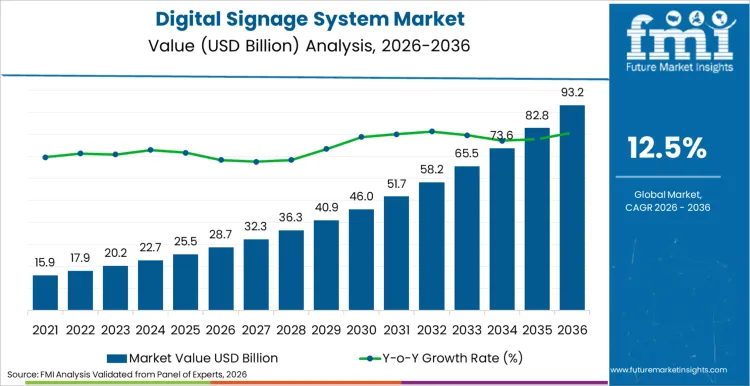
The digital signage system market is valued at USD 28.7 Billion in 2026 and is projected to reach USD 93.2 Billion by 2036, expanding at a 12.5% CAGR. The market expands as large vendors shift from one time display sales to managed fleets that bundle devices, content operations, and remote monitoring into standardised rollouts.
Samsung’s commercial display strategy signals how leadership is defended through scale and platform pull through. In its April 2024 release, Samsung noted leadership in signage manufacturing and tied it to solutions and services expansion, with Hoon Chung stating: ‘Achieving first place in the global display signage market for 15 consecutive years reflects our commitment to innovation and our ability to adapt to evolving market conditions and the needs of our customers.’
Cisco’s collaboration device roadmap also overlaps with signage style deployments in meeting rooms, classrooms, and shared spaces that run scheduled content alongside communications. At Enterprise Connect 2024, Jeetu Patel stated: ‘Cisco is expanding our portfolio of collaboration devices to deliver modern experiences to every corner of the office.’ This reinforces buyer preference for devices that can be centrally managed and repurposed across use cases.
Energy and sustainability positioning is becoming a purchase filter for always on screens. Sharp’s February 2024 launch of ePaper explicitly frames ultra low power signage for static information, with Keith Yanke stating: ‘Sharp’s new ePaper provides a sustainable and quick alternative to traditional poster boards and printed posters while fitting seamlessly into the ongoing business practices.’
Summary of Digital Signage System Market
- The digital signage system market comprises networked commercial displays and the associated content management, scheduling, distribution, and remote operations software used across retail, corporate, transport, healthcare, and public venues.
- The defined scope follows FMI taxonomy across display technology, software layer, deployment type, and application, excluding consumer televisions without managed signage software and non-electronic static media.
- The market is projected to grow at a 12.5% CAGR from 2026 to 2036, expanding from USD 28.7 billion in 2026 to USD 93.2 billion by 2036, based on installed-base refresh cycles, networked screen penetration, and rising CMS attach rates.
- LCD or plasma leads with a 56.0% share, content management software with 52.0%, and indoor deployments with 68.0%, reflecting procurement logic centred on lifecycle cost, fleet governance, and controllable operating environments.
- Competition includes Samsung, Cisco, NEC Display Solutions, Panasonic, BroadSign, and others, with leadership shaped by hardware scale, CMS platform depth, and compliance-ready fleet management capabilities.
- China (9.2% CAGR) and India (8.9%) show faster growth driven by smart city rollouts and high-footfall venue expansion, while mature markets focus on compliance-led refresh and managed fleet standardisation.
Digital Signage System Market Key Takeaways
| Metric | Value (USD Billion) |
|---|---|
| Market Size 2026 | USD 28.7 Billion |
| Forecast Value 2036 | USD 93.2 Billion |
| CAGR (2026 to 2036) | 12.5% |
What are the driving forces leading the demand for the Digital Signage System Market?
Enterprise and public venue buyers are tightening performance requirements around accessibility, energy use, and operational control, which increases the value of software governed signage fleets. In the United States, ADA guidance on signs reinforces enforceable expectations around legibility and accessible communication in public facing environments, pushing standardised design and placement requirements that favour managed deployments.
In Europe, Regulation (EU) 2019/2021 explicitly covers digital signs within electronic display ecodesign scope, adding efficiency and compliance gates that influence product selection and refresh timing. Vendors are responding with platforms that centralise content operations and remote management, which raises attach rates for content management software and services.
How is the Digital Signage System Market Segmented?
The digital signage system market is segmented by technology, software layer, deployment type, application, and region to reflect the diverse pathways of screen governance and content control across commercial and public venues. By technology, the market includes LCD or plasma and OLED and LED display formats that serve as the primary hardware interface. By software, demand spans content management, scheduling, and distribution modules, reflecting the need for centralised publishing and remote operations across distributed estates. By type, deployments are divided into indoor and outdoor environments, aligned with venue density and operating conditions. By application, adoption is led by corporate and commercial sectors, retail, transportation, healthcare, and government facilities where communication standardisation and compliance matter.
FMI analysis suggests that while premium display innovation continues, the market structure remains anchored in installed-base governance and fleet manageability. This segmentation highlights a dual-track market where hardware scale provides reach while software control delivers operational depth and lifecycle revenue stability.
How does LCD or plasma retain leadership in 2026 despite premium format innovation?
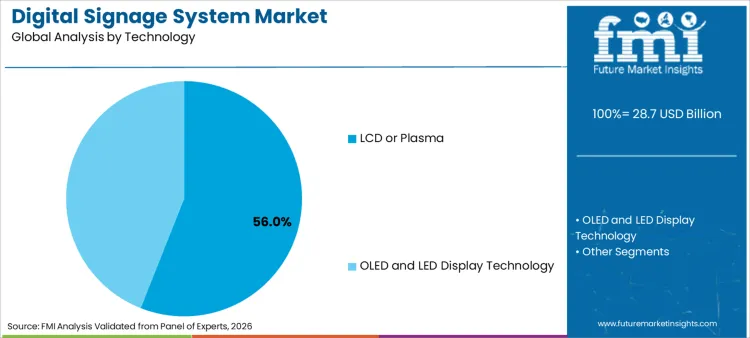
LCD or plasma leads with a 56.0% share in 2026 because procurement remains structured around predictable lifecycle cost, integrator familiarity, and broad availability across sizes that fit retail and workplace rollouts. Leadership vendors reinforce this by scaling commercial display portfolios and positioning them as standardised fleets rather than one off installs. Samsung’s signage communications emphasise specialised devices, solutions, and services, signalling that LCD based estates still underpin the recurring platform layer even as premium formats expand at the margin. EU ecodesign rules explicitly include digital signs within electronic display scope, which elevates compliance documentation and pushes buyers toward mainstream platforms with clear conformity pathways. The result is that LCD continues to win where buyers prioritise rapid deployment, spares availability, and predictable performance under 16 by 7 or 24 by 7 operation, while OLED and LED display technology concentrates in flagship environments with higher capex tolerance.
Why does content management software dominate the software stack in 2026?
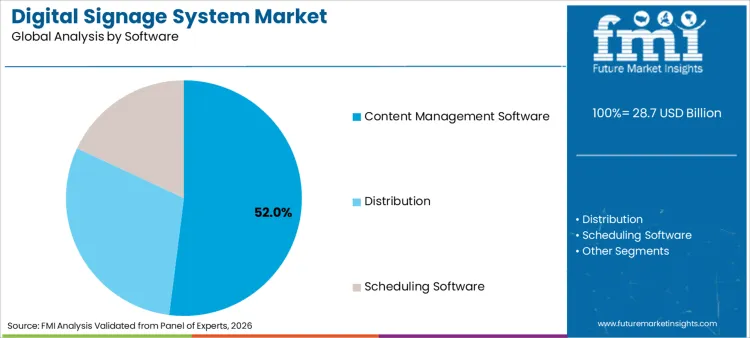
Content management software leads with a 52.0% share in 2026 because the commercial problem is no longer displaying content, it is governing content at scale across distributed estates. Centralised publishing workflows reduce brand risk, enable scheduling discipline, and compress labour per screen through remote administration. Cisco’s device strategy highlights the same control logic across shared spaces, with Jeetu Patel stating the intent to deliver modern experiences across the office, which aligns with buyer demand for centrally managed endpoints that can be updated, secured, and monitored as a fleet. Sharp’s ePaper launch also points to CMS partner distribution and scheduled publishing, reinforcing that software control is the operational layer buyers standardise first. As fleets scale, distribution and scheduling modules increasingly behave as features inside the CMS led control plane rather than standalone budget lines.
Why does indoor signage account for most deployments in 2026?
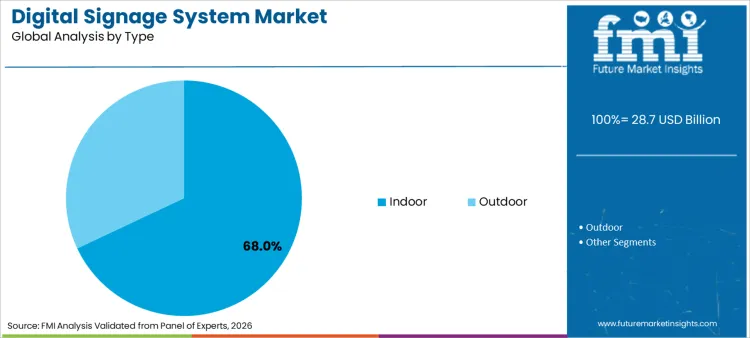
Indoor leads with a 68.0% share in 2026 because indoor venues concentrate the highest density of repeatable screen locations and provide controllable operating conditions. Corporate campuses, retail interiors, hospitals, and stations have stable power, mounting, and network access, which reduces failure rates and service cost per endpoint. Accessibility expectations for signs in public buildings and facilities reinforce standardisation in indoor settings where compliance is easier to enforce through consistent placement and legibility rules. Energy compliance also matters more in indoor estates that run continuously, pushing buyers to compare efficiency and standby behaviour across commercial display lines covered by EU electronic display requirements. Outdoor grows through DOOH monetisation, but indoor retains share because operational control and venue density keep total deployed units higher.
What are the Key Trends and Restraints in Digital Signage System Market?
Digital signage is trending toward energy accountable and remotely operated fleets as buyers face tighter operating cost scrutiny and compliance expectations. EU electronic display rules explicitly include digital signs, which makes efficiency and conformity documentation part of procurement, accelerating replacement of older, less efficient screens in regulated markets. Vendors are responding with platforms that consolidate content publishing and remote operations, visible in major player communications that emphasise solutions and services rather than hardware only positioning.
A key restraint is compliance and governance friction in public facing deployments where accessibility and effective communication expectations impose design, placement, and content discipline. ADA guidance on signs and effective communication raises the operational bar for public accommodations and government facilities, increasing approval cycles and raising the cost of non compliant rework. In practice, this slows rollout velocity for multi site operators until standard templates, mounting rules, and content governance are institutionalised, which shifts buying decisions toward vendors and integrators that can package compliance aligned deployment playbooks.
What is Digital Signage System Market Regional Outlook?
Sales in high-growth urban and smart infrastructure markets are outpacing the global average, driven by smart city programmes, high-footfall venue expansion, and fleet-based screen standardisation. While the global market expands at 12.5%, emerging economies are accelerating deployments through transport digitisation and public interface upgrades. China leads with a 9.2% CAGR, followed closely by India at 8.9%, creating a new growth axis centred on smart city rollouts and commercial venue densification. In contrast, mature markets such as the United States (7.8%) and Germany (6.5%) are focused more on compliance-led refresh cycles, accessibility alignment, and energy-efficient fleet upgrades rather than rapid volume expansion. FMI analysis indicates that future growth will concentrate in urbanised regions where managed signage estates become foundational to communication infrastructure.
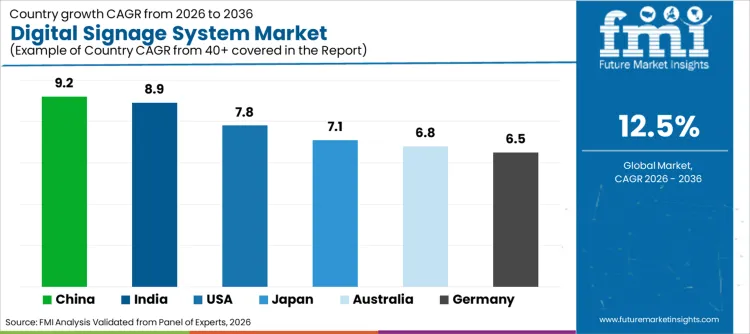
| Country | CAGR (2026 to 2036) |
|---|---|
| USA | 7.8% |
| China | 9.2% |
| Germany | 6.5% |
| Japan | 7.1% |
| India | 8.9% |
| Australia | 6.8% |
Source: Future Market Insights (FMI) analysis, based on proprietary forecasting model and primary research.
Why does the USA sustain a 7.8% CAGR through compliance driven standardisation and enterprise fleet scale?
The USA grows at a 7.8% CAGR as deployments concentrate in enterprise estates and public venues that must align with accessibility and communication expectations. ADA guidance on signs and effective communication pushes organisations to standardise legibility, placement, and accessible delivery, which favours centrally governed fleets over ad hoc screens. This environment supports higher attach for content management software because legal and brand risk is reduced when content and templates are controlled centrally. It also accelerates refresh of older screens as operators seek more controllable endpoints, aligning with vendor strategies that emphasise managed devices and remote operations platforms.
How does China’s 9.2% CAGR track smart city digitisation and high density public infrastructure rollouts?
China grows at a 9.2% CAGR because smart city digitisation programs and dense transport and commercial infrastructure support large scale deployments of networked screens for public information and commercial messaging. Public sector demand aligns with broad deployment of ICT visible infrastructure in public spaces. In practice, this increases demand for large fleets that can be centrally monitored and updated, lifting the value of CMS led architectures and standardised display platforms that can be procured repeatedly across city and venue operators.
Why does Germany expand at 6.5% CAGR under energy and compliance gates for electronic displays?
Germany grows at a 6.5% CAGR because procurement is shaped by energy and conformity requirements that influence display selection and replacement cycles. EU ecodesign rules for electronic displays explicitly include digital signs, which adds efficiency thresholds and compliance expectations that buyers must satisfy when placing products on the market or putting them into service. This increases refresh pressure on older fleets and favours vendors with clear documentation, service networks, and long term support for commercial displays and management platforms.
What keeps Japan at 7.1% CAGR as rail and venue media networks densify screen inventory?
Japan grows at a 7.1% CAGR as transport and station environments expand networked DOOH inventory with measurable impressions and scheduled publishing. LIVE BOARD’s May 2024 announcement of 26 screens at Seibu Railway Ikebukuro Station connected to its marketplace illustrates how rail locations are being integrated into managed media networks rather than treated as isolated installs. This supports demand for robust indoor screens, scheduling, and CMS governance, because station operators and media owners require uptime, content controls, and reporting suitable for contracted media sales.
Why does India deliver an 8.9% CAGR through smart city public interface buildout and compliance tightening?
India grows at an 8.9% CAGR as cities invest in digital public interfaces and operators monetise screens through PPP and contracted operations. Government communications on the Smart Cities Mission emphasise infrastructure and efficient services across cities, which underpins continued rollout of digital systems in public environments. At the same time, energy labelling enforcement is tightening across appliance categories including televisions, strengthening scrutiny on power claims that influences commercial display procurement toward compliant products and transparent specifications. These mechanisms raise demand for managed deployments where technical compliance and operating costs are controlled centrally.
How does Australia’s 6.8% CAGR link to airport and high footfall venue monetisation upgrades?
Australia grows at a 6.8% CAGR as airports and premium venues upgrade digital advertising assets tied to passenger experience and retail conversion. Sydney Airport’s July 2025 announcement with JCDecaux describes new premium digital advertising assets designed to enhance passenger experience and brand impact at key journey moments, reinforcing airport driven rollout of high visibility screens. This supports sustained spend on indoor signage systems, content scheduling, and operational management because airports require contracted uptime and coordinated content across terminals.
Who leads the digital signage system market and how does regional leadership differ across North America, Europe, and Asia?
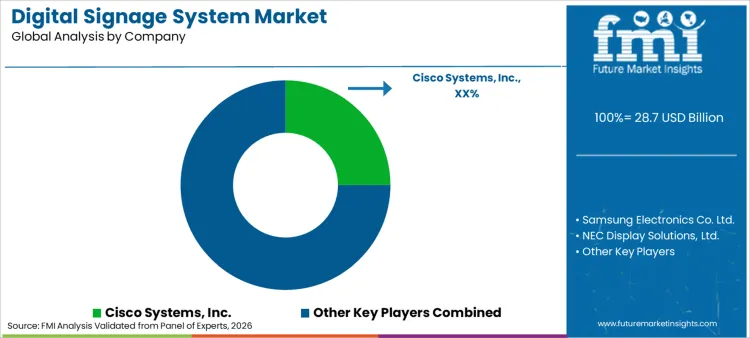
The competitive set spans commercial display OEMs, signage platform vendors, and system integrators delivering managed fleets. Samsung signals global leadership in hardware scale and solution bundling, stating it ranked number one in signage manufacturing for the sixteenth consecutive year and framing leadership around devices, solutions, and services. North America leadership is more fragmented because enterprise and venue buyers often procure through integrators and prioritise software governance and collaboration ecosystem fit, a positioning reinforced by Cisco’s emphasis on expanding collaboration devices across office spaces.
Europe places higher weight on compliance and energy performance since EU electronic display rules include digital signs, which favours vendors with strong conformity documentation and long support lifecycles. In Asia, dense transport and venue networks support large multi site deployments, with Japan showing networked DOOH expansion in rail environments that requires managed scheduling and operations. Scope includes commercial displays and video walls, content management software, scheduling, distribution, and services for networked operation. Scope excludes consumer televisions used without managed signage software and non networked static posters.
Recent developments
- In July 2025, Sydney Airport, in partnership with JCDecaux, launched “Iconic Impact” digital advertising assets across Terminals 1, 2, and 3, introducing high-impact screens in premium, high-dwell zones to enhance brand engagement and passenger experience.
- In March 2024, Cisco launched the AI-powered Board Pro G2 and Desk Phone 9800 Series at Enterprise Connect, delivering multifunctional collaboration devices designed to enhance hybrid work experiences with optimized video, touch-enabled features, and personalized productivity solutions.
Key Players in Digital Signage System Market
- Cisco Systems, Inc.
- Samsung Electronics Co. Ltd.
- NEC Display Solutions, Ltd.
- Broad Sign International, Inc.
- Panasonic Corporation
- Smart Digital Signage Inc.
- Out Front Digital Communications
- Israk Technology
- Net Display Systems PADS
- WinMate Communication Inc.
- Visix, Inc.
Market Definition
The digital signage system market covers networked electronic displays deployed in commercial and public environments, along with the software and services required to publish, schedule, distribute, and remotely manage content across single or multi site estates. The market includes commercial grade LCD, OLED, LED, and related professional display formats used for signage, plus content management software, scheduling, distribution modules, device management, and supporting integration services. The market value reflects hardware plus recurring software and services attached to operating screen fleets in retail, corporate, transport, education, government, and healthcare venues.
Market Inclusion
Included are professional and commercial displays sold for signage use, video walls and modular installations used as signage endpoints, indoor and outdoor signage screens, interactive signage deployed in public venues, and the software stack that governs content publishing and operations. Included software comprises content management platforms, scheduling tools, distribution and player software, remote monitoring, security management, and analytics used to operate signage networks. Included services cover installation, integration, managed operations, maintenance, and support contracts tied to signage estates. Included deployments span corporate, retail, transport terminals, campuses, hospitals, government facilities, and venue media networks.
Market Exclusion
Excluded are consumer televisions installed without signage software and without centrally managed publishing workflows. Excluded are printed posters, static boards, and non electronic wayfinding. Excluded are single purpose advertising inventory sales that do not bundle signage hardware or operations, and pure creative agencies that only design content without operating the signage network. Excluded are general IT networking products not sold as part of a signage system. Where vendors disclose only consolidated revenue, competitive positioning is inferred from documented signage portfolio scale, platform rollouts, installed base statements, and repeat emphasis on signage solutions within official company communications.
Scope of Report
| Items | Values |
|---|---|
| Quantitative Units | USD 28.7 Billion |
| Technology Segments | LCD or Plasma; OLED and LED Display Technology |
| Software Segments | Content Management Software; Distribution; Scheduling Software |
| Type | Indoor; Outdoor |
| Application Coverage | Corporate and Commercial Sector; Manufacturing; Educational Institutes; Government; Banking and Financial Institutes; Transportation; Retail and Wholesale; Media and Entertainment; Healthcare |
| Regions Covered | North America; Latin America; Western Europe; Eastern Europe; East Asia; South Asia and Pacific; Middle East and Africa (MEA) |
| Countries Covered | USA; China; Germany; Japan; India; Australia |
| Key Companies Profiled | Cisco Systems, Inc.; Samsung Electronics Co. Ltd.; NEC Display Solutions, Ltd.; Broad Sign International, Inc.; Panasonic Corporation; Smart Digital Signage Inc.; Out Front Digital Communications; Israk Technology; Net Display Systems PADS; WinMate Communication Inc.; Visix, Inc. |
| Additional Attributes | Revenue analysis by technology, software, type, and application; assessment of CMS attach rates and remote operations requirements shaping software mix; evaluation of energy and accessibility compliance effects on procurement and refresh cycles; analysis of indoor versus outdoor deployment density and uptime constraints; competitive positioning based on portfolio breadth, platform offerings, and enterprise and venue rollout capability. |
Digital Signage System Market by Key Segments
-
By Technology
- LCD or Plasma
- OLED and LED Display Technology
-
By Software
- Content Management Software
- Distribution
- Scheduling Software
-
By Type
- Indoor
- Outdoor
-
By Application
- Corporate and Commercial Sector
- Manufacturing
- Educational Institutes
- Government
- Banking and Financial Institutes
- Transportation
- Retail and Wholesale
- Media and Entertainment
- Healthcare
-
By Region
- North America
- Latin America
- Western Europe
- Eastern Europe
- East Asia
- South Asia and Pacific
- Middle East and Africa (MEA)
Bibliography
- European Parliament & Council of the European Union. (2024). Regulation (EU) 2024/1781 establishing a framework for the setting of ecodesign requirements for sustainable products. Official Journal of the European Union, L, 1781.
- Ministry of Electronics and Information Technology (MeitY). (2024). Annual report 2023-24: Digital infrastructure and smart cities. Government of India.
- U.S. Access Board. (2024). Guide to the ADA accessibility standards: Chapter 7 - Signs. U.S. Access Board Technical Guides.
- U.S. Department of Energy. (2023). Energy conservation program: Energy conservation standards for consumer products and commercial equipment; Final determination. Office of Energy Efficiency & Renewable Energy.
Frequently Asked Questions
How big is the digital signage system market in 2026 and what does FMI project for 2036?
The market is valued at USD 28.7 Billion in 2026 and is projected to reach USD 93.2 Billion by 2036.
What is the growth outlook for this market over 2026 to 2036?
The market is forecast to expand at a 12.5% CAGR from 2026 to 2036, driven by fleet based deployments and software attach.
Which segments anchor demand in 2026?
LCD or plasma leads technology with 56.0% share, content management software leads software with 52.0% share, and indoor deployments lead type with 68.0% share.
Which countries show the fastest growth and why does that matter for suppliers?
China at 9.2% and India at 8.9% CAGRs indicate higher volume formation in smart city and high footfall public deployments, favouring scalable operations platforms.
What are the main constraints affecting adoption in regulated venues?
Energy and accessibility compliance requirements raise procurement friction and increase the need for standardised templates, governance, and compliant hardware selection.
Preview the report firsthand - request a free sample
Get SampleGet the brochure for pricing and purchase details.
Get PDFTable of Content
- Executive Summary
- Global Market Outlook
- Demand-side Trends
- Supply-side Trends
- Technology Roadmap Analysis
- Analysis and Recommendations
- Market Overview
- Market Coverage / Taxonomy
- Market Definition / Scope / Limitations
- Research Methodology
- Chapter Orientation
- Analytical Lens and Working Hypotheses
- Market Structure, Signals, and Trend Drivers
- Benchmarking and Cross-market Comparability
- Market Sizing, Forecasting, and Opportunity Mapping
- Research Design and Evidence Framework
- Desk Research Programme (Secondary Evidence)
- Company Annual and Sustainability Reports
- Peer-reviewed Journals and Academic Literature
- Corporate Websites, Product Literature, and Technical Notes
- Earnings Decks and Investor Briefings
- Statutory Filings and Regulatory Disclosures
- Technical White Papers and Standards Notes
- Trade Journals, Industry Magazines, and Analyst Briefs
- Conference Proceedings, Webinars, and Seminar Materials
- Government Statistics Portals and Public Data Releases
- Press Releases and Reputable Media Coverage
- Specialist Newsletters and Curated Briefings
- Sector Databases and Reference Repositories
- FMI Internal Proprietary Databases and Historical Market Datasets
- Subscription Datasets and Paid Sources
- Social Channels, Communities, and Digital Listening Inputs
- Additional Desk Sources
- Expert Input and Fieldwork (Primary Evidence)
- Primary Modes
- Qualitative Interviews and Expert Elicitation
- Quantitative Surveys and Structured Data Capture
- Blended Approach
- Why Primary Evidence is Used
- Field Techniques
- Interviews
- Surveys
- Focus Groups
- Observational and In-context Research
- Social and Community Interactions
- Stakeholder Universe Engaged
- C-suite Leaders
- Board Members
- Presidents and Vice Presidents
- R&D and Innovation Heads
- Technical Specialists
- Domain Subject-matter Experts
- Scientists
- Physicians and Other Healthcare Professionals
- Governance, Ethics, and Data Stewardship
- Research Ethics
- Data Integrity and Handling
- Primary Modes
- Tooling, Models, and Reference Databases
- Desk Research Programme (Secondary Evidence)
- Data Engineering and Model Build
- Data Acquisition and Ingestion
- Cleaning, Normalisation, and Verification
- Synthesis, Triangulation, and Analysis
- Quality Assurance and Audit Trail
- Market Background
- Market Dynamics
- Drivers
- Restraints
- Opportunity
- Trends
- Scenario Forecast
- Demand in Optimistic Scenario
- Demand in Likely Scenario
- Demand in Conservative Scenario
- Opportunity Map Analysis
- Product Life Cycle Analysis
- Supply Chain Analysis
- Investment Feasibility Matrix
- Value Chain Analysis
- PESTLE and Porter’s Analysis
- Regulatory Landscape
- Regional Parent Market Outlook
- Production and Consumption Statistics
- Import and Export Statistics
- Market Dynamics
- Global Market Analysis 2021 to 2025 and Forecast, 2026 to 2036
- Historical Market Size Value (USD Million) Analysis, 2021 to 2025
- Current and Future Market Size Value (USD Million) Projections, 2026 to 2036
- Y-o-Y Growth Trend Analysis
- Absolute $ Opportunity Analysis
- Global Market Pricing Analysis 2021 to 2025 and Forecast 2026 to 2036
- Global Market Analysis 2021 to 2025 and Forecast 2026 to 2036, By Technology
- Introduction / Key Findings
- Historical Market Size Value (USD Million) Analysis By Technology , 2021 to 2025
- Current and Future Market Size Value (USD Million) Analysis and Forecast By Technology , 2026 to 2036
- LCD or Plasma
- OLED and LED Display Technology
- LCD or Plasma
- Y-o-Y Growth Trend Analysis By Technology , 2021 to 2025
- Absolute $ Opportunity Analysis By Technology , 2026 to 2036
- Global Market Analysis 2021 to 2025 and Forecast 2026 to 2036, By Software
- Introduction / Key Findings
- Historical Market Size Value (USD Million) Analysis By Software, 2021 to 2025
- Current and Future Market Size Value (USD Million) Analysis and Forecast By Software, 2026 to 2036
- Content Management Software
- Distribution
- Scheduling Software
- Content Management Software
- Y-o-Y Growth Trend Analysis By Software, 2021 to 2025
- Absolute $ Opportunity Analysis By Software, 2026 to 2036
- Global Market Analysis 2021 to 2025 and Forecast 2026 to 2036, By Region
- Introduction
- Historical Market Size Value (USD Million) Analysis By Region, 2021 to 2025
- Current Market Size Value (USD Million) Analysis and Forecast By Region, 2026 to 2036
- North America
- Latin America
- Western Europe
- Eastern Europe
- East Asia
- South Asia and Pacific
- Middle East & Africa
- Market Attractiveness Analysis By Region
- North America Market Analysis 2021 to 2025 and Forecast 2026 to 2036, By Country
- Historical Market Size Value (USD Million) Trend Analysis By Market Taxonomy, 2021 to 2025
- Market Size Value (USD Million) Forecast By Market Taxonomy, 2026 to 2036
- By Country
- USA
- Canada
- Mexico
- By Technology
- By Software
- By Country
- Market Attractiveness Analysis
- By Country
- By Technology
- By Software
- Key Takeaways
- Latin America Market Analysis 2021 to 2025 and Forecast 2026 to 2036, By Country
- Historical Market Size Value (USD Million) Trend Analysis By Market Taxonomy, 2021 to 2025
- Market Size Value (USD Million) Forecast By Market Taxonomy, 2026 to 2036
- By Country
- Brazil
- Chile
- Rest of Latin America
- By Technology
- By Software
- By Country
- Market Attractiveness Analysis
- By Country
- By Technology
- By Software
- Key Takeaways
- Western Europe Market Analysis 2021 to 2025 and Forecast 2026 to 2036, By Country
- Historical Market Size Value (USD Million) Trend Analysis By Market Taxonomy, 2021 to 2025
- Market Size Value (USD Million) Forecast By Market Taxonomy, 2026 to 2036
- By Country
- Germany
- UK
- Italy
- Spain
- France
- Nordic
- BENELUX
- Rest of Western Europe
- By Technology
- By Software
- By Country
- Market Attractiveness Analysis
- By Country
- By Technology
- By Software
- Key Takeaways
- Eastern Europe Market Analysis 2021 to 2025 and Forecast 2026 to 2036, By Country
- Historical Market Size Value (USD Million) Trend Analysis By Market Taxonomy, 2021 to 2025
- Market Size Value (USD Million) Forecast By Market Taxonomy, 2026 to 2036
- By Country
- Russia
- Poland
- Hungary
- Balkan & Baltic
- Rest of Eastern Europe
- By Technology
- By Software
- By Country
- Market Attractiveness Analysis
- By Country
- By Technology
- By Software
- Key Takeaways
- East Asia Market Analysis 2021 to 2025 and Forecast 2026 to 2036, By Country
- Historical Market Size Value (USD Million) Trend Analysis By Market Taxonomy, 2021 to 2025
- Market Size Value (USD Million) Forecast By Market Taxonomy, 2026 to 2036
- By Country
- China
- Japan
- South Korea
- By Technology
- By Software
- By Country
- Market Attractiveness Analysis
- By Country
- By Technology
- By Software
- Key Takeaways
- South Asia and Pacific Market Analysis 2021 to 2025 and Forecast 2026 to 2036, By Country
- Historical Market Size Value (USD Million) Trend Analysis By Market Taxonomy, 2021 to 2025
- Market Size Value (USD Million) Forecast By Market Taxonomy, 2026 to 2036
- By Country
- India
- ASEAN
- Australia & New Zealand
- Rest of South Asia and Pacific
- By Technology
- By Software
- By Country
- Market Attractiveness Analysis
- By Country
- By Technology
- By Software
- Key Takeaways
- Middle East & Africa Market Analysis 2021 to 2025 and Forecast 2026 to 2036, By Country
- Historical Market Size Value (USD Million) Trend Analysis By Market Taxonomy, 2021 to 2025
- Market Size Value (USD Million) Forecast By Market Taxonomy, 2026 to 2036
- By Country
- Kingdom of Saudi Arabia
- Other GCC Countries
- Turkiye
- South Africa
- Other African Union
- Rest of Middle East & Africa
- By Technology
- By Software
- By Country
- Market Attractiveness Analysis
- By Country
- By Technology
- By Software
- Key Takeaways
- Key Countries Market Analysis
- USA
- Pricing Analysis
- Market Share Analysis, 2025
- By Technology
- By Software
- Canada
- Pricing Analysis
- Market Share Analysis, 2025
- By Technology
- By Software
- Mexico
- Pricing Analysis
- Market Share Analysis, 2025
- By Technology
- By Software
- Brazil
- Pricing Analysis
- Market Share Analysis, 2025
- By Technology
- By Software
- Chile
- Pricing Analysis
- Market Share Analysis, 2025
- By Technology
- By Software
- Germany
- Pricing Analysis
- Market Share Analysis, 2025
- By Technology
- By Software
- UK
- Pricing Analysis
- Market Share Analysis, 2025
- By Technology
- By Software
- Italy
- Pricing Analysis
- Market Share Analysis, 2025
- By Technology
- By Software
- Spain
- Pricing Analysis
- Market Share Analysis, 2025
- By Technology
- By Software
- France
- Pricing Analysis
- Market Share Analysis, 2025
- By Technology
- By Software
- India
- Pricing Analysis
- Market Share Analysis, 2025
- By Technology
- By Software
- ASEAN
- Pricing Analysis
- Market Share Analysis, 2025
- By Technology
- By Software
- Australia & New Zealand
- Pricing Analysis
- Market Share Analysis, 2025
- By Technology
- By Software
- China
- Pricing Analysis
- Market Share Analysis, 2025
- By Technology
- By Software
- Japan
- Pricing Analysis
- Market Share Analysis, 2025
- By Technology
- By Software
- South Korea
- Pricing Analysis
- Market Share Analysis, 2025
- By Technology
- By Software
- Russia
- Pricing Analysis
- Market Share Analysis, 2025
- By Technology
- By Software
- Poland
- Pricing Analysis
- Market Share Analysis, 2025
- By Technology
- By Software
- Hungary
- Pricing Analysis
- Market Share Analysis, 2025
- By Technology
- By Software
- Kingdom of Saudi Arabia
- Pricing Analysis
- Market Share Analysis, 2025
- By Technology
- By Software
- Turkiye
- Pricing Analysis
- Market Share Analysis, 2025
- By Technology
- By Software
- South Africa
- Pricing Analysis
- Market Share Analysis, 2025
- By Technology
- By Software
- USA
- Market Structure Analysis
- Competition Dashboard
- Competition Benchmarking
- Market Share Analysis of Top Players
- By Regional
- By Technology
- By Software
- Competition Analysis
- Competition Deep Dive
- Cisco Systems Inc
- Overview
- Product Portfolio
- Profitability by Market Segments (Product/Age /Sales Channel/Region)
- Sales Footprint
- Strategy Overview
- Marketing Strategy
- Product Strategy
- Channel Strategy
- Samsung Electronics Co., Ltd
- NEC Display Solutions Ltd
- Broad sign International, Inc
- LG Electronics
- Cisco Systems Inc
- Competition Deep Dive
- Assumptions & Acronyms Used


