

- Industry Size (2026)
- USD 464 Mn
- Forecast (2036)
- USD 1139.4 Mn
- CAGR (2026 to 2036)
- 9.4%
Nutrient-Use-Efficiency Optimized NPK Solution Market Forecast and Outlook 2026 to 2036
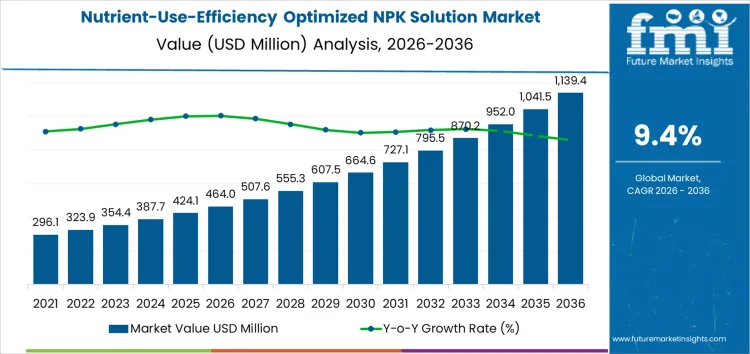
The nutrient-use-efficiency optimized NPK solution market is valued at USD 464 million in 2026 and is projected to reach USD 1,139.4 million by 2036, reflecting a CAGR of 9.4%. Adoption during forecast period is strongly influenced by regulatory oversight governing nutrient runoff, application limits, and reporting obligations. Compliance costs rise where formulations must demonstrate reduced loss pathways and verified uptake performance. Certification requirements add time and expense, particularly for products positioned across multiple crop systems. Suppliers with established regulatory dossiers progress faster through approval cycles. Smaller vendors face delayed commercialization due to testing burdens, shaping uneven adoption patterns across regions and channels.
Between 2026 and 2036, vendor positioning increasingly reflects the ability to manage compliance complexity rather than formulation performance alone. Buyers prioritize solutions aligned with evolving nutrient regulations to reduce audit exposure and operational risk. Once certified, products gain preference due to documentation continuity and reduced approval friction. Switching remains limited where regulatory filings are crop and region specific. Entry barriers persist through field validation mandates and multi-year data requirements. Strategic trade offs emerge between expanding market coverage and maintaining certification depth. Competitive advantage concentrates among suppliers integrating regulatory management into product development and commercial strategy.
Quick Stats for Nutrient-Use-Efficiency Optimized NPK Solution Market
- Nutrient-Use-Efficiency Optimized NPK Solution Market Value (2026): USD 464 million
- Nutrient-Use-Efficiency Optimized NPK Solution Market Forecast Value (2036): USD 1,139.4 million
- Nutrient-Use-Efficiency Optimized NPK Solution Market Forecast CAGR (2026-2036): 9.4%
- Leading Crop in Nutrient-Use-Efficiency Optimized NPK Solution Market: Greenhouse vegetables (about 50%)
- Key Growth Countries in Nutrient-Use-Efficiency Optimized NPK Solution Market: India, China, Brazil, United States
- Top Players in Nutrient-Use-Efficiency Optimized NPK Solution Market: Nutrien, Yara International, EuroChem, ICL Group, OCP, PhosAgro
What Is the Growth Forecast for Nutrient Use Efficiency Optimized NPK Solution Market through 2036?
Between 2026 and 2031, the nutrient use efficiency optimized NPK solution market grows from USD 464 million to USD 664 million, contributing USD 200 million to total expansion. This phase accounts for roughly 29% of cumulative growth through 2036, forming the first leg of the growth contribution index. Annual progression from USD 308 million to USD 464 million reflects increasing adoption of balanced NPK solutions formulated to improve nutrient uptake under conventional application practices. Yield-improvement goals and basic efficiency gains drove historical growth, while future contributions in this phase are supported by a wider distribution, compatibility with existing fertilizer equipment, and gradual inclusion in standard nutrient programs rather than aggressive acreage expansion.
From 2031 to 2036, the market expands from USD 664 million to USD 1,139.4 million, adding USD 489 million and contributing about 71% of the total forecast growth. This later phase represents the dominant growth contribution index, indicating stronger structural expansion. Annual values rise from USD 724 million to USD 1,139.4 million, reflecting deeper integration into precision nutrient management systems. Earlier growth emphasized product availability, whereas future contribution is driven by higher application intensity, multi nutrient optimization strategies, and broader use across commercial acreage. Improved agronomic confidence, repeat adoption, and tighter nutrient efficiency targets position this phase as the primary driver of overall market expansion.
Nutrient Use Efficiency Optimized NPK Solution Market Key Takeaways
| Metric | Value |
|---|---|
| Market Value (2026) | USD 464 million |
| Forecast Value (2036) | USD 1,139.4 million |
| Forecast CAGR (2026-2036) | 9.4% |
What Is Driving Demand in the Nutrient-Use-Efficiency Optimized NPK Solution Market?
Growth in the nutrient-use-efficiency optimized NPK solution market reflects real agronomic constraints rather than simple increases in fertiliser use. Traditional NPK blends apply fixed ratios of nitrogen, phosphorus and potassium based on broad recommendations. Crop response data repeatedly showed inefficiencies when soil supply, weather and root activity diverged from those assumptions, leading to nutrient fixation, leaching losses and uneven performance. Farmers observed that more conventional NPK did not always translate into yield gains and often increased environmental risk. Optimized solutions adjust ratios and release characteristics to match crop demand curves, reducing wasted inputs while supporting consistent early establishment, tiller development and grain filling.
Future demand will be shaped by integration with digital soil mapping, crop modelling and site-specific agronomy practices rather than incremental product reformulation alone. Precision agronomy is creating nutrient prescriptions tailored to field variability, crop stage and risk tolerance, making standardised blends less competitive. NPK solutions that release nutrients synchronised with crop uptake improve nitrogen retention, limit phosphorus fixation and enhance potassium availability under moisture and temperature fluctuations. Environmental regulation of nutrient runoff and demonstrable improvements in nutrient use efficiency are influencing procurement in commercial cereal, vegetable and speciality crop sectors. Traders and advisors now evaluate inputs on documented efficiency gains and reduced environmental footprint rather than simple nutrient content, embedding optimized NPK solutions into structured nutrient management plans that prioritise both agronomic performance and environmental outcomes.
What Factors Are Affecting the Demand for Nutrient Use Efficiency Optimized NPK Solution Market in Terms of Crop and Viscosity?
The nutrient use efficiency optimized NPK solution market is influenced by rising fertilizer costs, stricter nutrient loss regulations, and wider adoption of precision fertigation systems. Demand emphasizes formulations that improve nutrient uptake while reducing runoff and leaching. Adoption depends on crop value, irrigation intensity, and formulation handling characteristics such as viscosity. Market leadership reflects alignment with controlled application systems and measurable efficiency gains rather than total nutrient concentration.
What Is Driving Leadership by Crop in the Nutrient Use Efficiency Optimized NPK Solution Market?
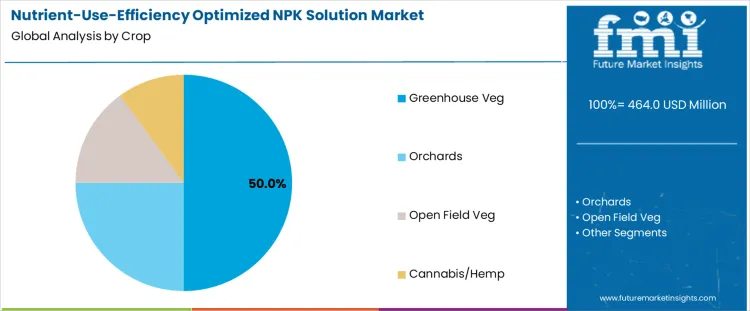
Greenhouse vegetables account for about 50% of demand because these crops are grown under highly controlled conditions where nutrient efficiency directly affects yield and quality. Greenhouse systems rely on drip irrigation and fertigation, enabling precise delivery of NPK solutions tailored to crop growth stages. Optimized NPK formulations reduce nutrient waste and support uniform plant development, which is critical for meeting retail quality standards. High crop value justifies investment in premium nutrient solutions that deliver consistent results across cycles. Frequent irrigation events also increase total nutrient dosing opportunities, amplifying demand for efficiency focused formulations.
Orchards represent about 25% of demand due to increasing use of localized fertigation in fruit production. Tree crops benefit from targeted root zone feeding, especially during flowering and fruit set stages. Open field vegetables account for about 15% of demand but face variability in irrigation infrastructure and weather exposure, limiting adoption. Cannabis and hemp represent about 10% of demand, driven by high crop value but smaller cultivated area. Crop leadership therefore reflects intensity of nutrient management, irrigation control, and economic sensitivity to nutrient efficiency rather than planted acreage alone.
What Is Driving Leadership by Viscosity in the Nutrient Use Efficiency Optimized NPK Solution Market?
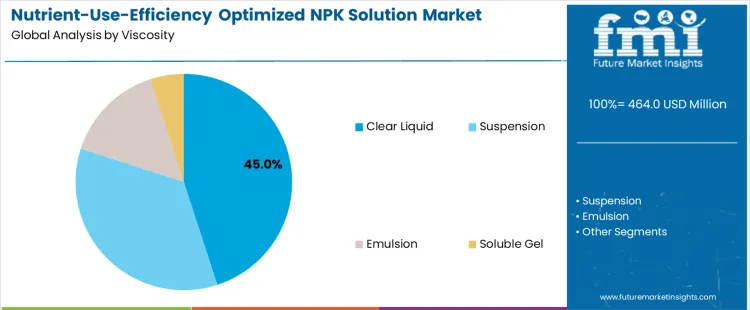
Clear liquid formulations account for about 45% of demand because they offer the highest compatibility with precision fertigation equipment. Clear liquids flow easily through pumps, emitters, and narrow tubing without clogging, ensuring uniform nutrient distribution. Their homogenous composition supports accurate dosing and rapid adjustment of nutrient ratios during the growing cycle. Fertilizer suppliers favor clear liquids for quality control and storage stability, while growers value reduced maintenance and predictable system performance.
Suspensions account for about 35% of demand, particularly in orchard systems where delivery rates are lower and agitation systems are available. These formulations allow inclusion of less soluble nutrients but require careful handling. Emulsions represent about 15% of demand, supporting micronutrient delivery but adding formulation complexity. Soluble gels account for about 5% of demand, offering slow release characteristics but limited by flow constraints. Viscosity leadership therefore reflects equipment reliability, dosing precision, and ease of integration into automated fertigation systems rather than nutrient density alone.
How Is the Nutrient-Use-Efficiency Optimized NPK Solution Being Applied Across Agriculture?
Use appears in row crops, vegetables, fruits, and high-value horticulture where balanced nutrient delivery is essential for maximizing yield and minimizing losses. Farmers adopt NPK solutions optimized for nutrient-use efficiency to provide precise ratios of nitrogen, phosphorus, and potassium tailored to crop requirements. Application through fertigation, foliar spraying, or soil incorporation enables improved uptake and reduced environmental runoff. These applications reflect operational and agronomic priorities rather than purely cost objectives, with adoption driven by enhanced nutrient efficiency, crop performance, and sustainable farming practices.
What Operational and Material Conditions Support Adoption of Nutrient-Use-Efficiency Optimized NPK Solutions?
Selection aligns with formulations compatible with soil, water, and irrigation systems, providing soluble, stable nutrients with minimal antagonistic interactions. Solutions are optimized for pH, osmotic balance, and homogeneity to ensure uniform distribution and bioavailability. Farmers monitor application rates, timing, and water quality to maximize uptake and reduce losses. Quality control evaluates nutrient concentration, stability, and efficacy to meet agronomic standards and regulatory compliance. These conditions emerge from operational efficiency, nutrient performance, and environmental sustainability priorities in structured crop nutrition workflows.
Which Practical Considerations Limit Wider Use of Nutrient-Use-Efficiency Optimized NPK Solutions?
Higher input costs and specialized application systems can restrict adoption in small-scale or low-margin farms. Compatibility with existing irrigation, foliar, or soil systems must be verified. Environmental factors such as rainfall, temperature, and soil properties affect nutrient uptake and efficiency. Regulatory approvals and safety standards differ by region. These factors lead to selective deployment where nutrient optimization, yield improvement, and sustainable practices justify incremental cost, monitoring, and precise workflow management.
What is the Demand for Nutrient Use Efficiency Optimized NPK Solutions by Country?
| Country | CAGR (%) |
|---|---|
| USA | 11.6% |
| China | 12.4% |
| India | 13.8% |
| Brazil | 12.0% |
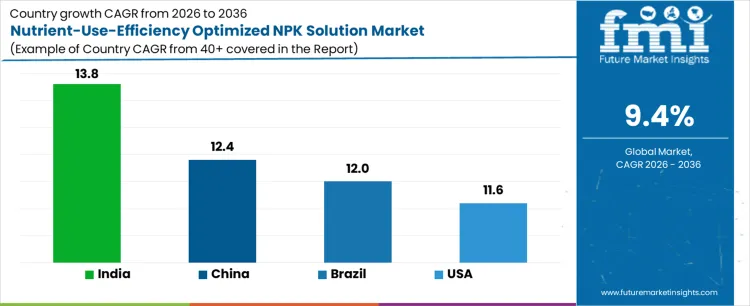
The demand for nutrient use efficiency optimized NPK solutions is increasing across major agricultural economies, driven by fertilizer cost pressures, regulatory limits on nutrient losses, and adoption of precision nutrient management practices. India leads with a 13.8% CAGR, supported by high fertilizer consumption intensity, government emphasis on improving nutrient efficiency, and widespread adoption in irrigated and multi crop systems. China follows at 12.4%, shaped by policy measures to reduce fertilizer overapplication and growing use of balanced NPK formulations tailored to crop demand. Brazil records 12.0%, reflecting large scale commercial farming, yield driven nutrient strategies, and increasing focus on efficiency under tropical conditions. The USA grows at 11.6%, driven by precision agriculture adoption, variable rate application, and demand for optimized NPK blends that improve returns while limiting environmental losses.
How are nutrient-use-efficiency optimized NPK solutions expanding adoption in the United States?
In the United States, the nutrient-use-efficiency optimized NPK solution market is growing at a CAGR of 11.6% through 2036, driven by precision agriculture adoption, large-scale row crop production, and demand for reduced fertilizer losses. Farmers are applying optimized NPK solutions to improve nutrient uptake, enhance crop yields, and lower environmental nitrogen runoff. Demand is concentrated in irrigated corn, soybean, and wheat regions, industrial farming zones, and high-value horticultural areas. Compared to India, adoption emphasizes compliance with environmental regulations and integration with advanced planting technologies. Domestic suppliers provide high-performance, precision-formulated solutions suitable for recurring seasonal applications.
- Irrigated corn, soybean, and wheat regions drive adoption
- Optimized NPK solutions improve nutrient uptake and yield
- Domestic suppliers provide precision-formulated, high-performance solutions
- Environmental compliance supports adoption
How are precision agriculture and industrial crop management driving growth in China?
In China, the market is expanding at a CAGR of 12.4% through 2036, fueled by high-intensity crop production, government programs promoting nutrient efficiency, and adoption of precision fertilizer application. Farmers are using nutrient-use-efficiency optimized NPK solutions to reduce nitrogen losses, enhance crop quality, and improve soil health. Demand is concentrated in industrial agricultural zones, irrigated cereal regions, and mechanized farming clusters. Compared to the USA, adoption emphasizes high-volume deployment across multiple crop types. Domestic suppliers provide cost-effective, environmentally friendly NPK solutions suitable for recurring seasonal fertilization.
- Industrial agricultural zones, irrigated cereal regions, and mechanized clusters drive adoption
- Solutions reduce nitrogen losses and improve crop quality
- Domestic suppliers provide cost-effective, environmentally friendly formulations
- Recurring seasonal fertilization sustains adoption
How are large-scale farming and nutrient efficiency initiatives driving adoption in India?
In India, the market is growing at a CAGR of 13.8% through 2036, supported by government subsidies, high-value crop production, and adoption of precision irrigation. Farmers are integrating nutrient-use-efficiency optimized NPK solutions to enhance plant growth, reduce fertilizer waste, and improve overall productivity. Demand is concentrated in irrigated horticultural regions, industrial grain zones, and precision farming hubs. Compared to Brazil, adoption emphasizes rapid scalability and coverage across diverse crop types. Domestic suppliers provide high-performance, affordable NPK formulations suitable for recurring seasonal applications.
- Irrigated horticultural regions, industrial grain zones, and precision farming hubs drive adoption
- Solutions enhance plant growth and reduce fertilizer waste
- Domestic suppliers provide high-performance, affordable formulations
- Recurring seasonal applications sustain adoption
How are industrial farming and sustainable nutrient practices driving growth in Brazil?
In Brazil, the market is expanding at a CAGR of 12% through 2036, fueled by large-scale grain and oilseed production, adoption of precision agriculture technologies, and environmental compliance initiatives. Farmers are using nutrient-use-efficiency optimized NPK solutions to improve nutrient delivery, increase early crop growth, and reduce environmental impact. Demand is concentrated in mechanized farming hubs, high-intensity grain regions, and irrigated crop zones. Compared to India, adoption emphasizes integration with industrial operations and sustainable fertilization practices. Domestic suppliers provide cost-effective, high-performance solutions suitable for recurring crop cycles.
- Mechanized farming hubs, high-intensity grain regions, and irrigated crop zones drive adoption
- Solutions improve nutrient delivery and early crop growth
- Domestic suppliers provide cost-effective, high-performance formulations
- Sustainable fertilization practices support adoption
Which Competitive Strategies Shape the Nutrient Use Efficiency Optimized NPK Solution Market under Regulatory Pressure and Farm-Level Accountability?
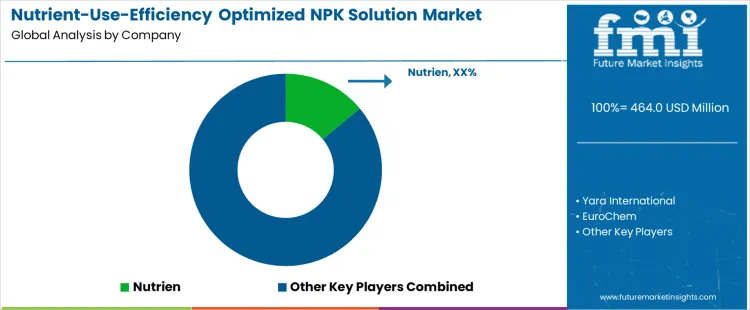
Competition in nutrient use efficiency optimized NPK solutions is shaped by how suppliers respond to tightening nutrient loss regulations and growing scrutiny of fertilizer outcomes at the field level. Nutrien and Yara International frame their strategies around accountability, linking NPK formulations to measurable nitrogen, phosphorus, and potassium uptake metrics. Their focus is on balanced nutrient ratios that reduce residual losses while fitting existing application practices. EuroChem emphasizes formulation robustness across soil types, ensuring efficiency claims hold under variable pH and moisture conditions. Purchasing decisions increasingly reflect compliance readiness, documented field performance, and the ability to demonstrate reduced nutrient leakage rather than nutrient concentration alone.
Strategic differentiation is also influenced by upstream integration and regional agronomy alignment. ICL Group positions efficiency optimized NPK solutions through specialty components and controlled nutrient interactions that support gradual release and root zone availability. OCP leverages phosphate expertise to improve phosphorus availability in soils prone to fixation, supporting early crop establishment. PhosAgro competes by aligning NPK efficiency with high purity raw materials and predictable nutrient behavior. Across the market, advantage is built through verifiable efficiency outcomes, regulatory alignment, and consistency across seasons, reinforcing trust among growers, advisors, and regulators.
Key Players in the Nutrient-Use-Efficiency Optimized NPK Solution Market
- Nutrien
- Yara International
- EuroChem
- ICL Group
- OCP
- PhosAgro
Scope of the Report
| Items | Values |
|---|---|
| Quantitative Units | USD million |
| Type | Nutrient-use-efficiency optimized NPK solutions, balanced NPK fertigation solutions, precision-formulated NPK blends |
| Application | Precision fertigation, controlled soil application, in-season nutrient optimization programs |
| End User | Commercial crop growers, greenhouse and horticulture operators, precision agriculture farms, large-scale field crop producers |
| Regions Covered | Asia Pacific, Europe, North America, Latin America, Middle East & Africa |
| Countries Covered | India, China, United States, Brazil, and other major agricultural economies |
| Key Companies Profiled | Nutrien, Yara International, EuroChem, ICL Group, OCP, PhosAgro |
| Additional Attributes | Dollar sales by crop category and viscosity type, adoption trends linked to nutrient runoff regulation and efficiency reporting requirements, competitive landscape shaped by regulatory compliance and certification depth, formulation viscosity and fertigation compatibility requirements, integration with precision agronomy platforms and nutrient accountability frameworks |
Nutrient-Use-Efficiency Optimized NPK Solution Market Segmentation
Crop
- Greenhouse Veg
- Orchards
- Open Field Veg
- Cannabis/Hemp
Viscosity
- Clear Liquid
- Suspension
- Emulsion
- Soluble Gel
Sales Channel
- Ag-Retailers
- Direct-to-Farmer
- Online Marketplaces
- Cooperatives
Region
- Asia Pacific
- China
- Japan
- South Korea
- India
- Australia & New Zealand
- ASEAN
- Rest of Asia Pacific
- Europe
- Germany
- United Kingdom
- France
- Italy
- Spain
- Nordic
- BENELUX
- Rest of Europe
- North America
- United States
- Canada
- Mexico
- Latin America
- Brazil
- Chile
- Rest of Latin America
- Middle East & Africa
- Kingdom of Saudi Arabia
- Other GCC Countries
- Turkey
- South Africa
- Other African Union
- Rest of Middle East & Africa
Frequently Asked Questions
How big is the nutrient-use-efficiency optimized npk solution market in 2026?
The global nutrient-use-efficiency optimized npk solution market is estimated to be valued at USD 464.0 million in 2026.
What will be the size of nutrient-use-efficiency optimized npk solution market in 2036?
The market size for the nutrient-use-efficiency optimized npk solution market is projected to reach USD 1,139.4 million by 2036.
How much will be the nutrient-use-efficiency optimized npk solution market growth between 2026 and 2036?
The nutrient-use-efficiency optimized npk solution market is expected to grow at a 9.4% CAGR between 2026 and 2036.
What are the key product types in the nutrient-use-efficiency optimized npk solution market?
The key product types in nutrient-use-efficiency optimized npk solution market are greenhouse veg, orchards, open field veg and cannabis/hemp.
Which viscosity segment to contribute significant share in the nutrient-use-efficiency optimized npk solution market in 2026?
In terms of viscosity, clear liquid segment to command 45.0% share in the nutrient-use-efficiency optimized npk solution market in 2026.
Preview the report firsthand - request a free sample
Get SampleGet the brochure for pricing and purchase details.
Get PDFTable of Content
- Executive Summary
- Global Market Outlook
- Demand-side Trends
- Supply-side Trends
- Technology Roadmap Analysis
- Analysis and Recommendations
- Market Overview
- Market Coverage / Taxonomy
- Market Definition / Scope / Limitations
- Market Background
- Market Dynamics
- Drivers
- Restraints
- Opportunity
- Trends
- Scenario Forecast
- Demand in Optimistic Scenario
- Demand in Likely Scenario
- Demand in Conservative Scenario
- Opportunity Map Analysis
- Product Life Cycle Analysis
- Supply Chain Analysis
- Investment Feasibility Matrix
- Value Chain Analysis
- PESTLE and Porter’s Analysis
- Regulatory Landscape
- Regional Parent Market Outlook
- Production and Consumption Statistics
- Import and Export Statistics
- Market Dynamics
- Global Market Analysis 2021 to 2025 and Forecast, 2026 to 2036
- Historical Market Size Value (USD Million) Analysis, 2021 to 2025
- Current and Future Market Size Value (USD Million) Projections, 2026 to 2036
- Y-o-Y Growth Trend Analysis
- Absolute $ Opportunity Analysis
- Global Market Pricing Analysis 2021 to 2025 and Forecast 2026 to 2036
- Global Market Analysis 2021 to 2025 and Forecast 2026 to 2036, By Crop
- Introduction / Key Findings
- Historical Market Size Value (USD Million) Analysis By Crop , 2021 to 2025
- Current and Future Market Size Value (USD Million) Analysis and Forecast By Crop , 2026 to 2036
- Greenhouse Veg
- Orchards
- Open Field Veg
- Cannabis/Hemp
- Greenhouse Veg
- Y-o-Y Growth Trend Analysis By Crop , 2021 to 2025
- Absolute $ Opportunity Analysis By Crop , 2026 to 2036
- Global Market Analysis 2021 to 2025 and Forecast 2026 to 2036, By Viscosity
- Introduction / Key Findings
- Historical Market Size Value (USD Million) Analysis By Viscosity, 2021 to 2025
- Current and Future Market Size Value (USD Million) Analysis and Forecast By Viscosity, 2026 to 2036
- Clear Liquid
- Suspension
- Emulsion
- Soluble Gel
- Clear Liquid
- Y-o-Y Growth Trend Analysis By Viscosity, 2021 to 2025
- Absolute $ Opportunity Analysis By Viscosity, 2026 to 2036
- Global Market Analysis 2021 to 2025 and Forecast 2026 to 2036, By Sales Channel
- Introduction / Key Findings
- Historical Market Size Value (USD Million) Analysis By Sales Channel, 2021 to 2025
- Current and Future Market Size Value (USD Million) Analysis and Forecast By Sales Channel, 2026 to 2036
- Ag-Retailers
- Direct-to-Farmer
- Online Marketplaces
- Cooperatives
- Ag-Retailers
- Y-o-Y Growth Trend Analysis By Sales Channel, 2021 to 2025
- Absolute $ Opportunity Analysis By Sales Channel, 2026 to 2036
- Global Market Analysis 2021 to 2025 and Forecast 2026 to 2036, By Region
- Introduction
- Historical Market Size Value (USD Million) Analysis By Region, 2021 to 2025
- Current Market Size Value (USD Million) Analysis and Forecast By Region, 2026 to 2036
- North America
- Latin America
- Western Europe
- Eastern Europe
- East Asia
- South Asia and Pacific
- Middle East & Africa
- Market Attractiveness Analysis By Region
- North America Market Analysis 2021 to 2025 and Forecast 2026 to 2036, By Country
- Historical Market Size Value (USD Million) Trend Analysis By Market Taxonomy, 2021 to 2025
- Market Size Value (USD Million) Forecast By Market Taxonomy, 2026 to 2036
- By Country
- USA
- Canada
- Mexico
- By Crop
- By Viscosity
- By Sales Channel
- By Country
- Market Attractiveness Analysis
- By Country
- By Crop
- By Viscosity
- By Sales Channel
- Key Takeaways
- Latin America Market Analysis 2021 to 2025 and Forecast 2026 to 2036, By Country
- Historical Market Size Value (USD Million) Trend Analysis By Market Taxonomy, 2021 to 2025
- Market Size Value (USD Million) Forecast By Market Taxonomy, 2026 to 2036
- By Country
- Brazil
- Chile
- Rest of Latin America
- By Crop
- By Viscosity
- By Sales Channel
- By Country
- Market Attractiveness Analysis
- By Country
- By Crop
- By Viscosity
- By Sales Channel
- Key Takeaways
- Western Europe Market Analysis 2021 to 2025 and Forecast 2026 to 2036, By Country
- Historical Market Size Value (USD Million) Trend Analysis By Market Taxonomy, 2021 to 2025
- Market Size Value (USD Million) Forecast By Market Taxonomy, 2026 to 2036
- By Country
- Germany
- UK
- Italy
- Spain
- France
- Nordic
- BENELUX
- Rest of Western Europe
- By Crop
- By Viscosity
- By Sales Channel
- By Country
- Market Attractiveness Analysis
- By Country
- By Crop
- By Viscosity
- By Sales Channel
- Key Takeaways
- Eastern Europe Market Analysis 2021 to 2025 and Forecast 2026 to 2036, By Country
- Historical Market Size Value (USD Million) Trend Analysis By Market Taxonomy, 2021 to 2025
- Market Size Value (USD Million) Forecast By Market Taxonomy, 2026 to 2036
- By Country
- Russia
- Poland
- Hungary
- Balkan & Baltic
- Rest of Eastern Europe
- By Crop
- By Viscosity
- By Sales Channel
- By Country
- Market Attractiveness Analysis
- By Country
- By Crop
- By Viscosity
- By Sales Channel
- Key Takeaways
- East Asia Market Analysis 2021 to 2025 and Forecast 2026 to 2036, By Country
- Historical Market Size Value (USD Million) Trend Analysis By Market Taxonomy, 2021 to 2025
- Market Size Value (USD Million) Forecast By Market Taxonomy, 2026 to 2036
- By Country
- China
- Japan
- South Korea
- By Crop
- By Viscosity
- By Sales Channel
- By Country
- Market Attractiveness Analysis
- By Country
- By Crop
- By Viscosity
- By Sales Channel
- Key Takeaways
- South Asia and Pacific Market Analysis 2021 to 2025 and Forecast 2026 to 2036, By Country
- Historical Market Size Value (USD Million) Trend Analysis By Market Taxonomy, 2021 to 2025
- Market Size Value (USD Million) Forecast By Market Taxonomy, 2026 to 2036
- By Country
- India
- ASEAN
- Australia & New Zealand
- Rest of South Asia and Pacific
- By Crop
- By Viscosity
- By Sales Channel
- By Country
- Market Attractiveness Analysis
- By Country
- By Crop
- By Viscosity
- By Sales Channel
- Key Takeaways
- Middle East & Africa Market Analysis 2021 to 2025 and Forecast 2026 to 2036, By Country
- Historical Market Size Value (USD Million) Trend Analysis By Market Taxonomy, 2021 to 2025
- Market Size Value (USD Million) Forecast By Market Taxonomy, 2026 to 2036
- By Country
- Kingdom of Saudi Arabia
- Other GCC Countries
- Turkiye
- South Africa
- Other African Union
- Rest of Middle East & Africa
- By Crop
- By Viscosity
- By Sales Channel
- By Country
- Market Attractiveness Analysis
- By Country
- By Crop
- By Viscosity
- By Sales Channel
- Key Takeaways
- Key Countries Market Analysis
- USA
- Pricing Analysis
- Market Share Analysis, 2025
- By Crop
- By Viscosity
- By Sales Channel
- Canada
- Pricing Analysis
- Market Share Analysis, 2025
- By Crop
- By Viscosity
- By Sales Channel
- Mexico
- Pricing Analysis
- Market Share Analysis, 2025
- By Crop
- By Viscosity
- By Sales Channel
- Brazil
- Pricing Analysis
- Market Share Analysis, 2025
- By Crop
- By Viscosity
- By Sales Channel
- Chile
- Pricing Analysis
- Market Share Analysis, 2025
- By Crop
- By Viscosity
- By Sales Channel
- Germany
- Pricing Analysis
- Market Share Analysis, 2025
- By Crop
- By Viscosity
- By Sales Channel
- UK
- Pricing Analysis
- Market Share Analysis, 2025
- By Crop
- By Viscosity
- By Sales Channel
- Italy
- Pricing Analysis
- Market Share Analysis, 2025
- By Crop
- By Viscosity
- By Sales Channel
- Spain
- Pricing Analysis
- Market Share Analysis, 2025
- By Crop
- By Viscosity
- By Sales Channel
- France
- Pricing Analysis
- Market Share Analysis, 2025
- By Crop
- By Viscosity
- By Sales Channel
- India
- Pricing Analysis
- Market Share Analysis, 2025
- By Crop
- By Viscosity
- By Sales Channel
- ASEAN
- Pricing Analysis
- Market Share Analysis, 2025
- By Crop
- By Viscosity
- By Sales Channel
- Australia & New Zealand
- Pricing Analysis
- Market Share Analysis, 2025
- By Crop
- By Viscosity
- By Sales Channel
- China
- Pricing Analysis
- Market Share Analysis, 2025
- By Crop
- By Viscosity
- By Sales Channel
- Japan
- Pricing Analysis
- Market Share Analysis, 2025
- By Crop
- By Viscosity
- By Sales Channel
- South Korea
- Pricing Analysis
- Market Share Analysis, 2025
- By Crop
- By Viscosity
- By Sales Channel
- Russia
- Pricing Analysis
- Market Share Analysis, 2025
- By Crop
- By Viscosity
- By Sales Channel
- Poland
- Pricing Analysis
- Market Share Analysis, 2025
- By Crop
- By Viscosity
- By Sales Channel
- Hungary
- Pricing Analysis
- Market Share Analysis, 2025
- By Crop
- By Viscosity
- By Sales Channel
- Kingdom of Saudi Arabia
- Pricing Analysis
- Market Share Analysis, 2025
- By Crop
- By Viscosity
- By Sales Channel
- Turkiye
- Pricing Analysis
- Market Share Analysis, 2025
- By Crop
- By Viscosity
- By Sales Channel
- South Africa
- Pricing Analysis
- Market Share Analysis, 2025
- By Crop
- By Viscosity
- By Sales Channel
- USA
- Market Structure Analysis
- Competition Dashboard
- Competition Benchmarking
- Market Share Analysis of Top Players
- By Regional
- By Crop
- By Viscosity
- By Sales Channel
- Competition Analysis
- Competition Deep Dive
- Nutrien
- Overview
- Product Portfolio
- Profitability by Market Segments (Product/Age /Sales Channel/Region)
- Sales Footprint
- Strategy Overview
- Marketing Strategy
- Product Strategy
- Channel Strategy
- Yara International
- EuroChem
- ICL Group
- OCP
- PhosAgro
- Nutrien
- Competition Deep Dive
- Assumptions & Acronyms Used
- Research Methodology


