

- Market Size (2026)
- USD 489.2 Mn
- Forecast (2036)
- USD 2233.8 Mn
- CAGR (2026 to 2036)
- 16.4%
E-Learning Solution Market Size, Market Forecast and Outlook By FMI
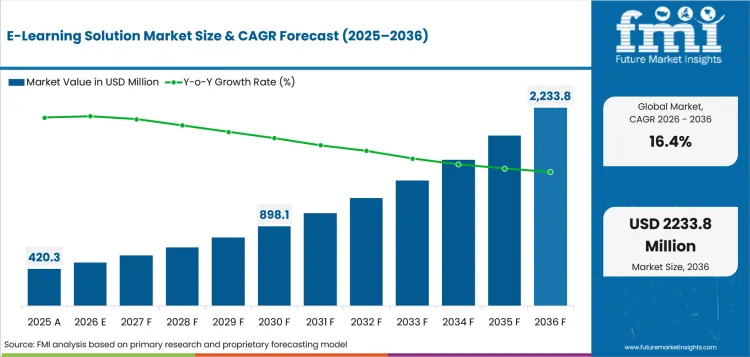
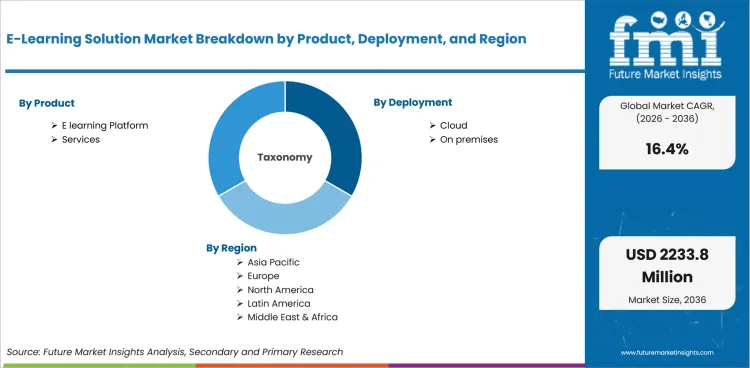
The global E-Learning Solution Market is projected to grow from USD 489.2 million in 2026 to USD 2233.8 million by 2036, expanding at a 16.4% CAGR, as enterprises, education providers, and channel-led businesses invest in scalable digital training platforms, AI-enabled learning delivery, partner enablement, compliance training, and workforce upskilling solutions.
Key Takeaways, Market Size, and Forecast
- The e-learning solution market was valued at USD 420.30 million in 2025.
- By 2036, the E-Learning Solution Market is expected to be worth USD 2233.79 million.
- From 2026 to 2036, the market is projected to expand at a CAGR of 16.4%.
- The market is projected to create an incremental opportunity of USD 1744.56 million between 2026 and 2036.
- In 2026, cloud is expected to account for 68.0% of the deployment segment, driven by demand for cloud applications.
- India (19.7%) and China (18.5%) are two of the fastest growing markets in the world.
Summary of the E-Learning Solution Market
- Demand and Growth Drivers
- Digital transformation in education and corporate training is accelerating platform adoption as institutions and enterprises migrate from classroom based to hybrid and fully online learning delivery models.
- Cloud deployment holds 68.0% of the deployment segment, reflecting preference for scalable, low capital intensity infrastructure that enables rapid implementation and geographic expansion of learning programs.
- India (19.7%) and China (18.5%) lead country level growth, supported by large student populations, expanding internet infrastructure, and government digitalization initiatives in education.
- Product and Segment View
- E learning Platform is expected to lead the product segment with 63.0% share in 2026.
- Cloud accounts for 68.0% of the deployment segment.
- Education leads the industry segment at 34.0% share.
- Geography and Competitive Outlook
- India is expected to lead at 19.7% CAGR through 2036.
- China follows at 18.5% CAGR, reflecting expanding procurement.
- Companies with established capabilities and distributor relationships are positioned to capture incremental demand.
- Analyst Opinion
- The e-learning solution market is evolving toward specification driven procurement where capability and supply reliability determine competitive positioning.
- Adoption is increasing due to end user demand for performance validated inputs and regulatory requirements.
- Companies combining cost competitiveness with consistent quality are positioned to strengthen market position over the forecast period.
- Demand is further supported by procurement stability in established end use sectors and incremental volume from emerging categories.
E-Learning Solution Market Definition
The e learning solution market includes learning management platforms, virtual classroom software, content authoring tools, and assessment systems deployed through cloud and on premise infrastructure for education, corporate training, healthcare, and government workforce development applications. Products support synchronous, asynchronous, and blended learning modes for student, corporate, and professional development users.
E-Learning Solution Market Inclusions
Market scope covers all commercially traded e learning solution products categorized by product (e learning platform, virtual classroom, content authoring, assessment systems), deployment (cloud, on premise, hybrid), industry (education, corporate, healthcare, government), user type (students, corporate learners, professional development), and learning mode (synchronous learning, asynchronous learning, blended learning). Revenue estimates span from 2026 to 2036.
E-Learning Solution Market Exclusions
The scope does not include educational content publishing, textbook sales, or hardware devices. General purpose video conferencing software without dedicated learning management functionality is excluded.
E-Learning Solution Market Research Methodology
- Primary Research: FMI analysts conducted interviews with manufacturers, distributors, and end users across key markets.
- Desk Research: Combined data from industry associations, regulatory filings, trade databases, and manufacturer disclosures.
- Market Sizing and Forecasting: Bottom up aggregation across segments, triangulated with top down validation.
- Data Validation: Cross checked quarterly against production statistics, trade data, and manufacturer figures.
Why is the E-Learning Solution Market Growing?
- Digital transformation in education and corporate training is accelerating platform adoption as institutions and enterprises migrate from classroom based to hybrid and fully online learning delivery models.
- Cloud deployment holds 68.0% of the deployment segment, reflecting preference for scalable, low capital intensity infrastructure that enables rapid implementation and geographic expansion of learning programs.
- India (19.7%) and China (18.5%) lead country level growth, supported by large student populations, expanding internet infrastructure, and government digitalization initiatives in education.
The e learning solution market is expanding at 16.4% CAGR as digital education infrastructure investment accelerates across academic, corporate, and professional development sectors. E learning platforms lead the product segment at 63.0%, reflecting demand for comprehensive learning management systems that integrate content delivery, assessment, and learner analytics.
Education sector applications account for 34.0% of industry demand, with K 12, higher education, and professional certification programs driving platform procurement. Corporate training, healthcare education, and government workforce development add diversified institutional demand. Students represent 52.0% of user type, with corporate learners and professional development users adding adult education demand.
Synchronous learning holds 57.0% of learning mode share, reflecting preference for real time instructor led sessions that enable interaction and engagement. Asynchronous and blended learning models serve self paced and geographically distributed learner populations. Cloud deployment at 68.0% supports scalable platform infrastructure without institutional capital investment in on premise servers.
Market Segmentation Analysis
- The e-learning solution market is segmented by product, deployment, industry, user type, learning mode, with e learning platform leading at 63.0% share.
- Cloud accounts for 68.0% of the deployment segment.
- Students leads the user type segment at 52.0%.
The e-learning solution market is organized across multiple dimensions reflecting product differentiation and procurement channel preferences.
Insights into the E learning Platform Product Segment
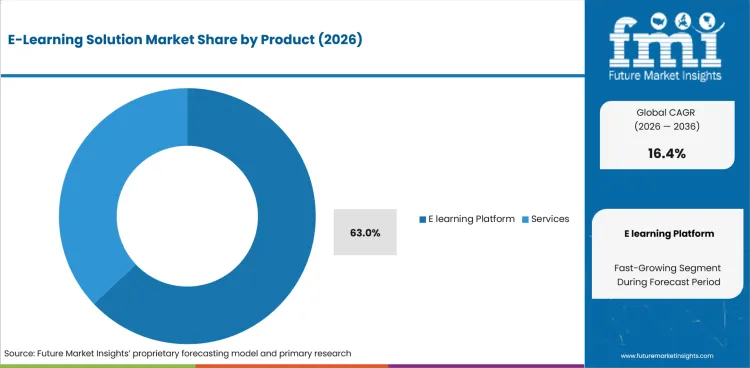
In 2026, e learning platform is expected to account for 63.0% of the product segment, reflecting established procurement patterns.
Sub segments including LMS Platforms, Virtual Classroom Solutions, Training Services represent primary specification categories.
Insights into the Cloud Deployment Segment
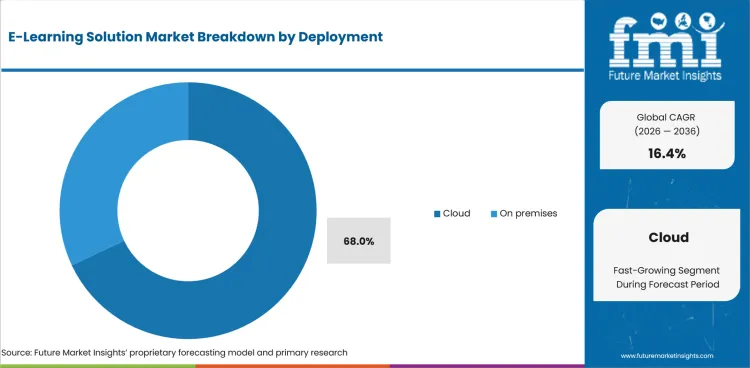
In 2026, cloud is expected to account for 68.0% of the deployment segment, reflecting established procurement patterns.
Sub segments including Public Cloud, Private Cloud, Enterprise Servers represent primary specification categories.
E-Learning Solution Market Drivers, Restraints, and Opportunities
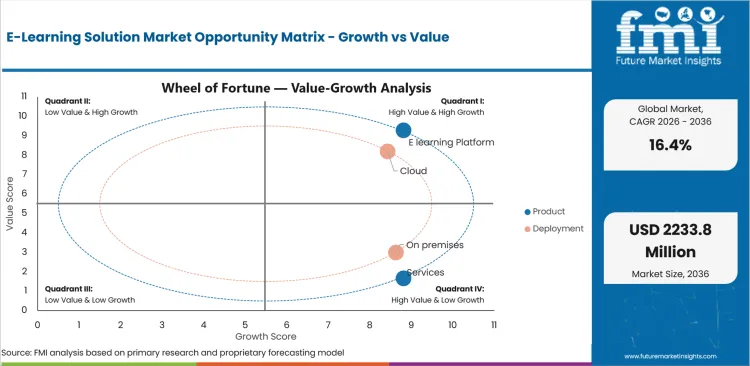
- Demand is shaped by institutional investment in digital learning infrastructure across K 12, higher education, and professional ce.
- Adoption is constrained by internet connectivity and device access gaps in rural and economically disadvantaged areas. The digital.
- Growth is supported by integration of AI driven personalization, adaptive learning pathways, and automated assessment into e learn.
The e-learning solution market is shaped by demand side drivers, supply side constraints, and regulatory influences varying by region.
Education Sector Digital Transformation
Demand is shaped by institutional investment in digital learning infrastructure across K 12, higher education, and professional certification programs. Government education digitalization policies in India, China, and the EU are creating structured procurement cycles for e learning platforms.
Corporate Training and Workforce Upskilling
Growth reflects enterprise investment in digital training platforms for employee onboarding, compliance training, and skills development. Remote workforce management requirements have normalized online training delivery as a permanent corporate function.
Digital Divide and Infrastructure Access Barriers
Adoption is constrained by internet connectivity and device access gaps in rural and economically disadvantaged areas. The digital divide limits e learning platform reach in markets where infrastructure development has not kept pace with platform availability.
AI Personalization and Adaptive Learning Technology
Growth is supported by integration of AI driven personalization, adaptive learning pathways, and automated assessment into e learning platforms. These technologies improve learner outcomes and engagement, which supports institutional adoption and retention.
Analysis of E-Learning Solution Market By Key Countries
.webp "Top Country Growth Comparison E Learning Solution Market Cagr (2026 2036)")
| Country | CAGR |
|---|---|
| India | 19.7% |
| China | 18.5% |
| Japan | 17.4% |
| USA | 15.6% |
| Germany | 14.0% |
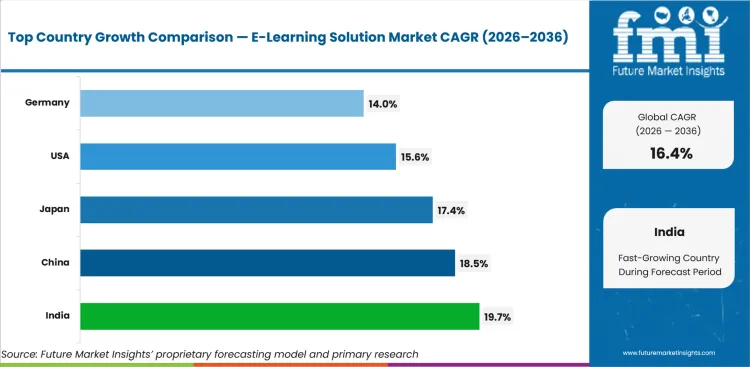
- India at 19.7% CAGR through 2036 reflects strong demand fundamentals.
- China at 18.5% CAGR through 2036 reflects strong demand fundamentals.
- Japan at 17.4% CAGR through 2036 reflects strong demand fundamentals.
The global e-learning solution market is projected to grow at 16.4% CAGR from 2026 to 2036, covering more than 30 countries.
Demand Outlook for E-Learning Solution Market in India
India is projected to grow at 19.7% through 2036. Government digital education initiatives including National Education Policy 2020 and DIKSHA platform deployment are creating structured institutional demand. India's large student population and expanding internet penetration provide the largest addressable user base for e learning platforms.
- National Education Policy 2020 mandates digital learning integration across educational institutions.
- Large student population creates the largest single country addressable market for e learning platforms.
- Expanding internet and smartphone penetration enable digital learning access in tier 2 and tier 3 cities.
Future Outlook for E-Learning Solution Market in China
China is projected to grow at 18.5% through 2036. The scale of China's education sector and technology infrastructure creates concentrated platform demand. Government regulation of the edtech sector has reshaped the competitive landscape toward compliance oriented platform development.
- Education sector scale creates concentrated institutional demand for compliant e learning platforms.
- Technology infrastructure maturity supports advanced platform features including AI personalization.
- Government edtech regulation has restructured the market toward compliance oriented platform development.
Opportunity Analysis of E-Learning Solution Market in Japan
Japan is projected to grow at 17.4% through 2036. Demand reflects the country's technology adoption capacity and corporate training investment. Japanese enterprises prioritize platform reliability, data security, and integration with existing HR systems.
- Corporate training investment supports enterprise e learning platform procurement for workforce development.
- Technology adoption capacity enables rapid deployment of advanced learning management features.
- Aging workforce demographics create demand for reskilling and continuous professional development platforms.
In-depth Analysis of E-Learning Solution Market in the United States
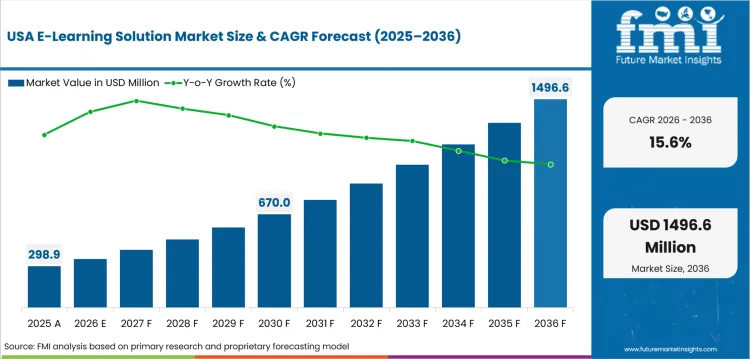
USA is projected to grow at 15.6% through 2036. Demand is shaped by established edtech market maturity, corporate training investment, and higher education digital transformation. Major platform companies including Blackboard, Coursera, and Udemy maintain competitive positions across institutional and enterprise segments.
- Established edtech market maturity supports continuous platform investment and feature development.
- Corporate training budgets sustain enterprise e learning procurement for compliance and skills development.
- Higher education digital transformation creates institutional demand for comprehensive learning management systems.
Sales Analysis of E-Learning Solution Market in Germany
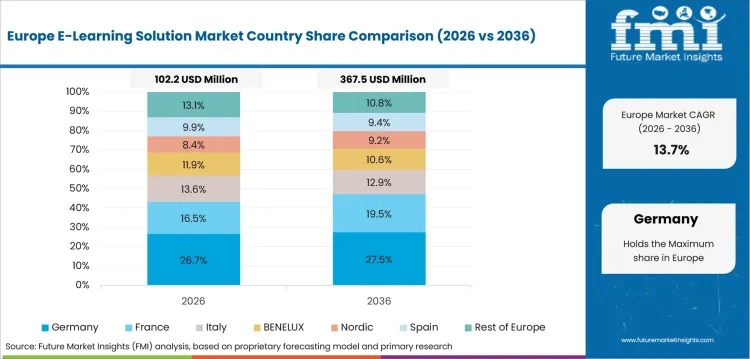
Germany is projected to grow at 14.0% through 2036. EU data protection regulations (GDPR) shape platform procurement requirements for educational institutions and enterprises. German organizations prioritize data sovereignty, security compliance, and integration with existing enterprise systems.
- GDPR compliance requirements influence platform selection criteria for German institutional buyers.
- Corporate training investment across manufacturing and services sectors sustains enterprise platform demand.
- Vocational training digitalization creates structured demand for industry specific e learning solutions.
Competitive Landscape and Strategic Positioning
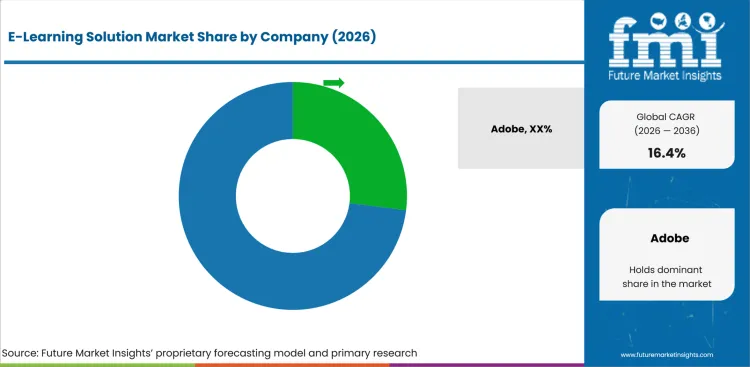
- Adobe leads with established capabilities and market presence.
- Blackboard and D2L (Desire2Learn) maintain competitive positions through product breadth.
- Emerging players target specialized segments where differentiation creates entry opportunities.
Adobe maintains strong position through integrated capabilities and procurement relationships.
Barriers include established supply relationships, regulatory compliance costs, and capital intensity.
Key Companies in the E-Learning Solution Market
Key global companies leading the e-learning solution market include:
- Adobe, Blackboard, D2L (Desire2Learn) maintain leading positions.
- Cornerstone OnDemand, SAP Litmos, Docebo, Moodle, TalentLMS have established segment specific positions.
Competitive Benchmarking: E-Learning Solution Market
| Company | Product Breadth | Manufacturing Scale | Distribution Reach | Geographic Footprint |
|---|---|---|---|---|
| Adobe | High | Strong | Strong | Global |
| Blackboard | High | Medium | Strong | Global |
| D2L (Desire2Learn) | Medium | High | Moderate | Regional |
| Cornerstone OnDemand | Medium | Medium | Moderate | Regional |
| SAP Litmos | Low | Medium | Low | Regional |
Source: Future Market Insights competitive analysis, 2026.
Key Developments in E-Learning Solution Market
- In 2025, Adobe expanded product portfolio and distribution for e learning platform products across key markets.
- In 2025, Blackboard introduced new formulations targeting emerging application segments.
Key Players in the E-Learning Solution Market
Major Global Players
- Adobe
- Blackboard
- D2L (Desire2Learn)
- Cornerstone OnDemand
- SAP Litmos
Emerging Players/Startups
- Docebo
- Moodle
- TalentLMS
- Udemy Business
- Coursera for Business
Report Scope and Coverage
| Parameter | Details |
|---|---|
| Quantitative Units | USD 489.23 million to USD 2233.79 million, at a CAGR of 16.4% |
| Market Definition | The e learning solution market includes learning management platforms, virtual classroom software, content authoring tools, and assessment systems deployed through cloud and on premise infrastructure for education, corporate training, healthcare, and government workforce development applications. Products support synchronous, asynchronous, and blended learning modes for student, corporate, and professional development users. |
| Regions Covered | North America, Latin America, Europe, East Asia, South Asia and Pacific, Middle East and Africa |
| Countries Covered | India, China, Japan, USA, Germany, 30 plus countries |
| Key Companies Profiled | Adobe, Blackboard, D2L (Desire2Learn), Cornerstone OnDemand, SAP Litmos, Docebo, Moodle, TalentLMS |
| Forecast Period | 2026 to 2036 |
| Approach | Hybrid bottom up and top down methodology starting with verified transaction data, projecting adoption velocity across segments and regions. |
Segmentation
E-Learning Solution Market Segmented by Product:
- E learning Platform
- LMS Platforms
- Virtual Classroom Solutions
- Services
- Training Services
- Content Development Services
E-Learning Solution Market Segmented by Deployment:
- Cloud
- Public Cloud
- Private Cloud
- On premises
- Enterprise Servers
- Local Data Centers
E-Learning Solution Market Segmented by Industry:
- Education
- Schools
- Universities
- Government
- Public Administration
- Defense Services
- Retail
- E commerce Retail
- Offline Retail Chains
- Healthcare
- Hospitals
- Diagnostic Centers
- Financial Services
- Banking Institutions
- Insurance Companies
- Others
- Manufacturing
- Logistics
- IT and Telecommunication
- Software Companies
- Telecom Service Providers
E-Learning Solution Market Segmented by User Type:
- Students
- School Students
- University Students
- Employees
- Corporate Employees
- Skill Development Trainees
- Professional Trainers
- Corporate Trainers
- Academic Trainers
E-Learning Solution Market Segmented by Learning Mode:
- Synchronous Learning
- Live Classes
- Webinars
- Asynchronous Learning
- Recorded Lectures
- Self Paced Modules
E-Learning Solution Market by Region:
- North America
- USA
- Canada
- Mexico
- Latin America
- Brazil
- Chile
- Rest of Latin America
- Western Europe
- Germany
- UK
- Italy
- Spain
- France
- Nordic
- BENELUX
- Rest of Western Europe
- Eastern Europe
- Russia
- Poland
- Hungary
- Balkan & Baltic
- Rest of Eastern Europe
- East Asia
- China
- Japan
- South Korea
- South Asia and Pacific
- India
- ASEAN
- Australia & New Zealand
- Rest of South Asia and Pacific
- Middle East & Africa
- Kingdom of Saudi Arabia
- Other GCC Countries
- Turkiye
- South Africa
- Other African Union
- Rest of Middle East & Africa
Research Sources and Bibliography
- 1. UNESCO. (2025). UNESCO Global Education Monitoring Report: Digital Learning Infrastructure. UNESCO.
- 2. European Commission. (2024). EC Digital Education Action Plan: E-Learning Platform Standards. EC.
- 3. USA Department of Education. (2025). National Education Technology Plan Update. USDOE.
- 4. World Bank. (2024). World Bank EdTech Investment and Digital Learning Development Report. World Bank.
- 5. Organisation for Economic Co-operation and Development. (2025). OECD Education at a Glance: Digital Learning Indicators. OECD.
This bibliography is provided for reader reference. The full Future Market Insights report contains the complete reference list with publication dates, URLs, and supporting data for all cited works.
This Report Answers
- Estimating the size of the market and revenue from 2026 to 2036.
- Segmentation by product, deployment, industry, user type.
- Insights about more than 30 markets by region.
- Analysis of key demand drivers, restraints, and growth opportunities.
- Assessment of the competitive landscape.
- Identification of investment opportunities across key segments and regions.
- Supply chain and procurement pattern analysis.
- Delivery of data in PDF and Excel formats.
Frequently Asked Questions
How big is the e-learning solution market in 2026?
The global e-learning solution market is estimated to be valued at USD 489.2 million in 2026.
What will be the size of e-learning solution market in 2036?
The market size for the e-learning solution market is projected to reach USD 2,233.8 million by 2036.
How much will be the e-learning solution market growth between 2026 and 2036?
The e-learning solution market is expected to grow at a 16.4% CAGR between 2026 and 2036.
What are the key product types in the e-learning solution market?
The key product types in e-learning solution market are e learning platform, services.
Which deployment segment is expected to contribute significant share in the e-learning solution market in 2026?
In terms of deployment, cloud segment is expected to command 68.0% share in the e-learning solution market in 2026.
Preview the report firsthand - request a free sample
Get SampleGet the brochure for pricing and purchase details.
Get PDFTable of Content
- Executive Summary
- Global Market Outlook
- Demand-side Trends
- Supply-side Trends
- Technology Roadmap Analysis
- Analysis and Recommendations
- Market Overview
- Market Coverage / Taxonomy
- Market Definition / Scope / Limitations
- Research Methodology
- Chapter Orientation
- Analytical Lens and Working Hypotheses
- Market Structure, Signals, and Trend Drivers
- Benchmarking and Cross-market Comparability
- Market Sizing, Forecasting, and Opportunity Mapping
- Research Design and Evidence Framework
- Desk Research Programme (Secondary Evidence)
- Company Annual and Sustainability Reports
- Peer-reviewed Journals and Academic Literature
- Corporate Websites, Product Literature, and Technical Notes
- Earnings Decks and Investor Briefings
- Statutory Filings and Regulatory Disclosures
- Technical White Papers and Standards Notes
- Trade Journals, Industry Magazines, and Analyst Briefs
- Conference Proceedings, Webinars, and Seminar Materials
- Government Statistics Portals and Public Data Releases
- Press Releases and Reputable Media Coverage
- Specialist Newsletters and Curated Briefings
- Sector Databases and Reference Repositories
- FMI Internal Proprietary Databases and Historical Market Datasets
- Subscription Datasets and Paid Sources
- Social Channels, Communities, and Digital Listening Inputs
- Additional Desk Sources
- Expert Input and Fieldwork (Primary Evidence)
- Primary Modes
- Qualitative Interviews and Expert Elicitation
- Quantitative Surveys and Structured Data Capture
- Blended Approach
- Why Primary Evidence is Used
- Field Techniques
- Interviews
- Surveys
- Focus Groups
- Observational and In-context Research
- Social and Community Interactions
- Stakeholder Universe Engaged
- C-suite Leaders
- Board Members
- Presidents and Vice Presidents
- R&D and Innovation Heads
- Technical Specialists
- Domain Subject-matter Experts
- Scientists
- Physicians and Other Healthcare Professionals
- Governance, Ethics, and Data Stewardship
- Research Ethics
- Data Integrity and Handling
- Primary Modes
- Tooling, Models, and Reference Databases
- Desk Research Programme (Secondary Evidence)
- Data Engineering and Model Build
- Data Acquisition and Ingestion
- Cleaning, Normalisation, and Verification
- Synthesis, Triangulation, and Analysis
- Quality Assurance and Audit Trail
- Market Background
- Market Dynamics
- Drivers
- Restraints
- Opportunity
- Trends
- Scenario Forecast
- Demand in Optimistic Scenario
- Demand in Likely Scenario
- Demand in Conservative Scenario
- Opportunity Map Analysis
- Product Life Cycle Analysis
- Supply Chain Analysis
- Investment Feasibility Matrix
- Value Chain Analysis
- PESTLE and Porter’s Analysis
- Regulatory Landscape
- Regional Parent Market Outlook
- Production and Consumption Statistics
- Import and Export Statistics
- Market Dynamics
- Global Market Analysis 2021 to 2025 and Forecast, 2026 to 2036
- Historical Market Size Value (USD Million) Analysis, 2021 to 2025
- Current and Future Market Size Value (USD Million) Projections, 2026 to 2036
- Y-o-Y Growth Trend Analysis
- Absolute $ Opportunity Analysis
- Global Market Pricing Analysis 2021 to 2025 and Forecast 2026 to 2036
- Global Market Analysis 2021 to 2025 and Forecast 2026 to 2036, By Product
- Introduction / Key Findings
- Historical Market Size Value (USD Million) Analysis By Product , 2021 to 2025
- Current and Future Market Size Value (USD Million) Analysis and Forecast By Product , 2026 to 2036
- E learning Platform
- LMS Platforms
- Virtual Classroom Solutions
- Services
- Training Services
- Content Development Services
- E learning Platform
- Y-o-Y Growth Trend Analysis By Product , 2021 to 2025
- Absolute $ Opportunity Analysis By Product , 2026 to 2036
- Global Market Analysis 2021 to 2025 and Forecast 2026 to 2036, By Deployment
- Introduction / Key Findings
- Historical Market Size Value (USD Million) Analysis By Deployment, 2021 to 2025
- Current and Future Market Size Value (USD Million) Analysis and Forecast By Deployment, 2026 to 2036
- Cloud
- Public Cloud
- Private Cloud
- On premises
- Enterprise Servers
- Local Data Centers
- Cloud
- Y-o-Y Growth Trend Analysis By Deployment, 2021 to 2025
- Absolute $ Opportunity Analysis By Deployment, 2026 to 2036
- Global Market Analysis 2021 to 2025 and Forecast 2026 to 2036, By Industry
- Introduction / Key Findings
- Historical Market Size Value (USD Million) Analysis By Industry, 2021 to 2025
- Current and Future Market Size Value (USD Million) Analysis and Forecast By Industry, 2026 to 2036
- Education
- Schools
- Universities
- Government
- Public Administration
- Defense Services
- Retail
- E commerce Retail
- Offline Retail Chains
- Healthcare
- Hospitals
- Diagnostic Centers
- Financial Services
- Banking Institutions
- Insurance Companies
- Others
- Manufacturing
- Logistics
- IT and Telecommunication
- Software Companies
- Telecom Service Providers
- Education
- Y-o-Y Growth Trend Analysis By Industry, 2021 to 2025
- Absolute $ Opportunity Analysis By Industry, 2026 to 2036
- Global Market Analysis 2021 to 2025 and Forecast 2026 to 2036, By User Type
- Introduction / Key Findings
- Historical Market Size Value (USD Million) Analysis By User Type, 2021 to 2025
- Current and Future Market Size Value (USD Million) Analysis and Forecast By User Type, 2026 to 2036
- Students
- School Students
- University Students
- Employees
- Corporate Employees
- Skill Development Trainees
- Professional Trainers
- Corporate Trainers
- Academic Trainers
- Students
- Y-o-Y Growth Trend Analysis By User Type, 2021 to 2025
- Absolute $ Opportunity Analysis By User Type, 2026 to 2036
- Global Market Analysis 2021 to 2025 and Forecast 2026 to 2036, By Learning Mode
- Introduction / Key Findings
- Historical Market Size Value (USD Million) Analysis By Learning Mode, 2021 to 2025
- Current and Future Market Size Value (USD Million) Analysis and Forecast By Learning Mode, 2026 to 2036
- Synchronous Learning
- Live Classes
- Webinars
- Asynchronous Learning
- Recorded Lectures
- Self Paced Modules
- Synchronous Learning
- Y-o-Y Growth Trend Analysis By Learning Mode, 2021 to 2025
- Absolute $ Opportunity Analysis By Learning Mode, 2026 to 2036
- Global Market Analysis 2021 to 2025 and Forecast 2026 to 2036, By Region
- Introduction
- Historical Market Size Value (USD Million) Analysis By Region, 2021 to 2025
- Current Market Size Value (USD Million) Analysis and Forecast By Region, 2026 to 2036
- North America
- Latin America
- Western Europe
- Eastern Europe
- East Asia
- South Asia and Pacific
- Middle East & Africa
- Market Attractiveness Analysis By Region
- North America Market Analysis 2021 to 2025 and Forecast 2026 to 2036, By Country
- Historical Market Size Value (USD Million) Trend Analysis By Market Taxonomy, 2021 to 2025
- Market Size Value (USD Million) Forecast By Market Taxonomy, 2026 to 2036
- By Country
- USA
- Canada
- Mexico
- By Product
- By Deployment
- By Industry
- By User Type
- By Learning Mode
- By Country
- Market Attractiveness Analysis
- By Country
- By Product
- By Deployment
- By Industry
- By User Type
- By Learning Mode
- Key Takeaways
- Latin America Market Analysis 2021 to 2025 and Forecast 2026 to 2036, By Country
- Historical Market Size Value (USD Million) Trend Analysis By Market Taxonomy, 2021 to 2025
- Market Size Value (USD Million) Forecast By Market Taxonomy, 2026 to 2036
- By Country
- Brazil
- Chile
- Rest of Latin America
- By Product
- By Deployment
- By Industry
- By User Type
- By Learning Mode
- By Country
- Market Attractiveness Analysis
- By Country
- By Product
- By Deployment
- By Industry
- By User Type
- By Learning Mode
- Key Takeaways
- Western Europe Market Analysis 2021 to 2025 and Forecast 2026 to 2036, By Country
- Historical Market Size Value (USD Million) Trend Analysis By Market Taxonomy, 2021 to 2025
- Market Size Value (USD Million) Forecast By Market Taxonomy, 2026 to 2036
- By Country
- Germany
- UK
- Italy
- Spain
- France
- Nordic
- BENELUX
- Rest of Western Europe
- By Product
- By Deployment
- By Industry
- By User Type
- By Learning Mode
- By Country
- Market Attractiveness Analysis
- By Country
- By Product
- By Deployment
- By Industry
- By User Type
- By Learning Mode
- Key Takeaways
- Eastern Europe Market Analysis 2021 to 2025 and Forecast 2026 to 2036, By Country
- Historical Market Size Value (USD Million) Trend Analysis By Market Taxonomy, 2021 to 2025
- Market Size Value (USD Million) Forecast By Market Taxonomy, 2026 to 2036
- By Country
- Russia
- Poland
- Hungary
- Balkan & Baltic
- Rest of Eastern Europe
- By Product
- By Deployment
- By Industry
- By User Type
- By Learning Mode
- By Country
- Market Attractiveness Analysis
- By Country
- By Product
- By Deployment
- By Industry
- By User Type
- By Learning Mode
- Key Takeaways
- East Asia Market Analysis 2021 to 2025 and Forecast 2026 to 2036, By Country
- Historical Market Size Value (USD Million) Trend Analysis By Market Taxonomy, 2021 to 2025
- Market Size Value (USD Million) Forecast By Market Taxonomy, 2026 to 2036
- By Country
- China
- Japan
- South Korea
- By Product
- By Deployment
- By Industry
- By User Type
- By Learning Mode
- By Country
- Market Attractiveness Analysis
- By Country
- By Product
- By Deployment
- By Industry
- By User Type
- By Learning Mode
- Key Takeaways
- South Asia and Pacific Market Analysis 2021 to 2025 and Forecast 2026 to 2036, By Country
- Historical Market Size Value (USD Million) Trend Analysis By Market Taxonomy, 2021 to 2025
- Market Size Value (USD Million) Forecast By Market Taxonomy, 2026 to 2036
- By Country
- India
- ASEAN
- Australia & New Zealand
- Rest of South Asia and Pacific
- By Product
- By Deployment
- By Industry
- By User Type
- By Learning Mode
- By Country
- Market Attractiveness Analysis
- By Country
- By Product
- By Deployment
- By Industry
- By User Type
- By Learning Mode
- Key Takeaways
- Middle East & Africa Market Analysis 2021 to 2025 and Forecast 2026 to 2036, By Country
- Historical Market Size Value (USD Million) Trend Analysis By Market Taxonomy, 2021 to 2025
- Market Size Value (USD Million) Forecast By Market Taxonomy, 2026 to 2036
- By Country
- Kingdom of Saudi Arabia
- Other GCC Countries
- Turkiye
- South Africa
- Other African Union
- Rest of Middle East & Africa
- By Product
- By Deployment
- By Industry
- By User Type
- By Learning Mode
- By Country
- Market Attractiveness Analysis
- By Country
- By Product
- By Deployment
- By Industry
- By User Type
- By Learning Mode
- Key Takeaways
- Key Countries Market Analysis
- USA
- Pricing Analysis
- Market Share Analysis, 2025
- By Product
- By Deployment
- By Industry
- By User Type
- By Learning Mode
- Canada
- Pricing Analysis
- Market Share Analysis, 2025
- By Product
- By Deployment
- By Industry
- By User Type
- By Learning Mode
- Mexico
- Pricing Analysis
- Market Share Analysis, 2025
- By Product
- By Deployment
- By Industry
- By User Type
- By Learning Mode
- Brazil
- Pricing Analysis
- Market Share Analysis, 2025
- By Product
- By Deployment
- By Industry
- By User Type
- By Learning Mode
- Chile
- Pricing Analysis
- Market Share Analysis, 2025
- By Product
- By Deployment
- By Industry
- By User Type
- By Learning Mode
- Germany
- Pricing Analysis
- Market Share Analysis, 2025
- By Product
- By Deployment
- By Industry
- By User Type
- By Learning Mode
- UK
- Pricing Analysis
- Market Share Analysis, 2025
- By Product
- By Deployment
- By Industry
- By User Type
- By Learning Mode
- Italy
- Pricing Analysis
- Market Share Analysis, 2025
- By Product
- By Deployment
- By Industry
- By User Type
- By Learning Mode
- Spain
- Pricing Analysis
- Market Share Analysis, 2025
- By Product
- By Deployment
- By Industry
- By User Type
- By Learning Mode
- France
- Pricing Analysis
- Market Share Analysis, 2025
- By Product
- By Deployment
- By Industry
- By User Type
- By Learning Mode
- India
- Pricing Analysis
- Market Share Analysis, 2025
- By Product
- By Deployment
- By Industry
- By User Type
- By Learning Mode
- ASEAN
- Pricing Analysis
- Market Share Analysis, 2025
- By Product
- By Deployment
- By Industry
- By User Type
- By Learning Mode
- Australia & New Zealand
- Pricing Analysis
- Market Share Analysis, 2025
- By Product
- By Deployment
- By Industry
- By User Type
- By Learning Mode
- China
- Pricing Analysis
- Market Share Analysis, 2025
- By Product
- By Deployment
- By Industry
- By User Type
- By Learning Mode
- Japan
- Pricing Analysis
- Market Share Analysis, 2025
- By Product
- By Deployment
- By Industry
- By User Type
- By Learning Mode
- South Korea
- Pricing Analysis
- Market Share Analysis, 2025
- By Product
- By Deployment
- By Industry
- By User Type
- By Learning Mode
- Russia
- Pricing Analysis
- Market Share Analysis, 2025
- By Product
- By Deployment
- By Industry
- By User Type
- By Learning Mode
- Poland
- Pricing Analysis
- Market Share Analysis, 2025
- By Product
- By Deployment
- By Industry
- By User Type
- By Learning Mode
- Hungary
- Pricing Analysis
- Market Share Analysis, 2025
- By Product
- By Deployment
- By Industry
- By User Type
- By Learning Mode
- Kingdom of Saudi Arabia
- Pricing Analysis
- Market Share Analysis, 2025
- By Product
- By Deployment
- By Industry
- By User Type
- By Learning Mode
- Turkiye
- Pricing Analysis
- Market Share Analysis, 2025
- By Product
- By Deployment
- By Industry
- By User Type
- By Learning Mode
- South Africa
- Pricing Analysis
- Market Share Analysis, 2025
- By Product
- By Deployment
- By Industry
- By User Type
- By Learning Mode
- USA
- Market Structure Analysis
- Competition Dashboard
- Competition Benchmarking
- Market Share Analysis of Top Players
- By Regional
- By Product
- By Deployment
- By Industry
- By User Type
- By Learning Mode
- Competition Analysis
- Competition Deep Dive
- Adobe
- Overview
- Product Portfolio
- Profitability by Market Segments (Product/Age /Sales Channel/Region)
- Sales Footprint
- Strategy Overview
- Marketing Strategy
- Product Strategy
- Channel Strategy
- Blackboard
- D2L (Desire2Learn)
- Cornerstone OnDemand
- SAP Litmos
- Docebo
- Moodle
- TalentLMS
- Udemy Business
- Coursera for Business
- Adobe
- Competition Deep Dive
- Assumptions & Acronyms Used


