

- Industry Size (2026)
- USD 1.6 Bn
- Forecast (2036)
- USD 3.0 Bn
- CAGR (2026 to 2036)
- 6.6%
Eco-Friendly Tire and Rubber Additives (Low PAH) Market Forecast and Outlook 2026 to 2036
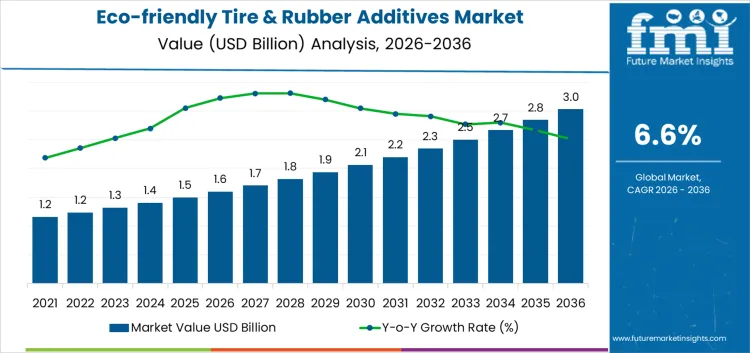
The global eco-friendly tire and rubber additives (low PAH) market, valued at USD 1.6 billion in 2026, is projected to reach USD 3.0 billion by 2036, advancing at a 6.6% CAGR. The market is driven by growing environmental concerns, stricter regulations, and rising demand for sustainable tire and rubber products. Low PAH additives help reduce toxic emissions during tire production and enhance sustainability, playing a key role in the automotive sector. Initially, the adoption of eco-friendly additives was limited, but as environmental standards tightened, manufacturers increasingly shifted towards low-PAH solutions to meet regulatory demands and consumer preferences.
Quick Stats for Eco-Friendly Tire and Rubber Additives (Low PAH) Market
- Eco-Friendly Tire and Rubber Additives (Low PAH) Market Value (2026): USD 1.6 billion
- Eco-Friendly Tire and Rubber Additives (Low PAH) Market Forecast Value (2036): USD 3.0 billion
- Eco-Friendly Tire and Rubber Additives (Low PAH) Market Forecast CAGR (2026-2036): 6.6%
- Leading Additive Type in Eco-Friendly Tire and Rubber Additives (Low PAH) Market: Low-PAH process oils (bio-based / treated distillates)
- Key Growth Regions in Eco-Friendly Tire and Rubber Additives (Low PAH) Market: Asia Pacific, North America
- Top Players in Eco-Friendly Tire and Rubber Additives (Low PAH) Market: Calgon Carbon (Kurary Group), Cabot Norit Activated Carbon, Haycarb PLC, Jacobi Carbons (Osaka Gas Chemicals), Eurocarb / Desotec
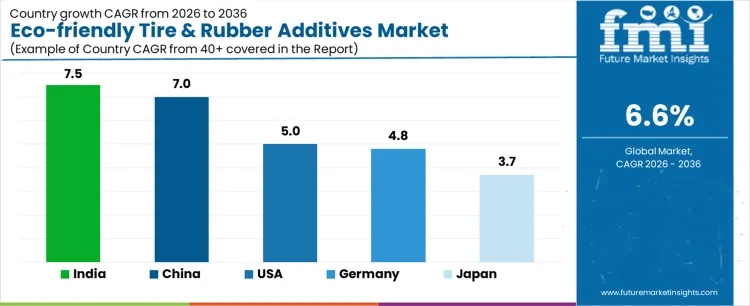
India leads the growth with a 7.5% CAGR, supported by a booming automotive sector and rising environmental consciousness. China follows with a 7.0% growth rate, driven by rapid industrialization and government-driven pollution control efforts. The USA and Germany show steady growth at 5.0% and 4.8%, respectively, due to strong regulatory frameworks and demand for greener tire products. Japan’s market grows moderately at 3.7%, with a focus on sustainability in the automotive industry. Key trends include the rise of bio-based additives, multifunctional low-PAH solutions, and growing collaborations between tire manufacturers and additive producers to meet environmental standards and consumer expectations.
Eco-Friendly Tire and Rubber Additives (Low PAH) Market Key Takeaways
| Metric | Value |
|---|---|
| Industry Value (2026) | USD 1.6 billion |
| Forecast Value (2036) | USD 3.0 billion |
| Forecast CAGR (2026-2036) | 6.6% |
How is the Global Eco-Friendly Tire and Rubber Additives (Low PAH) Sector Advancing?
The global eco-friendly tire and rubber additives market is experiencing growth driven by increasing environmental concerns and regulatory pressures related to harmful substances in tires and rubber products. Low PAH (polycyclic aromatic hydrocarbon) additives are designed to reduce the environmental impact of tire production and usage by minimizing toxic emissions and enhancing sustainability. Initially, the market for eco-friendly additives was limited, with standard chemical formulations being widely used. However, as environmental standards became more stringent and consumer demand for green products rose, manufacturers began shifting towards low-PAH additives to meet both regulatory requirements and market preferences for more sustainable solutions.
The market for eco-friendly tire and rubber additives is poised for continued expansion. As environmental regulations tighten globally, particularly in regions like Europe and North America, the demand for low-PAH additives will increase. Innovations in additive technologies that improve the performance, durability, and safety of tires while reducing environmental impact will drive further growth. However, challenges such as the higher cost of eco-friendly formulations and the need for manufacturers to invest in research and development will influence market dynamics. As sustainability becomes a central focus in the automotive and manufacturing industries, low-PAH additives will play a critical role in shaping the future of eco-friendly tire and rubber production.
What Is the Segment-Wise Analysis for the Global Eco-Friendly Tire and Rubber Additives Market?
The global eco-friendly tire and rubber additives (low PAH) market is driven by tire/rubber application areas and end-user categories. Passenger car tires lead with a 38% share, as they dominate the global tire market. Other significant applications include light truck & commercial tires, two-wheeler & small vehicle tires, off-the-road (OTR) & specialty industrial tires, high-performance EV tires, and general rubber goods. In terms of end-user categories, tire OEMs (global majors) account for 62%, driven by the high demand for eco-friendly additives in large-scale tire manufacturing.
Why Do Passenger Car Tires Lead the Eco-Friendly Tire and Rubber Additives Market?
 Market-tire-rubber-application-area.webp "Eco Friendly Tire And Rubber Additives (Low PAH) Market Tire Rubber Application Area")
Passenger car tires lead the global eco-friendly tire and rubber additives market with a 38% share due to their dominant role in the global tire sector. As the demand for sustainable and low-emission vehicles grows, tire manufacturers are increasingly adopting eco-friendly additives such as low-PAH process oils, bio-plasticizers, silica coupling agents, and sustainable antioxidants. These additives help reduce the environmental impact of tire production without compromising on performance, safety, or durability. Passenger car tires, being the most commonly used tire type worldwide, are at the forefront of this transition, making them a key driver in the market’s growth.
Why Do Tire OEMs (Global Majors) Hold the Largest Share in the Eco-Friendly Tire and Rubber Additives Market?
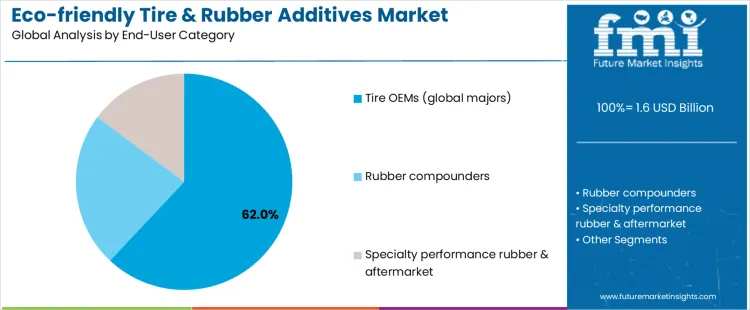
Tire OEMs (global majors) account for 62% of the global eco-friendly tire and rubber additives market due to their influential role in large-scale tire production. These major manufacturers are leading the way in sustainable tire production by integrating low-PAH additives, bio-based plasticizers, and other eco-friendly materials into their formulations. With stricter environmental regulations and increasing consumer demand for green products, tire OEMs are prioritizing sustainability in their manufacturing processes. This commitment to reducing the environmental footprint of tires, while maintaining high performance, drives the demand for eco-friendly additives, making tire OEMs the largest sector in the market.
What is Shaping the Eco‑Friendly Tire and Rubber Additives (Low PAH) Market?
The eco‑friendly tire and rubber additives (low PAH) market is shaped by growing regulatory pressure to reduce polycyclic aromatic hydrocarbons (PAHs), which pose environmental and health concerns. Tire and rubber manufacturers are increasingly adopting low PAH additives that improve performance while minimizing harmful emissions throughout the product lifecycle. Consumer preference for sustainable, safer products is rising, encouraging innovation in bio‑based and non‑toxic additive technologies.
What Are the Constraints Limiting the Adoption of Eco‑Friendly Tire and Rubber Additives (Low PAH)?
Adoption of eco‑friendly, low PAH tire and rubber additives is constrained by cost and performance concerns. Sustainable additive solutions can carry higher prices compared with conventional PAH‑rich alternatives, challenging price‑sensitive manufacturers. Some low PAH additives may initially underperform in specific mechanical properties, such as elasticity or abrasion resistance, requiring additional R&D investment to match traditional formulations. Transitioning manufacturing processes to accommodate new additives can also pose technical and operational challenges. Limited awareness or slower regulatory adoption in some regions further delays broader market uptake, particularly in developing economies.
What Are the Key Trends Shaping the Eco‑Friendly Tire and Rubber Additives (Low PAH) Market?
Key trends include the rise of bio‑based and renewable additive technologies that reduce reliance on petroleum‑derived chemicals while maintaining performance. Manufacturers are developing multifunctional additives that combine low PAH content with enhanced properties like wear resistance and fuel economy. There is increasing collaboration between additive producers and tire manufacturers to co‑innovate tailored solutions. Regulatory alignment across regions is encouraging global standardization of low PAH requirements, boosting market confidence. Sustainability reporting and eco‑labeling initiatives are influencing procurement decisions, as brands seek to demonstrate environmental responsibility and meet consumer expectations.
What is the Growth Outlook for the Eco-Friendly Tire and Rubber Additives (Low PAH) Market by Country?
| Country | CAGR (%) |
|---|---|
| China | 7% |
| USA | 5% |
| Germany | 4.8% |
| India | 7.5% |
| Japan | 3.7% |
The eco-friendly tire and rubber additives market is experiencing strong growth globally, with India leading at a 7.50% CAGR, driven by increasing demand for sustainable and low-PAH (polycyclic aromatic hydrocarbons) tire and rubber products. China follows closely with a 7.00% growth rate, fueled by rapid industrialization and stricter environmental regulations. The USA shows steady growth at 5.00%, supported by a rising focus on sustainable products and eco-friendly manufacturing processes. Germany's market grows at 4.80%, driven by strong environmental regulations and demand for greener tire and rubber additives. Japan’s market grows at a moderate 3.70%, supported by sustainability initiatives in the automotive and tire industries.
Why is the Eco-Friendly Tire and Rubber Additives (Low PAH) Market Growing in India?
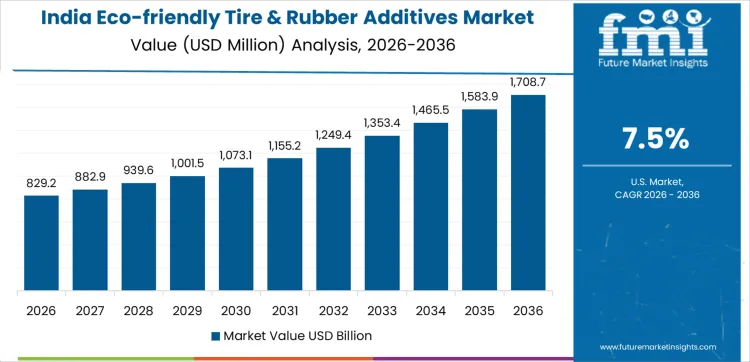
India’s eco-friendly tire and rubber additives market is growing at a 7.50% CAGR, driven by the country’s expanding automotive sector and increasing demand for sustainable products. As India’s industrial and automotive sectors continue to grow, there is rising awareness about the environmental impact of tire and rubber production. With stricter environmental regulations and growing consumer demand for eco-friendly solutions, the need for low-PAH tire and rubber additives is rising. The Indian government’s initiatives to promote sustainability and reduce carbon emissions are encouraging the adoption of eco-friendly tire and rubber additives in the manufacturing process. India’s expanding automotive industry and rising environmental consciousness contribute significantly to the strong growth of this market.
What is Contributing to the Growth of the Eco-Friendly Tire and Rubber Additives (Low PAH) Market in China?
China’s eco-friendly tire and rubber additives market is growing at a 7.00% CAGR, supported by the country’s rapid industrialization and increasing environmental awareness. The demand for low-PAH tire and rubber additives is rising as industries focus on reducing harmful emissions and adopting more sustainable manufacturing practices. China’s automotive industry, one of the largest in the world, is increasingly moving toward eco-friendly solutions in the production of tires and rubber components. The government’s strict regulations on pollution and environmental protection are encouraging the use of low-PAH additives in tire manufacturing. As global sustainability trends influence China’s manufacturing policies, the market for eco-friendly tire and rubber additives is expected to continue growing at a strong rate.
How is the Eco-Friendly Tire and Rubber Additives (Low PAH) Market Expanding in the USA?
The USA’s eco-friendly tire and rubber additives market is growing at a 5.00% CAGR, driven by the increasing demand for sustainable and environmentally responsible manufacturing solutions in the automotive and tire industries. As the USA continues to prioritize sustainability, manufacturers are adopting low-PAH additives to reduce harmful environmental impacts. Consumer demand for eco-friendly tires and rubber products is rising, pushing the automotive industry to incorporate sustainable materials and additives. The growing focus on reducing carbon footprints and complying with environmental regulations is contributing to market growth. As the USA embraces greener automotive solutions, the demand for eco-friendly tire and rubber additives will continue to rise steadily.
Why is the Eco-Friendly Tire and Rubber Additives (Low PAH) Market Growing in Germany?
Germany’s eco-friendly tire and rubber additives market is growing at a 4.80% CAGR, driven by the country’s strong commitment to sustainability and environmental protection. Germany has stringent regulations regarding the automotive industry’s environmental impact, pushing manufacturers to adopt low-PAH additives in tire and rubber production. The demand for eco-friendly tire products is on the rise, particularly as Germany’s automotive industry embraces greener alternatives to reduce emissions and improve the environmental footprint. Germany’s focus on sustainability and innovation, combined with increasing consumer demand for environmentally friendly products, is contributing to the market’s growth. As the country continues to lead in eco-conscious manufacturing practices, the market for low-PAH tire and rubber additives is expected to continue expanding.
What is Shaping the Eco-Friendly Tire and Rubber Additives (Low PAH) Market Growth in Japan?
Japan’s eco-friendly tire and rubber additives market is growing at a 3.70% CAGR, supported by the country’s focus on environmental sustainability and green manufacturing practices. Japan’s automotive industry, known for its innovation, is increasingly moving toward eco-friendly solutions, including the use of low-PAH additives in tire production. The country’s strict environmental regulations and the growing demand for sustainable automotive products are key drivers of market growth. Japan’s consumers are becoming more environmentally conscious, pushing for products that reduce harmful emissions and environmental impacts. As the automotive industry and government push for greater sustainability, Japan’s market for eco-friendly tire and rubber additives is expected to continue its moderate yet steady growth.
How are Companies Competing in the Eco‑Friendly Tire and Rubber Additives (Low PAH) Market?
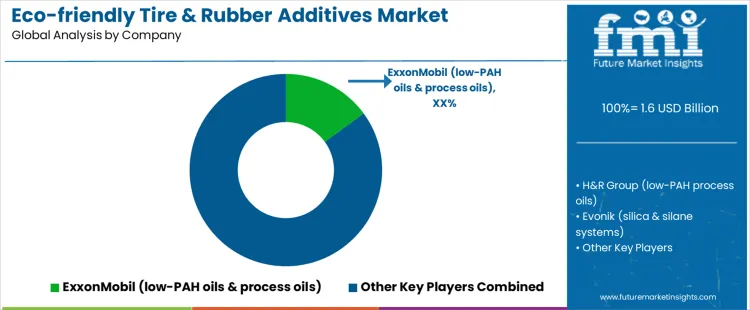
ExxonMobil, H & R Group, Evonik, Lanxess, Sichuan chemical suppliers, and Sasol pursue differentiated approaches in the eco‑friendly tire and rubber additives market with a focus on low PAH oils and performance‑enhancing chemistries. ExxonMobil and H & R Group stress low‑PAH process and refining oils tailored to modern tire compounds that meet strict environmental and regulatory standards. These product brochures highlight non‑toxic alternatives that help tire makers comply with global safety norms and reduce harmful aromatic content in rubber formulations. Low PAH oils are increasingly preferred as tire producers respond to tightening regulations and software quality standards.
Evonik stands out with silica and silane systems that reinforce rubber while enabling low rolling resistance and improved sustainability characteristics. Its brochures emphasize ULTRASIL® silica and advanced silanes designed to boost performance and support “green” tire designs that align with eco‑friendly goals. Lanxess showcases a broad range of rubber chemicals including antioxidants and antiozonants that extend tire life and durability while fitting into lower PAH formulations. Sichuan suppliers and Sasol provide base oils and specialty additives that balance performance with reduced PAH content. Across the sector, product literature underscores technical data, regulatory compliance, compatibility with bio‑based compounds, and support for tire makers pursuing sustainable material portfolios.
Key Players in Eco-Friendly Tire and Rubber Additives (Low PAH) Market
- Calgon Carbon (Kurary Group)
- Cabot Norit Activated Carbon
- Haycarb PLC
- Jacobi Carbons (Osaka Gas Chemicals)
- Eurocarb / Desotec
Scope of Report
| Items | Values |
|---|---|
| Quantitative Units (2026) | USD billion |
| Tire/Rubber Application Area | Passenger Car Tires, Light Truck & Commercial Tires, Two-Wheeler & Small Vehicle Tires, Off-the-Road (OTR) & Specialty Industrial Tires, High-Performance EV Tires, General Rubber Goods (Belts, Hoses, Seals) |
| Additive Type | Low-PAH Process Oils (Bio-Based / Treated Distillates), Low-PAH Plasticizers (Bio-Plasticizers, Citrate/Vegetable-Based), Silica & Silane Coupling Agents (for Low-Rolling-Resistance Tires), Sustainable Antioxidants (Low-Toxicity, Optimized Amine Systems), Low-PAH Antiozonants / Wax Blends, Sustainable Vulcanization Aids (Reduced Sulfur & Accelerators), Recycled Rubber Compatibilizers / Performance Boosters, Other Eco-Friendly Functional Additives |
| Additive Source Type | Bio-Based Oils & Plasticizers, Treated/Ultra-Low PAH Petroleum-Derived Oils, Silica/Silane Systems, Polymer-Modified / Specialty Eco-Formulations, Recycled / Circular Additive Ingredients |
| End-User Category | Tire OEMs (Global Majors), Rubber Compounders, Specialty Performance Rubber & Aftermarket |
| Regions Covered | Asia Pacific, Europe, North America, Latin America, Middle East & Africa |
| Countries Covered | USA, China, Japan, South Korea, India, Australia & New Zealand, ASEAN, Germany, UK, France, Italy, Spain, Nordic, BENELUX, Brazil, Chile, Mexico, Saudi Arabia, Other GCC Countries, Turkey, South Africa, Other African Union |
| Key Companies Profiled | Calgon Carbon (Kurary Group), Cabot Norit Activated Carbon, Haycarb PLC, Jacobi Carbons (Osaka Gas Chemicals), Eurocarb / Desotec |
| Additional Attributes | Dollar sales by additive type, additive source type, and end-user category; regional CAGR and growth outlook; distribution channels including tire OEMs, rubber compounders, and specialty aftermarket; innovation trends in bio-based and sustainable additives; competitive positioning of global vs regional suppliers. |
Eco-Friendly Tire and Rubber Additives (Low PAH) Market by Segments
Additive Type
- Low-PAH process oils (bio-based / treated distillates)
- Low-PAH plasticizers (bio-plasticizers, citrate/vegetable-based)
- Silica & silane coupling agents (for low-rolling-resistance tires)
- Sustainable antioxidants (low-toxicity, optimized amine systems)
- Low-PAH antiozonants / wax blends
- Sustainable vulcanization aids (reduced sulfur & accelerators)
- Recycled rubber compatibilizers / performance boosters
- Other eco-friendly functional additives
Tire/Rubber Application Area
- Passenger car tires
- Light truck & commercial tires
- Two-wheeler & small vehicle tires
- Off-the-road (OTR) & specialty industrial tires
- High-performance EV tires
- General rubber goods (belts, hoses, seals)
Additive Source Type
- Bio-based oils & plasticizers
- Treated/ultra-low PAH petroleum-derived oils
- Silica/silane systems
- Polymer-modified / specialty eco-formulations
- Recycled / circular additive ingredients
End-User Category
- Tire OEMs (global majors)
- Rubber compounders
- Specialty performance rubber & aftermarket
Region
- Asia Pacific
- China
- Japan
- South Korea
- India
- Australia & New Zealand
- ASEAN
- Rest of Asia Pacific
- Europe
- Germany
- United Kingdom
- France
- Italy
- Spain
- Nordic
- BENELUX
- Rest of Europe
- North America
- United States
- Canada
- Mexico
- Latin America
- Brazil
- Chile
- Rest of Latin America
- Middle East & Africa
- Kingdom of Saudi Arabia
- Other GCC Countries
- Turkey
- South Africa
- Other African Union
Frequently Asked Questions
How big is the eco-friendly tire and rubber additives (low PAH) market in 2026?
The global eco-friendly tire and rubber additives (low PAH) market is estimated to be valued at USD 1.6 billion in 2026.
What will be the size of eco-friendly tire and rubber additives (low PAH) market in 2036?
The market size for the eco-friendly tire and rubber additives (low PAH) market is projected to reach USD 3.0 billion by 2036.
How much will be the eco-friendly tire and rubber additives (low PAH) market growth between 2026 and 2036?
The eco-friendly tire and rubber additives (low PAH) market is expected to grow at a 6.6% CAGR between 2026 and 2036.
What are the key product types in the eco-friendly tire and rubber additives (low PAH) market?
The key product types in eco-friendly tire and rubber additives (low PAH) market are low-pah process oils (bio-based / treated distillates), low-pah plasticizers (bio-plasticizers, citrate/vegetable-based), silica & silane coupling agents (for low-rolling-resistance tires), sustainable antioxidants (low-toxicity, optimized amine systems), low-pah antiozonants / wax blends, sustainable vulcanization aids (reduced sulfur & accelerators), recycled rubber compatibilizers / performance boosters and other eco-friendly functional additives.
Which tire/rubber application area segment to contribute significant share in the eco-friendly tire and rubber additives (low PAH) market in 2026?
In terms of tire/rubber application area, passenger car tires segment to command 38.0% share in the eco-friendly tire and rubber additives (low PAH) market in 2026.
Preview the report firsthand - request a free sample
Get SampleGet the brochure for pricing and purchase details.
Get PDFTable of Content
- Executive Summary
- Global Market Outlook
- Demand-side Trends
- Supply-side Trends
- Technology Roadmap Analysis
- Analysis and Recommendations
- Market Overview
- Market Coverage / Taxonomy
- Market Definition / Scope / Limitations
- Market Background
- Market Dynamics
- Drivers
- Restraints
- Opportunity
- Trends
- Scenario Forecast
- Demand in Optimistic Scenario
- Demand in Likely Scenario
- Demand in Conservative Scenario
- Opportunity Map Analysis
- Product Life Cycle Analysis
- Supply Chain Analysis
- Investment Feasibility Matrix
- Value Chain Analysis
- PESTLE and Porter’s Analysis
- Regulatory Landscape
- Regional Parent Market Outlook
- Production and Consumption Statistics
- Import and Export Statistics
- Market Dynamics
- Global Market Analysis 2021 to 2025 and Forecast, 2026 to 2036
- Historical Market Size Value (USD Million) Analysis, 2021 to 2025
- Current and Future Market Size Value (USD Million) Projections, 2026 to 2036
- Y-o-Y Growth Trend Analysis
- Absolute $ Opportunity Analysis
- Global Market Pricing Analysis 2021 to 2025 and Forecast 2026 to 2036
- Global Market Analysis 2021 to 2025 and Forecast 2026 to 2036, By Additive Type
- Introduction / Key Findings
- Historical Market Size Value (USD Million) Analysis By Additive Type , 2021 to 2025
- Current and Future Market Size Value (USD Million) Analysis and Forecast By Additive Type , 2026 to 2036
- Low-PAH process oils (bio-based / treated distillates)
- Low-PAH plasticizers (bio-plasticizers, citrate/vegetable-based)
- Silica & silane coupling agents (for low-rolling-resistance tires)
- Sustainable antioxidants (low-toxicity, optimized amine systems)
- Low-PAH antiozonants / wax blends
- Sustainable vulcanization aids (reduced sulfur & accelerators)
- Recycled rubber compatibilizers / performance boosters
- Other eco-friendly functional additives
- Y-o-Y Growth Trend Analysis By Additive Type , 2021 to 2025
- Absolute $ Opportunity Analysis By Additive Type , 2026 to 2036
- Global Market Analysis 2021 to 2025 and Forecast 2026 to 2036, By Tire/Rubber Application Area
- Introduction / Key Findings
- Historical Market Size Value (USD Million) Analysis By Tire/Rubber Application Area, 2021 to 2025
- Current and Future Market Size Value (USD Million) Analysis and Forecast By Tire/Rubber Application Area, 2026 to 2036
- Passenger car tires
- Light truck & commercial tires
- Two-wheeler & small vehicle tires
- Off-the-road (OTR) & specialty industrial tires
- High-performance EV tires
- General rubber goods (belts, hoses, seals)
- Y-o-Y Growth Trend Analysis By Tire/Rubber Application Area, 2021 to 2025
- Absolute $ Opportunity Analysis By Tire/Rubber Application Area, 2026 to 2036
- Global Market Analysis 2021 to 2025 and Forecast 2026 to 2036, By Additive Source Type
- Introduction / Key Findings
- Historical Market Size Value (USD Million) Analysis By Additive Source Type, 2021 to 2025
- Current and Future Market Size Value (USD Million) Analysis and Forecast By Additive Source Type, 2026 to 2036
- Bio-based oils & plasticizers
- Treated/ultra-low PAH petroleum-derived oils
- Silica/silane systems
- Polymer-modified / specialty eco-formulations
- Recycled / circular additive ingredients
- Y-o-Y Growth Trend Analysis By Additive Source Type, 2021 to 2025
- Absolute $ Opportunity Analysis By Additive Source Type, 2026 to 2036
- Global Market Analysis 2021 to 2025 and Forecast 2026 to 2036, By End-User Category
- Introduction / Key Findings
- Historical Market Size Value (USD Million) Analysis By End-User Category, 2021 to 2025
- Current and Future Market Size Value (USD Million) Analysis and Forecast By End-User Category, 2026 to 2036
- Tire OEMs (global majors)
- Rubber compounders
- Specialty performance rubber & aftermarket
- Y-o-Y Growth Trend Analysis By End-User Category, 2021 to 2025
- Absolute $ Opportunity Analysis By End-User Category, 2026 to 2036
- Global Market Analysis 2021 to 2025 and Forecast 2026 to 2036, By Region
- Introduction
- Historical Market Size Value (USD Million) Analysis By Region, 2021 to 2025
- Current Market Size Value (USD Million) Analysis and Forecast By Region, 2026 to 2036
- North America
- Latin America
- Western Europe
- Eastern Europe
- East Asia
- South Asia and Pacific
- Middle East & Africa
- Market Attractiveness Analysis By Region
- North America Market Analysis 2021 to 2025 and Forecast 2026 to 2036, By Country
- Historical Market Size Value (USD Million) Trend Analysis By Market Taxonomy, 2021 to 2025
- Market Size Value (USD Million) Forecast By Market Taxonomy, 2026 to 2036
- By Country
- USA
- Canada
- Mexico
- By Additive Type
- By Tire/Rubber Application Area
- By Additive Source Type
- By End-User Category
- By Country
- Market Attractiveness Analysis
- By Country
- By Additive Type
- By Tire/Rubber Application Area
- By Additive Source Type
- By End-User Category
- Key Takeaways
- Latin America Market Analysis 2021 to 2025 and Forecast 2026 to 2036, By Country
- Historical Market Size Value (USD Million) Trend Analysis By Market Taxonomy, 2021 to 2025
- Market Size Value (USD Million) Forecast By Market Taxonomy, 2026 to 2036
- By Country
- Brazil
- Chile
- Rest of Latin America
- By Additive Type
- By Tire/Rubber Application Area
- By Additive Source Type
- By End-User Category
- By Country
- Market Attractiveness Analysis
- By Country
- By Additive Type
- By Tire/Rubber Application Area
- By Additive Source Type
- By End-User Category
- Key Takeaways
- Western Europe Market Analysis 2021 to 2025 and Forecast 2026 to 2036, By Country
- Historical Market Size Value (USD Million) Trend Analysis By Market Taxonomy, 2021 to 2025
- Market Size Value (USD Million) Forecast By Market Taxonomy, 2026 to 2036
- By Country
- Germany
- UK
- Italy
- Spain
- France
- Nordic
- BENELUX
- Rest of Western Europe
- By Additive Type
- By Tire/Rubber Application Area
- By Additive Source Type
- By End-User Category
- By Country
- Market Attractiveness Analysis
- By Country
- By Additive Type
- By Tire/Rubber Application Area
- By Additive Source Type
- By End-User Category
- Key Takeaways
- Eastern Europe Market Analysis 2021 to 2025 and Forecast 2026 to 2036, By Country
- Historical Market Size Value (USD Million) Trend Analysis By Market Taxonomy, 2021 to 2025
- Market Size Value (USD Million) Forecast By Market Taxonomy, 2026 to 2036
- By Country
- Russia
- Poland
- Hungary
- Balkan & Baltic
- Rest of Eastern Europe
- By Additive Type
- By Tire/Rubber Application Area
- By Additive Source Type
- By End-User Category
- By Country
- Market Attractiveness Analysis
- By Country
- By Additive Type
- By Tire/Rubber Application Area
- By Additive Source Type
- By End-User Category
- Key Takeaways
- East Asia Market Analysis 2021 to 2025 and Forecast 2026 to 2036, By Country
- Historical Market Size Value (USD Million) Trend Analysis By Market Taxonomy, 2021 to 2025
- Market Size Value (USD Million) Forecast By Market Taxonomy, 2026 to 2036
- By Country
- China
- Japan
- South Korea
- By Additive Type
- By Tire/Rubber Application Area
- By Additive Source Type
- By End-User Category
- By Country
- Market Attractiveness Analysis
- By Country
- By Additive Type
- By Tire/Rubber Application Area
- By Additive Source Type
- By End-User Category
- Key Takeaways
- South Asia and Pacific Market Analysis 2021 to 2025 and Forecast 2026 to 2036, By Country
- Historical Market Size Value (USD Million) Trend Analysis By Market Taxonomy, 2021 to 2025
- Market Size Value (USD Million) Forecast By Market Taxonomy, 2026 to 2036
- By Country
- India
- ASEAN
- Australia & New Zealand
- Rest of South Asia and Pacific
- By Additive Type
- By Tire/Rubber Application Area
- By Additive Source Type
- By End-User Category
- By Country
- Market Attractiveness Analysis
- By Country
- By Additive Type
- By Tire/Rubber Application Area
- By Additive Source Type
- By End-User Category
- Key Takeaways
- Middle East & Africa Market Analysis 2021 to 2025 and Forecast 2026 to 2036, By Country
- Historical Market Size Value (USD Million) Trend Analysis By Market Taxonomy, 2021 to 2025
- Market Size Value (USD Million) Forecast By Market Taxonomy, 2026 to 2036
- By Country
- Kingdom of Saudi Arabia
- Other GCC Countries
- Turkiye
- South Africa
- Other African Union
- Rest of Middle East & Africa
- By Additive Type
- By Tire/Rubber Application Area
- By Additive Source Type
- By End-User Category
- By Country
- Market Attractiveness Analysis
- By Country
- By Additive Type
- By Tire/Rubber Application Area
- By Additive Source Type
- By End-User Category
- Key Takeaways
- Key Countries Market Analysis
- USA
- Pricing Analysis
- Market Share Analysis, 2025
- By Additive Type
- By Tire/Rubber Application Area
- By Additive Source Type
- By End-User Category
- Canada
- Pricing Analysis
- Market Share Analysis, 2025
- By Additive Type
- By Tire/Rubber Application Area
- By Additive Source Type
- By End-User Category
- Mexico
- Pricing Analysis
- Market Share Analysis, 2025
- By Additive Type
- By Tire/Rubber Application Area
- By Additive Source Type
- By End-User Category
- Brazil
- Pricing Analysis
- Market Share Analysis, 2025
- By Additive Type
- By Tire/Rubber Application Area
- By Additive Source Type
- By End-User Category
- Chile
- Pricing Analysis
- Market Share Analysis, 2025
- By Additive Type
- By Tire/Rubber Application Area
- By Additive Source Type
- By End-User Category
- Germany
- Pricing Analysis
- Market Share Analysis, 2025
- By Additive Type
- By Tire/Rubber Application Area
- By Additive Source Type
- By End-User Category
- UK
- Pricing Analysis
- Market Share Analysis, 2025
- By Additive Type
- By Tire/Rubber Application Area
- By Additive Source Type
- By End-User Category
- Italy
- Pricing Analysis
- Market Share Analysis, 2025
- By Additive Type
- By Tire/Rubber Application Area
- By Additive Source Type
- By End-User Category
- Spain
- Pricing Analysis
- Market Share Analysis, 2025
- By Additive Type
- By Tire/Rubber Application Area
- By Additive Source Type
- By End-User Category
- France
- Pricing Analysis
- Market Share Analysis, 2025
- By Additive Type
- By Tire/Rubber Application Area
- By Additive Source Type
- By End-User Category
- India
- Pricing Analysis
- Market Share Analysis, 2025
- By Additive Type
- By Tire/Rubber Application Area
- By Additive Source Type
- By End-User Category
- ASEAN
- Pricing Analysis
- Market Share Analysis, 2025
- By Additive Type
- By Tire/Rubber Application Area
- By Additive Source Type
- By End-User Category
- Australia & New Zealand
- Pricing Analysis
- Market Share Analysis, 2025
- By Additive Type
- By Tire/Rubber Application Area
- By Additive Source Type
- By End-User Category
- China
- Pricing Analysis
- Market Share Analysis, 2025
- By Additive Type
- By Tire/Rubber Application Area
- By Additive Source Type
- By End-User Category
- Japan
- Pricing Analysis
- Market Share Analysis, 2025
- By Additive Type
- By Tire/Rubber Application Area
- By Additive Source Type
- By End-User Category
- South Korea
- Pricing Analysis
- Market Share Analysis, 2025
- By Additive Type
- By Tire/Rubber Application Area
- By Additive Source Type
- By End-User Category
- Russia
- Pricing Analysis
- Market Share Analysis, 2025
- By Additive Type
- By Tire/Rubber Application Area
- By Additive Source Type
- By End-User Category
- Poland
- Pricing Analysis
- Market Share Analysis, 2025
- By Additive Type
- By Tire/Rubber Application Area
- By Additive Source Type
- By End-User Category
- Hungary
- Pricing Analysis
- Market Share Analysis, 2025
- By Additive Type
- By Tire/Rubber Application Area
- By Additive Source Type
- By End-User Category
- Kingdom of Saudi Arabia
- Pricing Analysis
- Market Share Analysis, 2025
- By Additive Type
- By Tire/Rubber Application Area
- By Additive Source Type
- By End-User Category
- Turkiye
- Pricing Analysis
- Market Share Analysis, 2025
- By Additive Type
- By Tire/Rubber Application Area
- By Additive Source Type
- By End-User Category
- South Africa
- Pricing Analysis
- Market Share Analysis, 2025
- By Additive Type
- By Tire/Rubber Application Area
- By Additive Source Type
- By End-User Category
- USA
- Market Structure Analysis
- Competition Dashboard
- Competition Benchmarking
- Market Share Analysis of Top Players
- By Regional
- By Additive Type
- By Tire/Rubber Application Area
- By Additive Source Type
- By End-User Category
- Competition Analysis
- Competition Deep Dive
- ExxonMobil (low-PAH oils & process oils)
- Overview
- Product Portfolio
- Profitability by Market Segments (Product/Age /Sales Channel/Region)
- Sales Footprint
- Strategy Overview
- Marketing Strategy
- Product Strategy
- Channel Strategy
- H&R Group (low-PAH process oils)
- Evonik (silica & silane systems)
- Lanxess (antioxidants, antiozonants)
- Sichuan
- Sasol
- ExxonMobil (low-PAH oils & process oils)
- Competition Deep Dive
- Assumptions & Acronyms Used
- Research Methodology


