

- Industry Size (2026)
- USD 459.4 Mn
- Forecast (2036)
- USD 1128.1 Mn
- CAGR (2026 to 2036)
- 9.4%
Low-Noise Anti-Squeak Additives Market Forecast and Outlook 2026 to 2036
In 2026, the value is projected at USD 459.4 million, with a steady increase anticipated by 2036, when the value will reach USD 1,128.1 million. This growth is driven by an ongoing demand for noise-reduction solutions across various industries, such as automotive, construction, and consumer goods. The compound annual growth rate (CAGR) for the period is forecasted to be 9.4%. The steady rise in demand reflects increased emphasis on noise control and compliance with stricter regulations in multiple sectors.
In the automotive sector, low-noise anti-squeak additives are particularly critical for meeting stringent noise reduction requirements. Other industries, including construction and manufacturing, are expected to contribute to overall growth. As industries continue to focus on reducing noise levels and meeting environmental standards, demand for low-noise anti-squeak additives will rise. This trend will support a consistent upward trajectory, driven by ongoing product innovation and heightened awareness about the impact of noise on health and the environment.
Quick Stats of the Low-Noise Anti-Squeak Additives Market
- Low-Noise Anti-Squeak Additives Market Value (2026): USD 459.4 million
- Low-Noise Anti-Squeak Additives Market Forecast Value (2036): USD 1,128.1 million
- Low-Noise Anti-Squeak Additives Market Global Forecast CAGR (2026 to 2036): 9.4%
- Low-Noise Anti-Squeak Additives Market Leading Segment: Customer Type (Automotive OEMs & Tier-1s) 46%
- Key Growth Regions in Low-Noise Anti-Squeak Additives Market: China
- Top Players in Low-Noise Anti-Squeak Additives Market: Lubrizol, Afton Chemical, BASF, Evonik Industries, Clariant, DuPont, LANXESS, Croda International, Dow, Infineum
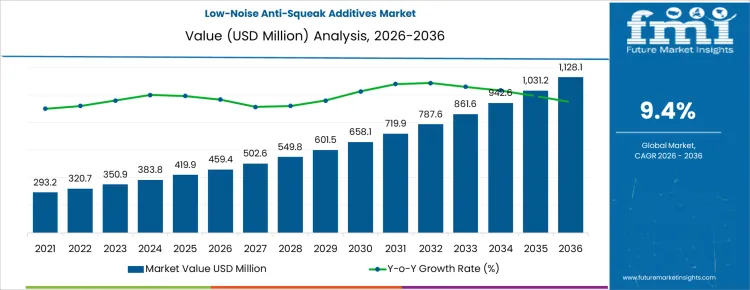
What is the Growth Forecast for the Low-Noice Anti-Squeak Additives Market through 2036?
Low-noise anti-squeak additives are forecasted to experience steady growth with a CAGR of 9.4% through 2036. Starting at USD 459.4 million in 2026, the value is expected to reach USD 1,128.1 million by 2036. Growth will remain consistent, with values rising to USD 502 million in 2027, USD 548 million in 2028, and USD 597.6 million in 2029. As the years progress, continued demand from various sectors will further drive this upward trend.
From 2030 to 2036, growth will continue to accelerate, reaching USD 651.1 million in 2030, USD 708.9 million in 2031, and USD 771.3 million in 2032. By 2033, the value will reach USD 838.7 million, followed by further increases to USD 911.5 million in 2034. The market value rises from USD 911.5 million in 2034 to approximately USD 1,015.0 million in 2035, before reaching USD 1,128.1 million by 2036.
Low-Noise Anti-Squeak Additives Market Key Takeaways
| Metric | Value |
|---|---|
| Industry Sales Value (2026) | USD 459.4 million |
| Industry Forecast Value (2036) | USD 1,128.1 million |
| Industry Forecast CAGR (2026 to 2036) | 9.4% |
What Is Driving the Demand for the Low-Noise Anti-Squeak Additives Market Globally?
The global demand for low-noise anti-squeak additives is being driven by rising expectations for product quality, user comfort, and perceived premium performance in automotive, appliance, consumer electronics, and industrial equipment sectors. Anti-squeak additives are formulation components that reduce friction-induced noise between contacting surfaces, helping to eliminate squeaks, rattles, and chatter that can degrade user experience and signal poor quality. In the automotive industry, where interior refinement is a key competitive attribute, these additives are incorporated into coatings, lubricants, elastomers, plastics, and composite materials used in door panels, seat tracks, dashboard assemblies, and trim interfaces.
Consumer electronics and household appliances face similar demands as products become thinner, more compact, and subject to tighter tolerance assemblies; manufacturers are under pressure to deliver quieter operation as a hallmark of quality. Growth in these end-use categories, particularly in regions with expanding middle-class populations and higher disposable incomes, supports demand for additives that can be formulated into diverse material systems without compromising mechanical properties or longevity. At the same time, design trends that favour lightweighting and miniaturisation create additional interfaces where noise generation can occur, reinforcing the role of tailored anti-squeak solutions.
Future demand for low-noise anti-squeak additives is expected to grow as product differentiation continues to emphasise holistic user experience and as sustainability considerations intersect with performance formulation. Advances in polymer science, particulate technologies, and surface-active agents will broaden the range of additive systems capable of delivering effective noise reduction across diverse materials and environmental conditions. Growth in electric vehicles, which lack engine noise that historically masks cabin squeaks, will further elevate the importance of anti-squeak technologies to maintain perceived quality and comfort. Regulatory frameworks that incentivise quieter products in residential, industrial, and transportation applications may also shape formulation priorities.
Suppliers that can offer additives compatible with recyclable, bio-derived, or reduced-VOC systems will be well-positioned as sustainability criteria become more integrated into procurement and design decisions. Expansion of global manufacturing, increased automation, and greater precision in mass production will enable broader integration of sophisticated additives as part of standard material specifications. As consumer and OEM expectations for quiet, refined performance grow across markets, the anti-squeak additive segment is expected to expand steadily, supported by innovation that balances noise control, material compatibility, and environmental considerations.
What are the Leading Segments in the Global Low-Noise Anti-Squeak Additives Market?
The global low-noise anti-squeak additives market is segmented by substrate and customer type. Among substrates, thermoplastics compounds lead the market, accounting for 36% of the share, followed by elastomers & rubber, coatings & tapes, metal-to-metal lubricants, and foams & others. Thermoplastics compounds are preferred due to their widespread use in automotive, industrial, and consumer goods applications, where noise reduction is a key concern. On the customer type side, automotive OEMs & Tier-1s are the largest segment, representing 46% of the market. Other significant customer types include industrial OEMs, appliance manufacturers, aftermarket lubricants, and other sectors. The growth of the market is driven by the increasing demand for noise-reducing materials in industries like automotive and industrial manufacturing.
What Drives the Growth of Thermoplastics Compounds in the Low-Noise Anti-Squeak Additives Market?
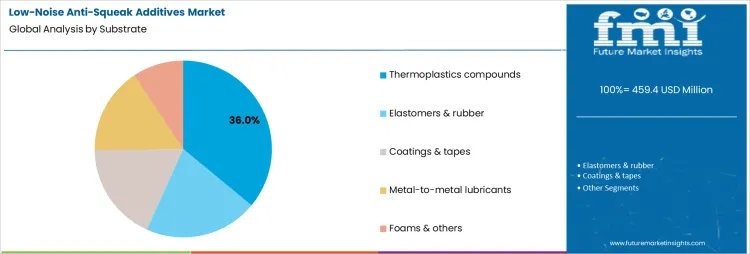
Thermoplastics compounds are the leading substrate in the low-noise anti-squeak additives market, capturing 36% of the share. This dominance is primarily driven by their extensive use in automotive and industrial applications, where reducing noise and improving comfort are key priorities. Thermoplastics compounds are versatile and can be easily molded, making them ideal for use in parts that require noise reduction, such as interior automotive components, electrical housings, and consumer goods. The incorporation of anti-squeak additives in thermoplastic compounds helps to reduce friction between moving parts, which prevents squeaking and unwanted noise. As noise control continues to be an important factor in improving the consumer experience in the automotive and appliance sectors, thermoplastic compounds are widely used in parts like dashboards, door panels, and seals. Additionally, the increasing use of thermoplastics in electric vehicles, where quieter operation is a crucial feature, further supports the growth of this segment. With a continued emphasis on product performance, comfort, and sound quality, the demand for thermoplastics compounds in low-noise applications is expected to remain strong.
What is Driving the Demand for Automotive OEMs & Tier-1s in the Low-Noise Anti-Squeak Additives Market?
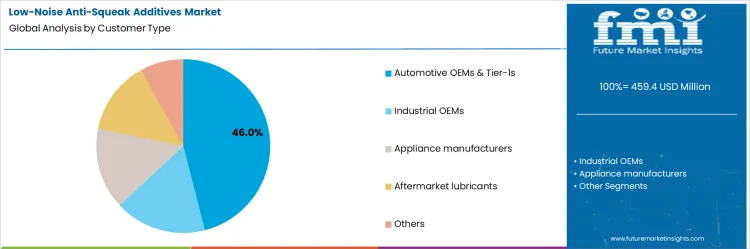
Automotive OEMs & Tier-1s are the leading customer type in the low-noise anti-squeak additives market, accounting for 46% of the share. This segment is driven by the automotive industry's increasing focus on enhancing vehicle quality, comfort, and noise reduction. As consumer expectations for quieter, more comfortable rides rise, automotive manufacturers are increasingly incorporating low-noise anti-squeak additives into vehicle parts, such as interiors, seals, and engine components. The growing adoption of electric vehicles, which operate more quietly than traditional combustion engine vehicles, has intensified the need for effective noise reduction technologies. OEMs and Tier-1 suppliers play a critical role in this segment, as they are responsible for sourcing and integrating these additives into a wide range of vehicle components. Additionally, the increasing demand for lightweight, durable, and high-performance materials in the automotive sector further drives the need for low-noise additives, particularly in thermoplastic and elastomer-based components. As the automotive industry continues to innovate and enhance vehicle performance, the demand for low-noise solutions from OEMs and Tier-1s is expected to remain a key driver in the market.
What are the Key Dynamics of the Global Low-Noise Anti-Squeak Additives Market?
The global low-noise anti-squeak additives market is expanding as manufacturers of automotive interiors, furniture, footwear and consumer products seek materials that reduce friction-induced noise between contacting surfaces. These additives are incorporated into polymers, elastomers and coatings to minimise squeak, chatter and other unwanted noises that affect product quality and user experience. Growth is supported by rising demand for premium, quiet products, stringent quality expectations, and focus on comfort in automotive and lifestyle applications. Adoption is global as brands prioritise acoustic performance without compromising material processability or aesthetics.
What are the Key Drivers for the Global Low-Noise Anti-Squeak Additives Market?
A key driver is increasing consumer and OEM focus on noise, vibration and harshness (NVH) performance, especially in automotive interiors where squeak and rattle complaints affect perceived quality. Additives that improve surface lubrication and reduce friction help meet NVH targets while supporting design flexibility. Growth in furniture and durable consumer goods also motivates integration of anti-squeak agents to enhance product longevity and user satisfaction. Advances in additive chemistry that deliver low-noise performance with minimal impact on mechanical properties support formulators. Rising quality standards and competitive differentiation across segments encourage adoption of engineered low-noise solutions worldwide.
What are the Restraints for the Global Low-Noise Anti-Squeak Additives Market?
One restraint is technical complexity, as optimizing anti-squeak additives requires careful selection and balancing within host materials to ensure noise reduction without degrading strength, wear resistance or surface appearance. Some high-performance additives may add cost, affecting pricing decisions in value-sensitive segments. Compatibility with diverse polymer and elastomer systems necessitates extensive testing and formulation expertise, which increases development time and resource needs. Regulatory and environmental considerations around certain additive chemistries can influence raw material choices and require compliance planning, especially in tightly regulated industries.
What is the Key Trends in the Global Low-Noise Anti-Squeak Additives Market?
A key trend is development of multifunctional additive systems that combine low-noise performance with improved lubricity, wear reduction and surface aesthetics, enabling broader application across product types. Manufacturers are innovating bio-based and environmentally preferable anti-squeak agents that align with sustainability goals while delivering effective friction control. Tailored solutions that address specific contact interfaces such as hard-soft polymer pairs in automotive interiors or textile-plastic combinations in consumer goods are gaining traction. Collaboration between additive suppliers and OEMs accelerates design of formulations that meet NVH, comfort and durability criteria. Use of predictive modelling and simulation in formulation design helps optimise additive performance earlier in development cycles.
What is the Country-Wise Analysis of the Low-Noise Anti-Squeak Additives Market?
The low-noise anti-squeak additives market is projected to grow steadily, driven by the increasing demand for automotive and industrial applications where noise reduction is critical. These additives are primarily used in applications that require friction modification, enhancing the performance and longevity of materials while reducing unwanted squeaks and noise. With growing consumer and regulatory emphasis on noise reduction and enhanced user experience, industries are turning to low-noise solutions for improved product performance. High-growth markets like China are seeing strong demand driven by industrial expansion and a growing automotive sector, while developed markets such as the USA, UK, and Germany are experiencing steady growth due to advanced manufacturing standards and a focus on product performance and quality.
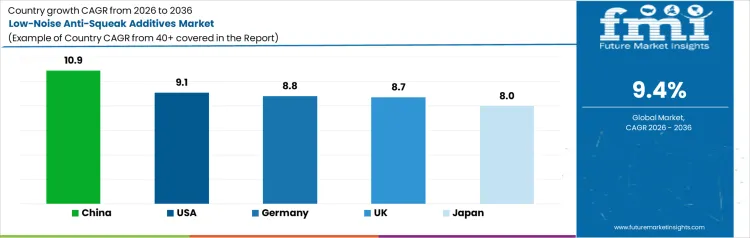
| Country | CAGR (2026-2036) |
|---|---|
| China | 10.9% |
| United States | 9.1% |
| United Kingdom | 8.7% |
| Germany | 8.8% |
| Japan | 8.0% |
What is the Growth Outlook for the Low-Noise Anti-Squeak Additives Market in China?
The low-noise anti-squeak additives market in China is expected to grow at the highest rate, with a projected CAGR of 10.9%. China’s rapidly expanding automotive industry, coupled with increasing industrial activity, is driving strong demand for noise reduction solutions in manufacturing processes. As noise pollution regulations become stricter and consumer demand for high-quality, low-noise products rises, the need for low-noise anti-squeak additives is increasing. The country’s vast industrial base and growing middle class are also fueling the adoption of noise-reduction technologies in consumer goods, automotive, and industrial sectors. As China continues to modernize its industries and meet environmental standards, the market for low-noise anti-squeak additives is poised for significant growth.
What is the Market Outlook for the Low-Noise Anti-Squeak Additives Market in the United States?
The low-noise anti-squeak additives market in the United States is projected to grow steadily, with a projected CAGR of 9.1%. The USA automotive and industrial sectors are key drivers of this growth, as both industries increasingly focus on product performance and noise reduction. As USA manufacturers strive to meet stringent environmental regulations and consumer demands for quieter, more efficient products, the adoption of low-noise anti-squeak additives is on the rise. In addition to automotive applications, these additives are also becoming increasingly popular in consumer goods and industrial equipment to improve performance and enhance user experience. As noise reduction and performance-enhancing technologies continue to evolve, the USA market is expected to see steady growth in demand for low-noise anti-squeak additives.
What is the Growth Forecast for the Low-Noise Anti-Squeak Additives Market in the United Kingdom?
The low-noise anti-squeak additives market in the United Kingdom is expected to grow at a steady pace, with a projected CAGR of 8.7%. The UK’s automotive, industrial, and consumer goods sectors are all driving the adoption of these additives, as manufacturers focus on improving product performance, reducing noise, and complying with environmental standards. The UK’s commitment to sustainability and high-quality manufacturing is fostering the growth of low-noise solutions, especially as the demand for quieter, more efficient products rises. Additionally, consumer preferences for improved user experiences are pushing manufacturers to adopt technologies that reduce noise and enhance the quality of materials. As these trends continue, the UK market for low-noise anti-squeak additives is expected to see steady growth.
What is the Market Outlook for the Low-Noise Anti-Squeak Additives Market in Germany?
The low-noise anti-squeak additives market in Germany is projected to grow at a steady pace, with a projected CAGR of 8.8%. Germany’s strong manufacturing base, particularly in automotive and industrial sectors, is driving the demand for low-noise solutions to improve product performance and comply with strict noise reduction regulations. As German manufacturers focus on both performance and sustainability, the use of low-noise anti-squeak additives is increasing. The country’s emphasis on environmental responsibility and high-quality products is further supporting the growth of these additives. With noise pollution regulations tightening and consumer demand for quieter products rising, Germany’s market for low-noise anti-squeak additives is expected to continue its steady growth.
What are the Growth Prospects for the Low-Noise Anti-Squeak Additives Market in Japan?
The low-noise anti-squeak additives market in Japan is expected to grow at a moderate pace, with a projected CAGR of 8%. Japan’s well-established automotive and industrial sectors, combined with increasing demand for high-performance, low-noise products, are contributing to the growth of the market. As consumer expectations for quieter products rise and noise reduction regulations become stricter, Japanese manufacturers are adopting low-noise solutions to improve product quality and meet regulatory standards. Japan’s focus on innovation, precision, and product quality is driving steady demand for these additives, especially in the automotive, electronics, and industrial equipment sectors. While growth in Japan may be slower than in other regions, the demand for low-noise anti-squeak additives is expected to continue growing steadily.
What is the Competitive Landscape for the Low-Noise Anti-Squeak Additives Market?
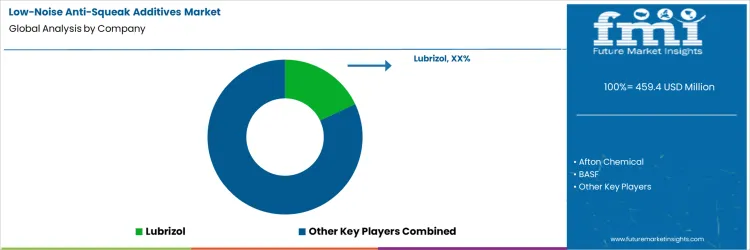
The low-noise anti-squeak additives market is growing as manufacturers across industries seek solutions to reduce friction and noise in various products, particularly in automotive and industrial applications. Lubrizol leads the market with its innovative low-noise anti-squeak additives, offering high-performance solutions that improve product functionality and enhance consumer satisfaction by reducing noise generation.
Their commitment to innovation and effective noise-reducing technologies has positioned them as a key player. Afton Chemical, BASF, and Evonik Industries are strong competitors, each providing specialized additives designed to address the growing demand for anti-squeak and low-noise solutions. Afton Chemical focuses on high-quality, effective solutions for automotive applications, while BASF and Evonik Industries offer a broad range of additives for noise reduction across various sectors.
Clariant, DuPont, LANXESS, Croda International, Dow, and Infineum further contribute to the competitive landscape by offering tailored anti-squeak additives for diverse applications. Clariant provides eco-friendly, high-performance additives that reduce friction and noise, while DuPont focuses on advanced formulations that improve product durability and reduce squeaking in industrial applications.
LANXESS and Croda International offer innovative solutions for a range of applications, including automotive and consumer products. Dow and Infineum specialize in additives that enhance low-noise properties in lubricants and materials. These companies compete by focusing on technological innovation, sustainability, and the ability to deliver effective anti-squeak solutions for improved product performance and consumer satisfaction.
Key Players of the Low-Noise Anti-Squeak Additives Market
- Lubrizol
- Afton Chemical
- BASF
- Evonik Industries
- Clariant
- DuPont
- LANXESS
- Croda International
- Dow
- Infineum
Scope of the Report
| Items | Values |
|---|---|
| Quantitative Units (2026) | USD Million |
| Application Area | Automotive Interior Trims, Seals & Weatherstrips, Appliance & White Goods, Industrial Machinery Components, Others |
| Additive Type | Friction Modifiers, Polymeric Lubricants, Solid Lubricant Concentrates, Silicone Lubricants, Others |
| Substrate | Thermoplastics Compounds, Elastomers & Rubber, Coatings & Tapes, Metal-to-Metal Lubricants, Foams & Others |
| Customer Type | Automotive OEMs & Tier-1s, Industrial OEMs, Appliance Manufacturers, Aftermarket Lubricants, Others |
| Companies | Lubrizol (Leading), Afton Chemical, BASF, Evonik Industries, Clariant, DuPont, LANXESS, Croda International, Dow, Infineum |
| Regions Covered | North America, Latin America, Western Europe, Eastern Europe, South Asia and Pacific, East Asia, Middle East & Africa |
| Countries Covered | United States, Canada, Mexico, Brazil, Argentina, Germany, France, United Kingdom, Italy, Spain, Netherlands, China, India, Japan, South Korea, ANZ, GCC Countries, South Africa |
| Additional Attributes | Dollar by sales by application area, additive type, substrate, customer type, and region. Includes market trends in low-noise anti-squeak additives, focusing on friction modifiers, polymeric lubricants, solid lubricants, and silicone lubricants. Highlights the role of thermoplastics, elastomers, coatings, and metal lubricants in automotive, industrial machinery, and appliance applications. Focus on cost-effectiveness, sustainability, regulatory compliance, market share, and competitive positioning of key companies in the additives market. |
Low-Noise Anti-Squeak Additives Market Segmentation
Application Area
- Automotive interior trims
- Seals & weatherstrips
- Appliance & white goods
- Industrial machinery components
- Others
Additive Type
- Friction modifiers
- Polymeric lubricants
- Solid lubricant concentrates
- Silicone lubricants
- Others
Substrate
- Thermoplastics compounds
- Elastomers & rubber
- Coatings & tapes
- Metal-to-metal lubricants
- Foams & others
Customer Type
- Automotive OEMs & Tier-1s
- Industrial OEMs
- Appliance manufacturers
- Aftermarket lubricants
- Others
Region
- Asia Pacific
- China
- Japan
- South Korea
- India
- Australia & New Zealand
- ASEAN
- Rest of Asia Pacific
- Europe
- Germany
- United Kingdom
- France
- Italy
- Spain
- Nordic
- BENELUX
- Rest of Europe
- North America
- United States
- Canada
- Mexico
- Latin America
- Brazil
- Chile
- Rest of Latin America
- Middle East & Africa
- Kingdom of Saudi Arabia
- Other GCC Countries
- Turkey
- South Africa
- Other African Union
- Rest of Middle East & Africa
Frequently Asked Questions
How big is the low-noise anti-squeak additives market in 2026?
The global low-noise anti-squeak additives market is estimated to be valued at USD 459.4 million in 2026.
What will be the size of low-noise anti-squeak additives market in 2036?
The market size for the low-noise anti-squeak additives market is projected to reach USD 1,128.1 million by 2036.
How much will be the low-noise anti-squeak additives market growth between 2026 and 2036?
The low-noise anti-squeak additives market is expected to grow at a 9.4% CAGR between 2026 and 2036.
What are the key product types in the low-noise anti-squeak additives market?
The key product types in low-noise anti-squeak additives market are automotive interior trims, seals & weatherstrips, appliance & white goods, industrial machinery components and others.
Which additive type segment to contribute significant share in the low-noise anti-squeak additives market in 2026?
In terms of additive type, friction modifiers segment to command 30.0% share in the low-noise anti-squeak additives market in 2026.
Preview the report firsthand - request a free sample
Get SampleGet the brochure for pricing and purchase details.
Get PDFTable of Content
- Executive Summary
- Global Market Outlook
- Demand-side Trends
- Supply-side Trends
- Technology Roadmap Analysis
- Analysis and Recommendations
- Market Overview
- Market Coverage / Taxonomy
- Market Definition / Scope / Limitations
- Market Background
- Market Dynamics
- Drivers
- Restraints
- Opportunity
- Trends
- Scenario Forecast
- Demand in Optimistic Scenario
- Demand in Likely Scenario
- Demand in Conservative Scenario
- Opportunity Map Analysis
- Product Life Cycle Analysis
- Supply Chain Analysis
- Investment Feasibility Matrix
- Value Chain Analysis
- PESTLE and Porter’s Analysis
- Regulatory Landscape
- Regional Parent Market Outlook
- Production and Consumption Statistics
- Import and Export Statistics
- Market Dynamics
- Global Market Analysis 2021 to 2025 and Forecast, 2026 to 2036
- Historical Market Size Value (USD Million) Analysis, 2021 to 2025
- Current and Future Market Size Value (USD Million) Projections, 2026 to 2036
- Y-o-Y Growth Trend Analysis
- Absolute $ Opportunity Analysis
- Global Market Pricing Analysis 2021 to 2025 and Forecast 2026 to 2036
- Global Market Analysis 2021 to 2025 and Forecast 2026 to 2036, By Application Area
- Introduction / Key Findings
- Historical Market Size Value (USD Million) Analysis By Application Area , 2021 to 2025
- Current and Future Market Size Value (USD Million) Analysis and Forecast By Application Area , 2026 to 2036
- Automotive interior trims
- Seals & weatherstrips
- Appliance & white goods
- Industrial machinery components
- Others
- Y-o-Y Growth Trend Analysis By Application Area , 2021 to 2025
- Absolute $ Opportunity Analysis By Application Area , 2026 to 2036
- Global Market Analysis 2021 to 2025 and Forecast 2026 to 2036, By Additive Type
- Introduction / Key Findings
- Historical Market Size Value (USD Million) Analysis By Additive Type, 2021 to 2025
- Current and Future Market Size Value (USD Million) Analysis and Forecast By Additive Type, 2026 to 2036
- Friction modifiers
- Polymeric lubricants
- Solid lubricant concentrates
- Silicone lubricants
- Others
- Y-o-Y Growth Trend Analysis By Additive Type, 2021 to 2025
- Absolute $ Opportunity Analysis By Additive Type, 2026 to 2036
- Global Market Analysis 2021 to 2025 and Forecast 2026 to 2036, By Substrate
- Introduction / Key Findings
- Historical Market Size Value (USD Million) Analysis By Substrate, 2021 to 2025
- Current and Future Market Size Value (USD Million) Analysis and Forecast By Substrate, 2026 to 2036
- Thermoplastics compounds
- Elastomers & rubber
- Coatings & tapes
- Metal-to-metal lubricants
- Foams & others
- Y-o-Y Growth Trend Analysis By Substrate, 2021 to 2025
- Absolute $ Opportunity Analysis By Substrate, 2026 to 2036
- Global Market Analysis 2021 to 2025 and Forecast 2026 to 2036, By Customer Type
- Introduction / Key Findings
- Historical Market Size Value (USD Million) Analysis By Customer Type, 2021 to 2025
- Current and Future Market Size Value (USD Million) Analysis and Forecast By Customer Type, 2026 to 2036
- Automotive OEMs & Tier-1s
- Industrial OEMs
- Appliance manufacturers
- Aftermarket lubricants
- Others
- Y-o-Y Growth Trend Analysis By Customer Type, 2021 to 2025
- Absolute $ Opportunity Analysis By Customer Type, 2026 to 2036
- Global Market Analysis 2021 to 2025 and Forecast 2026 to 2036, By Region
- Introduction
- Historical Market Size Value (USD Million) Analysis By Region, 2021 to 2025
- Current Market Size Value (USD Million) Analysis and Forecast By Region, 2026 to 2036
- North America
- Latin America
- Western Europe
- Eastern Europe
- East Asia
- South Asia and Pacific
- Middle East & Africa
- Market Attractiveness Analysis By Region
- North America Market Analysis 2021 to 2025 and Forecast 2026 to 2036, By Country
- Historical Market Size Value (USD Million) Trend Analysis By Market Taxonomy, 2021 to 2025
- Market Size Value (USD Million) Forecast By Market Taxonomy, 2026 to 2036
- By Country
- USA
- Canada
- Mexico
- By Application Area
- By Additive Type
- By Substrate
- By Customer Type
- By Country
- Market Attractiveness Analysis
- By Country
- By Application Area
- By Additive Type
- By Substrate
- By Customer Type
- Key Takeaways
- Latin America Market Analysis 2021 to 2025 and Forecast 2026 to 2036, By Country
- Historical Market Size Value (USD Million) Trend Analysis By Market Taxonomy, 2021 to 2025
- Market Size Value (USD Million) Forecast By Market Taxonomy, 2026 to 2036
- By Country
- Brazil
- Chile
- Rest of Latin America
- By Application Area
- By Additive Type
- By Substrate
- By Customer Type
- By Country
- Market Attractiveness Analysis
- By Country
- By Application Area
- By Additive Type
- By Substrate
- By Customer Type
- Key Takeaways
- Western Europe Market Analysis 2021 to 2025 and Forecast 2026 to 2036, By Country
- Historical Market Size Value (USD Million) Trend Analysis By Market Taxonomy, 2021 to 2025
- Market Size Value (USD Million) Forecast By Market Taxonomy, 2026 to 2036
- By Country
- Germany
- UK
- Italy
- Spain
- France
- Nordic
- BENELUX
- Rest of Western Europe
- By Application Area
- By Additive Type
- By Substrate
- By Customer Type
- By Country
- Market Attractiveness Analysis
- By Country
- By Application Area
- By Additive Type
- By Substrate
- By Customer Type
- Key Takeaways
- Eastern Europe Market Analysis 2021 to 2025 and Forecast 2026 to 2036, By Country
- Historical Market Size Value (USD Million) Trend Analysis By Market Taxonomy, 2021 to 2025
- Market Size Value (USD Million) Forecast By Market Taxonomy, 2026 to 2036
- By Country
- Russia
- Poland
- Hungary
- Balkan & Baltic
- Rest of Eastern Europe
- By Application Area
- By Additive Type
- By Substrate
- By Customer Type
- By Country
- Market Attractiveness Analysis
- By Country
- By Application Area
- By Additive Type
- By Substrate
- By Customer Type
- Key Takeaways
- East Asia Market Analysis 2021 to 2025 and Forecast 2026 to 2036, By Country
- Historical Market Size Value (USD Million) Trend Analysis By Market Taxonomy, 2021 to 2025
- Market Size Value (USD Million) Forecast By Market Taxonomy, 2026 to 2036
- By Country
- China
- Japan
- South Korea
- By Application Area
- By Additive Type
- By Substrate
- By Customer Type
- By Country
- Market Attractiveness Analysis
- By Country
- By Application Area
- By Additive Type
- By Substrate
- By Customer Type
- Key Takeaways
- South Asia and Pacific Market Analysis 2021 to 2025 and Forecast 2026 to 2036, By Country
- Historical Market Size Value (USD Million) Trend Analysis By Market Taxonomy, 2021 to 2025
- Market Size Value (USD Million) Forecast By Market Taxonomy, 2026 to 2036
- By Country
- India
- ASEAN
- Australia & New Zealand
- Rest of South Asia and Pacific
- By Application Area
- By Additive Type
- By Substrate
- By Customer Type
- By Country
- Market Attractiveness Analysis
- By Country
- By Application Area
- By Additive Type
- By Substrate
- By Customer Type
- Key Takeaways
- Middle East & Africa Market Analysis 2021 to 2025 and Forecast 2026 to 2036, By Country
- Historical Market Size Value (USD Million) Trend Analysis By Market Taxonomy, 2021 to 2025
- Market Size Value (USD Million) Forecast By Market Taxonomy, 2026 to 2036
- By Country
- Kingdom of Saudi Arabia
- Other GCC Countries
- Turkiye
- South Africa
- Other African Union
- Rest of Middle East & Africa
- By Application Area
- By Additive Type
- By Substrate
- By Customer Type
- By Country
- Market Attractiveness Analysis
- By Country
- By Application Area
- By Additive Type
- By Substrate
- By Customer Type
- Key Takeaways
- Key Countries Market Analysis
- USA
- Pricing Analysis
- Market Share Analysis, 2025
- By Application Area
- By Additive Type
- By Substrate
- By Customer Type
- Canada
- Pricing Analysis
- Market Share Analysis, 2025
- By Application Area
- By Additive Type
- By Substrate
- By Customer Type
- Mexico
- Pricing Analysis
- Market Share Analysis, 2025
- By Application Area
- By Additive Type
- By Substrate
- By Customer Type
- Brazil
- Pricing Analysis
- Market Share Analysis, 2025
- By Application Area
- By Additive Type
- By Substrate
- By Customer Type
- Chile
- Pricing Analysis
- Market Share Analysis, 2025
- By Application Area
- By Additive Type
- By Substrate
- By Customer Type
- Germany
- Pricing Analysis
- Market Share Analysis, 2025
- By Application Area
- By Additive Type
- By Substrate
- By Customer Type
- UK
- Pricing Analysis
- Market Share Analysis, 2025
- By Application Area
- By Additive Type
- By Substrate
- By Customer Type
- Italy
- Pricing Analysis
- Market Share Analysis, 2025
- By Application Area
- By Additive Type
- By Substrate
- By Customer Type
- Spain
- Pricing Analysis
- Market Share Analysis, 2025
- By Application Area
- By Additive Type
- By Substrate
- By Customer Type
- France
- Pricing Analysis
- Market Share Analysis, 2025
- By Application Area
- By Additive Type
- By Substrate
- By Customer Type
- India
- Pricing Analysis
- Market Share Analysis, 2025
- By Application Area
- By Additive Type
- By Substrate
- By Customer Type
- ASEAN
- Pricing Analysis
- Market Share Analysis, 2025
- By Application Area
- By Additive Type
- By Substrate
- By Customer Type
- Australia & New Zealand
- Pricing Analysis
- Market Share Analysis, 2025
- By Application Area
- By Additive Type
- By Substrate
- By Customer Type
- China
- Pricing Analysis
- Market Share Analysis, 2025
- By Application Area
- By Additive Type
- By Substrate
- By Customer Type
- Japan
- Pricing Analysis
- Market Share Analysis, 2025
- By Application Area
- By Additive Type
- By Substrate
- By Customer Type
- South Korea
- Pricing Analysis
- Market Share Analysis, 2025
- By Application Area
- By Additive Type
- By Substrate
- By Customer Type
- Russia
- Pricing Analysis
- Market Share Analysis, 2025
- By Application Area
- By Additive Type
- By Substrate
- By Customer Type
- Poland
- Pricing Analysis
- Market Share Analysis, 2025
- By Application Area
- By Additive Type
- By Substrate
- By Customer Type
- Hungary
- Pricing Analysis
- Market Share Analysis, 2025
- By Application Area
- By Additive Type
- By Substrate
- By Customer Type
- Kingdom of Saudi Arabia
- Pricing Analysis
- Market Share Analysis, 2025
- By Application Area
- By Additive Type
- By Substrate
- By Customer Type
- Turkiye
- Pricing Analysis
- Market Share Analysis, 2025
- By Application Area
- By Additive Type
- By Substrate
- By Customer Type
- South Africa
- Pricing Analysis
- Market Share Analysis, 2025
- By Application Area
- By Additive Type
- By Substrate
- By Customer Type
- USA
- Market Structure Analysis
- Competition Dashboard
- Competition Benchmarking
- Market Share Analysis of Top Players
- By Regional
- By Application Area
- By Additive Type
- By Substrate
- By Customer Type
- Competition Analysis
- Competition Deep Dive
- Lubrizol
- Overview
- Product Portfolio
- Profitability by Market Segments (Product/Age /Sales Channel/Region)
- Sales Footprint
- Strategy Overview
- Marketing Strategy
- Product Strategy
- Channel Strategy
- Afton Chemical
- BASF
- Evonik Industries
- Clariant
- DuPont
- LANXESS
- Croda International
- Dow
- Infineum
- Lubrizol
- Competition Deep Dive
- Assumptions & Acronyms Used
- Research Methodology


