

- Industry Size (2026)
- USD 0.4 Bn
- Forecast (2036)
- USD 1.5 Bn
- CAGR (2026 to 2036)
- 14.9%
Pre-Harvest Sprouting Control Chemistry Market Forecast and Outlook 2026 to 2036
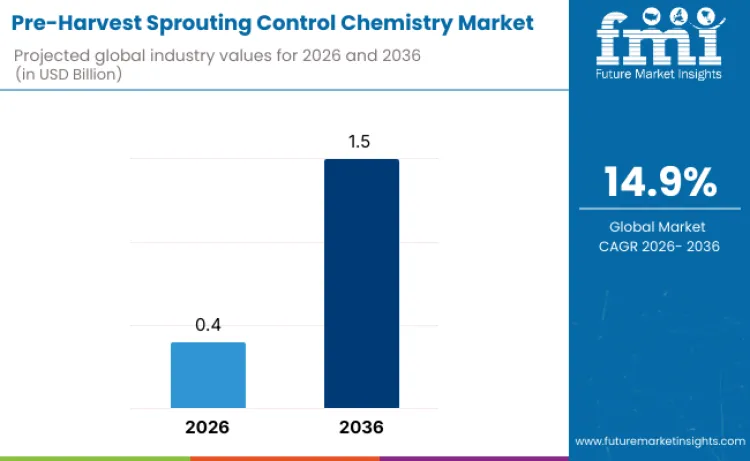
The global pre-harvest sprouting control chemistry market is projected to grow from USD 0.4 billion in 2026 to USD 1.5 billion by 2036, with a CAGR of 14.9%. Growth regulator-based sprout suppressants lead the market with a 35% share, due to their proven ability to delay germination and maintain grain quality in crops like wheat and barley. Other key chemistries include hormone modulation & ABA-pathway chemistries, which help regulate plant hormones, desiccation-dormancy synchronization blends that promote consistent ripening, and bio-derived anti-sprouting compounds focused on eco-friendly solutions. These innovations improve the reliability and efficiency of pre-harvest sprouting control, enabling growers to integrate them seamlessly into existing crop protection strategies.
Quick Stats for Pre-Harvest Sprouting Control Chemistry Market
- Pre-Harvest Sprouting Control Chemistry Market Value (2026): USD 0.4 billion
- Pre-Harvest Sprouting Control Chemistry Market Forecast Value (2036): USD 1.5 billion
- Pre-Harvest Sprouting Control Chemistry Market Forecast CAGR: 14.9%
- Leading Chemistry in Pre-Harvest Sprouting Control Chemistry Market: Growth Regulator-Based Sprout Suppressants (35%)
- Key Growth Regions in Pre-Harvest Sprouting Control Chemistry Market: Canada, Australia, UK, Germany, China
- Key Players in Pre-Harvest Sprouting Control Chemistry Market: Nufarm Dormancy Solutions, Philagro Holding, Helm Crop Solutions, UBE Agrochemicals, Qingdao KingAgroot Chemical
Key trends driving the market include the development of multi-functional formulations that combine sprouting control with other beneficial effects, such as enhancing plant stress resilience or improving water uptake regulation. There is also a growing interest in bio-based and low-toxicity solutions, which align with sustainability goals and meet stricter food safety standards. Precision agriculture tools like weather forecasting, crop sensors, and data-driven decision support systems are enabling more accurate and timely applications, optimizing the use of sprouting control chemistries. These trends reflect a broader push toward more efficient and environmentally responsible farming practices, which are essential for the continued growth of the pre-harvest sprouting control chemistry market.
Pre‑Harvest Sprouting Control Chemistry Market Key Takeaways
| Metric | Value |
|---|---|
| Industry Value (2026) | USD 0.4 billion |
| Forecast Value (2036) | USD 1.5 billion |
| Forecast CAGR (2026 to 2036) | 14.9% |
How is the Global Pre‑Harvest Sprouting Control Chemistry Sector Advancing?
The global pre‑harvest sprouting control chemistry market is growing rapidly as growers seek solutions to prevent yield and quality losses caused by pre‑harvest sprouting. Pre‑harvest sprouting occurs when grains start germinating on the plant before harvest, often triggered by untimely rainfall or high humidity during the maturation phase. This leads to reduced grain quality, lower market value, and challenges in milling and processing. Pre‑harvest sprouting control chemistries are specialized formulations applied during the late growth stages to inhibit premature germination, safeguarding crop quality and marketability. These solutions are gaining traction because they help producers protect returns on investment, particularly in climates prone to unpredictable weather patterns.
Demand for sprouting control products is rising across major cereal crops such as wheat, barley, and oats, where quality standards are crucial for end‑use performance in baking, brewing, and other food systems. Innovations in chemistry have improved product effectiveness, ensuring that active ingredients provide reliable sprouting inhibition while being compatible with broader crop protection programs. These advances support integration with existing spray schedules, enabling growers to manage both disease pressure and sprouting risk without additional operational complexity.
Demand is expected to expand as climate variability intensifies and growers prioritize tools that enhance crop resilience and quality assurance. Challenges such as variability in weather conditions, crop‑specific performance differences, and the need for tailored application guidance may affect adoption rates. Growing emphasis on maximizing yield quality, reducing post‑harvest losses, and meeting stringent quality standards will continue to drive demand for pre‑harvest sprouting control chemistries worldwide.
What is the Segment-Wise Analysis for the Global Pre-Harvest Sprouting Control Chemistry Market?
The global pre-harvest sprouting control chemistry market is segmented by chemistry type and crop type. Growth regulator-based sprout suppressants lead the market with a 35% share, as they effectively prevent sprouting in grains before harvest. Other key chemistry types include hormone modulation & ABA-pathway chemistries, desiccation-dormancy synchronization blends, and bio-derived anti-sprouting compounds. In terms of crop types, wheat holds the largest share at 42%, followed by barley, rice, and rye & oats.
How Do Growth Regulator-Based Sprout Suppressants Lead the Global Pre-Harvest Sprouting Control Chemistry Market?
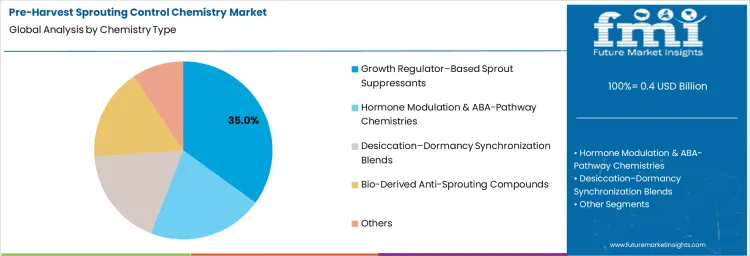
Growth regulator-based sprout suppressants hold a 35% share in the global pre-harvest sprouting control chemistry market due to their effectiveness in inhibiting sprout development in grains, particularly in wheat and barley. These chemicals regulate plant hormones to delay sprouting, ensuring that the crop remains in optimal condition for harvesting. They help maintain grain quality and prevent losses due to premature sprouting, especially under unfavorable weather conditions. As growers seek reliable and efficient solutions to improve crop yield and quality, growth regulator-based suppressants continue to lead the market.
Why Does Wheat Hold the Largest Share in the Global Pre-Harvest Sprouting Control Chemistry Market?
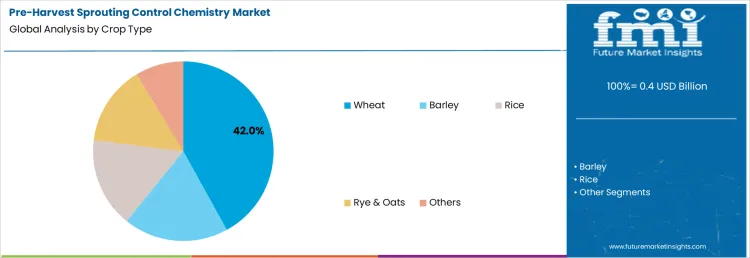
Wheat holds the largest share of 42% in the global pre-harvest sprouting control chemistry market due to its sensitivity to sprouting, which can severely affect grain quality and market value. As a major crop in global food production, wheat requires effective management to ensure that sprouting does not occur prematurely, especially in regions where rainfall and humidity levels can trigger unwanted germination. Pre-harvest sprouting control chemistries, such as growth regulator-based sprout suppressants, are crucial for ensuring that wheat remains in optimal condition for harvesting, driving their widespread use in wheat cultivation.
What is Driving the Demand for Pre-Harvest Sprouting Control in Agriculture?
The pre-harvest sprouting control chemistry market is seeing increased demand due to the need for protecting grain crops like wheat, barley, and oats from premature sprouting caused by unpredictable weather patterns. When crops are exposed to unseasonal rainfall or high humidity near harvest, it can lead to sprouting in the field, which damages the crop's quality. This damage can reduce milling quality and market value. Pre-harvest sprouting control chemistries, applied during crop maturation, help delay sprouting, ensuring that grains stay intact, providing growers with higher quality yields.
What Are the Key Drivers for Adoption of Pre-Harvest Sprouting Control Chemistry?
The primary drivers for adopting pre-harvest sprouting control chemicals include the rising risk of weather unpredictability, regulatory pressure to meet quality standards, and the need to maximize yields. As climatic shifts lead to more erratic weather, particularly near harvest time, the risk of crop sprouting increases. Sprouting control chemicals enable farmers to stabilize crop quality, ensuring better market acceptance. These solutions are critical for crops intended for high-quality milling or export, where sprouting can lead to economic losses. Advances in chemistry are also improving the effectiveness and eco-friendliness of these products, pushing broader adoption.
What Barriers Are Affecting the Growth of the Pre-Harvest Sprouting Control Market?
Adoption of pre-harvest sprouting control is hindered by several challenges, such as performance inconsistencies across various environments, particularly in regions with unpredictable weather. Growers often face uncertainty in application timing and effectiveness, as sprouting can occur under different environmental conditions. The cost of implementing these control solutions can also be a limiting factor, particularly for smaller farmers. Regulatory constraints regarding chemical use near harvest time, as well as residue limits for certain markets, can slow the adoption of sprouting control products.
What is the Growth Outlook for the Pre-Harvest Sprouting Control Chemistry Market by Country?
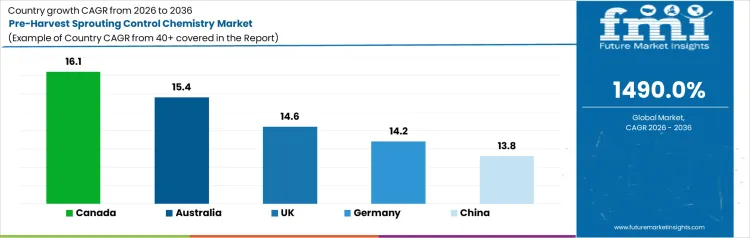
| Country | CAGR (%) |
|---|---|
| Canada | 16.1% |
| Australia | 15.4% |
| UK | 14.6% |
| Germany | 14.2% |
| China | 13.8% |
The pre-harvest sprouting control chemistry market is experiencing strong growth, with Canada leading at a 16.1% CAGR, driven by the increasing need for sprouting control solutions in crops like wheat, barley, and other grains. Australia follows closely with 15.4%, supported by its growing agricultural sector and the need to ensure high-quality grain production. The UK’s market grows at 14.6%, fueled by rising demand for effective sprouting control solutions in cereals and other crops. Germany’s market grows at 14.2%, driven by a strong emphasis on improving crop yields and preventing pre-harvest sprouting in grains. China’s market grows at 13.8%, influenced by its large-scale grain production and the need to manage sprouting during harvest.
Why is Canada Leading in the Pre-Harvest Sprouting Control Chemistry Market?
Canada’s pre-harvest sprouting control chemistry market is growing at 16.1%, driven by the country’s strong grain production, particularly in wheat and barley, which are highly susceptible to pre-harvest sprouting. As Canada is one of the world’s largest exporters of these grains, ensuring their quality during harvest is crucial to maintaining market standards. Pre-harvest sprouting control chemistry helps prevent early sprouting in grains, which can affect their quality and marketability. With Canada’s growing focus on improving agricultural efficiency and meeting international food safety standards, the demand for sprouting control solutions is rising. As farmers continue to seek ways to maximize crop yields and quality, Canada’s market for pre-harvest sprouting control chemistry is expected to grow steadily.
What is Driving the Growth of the Pre-Harvest Sprouting Control Chemistry Market in Australia?
Australia’s pre-harvest sprouting control chemistry market is growing at 15.4%, supported by the country’s large-scale grain production, especially in wheat and barley. Pre-harvest sprouting is a significant challenge in Australia, particularly in regions with high rainfall during the harvest season. Sprouting can reduce the quality of crops and their market value, making effective control solutions essential. The increasing demand for high-quality grains, combined with Australia’s emphasis on sustainable and efficient farming practices, is driving the adoption of pre-harvest sprouting control chemistry. As Australian farmers face unpredictable weather patterns and climate challenges, the need for sprouting control solutions to ensure better harvests and crop quality is growing. The market for pre-harvest sprouting control chemistry is expected to continue expanding as farmers seek ways to improve their crop productivity and resilience.
How is the Pre-Harvest Sprouting Control Chemistry Market Expanding in the UK?
The UK’s pre-harvest sprouting control chemistry market is growing at 14.6%, fueled by the demand for effective solutions to prevent sprouting in crops like wheat, barley, and other cereals. Pre-harvest sprouting can lead to quality degradation, particularly in grains used for baking and malting purposes, which are crucial to the UK’s agricultural exports. With the growing need for high-quality grains in both domestic and international markets, UK farmers are increasingly adopting sprouting control solutions. The demand for sustainable farming practices, alongside the need for improved crop quality, is contributing to the growth of this market. As the UK continues to focus on improving agricultural practices and reducing waste, the adoption of pre-harvest sprouting control chemistry is expected to rise, ensuring better crop yield and quality.
What is Contributing to the Growth of the Pre-Harvest Sprouting Control Chemistry Market in Germany?
Germany’s pre-harvest sprouting control chemistry market is growing at 14.2%, supported by the country’s strong agricultural focus, particularly in cereal production. With the increasing need to maintain the quality of grains used for food and industrial purposes, preventing pre-harvest sprouting has become a priority for German farmers. The demand for high-quality wheat, barley, and other cereal grains, both for domestic consumption and export, is driving the adoption of sprouting control chemistry. Germany’s agricultural sector is increasingly focused on improving yields while maintaining high-quality standards, and effective sprouting control plays a key role in this process. As farmers look for sustainable and efficient farming solutions, the market for pre-harvest sprouting control chemistry is expected to continue growing in Germany.
What is Driving the Growth of the Pre-Harvest Sprouting Control Chemistry Market in China?
China’s pre-harvest sprouting control chemistry market is growing at 13.8%, supported by the country’s large-scale grain production, particularly in wheat and rice, which are vulnerable to pre-harvest sprouting. As China seeks to boost agricultural productivity and ensure crop quality, the need for sprouting control solutions is rising. The market is driven by China’s efforts to improve food safety standards, reduce losses, and enhance grain quality for both domestic consumption and export. With the growing adoption of modern farming practices and an increasing focus on crop protection and quality, China is witnessing a steady rise in demand for pre-harvest sprouting control chemistry. As the country continues to prioritize agricultural innovation and resilience, the market for these solutions is expected to expand.
How are Companies Competing in the Pre‑Harvest Sprouting Control Chemistry Market?
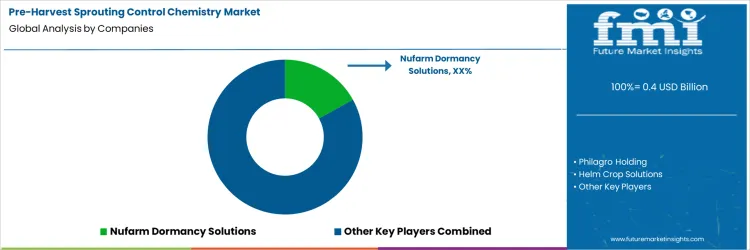
In the pre‑harvest sprouting control chemistry market Nufarm Dormancy Solutions, Philagro Holding, Helm Crop Solutions, UBE Agrochemicals, Qingdao KingAgroot Chemical, and others are positioned with product brochures that emphasize seed dormancy support and reduced sprouting risk under wet harvest conditions. At Nufarm Dormancy Solutions products are described with targeted chemistry that delays germination and promotes uniform dry‑down. Performance highlights and clear application timing guidance are provided to help growers plan treatments ahead of unpredictable weather. Philagro Holding materials present sprouting control chemistries with concise data on effectiveness across cereals and small seeds. Product briefs include recommended rates and environmental considerations to support agronomist decisions.
Helm Crop Solutions brochures showcase pre‑harvest sprouting inhibitors engineered for consistent performance. Trial results are shown with emphasis on reduced pre‑harvest sprout incidence and maintained grain quality. UBE Agrochemicals collateral focuses on formulation stability and adaptability across regions, with summarized use instructions and crop compatibility charts. Qingdao KingAgroot Chemical literature highlights cost‑competitive solutions described with straightforward guidance on integration with harvest schedules. Others in this market bring niche sprouting control agents or tailored blends that address specific crop types or climatic challenges.
Key Players in Pre-Harvest Sprouting Control Chemistry Market
- Nufarm Dormancy Solutions
- Philagro Holding
- Helm Crop Solutions
- UBE Agrochemicals
- Qingdao KingAgroot Chemical
- Others
Scope of Report
| Items | Values |
|---|---|
| Quantitative Units (2026) | USD billion |
| Chemistry Type | Growth Regulator-Based Sprout Suppressants, Hormone Modulation & ABA-Pathway Chemistries, Desiccation-Dormancy Synchronization Blends, Bio-Derived Anti-Sprouting Compounds |
| Crop Type | Wheat, Barley, Rice, Rye & Oats, Others |
| Regions Covered | Asia Pacific, Europe, North America, Latin America, Middle East & Africa |
| Countries Covered | USA, China, Japan, South Korea, India, Australia & New Zealand, ASEAN, Germany, UK, France, Italy, Spain, Nordic, BENELUX, Brazil, Chile, Mexico, Saudi Arabia, Other GCC Countries, Turkey, South Africa, Other African Union |
| Key Companies Profiled | Nufarm Dormancy Solutions, Philagro Holding, Helm Crop Solutions, UBE Agrochemicals, Qingdao KingAgroot Chemical, Others |
| Additional Attributes | Dollar sales by chemistry type, crop type, and region; regional CAGR and growth outlook; distribution channels including crop suppliers, agricultural product distributors; innovation trends in sprouting control; competitive positioning of global vs regional suppliers. |
Pre-Harvest Sprouting Control Chemistry Market by Segments
Chemistry Type
- Growth Regulator-Based Sprout Suppressants
- Hormone Modulation & ABA-Pathway Chemistries
- Desiccation-Dormancy Synchronization Blends
- Bio-Derived Anti-Sprouting Compounds
- Others
Crop Type
- Wheat
- Barley
- Rice
- Rye & Oats
- Others
Region:
- Asia Pacific
- China
- Japan
- South Korea
- India
- Australia & New Zealand
- ASEAN
- Rest of Asia Pacific
- Europe
- Germany
- United Kingdom
- France
- Italy
- Spain
- Nordic
- BENELUX
- Rest of Europe
- North America
- United States
- Canada
- Mexico
- Latin America
- Brazil
- Chile
- Rest of Latin America
- Middle East & Africa
- Kingdom of Saudi Arabia
- Other GCC Countries
- Turkey
- South Africa
- Other African Union
- Rest of Middle East & Africa
Frequently Asked Questions
How big is the pre-harvest sprouting control chemistry market in 2026?
The global pre-harvest sprouting control chemistry market is estimated to be valued at USD 0.4 billion in 2026.
What will be the size of pre-harvest sprouting control chemistry market in 2036?
The market size for the pre-harvest sprouting control chemistry market is projected to reach USD 1.5 billion by 2036.
How much will be the pre-harvest sprouting control chemistry market growth between 2026 and 2036?
The pre-harvest sprouting control chemistry market is expected to grow at a 14.9% CAGR between 2026 and 2036.
What are the key chemistry types in the pre-harvest sprouting control chemistry market?
The key product types in pre-harvest sprouting control chemistry market are growth regulator–based sprout suppressants, hormone modulation & aba-pathway chemistries, desiccation–dormancy synchronization blends, bio-derived anti-sprouting compounds and others.
Which crop type segment to contribute significant share in the pre-harvest sprouting control chemistry market in 2026?
In terms of crop type, wheat segment to command 42.0% share in the pre-harvest sprouting control chemistry market in 2026.
Preview the report firsthand - request a free sample
Get SampleGet the brochure for pricing and purchase details.
Get PDFTable of Content
- Executive Summary
- Global Market Outlook
- Demand-side Trends
- Supply-side Trends
- Technology Roadmap Analysis
- Analysis and Recommendations
- Market Overview
- Market Coverage / Taxonomy
- Market Definition / Scope / Limitations
- Market Background
- Market Dynamics
- Drivers
- Restraints
- Opportunity
- Trends
- Scenario Forecast
- Demand in Optimistic Scenario
- Demand in Likely Scenario
- Demand in Conservative Scenario
- Opportunity Map Analysis
- Product Life Cycle Analysis
- Supply Chain Analysis
- Investment Feasibility Matrix
- Value Chain Analysis
- PESTLE and Porter’s Analysis
- Regulatory Landscape
- Regional Parent Market Outlook
- Production and Consumption Statistics
- Import and Export Statistics
- Market Dynamics
- Global Market Analysis 2021 to 2025 and Forecast, 2026 to 2036
- Historical Market Size Value (USD Million) Analysis, 2021 to 2025
- Current and Future Market Size Value (USD Million) Projections, 2026 to 2036
- Y-o-Y Growth Trend Analysis
- Absolute $ Opportunity Analysis
- Global Market Pricing Analysis 2021 to 2025 and Forecast 2026 to 2036
- Global Market Analysis 2021 to 2025 and Forecast 2026 to 2036, By Chemistry Type
- Introduction / Key Findings
- Historical Market Size Value (USD Million) Analysis By Chemistry Type , 2021 to 2025
- Current and Future Market Size Value (USD Million) Analysis and Forecast By Chemistry Type , 2026 to 2036
- Growth Regulator-Based Sprout Suppressants
- Hormone Modulation & ABA-Pathway Chemistries
- Desiccation-Dormancy Synchronization Blends
- Bio-Derived Anti-Sprouting Compounds
- Others
- Y-o-Y Growth Trend Analysis By Chemistry Type , 2021 to 2025
- Absolute $ Opportunity Analysis By Chemistry Type , 2026 to 2036
- Global Market Analysis 2021 to 2025 and Forecast 2026 to 2036, By Crop Type
- Introduction / Key Findings
- Historical Market Size Value (USD Million) Analysis By Crop Type, 2021 to 2025
- Current and Future Market Size Value (USD Million) Analysis and Forecast By Crop Type, 2026 to 2036
- Wheat
- Barley
- Rice
- Rye & Oats
- Others
- Y-o-Y Growth Trend Analysis By Crop Type, 2021 to 2025
- Absolute $ Opportunity Analysis By Crop Type, 2026 to 2036
- Global Market Analysis 2021 to 2025 and Forecast 2026 to 2036, By Region
- Introduction
- Historical Market Size Value (USD Million) Analysis By Region, 2021 to 2025
- Current Market Size Value (USD Million) Analysis and Forecast By Region, 2026 to 2036
- North America
- Latin America
- Western Europe
- Eastern Europe
- East Asia
- South Asia and Pacific
- Middle East & Africa
- Market Attractiveness Analysis By Region
- North America Market Analysis 2021 to 2025 and Forecast 2026 to 2036, By Country
- Historical Market Size Value (USD Million) Trend Analysis By Market Taxonomy, 2021 to 2025
- Market Size Value (USD Million) Forecast By Market Taxonomy, 2026 to 2036
- By Country
- USA
- Canada
- Mexico
- By Chemistry Type
- By Crop Type
- By Country
- Market Attractiveness Analysis
- By Country
- By Chemistry Type
- By Crop Type
- Key Takeaways
- Latin America Market Analysis 2021 to 2025 and Forecast 2026 to 2036, By Country
- Historical Market Size Value (USD Million) Trend Analysis By Market Taxonomy, 2021 to 2025
- Market Size Value (USD Million) Forecast By Market Taxonomy, 2026 to 2036
- By Country
- Brazil
- Chile
- Rest of Latin America
- By Chemistry Type
- By Crop Type
- By Country
- Market Attractiveness Analysis
- By Country
- By Chemistry Type
- By Crop Type
- Key Takeaways
- Western Europe Market Analysis 2021 to 2025 and Forecast 2026 to 2036, By Country
- Historical Market Size Value (USD Million) Trend Analysis By Market Taxonomy, 2021 to 2025
- Market Size Value (USD Million) Forecast By Market Taxonomy, 2026 to 2036
- By Country
- Germany
- UK
- Italy
- Spain
- France
- Nordic
- BENELUX
- Rest of Western Europe
- By Chemistry Type
- By Crop Type
- By Country
- Market Attractiveness Analysis
- By Country
- By Chemistry Type
- By Crop Type
- Key Takeaways
- Eastern Europe Market Analysis 2021 to 2025 and Forecast 2026 to 2036, By Country
- Historical Market Size Value (USD Million) Trend Analysis By Market Taxonomy, 2021 to 2025
- Market Size Value (USD Million) Forecast By Market Taxonomy, 2026 to 2036
- By Country
- Russia
- Poland
- Hungary
- Balkan & Baltic
- Rest of Eastern Europe
- By Chemistry Type
- By Crop Type
- By Country
- Market Attractiveness Analysis
- By Country
- By Chemistry Type
- By Crop Type
- Key Takeaways
- East Asia Market Analysis 2021 to 2025 and Forecast 2026 to 2036, By Country
- Historical Market Size Value (USD Million) Trend Analysis By Market Taxonomy, 2021 to 2025
- Market Size Value (USD Million) Forecast By Market Taxonomy, 2026 to 2036
- By Country
- China
- Japan
- South Korea
- By Chemistry Type
- By Crop Type
- By Country
- Market Attractiveness Analysis
- By Country
- By Chemistry Type
- By Crop Type
- Key Takeaways
- South Asia and Pacific Market Analysis 2021 to 2025 and Forecast 2026 to 2036, By Country
- Historical Market Size Value (USD Million) Trend Analysis By Market Taxonomy, 2021 to 2025
- Market Size Value (USD Million) Forecast By Market Taxonomy, 2026 to 2036
- By Country
- India
- ASEAN
- Australia & New Zealand
- Rest of South Asia and Pacific
- By Chemistry Type
- By Crop Type
- By Country
- Market Attractiveness Analysis
- By Country
- By Chemistry Type
- By Crop Type
- Key Takeaways
- Middle East & Africa Market Analysis 2021 to 2025 and Forecast 2026 to 2036, By Country
- Historical Market Size Value (USD Million) Trend Analysis By Market Taxonomy, 2021 to 2025
- Market Size Value (USD Million) Forecast By Market Taxonomy, 2026 to 2036
- By Country
- Kingdom of Saudi Arabia
- Other GCC Countries
- Turkiye
- South Africa
- Other African Union
- Rest of Middle East & Africa
- By Chemistry Type
- By Crop Type
- By Country
- Market Attractiveness Analysis
- By Country
- By Chemistry Type
- By Crop Type
- Key Takeaways
- Key Countries Market Analysis
- USA
- Pricing Analysis
- Market Share Analysis, 2025
- By Chemistry Type
- By Crop Type
- Canada
- Pricing Analysis
- Market Share Analysis, 2025
- By Chemistry Type
- By Crop Type
- Mexico
- Pricing Analysis
- Market Share Analysis, 2025
- By Chemistry Type
- By Crop Type
- Brazil
- Pricing Analysis
- Market Share Analysis, 2025
- By Chemistry Type
- By Crop Type
- Chile
- Pricing Analysis
- Market Share Analysis, 2025
- By Chemistry Type
- By Crop Type
- Germany
- Pricing Analysis
- Market Share Analysis, 2025
- By Chemistry Type
- By Crop Type
- UK
- Pricing Analysis
- Market Share Analysis, 2025
- By Chemistry Type
- By Crop Type
- Italy
- Pricing Analysis
- Market Share Analysis, 2025
- By Chemistry Type
- By Crop Type
- Spain
- Pricing Analysis
- Market Share Analysis, 2025
- By Chemistry Type
- By Crop Type
- France
- Pricing Analysis
- Market Share Analysis, 2025
- By Chemistry Type
- By Crop Type
- India
- Pricing Analysis
- Market Share Analysis, 2025
- By Chemistry Type
- By Crop Type
- ASEAN
- Pricing Analysis
- Market Share Analysis, 2025
- By Chemistry Type
- By Crop Type
- Australia & New Zealand
- Pricing Analysis
- Market Share Analysis, 2025
- By Chemistry Type
- By Crop Type
- China
- Pricing Analysis
- Market Share Analysis, 2025
- By Chemistry Type
- By Crop Type
- Japan
- Pricing Analysis
- Market Share Analysis, 2025
- By Chemistry Type
- By Crop Type
- South Korea
- Pricing Analysis
- Market Share Analysis, 2025
- By Chemistry Type
- By Crop Type
- Russia
- Pricing Analysis
- Market Share Analysis, 2025
- By Chemistry Type
- By Crop Type
- Poland
- Pricing Analysis
- Market Share Analysis, 2025
- By Chemistry Type
- By Crop Type
- Hungary
- Pricing Analysis
- Market Share Analysis, 2025
- By Chemistry Type
- By Crop Type
- Kingdom of Saudi Arabia
- Pricing Analysis
- Market Share Analysis, 2025
- By Chemistry Type
- By Crop Type
- Turkiye
- Pricing Analysis
- Market Share Analysis, 2025
- By Chemistry Type
- By Crop Type
- South Africa
- Pricing Analysis
- Market Share Analysis, 2025
- By Chemistry Type
- By Crop Type
- USA
- Market Structure Analysis
- Competition Dashboard
- Competition Benchmarking
- Market Share Analysis of Top Players
- By Regional
- By Chemistry Type
- By Crop Type
- Competition Analysis
- Competition Deep Dive
- Nufarm Dormancy Solutions
- Overview
- Product Portfolio
- Profitability by Market Segments (Product/Age /Sales Channel/Region)
- Sales Footprint
- Strategy Overview
- Marketing Strategy
- Product Strategy
- Channel Strategy
- Philagro Holding
- Helm Crop Solutions
- UBE Agrochemicals
- Qingdao KingAgroot Chemical
- Others
- Nufarm Dormancy Solutions
- Competition Deep Dive
- Assumptions & Acronyms Used
- Research Methodology


