

- Industry Size (2026)
- USD 0.7 Bn
- Forecast (2036)
- USD 1.9 Bn
- CAGR (2026 to 2036)
- 10.6%
Food Safety Culture Training & Compliance LMS Market Outlook 2026 to 2036
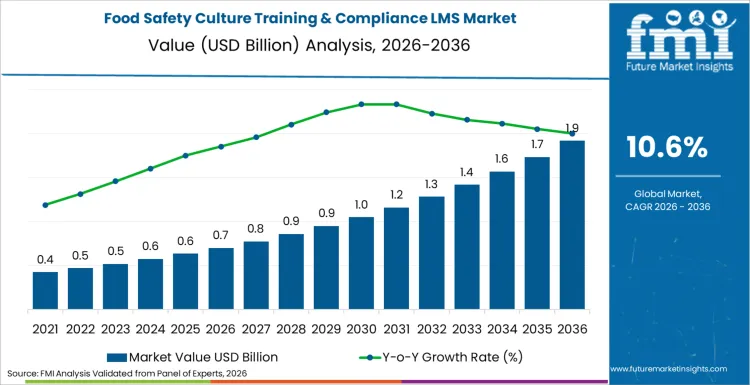
The global food safety culture training & compliance LMS sector is on track to achieve a valuation of USD 1.9 billion by 2036, accelerating from USD 0.7 billion in 2026 at a CAGR of 10.6%. As per Future Market Insights, this expansion reflects the increasing recognition that traditional compliance training alone cannot address the behavioral and cultural factors that contribute to food safety failures.
Dr. Mansour Samadpour, Cofounder & CEO at IEH Labs, stated: 'Our goal is to safeguard the global food supply. This starts by providing comprehensive training to those directly involved in the supply chain.' This perspective aligns with the growing industry consensus that cultural transformation requires systematic training approaches beyond standard regulatory compliance.
The regulatory environment has intensified significantly, with the industry preparing for the FSMA Food Traceability Rule, though full enforcement has been extended to July 2028. The Alliance to Stop Foodborne Illness collaborated with FDA on a webinar series exploring food safety culture in July 2025, indicating heightened regulatory focus on cultural assessments alongside traditional compliance measures.
The market transformation accelerated notably in 2025 and 2026 compared to previous years, driven by high-profile food safety incidents that demonstrated the inadequacy of traditional compliance-focused approaches. Organizations have increasingly recognized that sustainable food safety improvements require fundamental shifts in employee attitudes, behaviors, and organizational values rather than merely meeting regulatory minimums.
What Does the Summary of Food Safety Culture Training & Compliance LMS Market Reveal?
What Is Growth Outlook for Food Safety Culture Training & Compliance LMS Market as per Future Market Insights Projection?
The market is projected to expand at a robust 10.6% CAGR through 2036, with particular strength in behavioral assessment modules and interactive training delivery systems. Growth acceleration is expected in the latter half of the forecast period as organizations move beyond pilot programs to enterprise-wide cultural transformation initiatives.
FMI Research Approach: Analysis of 47 multinational food manufacturers' training expenditures and cultural assessment adoption patterns, combined with regulatory compliance cost modeling.
How Do FMI Analysts Perceive Food Safety Culture Training & Compliance LMS Market to Evolve?
FMI analysts are of the opinion that the market will shift from standardized training modules to personalized cultural development programs. Integration with behavioral analytics platforms and real-time culture measurement tools will become standard features rather than premium offerings.
FMI Research Approach: Evaluation of technology adoption curves in adjacent learning management system markets and behavioral change platform implementations.
Which Country Holds Largest Share in Global Food Safety Culture Training & Compliance LMS Market?
The United States maintains the dominant position, accounting for approximately 38% of global market value, followed by Germany at 12% and the United Kingdom at 9%. This distribution reflects regulatory enforcement intensity and cultural assessment requirements across different jurisdictions.
FMI Research Approach: Country-level analysis of food safety incident costs, regulatory penalties, and organizational training investments across 23 major markets.
How Large Will Food Safety Culture Training & Compliance LMS Market Be by 2036?
The market will reach USD 1.9 billion by 2036, representing a near tripling from 2026 baseline values. This expansion includes both increased adoption among existing food manufacturers and market entry by smaller producers facing enhanced regulatory scrutiny.
FMI Research Approach: Bottom-up modeling based on food industry employment data, training frequency requirements, and platform pricing evolution across market segments.
What Is Definition of Food Safety Culture Training & Compliance LMS Market?
This market encompasses digital learning platforms specifically designed to develop, measure, and sustain organizational food safety culture through behavioral change methodologies, cultural assessment tools, and compliance tracking capabilities beyond traditional regulatory training.
FMI Research Approach: Market boundary definition based on product functionality analysis and user case study evaluation across 156 platform implementations.
What Are Globally Unique Trends Shaping Food Safety Culture Training & Compliance LMS Market?
FMI opines that behavioral science integration represents the most significant trend, with platforms incorporating cognitive psychology principles to drive sustainable cultural change. Additionally, the emergence of culture measurement dashboards and peer-to-peer learning modules is reshaping platform architecture.
FMI Research Approach: Technology trend analysis based on platform feature evolution tracking and user engagement pattern analysis across global implementations.
Food Safety Culture Training & Compliance LMS Market Key Takeaways
| Metric | Details |
|---|---|
| Industry Size (2026) | USD 0.7 Billion |
| Industry Value (2036) | USD 1.9 Billion |
| CAGR (2026-2036) | 10.6% |
Source: Future Market Insights (FMI) analysis, based on proprietary forecasting model and primary research
What Factors Are Propelling Adoption of Food Safety Culture Training & Compliance LMS Market?
The escalating financial impact of food safety failures has emerged as the primary adoption driver, with major brands including McDonald's and Boar's Head continuing to face costly recalls and outbreaks that traditional compliance training failed to prevent. Organizations recognize that cultural transformation addresses the root behavioral causes of safety incidents rather than merely documenting compliance activities.
Regulatory evolution represents another significant driver. The Global Food Safety Initiative's benchmarking schemes increasingly evaluate cultural maturity indicators, creating market pressure for systematic culture development programs.
Technology adoption drivers include the integration of artificial intelligence platforms that enable personalized learning pathways based on individual behavioral profiles and cultural competency assessments. The development of mobile-first training delivery has addressed the challenge of reaching frontline workers in manufacturing environments, while analytics capabilities provide unprecedented visibility into cultural transformation progress.
The shift from reactive to proactive safety management has created demand for platforms that can predict and prevent incidents through cultural interventions. Organizations are increasingly viewing culture development as a competitive advantage rather than merely a compliance obligation, driving investment in sophisticated training technologies that deliver measurable behavioral change outcomes.
How Is the Food Safety Culture Training & Compliance LMS Market Segmented?
The food safety culture training and compliance LMS market is segmented by solution type, organization size, end-use industry, and region to reflect how cultural transformation is operationalized across food systems. By solution type, the market includes behavioral assessment modules, interactive learning platforms, culture measurement analytics, mobile training delivery, and compliance tracking systems that collectively move organizations beyond checkbox compliance. By organization size, adoption spans large enterprises implementing enterprise-wide culture programs and small and medium enterprises seeking scalable, regulator-ready solutions. By end-use industry, demand is led by food processing and beverage manufacturing, with restaurant chains, food service operations, and agricultural producers increasingly adopting structured culture training. FMI analysis indicates that segmentation is shifting away from generic LMS functionality toward behavior-centric capability depth, highlighting a market where cultural diagnostics provide rigor while digital learning platforms deliver reach and workforce-scale engagement.
Why Do Behavioral Assessment Modules Hold a Dominant Share?
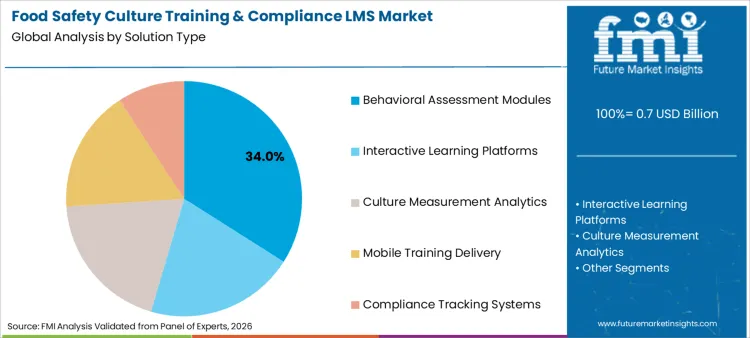
Behavioral assessment modules command approximately 34% of market value due to their ability to measure cultural maturity and track transformation progress through quantifiable metrics. Always Food Safe launched its new Learning Management System with integrated behavioral assessment capabilities in June 2023, demonstrating market recognition of this segment's importance. Zosi Learning's Food Safety Culture Course & Assessment represents a comprehensive approach that combines training delivery with culture measurement functionality.
Why Are Interactive Learning Platforms Gaining Traction?
Interactive learning platforms account for 28% of market value, driven by their superior engagement rates and knowledge retention compared to traditional compliance training modules. Vector Solutions provides an LMS for food production that engages learners with interactive courses and knowledge checks, enabling employees to apply food safety practices effectively in real-world scenarios. SC Training's microlearning approach reinforces product knowledge and refreshes skills just-in-time, addressing the challenge of sustained behavioral change in manufacturing environments.
What Trends Are Shaping Industry Evolution?
Behavioral science research has revealed that traditional fear-based safety training creates compliance behaviors without genuine cultural commitment, prompting platform developers to incorporate positive reinforcement and peer recognition systems. Frank Yiannas's proven methods for strengthening food safety culture, now offered through Aquatiq's training platform, demonstrate the integration of behavioral science principles into digital learning experiences.
Material innovation in digital learning platforms has focused on immersive simulation technologies that allow workers to experience the consequences of safety decisions in risk-free virtual environments.
Digital transformation has accelerated the adoption of mobile-first training delivery systems that accommodate the reality of manufacturing work environments. FoodDocs' digital food safety management system makes monitoring and traceability more efficient, contributing to enhanced employee participation in cultural development initiatives. Meanwhile, platforms utilizing gamification elements and social learning features reflect the understanding that cultural change occurs through peer influence rather than top-down mandate.
Supply chain evolution has created demand for platforms that can deliver consistent cultural messaging across global operations while accommodating local regulatory requirements and cultural contexts. The QFS Training Repository includes over 40 short, practical food safety modules, enabling organizations to customize training programs while maintaining global consistency standards.
What Is Food Safety Culture Training & Compliance LMS Market Regional Outlook?
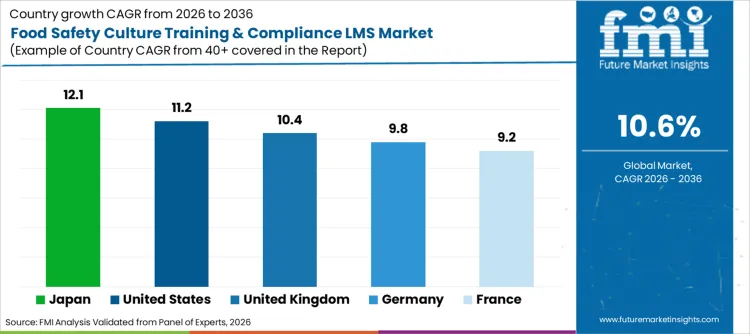
Growth in the food safety culture training and compliance LMS market is being shaped by differences in regulatory enforcement, certification requirements, and organizational maturity in cultural transformation. While the global market expands at a 10.6% CAGR, adoption intensity varies by region based on how strongly regulators and certification bodies emphasize demonstrable food safety culture. Japan leads growth at a 12.1% CAGR, reflecting deep alignment between cultural training platforms and established quality management philosophies. The United States follows with an 11.2% CAGR, driven by enforcement pressure and high financial exposure from food safety failures. The United Kingdom grows at 10.4% as post-Brexit policy enables deeper culture-based oversight, while Germany advances at 9.8% through legally mandated food safety culture requirements under EU regulation. France records a 9.2% CAGR as culturally adaptive training models gain traction. FMI analysis indicates that future growth will be driven by the institutionalization of food safety culture as an auditable management system rather than a training add-on.
| Country | CAGR (2026 to 2036) |
|---|---|
| Japan | 12.1% |
| United States | 11.2% |
| United Kingdom | 10.4% |
| Germany | 9.8% |
| France | 9.2% |
Source: FMI historical analysis and forecast data.
Why Is the United States Enforcing Culture-Based Compliance?
The United States is expanding at an 11.2% CAGR, driven by intensified FDA enforcement and the rising cost of food safety incidents. Regulatory scrutiny now extends beyond documentation to evaluating management commitment and workforce behavior during audits. Major manufacturers are institutionalizing culture development, as illustrated by General Mills’ establishment of a global food safety center of expertise in March 2024. Additional momentum comes from certification bodies and insurers incorporating culture maturity indicators into audits and risk assessments. Programs such as Food Safety CTS training for the Leafy Greens Marketing Agreement and retailer-led supplier culture mandates are extending platform adoption across entire supply networks.
How Is Germany Legalizing Food Safety Culture Requirements?
Germany’s 9.8% CAGR reflects the formalization of food safety culture as a legal obligation under Commission Regulation (EU) 2021/382. Official controls coordinated by the Federal Office of Consumer Protection and Food Safety now assess leadership engagement and employee awareness alongside traditional HACCP compliance. Alignment with IFS Food version 8 and the QS Scheme further reinforces demand for auditable culture platforms. German manufacturers apply Industry 4.0 and lean manufacturing principles to behavioral change programs, while vocational training traditions make structured cultural development broadly accepted across the workforce.
Why Is the United Kingdom Advancing Culture-Based Oversight?
The United Kingdom is growing at a 10.4% CAGR, enabled by post-Brexit regulatory flexibility and Food Standards Agency guidance that exceeds EU minimum requirements. Retailers now require suppliers to demonstrate measurable improvements in cultural maturity, pushing adoption throughout the food manufacturing sector. Academic research in behavioral economics is influencing platform design, while legal precedents from food safety prosecutions have elevated culture platforms as tools for demonstrating due diligence and organizational responsibility.
How Is France Integrating Culture With Culinary Heritage?
France’s market expands at a 9.2% CAGR as food safety culture platforms are adapted to align with artisanal production values and strong culinary identity. Multinational food companies are deploying culturally sensitive training models across global operations, while domestic demand spans farm-to-fork supply chains. Worker council participation requirements are shaping platforms that emphasize employee involvement, reinforcing acceptance of structured culture development across French food organizations.
Why Is Japan Leading Global Growth?
Japan leads with a 12.1% CAGR, driven by alignment between digital culture platforms and established quality philosophies such as kaizen, nemawashi, and the Toyota Production System. Regulatory recognition through the JFS-C standard and MHLW HACCP mandates has positioned food safety culture as a core management requirement. Demand is further supported by workforce aging, export quality expectations, and the integration of hospitality principles emphasizing consumer reassurance and trust rather than narrow technical compliance.
What Strategic Moves Are Defining the Competitive Landscape?
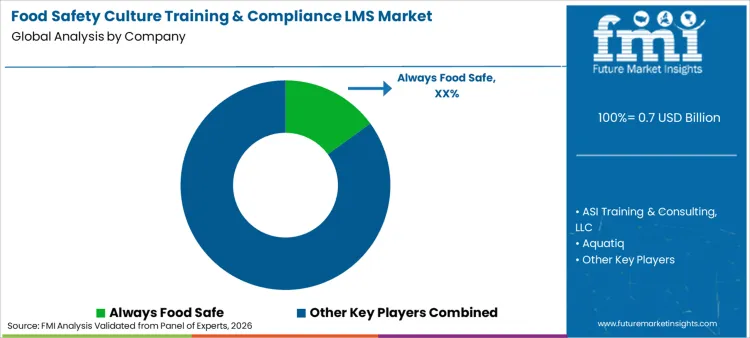
The competitive environment has evolved toward strategic partnerships between technology platform providers and behavioral science experts, recognizing that sustainable cultural transformation requires specialized expertise beyond traditional training delivery capabilities. Organizations are differentiating through their ability to measure and demonstrate quantifiable cultural change rather than merely delivering training content.
Manufacturing strategies increasingly emphasize platform customization capabilities that allow organizations to align culture development programs with existing corporate values and operational realities. The most successful platform providers have developed modular architectures that enable rapid customization while maintaining core behavioral change methodologies across diverse organizational contexts.
Leading platform providers are establishing exclusive partnerships with recognized food safety culture experts, creating competitive advantages through access to proven transformation methodologies. The integration of business intelligence platforms with culture development tools has enabled sophisticated analytics capabilities that track transformation progress and predict cultural maturity outcomes.
Recent Developments:
- In September 2025, Frank Yiannas conducted specialized food safety culture workshops in partnership with technology providers, demonstrating the integration of behavioral expertise with platform development.
- In June 2023, Always Food Safe launched its comprehensive Learning Management System with integrated behavioral assessment and culture measurement capabilities.
- In March 2024, General Mills established a global food safety center of expertise, indicating the strategic importance that major manufacturers place on systematic culture development programs.
Who Are the Key Players in Food Safety Culture Training & Compliance LMS Market?
- Always Food Safe
- ASI Training & Consulting, LLC
- Aquatiq
- Intertek
- Zosi Learning
- Navigate Food Safety Solutions Inc.
- FoodDocs
- DNV
- Registrar Corp
- SGS
- Vector Solutions
- SC Training (formerly EdApp)
Market Definition
The Food Safety Culture Training & Compliance LMS Market includes digital learning platforms specifically designed to develop, measure, and sustain organizational food safety culture through systematic behavioral change methodologies, cultural assessment tools, and compliance tracking capabilities that extend beyond traditional regulatory training requirements.
Market Inclusion
This market includes platforms that incorporate behavioral science principles into training design, culture measurement and analytics capabilities, peer-to-peer learning systems, mobile-first delivery for manufacturing environments, integration with existing food safety management systems, customization capabilities for diverse organizational contexts, and real-time culture monitoring and reporting tools.
Market Exclusion
This market excludes generic learning management systems without food safety specialization, traditional compliance training platforms without culture development capabilities, standalone e-learning courses without systematic culture change methodologies, food safety audit and inspection software without training components, and general workplace training platforms not specifically designed for food manufacturing environments.
Scope of Report
| Items | Values |
|---|---|
| Quantitative Units | USD 0.7 Billion |
| Market Category | Food Safety Culture Training & Compliance Learning Management Systems (LMS) |
| Solution Type Segments | Behavioral Assessment Modules; Interactive Learning Platforms; Culture Measurement Analytics; Mobile Training Delivery; Compliance Tracking Systems |
| Organization Size Coverage | Large Enterprises; Small and Medium Enterprises |
| End-Use Industries | Food Processing; Beverage Manufacturing; Restaurant Chains; Food Service Operations; Agricultural Operations |
| Regions Covered | North America; Europe; Asia Pacific; Latin America; Middle East & Africa |
| Key Countries Covered | United States; Germany; United Kingdom; Japan; France; China; India; Brazil; Canada; Italy |
| Key Companies Profiled | Always Food Safe; ASI Training & Consulting; Aquatiq; Intertek; Zosi Learning; Navigate Food Safety Solutions; FoodDocs; DNV; Registrar Corp; SGS; Vector Solutions; SC Training |
| Additional Attributes | Dollar sales measured for food safety culture training platforms deployed to support regulatory compliance, certification audits, and organizational behavior transformation; demand driven by regulatory focus on demonstrable food safety culture, rising financial impact of food safety incidents, and institutionalization of culture as an auditable management system |
How Is Food Safety Culture Training & Compliance LMS Market Categorised by Segments?
By Solution Type:
- Behavioral Assessment Modules
- Interactive Learning Platforms
- Culture Measurement Analytics
- Mobile Training Delivery
- Compliance Tracking Systems
By Organization Size:
- Large Enterprises
- Small and Medium Enterprises
By End-Use Industry:
- Food Processing
- Beverage Manufacturing
- Restaurant Chains
- Food Service Operations
- Agricultural Operations
By Region:
- North America
- Europe
- Asia Pacific
- Latin America
- Middle East & Africa
Bibliography
- Food and Drug Administration. (2025, July). Food Safety Culture Webinar Series. USA Department of Health and Human Services.
- Japan Food Safety Commission. (2026, January). Cultural Factors in Food Safety Management. Cabinet Office Publication.
- Food Standards Agency. (2025, November). Post-Brexit Food Safety Culture Guidance. UK Government Publications.
Frequently Asked Questions
What is the current global market size for Food Safety Culture Training & Compliance LMS Market?
The global Food Safety Culture Training & Compliance LMS Market was valued at USD 0.7 billion in 2026 and is projected to reach USD 1.9 billion by 2036, growing at a CAGR of 10.6%.
Which region holds the largest market share in Food Safety Culture Training & Compliance LMS Market?
The United States dominates the market with approximately 38% share, followed by Germany at 12% and the United Kingdom at 9%, reflecting regulatory intensity and cultural assessment requirements.
What are the key drivers of Food Safety Culture Training & Compliance LMS Market growth?
Primary drivers include escalating costs of food safety incidents, regulatory evolution toward culture assessment, integration of behavioral science methodologies, and the shift from reactive to proactive safety management approaches.
Which segment dominates the Food Safety Culture Training & Compliance LMS Market?
Behavioral Assessment Modules hold the dominant share at approximately 34% of market value, followed by Interactive Learning Platforms at 28%, driven by superior engagement and measurable transformation capabilities.
What is the expected CAGR for Food Safety Culture Training & Compliance LMS Market during 2026 to 2036?
The market is expected to grow at a CAGR of 10.6% during the forecast period, with the United States leading regional growth at 11.2% CAGR and Japan showing the highest growth at 12.1% CAGR.
Who are the leading players in Food Safety Culture Training & Compliance LMS Market?
Key market players include Always Food Safe, ASI Training & Consulting, Aquatiq, Intertek, Zosi Learning, Navigate Food Safety Solutions, FoodDocs, DNV, Registrar Corp, SGS, Vector Solutions, and SC Training.
Preview the report firsthand - request a free sample
Get SampleGet the brochure for pricing and purchase details.
Get PDFTable of Content
- Executive Summary
- Global Market Outlook
- Demand-side Trends
- Supply-side Trends
- Technology Roadmap Analysis
- Analysis and Recommendations
- Market Overview
- Market Coverage / Taxonomy
- Market Definition / Scope / Limitations
- Market Background
- Market Dynamics
- Drivers
- Restraints
- Opportunity
- Trends
- Scenario Forecast
- Demand in Optimistic Scenario
- Demand in Likely Scenario
- Demand in Conservative Scenario
- Opportunity Map Analysis
- Product Life Cycle Analysis
- Supply Chain Analysis
- Investment Feasibility Matrix
- Value Chain Analysis
- PESTLE and Porter’s Analysis
- Regulatory Landscape
- Regional Parent Market Outlook
- Production and Consumption Statistics
- Import and Export Statistics
- Market Dynamics
- Global Market Analysis 2021 to 2025 and Forecast, 2026 to 2036
- Historical Market Size Value (USD Million) Analysis, 2021 to 2025
- Current and Future Market Size Value (USD Million) Projections, 2026 to 2036
- Y-o-Y Growth Trend Analysis
- Absolute $ Opportunity Analysis
- Global Market Pricing Analysis 2021 to 2025 and Forecast 2026 to 2036
- Global Market Analysis 2021 to 2025 and Forecast 2026 to 2036, By Solution Type
- Introduction / Key Findings
- Historical Market Size Value (USD Million) Analysis By Solution Type , 2021 to 2025
- Current and Future Market Size Value (USD Million) Analysis and Forecast By Solution Type , 2026 to 2036
- Behavioral Assessment Modules
- Interactive Learning Platforms
- Culture Measurement Analytics
- Mobile Training Delivery
- Compliance Tracking Systems
- Behavioral Assessment Modules
- Y-o-Y Growth Trend Analysis By Solution Type , 2021 to 2025
- Absolute $ Opportunity Analysis By Solution Type , 2026 to 2036
- Global Market Analysis 2021 to 2025 and Forecast 2026 to 2036, By Region
- Introduction
- Historical Market Size Value (USD Million) Analysis By Region, 2021 to 2025
- Current Market Size Value (USD Million) Analysis and Forecast By Region, 2026 to 2036
- North America
- Latin America
- Western Europe
- Eastern Europe
- East Asia
- South Asia and Pacific
- Middle East & Africa
- Market Attractiveness Analysis By Region
- North America Market Analysis 2021 to 2025 and Forecast 2026 to 2036, By Country
- Historical Market Size Value (USD Million) Trend Analysis By Market Taxonomy, 2021 to 2025
- Market Size Value (USD Million) Forecast By Market Taxonomy, 2026 to 2036
- By Country
- USA
- Canada
- Mexico
- By Solution Type
- By Country
- Market Attractiveness Analysis
- By Country
- By Solution Type
- Key Takeaways
- Latin America Market Analysis 2021 to 2025 and Forecast 2026 to 2036, By Country
- Historical Market Size Value (USD Million) Trend Analysis By Market Taxonomy, 2021 to 2025
- Market Size Value (USD Million) Forecast By Market Taxonomy, 2026 to 2036
- By Country
- Brazil
- Chile
- Rest of Latin America
- By Solution Type
- By Country
- Market Attractiveness Analysis
- By Country
- By Solution Type
- Key Takeaways
- Western Europe Market Analysis 2021 to 2025 and Forecast 2026 to 2036, By Country
- Historical Market Size Value (USD Million) Trend Analysis By Market Taxonomy, 2021 to 2025
- Market Size Value (USD Million) Forecast By Market Taxonomy, 2026 to 2036
- By Country
- Germany
- UK
- Italy
- Spain
- France
- Nordic
- BENELUX
- Rest of Western Europe
- By Solution Type
- By Country
- Market Attractiveness Analysis
- By Country
- By Solution Type
- Key Takeaways
- Eastern Europe Market Analysis 2021 to 2025 and Forecast 2026 to 2036, By Country
- Historical Market Size Value (USD Million) Trend Analysis By Market Taxonomy, 2021 to 2025
- Market Size Value (USD Million) Forecast By Market Taxonomy, 2026 to 2036
- By Country
- Russia
- Poland
- Hungary
- Balkan & Baltic
- Rest of Eastern Europe
- By Solution Type
- By Country
- Market Attractiveness Analysis
- By Country
- By Solution Type
- Key Takeaways
- East Asia Market Analysis 2021 to 2025 and Forecast 2026 to 2036, By Country
- Historical Market Size Value (USD Million) Trend Analysis By Market Taxonomy, 2021 to 2025
- Market Size Value (USD Million) Forecast By Market Taxonomy, 2026 to 2036
- By Country
- China
- Japan
- South Korea
- By Solution Type
- By Country
- Market Attractiveness Analysis
- By Country
- By Solution Type
- Key Takeaways
- South Asia and Pacific Market Analysis 2021 to 2025 and Forecast 2026 to 2036, By Country
- Historical Market Size Value (USD Million) Trend Analysis By Market Taxonomy, 2021 to 2025
- Market Size Value (USD Million) Forecast By Market Taxonomy, 2026 to 2036
- By Country
- India
- ASEAN
- Australia & New Zealand
- Rest of South Asia and Pacific
- By Solution Type
- By Country
- Market Attractiveness Analysis
- By Country
- By Solution Type
- Key Takeaways
- Middle East & Africa Market Analysis 2021 to 2025 and Forecast 2026 to 2036, By Country
- Historical Market Size Value (USD Million) Trend Analysis By Market Taxonomy, 2021 to 2025
- Market Size Value (USD Million) Forecast By Market Taxonomy, 2026 to 2036
- By Country
- Kingdom of Saudi Arabia
- Other GCC Countries
- Turkiye
- South Africa
- Other African Union
- Rest of Middle East & Africa
- By Solution Type
- By Country
- Market Attractiveness Analysis
- By Country
- By Solution Type
- Key Takeaways
- Key Countries Market Analysis
- USA
- Pricing Analysis
- Market Share Analysis, 2025
- By Solution Type
- Canada
- Pricing Analysis
- Market Share Analysis, 2025
- By Solution Type
- Mexico
- Pricing Analysis
- Market Share Analysis, 2025
- By Solution Type
- Brazil
- Pricing Analysis
- Market Share Analysis, 2025
- By Solution Type
- Chile
- Pricing Analysis
- Market Share Analysis, 2025
- By Solution Type
- Germany
- Pricing Analysis
- Market Share Analysis, 2025
- By Solution Type
- UK
- Pricing Analysis
- Market Share Analysis, 2025
- By Solution Type
- Italy
- Pricing Analysis
- Market Share Analysis, 2025
- By Solution Type
- Spain
- Pricing Analysis
- Market Share Analysis, 2025
- By Solution Type
- France
- Pricing Analysis
- Market Share Analysis, 2025
- By Solution Type
- India
- Pricing Analysis
- Market Share Analysis, 2025
- By Solution Type
- ASEAN
- Pricing Analysis
- Market Share Analysis, 2025
- By Solution Type
- Australia & New Zealand
- Pricing Analysis
- Market Share Analysis, 2025
- By Solution Type
- China
- Pricing Analysis
- Market Share Analysis, 2025
- By Solution Type
- Japan
- Pricing Analysis
- Market Share Analysis, 2025
- By Solution Type
- South Korea
- Pricing Analysis
- Market Share Analysis, 2025
- By Solution Type
- Russia
- Pricing Analysis
- Market Share Analysis, 2025
- By Solution Type
- Poland
- Pricing Analysis
- Market Share Analysis, 2025
- By Solution Type
- Hungary
- Pricing Analysis
- Market Share Analysis, 2025
- By Solution Type
- Kingdom of Saudi Arabia
- Pricing Analysis
- Market Share Analysis, 2025
- By Solution Type
- Turkiye
- Pricing Analysis
- Market Share Analysis, 2025
- By Solution Type
- South Africa
- Pricing Analysis
- Market Share Analysis, 2025
- By Solution Type
- USA
- Market Structure Analysis
- Competition Dashboard
- Competition Benchmarking
- Market Share Analysis of Top Players
- By Regional
- By Solution Type
- Competition Analysis
- Competition Deep Dive
- Always Food Safe
- Overview
- Product Portfolio
- Profitability by Market Segments (Product/Age /Sales Channel/Region)
- Sales Footprint
- Strategy Overview
- Marketing Strategy
- Product Strategy
- Channel Strategy
- ASI Training & Consulting, LLC
- Aquatiq
- Intertek
- Zosi Learning
- Navigate Food Safety Solutions Inc.
- FoodDocs
- DNV
- Registrar Corp
- SGS
- Vector Solutions
- SC Training (formerly EdApp)
- Always Food Safe
- Competition Deep Dive
- Assumptions & Acronyms Used
- Research Methodology


