

- Market Size (2026)
- USD 285.5 Mn
- Forecast (2036)
- USD 618.5 Mn
- CAGR (2026 to 2036)
- 6.4%
Infant-Food Compliance Ready Fertility Input Market Size, Market Forecast and Outlook By FMI
Summary of the Infant-Food Compliance Ready Fertility Input Market
- Demand and Growth Drivers
- • Demand is linked with infant-food raw material programs that need lower nitrate exposure and tighter contaminant control from field to processor intake.
- • Growth is supported by organic conversion and natural farming expansion because these systems raise demand for approved low residue crop nutrition inputs.
- • Processor contracts now place more value on input traceability because non compliant fertility plans can delay lot release or export acceptance.
- Product and Segment View
- • Water-soluble fertility inputs lead the category because they allow tighter dose control during nursery growth and late season crop finishing.
- • Vegetable puree crops hold the largest crop share because carrot sweet potato pea and spinach chains face stricter screening pressure.
- • Organic certified and heavy-metal screened grades gain preference where processors source from audited farms and export oriented ingredient hubs.
- Geography and Competitive Outlook
- • India and China are the fastest growing countries because certified organic acreage and infant nutrition manufacturing are expanding from low bases.
- • Spain France and Italy retain strategic value because Europe remains the strictest region for infant-food contaminant compliance and buyer documentation.
- • Supplier strength depends on water-soluble portfolio depth field advisory support and the ability to document residue relevant input choices.
- Analyst Opinion
- Nikhil Kaitwade of FMI says "Demand is moving toward crop nutrition programs that reduce compliance risk before the crop reaches infant-food processors. Suppliers with strong water-soluble lines and residue aware advisory support are in the best position because growers need more than commodity nutrients. The next phase of growth will come from programs that combine calcium management micronutrient balance and approved biological inputs for high scrutiny crops. Price remains important yet rejected lots and delayed procurement carry a larger cost for processors and contract farms."
- Infant-Food Compliance Ready Fertility Input Market Value Analysis
- • The category is moving from a niche agronomy offer toward a specification driven input program tied to audited infant-food crop supply chains.
- • Adoption is strongest where processors buy from contracted farms that already follow detailed crop protocols and harvest testing routines.
- • Value realization is higher than in bulk fertilizer because screening support traceability records and agronomy service are sold with product supply.
- • Demand stays linked with premium fruit puree vegetable puree and infant cereal ingredients where compliance failure can block higher value channels.

Key Takeaways
- The market was valued at USD 312.6 million in 2025 and remains a small but fast formalizing niche within specialty crop nutrition programs.
- Market value is forecast to reach USD 618.5 million by 2036 as infant-food processors tighten input screening across contracted crop acreage.
- The market is expected to expand at a CAGR of 6.4% from 2026 to 2036 as residue control becomes a procurement condition.
- Incremental opportunity between 2026 and 2036 is estimated at USD 285.5 million under the base case sizing model.
- Water-soluble fertility inputs are expected to hold 31.0% of revenue in 2026 because soluble formats fit controlled feeding plans.
- India is projected to post a CAGR of 7.8% through 2036 while China is likely to follow at 7.1%.
- Revenue concentration stays highest in vegetable puree programs where nitrate control and heavy metal
Infant-Food Compliance Ready Fertility Input Market Definition
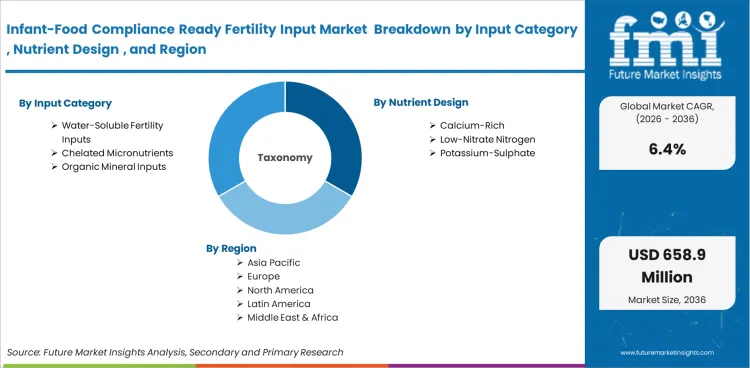
The market covers fertility inputs that are selected or formulated for crops entering infant-food supply chains with strict residue and contaminant expectations. It includes water-soluble nutrients controlled release grades chelated micronutrients and approved biological nutrition products used in field or protected cultivation. Commercial use is highest in fruit vegetable cereal and pulse crops sold to baby-food processors or ingredient suppliers.
Infant-Food Compliance Ready Fertility Input Market Inclusions
Scope includes fertility inputs sold with compliance positioning for infant-food crop programs. This covers water-soluble nutrient packs chelated micronutrients low chloride potassium sources calcium rich blends controlled release nutrition and biostimulant nutrition. The scope counts direct program supply distributor supply and agronomy service bundles used in puree crops infant cereals and pulse ingredients.
Infant-Food Compliance Ready Fertility Input Market Exclusions
Scope excludes bulk commodity fertilizer that is sold without crop specific compliance positioning. It excludes pesticide products seed treatment chemistry post-harvest wash aids and food testing services. Homemade farm inputs that lack formal approval screening or documented composition are not counted in this market.
Infant-Food Compliance Ready Fertility Input Market Research Methodology
- Primary Research: Interviews covered specialty nutrient suppliers processor sourcing teams crop advisors and contract growers active in baby-food raw material chains across Asia Europe and North America.
- Desk Research: Review focused on infant-food contaminant rules organic certification systems official organic area statistics and company filings tied to specialty crop nutrition development.
- Market Sizing and Forecasting: Bottom up sizing used baby-food crop acreage analogs specialty nutrient adoption rates and value per hectare assumptions across audited crop programs.
- Data Validation: The forecast was checked against official organic farming statistics compliance rule changes company activity and parent category ratios with a quarterly review cycle.
Why is the Infant-Food Compliance Ready Fertility Input Market Growing?
- Low nitrate and low residue crop plans are moving from optional agronomy advice toward written procurement conditions in infant-food ingredient contracts.
- Organic conversion and natural farming support are widening the farm base that needs approved fertility inputs with cleaner documentation trails.
- Processor demand is strongest in vegetable puree chains because nitrate exposure and contaminant carryover receive closer buyer scrutiny than bulk food crops.
Growth begins with stricter processor standards on crop inputs used in baby food and prepared baby food supply. Carrot pea sweet potato and cereal lots that fail residue or nitrate expectations can lose premium channels. Farms therefore move toward nutrient plans that give tighter dose control and cleaner documentation. The best fit is usually a soluble feeding program supported by field records and lot level guidance. This shift raises the share of specification led inputs inside a broader specialty fertilizers basket.
Factors propelling the demand includes regulation and certification. Codex has established more than 4300 MRLs across nearly 200 pesticides and the European Union keeps specific infant-food contaminant limits in force. Those conditions do not turn fertilizer into a direct residue source in the same way as crop protection chemistry. They still push growers toward lower risk nutrient programs that help avoid nitrate stress salinity issues and heavy metal exposure in sensitive crops. That is why buyers often compare approved fertility inputs against organic fertilizer and biostimulants rather than bulk nutrition alone.
Market Segmentation Analysis
- Water-soluble fertility inputs are estimated to account for 31.0% of revenue in 2026 because soluble dosing fits compliance driven crop programs.
- Vegetable puree crops are projected to hold 34.0% share in 2026 because leafy and root vegetables face sharper nitrate and contaminant review.
- Fertigation is expected to represent 44.0% of application demand in 2026 as growers seek more precise nutrient placement and timing.
The market is segmented by input category nutrient design application mode crop type compliance positioning end user and sales channel. Revenue clusters around inputs that offer high solubility cleaner raw material profiles and field advisory support. A compliance ready position does not mean one single standard across all countries. It means the product is selected for crops that move through audited infant-food chains where nitrate control raw material quality and documentation matter more than simple price.
Insights into the Input Category Segment
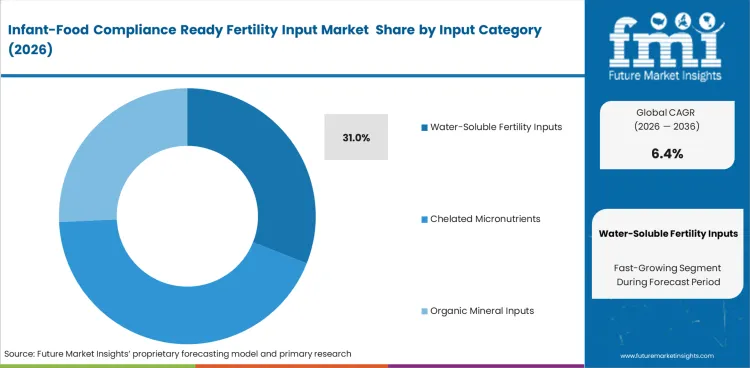
Water-soluble fertility inputs are expected to account for 31.0% share in 2026. The segment stays ahead because dose precision and tank mix flexibility support audited feeding schedules.
Controlled release and biostimulant nutrition add value where growers need steadier nutrient release or lower stress response in sensitive crop stages.
Insights into the Nutrient Design Segment
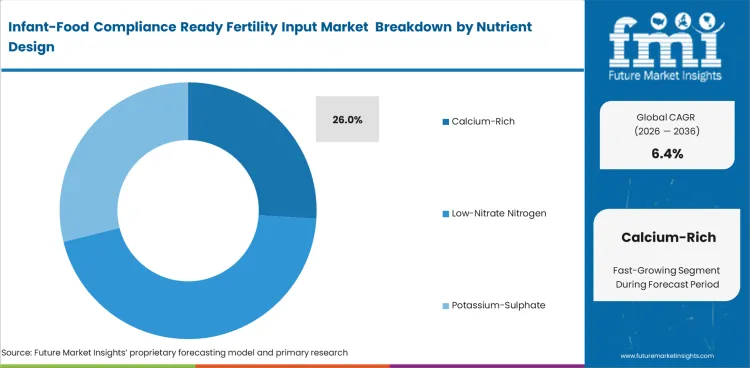
Calcium-rich grades are projected to hold 26.0% share in 2026. Their lead reflects the need for cell integrity shelf life support and lower physiological defects in puree crops.
Low-nitrate nitrogen and boron-zinc programs gain traction where foliage load root quality and processing performance are screened closely by buyers.
Insights into the Application Mode Segment

Fertigation is expected to account for 44.0% share in 2026. Growers favor this route because split feeding lowers excess application risk and supports uniform crop uptake.
Foliar use remains important in correction windows where quick micronutrient delivery matters yet total nutrient loading must stay controlled.
Insights into the Crop Type Segment
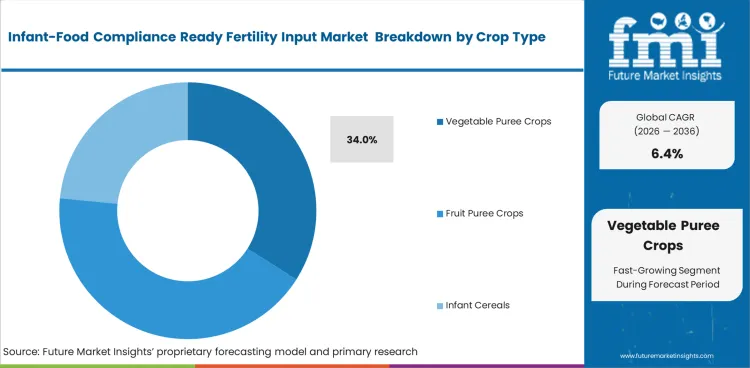
Vegetable puree crops are likely to hold 34.0% share in 2026. Root vegetables peas and spinach absorb most demand because contaminant review is more intense in infant-food chains.
Fruit puree crops and infant cereals retain value where processors need consistent raw material quality and traceable pre-harvest agronomy records.
Insights into the Compliance Positioning Segment
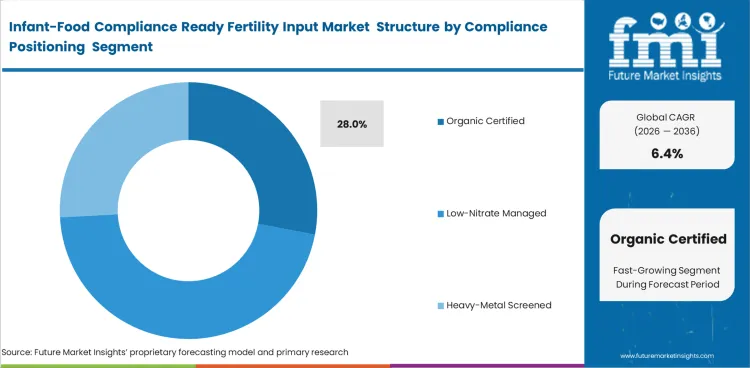
Organic certified grades are set to hold 28.0% share in 2026. Processor demand for cleaner labels and approved farm inputs keeps this category in front.
Heavy-metal screened and low-chloride grades gain share where processor protocols target mineral purity and controlled salt load in crop production.
Insights into the End User Segment
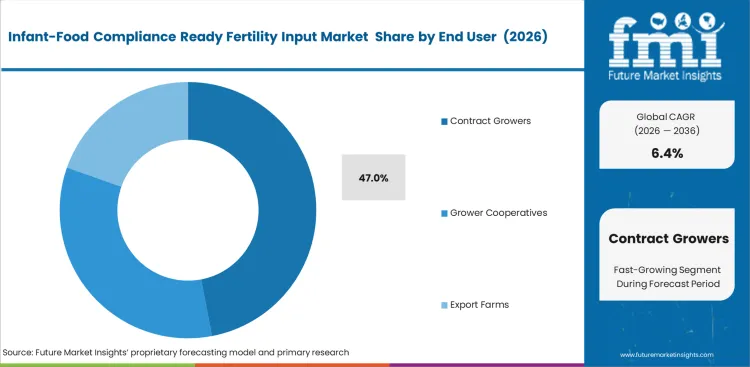
Contract growers are projected to account for 47.0% share in 2026. They lead because infant-food processors often source through managed acreage with input protocols.
Ingredient processors and grower cooperatives create the next layer of demand where raw material intake standards are tied to annual supply agreements.
Insights into the Sales Channel Segment
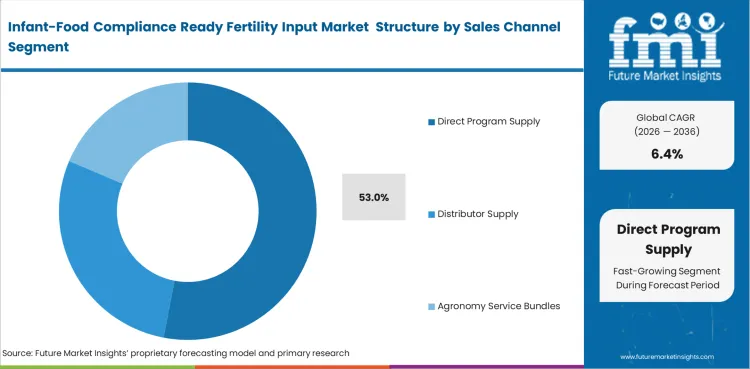
Direct program supply is expected to account for 53.0% share in 2026. Supplier control is higher when agronomy support and product approval travel together.
Distributor supply still matters in fragmented farming areas where local advisory access and inventory reach influence crop season decisions.
Infant-Food Compliance Ready Fertility Input Market Drivers, Restraints, and Opportunities
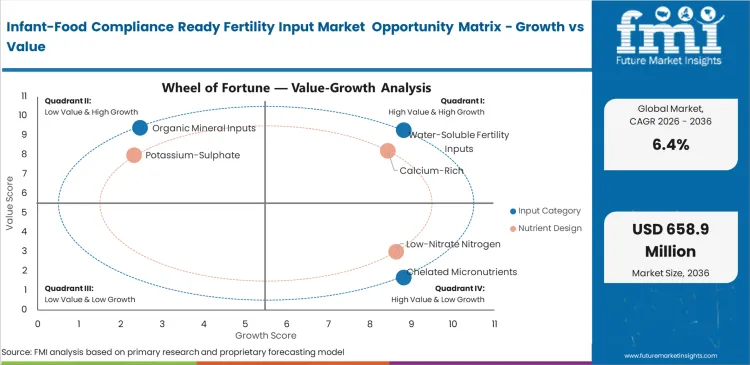
- Processor led crop protocols support demand for documented low risk fertility programs across high scrutiny fruit and vegetable acreage.
- Commodity fertilizer price gaps can slow adoption where growers do not receive a premium for cleaner input programs.
- Organic expansion and audited export chains create room for premium nutrient packs with stronger field support.
Processor Protocol Alignment
Infant-food processors buy consistency before they buy yield. Contracts for puree vegetables and infant cereals often spell out what agronomy records must be maintained during the crop cycle. That practice pushes farms toward water soluble fertilizers and crop micronutrients that can be scheduled with more precision than bulk blends. Program suppliers gain an edge when they can show composition control and field support instead of only invoice price. This is one reason compliance ready inputs expand faster than the broader fertilizer category.
Nitrate and Contaminant Risk Management
The strongest use case sits in crops where nitrate accumulation or raw material contamination can interrupt processor intake. EU contaminant rules keep a 200 mg per kg nitrate maximum for baby food on a dry matter basis and national food authorities continue residue oversight. Growers therefore use calcium sulfate based potash programs and moderated nitrogen feeding to avoid excess load. This favors starter fertilizers in early growth and controlled and slow release fertilizers where steady feeding lowers late season spikes.
Organic Conversion and Clean Label Pull
The clean label push in infant nutrition is not limited to finished food claims. It reaches backward into crop sourcing and farm certification. India reported 7.3 million hectares under organic cultivation in FY24 and global organic farmland reached nearly 98.9 million hectares in 2023. That expansion broadens the field base for approved nutrient programs built around north america organic fertilizers and demand for organic fertilizer in the EU. It opens room for suppliers that can pair certified inputs with crop advisory support.
Biological Nutrition and Screening Support
Biological nutrition does not replace mineral feeding in infant-food crops. It does widen the toolkit where growers want lower stress and tighter nutrient efficiency. Products tied to humic fractions microbial support or extract based nutrition are getting more field attention in compliance sensitive crop systems. That keeps demand moving in humic and fulvic acid based biostimulants and seed biostimulants while mainstream demand for biostimulants in the EU shows where regulation and sustainability goals can lift category acceptance.
Analysis of Infant-Food Compliance Ready Fertility Input Market By Key Countries
.webp "Top Country Growth Comparison Infant Food Compliance Ready Fertility Input Market Cagr (2026 2036)")
| Country | CAGR |
|---|---|
| India | 7.8% |
| China | 7.1% |
| United States | 6.2% |
| Spain | 6.0% |
| Italy | 5.9% |
| France | 5.8% |
| Germany | 5.7% |
Source: FMI analysis based on primary research and proprietary forecasting model
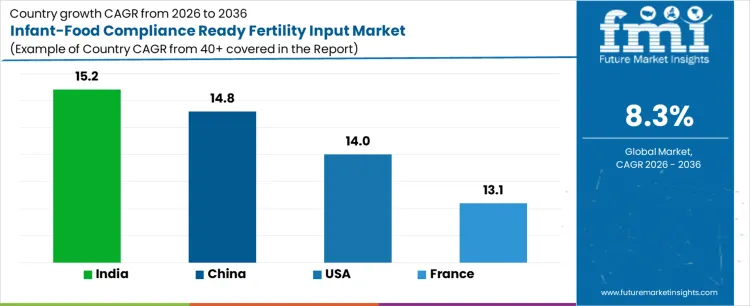
Country growth stays above the global average in Asia because organic acreage expansion and infant nutrition manufacturing are rising together. Europe grows at a slower pace yet remains central to market value because infant-food compliance rules are tighter and processor documentation is deeper. The United States sits between these poles with stronger organic demand yet more mixed grower economics across crop categories.
Demand Outlook for Infant-Food Compliance Ready Fertility Input Market in India
India is projected to expand at a CAGR of 7.8% through 2036. The country combines rising infant nutrition demand with a large organic cultivation base and stronger public support for natural farming. APEDA reported 7.3 million hectares under organic cultivation in FY24 and 3.6 million metric tons of organic production. Compliance ready fertility programs are gaining weight in vegetable puree crops and export oriented fruit supply. Suppliers win where they can support direct farm programs and residue aware feeding schedules.
- Organic acreage supports wider program adoption.
- Natural farming policy increases interest in approved inputs.
- Processor contracts favor documented nutrient programs.
Future Outlook for Infant-Food Compliance Ready Fertility Input Market in China
China is expected to grow at a CAGR of 7.1% through 2036. FiBL reported a 522267 hectare increase in organic farmland in 2023 which was one of the largest gains in the world. The country already holds a large infant nutrition manufacturing base and has scale in vegetable puree and cereal ingredients. Farms supplying those chains need tighter crop programs when buyers ask for cleaner records and lower contaminant risk. Water-soluble nutrition suppliers are likely to benefit first because precision matters more in these contracts.
- Organic land growth widens the addressable farm base.
- Infant nutrition manufacturing supports stable crop demand.
- Precision feeding formats fit buyer scrutiny better.
Sales Analysis of Infant-Food Compliance Ready Fertility Input Market in the United States
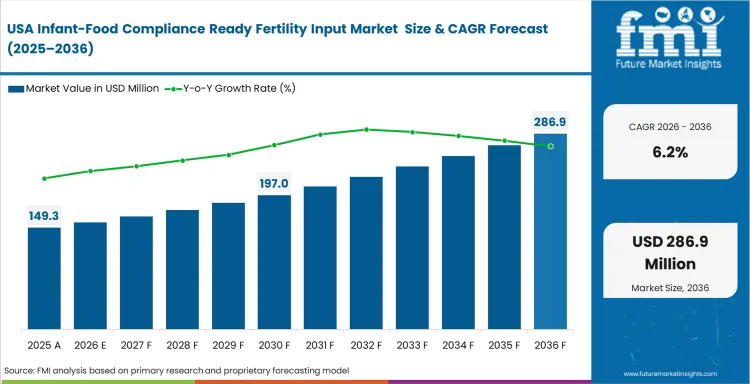
The United States is projected to grow at a CAGR of 6.2% through 2036. FiBL noted 2.06 million hectares of organic agricultural land in the country during 2023 and organic food sales of EUR 59003 million. Infant-food sourcing in the United States places value on traceable fruit vegetable and cereal inputs rather than low upfront nutrient cost alone. Demand is strongest in contract acreage that serves premium puree and cereal lines. Growth is moderated by price sensitivity in field crops outside audited supply programs.
- Organic food demand supports cleaner upstream sourcing.
- Contract farms value service as much as product.
- Price gaps limit wider use in commodity acres.
Opportunity Analysis of Infant-Food Compliance Ready Fertility Input Market in Spain
Spain is forecast to expand at a CAGR of 6.0% through 2036. FiBL reported 2.99 million hectares of organic agricultural land in Spain by the end of 2023 and a gain of 316550 hectares during that year. Spain matters because it is a major European supplier of fruit and vegetable raw materials used in purees and prepared infant foods. Compliance ready fertility plans gain traction where irrigation and export discipline already support controlled crop management. Soluble and low chloride inputs are well placed in that setting.
- Large organic area supports premium crop sourcing.
- Fruit and vegetable chains align with puree demand.
- Irrigated farming supports precise nutrient dosing.
Future Outlook for Infant-Food Compliance Ready Fertility Input Market in Italy
Italy is expected to expand at a CAGR of 5.9% through 2036. FiBL placed Italian organic agricultural land at 2.46 million hectares in 2023 which keeps the country among Europe's largest certified supply bases. Italy brings value through fruit vegetable and cereal ingredients that move into higher quality infant nutrition channels across Europe. Demand for compliance ready inputs is centered on quality assurance rather than acreage growth alone. That keeps premium micronutrients and calcium led programs relevant across processing crops.
- Large certified land base supports ingredient supply.
- Quality focused channels favor screened inputs.
- Micronutrient packs fit premium crop management.
Demand Outlook for Infant-Food Compliance Ready Fertility Input Market in France
France is likely to grow at a CAGR of 5.8% through 2036. FiBL reported 2.77 million hectares of organic agricultural land in France by the end of 2023 which keeps it among the top European producers. French demand is tied to domestic infant nutrition standards and to regional ingredient flows into neighboring markets. Growers in audited chains need reliable crop nutrition without excessive nitrate pressure in vegetables and cereals. That balance supports steady use of controlled feeding programs and approved biological support.
- Domestic standards support upstream discipline.
- Regional ingredient trade sustains demand.
- Controlled feeding limits crop quality swings.
In-depth Analysis of Infant-Food Compliance Ready Fertility Input Market in Germany
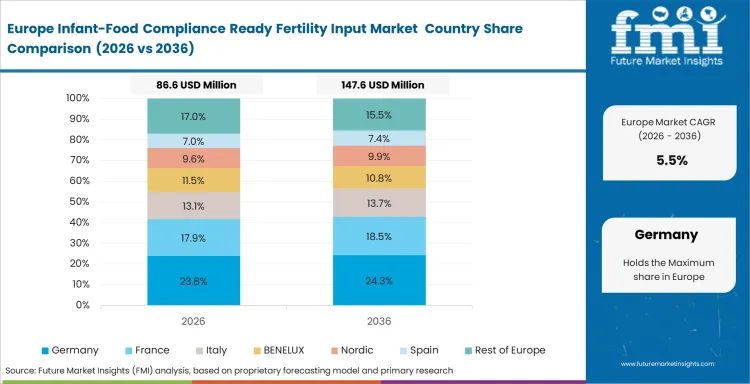
Germany is set to advance at a CAGR of 5.7% through 2036. FiBL reported Germany as one of the world's largest organic food markets with sales of EUR 16080 million in 2023. The country matters less for field area than for buyer standards and importer expectations across infant-food raw materials. Processor and retail scrutiny raise the value of documented agronomy choices across vegetables and cereals sourced at home or from nearby EU suppliers. Suppliers that can support specification led procurement should hold the stronger position.
- Buyer standards are stricter than simple price tests.
- Importer scrutiny supports documented input choices.
- Supplier support matters across regional sourcing programs.
Competitive Landscape and Strategic Positioning
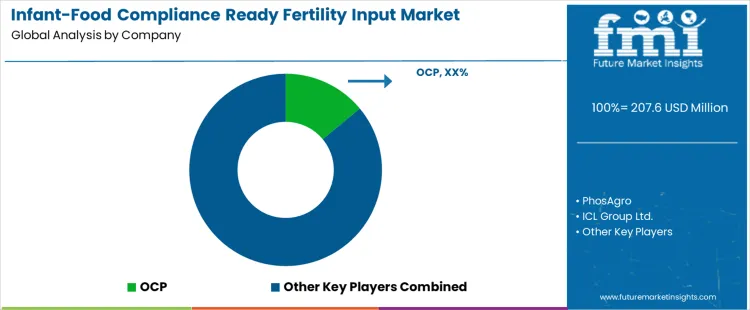
- Yara International holds the strongest visible position with an estimated 14.0% share because of its soluble portfolio field advisory reach and multinational processor relationships.
- ICL Group Haifa Group and SQM retain strong positions in soluble and specialty crop nutrition where product purity and application precision carry more weight.
- Rovensa Next Coromandel International and UPL add pressure through biological and specialty nutrient offers that fit cleaner crop programs.
Competition among the major players in the industry is driven mainly by specification fit. Infant-food crop programs need repeatable composition and better agronomy support than broad acre fertilizer channels. That gives an advantage to companies with water-soluble lines calcium nutrition depth and field service teams that can work beside growers. The strongest portfolios sit close to fertilizer and agrochemicals yet borrow product architecture from fertilizer value added coatings and premium micronutrient categories.
Large suppliers compete on program breadth while regional suppliers compete on crop intimacy. A contract grower serving infant puree vegetables may need a calcium nitrate alternative a low chloride potash source and a screened micronutrient pack in one season. That pattern supports firms with deep sulfur-based micronutrients and starter fertilizers knowledge because crop timing is as important as nutrient content. Supplier switching stays limited once a processor approved farm protocol is in place.
Biological nutrition is becoming a second front of competition. Producers that once sold only soluble minerals now add microbial and extract based tools to support stress tolerance and nutrient efficiency. This competitive layer connects the market with BRIC organic baby food sourcing trends and with growth signals from early life nutrition where cleaner upstream inputs help brand positioning. The result is a market where agronomy service and compliance support travel together.
Key Companies in the Infant-Food Compliance Ready Fertility Input Market
- Yara International leads in soluble crop nutrition and advisory reach across processor linked fruit vegetable and cereal supply chains.
- ICL Group Haifa Group and SQM hold strong positions in premium water-soluble and specialty nutrient programs for high value crops.
- Coromandel International Rovensa Next and UPL expand the field through specialty nutrients biological inputs and wider channel access in emerging regions.
Competitive Benchmarking: Infant-Food Compliance Ready Fertility Input Market
| Company | Residue-Screened Portfolio | Water-Soluble Depth | Program Support | Geographic Footprint |
|---|---|---|---|---|
| Yara International | High | High | Strong | Global |
| ICL Group | High | High | Strong | Global |
| Haifa Group | High | High | Moderate | Global |
| SQM International N.V. | Medium | High | Moderate | Global |
| Coromandel International | Medium | Medium | Strong | India and export |
| Rovensa Next | Medium | Medium | Strong | Europe and LatAm |
| UPL Ltd. | Medium | Medium | Moderate | Global |
Source: Future Market Insights competitive analysis based on product focus field support and regional crop nutrition presence.
Key Developments in Infant-Food Compliance Ready Fertility Input Market
- In May 2025 Coromandel International signed an MOU with Maaden to expand long term cooperation in fertilizers and specialty nutrients.
- In July 2024 Rovensa Next secured new registrations in Colombia and Peru which widened its biosolutions portfolio in fruit and vegetable crops.
- In March 2025 SQM reported that specialty plant nutrition sales volumes grew about 17% in 2024 to nearly 983 thousand tons.
Key Players in the Infant-Food Compliance Ready Fertility Input Market
Major Global Players
- Yara International
- ICL Group
- Haifa Group
- SQM International N.V.
Emerging and Regional Players
- Coromandel International
- Rovensa Next
- UPL Ltd.
Report Scope and Coverage
| Parameter | Details |
|---|---|
| Quantitative Units | USD million for value and CAGR from 2026 to 2036 |
| Market Definition | Compliance positioned fertility inputs used in crops that enter infant-food supply chains |
| Regions Covered | North America Latin America Europe Asia Pacific Middle East and Africa |
| Countries Covered | India China United States Spain Italy France Germany |
| Key Companies Profiled | Yara International ICL Group Haifa Group SQM Coromandel Rovensa Next UPL |
| Forecast Period | 2026 to 2036 |
| Historical Reference | 2025 |
| Approach | Primary interviews desk research bottom up sizing and forecast validation |
Infant-Food Compliance Ready Fertility Input Market by Segment
Infant-Food Compliance Ready Fertility Input Market Segmented by Input Category:
- • Water-Soluble Fertility Inputs
- • Chelated Micronutrients
- • Organic Mineral Inputs
- • Controlled-Release Inputs
- • Biostimulant Nutrition
Infant-Food Compliance Ready Fertility Input Market Segmented by Nutrient Design:
- • Calcium-Rich
- • Low-Nitrate Nitrogen
- • Potassium-Sulphate
- • Boron-Zinc
- • Multi-Micronutrient
Infant-Food Compliance Ready Fertility Input Market Segmented by Application Mode:
- • Fertigation
- • Foliar
- • Soil Drench
Infant-Food Compliance Ready Fertility Input Market Segmented by Crop Type:
- • Vegetable Puree Crops
- • Fruit Puree Crops
- • Infant Cereals
- • Pulse Ingredients
Infant-Food Compliance Ready Fertility Input Market Segmented by Compliance Positioning:
- • Organic Certified
- • Low-Nitrate Managed
- • Heavy-Metal Screened
- • Low-Chloride
- • Residue-Monitored
Infant-Food Compliance Ready Fertility Input Market Segmented by End User:
- • Contract Growers
- • Baby-Food Ingredient Processors
- • Grower Cooperatives
- • Export Farms
- • Nursery Programs
Infant-Food Compliance Ready Fertility Input Market Segmented by Sales Channel:
- • Direct Program Supply
- • Distributor Supply
- • Agronomy Service Bundles
Infant-Food Compliance Ready Fertility Input Market Segmented by Region:
- • North America
- • Latin America
- • Europe
- • Asia Pacific
- • Middle East and Africa
Frequently Asked Questions
What is the global market demand for Infant-Food Compliance Ready Fertility Input in 2026?
In 2026 the global market for infant-food compliance ready fertility input is expected to be worth USD 333.0 million under the base case forecast.
How big will the Infant-Food Compliance Ready Fertility Input market be in 2036?
By 2036 the infant-food compliance ready fertility input market is projected to reach USD 618.5 million as audited crop nutrition programs widen globally.
How fast will demand for Infant-Food Compliance Ready Fertility Input grow between 2026 and 2036?
Demand for infant-food compliance ready fertility input is projected to rise at a CAGR of 6.4% between 2026 and 2036 in the base case.
Which input category is expected to lead the Infant-Food Compliance Ready Fertility Input market by 2026?
Water-soluble fertility inputs are expected to lead the market by 2026 with 31.0% share because they support tighter feeding control.
Which crop group creates the largest demand in the Infant-Food Compliance Ready Fertility Input market?
Vegetable puree crops are expected to hold 34.0% share in 2026 because nitrate control matters more in infant-food vegetable chains.
Which countries are projected to grow fastest in the Infant-Food Compliance Ready Fertility Input market?
India leads projected growth at 7.8% CAGR through 2036 while China follows at 7.1% due to organic acreage and infant nutrition demand.
What supports premium pricing in the Infant-Food Compliance Ready Fertility Input market?
Premium pricing is supported by composition control screening support agronomy service and better fit with processor protocols for infant-food crop sourcing.
What limits wider adoption of Infant-Food Compliance Ready Fertility Input?
Wider adoption is limited by price gaps versus commodity fertilizer and by uneven grower access to premiums for compliance linked crop programs.
Preview the report firsthand - request a free sample
Get SampleGet the brochure for pricing and purchase details.
Get PDFTable of Content
- Executive Summary
- Global Market Outlook
- Demand-side Trends
- Supply-side Trends
- Technology Roadmap Analysis
- Analysis and Recommendations
- Market Overview
- Market Coverage / Taxonomy
- Market Definition / Scope / Limitations
- Research Methodology
- Chapter Orientation
- Analytical Lens and Working Hypotheses
- Market Structure, Signals, and Trend Drivers
- Benchmarking and Cross-market Comparability
- Market Sizing, Forecasting, and Opportunity Mapping
- Research Design and Evidence Framework
- Desk Research Programme (Secondary Evidence)
- Company Annual and Sustainability Reports
- Peer-reviewed Journals and Academic Literature
- Corporate Websites, Product Literature, and Technical Notes
- Earnings Decks and Investor Briefings
- Statutory Filings and Regulatory Disclosures
- Technical White Papers and Standards Notes
- Trade Journals, Industry Magazines, and Analyst Briefs
- Conference Proceedings, Webinars, and Seminar Materials
- Government Statistics Portals and Public Data Releases
- Press Releases and Reputable Media Coverage
- Specialist Newsletters and Curated Briefings
- Sector Databases and Reference Repositories
- FMI Internal Proprietary Databases and Historical Market Datasets
- Subscription Datasets and Paid Sources
- Social Channels, Communities, and Digital Listening Inputs
- Additional Desk Sources
- Expert Input and Fieldwork (Primary Evidence)
- Primary Modes
- Qualitative Interviews and Expert Elicitation
- Quantitative Surveys and Structured Data Capture
- Blended Approach
- Why Primary Evidence is Used
- Field Techniques
- Interviews
- Surveys
- Focus Groups
- Observational and In-context Research
- Social and Community Interactions
- Stakeholder Universe Engaged
- C-suite Leaders
- Board Members
- Presidents and Vice Presidents
- R&D and Innovation Heads
- Technical Specialists
- Domain Subject-matter Experts
- Scientists
- Physicians and Other Healthcare Professionals
- Governance, Ethics, and Data Stewardship
- Research Ethics
- Data Integrity and Handling
- Primary Modes
- Tooling, Models, and Reference Databases
- Desk Research Programme (Secondary Evidence)
- Data Engineering and Model Build
- Data Acquisition and Ingestion
- Cleaning, Normalisation, and Verification
- Synthesis, Triangulation, and Analysis
- Quality Assurance and Audit Trail
- Market Background
- Market Dynamics
- Drivers
- Restraints
- Opportunity
- Trends
- Scenario Forecast
- Demand in Optimistic Scenario
- Demand in Likely Scenario
- Demand in Conservative Scenario
- Opportunity Map Analysis
- Product Life Cycle Analysis
- Supply Chain Analysis
- Investment Feasibility Matrix
- Value Chain Analysis
- PESTLE and Porter’s Analysis
- Regulatory Landscape
- Regional Parent Market Outlook
- Production and Consumption Statistics
- Import and Export Statistics
- Market Dynamics
- Global Market Analysis 2021 to 2025 and Forecast, 2026 to 2036
- Historical Market Size Value (USD Million) Analysis, 2021 to 2025
- Current and Future Market Size Value (USD Million) Projections, 2026 to 2036
- Y-o-Y Growth Trend Analysis
- Absolute $ Opportunity Analysis
- Global Market Pricing Analysis 2021 to 2025 and Forecast 2026 to 2036
- Global Market Analysis 2021 to 2025 and Forecast 2026 to 2036, By Input Category
- Introduction / Key Findings
- Historical Market Size Value (USD Million) Analysis By Input Category , 2021 to 2025
- Current and Future Market Size Value (USD Million) Analysis and Forecast By Input Category , 2026 to 2036
- Water-Soluble Fertility Inputs
- Chelated Micronutrients
- Organic Mineral Inputs
- Water-Soluble Fertility Inputs
- Y-o-Y Growth Trend Analysis By Input Category , 2021 to 2025
- Absolute $ Opportunity Analysis By Input Category , 2026 to 2036
- Global Market Analysis 2021 to 2025 and Forecast 2026 to 2036, By Nutrient Design
- Introduction / Key Findings
- Historical Market Size Value (USD Million) Analysis By Nutrient Design, 2021 to 2025
- Current and Future Market Size Value (USD Million) Analysis and Forecast By Nutrient Design, 2026 to 2036
- Calcium-Rich
- Low-Nitrate Nitrogen
- Potassium-Sulphate
- Calcium-Rich
- Y-o-Y Growth Trend Analysis By Nutrient Design, 2021 to 2025
- Absolute $ Opportunity Analysis By Nutrient Design, 2026 to 2036
- Global Market Analysis 2021 to 2025 and Forecast 2026 to 2036, By Application Mode
- Introduction / Key Findings
- Historical Market Size Value (USD Million) Analysis By Application Mode, 2021 to 2025
- Current and Future Market Size Value (USD Million) Analysis and Forecast By Application Mode, 2026 to 2036
- Fertigation
- Foliar
- Soil Drench
- Fertigation
- Y-o-Y Growth Trend Analysis By Application Mode, 2021 to 2025
- Absolute $ Opportunity Analysis By Application Mode, 2026 to 2036
- Global Market Analysis 2021 to 2025 and Forecast 2026 to 2036, By Crop Type
- Introduction / Key Findings
- Historical Market Size Value (USD Million) Analysis By Crop Type, 2021 to 2025
- Current and Future Market Size Value (USD Million) Analysis and Forecast By Crop Type, 2026 to 2036
- Vegetable Puree Crops
- Fruit Puree Crops
- Infant Cereals
- Vegetable Puree Crops
- Y-o-Y Growth Trend Analysis By Crop Type, 2021 to 2025
- Absolute $ Opportunity Analysis By Crop Type, 2026 to 2036
- Global Market Analysis 2021 to 2025 and Forecast 2026 to 2036, By Compliance Positioning
- Introduction / Key Findings
- Historical Market Size Value (USD Million) Analysis By Compliance Positioning, 2021 to 2025
- Current and Future Market Size Value (USD Million) Analysis and Forecast By Compliance Positioning, 2026 to 2036
- Organic Certified
- Low-Nitrate Managed
- Heavy-Metal Screened
- Organic Certified
- Y-o-Y Growth Trend Analysis By Compliance Positioning, 2021 to 2025
- Absolute $ Opportunity Analysis By Compliance Positioning, 2026 to 2036
- Global Market Analysis 2021 to 2025 and Forecast 2026 to 2036, By End User
- Introduction / Key Findings
- Historical Market Size Value (USD Million) Analysis By End User, 2021 to 2025
- Current and Future Market Size Value (USD Million) Analysis and Forecast By End User, 2026 to 2036
- Contract Growers
- Grower Cooperatives
- Export Farms
- Contract Growers
- Y-o-Y Growth Trend Analysis By End User, 2021 to 2025
- Absolute $ Opportunity Analysis By End User, 2026 to 2036
- Global Market Analysis 2021 to 2025 and Forecast 2026 to 2036, By Sales Channel
- Introduction / Key Findings
- Historical Market Size Value (USD Million) Analysis By Sales Channel, 2021 to 2025
- Current and Future Market Size Value (USD Million) Analysis and Forecast By Sales Channel, 2026 to 2036
- Direct Program Supply
- Distributor Supply
- Agronomy Service Bundles
- Direct Program Supply
- Y-o-Y Growth Trend Analysis By Sales Channel, 2021 to 2025
- Absolute $ Opportunity Analysis By Sales Channel, 2026 to 2036
- Global Market Analysis 2021 to 2025 and Forecast 2026 to 2036, By Region
- Introduction
- Historical Market Size Value (USD Million) Analysis By Region, 2021 to 2025
- Current Market Size Value (USD Million) Analysis and Forecast By Region, 2026 to 2036
- North America
- Latin America
- Western Europe
- Eastern Europe
- East Asia
- South Asia and Pacific
- Middle East & Africa
- Market Attractiveness Analysis By Region
- North America Market Analysis 2021 to 2025 and Forecast 2026 to 2036, By Country
- Historical Market Size Value (USD Million) Trend Analysis By Market Taxonomy, 2021 to 2025
- Market Size Value (USD Million) Forecast By Market Taxonomy, 2026 to 2036
- By Country
- USA
- Canada
- Mexico
- By Input Category
- By Nutrient Design
- By Application Mode
- By Crop Type
- By Compliance Positioning
- By End User
- By Sales Channel
- By Country
- Market Attractiveness Analysis
- By Country
- By Input Category
- By Nutrient Design
- By Application Mode
- By Crop Type
- By Compliance Positioning
- By End User
- By Sales Channel
- Key Takeaways
- Latin America Market Analysis 2021 to 2025 and Forecast 2026 to 2036, By Country
- Historical Market Size Value (USD Million) Trend Analysis By Market Taxonomy, 2021 to 2025
- Market Size Value (USD Million) Forecast By Market Taxonomy, 2026 to 2036
- By Country
- Brazil
- Chile
- Rest of Latin America
- By Input Category
- By Nutrient Design
- By Application Mode
- By Crop Type
- By Compliance Positioning
- By End User
- By Sales Channel
- By Country
- Market Attractiveness Analysis
- By Country
- By Input Category
- By Nutrient Design
- By Application Mode
- By Crop Type
- By Compliance Positioning
- By End User
- By Sales Channel
- Key Takeaways
- Western Europe Market Analysis 2021 to 2025 and Forecast 2026 to 2036, By Country
- Historical Market Size Value (USD Million) Trend Analysis By Market Taxonomy, 2021 to 2025
- Market Size Value (USD Million) Forecast By Market Taxonomy, 2026 to 2036
- By Country
- Germany
- UK
- Italy
- Spain
- France
- Nordic
- BENELUX
- Rest of Western Europe
- By Input Category
- By Nutrient Design
- By Application Mode
- By Crop Type
- By Compliance Positioning
- By End User
- By Sales Channel
- By Country
- Market Attractiveness Analysis
- By Country
- By Input Category
- By Nutrient Design
- By Application Mode
- By Crop Type
- By Compliance Positioning
- By End User
- By Sales Channel
- Key Takeaways
- Eastern Europe Market Analysis 2021 to 2025 and Forecast 2026 to 2036, By Country
- Historical Market Size Value (USD Million) Trend Analysis By Market Taxonomy, 2021 to 2025
- Market Size Value (USD Million) Forecast By Market Taxonomy, 2026 to 2036
- By Country
- Russia
- Poland
- Hungary
- Balkan & Baltic
- Rest of Eastern Europe
- By Input Category
- By Nutrient Design
- By Application Mode
- By Crop Type
- By Compliance Positioning
- By End User
- By Sales Channel
- By Country
- Market Attractiveness Analysis
- By Country
- By Input Category
- By Nutrient Design
- By Application Mode
- By Crop Type
- By Compliance Positioning
- By End User
- By Sales Channel
- Key Takeaways
- East Asia Market Analysis 2021 to 2025 and Forecast 2026 to 2036, By Country
- Historical Market Size Value (USD Million) Trend Analysis By Market Taxonomy, 2021 to 2025
- Market Size Value (USD Million) Forecast By Market Taxonomy, 2026 to 2036
- By Country
- China
- Japan
- South Korea
- By Input Category
- By Nutrient Design
- By Application Mode
- By Crop Type
- By Compliance Positioning
- By End User
- By Sales Channel
- By Country
- Market Attractiveness Analysis
- By Country
- By Input Category
- By Nutrient Design
- By Application Mode
- By Crop Type
- By Compliance Positioning
- By End User
- By Sales Channel
- Key Takeaways
- South Asia and Pacific Market Analysis 2021 to 2025 and Forecast 2026 to 2036, By Country
- Historical Market Size Value (USD Million) Trend Analysis By Market Taxonomy, 2021 to 2025
- Market Size Value (USD Million) Forecast By Market Taxonomy, 2026 to 2036
- By Country
- India
- ASEAN
- Australia & New Zealand
- Rest of South Asia and Pacific
- By Input Category
- By Nutrient Design
- By Application Mode
- By Crop Type
- By Compliance Positioning
- By End User
- By Sales Channel
- By Country
- Market Attractiveness Analysis
- By Country
- By Input Category
- By Nutrient Design
- By Application Mode
- By Crop Type
- By Compliance Positioning
- By End User
- By Sales Channel
- Key Takeaways
- Middle East & Africa Market Analysis 2021 to 2025 and Forecast 2026 to 2036, By Country
- Historical Market Size Value (USD Million) Trend Analysis By Market Taxonomy, 2021 to 2025
- Market Size Value (USD Million) Forecast By Market Taxonomy, 2026 to 2036
- By Country
- Kingdom of Saudi Arabia
- Other GCC Countries
- Turkiye
- South Africa
- Other African Union
- Rest of Middle East & Africa
- By Input Category
- By Nutrient Design
- By Application Mode
- By Crop Type
- By Compliance Positioning
- By End User
- By Sales Channel
- By Country
- Market Attractiveness Analysis
- By Country
- By Input Category
- By Nutrient Design
- By Application Mode
- By Crop Type
- By Compliance Positioning
- By End User
- By Sales Channel
- Key Takeaways
- Key Countries Market Analysis
- USA
- Pricing Analysis
- Market Share Analysis, 2025
- By Input Category
- By Nutrient Design
- By Application Mode
- By Crop Type
- By Compliance Positioning
- By End User
- By Sales Channel
- Canada
- Pricing Analysis
- Market Share Analysis, 2025
- By Input Category
- By Nutrient Design
- By Application Mode
- By Crop Type
- By Compliance Positioning
- By End User
- By Sales Channel
- Mexico
- Pricing Analysis
- Market Share Analysis, 2025
- By Input Category
- By Nutrient Design
- By Application Mode
- By Crop Type
- By Compliance Positioning
- By End User
- By Sales Channel
- Brazil
- Pricing Analysis
- Market Share Analysis, 2025
- By Input Category
- By Nutrient Design
- By Application Mode
- By Crop Type
- By Compliance Positioning
- By End User
- By Sales Channel
- Chile
- Pricing Analysis
- Market Share Analysis, 2025
- By Input Category
- By Nutrient Design
- By Application Mode
- By Crop Type
- By Compliance Positioning
- By End User
- By Sales Channel
- Germany
- Pricing Analysis
- Market Share Analysis, 2025
- By Input Category
- By Nutrient Design
- By Application Mode
- By Crop Type
- By Compliance Positioning
- By End User
- By Sales Channel
- UK
- Pricing Analysis
- Market Share Analysis, 2025
- By Input Category
- By Nutrient Design
- By Application Mode
- By Crop Type
- By Compliance Positioning
- By End User
- By Sales Channel
- Italy
- Pricing Analysis
- Market Share Analysis, 2025
- By Input Category
- By Nutrient Design
- By Application Mode
- By Crop Type
- By Compliance Positioning
- By End User
- By Sales Channel
- Spain
- Pricing Analysis
- Market Share Analysis, 2025
- By Input Category
- By Nutrient Design
- By Application Mode
- By Crop Type
- By Compliance Positioning
- By End User
- By Sales Channel
- France
- Pricing Analysis
- Market Share Analysis, 2025
- By Input Category
- By Nutrient Design
- By Application Mode
- By Crop Type
- By Compliance Positioning
- By End User
- By Sales Channel
- India
- Pricing Analysis
- Market Share Analysis, 2025
- By Input Category
- By Nutrient Design
- By Application Mode
- By Crop Type
- By Compliance Positioning
- By End User
- By Sales Channel
- ASEAN
- Pricing Analysis
- Market Share Analysis, 2025
- By Input Category
- By Nutrient Design
- By Application Mode
- By Crop Type
- By Compliance Positioning
- By End User
- By Sales Channel
- Australia & New Zealand
- Pricing Analysis
- Market Share Analysis, 2025
- By Input Category
- By Nutrient Design
- By Application Mode
- By Crop Type
- By Compliance Positioning
- By End User
- By Sales Channel
- China
- Pricing Analysis
- Market Share Analysis, 2025
- By Input Category
- By Nutrient Design
- By Application Mode
- By Crop Type
- By Compliance Positioning
- By End User
- By Sales Channel
- Japan
- Pricing Analysis
- Market Share Analysis, 2025
- By Input Category
- By Nutrient Design
- By Application Mode
- By Crop Type
- By Compliance Positioning
- By End User
- By Sales Channel
- South Korea
- Pricing Analysis
- Market Share Analysis, 2025
- By Input Category
- By Nutrient Design
- By Application Mode
- By Crop Type
- By Compliance Positioning
- By End User
- By Sales Channel
- Russia
- Pricing Analysis
- Market Share Analysis, 2025
- By Input Category
- By Nutrient Design
- By Application Mode
- By Crop Type
- By Compliance Positioning
- By End User
- By Sales Channel
- Poland
- Pricing Analysis
- Market Share Analysis, 2025
- By Input Category
- By Nutrient Design
- By Application Mode
- By Crop Type
- By Compliance Positioning
- By End User
- By Sales Channel
- Hungary
- Pricing Analysis
- Market Share Analysis, 2025
- By Input Category
- By Nutrient Design
- By Application Mode
- By Crop Type
- By Compliance Positioning
- By End User
- By Sales Channel
- Kingdom of Saudi Arabia
- Pricing Analysis
- Market Share Analysis, 2025
- By Input Category
- By Nutrient Design
- By Application Mode
- By Crop Type
- By Compliance Positioning
- By End User
- By Sales Channel
- Turkiye
- Pricing Analysis
- Market Share Analysis, 2025
- By Input Category
- By Nutrient Design
- By Application Mode
- By Crop Type
- By Compliance Positioning
- By End User
- By Sales Channel
- South Africa
- Pricing Analysis
- Market Share Analysis, 2025
- By Input Category
- By Nutrient Design
- By Application Mode
- By Crop Type
- By Compliance Positioning
- By End User
- By Sales Channel
- USA
- Market Structure Analysis
- Competition Dashboard
- Competition Benchmarking
- Market Share Analysis of Top Players
- By Regional
- By Input Category
- By Nutrient Design
- By Application Mode
- By Crop Type
- By Compliance Positioning
- By End User
- By Sales Channel
- Competition Analysis
- Competition Deep Dive
- Yara International
- Overview
- Product Portfolio
- Profitability by Market Segments (Product/Age /Sales Channel/Region)
- Sales Footprint
- Strategy Overview
- Marketing Strategy
- Product Strategy
- Channel Strategy
- ICL Group
- Haifa Group
- SQM International N.V.
- Coromandel International
- Rovensa Next
- Yara International
- Competition Deep Dive
- Assumptions & Acronyms Used


