

- Industry Size (2026)
- USD 2.8 Bn
- Forecast (2036)
- USD 9.7 Bn
- CAGR (2026 to 2036)
- 13.2%
Electrolyzed Water Generator Market Forecast and Outlook 2026 to 2036
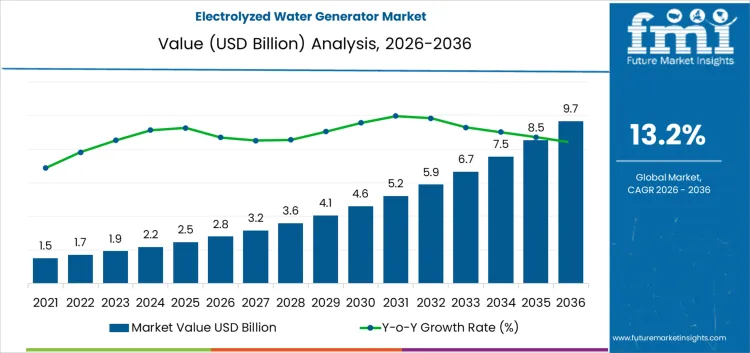
The electrolyzed water generator market value is anticipated to rise from USD 2.8 billion in 2026 to USD 9.7 billion by 2036, reflecting a compound annual growth rate (CAGR) of 13.2%. The initial adoption of these systems is typically rooted in stringent sanitation protocols that emphasize specific concentration ranges, flow stability, and operational duty cycles. Once these procedures are included in audits, the replacement of equipment becomes infrequent. Plant managers are increasingly favoring on-site generation solutions to minimize the risks associated with chemical storage and handling.
The focus for engineering assessments centers on key aspects such as electrode lifespan, accuracy in power control, and accessibility for servicing. Furthermore, purchasing decisions are influenced by warranty details and lead times for replacement parts. Planning for installation must consider essential utilities, drainage, ventilation, and the training of operators. The commissioning phase is dependent upon robust verification processes and comprehensive record-keeping.
In the competitive landscape, success hinges more on certification comprehensiveness, service capabilities, and uptime assurances rather than mere pricing strategies. Manufacturers are continually improving their offerings by refining electrode coatings, enhancing power electronics, and advancing control logic to ensure stable outputs, even when feed water quality varies. Assembling production lines requires meticulous balancing of stack configurations, skid integration, and testing capacities. Each shipment release mandates rigorous checks for concentrations, flow rates, and safety interlocks.
Quick Stats for Electrolyzed Water Generator Market
- Electrolyzed Water Generator Market Value (2026): USD 2.8 billion
- Electrolyzed Water Generator Market Forecast Value (2036): USD 9.7 billion
- Electrolyzed Water Generator Market Forecast CAGR 2026 to 2036: 13.2%
- Leading Product Type in Electrolyzed Water Generator Market: On-site electrolyzed water generators
- Leading Application in Electrolyzed Water Generator Market: Food and beverage sanitation
- Key Growth Regions in Electrolyzed Water Generator Market: Asia Pacific, Europe, North America
- Top Players in Electrolyzed Water Generator Market: EcoloxTech, BioSafe Systems, EAU Technologies, Kirkmayer Industries, De Nora
What Is the Growth Forecast for the Electrolyzed Water Generator Market through 2036?
Adoption in the electrolyzed water generator market follows operational policy and compliance practice more than equipment replacement cycles. In 2026, at about USD 2.8 billion, installations concentrate in food processing, healthcare facilities, and public spaces where disinfection protocols are centrally managed. Once a site standard is set, equipment stays in service across many years, supported by consumables and periodic cell replacement. Demand expands as organizations extend the same sanitation rules across more locations and functions. Purchasing decisions sit with operations and quality teams rather than general procurement, which ties growth to internal standardization programs and audit frameworks instead of to short term capital spending patterns.
Service logistics and operating cost structure shape the upper part of the forecast for the electrolyzed water generator market. As value approaches roughly USD 9.7 billion by 2036, buyers focus on uptime, maintenance intervals, and predictable output quality. System design shifts toward higher capacity units and centralized installations that serve multiple use points. Manufacturing and distribution effort increases as aftersales support becomes a larger part of the total cost of ownership. The move from the low single digits into the high single digit billions reflects broad institutional rollout across many sectors rather than a single regulatory trigger. Suppliers that combine field service coverage, stable performance, and simple operation tend to secure multi-site contracts.
Electrolyzed Water Generator Market Key Takeaways
| Metric | Value |
|---|---|
| Market Value (2026) | USD 2.8 billion |
| Forecast Value (2036) | USD 9.7 billion |
| Forecast CAGR 2026 to 2036 | 13.2% |
How Is the Electrolyzed Water Generator Market Changing On-Site Cleaning and Disinfection Practices?
Electrolyzed water generators produce cleaning and sanitizing solutions by passing an electric current through water and salt. This allows facilities to make disinfectant on site instead of storing and handling packaged chemicals. Early adoption focused on food processing, healthcare, and hospitality sites where chemical inventory, worker exposure, and residue control created operating risk. System performance depends on cell design, current control, water quality management, and consistent output concentration. Buyers evaluate units by production rate, stability of the generated solution, and compatibility with existing cleaning procedures. Use has expanded into cold storage, commercial kitchens, and public facilities because operators can standardize cleaning routines and reduce dependence on delivered chemicals. Installation decisions usually follow process reviews rather than procurement cycles, since the equipment becomes part of sanitation protocol and audit programs.
Capital approval for these systems is often tied to operating cost reduction and compliance simplification rather than to equipment replacement cycles. Earlier projects were limited to pilot lines or single sites, which kept volumes small and specifications flexible. Current rollouts focus on multi-site standardization, operator training, and defined maintenance schedules. Manufacturers compete on electrode life, control reliability, and service support more than on headline output figures. Users track total cost through salt use, power consumption, downtime, and audit findings, not through unit price alone. Distributors support adoption by providing installation, validation, and spare parts coverage. Over time, demand follows stricter hygiene protocols and labor constraints in cleaning operations. Suppliers that deliver stable output and predictable maintenance intervals gain preferred status in long term contracts across regulated facilities.
What is Electrolyzed Water Generator Market Outlook by Product Type and Application?
Adoption in Electrolyzed Water Generator Market follows changes in cleaning protocols and chemical handling rules rather than equipment replacement cycles. Many users shift only after internal audits or regulatory reviews rewrite sanitation procedures. Once electrolyzed water is approved as a process input, generation equipment becomes part of site utilities, not a discretionary purchase. This ties demand to facility retrofits, capacity expansions, and compliance programs. System sizing, redundancy planning, and operator training shape purchasing decisions more than unit price. Segment structure reflects how users balance production volume, mobility needs, and integration with existing water and power infrastructure. Suppliers compete on uptime records, serviceability, and documented performance under real operating conditions.
How Does Product Type Selection Influence Installation Strategy and Operating Economics in the Electrolyzed Water Generator Market?
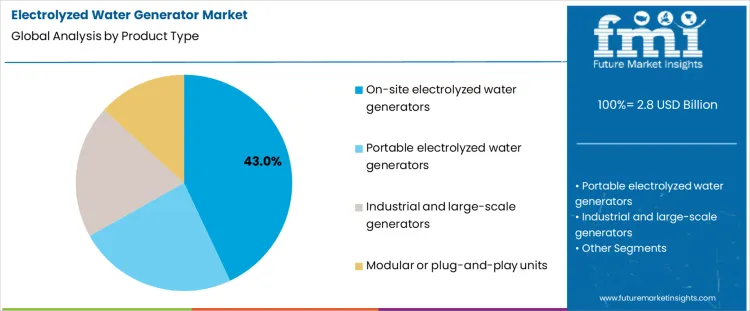
On site electrolyzed water generators represent about 43% of demand in the Electrolyzed Water Generator Market because they integrate directly into fixed sanitation workflows and remove dependence on delivered chemicals. These systems suit facilities with stable, continuous cleaning demand and available utility connections. Portable generators serve operations that need flexibility across rooms or sites, though their output capacity and duty cycles are limited. Industrial and large scale units address plants with high daily volume requirements, where centralized generation and distribution lines make sense. Modular or plug and play units target sites that expand in stages or want redundancy without full system redesign. Each type implies different installation work, operator involvement, and maintenance planning.
Operating cost behavior differs sharply across these product types. On site and industrial systems justify higher upfront spend through lower per liter operating cost and reduced chemical logistics. Portable units trade efficiency for convenience, which fits intermittent use cases but raises cost per treated area. Modular systems spread capital spending over time, yet require careful matching of added capacity with utility limits. Switching between types is uncommon once a site is configured, since plumbing, drainage, and electrical layouts are fixed. Demand by product type therefore follows facility design choices and expansion plans rather than short term changes in cleaning frequency or staffing levels.
Why Does Application Mix Determine Scale Requirements and Validation Effort in the Electrolyzed Water Generator Market?
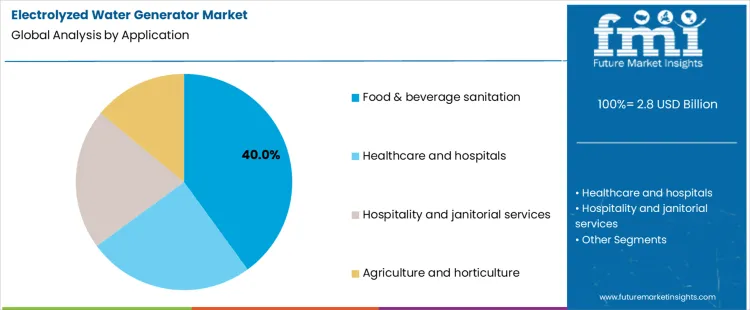
Food and beverage sanitation accounts for about 40% of demand in the Electrolyzed Water Generator Market because these facilities perform frequent, standardized cleaning across large surface areas and process equipment. This creates steady volume needs and justifies permanent installations. Healthcare and hospitals focus on infection control and protocol compliance, which increases validation work and documentation while keeping volumes moderate. Hospitality and janitorial services value flexibility and rapid deployment across multiple sites, favoring smaller or mobile systems. Agriculture and horticulture use electrolyzed water for equipment, surface, and sometimes crop related sanitation, where outdoor conditions and seasonal cycles shape usage patterns. These differences explain why scale and configuration vary widely across applications.
Application mix also shapes approval paths and sales cycles. Food processors and hospitals require formal validation and periodic audits, which lengthens decision timelines but stabilizes long term demand. Hospitality buyers decide faster, yet place smaller and more variable orders. Agricultural users often adopt through pilot programs tied to seasonal operations, creating uneven purchasing patterns. The combined effect is a market where volume concentration sits in regulated processing environments, while growth in unit count often comes from service oriented sectors. Segment shares therefore move with changes in hygiene standards, inspection regimes, and facility investment plans rather than with general equipment spending trends.
How Is the Electrolyzed Water Generator Sales Impacted by Hygiene Control and Operating Cost Discipline?
The Electrolyzed Water Generator Market is being shaped by how facilities manage hygiene outcomes while controlling chemical handling, storage, and recurring consumable costs. In food processing, healthcare, hospitality, and public facilities, electrolyzed water is used where predictable disinfection performance and on-site generation simplify daily operations. Buyers evaluate systems based on output stability, maintenance needs, uptime, and documentation support rather than on equipment price alone. Procurement decisions often involve quality, operations, and compliance teams. This positions electrolyzed water generators as part of routine process control infrastructure instead of as optional cleaning equipment, which changes how systems are specified, budgeted, and maintained over long operating cycles.
How Is Usage Pattern Consolidation Changing Demand in The Electrolyzed Water Generator Market?
Many organizations are standardizing cleaning and disinfection practices across multiple sites and departments to reduce procedural variation and training complexity. This behavior is shifting demand in the Electrolyzed Water Generator Market toward centralized or standardized generator models that can serve repeatable workflows. Buyers increasingly prefer systems with consistent output profiles, simple operation, and predictable service intervals. In food plants, hospitals, and large facilities, this reduces dependence on multiple chemical products and simplifies internal audits. As a result, purchasing decisions are moving away from ad hoc equipment selection and toward fleet-level standardization, where reliability, service support, and long-term operating consistency matter more than incremental feature differences.
Where Is Scalable Demand Being Built in The Electrolyzed Water Generator Market Across Daily Use Environments?
Scalable demand is being built in environments that rely on frequent, routine cleaning rather than occasional deep disinfection. Food preparation areas, cold storage, processing lines, commercial kitchens, clinics, and public facilities create steady usage patterns that favor on-site generation systems. The Electrolyzed Water Generator Market benefits when customers replace repeated chemical purchasing with continuous production models tied to daily operations. There is also opportunity in supplying systems bundled with service, monitoring, and documentation support, which reduces customer management burden. Suppliers that integrate into customer operating procedures rather than only selling equipment can secure long-term placements and recurring system expansion across facility networks.
Why Do Performance Expectations and Process Fit Limit Faster Adoption in The Electrolyzed Water Generator Market?
Adoption in the Electrolyzed Water Generator Market is limited when users expect one solution to replace all cleaning and disinfection chemicals across every application. Electrolyzed water performance depends on concentration control, contact time, and correct usage, which requires process discipline. Some facilities also operate equipment and surfaces that demand specialized cleaners, limiting full replacement. In addition, system installation, water quality requirements, and staff training introduce change management effort. Cost-focused buyers may hesitate when upfront equipment investment is compared to short-term chemical purchasing. These factors slow conversion in mixed-use environments where cleaning practices are deeply embedded and difficult to standardize quickly.
What is the Demand for Electrolyzed Water Generator by Country?
| Country | CAGR |
|---|---|
| USA | 12.5% |
| UK | 12.0% |
| China | 14.0% |
| India | 15.2% |
| Brazil | 13.0% |
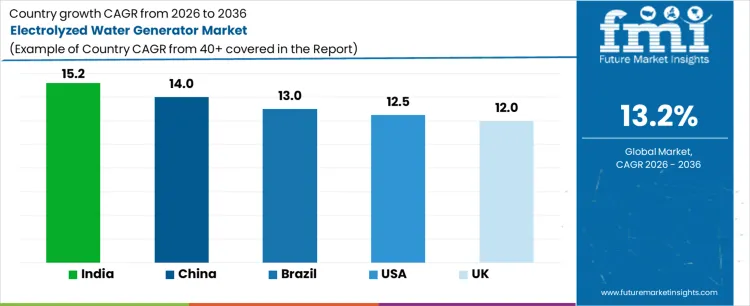
Demand for electrolyzed water generators is rising rapidly as industries, healthcare facilities, and food processing units adopt on site disinfection systems that reduce chemical handling and storage. India leads with a 15.2% CAGR, supported by growing hygiene standards in hospitals, hospitality, and food processing, along with wider adoption in municipal and commercial cleaning applications. China follows at 14.0%, driven by large scale food manufacturing, public sanitation programs, and industrial cleaning requirements. Brazil records 13.0%, reflecting increasing use in agriculture, food plants, and healthcare facilities. The USA grows at 12.5%, shaped by interest in chemical free sanitation and operational cost control. The UK, at 12.0%, reflects strong uptake in healthcare and commercial cleaning environments.
How Do Food Safety Protocols and Institutional Procurement Shape Demand in The United States?
Regulatory pressure and hygiene standardization keep the electrolyzed water generator market in the United States on a 12.5% CAGR path. Demand centers on food processing plants, hospitals, commercial kitchens, and public facilities that require on site disinfectant generation. Procurement teams evaluate equipment based on output stability, electrode life, and documented kill rates. System purchases usually appear inside broader sanitation equipment budgets. Service contracts influence brand continuity across multi-site operators. Installation planning considers water quality and electrical integration. Operators favor equipment that reduces chemical storage and handling. Training programs affect usage consistency across shifts. Replacement cycles depend on electrode wear and control unit reliability. Distribution networks manage regional service coverage. Commercial position depends on audit acceptance, service responsiveness, and inclusion in approved equipment catalogs used by large institutional buyers nationwide.
Why Do Audit Frameworks and Catering Standards Guide Adoption in The United Kingdom?
Inspection regimes and catering hygiene rules place the electrolyzed water generator market in the United Kingdom on a 12.0% CAGR track. Hospitals, school kitchens, food manufacturers, and facility management contractors represent the main buyer groups. Equipment selection follows performance certification covering microbial reduction and material compatibility. Central purchasing units manage approved equipment lists. Orders align with contract renewals and site upgrade programs. Water chemistry conditions influence system configuration. Maintenance documentation remains part of compliance records. Training requirements affect operator acceptance at site level. Replacement planning depends on electrode lifespan and controller reliability. Distribution partners handle installation and service coordination. Stocking strategies follow framework schedules. Commercial access depends on audit history and framework participation rather than competition for isolated single site equipment orders during routine procurement cycles.
What Role Do Industrial Scale Hygiene Programs Play in China?
Manufacturing hygiene programs place the electrolyzed water generator market in China on a 14.0% growth trajectory. Food processing clusters, pharmaceutical plants, and public facilities account for most installations. Equipment adoption focuses on reducing chemical transport and storage inside large sites. Engineering departments define specifications covering output capacity, automation interfaces, and electrode durability. Local manufacturing supports volume supply and service coverage. Project orders follow factory upgrade schedules. Installation teams integrate systems with existing wash lines and cleaning stations. Quality systems track performance through internal inspection records. Replacement activity follows component wear patterns rather than calendar cycles. Provincial distribution networks support after sales service. Commercial success depends on placement inside industrial upgrade programs and equipment packages rather than fragmented sales to small independent operators across separate regions.
How Do Public Health Expansion and Contract Manufacturing Drive Volumes in India?
Public sanitation investment and contract manufacturing growth fix the electrolyzed water generator market in India at a 15.2% CAGR. Food processing plants, hospitals, laboratories, and large kitchens represent core application areas. Procurement decisions focus on reliability, local service access, and documentation support. Many installations occur inside turnkey facility projects. Water quality variation requires site specific system sizing. Operator training influences adoption speed and sustained usage. Maintenance contracts affect brand retention across multi-location operators. Replacement demand follows electrode wear and power supply stability. Distribution coverage determines regional penetration. Imports and domestic assembly compete under qualification rules. Approval by institutional buyers remains critical for repeat orders. Commercial results depend on inclusion in project specifications and maintaining service performance across expanding public and private facility networks nationwide.
How Do Retail Food Chains and Facility Services Shape Spending in Brazil?
Expansion of professional cleaning practices keeps the electrolyzed water generator market in Brazil near a 13.0% CAGR. Supermarket chains, food processors, hospitals, and facility service providers represent primary customers. Buyers focus on reducing chemical purchasing and storage inside operating sites. Equipment selection considers output volume, durability, and service availability. Import procedures and local assembly shape lead times. Installation projects align with store openings and plant upgrades. Training programs affect consistent usage across staff groups. Maintenance planning centers on electrode replacement and control unit reliability. Distribution partners manage regional support coverage. Replacement activity grows as early systems reach service limits. Commercial access depends on distributor reach, service reliability, and acceptance by corporate procurement teams rather than competition for small independent customer orders.
How Do Suppliers Compete for Deployment Positions in the Electrolyzed Water Generator Market?
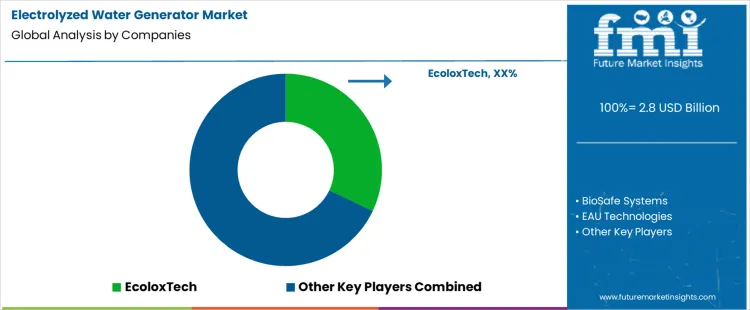
Electrolyzed water generator demand supports sanitation programs across food and healthcare facilities. Agriculture and industrial sites specify on site production to control chemical logistics risk. EcoloxTech BioSafe Systems EAU Technologies Kirkmayer Industries De Nora compete at specification. Buyers define output capacity concentration targets footprint constraints service intervals monitoring requirements. Once approved equipment references enter procurement lists and validation files remain fixed. EcoloxTech focuses on packaged generators for controlled institutional deployments with training support. BioSafe Systems aligns units with food safety protocols and service programs standard. EAU Technologies targets municipal and process water disinfection workflows requiring audit trails. Kirkmayer Industries supplies ruggedized systems for industrial washdown and equipment rooms environments. De Nora leverages electrochemistry heritage and electrode manufacturing control for reliability targets.
Competitive position follows uptime records service coverage documentation depth operator training capacity. Procurement teams review oxidation strength stability materials compliance and maintenance schedules records. Stocking strategies matter where sites require rapid cartridge replacement and electrode servicing. EcoloxTech uses standardized platforms and service kits to simplify operator training cycles. BioSafe Systems supports customers through installation protocols and compliance documentation packages review. EAU Technologies competes where municipal procurement favors audit readiness and reporting discipline. Kirkmayer Industries holds positions in plants needing rugged housings and simple controls. De Nora benefits from electrode lifecycle control and performance testing archives access. Price pressure stays limited by site qualification steps and retraining costs cycles. Market shares vary by sector oversight intensity and local inspection practices rules.
Key Players in the Electrolyzed Water Generator Market
- EcoloxTech
- BioSafe Systems
- EAU Technologies
- Kirkmayer Industries
- De Nora
Scope of the Report
| Items | Values |
|---|---|
| Quantitative Units (2026) | USD billion |
| Product Type | On-site electrolyzed water generators, Portable electrolyzed water generators, Industrial and large-scale generators, Modular or plug-and-play units |
| Application | Food and beverage sanitation, Healthcare and hospitals, Hospitality and janitorial services, Agriculture and horticulture |
| Region | Asia Pacific, Europe, North America, Latin America, Middle East & Africa |
| Countries Covered | China, Japan, South Korea, India, Australia & New Zealand, ASEAN, Germany, United Kingdom, France, Italy, Spain, Nordic, BENELUX, United States, Canada, Mexico, Brazil, Chile, Saudi Arabia, Turkey, South Africa, and other regional markets |
| Key Companies Profiled | EcoloxTech, BioSafe Systems, EAU Technologies, Kirkmayer Industries, De Nora |
| Additional Attributes | Dollar by sales by product type and application; demand driven by sanitation protocols and chemical handling reduction; growth led by food processing, healthcare, and public facilities; purchasing shaped by certification, uptime, service coverage, electrode life, audit requirements, and multi-site standardization rather than unit price. |
Electrolyzed Water Generator Market Segmentation
Product Type:
- On-site electrolyzed water generators
- Portable electrolyzed water generators
- Industrial and large-scale generators
- Modular or plug-and-play units
Application:
- Food & beverage sanitation
- Healthcare and hospitals
- Hospitality and janitorial services
- Agriculture and horticulture
Region:
- Asia Pacific
- China
- Japan
- South Korea
- India
- Australia & New Zealand
- ASEAN
- Rest of Asia Pacific
- Europe
- Germany
- United Kingdom
- France
- Italy
- Spain
- Nordic
- BENELUX
- Rest of Europe
- North America
- United States
- Canada
- Mexico
- Latin America
- Brazil
- Chile
- Rest of Latin America
- Middle East & Africa
- Kingdom of Saudi Arabia
- Other GCC Countries
- Turkey
- South Africa
- Other African Union
- Rest of Middle East & Africa
Bibliography
- Codex Alimentarius Commission. (2023). General principles of food hygiene (CXC 1-1969, Rev. 2023). FAO & World Health Organization.
- U.S. Food and Drug Administration. (2024). Food code. U.S. Department of Health and Human Services.
- International Organization for Standardization. (2023). Washer-disinfectors—Requirements and tests (ISO 15883 series). ISO.
- International Organization for Standardization. (2024). Food safety management systems—Requirements for any organization in the food chain (ISO 22000). ISO.
Frequently Asked Questions
How big is the electrolyzed water generator market in 2026?
The global electrolyzed water generator market is estimated to be valued at USD 2.8 billion in 2026.
What will be the size of electrolyzed water generator market in 2036?
The market size for the electrolyzed water generator market is projected to reach USD 9.7 billion by 2036.
How much will be the electrolyzed water generator market growth between 2026 and 2036?
The electrolyzed water generator market is expected to grow at a 13.2% CAGR between 2026 and 2036.
What are the key product types in the electrolyzed water generator market?
The key product types in electrolyzed water generator market are on‑site electrolyzed water generators , portable electrolyzed water generators, industrial and large‑scale generators and modular or plug‑and‑play units.
Which application segment to contribute significant share in the electrolyzed water generator market in 2026?
In terms of application, food & beverage sanitation segment to command 40.0% share in the electrolyzed water generator market in 2026.
Preview the report firsthand - request a free sample
Get SampleGet the brochure for pricing and purchase details.
Get PDFTable of Content
- Executive Summary
- Global Market Outlook
- Demand-side Trends
- Supply-side Trends
- Technology Roadmap Analysis
- Analysis and Recommendations
- Market Overview
- Market Coverage / Taxonomy
- Market Definition / Scope / Limitations
- Market Background
- Market Dynamics
- Drivers
- Restraints
- Opportunity
- Trends
- Scenario Forecast
- Demand in Optimistic Scenario
- Demand in Likely Scenario
- Demand in Conservative Scenario
- Opportunity Map Analysis
- Product Life Cycle Analysis
- Supply Chain Analysis
- Investment Feasibility Matrix
- Value Chain Analysis
- PESTLE and Porter’s Analysis
- Regulatory Landscape
- Regional Parent Market Outlook
- Production and Consumption Statistics
- Import and Export Statistics
- Market Dynamics
- Global Market Analysis 2021 to 2025 and Forecast, 2026 to 2036
- Historical Market Size Value (USD Million) Analysis, 2021 to 2025
- Current and Future Market Size Value (USD Million) Projections, 2026 to 2036
- Y-o-Y Growth Trend Analysis
- Absolute $ Opportunity Analysis
- Global Market Pricing Analysis 2021 to 2025 and Forecast 2026 to 2036
- Global Market Analysis 2021 to 2025 and Forecast 2026 to 2036, By Product Type
- Introduction / Key Findings
- Historical Market Size Value (USD Million) Analysis By Product Type , 2021 to 2025
- Current and Future Market Size Value (USD Million) Analysis and Forecast By Product Type , 2026 to 2036
- On‑site electrolyzed water generators
- Portable electrolyzed water generators
- Industrial and large‑scale generators
- Modular or plug‑and‑play units
- On‑site electrolyzed water generators
- Y-o-Y Growth Trend Analysis By Product Type , 2021 to 2025
- Absolute $ Opportunity Analysis By Product Type , 2026 to 2036
- Global Market Analysis 2021 to 2025 and Forecast 2026 to 2036, By Application
- Introduction / Key Findings
- Historical Market Size Value (USD Million) Analysis By Application, 2021 to 2025
- Current and Future Market Size Value (USD Million) Analysis and Forecast By Application, 2026 to 2036
- Food & beverage sanitation
- Healthcare and hospitals
- Hospitality and janitorial services
- Agriculture and horticulture
- Food & beverage sanitation
- Y-o-Y Growth Trend Analysis By Application, 2021 to 2025
- Absolute $ Opportunity Analysis By Application, 2026 to 2036
- Global Market Analysis 2021 to 2025 and Forecast 2026 to 2036, By Region
- Introduction
- Historical Market Size Value (USD Million) Analysis By Region, 2021 to 2025
- Current Market Size Value (USD Million) Analysis and Forecast By Region, 2026 to 2036
- North America
- Latin America
- Western Europe
- Eastern Europe
- East Asia
- South Asia and Pacific
- Middle East & Africa
- Market Attractiveness Analysis By Region
- North America Market Analysis 2021 to 2025 and Forecast 2026 to 2036, By Country
- Historical Market Size Value (USD Million) Trend Analysis By Market Taxonomy, 2021 to 2025
- Market Size Value (USD Million) Forecast By Market Taxonomy, 2026 to 2036
- By Country
- USA
- Canada
- Mexico
- By Product Type
- By Application
- By Country
- Market Attractiveness Analysis
- By Country
- By Product Type
- By Application
- Key Takeaways
- Latin America Market Analysis 2021 to 2025 and Forecast 2026 to 2036, By Country
- Historical Market Size Value (USD Million) Trend Analysis By Market Taxonomy, 2021 to 2025
- Market Size Value (USD Million) Forecast By Market Taxonomy, 2026 to 2036
- By Country
- Brazil
- Chile
- Rest of Latin America
- By Product Type
- By Application
- By Country
- Market Attractiveness Analysis
- By Country
- By Product Type
- By Application
- Key Takeaways
- Western Europe Market Analysis 2021 to 2025 and Forecast 2026 to 2036, By Country
- Historical Market Size Value (USD Million) Trend Analysis By Market Taxonomy, 2021 to 2025
- Market Size Value (USD Million) Forecast By Market Taxonomy, 2026 to 2036
- By Country
- Germany
- UK
- Italy
- Spain
- France
- Nordic
- BENELUX
- Rest of Western Europe
- By Product Type
- By Application
- By Country
- Market Attractiveness Analysis
- By Country
- By Product Type
- By Application
- Key Takeaways
- Eastern Europe Market Analysis 2021 to 2025 and Forecast 2026 to 2036, By Country
- Historical Market Size Value (USD Million) Trend Analysis By Market Taxonomy, 2021 to 2025
- Market Size Value (USD Million) Forecast By Market Taxonomy, 2026 to 2036
- By Country
- Russia
- Poland
- Hungary
- Balkan & Baltic
- Rest of Eastern Europe
- By Product Type
- By Application
- By Country
- Market Attractiveness Analysis
- By Country
- By Product Type
- By Application
- Key Takeaways
- East Asia Market Analysis 2021 to 2025 and Forecast 2026 to 2036, By Country
- Historical Market Size Value (USD Million) Trend Analysis By Market Taxonomy, 2021 to 2025
- Market Size Value (USD Million) Forecast By Market Taxonomy, 2026 to 2036
- By Country
- China
- Japan
- South Korea
- By Product Type
- By Application
- By Country
- Market Attractiveness Analysis
- By Country
- By Product Type
- By Application
- Key Takeaways
- South Asia and Pacific Market Analysis 2021 to 2025 and Forecast 2026 to 2036, By Country
- Historical Market Size Value (USD Million) Trend Analysis By Market Taxonomy, 2021 to 2025
- Market Size Value (USD Million) Forecast By Market Taxonomy, 2026 to 2036
- By Country
- India
- ASEAN
- Australia & New Zealand
- Rest of South Asia and Pacific
- By Product Type
- By Application
- By Country
- Market Attractiveness Analysis
- By Country
- By Product Type
- By Application
- Key Takeaways
- Middle East & Africa Market Analysis 2021 to 2025 and Forecast 2026 to 2036, By Country
- Historical Market Size Value (USD Million) Trend Analysis By Market Taxonomy, 2021 to 2025
- Market Size Value (USD Million) Forecast By Market Taxonomy, 2026 to 2036
- By Country
- Kingdom of Saudi Arabia
- Other GCC Countries
- Turkiye
- South Africa
- Other African Union
- Rest of Middle East & Africa
- By Product Type
- By Application
- By Country
- Market Attractiveness Analysis
- By Country
- By Product Type
- By Application
- Key Takeaways
- Key Countries Market Analysis
- USA
- Pricing Analysis
- Market Share Analysis, 2025
- By Product Type
- By Application
- Canada
- Pricing Analysis
- Market Share Analysis, 2025
- By Product Type
- By Application
- Mexico
- Pricing Analysis
- Market Share Analysis, 2025
- By Product Type
- By Application
- Brazil
- Pricing Analysis
- Market Share Analysis, 2025
- By Product Type
- By Application
- Chile
- Pricing Analysis
- Market Share Analysis, 2025
- By Product Type
- By Application
- Germany
- Pricing Analysis
- Market Share Analysis, 2025
- By Product Type
- By Application
- UK
- Pricing Analysis
- Market Share Analysis, 2025
- By Product Type
- By Application
- Italy
- Pricing Analysis
- Market Share Analysis, 2025
- By Product Type
- By Application
- Spain
- Pricing Analysis
- Market Share Analysis, 2025
- By Product Type
- By Application
- France
- Pricing Analysis
- Market Share Analysis, 2025
- By Product Type
- By Application
- India
- Pricing Analysis
- Market Share Analysis, 2025
- By Product Type
- By Application
- ASEAN
- Pricing Analysis
- Market Share Analysis, 2025
- By Product Type
- By Application
- Australia & New Zealand
- Pricing Analysis
- Market Share Analysis, 2025
- By Product Type
- By Application
- China
- Pricing Analysis
- Market Share Analysis, 2025
- By Product Type
- By Application
- Japan
- Pricing Analysis
- Market Share Analysis, 2025
- By Product Type
- By Application
- South Korea
- Pricing Analysis
- Market Share Analysis, 2025
- By Product Type
- By Application
- Russia
- Pricing Analysis
- Market Share Analysis, 2025
- By Product Type
- By Application
- Poland
- Pricing Analysis
- Market Share Analysis, 2025
- By Product Type
- By Application
- Hungary
- Pricing Analysis
- Market Share Analysis, 2025
- By Product Type
- By Application
- Kingdom of Saudi Arabia
- Pricing Analysis
- Market Share Analysis, 2025
- By Product Type
- By Application
- Turkiye
- Pricing Analysis
- Market Share Analysis, 2025
- By Product Type
- By Application
- South Africa
- Pricing Analysis
- Market Share Analysis, 2025
- By Product Type
- By Application
- USA
- Market Structure Analysis
- Competition Dashboard
- Competition Benchmarking
- Market Share Analysis of Top Players
- By Regional
- By Product Type
- By Application
- Competition Analysis
- Competition Deep Dive
- EcoloxTech
- Overview
- Product Portfolio
- Profitability by Market Segments (Product/Age /Sales Channel/Region)
- Sales Footprint
- Strategy Overview
- Marketing Strategy
- Product Strategy
- Channel Strategy
- BioSafe Systems
- EAU Technologies
- Kirkmayer Industries
- De Nora
- EcoloxTech
- Competition Deep Dive
- Assumptions & Acronyms Used
- Research Methodology


