

- Industry Size (2026)
- USD 1323.8 Mn
- Forecast (2036)
- USD 2348.5 Mn
- CAGR (2026 to 2036)
- 5.9%
Waterjet Intensifier Pump Market Forecast and Outlook 2026 to 2036
The waterjet intensifier pump market is likely to be valued at USD 1,323.8 million in 2026 and is forecasted to reach USD 2,348.5 million by 2036 at a CAGR of 5.9%. Value formation reflects capital allocation toward ultra-high-pressure generation systems that enable non-thermal cutting across metals, composites, stone, and advanced materials. Intensifier pumps function as the pressure core of waterjet systems, making demand structurally tied to cutting accuracy requirements, material thickness capability, and pressure stability rather than to machine count alone. Specification decisions prioritize sustained pressure output, seal life under cyclic loading, and compatibility with abrasive delivery systems. Investment is concentrated where cold cutting is mandatory to avoid metallurgical change, dimensional distortion, or secondary finishing, anchoring expenditure to process necessity rather than discretionary fabrication upgrades.
Expansion through the forecast period is governed by utilization economics, maintenance intensity, and energy efficiency constraints. High capital cost and hydraulic energy losses limit adoption to operations with predictable duty cycles and high machine loading. Seal wear, check valve fatigue, and hydraulic component servicing shape total cost of ownership and influence replacement timing. Integration with CNC controls and automation platforms raises switching costs, reinforcing installed base persistence. Regional growth reflects concentration of export-oriented fabrication, aerospace supply chains, and advanced manufacturing clusters where material diversity justifies intensifier complexity. Procurement emphasis remains on uptime predictability, service access, and rebuild cycles, supporting steady growth driven by production intensity and equipment lifecycle renewal rather than broad diffusion into low-volume cutting environments.
Quick Stats for Waterjet Intensifier Pump Market
- Waterjet Intensifier Pump Market Value (2026): USD 1,323.8 million
- Waterjet Intensifier Pump Market Forecast Value (2036): USD 2,348.5 million
- Waterjet Intensifier Pump Market Forecast CAGR 2026 to 2036: 5.9%
- Leading Pressure Class by Demand Share: 60,000 to 90,000 psi
- Fastest-Growing Countries: China, India, Mexico, South Korea, USA
- Top Players in Global Demand: KMT Waterjet, Flow International, Jet Edge, Techni Waterjet, WARDJet, OMAX, Hammelmann, Accustream, Resato, BFT GmbH
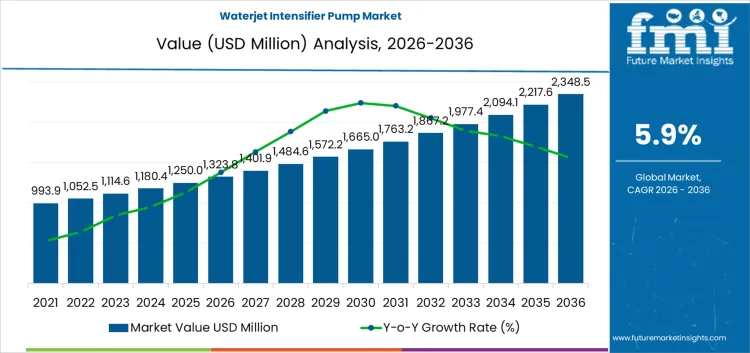
Waterjet Intensifier Pump Market Key Takeaways
| Metric | Value |
|---|---|
| Market Value (2026) | USD 1,323.8 million |
| Market Forecast Value (2036) | USD 2,348.5 million |
| Forecast CAGR 2026 to 2036 | 5.9% |
Why is the Demand for Waterjet Intensifier Pump Growing?
Demand for waterjet intensifier pumps is increasing as industrial precision cutting applications expand across automotive, aerospace, and specialty fabrication sectors that require non-thermal material removal. Manufacturers of thick and hard materials such as high-strength alloys, composites, and ceramics specify high-pressure intensifier pumps because they generate consistent output pressures typically above 60,000 psi, which is essential for clean, burr-free cutting without heat-affected zones. Fabricators engaged in intricate parts production for turbine components, armor plating, and architectural stone benefit from stable pressure delivery that improves dimensional accuracy and reduces secondary finishing. Engineers also prioritize intensifier pump designs that deliver low pulsation and consistent flow rate to support repeatable cutting performance across long operating cycles.
Procurement teams evaluate unit reliability, ease of maintenance, and integration with CNC cutting systems to ensure uptime on production floors where throughput and machine availability affect competitiveness. Growth in customized fabrication and demand for complex geometries reinforces uptake of waterjet systems equipped with advanced intensifier pumps because these units balance high pressure generation with manageable operating costs. Adoption of abrasive waterjet cutting in sectors like aerospace and industrial equipment manufacturing spurs investment in pumps that withstand cyclic stress with durable seals and optimized intensifier hydraulics. Service technicians require accessible components and predictable maintenance intervals to minimize extended downtime. These factors are increasing demand for waterjet intensifier pumps that deliver performance and reliability in technically demanding cutting environments.
How Are the Segments Classified in the Waterjet Intensifier Pump Market?
Demand for waterjet intensifier pumps is shaped by precision cutting requirements, material versatility, and operational reliability across industrial machining environments. Adoption aligns with need for cold cutting processes that avoid thermal distortion and material degradation. System selection prioritizes pressure stability, duty cycle endurance, and maintenance predictability. Expansion of advanced manufacturing workflows increases reliance on high-pressure waterjet systems. Segment classification reflects differentiation by pressure capability, end-use industry, and pump configuration. Structure highlights how cutting intensity, application complexity, and drive architecture influence specification priorities, utilization patterns, and equipment deployment across industrial waterjet operations.
Which Pressure Class Represents the Largest Share of Demand?
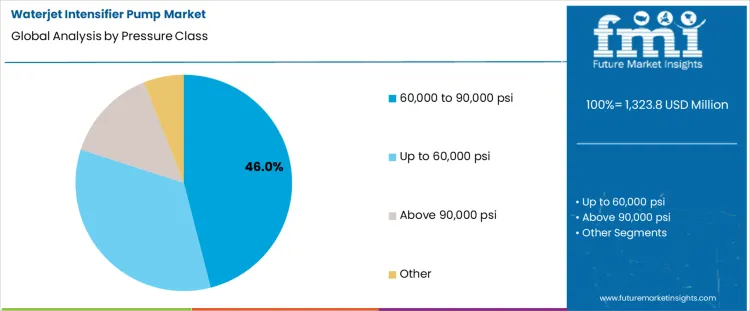
60,000 to 90,000 psi systems hold 46.0%, representing the largest share among pressure classes due to balanced cutting capability and equipment longevity. This pressure range supports efficient cutting of metals, composites, and stone with controlled wear rates. Operational stability suits continuous production environments requiring consistent cut quality. Energy consumption remains manageable compared with ultra-high-pressure systems. Lower pressure systems address softer materials with reduced cutting speed. Above 90,000 psi systems enable extreme precision with higher maintenance intensity. Pressure class segmentation reflects preference for versatile performance balancing throughput, reliability, and operating cost control.
Key Points
- Mid-range pressure supports broad material cutting requirements.
- Balanced operation reduces wear and maintenance frequency.
- Other pressure classes address softer materials or extreme precision needs.
Which End Use Industry Accounts for the Highest Share of Demand?
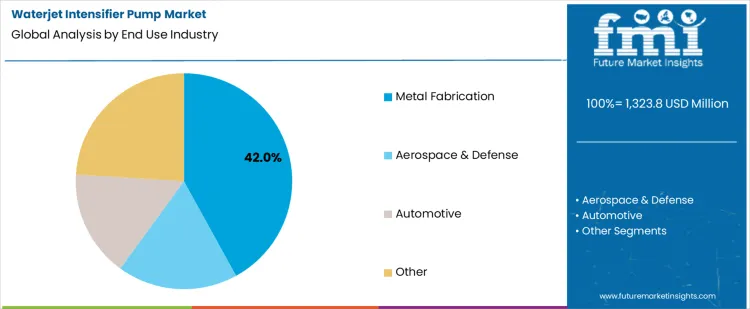
Metal fabrication holds 42.0%, representing the largest share among end-use industries due to widespread adoption of waterjet cutting. Fabricators use waterjets for steel, aluminum, and alloy processing without heat-affected zones. Flexibility supports prototyping and low-volume production with minimal tooling change. Precision edge quality reduces secondary finishing requirements. Aerospace and defense applications emphasize composite and exotic material cutting. Automotive applications support prototype and specialty component fabrication. End-use segmentation reflects concentration of waterjet pump deployment where material diversity and precision cutting drive sustained equipment utilization.
Key Points
- Metal fabrication relies on cold cutting for diverse materials.
- Precision edges reduce secondary processing steps.
- Other industries apply waterjets for specialized material needs.
Which Pump Configuration Drives the Largest Share of Demand?
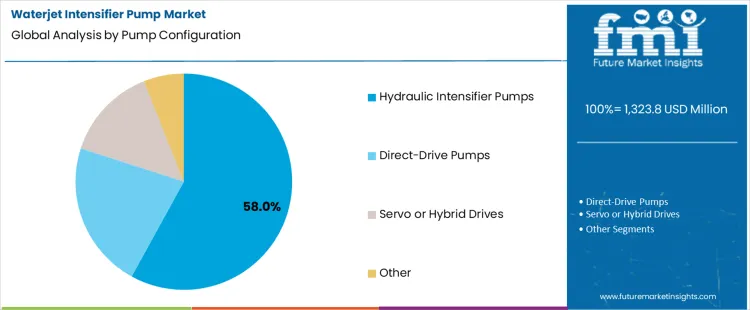
Hydraulic intensifier pumps hold 58.0%, representing the largest share among pump configurations due to pressure consistency and durability. Intensifier designs generate stable ultra-high pressure suitable for continuous industrial operation. Separation of hydraulic and water circuits enhances component life and serviceability. Proven architecture supports predictable maintenance cycles and uptime planning. Direct-drive pumps offer compact design with lower pressure capability. Servo and hybrid drives improve efficiency with higher system complexity. Pump configuration segmentation reflects preference for robust, field-proven solutions delivering sustained high-pressure performance across demanding waterjet cutting applications.
Key Points
- Intensifier pumps provide stable and sustained high pressure.
- Proven design supports durability and service predictability.
- Other configurations address compactness or efficiency priorities.
What are the Key Dynamics in the Waterjet Intensifier Pump Market?
Demand for waterjet intensifier pumps reflects requirement for ultra-high-pressure water generation in precision cold-cutting applications. Adoption concentrates within metal fabrication, aerospace components, stone processing, automotive parts, and defense manufacturing. Global scope aligns with need for material versatility, edge quality control, and thermal distortion avoidance. Usage centers on hydraulic intensifier pumps capable of sustained pressures above 60,000 psi supporting abrasive and pure waterjet cutting systems.
How do cutting precision and material versatility requirements shape adoption?
Manufacturers adopt waterjet intensifier pumps where heat-affected zones, microcracking, or metallurgical alteration cannot be tolerated. Demand increases in aerospace and automotive applications requiring tight tolerances across titanium, aluminum, composites, and hardened steels. Intensifier pumps deliver consistent pressure profiles essential for repeatable kerf width and cut accuracy. Ability to cut stacked materials and complex geometries supports flexible production scheduling. Stone and glass processors rely on stable pressure output to prevent edge chipping and surface defects. Compatibility with abrasive delivery systems expands applicability across thick and high-hardness materials. Adoption reflects operational dependence on precision cutting rather than throughput maximization alone.
How do energy intensity, maintenance burden, and capital cost influence market scalability?
Waterjet intensifier pumps involve high capital investment due to hydraulic systems, precision seals, and pressure containment requirements. Demand sensitivity rises where fabrication shops operate under tight equipment utilization thresholds. Energy consumption remains significant due to hydraulic inefficiency compared with direct drive alternatives. Seal wear and check valve fatigue increase maintenance frequency under continuous high-pressure cycling. Downtime risk affects production planning in high-mix environments. Skilled service requirements elevate operating cost in regions with limited technical support. Noise and vibration management adds installation complexity. Capital justification depends on sustained utilization, constraining adoption among low-volume cutting operations.
How Is Demand for Waterjet Intensifier Pumps Evolving Globally?
Demand for waterjet intensifier pumps is expanding globally due to precision manufacturing requirements, material versatility, and cold-cutting advantages across industrial applications. Adoption aligns with need for high-pressure, contamination-free cutting in metals, composites, stone, and advanced materials. Capital equipment upgrades and automation integration support replacement and incremental capacity addition. Growth rates in China at 6.8%, India at 6.2%, Mexico at 5.7%, South Korea at 5.2%, and USA at 4.3% indicate sustained expansion driven by manufacturing intensity, export-oriented production, and lifecycle equipment renewal.
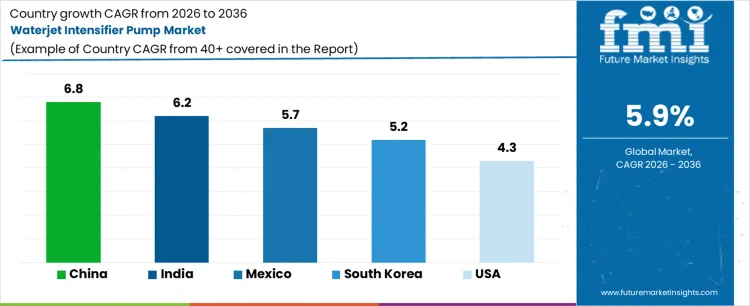
| Country | CAGR (%) |
|---|---|
| China | 6.8% |
| India | 6.2% |
| Mexico | 5.7% |
| South Korea | 5.2% |
| USA | 4.3% |
What Is Driving Strong Growth of Waterjet Intensifier Pump Demand in China?
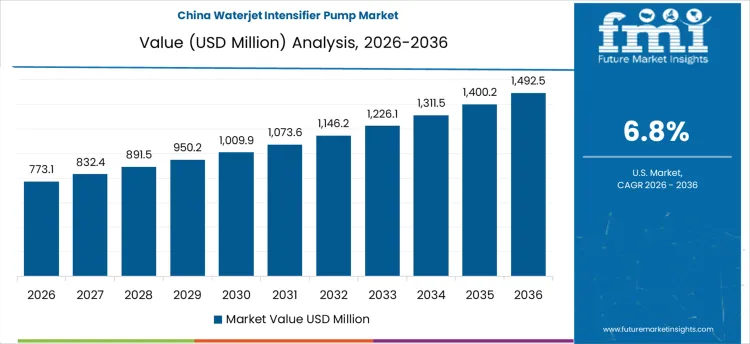
Waterjet intensifier pump demand in China is growing at a CAGR of 6.8%, supported by large-scale manufacturing and diversification into high-precision fabrication. Aerospace components, automotive parts, and electronics enclosures require burr-free cutting without thermal distortion. Contract manufacturers expand waterjet capacity to serve export orders across varied materials. Automation integration increases demand for reliable, high-duty-cycle intensifier pumps. Domestic equipment suppliers improve pressure ratings and maintenance intervals. Demand growth reflects production scale, export competitiveness, and process flexibility rather than niche prototyping use.
- High-volume precision manufacturing requirements
- Multi-material cutting without thermal impact
- Automation integration in fabrication workshops
- Strong domestic equipment supply capability
Why Is India Experiencing Accelerated Adoption of Waterjet Intensifier Pumps?
India is expanding at a CAGR of 6.2%, driven by growth in fabrication services and infrastructure-linked manufacturing. Metal processing workshops adopt waterjet systems for stainless steel, stone, and composite cutting. Rising demand from rail, construction equipment, and architectural fabrication supports capacity additions. Cost sensitivity favors intensifier pumps with lower operating downtime. Skill availability and localized service networks support adoption beyond Tier-1 cities. Growth reflects manufacturing diversification and job-shop expansion rather than concentration in single end-use sectors.
- Expansion of fabrication and job-shop operations
- Infrastructure and construction-linked material cutting
- Demand for low thermal distortion processes
- Local service and operator skill availability
How Is Mexico Shaping Demand for Waterjet Intensifier Pumps?
Waterjet intensifier pump demand in Mexico is growing at a CAGR of 5.7%, influenced by export-oriented manufacturing for automotive, aerospace, and industrial assemblies. Tier-1 and Tier-2 suppliers adopt waterjet cutting to meet tight dimensional tolerances. Proximity to North American OEMs supports investment in flexible cutting technologies. Intensifier pumps enable rapid material changeover within contract manufacturing environments. Stable production programs sustain predictable equipment utilization. Demand growth reflects export supply chain requirements rather than domestic fabrication growth alone.
- Export-driven automotive and aerospace manufacturing
- Tight tolerance requirements from OEM supply chains
- Flexible cutting across metals and composites
- Predictable utilization from long-term contracts
What Factors Are Supporting Waterjet Intensifier Pump Demand in South Korea?
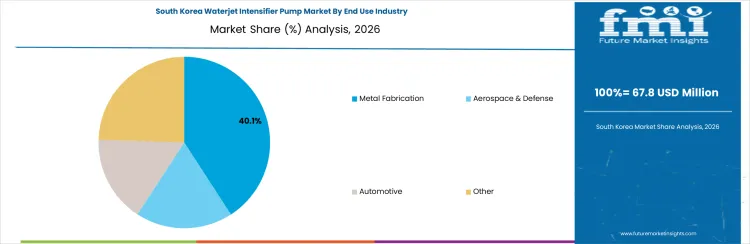
South Korea is expanding at a CAGR of 5.2%, shaped by advanced manufacturing and materials engineering. Shipbuilding, electronics, and industrial equipment sectors use waterjet cutting for thick and sensitive materials. Precision requirements favor stable pressure output and repeatable performance. Automation and smart factory initiatives integrate smart pumps into digitally controlled cutting systems. High maintenance discipline supports lifecycle replacement of installed equipment. Growth reflects process optimization and technology upgrading within mature industrial sectors.
- Advanced materials processing requirements
- Integration with automated cutting systems
- Demand for stable high-pressure performance
- Lifecycle replacement within mature industries
Why Is the USA Showing Moderate Growth in Waterjet Intensifier Pump Demand?
Waterjet intensifier pump demand in the USA is growing at a CAGR of 4.3%, supported by replacement demand and niche precision applications. Aerospace, defense, and specialty fabrication value cold-cutting for heat-sensitive alloys. Installed base maturity limits rapid capacity expansion. Users prioritize efficiency improvements, pressure stability, and reduced maintenance downtime. Contract manufacturers retain waterjet systems for complex, low-volume components. Growth remains measured, reflecting equipment renewal and process optimization rather than broad manufacturing expansion.
- Replacement of aging installed equipment
- Aerospace and defense precision cutting needs
- Focus on efficiency and maintenance reduction
- Stable demand from specialty fabrication segments
What is the competitive landscape of demand for the waterjet intensifier pump market globally?
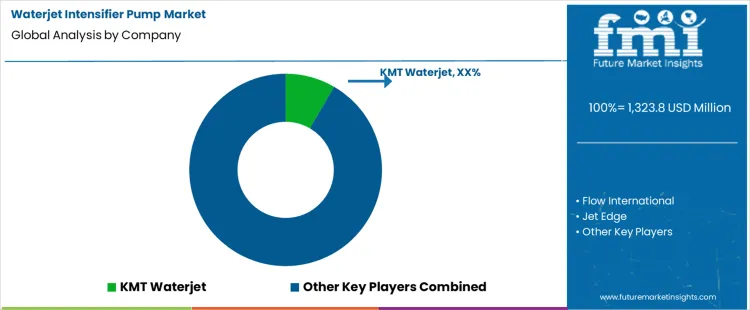
Demand for waterjet intensifier pumps is driven by precision cutting, surface preparation, and industrial fabrication across aerospace, automotive, stone, metalworking, and energy sectors. These pumps generate high-pressure flows that enable cutting without heat-affected zones, supporting complex geometries and diverse material thicknesses. Buyers evaluate pump pressure capacity, reliability under continuous operation, energy efficiency, maintenance intervals, and integration with CNC control systems. Procurement teams prioritize suppliers with proven performance records, global service networks, aftermarket support, and consistency in delivering high-pressure platforms. Trend in the global market reflects adoption of advanced machining technologies, growth of custom fabrication services, and emphasis on lean manufacturing with minimal material waste.
KMT Waterjet holds leading positioning through high-pressure intensifier pump systems and integrated waterjet platforms widely adopted by industrial OEMs and job shops worldwide. Flow International supports demand with advanced waterjet assemblies and intensifier pumps designed for durability, energy efficiency, and precision control. Jet Edge contributes high-pressure pump technologies and modular systems tailored for heavy cutting and industrial waterjet applications. Several companies participate with pump and cutting system solutions suited for specialized material processing and precision fabrication. WARDJet supplies intensifier pumps and complete waterjet systems with emphasis on reliability and ease of maintenance. Competitive differentiation depends on pump pressure stability, serviceability, spare parts availability, integration flexibility, and ability to meet diverse application demands across sectors.
Key Players in the Waterjet Intensifier Pump Market
- KMT Waterjet
- Flow International
- Jet Edge
- Techni Waterjet
- WARDJet
- OMAX
- Hammelmann
- Accustream
- Resato
- BFT GmbH
Scope of the Report
| Items | Values |
|---|---|
| Quantitative Units | USD million |
| Pressure Class | 60,000 to 90,000 psi; Up to 60,000 psi; Above 90,000 psi; Other |
| End Use Industry | Metal Fabrication; Aerospace & Defense; Automotive; Other |
| Pump Configuration | Hydraulic Intensifier Pumps; Direct-Drive Pumps; Servo or Hybrid Drives; Other |
| Sales Channel | OEM Waterjet Systems; Aftermarket Upgrades; Service & Spares; Other |
| Regions Covered | Asia Pacific, Europe, North America, Latin America, Middle East & Africa |
| Countries Covered | China, India, Mexico, South Korea, USA, and 40+ countries |
| Key Companies Profiled | KMT Waterjet; Flow International; Jet Edge; Techni Waterjet; WARDJet; OMAX; Hammelmann; Accustream; Resato; BFT GmbH |
| Additional Attributes | Dollar sales by pressure class and pump configuration; adoption trends for ultra-high-pressure intensifier systems enabling faster cutting speeds and thicker material capability; pressure stability, seal life, and energy efficiency performance metrics; duty cycle durability, maintenance intervals, and uptime considerations; compatibility with abrasive delivery systems and multi-head installations; aftermarket upgrade demand for pressure intensification and drive retrofits; service revenue contribution from seals, valves, and intensifier rebuilds; compliance with industrial safety standards and OEM validation requirements influencing waterjet intensifier pump specification. |
Waterjet Intensifier Pump Market by Segment
Pressure Class:
- 60,000 to 90,000 psi
- Up to 60,000 psi
- Above 90,000 psi
- Other
End Use Industry:
- Metal Fabrication
- Aerospace & Defense
- Automotive
- Other
Pump Configuration:
- Hydraulic Intensifier Pumps
- Direct-Drive Pumps
- Servo or Hybrid Drives
- Other
Sales Channel:
- OEM Waterjet Systems
- Aftermarket Upgrades
- Service & Spares
- Other
Region:
- Asia Pacific
- China
- Japan
- South Korea
- India
- Australia & New Zealand
- ASEAN
- Rest of Asia Pacific
- Europe
- Germany
- United Kingdom
- France
- Italy
- Spain
- Nordic
- BENELUX
- Rest of Europe
- North America
- United States
- Canada
- Mexico
- Latin America
- Brazil
- Chile
- Rest of Latin America
- Middle East & Africa
- Kingdom of Saudi Arabia
- Other GCC Countries
- Turkey
- South Africa
- Other African Union
- Rest of Middle East & Africa
Bibliography
- International Organization for Standardization. (2023). ISO 30042: Waterjet cutting machines - Safety requirements, pressure systems, and operational performance criteria for ultra-high-pressure equipment. International Organization for Standardization.
- International Organization for Standardization. (2023). ISO 4406: Hydraulic fluid power - Fluids - Method for coding the level of contamination by solid particles, applied to intensifier pump hydraulic circuits. International Organization for Standardization.
- International Electrotechnical Commission. (2023). IEC 60204-1: Safety of machinery - Electrical equipment of machines, applied to CNC-integrated waterjet cutting and pump systems. International Electrotechnical Commission.
- European Commission. (2024). Machinery Regulation (EU) 2023/1230 - Requirements for high-pressure industrial machinery, hydraulic systems, and operator safety, applicable from 2024 onward. Official Journal of the European Union.
- United States Department of Labor. (2023). Occupational Safety and Health Standards for ultra-high-pressure waterjet cutting and surface preparation operations. Occupational Safety and Health Administration.
- International Energy Agency. (2023). Energy efficiency considerations in high-pressure industrial hydraulic systems used in advanced manufacturing. International Energy Agency.
Frequently Asked Questions
How big is the waterjet intensifier pump market in 2026?
The global waterjet intensifier pump market is estimated to be valued at USD 1,323.8 million in 2026.
What will be the size of waterjet intensifier pump market in 2036?
The market size for the waterjet intensifier pump market is projected to reach USD 2,348.5 million by 2036.
How much will be the waterjet intensifier pump market growth between 2026 and 2036?
The waterjet intensifier pump market is expected to grow at a 5.9% CAGR between 2026 and 2036.
What are the key product types in the waterjet intensifier pump market?
The key product types in waterjet intensifier pump market are 60,000 to 90,000 psi, up to 60,000 psi, above 90,000 psi and other.
Which end use industry segment to contribute significant share in the waterjet intensifier pump market in 2026?
In terms of end use industry, metal fabrication segment to command 42.0% share in the waterjet intensifier pump market in 2026.
Preview the report firsthand - request a free sample
Get SampleGet the brochure for pricing and purchase details.
Get PDFTable of Content
- Executive Summary
- Global Market Outlook
- Demand-side Trends
- Supply-side Trends
- Technology Roadmap Analysis
- Analysis and Recommendations
- Market Overview
- Market Coverage / Taxonomy
- Market Definition / Scope / Limitations
- Market Background
- Market Dynamics
- Drivers
- Restraints
- Opportunity
- Trends
- Scenario Forecast
- Demand in Optimistic Scenario
- Demand in Likely Scenario
- Demand in Conservative Scenario
- Opportunity Map Analysis
- Product Life Cycle Analysis
- Supply Chain Analysis
- Investment Feasibility Matrix
- Value Chain Analysis
- PESTLE and Porter’s Analysis
- Regulatory Landscape
- Regional Parent Market Outlook
- Production and Consumption Statistics
- Import and Export Statistics
- Market Dynamics
- Global Market Analysis 2021 to 2025 and Forecast, 2026 to 2036
- Historical Market Size Value (USD Million) Analysis, 2021 to 2025
- Current and Future Market Size Value (USD Million) Projections, 2026 to 2036
- Y-o-Y Growth Trend Analysis
- Absolute $ Opportunity Analysis
- Global Market Pricing Analysis 2021 to 2025 and Forecast 2026 to 2036
- Global Market Analysis 2021 to 2025 and Forecast 2026 to 2036, By Pressure Class
- Introduction / Key Findings
- Historical Market Size Value (USD Million) Analysis By Pressure Class , 2021 to 2025
- Current and Future Market Size Value (USD Million) Analysis and Forecast By Pressure Class , 2026 to 2036
- 60,000 to 90,000 psi
- Up to 60,000 psi
- Above 90,000 psi
- Other
- 60,000 to 90,000 psi
- Y-o-Y Growth Trend Analysis By Pressure Class , 2021 to 2025
- Absolute $ Opportunity Analysis By Pressure Class , 2026 to 2036
- Global Market Analysis 2021 to 2025 and Forecast 2026 to 2036, By End Use Industry
- Introduction / Key Findings
- Historical Market Size Value (USD Million) Analysis By End Use Industry, 2021 to 2025
- Current and Future Market Size Value (USD Million) Analysis and Forecast By End Use Industry, 2026 to 2036
- Metal Fabrication
- Aerospace & Defense
- Automotive
- Other
- Metal Fabrication
- Y-o-Y Growth Trend Analysis By End Use Industry, 2021 to 2025
- Absolute $ Opportunity Analysis By End Use Industry, 2026 to 2036
- Global Market Analysis 2021 to 2025 and Forecast 2026 to 2036, By Pump Configuration
- Introduction / Key Findings
- Historical Market Size Value (USD Million) Analysis By Pump Configuration, 2021 to 2025
- Current and Future Market Size Value (USD Million) Analysis and Forecast By Pump Configuration, 2026 to 2036
- Hydraulic Intensifier Pumps
- Direct-Drive Pumps
- Servo or Hybrid Drives
- Other
- Hydraulic Intensifier Pumps
- Y-o-Y Growth Trend Analysis By Pump Configuration, 2021 to 2025
- Absolute $ Opportunity Analysis By Pump Configuration, 2026 to 2036
- Global Market Analysis 2021 to 2025 and Forecast 2026 to 2036, By Sales Channel
- Introduction / Key Findings
- Historical Market Size Value (USD Million) Analysis By Sales Channel, 2021 to 2025
- Current and Future Market Size Value (USD Million) Analysis and Forecast By Sales Channel, 2026 to 2036
- OEM Waterjet Systems
- Aftermarket Upgrades
- Service & Spares
- Other
- OEM Waterjet Systems
- Y-o-Y Growth Trend Analysis By Sales Channel, 2021 to 2025
- Absolute $ Opportunity Analysis By Sales Channel, 2026 to 2036
- Global Market Analysis 2021 to 2025 and Forecast 2026 to 2036, By Region
- Introduction
- Historical Market Size Value (USD Million) Analysis By Region, 2021 to 2025
- Current Market Size Value (USD Million) Analysis and Forecast By Region, 2026 to 2036
- North America
- Latin America
- Western Europe
- Eastern Europe
- East Asia
- South Asia and Pacific
- Middle East & Africa
- Market Attractiveness Analysis By Region
- North America Market Analysis 2021 to 2025 and Forecast 2026 to 2036, By Country
- Historical Market Size Value (USD Million) Trend Analysis By Market Taxonomy, 2021 to 2025
- Market Size Value (USD Million) Forecast By Market Taxonomy, 2026 to 2036
- By Country
- USA
- Canada
- Mexico
- By Pressure Class
- By End Use Industry
- By Pump Configuration
- By Sales Channel
- By Country
- Market Attractiveness Analysis
- By Country
- By Pressure Class
- By End Use Industry
- By Pump Configuration
- By Sales Channel
- Key Takeaways
- Latin America Market Analysis 2021 to 2025 and Forecast 2026 to 2036, By Country
- Historical Market Size Value (USD Million) Trend Analysis By Market Taxonomy, 2021 to 2025
- Market Size Value (USD Million) Forecast By Market Taxonomy, 2026 to 2036
- By Country
- Brazil
- Chile
- Rest of Latin America
- By Pressure Class
- By End Use Industry
- By Pump Configuration
- By Sales Channel
- By Country
- Market Attractiveness Analysis
- By Country
- By Pressure Class
- By End Use Industry
- By Pump Configuration
- By Sales Channel
- Key Takeaways
- Western Europe Market Analysis 2021 to 2025 and Forecast 2026 to 2036, By Country
- Historical Market Size Value (USD Million) Trend Analysis By Market Taxonomy, 2021 to 2025
- Market Size Value (USD Million) Forecast By Market Taxonomy, 2026 to 2036
- By Country
- Germany
- UK
- Italy
- Spain
- France
- Nordic
- BENELUX
- Rest of Western Europe
- By Pressure Class
- By End Use Industry
- By Pump Configuration
- By Sales Channel
- By Country
- Market Attractiveness Analysis
- By Country
- By Pressure Class
- By End Use Industry
- By Pump Configuration
- By Sales Channel
- Key Takeaways
- Eastern Europe Market Analysis 2021 to 2025 and Forecast 2026 to 2036, By Country
- Historical Market Size Value (USD Million) Trend Analysis By Market Taxonomy, 2021 to 2025
- Market Size Value (USD Million) Forecast By Market Taxonomy, 2026 to 2036
- By Country
- Russia
- Poland
- Hungary
- Balkan & Baltic
- Rest of Eastern Europe
- By Pressure Class
- By End Use Industry
- By Pump Configuration
- By Sales Channel
- By Country
- Market Attractiveness Analysis
- By Country
- By Pressure Class
- By End Use Industry
- By Pump Configuration
- By Sales Channel
- Key Takeaways
- East Asia Market Analysis 2021 to 2025 and Forecast 2026 to 2036, By Country
- Historical Market Size Value (USD Million) Trend Analysis By Market Taxonomy, 2021 to 2025
- Market Size Value (USD Million) Forecast By Market Taxonomy, 2026 to 2036
- By Country
- China
- Japan
- South Korea
- By Pressure Class
- By End Use Industry
- By Pump Configuration
- By Sales Channel
- By Country
- Market Attractiveness Analysis
- By Country
- By Pressure Class
- By End Use Industry
- By Pump Configuration
- By Sales Channel
- Key Takeaways
- South Asia and Pacific Market Analysis 2021 to 2025 and Forecast 2026 to 2036, By Country
- Historical Market Size Value (USD Million) Trend Analysis By Market Taxonomy, 2021 to 2025
- Market Size Value (USD Million) Forecast By Market Taxonomy, 2026 to 2036
- By Country
- India
- ASEAN
- Australia & New Zealand
- Rest of South Asia and Pacific
- By Pressure Class
- By End Use Industry
- By Pump Configuration
- By Sales Channel
- By Country
- Market Attractiveness Analysis
- By Country
- By Pressure Class
- By End Use Industry
- By Pump Configuration
- By Sales Channel
- Key Takeaways
- Middle East & Africa Market Analysis 2021 to 2025 and Forecast 2026 to 2036, By Country
- Historical Market Size Value (USD Million) Trend Analysis By Market Taxonomy, 2021 to 2025
- Market Size Value (USD Million) Forecast By Market Taxonomy, 2026 to 2036
- By Country
- Kingdom of Saudi Arabia
- Other GCC Countries
- Turkiye
- South Africa
- Other African Union
- Rest of Middle East & Africa
- By Pressure Class
- By End Use Industry
- By Pump Configuration
- By Sales Channel
- By Country
- Market Attractiveness Analysis
- By Country
- By Pressure Class
- By End Use Industry
- By Pump Configuration
- By Sales Channel
- Key Takeaways
- Key Countries Market Analysis
- USA
- Pricing Analysis
- Market Share Analysis, 2025
- By Pressure Class
- By End Use Industry
- By Pump Configuration
- By Sales Channel
- Canada
- Pricing Analysis
- Market Share Analysis, 2025
- By Pressure Class
- By End Use Industry
- By Pump Configuration
- By Sales Channel
- Mexico
- Pricing Analysis
- Market Share Analysis, 2025
- By Pressure Class
- By End Use Industry
- By Pump Configuration
- By Sales Channel
- Brazil
- Pricing Analysis
- Market Share Analysis, 2025
- By Pressure Class
- By End Use Industry
- By Pump Configuration
- By Sales Channel
- Chile
- Pricing Analysis
- Market Share Analysis, 2025
- By Pressure Class
- By End Use Industry
- By Pump Configuration
- By Sales Channel
- Germany
- Pricing Analysis
- Market Share Analysis, 2025
- By Pressure Class
- By End Use Industry
- By Pump Configuration
- By Sales Channel
- UK
- Pricing Analysis
- Market Share Analysis, 2025
- By Pressure Class
- By End Use Industry
- By Pump Configuration
- By Sales Channel
- Italy
- Pricing Analysis
- Market Share Analysis, 2025
- By Pressure Class
- By End Use Industry
- By Pump Configuration
- By Sales Channel
- Spain
- Pricing Analysis
- Market Share Analysis, 2025
- By Pressure Class
- By End Use Industry
- By Pump Configuration
- By Sales Channel
- France
- Pricing Analysis
- Market Share Analysis, 2025
- By Pressure Class
- By End Use Industry
- By Pump Configuration
- By Sales Channel
- India
- Pricing Analysis
- Market Share Analysis, 2025
- By Pressure Class
- By End Use Industry
- By Pump Configuration
- By Sales Channel
- ASEAN
- Pricing Analysis
- Market Share Analysis, 2025
- By Pressure Class
- By End Use Industry
- By Pump Configuration
- By Sales Channel
- Australia & New Zealand
- Pricing Analysis
- Market Share Analysis, 2025
- By Pressure Class
- By End Use Industry
- By Pump Configuration
- By Sales Channel
- China
- Pricing Analysis
- Market Share Analysis, 2025
- By Pressure Class
- By End Use Industry
- By Pump Configuration
- By Sales Channel
- Japan
- Pricing Analysis
- Market Share Analysis, 2025
- By Pressure Class
- By End Use Industry
- By Pump Configuration
- By Sales Channel
- South Korea
- Pricing Analysis
- Market Share Analysis, 2025
- By Pressure Class
- By End Use Industry
- By Pump Configuration
- By Sales Channel
- Russia
- Pricing Analysis
- Market Share Analysis, 2025
- By Pressure Class
- By End Use Industry
- By Pump Configuration
- By Sales Channel
- Poland
- Pricing Analysis
- Market Share Analysis, 2025
- By Pressure Class
- By End Use Industry
- By Pump Configuration
- By Sales Channel
- Hungary
- Pricing Analysis
- Market Share Analysis, 2025
- By Pressure Class
- By End Use Industry
- By Pump Configuration
- By Sales Channel
- Kingdom of Saudi Arabia
- Pricing Analysis
- Market Share Analysis, 2025
- By Pressure Class
- By End Use Industry
- By Pump Configuration
- By Sales Channel
- Turkiye
- Pricing Analysis
- Market Share Analysis, 2025
- By Pressure Class
- By End Use Industry
- By Pump Configuration
- By Sales Channel
- South Africa
- Pricing Analysis
- Market Share Analysis, 2025
- By Pressure Class
- By End Use Industry
- By Pump Configuration
- By Sales Channel
- USA
- Market Structure Analysis
- Competition Dashboard
- Competition Benchmarking
- Market Share Analysis of Top Players
- By Regional
- By Pressure Class
- By End Use Industry
- By Pump Configuration
- By Sales Channel
- Competition Analysis
- Competition Deep Dive
- KMT Waterjet
- Overview
- Product Portfolio
- Profitability by Market Segments (Product/Age /Sales Channel/Region)
- Sales Footprint
- Strategy Overview
- Marketing Strategy
- Product Strategy
- Channel Strategy
- Flow International
- Jet Edge
- Techni Waterjet
- WARDJet
- OMAX
- Hammelmann
- Accustream
- Resato
- BFT GmbH
- KMT Waterjet
- Competition Deep Dive
- Assumptions & Acronyms Used
- Research Methodology


