

- Industry Size (2026)
- USD 582.8 Mn
- Forecast (2036)
- USD 1246.6 Mn
- CAGR (2026 to 2036)
- 7.9%
Cold-Wash Laundry Enzyme Stabilizers Market Forecast and Outlook 2026 to 2036
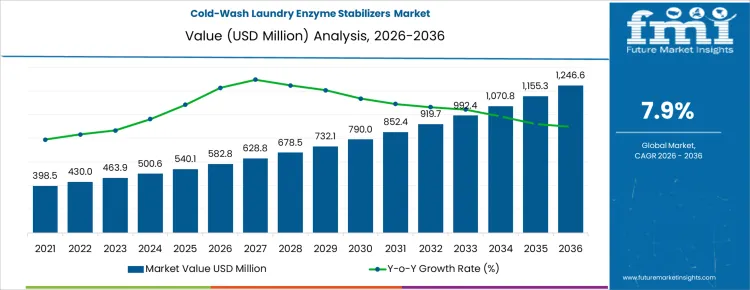
The cold-wash laundry enzyme stabilizers market is expected to grow from USD 582.8 million in 2026 to USD 1,246.6 million by 2036, reflecting a compound annual growth rate (CAGR) of 7.9%. These stabilizers are used in laundry detergents to maintain the efficacy of enzymes at lower temperatures, which allows for energy savings and better preservation of fabrics. As consumers increasingly prefer energy-efficient laundry solutions, cold-wash detergent formulas, supported by enzyme stabilizers, are gaining traction. The market is driven by the growing demand for sustainable cleaning solutions and the need for washing products that perform effectively in cooler water temperatures, which reduce electricity usage and minimize environmental impact.
The market’s growth is further supported by the increasing awareness of eco-friendly laundry products, along with rising consumer preference for fabric care that retains the longevity and quality of clothing. The ongoing shift toward more sustainable and energy-efficient laundry solutions is expected to drive the demand for cold-wash laundry enzyme stabilizers. Additionally, innovations in enzyme stabilization technologies are expected to improve the performance of these stabilizers, expanding their application across both residential and industrial laundry sectors.
Quick Stats of the Cold-Wash Laundry Enzyme Stabilizers Market
- Cold-Wash Laundry Enzyme Stabilizers Market Value (2026): USD 582.8 million
- Cold-Wash Laundry Enzyme Stabilizers Market Forecast Value (2036): USD 1,246.6 million
- Cold-Wash Laundry Enzyme Stabilizers Market Global Forecast CAGR (2026 to 2036): 7.9%
- Cold-Wash Laundry Enzyme Stabilizers Market Leading Segment: Detergent Format (Liquids) 44%
- Key Growth Regions in Cold-Wash Laundry Enzyme Stabilizers Market: China
- Top Players in Cold-Wash Laundry Enzyme Stabilizers Market: BASF, Nouryon, Clariant, Dow, Solvay, Evonik, Novonesis, IFF, Kao Corporation, Stepan
What is the Growth Forecast for the Cold-Wash Laundry Enzyme Stabilizers Market through 2036?
The rolling CAGR analysis for the cold-wash laundry enzyme stabilizers market shows consistent growth, with moderate acceleration throughout the forecast period. Starting at USD 582.8 million in 2026, the market grows to USD 628.7 million in 2027 and USD 678.9 million in 2028, reflecting steady adoption as the demand for cold-water laundry detergents continues to rise. These early years indicate gradual growth driven by increasing awareness of the benefits of energy-efficient laundry solutions.
From 2028 to 2030, the market continues to expand, reaching USD 732.6 million in 2029 and USD 790.2 million in 2030. This period shows a slight acceleration as more consumers and commercial laundry services adopt cold-water washing technologies, fueled by both environmental concerns and energy-saving incentives. Between 2030 and 2035, the market experiences stronger growth, reaching USD 852.1 million in 2031, USD 918.7 million in 2032, and USD 990.3 million in 2033, driven by technological improvements in enzyme stabilization and growing demand for fabric care. By 2035, the market is projected to reach USD 1,067.2 million, with the final market value of USD 1,246.6 million expected in 2036. The rolling CAGR analysis highlights steady growth, reflecting increased adoption and innovation in the market, with a particular emphasis on sustainability and energy efficiency.
Cold-Wash Laundry Enzyme Stabilizers Market Key Takeaways
| Metric | Value |
|---|---|
| Industry Sales Value (2026) | USD 582.8 million |
| Industry Forecast Value (2036) | USD 1,246.6 million |
| Industry Forecast CAGR (2026 to 2036) | 7.9% |
What Is Driving the Demand for the Cold-Wash Laundry Enzyme Stabilizers Market Globally?
The global demand for cold wash laundry enzyme stabilizers is being driven by growing consumer and industry focus on energy efficiency, fabric care performance, and sustainability in laundry products. Laundry enzymes - including proteases, amylases, lipases, and cellulases - help break down protein, starch, oil, and soil deposits on fabrics at lower temperatures. Washing at cold or cool settings significantly reduces energy consumption compared with hot cycles, aligning with environmental goals and cost saving priorities for households and commercial laundries alike.
However, enzyme performance can be compromised by instability during storage or exposure to variable pH, surfactants, and formulation components. Stabilizers are added to protect enzymatic activity during processing, shelf life, and use, enabling formulations to deliver reliable cleaning efficiency in cold water conditions. As appliance manufacturers improve cold wash performance and consumers increasingly select cold cycles to reduce energy bills and carbon footprint, formulators are incentivised to invest in robust enzyme stabilization systems that maintain high cleaning efficacy while extending enzyme viability.
Future demand for cold wash laundry enzyme stabilizers is expected to grow as formulation innovation and sustainability priorities continue to shape detergent markets. Advances in stabilizer technologies - such as polymeric carriers, protective encapsulation, and synergistic co ingredients - will enhance enzyme resilience against temperature fluctuation, hard water ions, and interaction with other detergent components. As regulatory frameworks in regions across Europe, Asia Pacific, Latin America, and the Middle East promote energy saving standards and eco labelling for cleaning products, brands will increasingly adopt enzyme focused solutions to meet performance benchmarks and certification criteria.
Growth in concentrated and unit dose laundry formats will also support demand for stabilizers that ensure enzyme activity throughout longer shelf life and varied consumer use patterns. Consumer interest in gentle, fabric friendly cleaning that reduces colour fading, fibre damage, and residue build up further reinforces the role of stabilized enzymes in premium laundry formulations. Expansion of e commerce and broader access to differentiated laundry products will accelerate awareness and adoption of cold wash enzyme systems that deliver both sustainability and performance benefits. As energy costs and environmental concerns persist as global priorities, demand for stabilizers that enable effective cold wash enzymatic cleaning is expected to expand steadily across markets.
What are the Leading Segments in the Global Cold-Wash Laundry Enzyme Stabilizers Market?
The global cold-wash laundry enzyme stabilizers market is segmented by target enzyme and detergent format. Among the target enzymes, protease holds the largest share, followed by amylase, lipase, and cellulase/other enzymes. Protease is particularly effective in breaking down protein-based stains, making it essential in cold-water laundry formulations. In terms of detergent format, liquids dominate the market, followed by pods/capsules, powders, and concentrates. The growth of the market is driven by the increasing consumer demand for energy-efficient, cold-water laundry solutions, and the growing focus on environmentally friendly and effective stain removal products that preserve fabric quality.
What Drives the Growth of Protease in the Cold-Wash Laundry Enzyme Stabilizers Market?
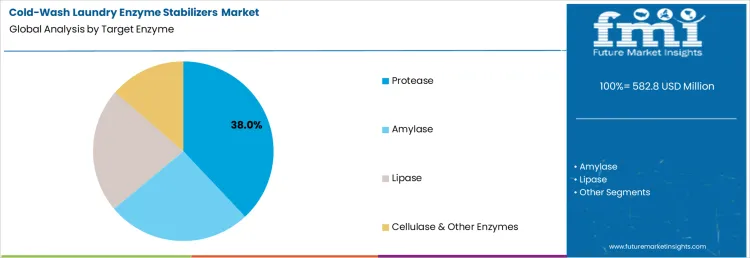
Protease is the leading target enzyme in the cold-wash laundry enzyme stabilizers market, accounting for the largest share due to its high efficacy in breaking down protein-based stains, such as food, blood, and sweat. Proteases work effectively in cold water, making them ideal for energy-efficient laundry solutions that reduce the need for hot water, thereby saving energy and lowering household utility costs. The increased consumer demand for environmentally friendly laundry products further boosts the growth of protease-based stabilizers, as they allow consumers to achieve superior cleaning performance without relying on harsh chemicals or high-temperature washing.
Additionally, proteases are widely used in a variety of detergent formats, including liquid detergents, where they provide targeted stain removal and help preserve fabric integrity. As the trend toward sustainable laundry products continues to rise, protease-based enzyme stabilizers are expected to remain a dominant force, as they contribute to both effective stain removal and environmental benefits. With advancements in enzyme formulations that improve stability and effectiveness in cold washes, protease is expected to continue driving market growth, particularly as more consumers seek convenient and energy-efficient laundry solutions.
What is Driving the Demand for Liquids in the Cold-Wash Laundry Enzyme Stabilizers Market?
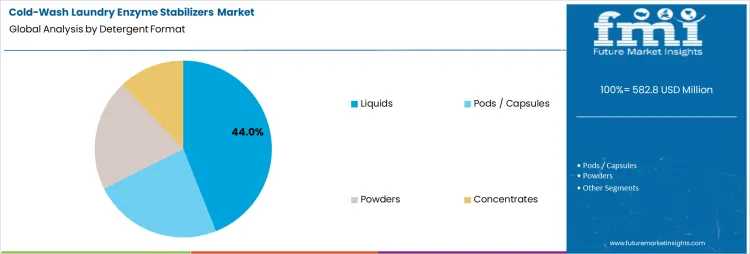
Liquids are the leading detergent format in the cold-wash laundry enzyme stabilizers market, driven by their ease of use, fast-dissolving properties, and effectiveness in various laundry applications. Liquid detergents, which contain enzyme stabilizers, are popular because they offer superior performance in cold washes, ensuring that stains are effectively removed without the need for hot water. The convenience of liquid detergents, combined with their ability to provide targeted and uniform application, makes them a preferred choice among consumers.
Additionally, liquid detergents are highly effective at delivering a stable release of enzymes, which is crucial for maintaining cleaning performance, particularly in cold-water settings. With the growing trend of cold-water washing, which offers energy savings and a reduced environmental footprint, liquid detergents containing enzyme stabilizers have become an essential part of sustainable laundry routines. The demand for liquids is also fueled by their compatibility with modern washing machines, which often use low-temperature settings, making them ideal for everyday laundry needs. As consumers continue to prioritize both performance and sustainability, liquid detergents with cold-wash enzyme stabilizers are expected to maintain their dominant position in the market.
What are the Key Dynamics of the Global Cold-Wash Laundry Enzyme Stabilizers Market?
The global cold-wash laundry enzyme stabilizers market is growing as detergent manufacturers focus on products that deliver strong cleaning performance at low temperatures. Stabilizers protect enzymes that break down stains during cold cycles, extending their activity and supporting effective soil removal without high energy use. Demand rises with consumer interest in energy saving laundry practices, fabric care and sustainability. Adoption spans household laundry detergents and commercial cleaning formulations where enzymes must remain active in varied water conditions. Growth reflects investment in formulation technology and rising laundry machine penetration worldwide.
What are the Key Drivers for the Global Cold-Wash Laundry Enzyme Stabilizers Market?
Increasing emphasis on energy efficiency and lower carbon footprints drives interest in washing at cooler temperatures. Laundry detergents formulated for cold water cycles require enzyme stabilizers that maintain catalytic activity despite reduced heat. Consumers and professional launderers are adopting cold wash to preserve fabric quality and reduce utility cost. Advances in biotechnology and stabilizer chemistry enable robust protection of proteases, amylases and lipases in dynamic wash conditions. Growth of concentrated and liquid detergent formats also supports use of stabilizers that prevent enzyme degradation during storage and use. Environmental awareness and regulations encouraging energy reduction in household appliances further motivate brands to invest in cold-wash performance enhancers.
What are the Restraints for the Global Cold-Wash Laundry Enzyme Stabilizers Market?
One restraint is the technical challenge of formulating stabilizers that perform consistently across diverse water hardness levels and wash conditions. Stabilizer effectiveness can vary with pH, mineral content and detergent base, requiring extensive testing and optimisation that increases development cost. Some manufacturers may prefer traditional hot water enzyme systems in regions where cold wash adoption is slower. Pricing pressures in value oriented markets may limit use of advanced stabilizers if cost increases cannot be passed to end users. Regulatory scrutiny on novel enzyme stabilizer ingredients varies by market and may require additional safety data and compliance work. Supply chain complexity for specialty biobased and synthetic stabilizers can also affect availability and formulation lead times.
What is the Key Trends in the Global Cold-Wash Laundry Enzyme Stabilizers Market?
A key trend is development of next generation stabilizers derived from bio based and engineered polymer systems that extend enzyme shelf life and activity in cold washes. Formulators are combining stabilizers with controlled release and encapsulation technologies to protect enzymes until they interact with stains. Integration of cold-wash enzyme systems with digital formulation tools accelerates design of detergents that balance cleaning, fabric care and environmental impact. Collaboration between ingredient suppliers and consumer product companies supports tailored stabilizer systems for specific laundry formats, including pods and concentrates. Interest in transparent sustainability claims and eco certifications influences product positioning and consumer acceptance of cold-wash enzyme enhanced detergents.
What is the Country-Wise Analysis of the Cold-Wash Laundry Enzyme Stabilizers Market?
The cold-wash laundry enzyme stabilizers market is expected to grow steadily, driven by increasing demand for energy-efficient and eco-friendly laundry solutions. These stabilizers enhance the effectiveness of enzymes in laundry detergents, allowing for cleaner clothes at lower temperatures, thus reducing energy consumption and environmental impact. With growing consumer awareness of sustainability, there is increasing demand for products that reduce water and energy use in the laundry process. High-growth markets like China are seeing significant demand due to expanding industrial sectors and a rising middle class. Developed markets such as the USA, UK, and Germany are experiencing steady growth, supported by strong regulatory frameworks and consumer demand for sustainable and efficient cleaning products.
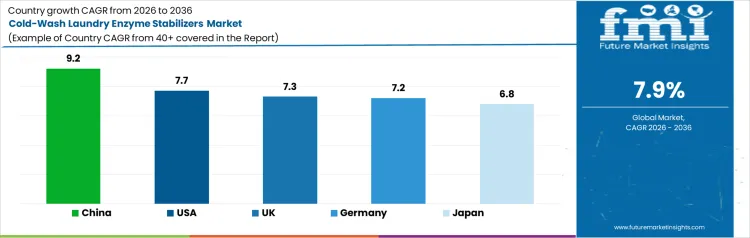
| Country | CAGR (2026 to 2036) |
|---|---|
| China | 9.2% |
| United States | 7.7% |
| United Kingdom | 7.3% |
| Germany | 7.2% |
| Japan | 6.8% |
What is the Growth Outlook for the Cold-Wash Laundry Enzyme Stabilizers Market in China?
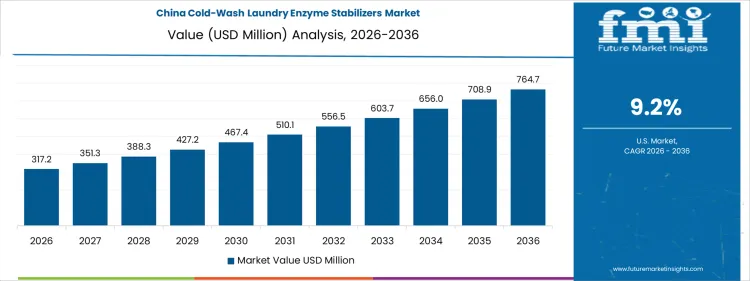
The cold-wash laundry enzyme stabilizers market in China is expected to grow at the highest rate, with a projected CAGR of 9.2%. China’s rapidly expanding consumer goods market, particularly in personal care and household products, is driving the demand for more energy-efficient and sustainable laundry solutions. As Chinese consumers become more aware of environmental issues and energy conservation, the adoption of cold-wash laundry solutions, including enzyme stabilizers, is increasing. Additionally, China’s large manufacturing base and increasing middle-class population contribute to the rising demand for laundry products that reduce energy consumption while maintaining effectiveness. As the market for sustainable household products grows, China is poised to lead the global demand for cold-wash laundry enzyme stabilizers.
What is the Market Outlook for the Cold-Wash Laundry Enzyme Stabilizers Market in the United States?
The cold-wash laundry enzyme stabilizers market in the United States is projected to grow at a moderate pace, with a projected CAGR of 7.7%. The U.S. market is driven by the increasing consumer demand for energy-efficient and environmentally friendly laundry products. With rising energy costs and growing awareness of sustainability, more consumers are opting for cold-water laundry solutions that help reduce energy consumption without compromising cleaning performance. The increasing adoption of eco-friendly products in the household care segment further supports market growth. As consumers in the U.S. continue to prioritize sustainability and cost-effectiveness, the demand for cold-wash laundry enzyme stabilizers is expected to rise steadily.
What is the Growth Forecast for the Cold-Wash Laundry Enzyme Stabilizers Market in the United Kingdom?
The cold-wash laundry enzyme stabilizers market in the United Kingdom is expected to grow steadily, with a projected CAGR of 7.3%. The UK’s consumer market is increasingly prioritizing sustainability, with a growing demand for laundry products that are energy-efficient and environmentally responsible. As the government and consumers push for greener alternatives in everyday products, the demand for cold-wash laundry solutions, including enzyme stabilizers, is rising. The UK’s commitment to reducing carbon footprints and energy consumption is further driving the adoption of products that perform well in cold water. As sustainability trends continue, the UK market for cold-wash laundry enzyme stabilizers is expected to grow steadily over the coming years.
What is the Market Outlook for the Cold-Wash Laundry Enzyme Stabilizers Market in Germany?
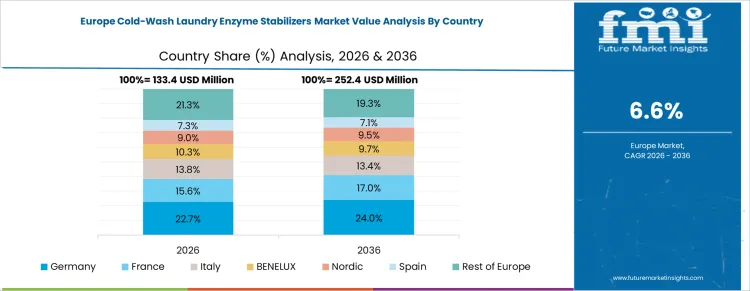
The cold-wash laundry enzyme stabilizers market in Germany is projected to grow at a steady pace, with a projected CAGR of 7.2%. Germany’s strong focus on sustainability and environmental protection is driving the demand for energy-efficient and eco-friendly laundry products. With growing consumer awareness of the environmental impact of laundry processes, including energy consumption and water usage, there is increasing interest in cold-wash laundry products. The German market is particularly focused on reducing resource consumption and adopting cleaner, more sustainable solutions. As the demand for high-performance, eco-friendly household products continues to rise, Germany is expected to see steady growth in the adoption of cold-wash laundry enzyme stabilizers.
What are the Growth Prospects for the Cold-Wash Laundry Enzyme Stabilizers Market in Japan?
The cold-wash laundry enzyme stabilizers market in Japan is expected to grow at a moderate pace, with a projected CAGR of 6.8%. Japan’s well-established consumer goods market, particularly in the home care sector, is witnessing growing demand for products that offer energy savings and environmental benefits. Japanese consumers are increasingly seeking laundry solutions that reduce energy consumption while maintaining effectiveness. Cold-wash solutions, powered by enzyme stabilizers, are becoming more popular as consumers prioritize energy-efficient products. As Japan continues to focus on sustainability and eco-friendly innovations, the market for cold-wash laundry enzyme stabilizers is expected to grow steadily, albeit at a slower pace compared to other regions.
What is the Competitive Landscape for the Cold-Wash Laundry Enzyme Stabilizers Market?
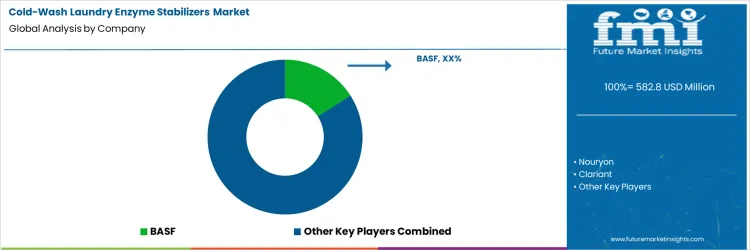
The cold-wash laundry enzyme stabilizers market is expanding as consumer demand grows for energy-efficient, eco-friendly laundry solutions. BASF leads the market with its innovative enzyme stabilizers, designed to enhance the stability and effectiveness of enzymes in cold-water laundry detergents. Their focus on improving detergent performance while ensuring sustainability positions them as a key player in the market. Nouryon, Clariant, and Dow are strong competitors, each offering advanced stabilizer formulations that boost the performance of enzymes, ensuring better stain removal at lower wash temperatures. Nouryon and Clariant focus on sustainable, high-performance ingredients for the laundry industry, while Dow offers versatile solutions that enhance enzyme efficacy across various detergent types.
Solvay, Evonik, Novonesis, IFF, Kao Corporation, and Stepan further contribute to the competitive landscape by providing specialized enzyme stabilizers designed for cold-wash applications. Solvay offers eco-friendly stabilizers that improve enzyme stability and performance, while Evonik focuses on solutions that enhance wash quality and product longevity. Novonesis and IFF bring innovative stabilizer technologies to the market, while Kao Corporation and Stepan provide stabilizers that ensure optimal enzyme activity in cold-water washing. These companies compete by offering high-performance, sustainable solutions that meet the growing demand for energy-efficient laundry products. Their strategies focus on improving enzyme stability, reducing environmental impact, and enhancing cleaning efficiency in cold-water laundry formulations.
Key Players of the Cold-Wash Laundry Enzyme Stabilizers Market
- BASF
- Nouryon
- Clariant
- Dow
- Solvay
- Evonik
- Novonesis
- IFF
- Kao Corporation
- Stepan
Scope of the Report
| Items | Values |
|---|---|
| Quantitative Units (2026) | USD Million |
| Stabilizer Type | Polyols / Sugars & Humectants, Chelants / Sequestrants, Polymer / Protein Stabilizers, Salt Systems & Buffering Agents |
| Target Enzyme | Protease, Amylase, Lipase, Cellulase & Other Enzymes |
| Detergent Format | Liquids, Pods / Capsules, Powders, Concentrates |
| Performance Claim | Cold-Wash Efficacy, Color & Fabric Care, High-Efficiency / Low-Water, Bio-Based / Low-VOC Systems |
| Companies | BASF, Nouryon, Clariant, Dow, Solvay, Evonik, Novonesis, IFF, Kao Corporation, Stepan |
| Regions Covered | North America, Latin America, Western Europe, Eastern Europe, South Asia and Pacific, East Asia, Middle East & Africa |
| Countries Covered | United States, Canada, Mexico, Brazil, Argentina, Germany, France, United Kingdom, Italy, Spain, Netherlands, China, India, Japan, South Korea, ANZ, GCC Countries, South Africa |
| Additional Attributes | Dollar by sales by stabilizer type, target enzyme, detergent format, performance claim, and region. Includes market trends in cold-wash laundry enzyme stabilizers, focusing on polyols, chelants, polymer stabilizers, and salt systems. Highlights the role of protease, amylase, lipase, and cellulase in enhancing cold-wash efficacy, fabric care, and high-efficiency laundry solutions. Focus on bio-based, low-VOC systems, sustainability, regulatory compliance, market share, and competitive positioning of key companies in the laundry industry. |
Cold-Wash Laundry Enzyme Stabilizers Market Segmentation
By Stabilizer Type:
- Polyols / Sugars & Humectants
- Chelants / Sequestrants
- Polymer / Protein Stabilizers
- Salt Systems & Buffering Agents
By Target Enzyme:
- Protease
- Amylase
- Lipase
- Cellulase & Other Enzymes
By Detergent Format:
- Liquids
- Pods / Capsules
- Powders
- Concentrates
By Performance Claim:
- Cold-Wash Efficacy
- Color & Fabric Care
- High-Efficiency / Low-Water
- Bio-Based / Low-VOC Systems
By Region:
- Asia Pacific
- China
- Japan
- South Korea
- India
- Australia & New Zealand
- ASEAN
- Rest of Asia Pacific
- Europe
- Germany
- United Kingdom
- France
- Italy
- Spain
- Nordic
- BENELUX
- Rest of Europe
- North America
- United States
- Canada
- Mexico
- Latin America
- Brazil
- Chile
- Rest of Latin America
- Middle East & Africa
- Kingdom of Saudi Arabia
- Other GCC Countries
- Turkey
- South Africa
- Other African Union
- Rest of Middle East & Africa
Frequently Asked Questions
How big is the cold-wash laundry enzyme stabilizers market in 2026?
The global cold-wash laundry enzyme stabilizers market is estimated to be valued at USD 582.8 million in 2026.
What will be the size of cold-wash laundry enzyme stabilizers market in 2036?
The market size for the cold-wash laundry enzyme stabilizers market is projected to reach USD 1,246.6 million by 2036.
How much will be the cold-wash laundry enzyme stabilizers market growth between 2026 and 2036?
The cold-wash laundry enzyme stabilizers market is expected to grow at a 7.9% CAGR between 2026 and 2036.
What are the key stabilizer type in the cold-wash laundry enzyme stabilizers market?
The key stabilizer types in cold-wash laundry enzyme stabilizers market are chelants / sequestrants, polyols / sugars & humectants, polymer / protein stabilizers and salt systems & buffering agents.
Which target enzyme segment to contribute significant share in the cold-wash laundry enzyme stabilizers market in 2026?
In terms of target enzyme, protease segment to command 38.0% share in the cold-wash laundry enzyme stabilizers market in 2026.
Preview the report firsthand - request a free sample
Get SampleGet the brochure for pricing and purchase details.
Get PDFTable of Content
- Executive Summary
- Global Market Outlook
- Demand-side Trends
- Supply-side Trends
- Technology Roadmap Analysis
- Analysis and Recommendations
- Market Overview
- Market Coverage / Taxonomy
- Market Definition / Scope / Limitations
- Market Background
- Market Dynamics
- Drivers
- Restraints
- Opportunity
- Trends
- Scenario Forecast
- Demand in Optimistic Scenario
- Demand in Likely Scenario
- Demand in Conservative Scenario
- Opportunity Map Analysis
- Product Life Cycle Analysis
- Supply Chain Analysis
- Investment Feasibility Matrix
- Value Chain Analysis
- PESTLE and Porter’s Analysis
- Regulatory Landscape
- Regional Parent Market Outlook
- Production and Consumption Statistics
- Import and Export Statistics
- Market Dynamics
- Global Market Analysis 2021 to 2025 and Forecast, 2026 to 2036
- Historical Market Size Value (USD Million) Analysis, 2021 to 2025
- Current and Future Market Size Value (USD Million) Projections, 2026 to 2036
- Y-o-Y Growth Trend Analysis
- Absolute $ Opportunity Analysis
- Global Market Pricing Analysis 2021 to 2025 and Forecast 2026 to 2036
- Global Market Analysis 2021 to 2025 and Forecast 2026 to 2036, By Stabilizer Type
- Introduction / Key Findings
- Historical Market Size Value (USD Million) Analysis By Stabilizer Type , 2021 to 2025
- Current and Future Market Size Value (USD Million) Analysis and Forecast By Stabilizer Type , 2026 to 2036
- Chelants / Sequestrants
- Polyols / Sugars & Humectants
- Polymer / Protein Stabilizers
- Salt Systems & Buffering Agents
- Y-o-Y Growth Trend Analysis By Stabilizer Type , 2021 to 2025
- Absolute $ Opportunity Analysis By Stabilizer Type , 2026 to 2036
- Global Market Analysis 2021 to 2025 and Forecast 2026 to 2036, By Target Enzyme
- Introduction / Key Findings
- Historical Market Size Value (USD Million) Analysis By Target Enzyme, 2021 to 2025
- Current and Future Market Size Value (USD Million) Analysis and Forecast By Target Enzyme, 2026 to 2036
- Protease
- Amylase
- Lipase
- Cellulase & Other Enzymes
- Y-o-Y Growth Trend Analysis By Target Enzyme, 2021 to 2025
- Absolute $ Opportunity Analysis By Target Enzyme, 2026 to 2036
- Global Market Analysis 2021 to 2025 and Forecast 2026 to 2036, By Detergent Format
- Introduction / Key Findings
- Historical Market Size Value (USD Million) Analysis By Detergent Format, 2021 to 2025
- Current and Future Market Size Value (USD Million) Analysis and Forecast By Detergent Format, 2026 to 2036
- Liquids
- Pods / Capsules
- Powders
- Concentrates
- Y-o-Y Growth Trend Analysis By Detergent Format, 2021 to 2025
- Absolute $ Opportunity Analysis By Detergent Format, 2026 to 2036
- Global Market Analysis 2021 to 2025 and Forecast 2026 to 2036, By Performance Claim
- Introduction / Key Findings
- Historical Market Size Value (USD Million) Analysis By Performance Claim, 2021 to 2025
- Current and Future Market Size Value (USD Million) Analysis and Forecast By Performance Claim, 2026 to 2036
- Cold-Wash Efficacy
- Color & Fabric Care
- High-Efficiency / Low-Water
- Bio-Based / Low-VOC Systems
- Y-o-Y Growth Trend Analysis By Performance Claim, 2021 to 2025
- Absolute $ Opportunity Analysis By Performance Claim, 2026 to 2036
- Global Market Analysis 2021 to 2025 and Forecast 2026 to 2036, By Region
- Introduction
- Historical Market Size Value (USD Million) Analysis By Region, 2021 to 2025
- Current Market Size Value (USD Million) Analysis and Forecast By Region, 2026 to 2036
- North America
- Latin America
- Western Europe
- Eastern Europe
- East Asia
- South Asia and Pacific
- Middle East & Africa
- Market Attractiveness Analysis By Region
- North America Market Analysis 2021 to 2025 and Forecast 2026 to 2036, By Country
- Historical Market Size Value (USD Million) Trend Analysis By Market Taxonomy, 2021 to 2025
- Market Size Value (USD Million) Forecast By Market Taxonomy, 2026 to 2036
- By Country
- USA
- Canada
- Mexico
- By Stabilizer Type
- By Target Enzyme
- By Detergent Format
- By Performance Claim
- By Country
- Market Attractiveness Analysis
- By Country
- By Stabilizer Type
- By Target Enzyme
- By Detergent Format
- By Performance Claim
- Key Takeaways
- Latin America Market Analysis 2021 to 2025 and Forecast 2026 to 2036, By Country
- Historical Market Size Value (USD Million) Trend Analysis By Market Taxonomy, 2021 to 2025
- Market Size Value (USD Million) Forecast By Market Taxonomy, 2026 to 2036
- By Country
- Brazil
- Chile
- Rest of Latin America
- By Stabilizer Type
- By Target Enzyme
- By Detergent Format
- By Performance Claim
- By Country
- Market Attractiveness Analysis
- By Country
- By Stabilizer Type
- By Target Enzyme
- By Detergent Format
- By Performance Claim
- Key Takeaways
- Western Europe Market Analysis 2021 to 2025 and Forecast 2026 to 2036, By Country
- Historical Market Size Value (USD Million) Trend Analysis By Market Taxonomy, 2021 to 2025
- Market Size Value (USD Million) Forecast By Market Taxonomy, 2026 to 2036
- By Country
- Germany
- UK
- Italy
- Spain
- France
- Nordic
- BENELUX
- Rest of Western Europe
- By Stabilizer Type
- By Target Enzyme
- By Detergent Format
- By Performance Claim
- By Country
- Market Attractiveness Analysis
- By Country
- By Stabilizer Type
- By Target Enzyme
- By Detergent Format
- By Performance Claim
- Key Takeaways
- Eastern Europe Market Analysis 2021 to 2025 and Forecast 2026 to 2036, By Country
- Historical Market Size Value (USD Million) Trend Analysis By Market Taxonomy, 2021 to 2025
- Market Size Value (USD Million) Forecast By Market Taxonomy, 2026 to 2036
- By Country
- Russia
- Poland
- Hungary
- Balkan & Baltic
- Rest of Eastern Europe
- By Stabilizer Type
- By Target Enzyme
- By Detergent Format
- By Performance Claim
- By Country
- Market Attractiveness Analysis
- By Country
- By Stabilizer Type
- By Target Enzyme
- By Detergent Format
- By Performance Claim
- Key Takeaways
- East Asia Market Analysis 2021 to 2025 and Forecast 2026 to 2036, By Country
- Historical Market Size Value (USD Million) Trend Analysis By Market Taxonomy, 2021 to 2025
- Market Size Value (USD Million) Forecast By Market Taxonomy, 2026 to 2036
- By Country
- China
- Japan
- South Korea
- By Stabilizer Type
- By Target Enzyme
- By Detergent Format
- By Performance Claim
- By Country
- Market Attractiveness Analysis
- By Country
- By Stabilizer Type
- By Target Enzyme
- By Detergent Format
- By Performance Claim
- Key Takeaways
- South Asia and Pacific Market Analysis 2021 to 2025 and Forecast 2026 to 2036, By Country
- Historical Market Size Value (USD Million) Trend Analysis By Market Taxonomy, 2021 to 2025
- Market Size Value (USD Million) Forecast By Market Taxonomy, 2026 to 2036
- By Country
- India
- ASEAN
- Australia & New Zealand
- Rest of South Asia and Pacific
- By Stabilizer Type
- By Target Enzyme
- By Detergent Format
- By Performance Claim
- By Country
- Market Attractiveness Analysis
- By Country
- By Stabilizer Type
- By Target Enzyme
- By Detergent Format
- By Performance Claim
- Key Takeaways
- Middle East & Africa Market Analysis 2021 to 2025 and Forecast 2026 to 2036, By Country
- Historical Market Size Value (USD Million) Trend Analysis By Market Taxonomy, 2021 to 2025
- Market Size Value (USD Million) Forecast By Market Taxonomy, 2026 to 2036
- By Country
- Kingdom of Saudi Arabia
- Other GCC Countries
- Turkiye
- South Africa
- Other African Union
- Rest of Middle East & Africa
- By Stabilizer Type
- By Target Enzyme
- By Detergent Format
- By Performance Claim
- By Country
- Market Attractiveness Analysis
- By Country
- By Stabilizer Type
- By Target Enzyme
- By Detergent Format
- By Performance Claim
- Key Takeaways
- Key Countries Market Analysis
- USA
- Pricing Analysis
- Market Share Analysis, 2025
- By Stabilizer Type
- By Target Enzyme
- By Detergent Format
- By Performance Claim
- Canada
- Pricing Analysis
- Market Share Analysis, 2025
- By Stabilizer Type
- By Target Enzyme
- By Detergent Format
- By Performance Claim
- Mexico
- Pricing Analysis
- Market Share Analysis, 2025
- By Stabilizer Type
- By Target Enzyme
- By Detergent Format
- By Performance Claim
- Brazil
- Pricing Analysis
- Market Share Analysis, 2025
- By Stabilizer Type
- By Target Enzyme
- By Detergent Format
- By Performance Claim
- Chile
- Pricing Analysis
- Market Share Analysis, 2025
- By Stabilizer Type
- By Target Enzyme
- By Detergent Format
- By Performance Claim
- Germany
- Pricing Analysis
- Market Share Analysis, 2025
- By Stabilizer Type
- By Target Enzyme
- By Detergent Format
- By Performance Claim
- UK
- Pricing Analysis
- Market Share Analysis, 2025
- By Stabilizer Type
- By Target Enzyme
- By Detergent Format
- By Performance Claim
- Italy
- Pricing Analysis
- Market Share Analysis, 2025
- By Stabilizer Type
- By Target Enzyme
- By Detergent Format
- By Performance Claim
- Spain
- Pricing Analysis
- Market Share Analysis, 2025
- By Stabilizer Type
- By Target Enzyme
- By Detergent Format
- By Performance Claim
- France
- Pricing Analysis
- Market Share Analysis, 2025
- By Stabilizer Type
- By Target Enzyme
- By Detergent Format
- By Performance Claim
- India
- Pricing Analysis
- Market Share Analysis, 2025
- By Stabilizer Type
- By Target Enzyme
- By Detergent Format
- By Performance Claim
- ASEAN
- Pricing Analysis
- Market Share Analysis, 2025
- By Stabilizer Type
- By Target Enzyme
- By Detergent Format
- By Performance Claim
- Australia & New Zealand
- Pricing Analysis
- Market Share Analysis, 2025
- By Stabilizer Type
- By Target Enzyme
- By Detergent Format
- By Performance Claim
- China
- Pricing Analysis
- Market Share Analysis, 2025
- By Stabilizer Type
- By Target Enzyme
- By Detergent Format
- By Performance Claim
- Japan
- Pricing Analysis
- Market Share Analysis, 2025
- By Stabilizer Type
- By Target Enzyme
- By Detergent Format
- By Performance Claim
- South Korea
- Pricing Analysis
- Market Share Analysis, 2025
- By Stabilizer Type
- By Target Enzyme
- By Detergent Format
- By Performance Claim
- Russia
- Pricing Analysis
- Market Share Analysis, 2025
- By Stabilizer Type
- By Target Enzyme
- By Detergent Format
- By Performance Claim
- Poland
- Pricing Analysis
- Market Share Analysis, 2025
- By Stabilizer Type
- By Target Enzyme
- By Detergent Format
- By Performance Claim
- Hungary
- Pricing Analysis
- Market Share Analysis, 2025
- By Stabilizer Type
- By Target Enzyme
- By Detergent Format
- By Performance Claim
- Kingdom of Saudi Arabia
- Pricing Analysis
- Market Share Analysis, 2025
- By Stabilizer Type
- By Target Enzyme
- By Detergent Format
- By Performance Claim
- Turkiye
- Pricing Analysis
- Market Share Analysis, 2025
- By Stabilizer Type
- By Target Enzyme
- By Detergent Format
- By Performance Claim
- South Africa
- Pricing Analysis
- Market Share Analysis, 2025
- By Stabilizer Type
- By Target Enzyme
- By Detergent Format
- By Performance Claim
- USA
- Market Structure Analysis
- Competition Dashboard
- Competition Benchmarking
- Market Share Analysis of Top Players
- By Regional
- By Stabilizer Type
- By Target Enzyme
- By Detergent Format
- By Performance Claim
- Competition Analysis
- Competition Deep Dive
- BASF
- Overview
- Product Portfolio
- Profitability by Market Segments (Product/Age /Sales Channel/Region)
- Sales Footprint
- Strategy Overview
- Marketing Strategy
- Product Strategy
- Channel Strategy
- Nouryon
- Clariant
- Dow
- Solvay
- Evonik
- Novonesis
- IFF
- Kao Corporation
- Stepan
- BASF
- Competition Deep Dive
- Assumptions & Acronyms Used
- Research Methodology


