

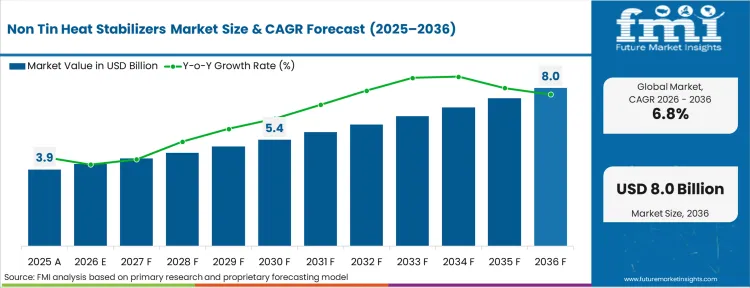
- Industry Size (2026)
- USD 4.13 Bn
- Forecast (2036)
- USD 7.95 Bn
- CAGR (2026 to 2036)
- 6.80%
Non Tin Heat Stabilizers Market Size, Market Forecast and Outlook By FMI
The non-tin heat stabilizers market was valued at USD 3.89 billion in 2025. The industry is set to reach USD 4.13 billion in 2026 at a CAGR of 6.80% during the forecast period. Investment drives the valuation to USD 7.95 billion by 2036 as the irreversible phase-out of heavy metal formulations in rigid polyvinyl chloride extrusion compels formulators to requalify entire lubrication and stabilisation packages without compromising early-colour hold.
Resin compounding directors are no longer debating whether to transition away from legacy tin systems; they are deciding how much extrusion line speed they are willing to trade for regulatory compliance. Heavy metal phase-outs create a direct processing penalty, compelling operations managers to invest in advanced heat stabilizer packages that prevent dynamic thermal degradation during high-shear processing. FMI analysts note that holding out for true drop‑in chemical parity only leads to a longer stretch of high scrap rates, as operators who skip timely process recalibration end up battling unexpected plate‑out and erratic rheology.
The threshold for self-reinforcing adoption is the commercial scaling of organic-based stabilizers capable of matching organotin's optical clarity in rigid applications. Specialty chemical formulators accelerate adoption by achieving parity in dynamic heat stability without the associated haze issues. Once optical parity is reached at a viable price point, the remaining technical friction for clear film and sheet manufacturers dissolves.
Summary of Non Tin Heat Stabilizers Market
- Non Tin Heat Stabilizers Market Definition
- This market tracks the commercial adoption of non-heavy-metal thermal protection additives essential for processing halogenated polymers. It isolates the transition from legacy tin/lead systems to calcium-zinc and organic alternatives, driven by regulatory bans and the technical challenge of maintaining extrusion efficiencies.
- Demand Drivers in the Market
- Extended producer responsibility and chemical restriction frameworks compel resin compounding directors to strip restricted organotins from their masterbatches.
- Corporate targets require tier‑1 construction material buyers to specify heavy‑metal‑free piping and profiles in their public procurement bids.
- The expansion of closed-loop recycling infrastructure pushes municipal waste coordinators to reject legacy PVC formulations that contaminate heavy-metal-free recycling streams.
- Key Segments Analyzed in the FMI Report
- Calcium-zinc stabilizers: Calcium-zinc stabilizers is expected to grab 41.0% share in 2026, offering the most economically viable and chemically similar drop-in replacement for rigid extrusion lines currently running legacy soaps.
- Pipes and fittings: Pipes and fittings is projected to hold 33.0% share in 2026, driven by municipal water infrastructure upgrades requiring non-toxic, lead-free, and tin-free certifications for potable water contact.
- Building and construction: Building and construction is anticipated to garner 31.0% share in 2026, as building code revisions systematically penalize the use of hazardous additives in long-life residential applications.
- India: 7.1% compound growth, anchored by aggressive state-funded agricultural water distribution projects that legally mandate heavy-metal-free PVC specifications.
- Analyst Opinion at FMI
- Nikhil Kaitwade, Principal Analyst, Chemicals, at FMI, opines, "The general market assumption is that switching to non-tin stabilizers is a simple 1:1 chemical substitution. However, practitioners on the factory floor know that pulling tin out of the matrix destroys the existing lubrication balance. Extruders are forced to redesign their entire rheology package, recalibrate their thermal zones, and accept narrower processing windows. The real commercial battle isn't just about selling a compliance chemical; it's about providing the technical service required to keep the customer's line running at historical output speeds."
- Strategic Implications / Executive Takeaways
- Formulators must bundle custom technical troubleshooting services alongside their chemical masterbatches to capture mid-sized extruders who lack internal R&D capabilities.
- Resin buyers should lock in long-term supply agreements for high-grade organic-based stabilizers to avoid expected supply bottlenecks as European and North American phase-out deadlines align.
- Extrusion line operators face a pressing imperative to upgrade legacy machinery with tighter temperature control zones that can handle the narrower processing windows of calcium‑zinc systems.
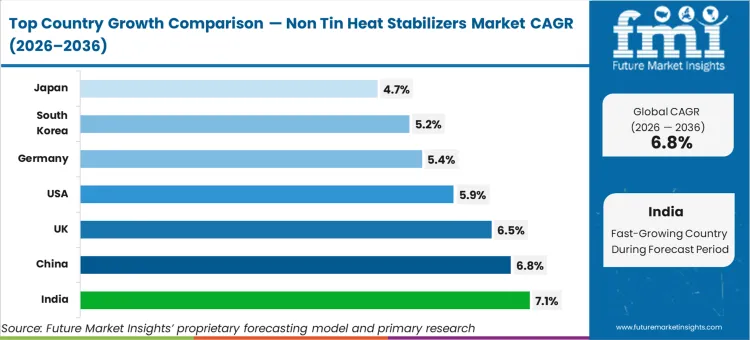
Demand for non-tin heat stabilizers in India is expected to track at 7.1%, followed by China expanding at 6.8%, and the United Kingdom advancing at 6.5%. The United States is estimated to register 5.9%, Germany follows at 5.4%, South Korea is poised to garner 5.2%, and Japan will grow at 4.7%. The divergence across this range reflects the difference between markets driven by rigid procurement mandates for state infrastructure projects and those shaped by gradual, consumer‑led preference shifts in residential construction materials.
Non Tin Heat Stabilizers Market Key Takeaways
| Metric | Details |
|---|---|
| Industry Size (2026) | USD 4.13 Billion |
| Industry Value (2036) | USD 7.95 Billion |
| CAGR (2026–2036) | 6.80% |
Source: Future Market Insights (FMI) analysis, based on proprietary forecasting model and primary research
Non Tin Heat Stabilizers Market Definition
The Non Tin Heat Stabilizers Market encompasses chemical additives formulated without tin, lead, or cadmium, designed to prevent the thermal degradation (dehydrochlorination) of polyvinyl chloride and halogenated polymers during elevated processing temperatures. Functionally, these formulations neutralize hydrochloric acid generated during extrusion or molding, substituting the primary stabilization mechanism of heavy metal soaps with complex metal carboxylates, hydrotalcites, or organic intermediates.
Non Tin Heat Stabilizers Market Inclusions
The market includes calcium-zinc, barium-zinc, magnesium-zinc, and potassium-zinc single-pack and multi-pack systems, alongside purely organic-based stabilizers such as uracils and epoxidized esters used in polymer stabilizers applications. Co-stabilizers, including phosphites, antioxidants, and specific polyols packaged directly within the stabilization masterbatch by the primary vendor, are evaluated within the overall volume and value of the formulated product.
Non Tin Heat Stabilizers Market Exclusions
External lubricants, standalone plasticizers, impact modifiers, and titanium dioxide pigments are explicitly excluded from this sizing, as their primary functional role dictates rheology or optical properties rather than thermal degradation prevention. Organotin compounds (such as methyltin, butyltin, and octyltin mercaptides), lead-based systems, and any cadmium-containing formulations are permanently excluded from this taxonomy due to their heavy-metal categorisation.
Non Tin Heat Stabilizers Market Research Methodology
- Primary Research: Chief Technology Officers at specialty chemical formulators, Procurement Directors at tier-1 PVC pipe extruders, and Compliance Officers navigating REACH and EPA chemical registries.
- Desk Research: Aggregation of chemical restriction annexes, technical datasheets from primary stabilizer manufacturers, and material qualification logs from regional building code authorities.
- Market-Sizing and Forecasting: Baseline sizing anchors to total virgin and recycled PVC resin consumption specifically allocated to rigid extrusion and flexible calendering, multiplied by average stabilizer dosing rates (phr) across non-tin chemistries.
- Data Validation and Update Cycle: Forecasts are triangulated against the quarterly production volumes of key precursors, including stearic acid and zinc oxide, factoring in regional heavy metal phase-out calendars.
Segmental Analysis
Non Tin Heat Stabilizers Market Analysis by Type / Chemistry
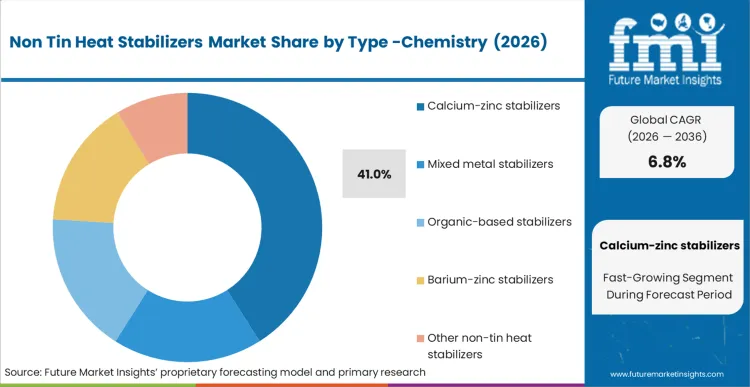
The reason calcium-zinc stabilizers hold 41.0% of this market comes down to a single operational reality: rigid PVC extruders cannot absorb the severe cost penalties associated with purely organic alternatives. This chemistry is not chosen because it matches tin's performance perfectly; it is chosen because it is the only commercially scalable option that allows global polyvinyl chloride pipe and profile manufacturers to remain cost-competitive in municipal bidding wars.
FMI points out that one of the biggest advantages of Ca‑Zn stabilizers is how well they work with modern co‑stabilizers, giving formulators just enough flexibility in the processing window to help keep the material from breaking down too early. Operators who rely on older extrusion equipment and push it aggressively with a basic Ca‑Zn formulation are likely to face rapid plate‑out formation and noticeable early-colour drift, ultimately resulting in expensive production stoppages.
- Early Color Hold: Calcium-zinc chemistry relies heavily on synergistic co-stabilizers to prevent the initial yellowing of the polymer melt. Extrusion managers who fail to optimize this synergy face immediate rejection of visible profile products like window frames.
- Plate-Out Resistance: The metallic soaps in these formulations can migrate to the extruder die if not properly balanced with external lubricants. Tooling engineers must carefully monitor die pressure and surface finish to prevent the buildup that causes surface scoring.
- Long-Term Thermal Stability: While adequate for processing, the chemistry provides a narrower margin for error if line speeds drop. Factory managers who delay equipment upgrades risk catastrophic resin crosslinking within the barrel during unexpected stoppages.
Non Tin Heat Stabilizers Market Analysis by Application
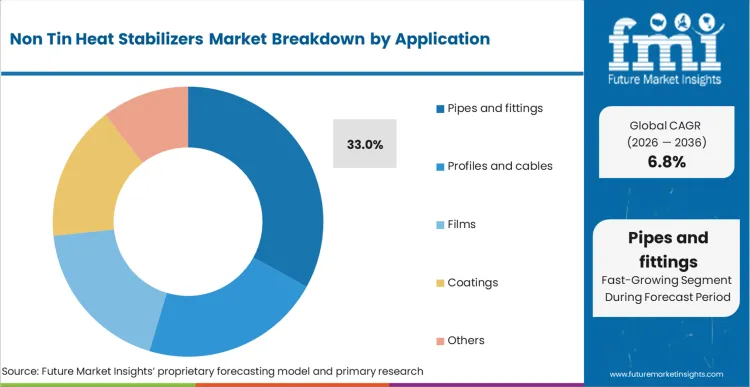
The transition within the pipes and fittings segment, which commands 33.0% of the market, is driven by an unavoidable qualification threshold for potable water contact. Municipal water authorities have systematically purged heavy metal allowances from their procurement standards, forcing pipe extruders to overhaul their historical tin-based formulations.
Based on FMI's assessment, the decision pattern for a pipe manufacturer is binary: either formulate a verifiable non-tin product or forfeit access to public infrastructure contracts. Because underground infrastructure demands decades of hydrostatic pressure resistance, buyers must heavily scrutinise the secondary effects of these new stabiliser packages on the polymer's long-term mechanical strength. Extruders who try to value-engineer their non-tin packages by reducing co-stabiliser loads invariably fail burst-pressure certifications, losing major utility clients entirely.
- Potable Qualification: Strict leaching standards dictate the permissible chemistries for water transport. Compliance officers must submit extensive extraction test data to certify that no toxic components migrate into the water supply.
- Hydrostatic Integrity: The stabilizer must not interfere with the fusion of the PVC particles during extrusion. Quality control directors who overlook this dynamic face catastrophic pipe failures under high-pressure testing.
- Scrap Reprocessing: The thermal history of non-tin stabilized pipes reduces the window for regrinding and recycling factory scrap. Plant managers must implement stricter closed-loop sorting to prevent thermal degradation during the second heat cycle.
Non Tin Heat Stabilizers Market Analysis by End-use industry
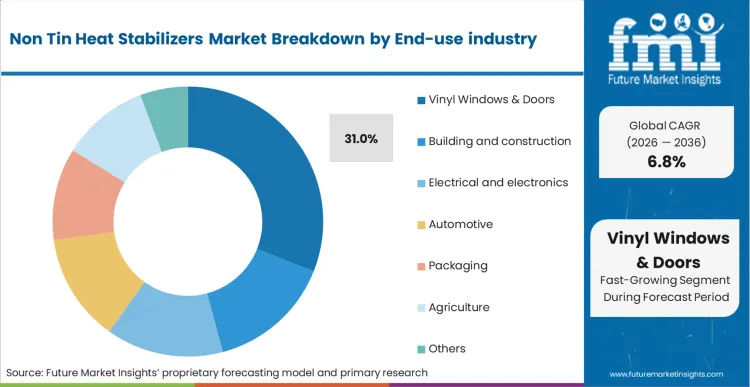
Buyers in the building and construction sector are currently being forced to decide how to weather-proof their exterior vinyl windows and doors without the UV-protective synergies historically provided by tin and lead. This segment, representing 31.0% of demand, operates under the dual pressures of chemical restriction and intense consumer expectation for long-term colorfastness.
In FMI's view, the non-obvious friction here is that replacing the stabilizer forces a complete reformulation of the titanium dioxide and impact modifier package. A formulation director cannot just swap the thermal additive; they must rebuild the entire weathering strategy. Those who underestimate the complexity of this interaction face severe commercial consequences: massive warranty claims for chalking and pinking on exterior profiles within three years of installation.
- Weathering Synergy: Non-tin stabilizers often lack the inherent UV-blocking support of legacy systems. Formulators must over-engineer their pigment loading to guarantee the color stability of exterior cladding and fencing.
- Impact Retention: The altered lubrication dynamics required by Ca-Zn systems can interfere with the dispersion of acrylic impact modifiers. Production engineers must increase shear during compounding to ensure window profiles do not shatter during cold-weather installation.
- Regulatory Audits: Green building certifications increasingly demand full chemical transparency declarations. Procurement managers who rely on unverified imported stabilizers risk disqualification from LEED-certified commercial projects.
Non Tin Heat Stabilizers Market Drivers, Restraints, and Opportunities
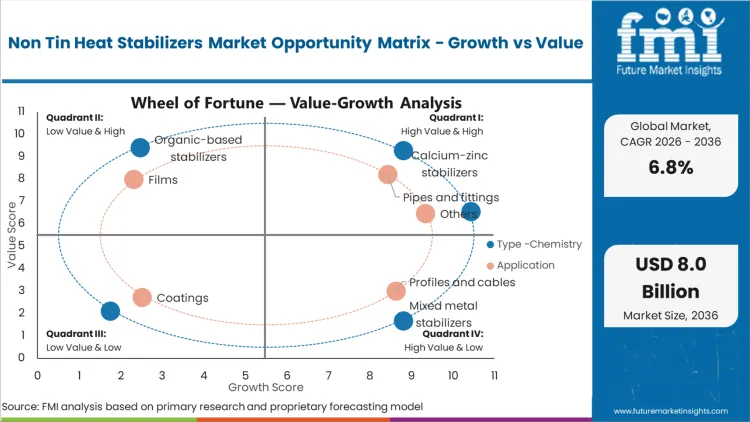
Extended producer responsibility frameworks across major economies legally obligate resin compounders to strip restricted organotins and legacy heavy metals from their active masterbatches. T This pressure pushes procurement directors at tier‑1 construction material firms to rethink their sourcing strategies, directing more capital toward advanced calcium‑zinc and organic‑based alternatives despite the unit cost premium. Putting off this transition is no longer a viable cost‑saving strategy; it ultimately leads to exclusion from municipal infrastructure bids and major retail supply chains, forcing late adopters to lose substantial commercial ground to compliant competitors.
The single biggest friction slowing seamless adoption is the severe contraction of the processing window during high‑speed extrusion. Unlike legacy tin systems, which offered broad thermal forgiveness, non-tin alternatives require precise, narrow temperature bands to prevent dynamic degradation and die plate-out. This is a structural engineering constraint, not a temporary lack of awareness, requiring extruders to physically upgrade their heating zones and screw geometries. While chemical formulators are developing complex co-stabiliser packages to widen this window, these solutions add high variable costs and still cannot perfectly replicate the operational flexibility of the banned heavy metals.
Opportunities in the Non Tin Heat Stabilizers Market
- Custom Formulation Services: The complexity of rheological tuning creates an opening for chemical suppliers to bundle formulation consulting with their raw materials. Specialty chemical vendors capture margin by solving the extrusion challenges of mid-tier pvc electrical conduit manufacturers who lack in-house R&D.
- Bio-based Organic Stabilizers: Stringent corporate mandates are accelerating the commercialisation of fully organic, bio‑derived thermal protectors. Innovative formulators capture premium pricing from eco-conscious flooring and medical tubing brands seeking entirely heavy-metal-free and synthetic-free marketing claims.
- High-Clarity Film Solutions: The persistent haze issues associated with calcium-zinc in transparent applications create a massive technical void. R&D teams that perfect the optical clarity of organic stabilizers dominate the high-margin medical and packaging film sectors.
Regional Analysis
Based on the regional analysis, the Non Tin Heat Stabilizers Market is segmented into Asia Pacific, Europe, North America across 40 plus countries.
.webp "Top Country Growth Comparison Non Tin Heat Stabilizers Market Cagr (2026 2036)")
| Country | CAGR (2026 to 2036) |
|---|---|
| India | 7.1% |
| China | 6.8% |
| United Kingdom | 6.5% |
| United States | 5.9% |
| Germany | 5.4% |
| South Korea | 5.2% |
| Japan | 4.7% |
Source: Future Market Insights (FMI) analysis, based on proprietary forecasting model and primary research
Asia Pacific Non Tin Heat Stabilizers Market Analysis
The trajectory in Asia Pacific is defined by the massive scale of state-funded infrastructure deployment colliding with newly introduced domestic chemical standards. While historically reliant on cost-effective lead and tin packages, the region's top-tier asia pacific plastic additives buyers are now aggressively pulling forward their transition timelines to align with export requirements and localized BIS/GB mandates.
As per FMI's projection, this dynamic creates a highly bifurcated landscape: massive integrated resin producers rapidly adopting advanced Ca-Zn systems for premium infrastructure, while thousands of fragmented, tier-3 extruders struggle to absorb the associated processing penalties.
- India: A CAGR of 7.1% is expected for non-tin heat stabilisers in India over the forecast period. India's aggressive execution of state-level agricultural and potable water infrastructure projects legally mandates heavy-metal-free certifications for all public procurement. Factory operators serving these massive bids must immediately convert their legacy formulations or face permanent exclusion from the Jal Jeevan Mission pipeline. Companies that establish localized technical support to help regional extruders dial in these sensitive, low carbon pvc piping and water distribution systems formulations capture long-term contract lock-in.
- China: The consolidation of China's rigid extrusion sector forces domestic operators to standardize their stabilization packages against stricter national environmental policies (GB standards). Export-oriented profile manufacturers must simultaneously meet stringent European REACH standards to maintain their Western market access. The China market is forecast to register a CAGR of 6.8%. This dual pressure positions Chinese chemical formulators to rapidly scale their domestic Ca-Zn production capacity, closing the technological gap with Western competitors.
- South Korea: FMI estimates the non-tin heat stabilisers market in South Korea to expand at an annual growth rate of 5.2%. Procurement directors at top-tier South Korean chaebols operate under strict corporate governance mandates that push heavy metal phase-outs faster than baseline national regulations require. They demand complex, high-performance organic stabilizer blends for premium consumer electronics and residential pvc electrical conduit applications. This creates a high-margin opportunity for speciality chemical importers capable of meeting rigorous electronic-grade purity specifications.
- Japan: Japan's highly mature and quality-obsessed construction sector relies on decades-old, finely tuned legacy formulations that resist disruption. The heat stabilizers market in Japan is set to achieve a CAGR of 4.7%. Extrusion engineers here demand absolute drop-in parity, forcing chemical vendors into exhausting, multi-year qualification cycles for new non-tin alternatives. The commercial reality is that once a specific organic-based package is validated for a major residential cladding OEM, that formulation is virtually immune to displacement by lower-cost regional competitors.
FMI's report includes Southeast Asian markets such as Vietnam and Indonesia. Across these emerging hubs, the defining pattern is a reliance on imported masterbatch technologies, making their transition speed entirely dependent on the technical assistance provided by multinational chemical suppliers.
Europe Non Tin Heat Stabilizers Market Analysis
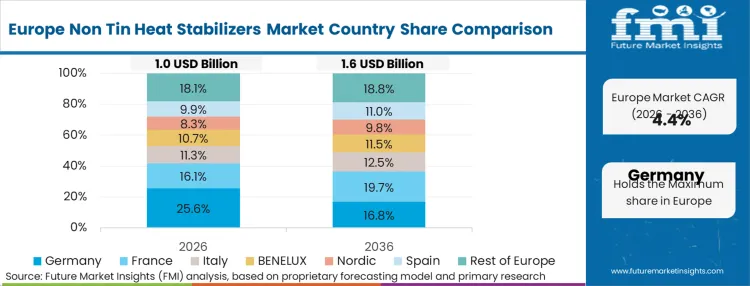
Europe's market is entirely policy-led, dictated by the absolute authority of the REACH annexes and the aggressive self-regulation of the VinylPlus framework. The regional dynamic is not about discovering the need for non-tin alternatives; it is about navigating the operational friction of the final, irreversible phase-outs of the last remaining legacy exceptions. Formulators in this region operate under intense scrutiny, continuously reformulating to anticipate the next wave of SVHC (Substances of Very High Concern) restrictions.
- United Kingdom: Post-Brexit regulatory divergence requires UK-based resin compounders to simultaneously track UK REACH and EU REACH compliance, duplicating the administrative burden of chemical qualification. Procurement directors must source stabilizer packages that legally satisfy both regimes to maintain cross-channel supply chains. The united kingdom heat stabilizers segment in United Kingdom is projected to grow at an annual rate of 6.5%. The nuance here is that UK extruders, operating with generally older legacy equipment than their German counterparts, face significantly higher capital expenditure hurdles when adapting to the narrower processing windows of advanced Ca-Zn systems.
- Germany: Germany's updated extended producer responsibility requirements create a direct cost differential between legacy mixed-material systems and fully compliant, highly recyclable rigid PVC profiles. Pharmaceutical and construction logistics operators running German distribution routes have already begun requalification processes for their primary materials. Demand for non tin heat stabilizers in Germany is set to grow at 5.4%. Companies that move first capture preferred supplier status in rigid procurement frameworks that are unlikely to reopen once initial vendors are qualified.
FMI's report includes Italy, France, and Spain. Across these Mediterranean manufacturing hubs, the prevailing pattern centers on the agricultural film and flexible hose sectors, where buyers are prioritizing advanced organic‑based stabilizers to prevent the exudation and hazing common in early‑generation tin replacements.
North America Non Tin Heat Stabilizers Market Analysis
North America's adoption curve is infrastructure-led, heavily influenced by localized building codes and the aggressive lobbying of municipal water authorities. The transition away from organotins is fragmented across state lines, forcing national chemical distributors to manage highly complex, multi-tiered inventory systems to satisfy both progressive coastal mandates and cost-focused interior markets.
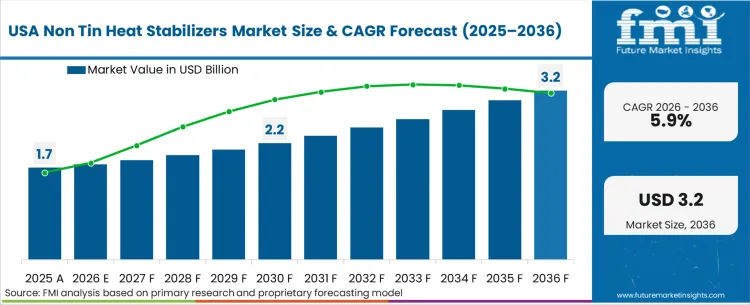
- United States: The United States is expected to see its non tin heat stabilizers sector grow at a compound annual rate of 5.9%. The trajectory of united states heat stabilizers adoption is driven by the EPA's increasing scrutiny of organotin leachates in potable water and the progressive tightening of NSF/ANSI Standard 61. Major pipe extruders must systematically flush their silos of legacy compounds and validate complex calcium-zinc packages to maintain their critical infrastructure certifications. Plant managers who successfully dial in these new rheology profiles achieve a massive operational advantage, securing the ability to bid on federally funded water replacement projects without compliance risk.
FMI's report includes Canada and Mexico. The cross-border dynamic reveals Mexican extruders rapidly upgrading their chemical packages to maintain USMCA export compliance, effectively harmonizing the North American formulation standard upward despite lower domestic regulatory pressure.
Competitive Aligners for Market Players
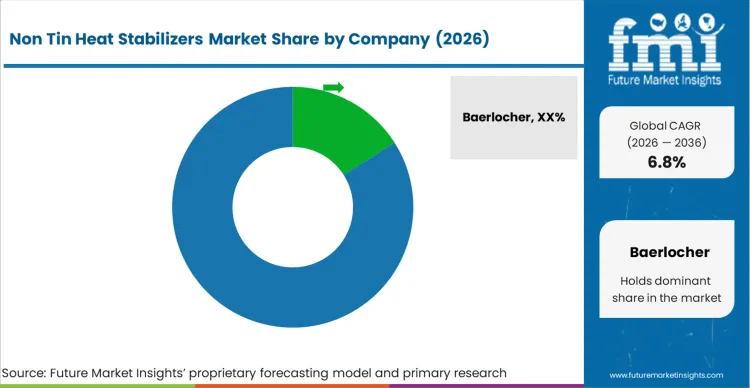
The concentrated nature of the top-tier non-tin stabilizers market stems directly from the intense R&D required to synthesize proprietary co-stabilizer molecules. Buyers do not select vendors based simply on the base calcium-zinc ratio; they qualify partners based on the performance of the proprietary "booster" packages that prevent early color degradation and extend dynamic thermal stability. Major players like Baerlocher and Akdeniz Chemson dominate because they offer fully integrated, custom-tailored "one-pack" systems that drastically reduce the weighing and blending errors for end-users, serving as the primary variable procurement directors use to distinguish capable technical partners from mere commodity chemical blenders.
To match the advantage held by established players, challengers need to build advanced application testing laboratories capable of mimicking a client's specific utility electrical conduit extrusion conditions. ADEKA and Valtris Specialty Chemicals maintain their competitive moats not just through chemical patents, but through massive libraries of historical rheological data. A regional challenger attempting to capture market share cannot simply offer a cheaper organic-based stabilizer; they must provide the on-site technical engineering necessary to help the commercial scale non metal electrical conduit manufacturer adjust their screw speeds and thermal zones to prevent catastrophic plate-out during the transition phase.
Large integrated PVC buyers resist vendor lock-in by aggressively qualifying secondary suppliers for their baseline fire protection system pipes applications, intentionally fragmenting their procurement across multiple chemistries. However, the forces shaping the market through 2036 point to rising consolidation. As regulatory scrutiny deepens on the specific organic intermediates used in next-generation bio-based stabilizers, only the most capitalized vendors will possess the regulatory affairs infrastructure required to secure global REACH, EPA, and FDA approvals, effectively pricing smaller regional blenders out of the premium technical market.
Key Players in Non Tin Heat Stabilizers Market
- Baerlocher
- Akdeniz Chemson
- ADEKA
- Valtris Specialty Chemicals
- Reagens
- SONGWON Industrial Group
- Pau Tai Industrial Corp.
Scope of the Report
| Metric | Value |
|---|---|
| Quantitative Units | USD 4.13 Billion to USD 7.95 Billion, at a CAGR of 6.80% |
| Market Definition | The market covers chemical additives devoid of heavy metals (tin, lead, cadmium) designed to prevent the thermal degradation and dehydrochlorination of halogenated polymers during elevated processing temperatures. |
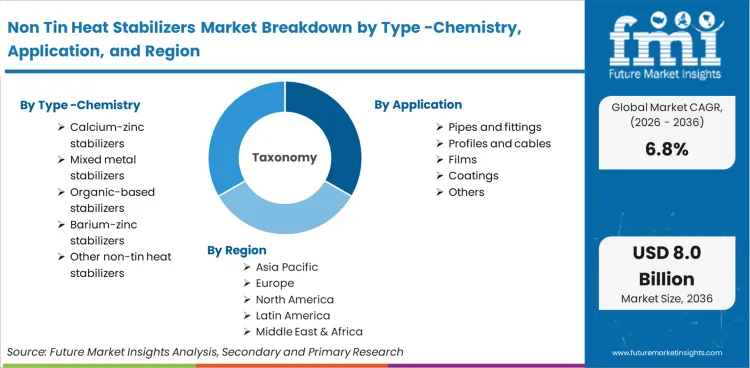
| Type / Chemistry Segmentation | Calcium-zinc stabilizers, Mixed metal stabilizers, Organic-based stabilizers, Barium-zinc stabilizers, Other non-tin heat stabilizers |
| Application Segmentation | Pipes and fittings, Profiles and cables, Films, Coatings, Others |
| End-use industry Segmentation | Building and construction, Electrical and electronics, Automotive, Packaging, Agriculture, Others |
| Regions Covered | Asia Pacific, Europe, North America |
| Countries Covered | United States, United Kingdom, Japan, China, India, Germany, South Korea, and 40 plus countries |
| Key Companies Profiled | Baerlocher, Akdeniz Chemson, ADEKA, Valtris Specialty Chemicals, Reagens, SONGWON Industrial Group, Pau Tai Industrial Corp. |
| Forecast Period | 2026 to 2036 |
| Approach | Primary interviews targeted chief technology officers and procurement directors across the PVC extrusion landscape. The baseline was anchored to aggregate rigid and flexible PVC resin consumption models. Validation involved cross-referencing regional phase-out calendars with upstream precursor production data. |
Source: Future Market Insights (FMI) analysis, based on proprietary forecasting model and primary research
Non Tin Heat Stabilizers Market Analysis by Segments
Type / Chemistry:
- Calcium-zinc stabilizers
- Mixed metal stabilizers
- Organic-based stabilizers
- Barium-zinc stabilizers
- Other non-tin heat stabilizers
Application:
- Pipes and fittings
- Profiles and cables
- Films
- Coatings
- Others
End-use industry:
- Building and construction
- Electrical and electronics
- Automotive
- Packaging
- Agriculture
- Others
Region:
- Asia Pacific
- India
- China
- South Korea
- Japan
- Europe
- United Kingdom
- Germany
- North America
- United States
Bibliography
- European Chemicals Agency. (2025). ANNEX XVII TO REACH - Conditions of restriction. European Chemicals Agency.
- Environment Agency. (2024, March). Polyvinyl Chloride (PVC) additives: a scoping review. GOV.UK.
- VinylPlus. (2024, May). Progress Report 2024. VinylPlus.
- Plastics Pipe Institute, Inc. (2024). TR-2 2024 - PPI PVC Range Composition Listing of Qualified Ingredients. Plastics Pipe Institute.
- Wiesinger, H., Bleuler, C., Christen, V., Favreau, P., Hellweg, S., Langer, M., Pasquettaz, R., Schönborn, A., & Wang, Z. (2024). Legacy and emerging plasticizers and stabilizers in PVC floorings and implications for recycling. Environmental Science & Technology.
- Gardi, S., Giannone, L., Sarti, G. C., & Sarti, G. C. (2024). Surface chalking upon weathering of dark-colored PVC articles and relevant stabilizers. Polymers.
- Putrawan, I. D. G. A., Mardiani, S., & Wonoputri, V. (2024). Using solid waste from the leather tanning industry to produce a mixed calcium/zinc thermal stabilizer for polyvinyl chloride. Circular Economy.
- Putrawan, I. D. G. A., Nento, N. A. P., Pratama, S. H., Kusuma, A., Chandra, Y. H., Tayip, D. K., Azharuddin, A., Indarto, A., & Adityawarman, D. (2025). Thermal stabilization of polyvinyl chloride using mixed metal palmates in the presence of co-stabilizers. AIP Conference Proceedings.
- Wang, N., Jiang, P., Zhang, P., Qi, S., Xu, J., Chen, S., Sheng, X., Gao, J., & Gao, H. (2025). Synthesis of multifunctional heat stabilizer bio-based Ade-Zn and its application in PVC. Macromolecular Rapid Communications.
- This bibliography is provided for the reader's reference. The full FMI report includes the complete reference list with primary-source documentation.
This Report Addresses
- Market intelligence to support strategic decision making across non-tin stabilization formulations, organic-based packages, and complex calcium-zinc single-pack systems.
- Market size estimation and 10-year revenue forecasts from 2026 to 2036, supported by resin production baseline modelling and regional phase-out regulatory tracking.
- Growth opportunity mapping across rigid extrusion, flexible calendaring, and high-clarity film sectors with emphasis on achieving optical parity with legacy heavy metals.
- Segment and regional revenue forecasts covering calcium-zinc systems and organic alternatives across aggressive state-level procurement environments and strict REACH jurisdictions.
- Competition strategy assessment including custom formulation services, rheological testing capabilities, and fully integrated one-pack systems.
- Additive capability development tracking including advanced epoxy co-stabilizers, bio-derived organic intermediates, and high-efficiency low carbon pvc for window profile and door systems.
- Market access analysis covering stringent municipal potable water certifications, extended producer responsibility frameworks, and corporate LEED initiatives.
- Market report delivery in PDF, Excel, PPT, and interactive dashboard formats for executive strategy, chemical formulation planning, and operational benchmarking use.
Frequently Asked Questions
How large is the Non Tin Heat Stabilizers Market in 2026?
The market is valued at USD 4.13 billion in 2026. This figure establishes the baseline reality of the global transition away from heavy metals, indicating that substitution has already reached critical mass across major Western regulatory jurisdictions and tier-1 procurement networks.
What will it be valued at by 2036?
It will reach USD 7.95 billion by 2036. The cumulative buildup to this valuation reflects the absolute replacement of organotins globally, not merely an expansion of baseline PVC resin production.
What CAGR is projected?
A CAGR of 6.80% is expected during the forecast period. This 6.80% rate captures the speed at which rigid profile extruders and pipe manufacturers are cycling out their legacy lead and tin formulations to comply with rigid state and federal infrastructure procurement rules.
Which Type / Chemistry segment leads?
Calcium-zinc stabilizers hold the dominant position. They lead because they offer the most economically viable, near-drop-in replacement for rigid pipe and profile extruders who cannot absorb the extreme processing premiums of purely organic-based alternatives.
Which Application segment leads?
Pipes and fittings represent the largest application. This segment leads because global municipal water authorities have systemically purged all allowances for heavy-metal leachates in potable water transport, legally forcing extruders to adopt complex non-tin packages to maintain their bidding eligibility.
Which End-use industry segment leads?
Building and construction commands the highest share. The transition here is forced by the collision of stricter green building codes (like LEED) and extended producer responsibility laws that penalize toxic additives in long-life residential applications like siding and window frames.
What drives rapid growth?
Growth is forced by irreversible chemical restriction annexes and corporate sustainability mandates. Procurement directors at tier-1 brands are pushing non-tin specifications down their supply chains to eliminate long-term liability and secure closed-loop recycling viability.
What is the primary restraint?
The severe contraction of the processing window during high-speed extrusion acts as the primary friction. Non-tin stabilizers require significantly tighter temperature control bands, forcing factory managers to physically upgrade their heating zones or accept costly increases in scrap rates.
Which country grows fastest?
India leads at 7.1%. Unlike the more mature German market, India's growth is anchored by massive new installations of state-funded agricultural water networks that legally mandate heavy-metal-free PVC, forcing regional extruders into immediate compliance.
How do extended producer responsibility laws affect adoption?
These frameworks create a direct financial penalty for non-recyclable or hazardous formulations. Extruders are switching to calcium-zinc not just for primary compliance, but to ensure their end-products can be accepted into municipal recycling streams without triggering heavy-metal contamination fines.
What role do co-stabilizers play in this market?
Co-stabilizers are the technical bridge that makes non-tin systems viable. Without precise additions of phosphites or epoxies to extend early-color hold and prevent sudden cross-linking, baseline calcium-zinc systems would cause unacceptable plate-out during long extrusion runs.
How do Tier-1 chemical vendors maintain their competitive edge?
Incumbents dominate by selling fully integrated, custom-tailored "one-pack" systems backed by extensive on-site rheology troubleshooting. They do not just sell a powder; they sell the engineering service required to keep an extruder's line running at historical output speeds.
Why are organic-based stabilizers critical for the films segment?
Standard calcium-zinc formulations often introduce a slight haze to transparent PVC. Organic-based systems achieve the optical clarity required for premium medical and packaging films, solving the critical performance gap left by the removal of organotins.
How does the UK's trajectory differ from Germany's?
The UK market contends with the dual administrative burden of tracking both UK REACH and EU REACH compliance, while operating on an older base of legacy extrusion equipment. This creates higher capital expenditure hurdles for UK manufacturers attempting to dial in sensitive non-tin processing windows.
What is the significance of NSF/ANSI Standard 61 in the US market?
This standard dictates the acceptable extraction limits for drinking water components. Its progressive tightening forces US pipe extruders to systematically flush their silos of legacy compounds and validate expensive new non-tin packages to avoid catastrophic infrastructure contract losses.
Why is Japan's growth slower than other Asian markets?
Japan relies on highly optimized, decades-old legacy formulations. Extrusion engineers demand absolute drop-in parity before switching, forcing chemical vendors into multi-year qualification cycles that significantly delay broad commercial adoption.
How do bio-based stabilizers change the vendor landscape?
They allow formulators to target eco-conscious low carbon pvc flooring and wall covering materials brands seeking 100% synthetic-free marketing claims. This niche commands premium pricing and bypasses the commodity price wars associated with standard calcium-zinc packages.
What makes potable water qualification so difficult for non-tin systems?
The stabilizer must maintain the hydrostatic integrity of the pipe for decades without leaching proprietary organic intermediates into the water supply. Value-engineering these packages invariably leads to burst-pressure failures during certification.
Why do exterior profiles struggle with the transition?
Legacy heavy metals provided inherent UV-blocking synergies. Swapping to non-tin systems forces formulators to completely rebuild their titanium dioxide and impact modifier packages to prevent severe chalking and pinking on exterior window frames within a few years of installation.
How do closed-loop recycling systems drive immediate substitution?
Municipal waste coordinators are beginning to reject PVC lots that test positive for heavy metals. Resin buyers must adopt non-tin systems today to ensure the material they install can be legally reprocessed at the end of its 30-year lifecycle without contaminating clean recycling streams.
What methodology ensures the accuracy of FMI's volume forecasts?
Baseline sizing anchors directly to total virgin and recycled PVC resin consumption allocated to rigid and flexible applications. This is multiplied by the specific dosing rates (phr) required for non-tin chemistries and triangulated against regional regulatory phase-out calendars.
Does the scope of this report include impact modifiers and external lubricants?
No. These additives are explicitly excluded as their primary functions dictate rheology or optical properties rather than the prevention of thermal degradation and dehydrochlorination during high-temperature processing.
Preview the report firsthand - request a free sample
Get SampleGet the brochure for pricing and purchase details.
Get PDFTable of Content
- Executive Summary
- Global Market Outlook
- Demand-side Trends
- Supply-side Trends
- Technology Roadmap Analysis
- Analysis and Recommendations
- Market Overview
- Market Coverage / Taxonomy
- Market Definition / Scope / Limitations
- Research Methodology
- Chapter Orientation
- Analytical Lens and Working Hypotheses
- Market Structure, Signals, and Trend Drivers
- Benchmarking and Cross-market Comparability
- Market Sizing, Forecasting, and Opportunity Mapping
- Research Design and Evidence Framework
- Desk Research Programme (Secondary Evidence)
- Company Annual and Sustainability Reports
- Peer-reviewed Journals and Academic Literature
- Corporate Websites, Product Literature, and Technical Notes
- Earnings Decks and Investor Briefings
- Statutory Filings and Regulatory Disclosures
- Technical White Papers and Standards Notes
- Trade Journals, Industry Magazines, and Analyst Briefs
- Conference Proceedings, Webinars, and Seminar Materials
- Government Statistics Portals and Public Data Releases
- Press Releases and Reputable Media Coverage
- Specialist Newsletters and Curated Briefings
- Sector Databases and Reference Repositories
- FMI Internal Proprietary Databases and Historical Market Datasets
- Subscription Datasets and Paid Sources
- Social Channels, Communities, and Digital Listening Inputs
- Additional Desk Sources
- Expert Input and Fieldwork (Primary Evidence)
- Primary Modes
- Qualitative Interviews and Expert Elicitation
- Quantitative Surveys and Structured Data Capture
- Blended Approach
- Why Primary Evidence is Used
- Field Techniques
- Interviews
- Surveys
- Focus Groups
- Observational and In-context Research
- Social and Community Interactions
- Stakeholder Universe Engaged
- C-suite Leaders
- Board Members
- Presidents and Vice Presidents
- R&D and Innovation Heads
- Technical Specialists
- Domain Subject-matter Experts
- Scientists
- Physicians and Other Healthcare Professionals
- Governance, Ethics, and Data Stewardship
- Research Ethics
- Data Integrity and Handling
- Primary Modes
- Tooling, Models, and Reference Databases
- Desk Research Programme (Secondary Evidence)
- Data Engineering and Model Build
- Data Acquisition and Ingestion
- Cleaning, Normalisation, and Verification
- Synthesis, Triangulation, and Analysis
- Quality Assurance and Audit Trail
- Market Background
- Market Dynamics
- Drivers
- Restraints
- Opportunity
- Trends
- Scenario Forecast
- Demand in Optimistic Scenario
- Demand in Likely Scenario
- Demand in Conservative Scenario
- Opportunity Map Analysis
- Product Life Cycle Analysis
- Supply Chain Analysis
- Investment Feasibility Matrix
- Value Chain Analysis
- PESTLE and Porter’s Analysis
- Regulatory Landscape
- Regional Parent Market Outlook
- Production and Consumption Statistics
- Import and Export Statistics
- Market Dynamics
- Global Market Analysis 2021 to 2025 and Forecast, 2026 to 2036
- Historical Market Size Value (USD Million) Analysis, 2021 to 2025
- Current and Future Market Size Value (USD Million) Projections, 2026 to 2036
- Y-o-Y Growth Trend Analysis
- Absolute $ Opportunity Analysis
- Global Market Pricing Analysis 2021 to 2025 and Forecast 2026 to 2036
- Global Market Analysis 2021 to 2025 and Forecast 2026 to 2036, By Type / Chemistry
- Introduction / Key Findings
- Historical Market Size Value (USD Million) Analysis By Type / Chemistry , 2021 to 2025
- Current and Future Market Size Value (USD Million) Analysis and Forecast By Type / Chemistry , 2026 to 2036
- Calcium-zinc stabilizers
- Mixed metal stabilizers
- Organic-based stabilizers
- Barium-zinc stabilizers
- Other non-tin heat stabilizers
- Calcium-zinc stabilizers
- Y-o-Y Growth Trend Analysis By Type / Chemistry , 2021 to 2025
- Absolute $ Opportunity Analysis By Type / Chemistry , 2026 to 2036
- Global Market Analysis 2021 to 2025 and Forecast 2026 to 2036, By Application
- Introduction / Key Findings
- Historical Market Size Value (USD Million) Analysis By Application, 2021 to 2025
- Current and Future Market Size Value (USD Million) Analysis and Forecast By Application, 2026 to 2036
- Pipes and fittings
- Profiles and cables
- Films
- Coatings
- Others
- Pipes and fittings
- Y-o-Y Growth Trend Analysis By Application, 2021 to 2025
- Absolute $ Opportunity Analysis By Application, 2026 to 2036
- Global Market Analysis 2021 to 2025 and Forecast 2026 to 2036, By End-use industry
- Introduction / Key Findings
- Historical Market Size Value (USD Million) Analysis By End-use industry, 2021 to 2025
- Current and Future Market Size Value (USD Million) Analysis and Forecast By End-use industry, 2026 to 2036
- Vinyl Windows & Doors
- Building and construction
- Electrical and electronics
- Automotive
- Packaging
- Agriculture
- Others
- Vinyl Windows & Doors
- Y-o-Y Growth Trend Analysis By End-use industry, 2021 to 2025
- Absolute $ Opportunity Analysis By End-use industry, 2026 to 2036
- Global Market Analysis 2021 to 2025 and Forecast 2026 to 2036, By Region
- Introduction
- Historical Market Size Value (USD Million) Analysis By Region, 2021 to 2025
- Current Market Size Value (USD Million) Analysis and Forecast By Region, 2026 to 2036
- North America
- Latin America
- Western Europe
- Eastern Europe
- East Asia
- South Asia and Pacific
- Middle East & Africa
- Market Attractiveness Analysis By Region
- North America Market Analysis 2021 to 2025 and Forecast 2026 to 2036, By Country
- Historical Market Size Value (USD Million) Trend Analysis By Market Taxonomy, 2021 to 2025
- Market Size Value (USD Million) Forecast By Market Taxonomy, 2026 to 2036
- By Country
- USA
- Canada
- Mexico
- By Type / Chemistry
- By Application
- By End-use industry
- By Country
- Market Attractiveness Analysis
- By Country
- By Type / Chemistry
- By Application
- By End-use industry
- Key Takeaways
- Latin America Market Analysis 2021 to 2025 and Forecast 2026 to 2036, By Country
- Historical Market Size Value (USD Million) Trend Analysis By Market Taxonomy, 2021 to 2025
- Market Size Value (USD Million) Forecast By Market Taxonomy, 2026 to 2036
- By Country
- Brazil
- Chile
- Rest of Latin America
- By Type / Chemistry
- By Application
- By End-use industry
- By Country
- Market Attractiveness Analysis
- By Country
- By Type / Chemistry
- By Application
- By End-use industry
- Key Takeaways
- Western Europe Market Analysis 2021 to 2025 and Forecast 2026 to 2036, By Country
- Historical Market Size Value (USD Million) Trend Analysis By Market Taxonomy, 2021 to 2025
- Market Size Value (USD Million) Forecast By Market Taxonomy, 2026 to 2036
- By Country
- Germany
- UK
- Italy
- Spain
- France
- Nordic
- BENELUX
- Rest of Western Europe
- By Type / Chemistry
- By Application
- By End-use industry
- By Country
- Market Attractiveness Analysis
- By Country
- By Type / Chemistry
- By Application
- By End-use industry
- Key Takeaways
- Eastern Europe Market Analysis 2021 to 2025 and Forecast 2026 to 2036, By Country
- Historical Market Size Value (USD Million) Trend Analysis By Market Taxonomy, 2021 to 2025
- Market Size Value (USD Million) Forecast By Market Taxonomy, 2026 to 2036
- By Country
- Russia
- Poland
- Hungary
- Balkan & Baltic
- Rest of Eastern Europe
- By Type / Chemistry
- By Application
- By End-use industry
- By Country
- Market Attractiveness Analysis
- By Country
- By Type / Chemistry
- By Application
- By End-use industry
- Key Takeaways
- East Asia Market Analysis 2021 to 2025 and Forecast 2026 to 2036, By Country
- Historical Market Size Value (USD Million) Trend Analysis By Market Taxonomy, 2021 to 2025
- Market Size Value (USD Million) Forecast By Market Taxonomy, 2026 to 2036
- By Country
- China
- Japan
- South Korea
- By Type / Chemistry
- By Application
- By End-use industry
- By Country
- Market Attractiveness Analysis
- By Country
- By Type / Chemistry
- By Application
- By End-use industry
- Key Takeaways
- South Asia and Pacific Market Analysis 2021 to 2025 and Forecast 2026 to 2036, By Country
- Historical Market Size Value (USD Million) Trend Analysis By Market Taxonomy, 2021 to 2025
- Market Size Value (USD Million) Forecast By Market Taxonomy, 2026 to 2036
- By Country
- India
- ASEAN
- Australia & New Zealand
- Rest of South Asia and Pacific
- By Type / Chemistry
- By Application
- By End-use industry
- By Country
- Market Attractiveness Analysis
- By Country
- By Type / Chemistry
- By Application
- By End-use industry
- Key Takeaways
- Middle East & Africa Market Analysis 2021 to 2025 and Forecast 2026 to 2036, By Country
- Historical Market Size Value (USD Million) Trend Analysis By Market Taxonomy, 2021 to 2025
- Market Size Value (USD Million) Forecast By Market Taxonomy, 2026 to 2036
- By Country
- Kingdom of Saudi Arabia
- Other GCC Countries
- Turkiye
- South Africa
- Other African Union
- Rest of Middle East & Africa
- By Type / Chemistry
- By Application
- By End-use industry
- By Country
- Market Attractiveness Analysis
- By Country
- By Type / Chemistry
- By Application
- By End-use industry
- Key Takeaways
- Key Countries Market Analysis
- USA
- Pricing Analysis
- Market Share Analysis, 2025
- By Type / Chemistry
- By Application
- By End-use industry
- Canada
- Pricing Analysis
- Market Share Analysis, 2025
- By Type / Chemistry
- By Application
- By End-use industry
- Mexico
- Pricing Analysis
- Market Share Analysis, 2025
- By Type / Chemistry
- By Application
- By End-use industry
- Brazil
- Pricing Analysis
- Market Share Analysis, 2025
- By Type / Chemistry
- By Application
- By End-use industry
- Chile
- Pricing Analysis
- Market Share Analysis, 2025
- By Type / Chemistry
- By Application
- By End-use industry
- Germany
- Pricing Analysis
- Market Share Analysis, 2025
- By Type / Chemistry
- By Application
- By End-use industry
- UK
- Pricing Analysis
- Market Share Analysis, 2025
- By Type / Chemistry
- By Application
- By End-use industry
- Italy
- Pricing Analysis
- Market Share Analysis, 2025
- By Type / Chemistry
- By Application
- By End-use industry
- Spain
- Pricing Analysis
- Market Share Analysis, 2025
- By Type / Chemistry
- By Application
- By End-use industry
- France
- Pricing Analysis
- Market Share Analysis, 2025
- By Type / Chemistry
- By Application
- By End-use industry
- India
- Pricing Analysis
- Market Share Analysis, 2025
- By Type / Chemistry
- By Application
- By End-use industry
- ASEAN
- Pricing Analysis
- Market Share Analysis, 2025
- By Type / Chemistry
- By Application
- By End-use industry
- Australia & New Zealand
- Pricing Analysis
- Market Share Analysis, 2025
- By Type / Chemistry
- By Application
- By End-use industry
- China
- Pricing Analysis
- Market Share Analysis, 2025
- By Type / Chemistry
- By Application
- By End-use industry
- Japan
- Pricing Analysis
- Market Share Analysis, 2025
- By Type / Chemistry
- By Application
- By End-use industry
- South Korea
- Pricing Analysis
- Market Share Analysis, 2025
- By Type / Chemistry
- By Application
- By End-use industry
- Russia
- Pricing Analysis
- Market Share Analysis, 2025
- By Type / Chemistry
- By Application
- By End-use industry
- Poland
- Pricing Analysis
- Market Share Analysis, 2025
- By Type / Chemistry
- By Application
- By End-use industry
- Hungary
- Pricing Analysis
- Market Share Analysis, 2025
- By Type / Chemistry
- By Application
- By End-use industry
- Kingdom of Saudi Arabia
- Pricing Analysis
- Market Share Analysis, 2025
- By Type / Chemistry
- By Application
- By End-use industry
- Turkiye
- Pricing Analysis
- Market Share Analysis, 2025
- By Type / Chemistry
- By Application
- By End-use industry
- South Africa
- Pricing Analysis
- Market Share Analysis, 2025
- By Type / Chemistry
- By Application
- By End-use industry
- USA
- Market Structure Analysis
- Competition Dashboard
- Competition Benchmarking
- Market Share Analysis of Top Players
- By Regional
- By Type / Chemistry
- By Application
- By End-use industry
- Competition Analysis
- Competition Deep Dive
- Baerlocher
- Overview
- Product Portfolio
- Profitability by Market Segments (Product/Age /Sales Channel/Region)
- Sales Footprint
- Strategy Overview
- Marketing Strategy
- Product Strategy
- Channel Strategy
- Akdeniz Chemson
- ADEKA
- Valtris Specialty Chemicals
- Reagens
- SONGWON Industrial Group
- Pau Tai Industrial Corp.
- Baerlocher
- Competition Deep Dive
- Assumptions & Acronyms Used


