

- Industry Size (2026)
- USD 936.4 Mn
- Forecast (2036)
- USD 2176.5 Mn
- CAGR (2026 to 2036)
- 8.8%
Non-Toxic Plasticizers for PVC and Elastomers Market Forecast and Outlook 2026 to 2036
The non-toxic plasticizers for PVC and elastomers market is expected to experience steady growth from 2026 to 2036. In 2026, the market value is projected to be USD 936.4 million, with continued growth anticipated, reaching USD 2,176.5 million by 2036. The compound annual growth rate (CAGR) for this market is forecasted at 8.8%, driven by increasing demand for safer, environmentally friendly alternatives to traditional plasticizers in various industries. Non-toxic plasticizers are widely used in PVC and elastomers to improve flexibility and durability while avoiding the health risks associated with conventional plasticizers like phthalates.
The market’s growth is fueled by growing regulatory pressure for safer materials, particularly in applications such as medical devices, toys, and food packaging, where non-toxic materials are crucial for consumer safety. Additionally, rising consumer awareness of the health risks posed by traditional plasticizers is pushing industries to adopt non-toxic alternatives. Innovations in plasticizer formulations and improved manufacturing processes will further accelerate the adoption of non-toxic plasticizers across different sectors. Over the forecast period, the market is expected to grow steadily, driven by both regulatory factors and evolving consumer preferences for safer materials.
Quick Stats of the Non-Toxic Plasticizers for PVC and Elastomers Market
- Non-Toxic Plasticizers for PVC and Elastomers Market Value (2026): USD 936.4 million
- Non-Toxic Plasticizers for PVC and Elastomers Market Forecast Value (2036): USD 2,176.5 million
- Non-Toxic Plasticizers for PVC and Elastomers Market Global Forecast CAGR (2026-2036): 8.8%
- Non-Toxic Plasticizers for PVC and Elastomers Market Leading Segment: Application (PVC – Polyvinyl Chloride) 42%
- Key Growth Regions in Non-Toxic Plasticizers for PVC and Elastomers Market: India
- Top Players in Non-Toxic Plasticizers for PVC and Elastomers Market: BASF SE, Dow Inc., Eastman Chemical Company, Evonik Industries, LANXESS

What is the Growth Forecast for the Non-Toxic Plasticizers for PVC and Elastomers Market through 2036?
The growth forecast for the non-toxic plasticizers for PVC and elastomers market shows a consistent upward trajectory, with a projected CAGR of 8.8%. Starting at USD 936.4 million in 2026, the market will gradually increase, reaching USD 1,021.4 million in 2027, USD 1,115.2 million in 2028, and USD 1,218.5 million in 2029. By 2030, the market value is projected to rise to USD 1,332.3 million, continuing steady growth throughout the forecast period.
From 2031 to 2036, the market will experience continued expansion, reaching USD 1,457.5 million in 2031, USD 1,595.5 million in 2032, and USD 1,747.2 million in 2033. The market will continue to grow steadily, with values rising to USD 1,914.6 million in 2034, USD 1,999 million in 2035, and USD 2,176.5 million by 2036. The breakpoint analysis shows that the market will experience gradual but steady growth, driven by the increasing demand for non-toxic plasticizers in various applications, as industries transition toward safer and more sustainable materials.
Non-Toxic Plasticizers for PVC and Elastomers Market Key Takeaways
| Metric | Value |
|---|---|
| Industry Sales Value (2026) | USD 936.4 million |
| Industry Forecast Value (2036) | USD 2,176.5 million |
| Industry Forecast CAGR (2026-2036) | 8.8% |
What Is Driving the Demand for the Non-Toxic Plasticizers for PVC and Elastomers Market Globally?
The global demand for non toxic plasticizers for PVC and elastomers is driven by regulatory pressure, heightened health and safety expectations, and sustainability commitments across industries that rely on flexible polymers. Traditional phthalate plasticizers have faced restrictions in many regions due to concerns about reproductive toxicity, endocrine disruption, and environmental persistence, prompting regulators to limit or phase out certain chemistries in consumer goods, medical devices, children’s products, and building materials. In response, manufacturers are reformulating products with non toxic alternatives-such as bio based plasticizers, trimellitates, adipates, and polymeric plasticizers-that deliver flexibility, low temperature performance, and durability without regulated health risks.
Market segments such as flooring, wire and cable insulation, automotive interiors, medical tubing, and flexible films have accelerated adoption because compliance with chemical safety standards is critical to market access. Consumer awareness of chemical exposure and brand emphasis on safer materials further reinforces uptake, especially in products with direct human contact or extended use. Extended producer responsibility frameworks and green building criteria also support demand for safer plasticizer systems that align with broader environmental and health goals.
Future demand for non toxic plasticizers for PVC and elastomers is expected to grow as performance and sustainability expectations continue to evolve. Advances in formulation science-including tailored molecular designs and bio derived feedstocks-are improving compatibility with diverse resin systems while maintaining required mechanical properties. Growth in applications for medical and healthcare devices, where biocompatibility and safety are integral to product specification, will sustain interest in non toxic plasticizers. Regulatory alignment and harmonization across major markets will reduce barriers to global adoption and simplify compliance strategies for multinational manufacturers.
The shift toward circular economy principles may also elevate interest in plasticizers that support recyclability or facilitate material recovery without hazardous residues. Demand will be influenced by how well alternative plasticizers can match performance and cost expectations of incumbent chemistries, particularly in high volume sectors such as construction and transportation. As sustainability reporting and environmental, social, and governance (ESG) criteria shape procurement decisions, investment in non toxic plasticizers that balance safety, durability, and environmental profile is expected to expand steadily across regions worldwide.
What are the Leading Segments in the Global Non-Toxic Plasticizers for PVC and Elastomers Market?
The global non-toxic plasticizers for PVC and elastomers market is segmented by plasticizer type and application. Among plasticizer types, bio-based plasticizers (citrate, epoxidized oils) lead the market, capturing 30% of the share, followed by polymeric plasticizers, trimellitate esters, phthalate-free adipates & sebacates, and other specialty non-toxic plasticizers. Bio-based plasticizers are preferred for their renewable sources and safer, non-toxic alternatives to traditional plasticizers. On the application side, PVC (polyvinyl chloride) dominates the market, holding 42% of the share, followed by elastomers (NBR, EPDM, CR, etc.), TPU & TPE, rubber compounds, and specialty polymers & bioplastics. PVC is the largest application for non-toxic plasticizers, as they improve flexibility and processability without the health risks associated with traditional plasticizers.
What Drives the Growth of Bio-Based Plasticizers in the Non-Toxic Plasticizers Market?
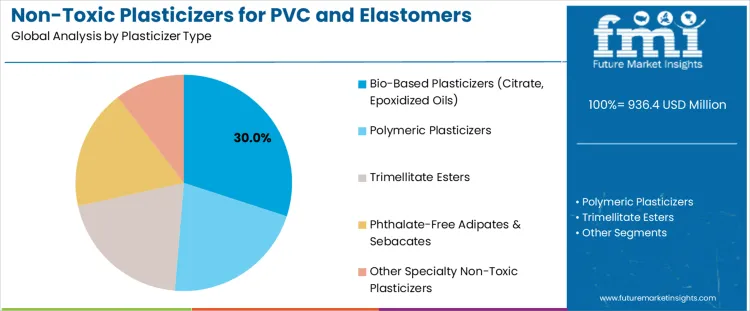
Bio-based plasticizers (citrate, epoxidized oils) are the leading plasticizer type in the non-toxic plasticizers for PVC and elastomers market, capturing 30% of the share. These plasticizers are gaining popularity due to their renewable, non-toxic nature and their ability to provide an eco-friendly alternative to conventional petrochemical-based plasticizers. Bio-based plasticizers, such as citrate esters and epoxidized oils, are derived from natural sources, reducing environmental impact and improving sustainability. As industries increasingly seek to comply with environmental regulations and consumer demand for safer, non-toxic products rises, bio-based plasticizers are becoming the preferred choice, particularly in products like flooring, medical devices, and food packaging. The growing adoption of bio-based alternatives across various industries, coupled with their improved performance in PVC and elastomers, is expected to drive the continued growth of this segment.
What is Driving the Demand for PVC (Polyvinyl Chloride) in the Non-Toxic Plasticizers Market?

PVC (polyvinyl chloride) is the leading application in the non-toxic plasticizers market, holding 42% of the share. The demand for non-toxic plasticizers in PVC is driven by the widespread use of PVC in a variety of products, including flooring, medical devices, and electrical cables. PVC is inherently rigid and brittle, and plasticizers are essential to improve its flexibility, durability, and workability. Non-toxic plasticizers, particularly bio-based and phthalate-free options, are increasingly used in PVC to reduce health and environmental risks associated with traditional plasticizers. As regulatory pressures on the use of harmful chemicals in consumer products increase, PVC manufacturers are adopting safer, non-toxic plasticizer solutions to meet market demands for sustainable and health-conscious products. The shift toward environmentally friendly and non-toxic alternatives, coupled with the versatility and widespread use of PVC, ensures that PVC will remain a dominant application segment for non-toxic plasticizers in the market.
What are the Key Dynamics in the Global Non-Toxic Plasticizers for PVC and Elastomers Market?
The global non toxic plasticizers for PVC and elastomers market is growing as manufacturers shift toward safer, regulatory aligned alternatives to traditional phthalate plasticizers. These non toxic plasticizers help maintain flexibility, durability and performance while minimizing health and environmental concerns. Demand spans construction, medical devices, consumer goods and automotive applications where product safety and compliance with strict chemical standards are priorities. Market expansion reflects increasing regulation on hazardous substances, rising awareness of material safety among brands and end users, and innovation in green chemistry that supports high performance, low risk formulations.
What are the Key Drivers for the Global Non Toxic Plasticizers for PVC and Elastomers Market?
Regulatory pressure on phthalates and other hazardous plasticizers is a major driver shaping this market. Agencies in North America, Europe and parts of Asia are imposing limits on chemical use in sensitive applications such as toys, medical products and food contact materials. Consumer demand for safer, healthier products encourages brands to adopt non toxic plasticizers that align with sustainability and corporate responsibility commitments. Advances in polymer science and green chemistry expand options that deliver comparable flexibility, processing ease and performance. Growth in sectors like healthcare, building infrastructure and wearable devices supports continued adoption of non toxic plasticizer solutions worldwide.
What are the Restraints for the Global Non Toxic Plasticizers for PVC and Elastomers Market?
Challenges in balancing safety and technical performance can restrain market uptake. Some non toxic plasticizers may require reformulation or process adaptation to achieve the same flexibility or low temperature performance as legacy plasticizers, adding development time and cost. Higher raw material costs for bio based or specialty plasticizers can influence pricing in cost sensitive segments. Limited awareness or understanding of alternative plasticizer benefits among smaller converters and formulators affects wider adoption. Variations in regional chemical regulations and acceptance of new plasticizer chemistries create planning complexity for global suppliers and users.
What are the Key Trends in the Global Non Toxic Plasticizers for PVC and Elastomers Market?
Innovation in bio based, renewable feedstock plasticizers is a key trend, aligning product performance with sustainability goals and circular economy principles. Suppliers are developing tailored chemistries designed to integrate seamlessly with existing PVC and elastomer processing lines while delivering reduced health risk profiles. Collaboration among material scientists, brands and regulatory bodies accelerates validation and standardization of non toxic alternatives. Integration of digital tools for material selection and life cycle assessment supports transparent decision making. Growth of eco certification programs and rising consumer emphasis on product safety claims are influencing purchasing and specification of safer plasticizer systems across industries.
What is the Country-Wise Analysis of the Non-Toxic Plasticizers for PVC and Elastomers Market?
The non-toxic plasticizers for PVC and elastomers market is expected to experience steady growth, driven by the increasing demand for safer, more sustainable alternatives to traditional plasticizers. Non-toxic plasticizers, which are used to enhance the flexibility and durability of materials such as PVC and elastomers, are becoming increasingly popular in industries such as construction, automotive, and consumer goods due to growing concerns about the health and environmental impacts of traditional plasticizers like phthalates. High-growth markets such as India and China are witnessing strong demand due to their large manufacturing bases, expanding industries, and increasing regulatory pressure to adopt safer alternatives. Developed markets such as the United States, Germany, and South Korea are also seeing steady growth, supported by growing regulatory frameworks and a rising consumer demand for safer, eco-friendly materials.

| Country | CAGR (2026-2036) |
|---|---|
| India | 9.6% |
| China | 9.3% |
| United States | 7.9% |
| Germany | 7.4% |
| South Korea | 7.1% |
What is the Growth Outlook for the Non-Toxic Plasticizers for PVC and Elastomers Market in India?
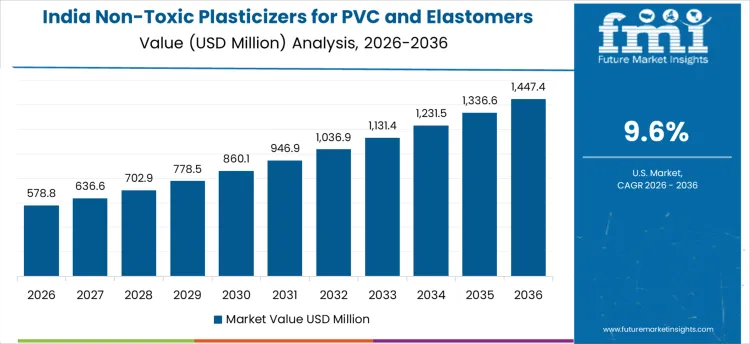
The non-toxic plasticizers for PVC and elastomers market in India is expected to grow at the highest rate, with a projected CAGR of 9.6%. India’s rapidly expanding manufacturing sector, coupled with increasing regulatory pressure to reduce harmful chemical usage, is driving the adoption of non-toxic plasticizers in PVC and elastomer applications. As the country’s industrial base continues to expand, there is a growing demand for materials that are both effective and safe for consumers and workers. The increasing awareness of health and environmental risks associated with traditional plasticizers is leading to higher demand for non-toxic alternatives in industries such as construction, automotive, and packaging. Additionally, India’s growing focus on sustainable practices and eco-friendly materials is further boosting the market for non-toxic plasticizers. As India modernizes its industrial practices, the adoption of non-toxic plasticizers is expected to see rapid growth.
What is the Market Outlook for the Non-Toxic Plasticizers for PVC and Elastomers Market in China?
The non-toxic plasticizers for PVC and elastomers market in China is projected to grow steadily, with a projected CAGR of 9.3%. As China continues to lead the global manufacturing sector, there is a growing focus on adopting safer, more sustainable materials in production processes. The demand for non-toxic plasticizers is rising in the country as stricter regulations are introduced to reduce the harmful effects of traditional plasticizers. Additionally, China’s increasing awareness of environmental sustainability and public health concerns is pushing industries to adopt safer alternatives. With China’s strong emphasis on environmental regulations and the expansion of key sectors such as construction and automotive, the market for non-toxic plasticizers in PVC and elastomers is expected to continue growing, driven by both domestic and international demand for safer, eco-friendly products.
What is the Growth Forecast for the Non-Toxic Plasticizers for PVC and Elastomers Market in the United States?
The non-toxic plasticizers for PVC and elastomers market in the United States is expected to grow steadily, with a projected CAGR of 7.9%. In the U.S., there is a growing demand for sustainable and safe materials, driven by both consumer preferences and regulatory pressures. As the government continues to implement stricter regulations on chemical usage, particularly in industries such as construction, automotive, and healthcare, the demand for non-toxic plasticizers in PVC and elastomer products is increasing. Additionally, rising consumer awareness about the health risks associated with traditional plasticizers, such as phthalates, is driving manufacturers to switch to safer alternatives. The U.S. market is also being supported by the growing emphasis on sustainability and eco-friendly production processes. As industries and consumers continue to prioritize health and environmental safety, the market for non-toxic plasticizers in the U.S. is expected to see steady growth.
What is the Market Outlook for the Non-Toxic Plasticizers for PVC and Elastomers Market in Germany?
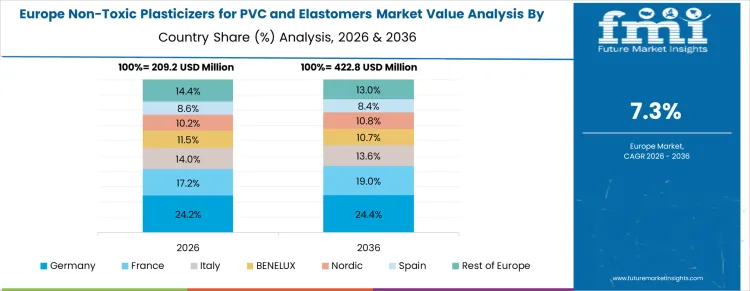
The non-toxic plasticizers for PVC and elastomers market in Germany is projected to grow at a steady pace, with a projected CAGR of 7.4%. Germany’s stringent environmental regulations and strong commitment to sustainability are key drivers of demand for non-toxic plasticizers. The country’s well-established manufacturing sector, particularly in automotive, construction, and healthcare industries, is adopting safer, more sustainable alternatives to traditional plasticizers. As German manufacturers work to meet both domestic and international environmental standards, the adoption of non-toxic plasticizers is becoming increasingly common. Additionally, Germany’s growing focus on reducing chemical exposure and increasing consumer demand for eco-friendly products is supporting market growth. With continued advancements in environmental regulations and an increasing shift towards sustainable practices, Germany’s market for non-toxic plasticizers is expected to grow steadily
What are the Growth Prospects for the Non-Toxic Plasticizers for PVC and Elastomers Market in South Korea?

The non-toxic plasticizers for PVC and elastomers market in South Korea is expected to grow at a moderate pace, with a projected CAGR of 7.1%. South Korea’s growing industrial base and focus on sustainable manufacturing practices are driving the demand for non-toxic plasticizers in key industries such as electronics, automotive, and construction. With increasing awareness of environmental and health concerns surrounding traditional plasticizers, South Korean manufacturers are increasingly adopting safer, eco-friendly alternatives. Additionally, the government’s efforts to regulate the use of harmful chemicals and encourage more sustainable production processes are contributing to the market’s growth. As demand for non-toxic materials rises globally, South Korea is expected to continue adopting these innovations, further supporting the growth of the non-toxic plasticizers market for PVC and elastomers.
What is the Competitive Landscape for the Non-Toxic Plasticizers for PVC and Elastomers Market?
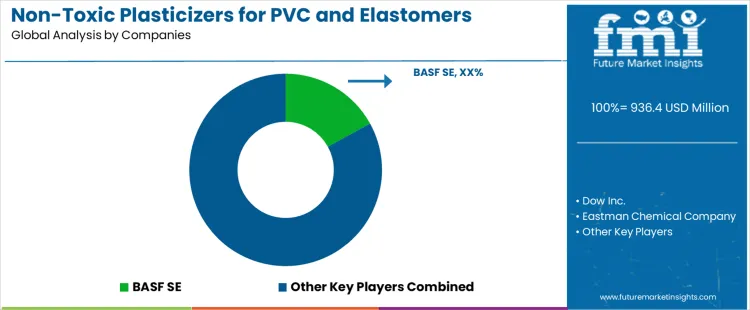
The non-toxic plasticizers for PVC and elastomers market is experiencing significant growth as industries increasingly demand safer, more sustainable alternatives to traditional plasticizers, which are often linked to health risks. BASF SE leads the market with its innovative non-toxic plasticizers, offering high-performance solutions for PVC and elastomer applications that improve flexibility, durability, and safety. Their commitment to sustainability, product quality, and regulatory compliance has positioned them as a dominant player in this sector. Dow Inc., Eastman Chemical Company, and Evonik Industries are key competitors, providing specialized plasticizers designed to enhance the properties of PVC and elastomers while eliminating harmful chemicals. Dow Inc. focuses on advanced non-toxic plasticizers that deliver superior performance, while Eastman Chemical Company and Evonik Industries offer effective solutions that meet the growing demand for safer, eco-friendly plasticizers in various applications.
LANXESS further strengthens the competitive landscape by offering non-toxic plasticizers for PVC and elastomers, focusing on sustainability and performance. LANXESS provides specialized solutions that improve material characteristics while ensuring environmental safety. These companies compete by focusing on product innovation, sustainability, and their ability to meet the increasing regulatory pressure for safer plasticizers in the PVC and elastomer markets. The market is expected to continue evolving as manufacturers strive to meet the growing demand for eco-friendly, non-toxic plasticizers that perform effectively in diverse industrial applications.
Key Players of the Non-Toxic Plasticizers for PVC and Elastomers Market
- BASF SE
- Dow Inc.
- Eastman Chemical Company
- Evonik Industries
- LANXESS
Scope of the Report
| Items | Values |
|---|---|
| Quantitative Units (2026) | USD Million |
| Plasticizer Type | Bio-Based Plasticizers (Citrate, Epoxidized Oils), Polymeric Plasticizers, Trimellitate Esters, Phthalate-Free Adipates & Sebacates, Other Specialty Non-Toxic Plasticizers |
| Application | PVC (Polyvinyl Chloride), Elastomers (NBR, EPDM, CR, etc.), TPU & TPE, Rubber Compounds, Specialty Polymers & Bioplastics |
| Substrate Type | Construction & Building Materials, Automotive & Transportation, Medical & Healthcare Products, Consumer Goods & Packaging, Electrical & Industrial Products |
| Companies | BASF SE, Dow Inc., Eastman Chemical Company, Evonik Industries, LANXESS |
| Regions Covered | North America, Latin America, Western Europe, Eastern Europe, South Asia and Pacific, East Asia, Middle East & Africa |
| Countries Covered | United States, Canada, Mexico, Brazil, Argentina, Germany, France, United Kingdom, Italy, Spain, Netherlands, China, India, Japan, South Korea, ANZ, GCC Countries, South Africa |
| Additional Attributes | Dollar by sales by plasticizer type, application, substrate type, and region. Includes market trends in non-toxic plasticizers, focusing on bio-based plasticizers, polymeric plasticizers, trimellitate esters, and phthalate-free adipates & sebacates. Highlights the role of PVC, elastomers, and rubber compounds in construction, automotive, medical, consumer goods, and industrial products. Focus on sustainability, performance, regulatory compliance, market share, and competitive positioning of key companies in the plasticizers market. |
Non-Toxic Plasticizers for PVC and Elastomers Market Segmentation
Plasticizer Type:
- Bio-Based Plasticizers (Citrate, Epoxidized Oils)
- Polymeric Plasticizers
- Trimellitate Esters
- Phthalate-Free Adipates & Sebacates
- Other Specialty Non-Toxic Plasticizers
Application:
- PVC (Polyvinyl Chloride)
- Elastomers (NBR, EPDM, CR, etc.)
- TPU & TPE
- Rubber Compounds
- Specialty Polymers & Bioplastics
Substrate Type:
- Construction & Building Materials
- Automotive & Transportation
- Medical & Healthcare Products
- Consumer Goods & Packaging
- Electrical & Industrial Products
Region:
- Asia Pacific
- China
- Japan
- South Korea
- India
- Australia & New Zealand
- ASEAN
- Rest of Asia Pacific
- Europe
- Germany
- United Kingdom
- France
- Italy
- Spain
- Nordic
- BENELUX
- Rest of Europe
- North America
- United States
- Canada
- Mexico
- Latin America
- Brazil
- Chile
- Rest of Latin America
- Middle East & Africa
- Kingdom of Saudi Arabia
- Other GCC Countries
- Turkey
- South Africa
- Other African Union
- Rest of Middle East & Africa
Frequently Asked Questions
How big is the non-toxic plasticizers for PVC and elastomers market in 2026?
The global non-toxic plasticizers for PVC and elastomers market is estimated to be valued at USD 936.4 million in 2026.
What will be the size of non-toxic plasticizers for PVC and elastomers market in 2036?
The market size for the non-toxic plasticizers for PVC and elastomers market is projected to reach USD 2,176.5 million by 2036.
How much will be the non-toxic plasticizers for PVC and elastomers market growth between 2026 and 2036?
The non-toxic plasticizers for PVC and elastomers market is expected to grow at a 8.8% CAGR between 2026 and 2036.
What are the key plasticizer types in the non-toxic plasticizers for PVC and elastomers market?
The key plasticizer types in non-toxic plasticizers for PVC and elastomers market are bio-based plasticizers (citrate, epoxidized oils), polymeric plasticizers, trimellitate esters, phthalate-free adipates & sebacates and other specialty non-toxic plasticizers.
Which application segment to contribute significant share in the non-toxic plasticizers for PVC and elastomers market in 2026?
In terms of application, PVC (polyvinyl chloride) segment to command 42.0% share in the non-toxic plasticizers for pvc and elastomers market in 2026.
Preview the report firsthand - request a free sample
Get SampleGet the brochure for pricing and purchase details.
Get PDFTable of Content
- Executive Summary
- Global Market Outlook
- Demand-side Trends
- Supply-side Trends
- Technology Roadmap Analysis
- Analysis and Recommendations
- Market Overview
- Market Coverage / Taxonomy
- Market Definition / Scope / Limitations
- Market Background
- Market Dynamics
- Drivers
- Restraints
- Opportunity
- Trends
- Scenario Forecast
- Demand in Optimistic Scenario
- Demand in Likely Scenario
- Demand in Conservative Scenario
- Opportunity Map Analysis
- Product Life Cycle Analysis
- Supply Chain Analysis
- Investment Feasibility Matrix
- Value Chain Analysis
- PESTLE and Porter’s Analysis
- Regulatory Landscape
- Regional Parent Market Outlook
- Production and Consumption Statistics
- Import and Export Statistics
- Market Dynamics
- Global Market Analysis 2021 to 2025 and Forecast, 2026 to 2036
- Historical Market Size Value (USD Million) Analysis, 2021 to 2025
- Current and Future Market Size Value (USD Million) Projections, 2026 to 2036
- Y-o-Y Growth Trend Analysis
- Absolute $ Opportunity Analysis
- Global Market Pricing Analysis 2021 to 2025 and Forecast 2026 to 2036
- Global Market Analysis 2021 to 2025 and Forecast 2026 to 2036, By Plasticizer Type
- Introduction / Key Findings
- Historical Market Size Value (USD Million) Analysis By Plasticizer Type , 2021 to 2025
- Current and Future Market Size Value (USD Million) Analysis and Forecast By Plasticizer Type , 2026 to 2036
- Bio-Based Plasticizers (Citrate, Epoxidized Oils)
- Polymeric Plasticizers
- Trimellitate Esters
- Phthalate-Free Adipates & Sebacates
- Other Specialty Non-Toxic Plasticizers
- Bio-Based Plasticizers (Citrate, Epoxidized Oils)
- Y-o-Y Growth Trend Analysis By Plasticizer Type , 2021 to 2025
- Absolute $ Opportunity Analysis By Plasticizer Type , 2026 to 2036
- Global Market Analysis 2021 to 2025 and Forecast 2026 to 2036, By Application
- Introduction / Key Findings
- Historical Market Size Value (USD Million) Analysis By Application, 2021 to 2025
- Current and Future Market Size Value (USD Million) Analysis and Forecast By Application, 2026 to 2036
- PVC (Polyvinyl Chloride)
- Elastomers (NBR, EPDM, CR, etc.)
- TPU & TPE
- Rubber Compounds
- Specialty Polymers & Bioplastics
- PVC (Polyvinyl Chloride)
- Y-o-Y Growth Trend Analysis By Application, 2021 to 2025
- Absolute $ Opportunity Analysis By Application, 2026 to 2036
- Global Market Analysis 2021 to 2025 and Forecast 2026 to 2036, By Substrate Type
- Introduction / Key Findings
- Historical Market Size Value (USD Million) Analysis By Substrate Type, 2021 to 2025
- Current and Future Market Size Value (USD Million) Analysis and Forecast By Substrate Type, 2026 to 2036
- Construction & Building Materials
- Automotive & Transportation
- Medical & Healthcare Products
- Consumer Goods & Packaging
- Electrical & Industrial Products
- Construction & Building Materials
- Y-o-Y Growth Trend Analysis By Substrate Type, 2021 to 2025
- Absolute $ Opportunity Analysis By Substrate Type, 2026 to 2036
- Global Market Analysis 2021 to 2025 and Forecast 2026 to 2036, By Region
- Introduction
- Historical Market Size Value (USD Million) Analysis By Region, 2021 to 2025
- Current Market Size Value (USD Million) Analysis and Forecast By Region, 2026 to 2036
- North America
- Latin America
- Western Europe
- Eastern Europe
- East Asia
- South Asia and Pacific
- Middle East & Africa
- Market Attractiveness Analysis By Region
- North America Market Analysis 2021 to 2025 and Forecast 2026 to 2036, By Country
- Historical Market Size Value (USD Million) Trend Analysis By Market Taxonomy, 2021 to 2025
- Market Size Value (USD Million) Forecast By Market Taxonomy, 2026 to 2036
- By Country
- USA
- Canada
- Mexico
- By Plasticizer Type
- By Application
- By Substrate Type
- By Country
- Market Attractiveness Analysis
- By Country
- By Plasticizer Type
- By Application
- By Substrate Type
- Key Takeaways
- Latin America Market Analysis 2021 to 2025 and Forecast 2026 to 2036, By Country
- Historical Market Size Value (USD Million) Trend Analysis By Market Taxonomy, 2021 to 2025
- Market Size Value (USD Million) Forecast By Market Taxonomy, 2026 to 2036
- By Country
- Brazil
- Chile
- Rest of Latin America
- By Plasticizer Type
- By Application
- By Substrate Type
- By Country
- Market Attractiveness Analysis
- By Country
- By Plasticizer Type
- By Application
- By Substrate Type
- Key Takeaways
- Western Europe Market Analysis 2021 to 2025 and Forecast 2026 to 2036, By Country
- Historical Market Size Value (USD Million) Trend Analysis By Market Taxonomy, 2021 to 2025
- Market Size Value (USD Million) Forecast By Market Taxonomy, 2026 to 2036
- By Country
- Germany
- UK
- Italy
- Spain
- France
- Nordic
- BENELUX
- Rest of Western Europe
- By Plasticizer Type
- By Application
- By Substrate Type
- By Country
- Market Attractiveness Analysis
- By Country
- By Plasticizer Type
- By Application
- By Substrate Type
- Key Takeaways
- Eastern Europe Market Analysis 2021 to 2025 and Forecast 2026 to 2036, By Country
- Historical Market Size Value (USD Million) Trend Analysis By Market Taxonomy, 2021 to 2025
- Market Size Value (USD Million) Forecast By Market Taxonomy, 2026 to 2036
- By Country
- Russia
- Poland
- Hungary
- Balkan & Baltic
- Rest of Eastern Europe
- By Plasticizer Type
- By Application
- By Substrate Type
- By Country
- Market Attractiveness Analysis
- By Country
- By Plasticizer Type
- By Application
- By Substrate Type
- Key Takeaways
- East Asia Market Analysis 2021 to 2025 and Forecast 2026 to 2036, By Country
- Historical Market Size Value (USD Million) Trend Analysis By Market Taxonomy, 2021 to 2025
- Market Size Value (USD Million) Forecast By Market Taxonomy, 2026 to 2036
- By Country
- China
- Japan
- South Korea
- By Plasticizer Type
- By Application
- By Substrate Type
- By Country
- Market Attractiveness Analysis
- By Country
- By Plasticizer Type
- By Application
- By Substrate Type
- Key Takeaways
- South Asia and Pacific Market Analysis 2021 to 2025 and Forecast 2026 to 2036, By Country
- Historical Market Size Value (USD Million) Trend Analysis By Market Taxonomy, 2021 to 2025
- Market Size Value (USD Million) Forecast By Market Taxonomy, 2026 to 2036
- By Country
- India
- ASEAN
- Australia & New Zealand
- Rest of South Asia and Pacific
- By Plasticizer Type
- By Application
- By Substrate Type
- By Country
- Market Attractiveness Analysis
- By Country
- By Plasticizer Type
- By Application
- By Substrate Type
- Key Takeaways
- Middle East & Africa Market Analysis 2021 to 2025 and Forecast 2026 to 2036, By Country
- Historical Market Size Value (USD Million) Trend Analysis By Market Taxonomy, 2021 to 2025
- Market Size Value (USD Million) Forecast By Market Taxonomy, 2026 to 2036
- By Country
- Kingdom of Saudi Arabia
- Other GCC Countries
- Turkiye
- South Africa
- Other African Union
- Rest of Middle East & Africa
- By Plasticizer Type
- By Application
- By Substrate Type
- By Country
- Market Attractiveness Analysis
- By Country
- By Plasticizer Type
- By Application
- By Substrate Type
- Key Takeaways
- Key Countries Market Analysis
- USA
- Pricing Analysis
- Market Share Analysis, 2025
- By Plasticizer Type
- By Application
- By Substrate Type
- Canada
- Pricing Analysis
- Market Share Analysis, 2025
- By Plasticizer Type
- By Application
- By Substrate Type
- Mexico
- Pricing Analysis
- Market Share Analysis, 2025
- By Plasticizer Type
- By Application
- By Substrate Type
- Brazil
- Pricing Analysis
- Market Share Analysis, 2025
- By Plasticizer Type
- By Application
- By Substrate Type
- Chile
- Pricing Analysis
- Market Share Analysis, 2025
- By Plasticizer Type
- By Application
- By Substrate Type
- Germany
- Pricing Analysis
- Market Share Analysis, 2025
- By Plasticizer Type
- By Application
- By Substrate Type
- UK
- Pricing Analysis
- Market Share Analysis, 2025
- By Plasticizer Type
- By Application
- By Substrate Type
- Italy
- Pricing Analysis
- Market Share Analysis, 2025
- By Plasticizer Type
- By Application
- By Substrate Type
- Spain
- Pricing Analysis
- Market Share Analysis, 2025
- By Plasticizer Type
- By Application
- By Substrate Type
- France
- Pricing Analysis
- Market Share Analysis, 2025
- By Plasticizer Type
- By Application
- By Substrate Type
- India
- Pricing Analysis
- Market Share Analysis, 2025
- By Plasticizer Type
- By Application
- By Substrate Type
- ASEAN
- Pricing Analysis
- Market Share Analysis, 2025
- By Plasticizer Type
- By Application
- By Substrate Type
- Australia & New Zealand
- Pricing Analysis
- Market Share Analysis, 2025
- By Plasticizer Type
- By Application
- By Substrate Type
- China
- Pricing Analysis
- Market Share Analysis, 2025
- By Plasticizer Type
- By Application
- By Substrate Type
- Japan
- Pricing Analysis
- Market Share Analysis, 2025
- By Plasticizer Type
- By Application
- By Substrate Type
- South Korea
- Pricing Analysis
- Market Share Analysis, 2025
- By Plasticizer Type
- By Application
- By Substrate Type
- Russia
- Pricing Analysis
- Market Share Analysis, 2025
- By Plasticizer Type
- By Application
- By Substrate Type
- Poland
- Pricing Analysis
- Market Share Analysis, 2025
- By Plasticizer Type
- By Application
- By Substrate Type
- Hungary
- Pricing Analysis
- Market Share Analysis, 2025
- By Plasticizer Type
- By Application
- By Substrate Type
- Kingdom of Saudi Arabia
- Pricing Analysis
- Market Share Analysis, 2025
- By Plasticizer Type
- By Application
- By Substrate Type
- Turkiye
- Pricing Analysis
- Market Share Analysis, 2025
- By Plasticizer Type
- By Application
- By Substrate Type
- South Africa
- Pricing Analysis
- Market Share Analysis, 2025
- By Plasticizer Type
- By Application
- By Substrate Type
- USA
- Market Structure Analysis
- Competition Dashboard
- Competition Benchmarking
- Market Share Analysis of Top Players
- By Regional
- By Plasticizer Type
- By Application
- By Substrate Type
- Competition Analysis
- Competition Deep Dive
- BASF SE
- Overview
- Product Portfolio
- Profitability by Market Segments (Product/Age /Sales Channel/Region)
- Sales Footprint
- Strategy Overview
- Marketing Strategy
- Product Strategy
- Channel Strategy
- Dow Inc.
- Eastman Chemical Company
- Evonik Industries
- LANXESS
- BASF SE
- Competition Deep Dive
- Assumptions & Acronyms Used
- Research Methodology


