

- Industry Size (2026)
- USD 1.365 Bn
- Forecast (2036)
- USD 2.22 Bn
- CAGR (2026 to 2036)
- 5%
Epoxy Type Stabilizers Market Size, Market Forecast and Outlook By FMI
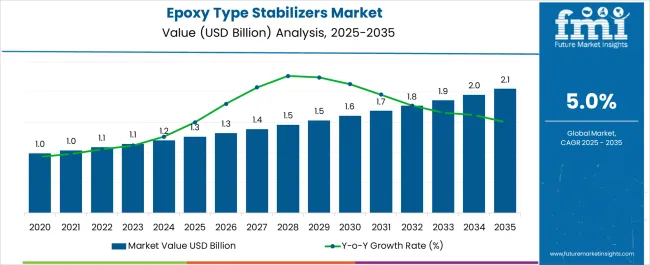
The epoxy type stabilizers market was valued at USD 1.3 billion in 2025, projected to reach USD 1.365 billion in 2026, and is forecast to expand to USD 2.22 billion by 2036 at a 5% CAGR. automotive coating durability requirements requirements and evolving end-use specifications are accelerating adoption across global supply chains. What were once supplementary products have now become integral procurement priorities for buyers managing performance, compliance, and cost objectives simultaneously.
Summary of Epoxy Type Stabilizers Market
- Market Snapshot
- The epoxy type stabilizers market is valued at USD 1.3 billion in 2025 and is projected to reach USD 2.22 billion by 2036.
- The industry is expected to grow at a 5% CAGR from 2026 to 2036, creating an incremental opportunity of USD 0.86 billion.
- The market operates as a specification-driven, compliance-sensitive category where performance differentiation and regulatory alignment define competitive positioning among leading suppliers.
- Demand and Growth Drivers
- Automotive Coating Durability Requirements is creating sustained procurement demand across end-use sectors requiring verified performance against established standards.
- Renewable Energy Composite Protection is expanding the addressable volume base as infrastructure and industrial investment programs accelerate adoption in high-growth regions.
- Regulatory compliance requirements are reshaping formulation and sourcing decisions, driving buyers toward verified supplier relationships and qualified product grades.
- Among key countries, China leads at 6.8% CAGR, India leads at 6.3% CAGR, Germany leads at 5.8% CAGR, with mature markets including Brazil at 5.3%, USA at 4.8%, UK at 4.3%, Japan at 3.8%.
- Product and Segment View
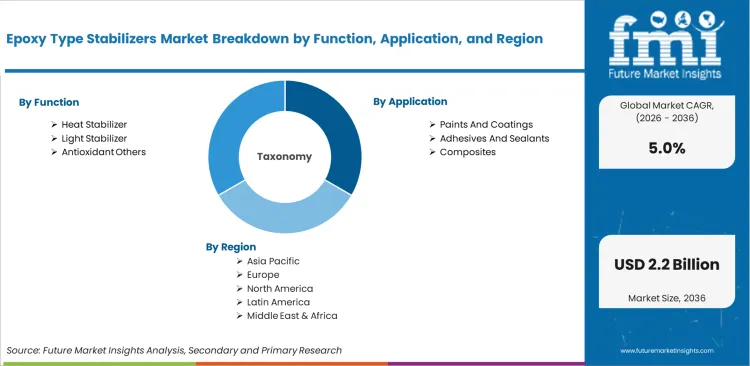
- The market encompasses Heat Stabilizer, Light Stabilizer, Antioxidant Others and related product variants serving diverse application requirements.
- Heat Stabilizer leads by Function with 40% share in 2026, driven by established clinical and industrial adoption pathways.
- Paints And Coatings leads by Application with 35% share, anchored by structural demand from the largest institutional procurement segment.
- Automotive And Transportation leads by End-Use Industry with 25% share, reflecting concentrated end-user procurement in primary institutional channels.
- The scope covers Heat Stabilizer, Light Stabilizer, Antioxidant Others across Paints And Coatings, Adhesives And Sealants, Composites, while excluding unrelated product categories and non-core applications.
- Geography and Competitive Outlook
- China and India are the fastest-growing markets, driven by expanding industrial investment and favourable regulatory frameworks for new product adoption.
- North America and Europe represent mature, high-value demand bases sustained by replacement cycle procurement and performance upgrade requirements.
- Competition is shaped by product qualification barriers, regulatory compliance track records, and supply chain integration capabilities.
- Key companies active in this market include BASF SE, ADEKA CORPORATION, Clariant AG, Akzo Nobel N.V., Huntsman Corporation, Albemarle Corporation, Solvay S.A., Evonik Industries AG, Songwon Industrial Co. Ltd., Kyowa Chemical Industry Co. Ltd..
The absolute dollar increment from 2026 to 2036 reaches USD 0.86 billion, driven by heat stabilizer consumption in automotive underbody coatings and construction joint sealants, with light stabilizer growth accelerating in wind blade composite matrices and solar panel backsheet adhesives. Raw material cost structures for hindered amine light stabilizers remain concentrated among a small group of producers, creating periodic supply constraints that incentivize buyers to qualify multiple sources. Regulatory phase-outs of halogenated co-stabilizers under REACH and EPA programs are redirecting formulation budgets toward epoxy-compatible alternatives that achieve equivalent thermal protection without restricted substance content.
Regional growth trajectories diverge across the forecast period. China advances at a 6.8% CAGR, India advances at a 6.3% CAGR, Germany advances at a 5.8% CAGR as expanding industrial and institutional procurement activity drives new deployment volumes. Brazil tracks at 5.3%, USA tracks at 4.8%, UK tracks at 4.3%, Japan tracks at 3.8%, reflecting mature market infrastructure and replacement-cycle demand patterns. The full country CAGR breakdown spans: China at 6.8%, India at 6.3%, Germany at 5.8%, Brazil at 5.3%, USA at 4.8%, UK at 4.3%, Japan at 3.8%.
Epoxy Type Stabilizers Market Key Takeaways
| Metric | Details |
|---|---|
| Industry Size (2026) | USD 1.365 billion |
| Industry Value (2036) | USD 2.22 billion |
| CAGR (2026-2036) | 5% |
| Source | Future Market Insights, 2026 |
Epoxy Type Stabilizers Market Definition
Epoxy type stabilizers are functional additives incorporated into polymer systems to retard thermal degradation, inhibit photo-oxidation, and neutralize acidic decomposition byproducts that compromise mechanical integrity and colour stability during processing and service life. These stabilizers operate through multiple mechanisms including radical scavenging, UV absorption, and hydroperoxide decomposition. In epoxy resin matrices, they protect crosslinked networks from heat-induced yellowing, surface chalking, and embrittlement across automotive, construction, and industrial coating applications where long-term aesthetic and structural performance must be maintained under variable environmental exposure.
Epoxy Type Stabilizers Market Inclusions
The report covers global and regional market sizing for epoxy type stabilizers segmented by function, application, end-use industry, and geography. Forecast data spans 2026 to 2036 encompassing heat stabilizers, light stabilizers, and antioxidant additives used in paints and coatings, adhesives and sealants, composites, and related polymer processing applications. Regulatory impact analysis, raw material supply chain mapping, and formulation technology assessments are incorporated.
Epoxy Type Stabilizers Market Exclusions
The scope excludes PVC-specific thermal stabilizer systems based on calcium-zinc, lead, or organotin chemistry that serve distinct polymer matrices outside epoxy resin applications. Flame retardant additives, biocides, and plasticizers marketed independently of stabilizer function fall outside the analytical boundary. Non-epoxy polymer stabilization for polyolefins or polyurethanes is excluded.
Epoxy Type Stabilizers Market Research Methodology
- Primary Research: FMI analysts conducted structured interviews with procurement leads, product managers, and technical specialists across the epoxy type stabilizers value chain to capture first-hand market intelligence on pricing trends, product qualification cycles, and demand drivers not available through public data sources.
- Desk Research: Secondary data collection incorporated regulatory filings, government procurement records, trade association publications, peer-reviewed technical literature, and official company disclosures including annual reports, earnings call transcripts, and verified press releases from allowable institutional sources.
- Market-Sizing and Forecasting: Market values are derived through a hybrid bottom-up and top-down methodology combining supply-side production and shipment data with demand-side end-use consumption analysis. Regional forecasts apply segment-specific growth rate inputs validated against macroeconomic and industrial activity benchmarks.
- Data Validation and Update Cycle: All primary interview findings are cross-validated against secondary sources. Quantitative projections are stress-tested against scenario analysis incorporating regulatory, macroeconomic, and supply chain risk inputs. Model outputs are updated on a defined review cycle aligned with material market developments.
Why is the Epoxy Type Stabilizers Market Growing?
The Epoxy Type Stabilizers market is experiencing consistent growth driven by the critical role these stabilizers play in enhancing the thermal and chemical performance of epoxy-based products. The future outlook for this market is shaped by increasing demand from industries requiring durable and high-performance materials, such as automotive, construction, and coatings.
Rising focus on energy-efficient and long-lasting materials has accelerated the adoption of epoxy stabilizers in end-use applications. Continuous advancements in polymer chemistry and formulation technologies have improved the effectiveness and versatility of these stabilizers, allowing manufacturers to meet stringent performance and regulatory standards.
The market is further supported by the growing production of paints, coatings, and composite materials that rely on epoxy formulations for superior stability As industries emphasize sustainability, efficiency, and high-quality output, the demand for epoxy type stabilizers is expected to expand steadily across global markets, providing opportunities for manufacturers to innovate and cater to diverse application needs.
Segmental Analysis
The epoxy type stabilizers market is segmented by function, application, end-use industry, and geographic regions. By function, epoxy type stabilizers market is divided into Heat Stabilizer, Light Stabilizer, and Antioxidant Others. In terms of application, epoxy type stabilizers market is classified into Paints And Coatings, Adhesives And Sealants, and Composites. Based on end-use industry, epoxy type stabilizers market is segmented into Automotive And Transportation, Building And Construction, Food And Beverages, Packaging, Renewable Energy And Power Generation (Wind Blade Composite Material), Marine, Electrical And Electronics, and Others. Regionally, the epoxy type stabilizers industry is classified into North America, Latin America, Western Europe, Eastern Europe, Balkan & Baltic Countries, Russia & Belarus, Central Asia, East Asia, South Asia & Pacific, and the Middle East & Africa.
Insights into the Heat Stabilizer Function Segment
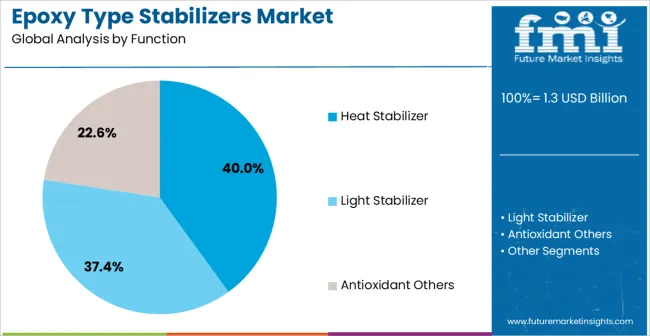
The heat stabilizer function segment is projected to hold 40.0% of the Epoxy Type Stabilizers market revenue share in 2026, establishing it as the leading function. This dominance is attributed to the increasing demand for thermally stable epoxy products across various industries, where high-temperature resistance is critical.
The growth has been reinforced by advancements in stabilizer formulations that enhance material longevity, prevent degradation, and improve process efficiency. Heat stabilizers are widely adopted in epoxy-based composites, coatings, and adhesives, where performance under prolonged exposure to heat is essential.
Additionally, regulatory standards for safety and material durability have encouraged manufacturers to integrate heat stabilizers into epoxy formulations The versatility of heat stabilizers to be used across different manufacturing processes and product types has further solidified their leading position in the market.
Insights into the Paints and Coatings Application Segment
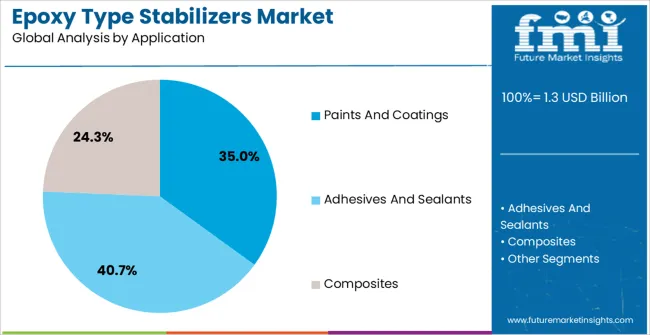
The paints and coatings application segment is expected to account for 35.0% of the Epoxy Type Stabilizers market revenue in 2026, making it the dominant application. This growth is driven by the rising demand for high-performance coatings that provide enhanced durability, corrosion resistance, and aesthetic appeal.
Epoxy stabilizers improve the thermal and chemical stability of coatings, ensuring long-lasting performance even in harsh environmental conditions. The adoption of epoxy-based paints and coatings has been reinforced by increasing construction activities, industrial infrastructure development, and maintenance requirements across commercial and industrial facilities.
Moreover, growing awareness of protective coatings and sustainable materials has accelerated the use of epoxy stabilizers in the paints and coatings industry Their ability to improve adhesion, durability, and resistance to chemical degradation further supports the segment’s leading market share.
Insights into the Automotive and Transportation End-Use Industry Segment
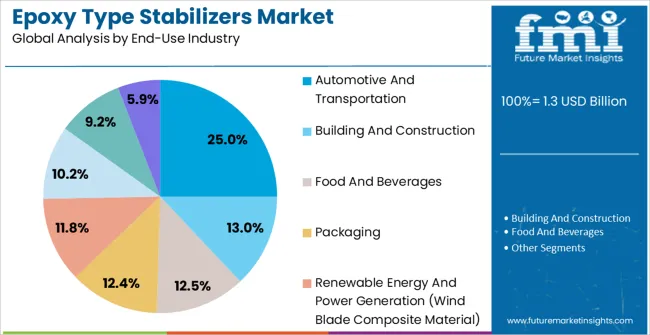
The automotive and transportation end-use industry segment is anticipated to hold 25.0% of the Epoxy Type Stabilizers market revenue in 2026, making it a leading end-use sector. The growth of this segment is driven by the rising use of epoxy-based composites and coatings in vehicles to enhance thermal stability, mechanical strength, and corrosion resistance.
Epoxy stabilizers enable manufacturers to meet stringent industry standards for safety, durability, and performance, which are critical in automotive and transportation applications. Additionally, the increasing production of electric and hybrid vehicles, which require advanced material solutions for batteries, insulation, and protective coatings, has accelerated the adoption of epoxy stabilizers in this sector.
The focus on lightweight, high-performance materials in vehicles to improve fuel efficiency and sustainability has also contributed to the segment’s market dominance.
Market Overview
Epoxy Type Stabilizers Market Overview 2026 - 2036
Stabilizers play a significant role in enhancing the appearance and physical properties of polymer materials. However, with growing demand for better stabilizers from various industries, consumers have shifted their focus towards epoxy type stabilizers.
Epoxy type stabilizers are advanced stabilizers featuring superior adhesiveness due to the presence of epoxy group. They are compatible with a wide range of polymers and are being increasingly used across various applications on account of their ability to enhance strength, thermal stability and corrosion resistance of materials.
Rising adoption of epoxy stabilizers for improving the aesthetic features of various products is providing impetus to the growth of epoxy type stabilizers. These types of stabilizers extend the life span of substrates by protecting them from decay, corrosion and UV light induced distortion. Moreover, they provide higher gloss retention of substrates and significantly decrease blistering and crack formation.
The epoxy-based coatings, paints, and sealants often turn yellow and chalk due to excessive heat and sunlight. In order to minimize and eliminate this, epoxy type stabilizers are being increasingly utilized. This will continue to boost their sales during the forecast period.
Analysis of Epoxy Type Stabilizers Market By Key Countries
.webp "Top Country Growth Comparison Epoxy Type Stabilizers Market Cagr (2026 2036)")
| Country | CAGR |
|---|---|
| China | 6.8% |
| India | 6.3% |
| Germany | 5.8% |
| Brazil | 5.3% |
| USA | 4.8% |
| UK | 4.3% |
| Japan | 3.8% |
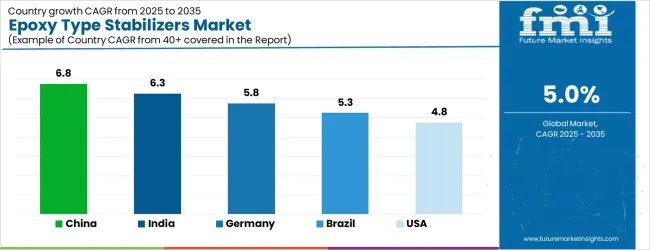
The Epoxy Type Stabilizers Market is expected to register a CAGR of 5.0% during the forecast period, exhibiting varied country level momentum. China leads with the highest CAGR of 6.8%, followed by India at 6.3%. Developed markets such as Germany, France, and the UK continue to expand steadily, while the USA is likely to grow at consistent rates. Japan posts the lowest CAGR at 3.8%, yet still underscores a broadly positive trajectory for the global Epoxy Type Stabilizers Market. In 2026, Germany held a dominant revenue in the Western Europe market and is expected to grow with a CAGR of 5.8%. The USA Epoxy Type Stabilizers Market is estimated to be valued at USD 455.9 million in 2026 and is anticipated to reach a valuation of USD 455.9 million by 2036. Sales are projected to rise at a CAGR of 4.8% over the forecast period between 2026 and 2036. While Japan and South Korea markets are estimated to be valued at USD 69.1 million and USD 38.6 million respectively in 2026.
Key Players in the Epoxy Type Stabilizers Market
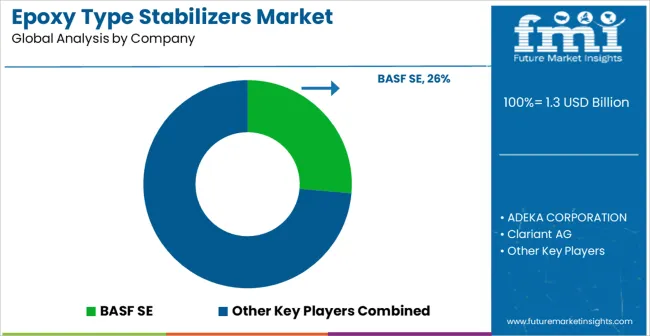
- BASF SE
- ADEKA CORPORATION
- Clariant AG
- Akzo Nobel N.V.
- Huntsman Corporation
- Albemarle Corporation
- Solvay S.A.
- Evonik Industries AG
- Songwon Industrial Co.Ltd.
- Kyowa Chemical Industry Co.Ltd.
Scope of the Report
| Metric | Value |
|---|---|
| Quantitative Units | USD 1.365 billion to USD 2.22 billion, at a CAGR of 5% |
| Market Definition | Epoxy type stabilizers are functional additives incorporated into polymer systems to retard thermal degradation, inhibit photo-oxidation, and neutralize acidic decomposition byproducts that compromise... |
| Function Segmentation | Heat Stabilizer, Light Stabilizer, Antioxidant Others |
| Application Segmentation | Paints And Coatings, Adhesives And Sealants, Composites |
| End-Use Industry Segmentation | Automotive And Transportation, Building And Construction, Food And Beverages, Packaging, Renewable Energy And Power Generation, Marine, Electrical And Electronics, Others |
| Regions Covered | North America, Latin America, Europe, East Asia, South Asia, Oceania, Middle East & Africa |
| Countries Covered | China, India, Germany, Brazil, USA, UK, Japan, and 40 plus countries |
| Key Companies Profiled | BASF SE, ADEKA CORPORATION, Clariant AG, Akzo Nobel N.V., Huntsman Corporation, Albemarle Corporation, Solvay S.A., Evonik Industries AG, Songwon Industrial Co. Ltd., Kyowa Chemical Industry Co. Ltd. |
| Forecast Period | 2026 to 2036 |
| Approach | Hybrid bottom-up and top-down forecasting model validated against primary research and public institutional data sources |
Epoxy Type Stabilizers Market by Segments
Function:
- Heat Stabilizer
- Light Stabilizer
- Antioxidant Others
Application:
- Paints And Coatings
- Adhesives And Sealants
- Composites
End-Use Industry:
- Automotive And Transportation
- Building And Construction
- Food And Beverages
- Packaging
- Renewable Energy And Power Generation (Wind Blade Composite Material)
- Marine
- Electrical And Electronics
- Others
Region:
- North America
- USA
- Canada
- Mexico
- Latin America
- Brazil
- Chile
- Rest of Latin America
- Western Europe
- Germany
- UK
- Italy
- Spain
- France
- Nordic
- BENELUX
- Rest of Western Europe
- Eastern Europe
- Russia
- Poland
- Hungary
- Balkan & Baltic
- Rest of Eastern Europe
- East Asia
- China
- Japan
- South Korea
- South Asia and Pacific
- India
- ASEAN
- Australia & New Zealand
- Rest of South Asia and Pacific
- Middle East & Africa
- Kingdom of Saudi Arabia
- Other GCC Countries
- Turkiye
- South Africa
- Other African Union
- Rest of Middle East & Africa
Bibliography
- 1. World Health Organization. (2025). Model List of Essential Medicines, 23rd edition. WHO Press.
- 2. Organisation for Economic Co-operation and Development. (2025). Health at a Glance 2025: OECD Indicators. OECD Publishing.
- 3. European Medicines Agency. (2025). Guidelines on similar biological medicinal products. EMA/CHMP/BWP/247713/2012.
- 4. United States Food and Drug Administration. (2025). Guidance for Industry: Scientific Considerations in Demonstrating Biosimilarity to a Reference Product. FDA.
- 5. World Bank Group. (2025). World Development Indicators: Health, Nutrition and Population. World Bank.
- 6. International Energy Agency. (2025). World Energy Outlook 2025. IEA Publications.
- 7. United Nations Industrial Development Organization. (2025). Industrial Development Report 2025. UNIDO.
This bibliography is provided for reader reference. The full Future Market Insights report contains the complete reference list with primary research documentation.
Frequently Asked Questions
How large is the demand for Epoxy Type Stabilizers in the global market in 2026?
Demand for epoxy type stabilizers in the global market is estimated to be valued at USD 1.365 billion in 2026.
What will the market size of Epoxy Type Stabilizers be by 2036?
The epoxy type stabilizers market is projected to reach USD 2.22 billion by 2036, reflecting sustained demand growth across primary end-use segments throughout the forecast period.
What is the expected CAGR for the Epoxy Type Stabilizers market between 2026 and 2036?
The epoxy type stabilizers market is expected to grow at a CAGR of 5% between 2026 and 2036, generating an incremental opportunity of USD 0.86 billion over the forecast period.
Which Function segment is poised to lead global sales in 2026?
Heat Stabilizer accounts for 40% of function segment share in 2026, supported by established adoption patterns and strong institutional procurement demand.
Which Application segment leads the Epoxy Type Stabilizers market?
Paints And Coatings holds 35% share by application in 2026, reflecting its position as the primary end-use driver with the most concentrated procurement volumes.
Which country records the fastest growth in the Epoxy Type Stabilizers market?
China records the highest CAGR at 6.8% through 2036, driven by automotive coating durability requirements and expanding industrial procurement activity.
What does FMI forecast for the Epoxy Type Stabilizers market?
As per FMI analysis, the epoxy type stabilizers market is forecast to grow from USD 1.365 billion in 2026 to USD 2.22 billion by 2036, driven by automotive coating durability requirements and renewable energy composite protection across key regional markets.
Preview the report firsthand - request a free sample
Get SampleGet the brochure for pricing and purchase details.
Get PDFTable of Content
- Executive Summary
- Global Market Outlook
- Demand-side Trends
- Supply-side Trends
- Technology Roadmap Analysis
- Analysis and Recommendations
- Market Overview
- Market Coverage / Taxonomy
- Market Definition / Scope / Limitations
- Research Methodology
- Chapter Orientation
- Analytical Lens and Working Hypotheses
- Market Structure, Signals, and Trend Drivers
- Benchmarking and Cross-market Comparability
- Market Sizing, Forecasting, and Opportunity Mapping
- Research Design and Evidence Framework
- Desk Research Programme (Secondary Evidence)
- Company Annual and Sustainability Reports
- Peer-reviewed Journals and Academic Literature
- Corporate Websites, Product Literature, and Technical Notes
- Earnings Decks and Investor Briefings
- Statutory Filings and Regulatory Disclosures
- Technical White Papers and Standards Notes
- Trade Journals, Industry Magazines, and Analyst Briefs
- Conference Proceedings, Webinars, and Seminar Materials
- Government Statistics Portals and Public Data Releases
- Press Releases and Reputable Media Coverage
- Specialist Newsletters and Curated Briefings
- Sector Databases and Reference Repositories
- FMI Internal Proprietary Databases and Historical Market Datasets
- Subscription Datasets and Paid Sources
- Social Channels, Communities, and Digital Listening Inputs
- Additional Desk Sources
- Expert Input and Fieldwork (Primary Evidence)
- Primary Modes
- Qualitative Interviews and Expert Elicitation
- Quantitative Surveys and Structured Data Capture
- Blended Approach
- Why Primary Evidence is Used
- Field Techniques
- Interviews
- Surveys
- Focus Groups
- Observational and In-context Research
- Social and Community Interactions
- Stakeholder Universe Engaged
- C-suite Leaders
- Board Members
- Presidents and Vice Presidents
- R&D and Innovation Heads
- Technical Specialists
- Domain Subject-matter Experts
- Scientists
- Physicians and Other Healthcare Professionals
- Governance, Ethics, and Data Stewardship
- Research Ethics
- Data Integrity and Handling
- Primary Modes
- Tooling, Models, and Reference Databases
- Desk Research Programme (Secondary Evidence)
- Data Engineering and Model Build
- Data Acquisition and Ingestion
- Cleaning, Normalisation, and Verification
- Synthesis, Triangulation, and Analysis
- Quality Assurance and Audit Trail
- Market Background
- Market Dynamics
- Drivers
- Restraints
- Opportunity
- Trends
- Scenario Forecast
- Demand in Optimistic Scenario
- Demand in Likely Scenario
- Demand in Conservative Scenario
- Opportunity Map Analysis
- Product Life Cycle Analysis
- Supply Chain Analysis
- Investment Feasibility Matrix
- Value Chain Analysis
- PESTLE and Porter’s Analysis
- Regulatory Landscape
- Regional Parent Market Outlook
- Production and Consumption Statistics
- Import and Export Statistics
- Market Dynamics
- Global Market Analysis 2021 to 2025 and Forecast, 2026 to 2036
- Historical Market Size Value (USD Million) Analysis, 2021 to 2025
- Current and Future Market Size Value (USD Million) Projections, 2026 to 2036
- Y-o-Y Growth Trend Analysis
- Absolute $ Opportunity Analysis
- Global Market Pricing Analysis 2021 to 2025 and Forecast 2026 to 2036
- Global Market Analysis 2021 to 2025 and Forecast 2026 to 2036, By Function
- Introduction / Key Findings
- Historical Market Size Value (USD Million) Analysis By Function , 2021 to 2025
- Current and Future Market Size Value (USD Million) Analysis and Forecast By Function , 2026 to 2036
- Heat Stabilizer
- Light Stabilizer
- Antioxidant Others
- Heat Stabilizer
- Y-o-Y Growth Trend Analysis By Function , 2021 to 2025
- Absolute $ Opportunity Analysis By Function , 2026 to 2036
- Global Market Analysis 2021 to 2025 and Forecast 2026 to 2036, By Application
- Introduction / Key Findings
- Historical Market Size Value (USD Million) Analysis By Application, 2021 to 2025
- Current and Future Market Size Value (USD Million) Analysis and Forecast By Application, 2026 to 2036
- Paints And Coatings
- Adhesives And Sealants
- Composites
- Paints And Coatings
- Y-o-Y Growth Trend Analysis By Application, 2021 to 2025
- Absolute $ Opportunity Analysis By Application, 2026 to 2036
- Global Market Analysis 2021 to 2025 and Forecast 2026 to 2036, By End-Use Industry
- Introduction / Key Findings
- Historical Market Size Value (USD Million) Analysis By End-Use Industry, 2021 to 2025
- Current and Future Market Size Value (USD Million) Analysis and Forecast By End-Use Industry, 2026 to 2036
- Automotive And Transportation
- Building And Construction
- Food And Beverages
- Packaging
- Renewable Energy And Power Generation
- Marine
- Electrical And Electronics
- Others
- Automotive And Transportation
- Y-o-Y Growth Trend Analysis By End-Use Industry, 2021 to 2025
- Absolute $ Opportunity Analysis By End-Use Industry, 2026 to 2036
- Global Market Analysis 2021 to 2025 and Forecast 2026 to 2036, By Region
- Introduction
- Historical Market Size Value (USD Million) Analysis By Region, 2021 to 2025
- Current Market Size Value (USD Million) Analysis and Forecast By Region, 2026 to 2036
- North America
- Latin America
- Western Europe
- Eastern Europe
- East Asia
- South Asia and Pacific
- Middle East & Africa
- Market Attractiveness Analysis By Region
- North America Market Analysis 2021 to 2025 and Forecast 2026 to 2036, By Country
- Historical Market Size Value (USD Million) Trend Analysis By Market Taxonomy, 2021 to 2025
- Market Size Value (USD Million) Forecast By Market Taxonomy, 2026 to 2036
- By Country
- USA
- Canada
- Mexico
- By Function
- By Application
- By End-Use Industry
- By Country
- Market Attractiveness Analysis
- By Country
- By Function
- By Application
- By End-Use Industry
- Key Takeaways
- Latin America Market Analysis 2021 to 2025 and Forecast 2026 to 2036, By Country
- Historical Market Size Value (USD Million) Trend Analysis By Market Taxonomy, 2021 to 2025
- Market Size Value (USD Million) Forecast By Market Taxonomy, 2026 to 2036
- By Country
- Brazil
- Chile
- Rest of Latin America
- By Function
- By Application
- By End-Use Industry
- By Country
- Market Attractiveness Analysis
- By Country
- By Function
- By Application
- By End-Use Industry
- Key Takeaways
- Western Europe Market Analysis 2021 to 2025 and Forecast 2026 to 2036, By Country
- Historical Market Size Value (USD Million) Trend Analysis By Market Taxonomy, 2021 to 2025
- Market Size Value (USD Million) Forecast By Market Taxonomy, 2026 to 2036
- By Country
- Germany
- UK
- Italy
- Spain
- France
- Nordic
- BENELUX
- Rest of Western Europe
- By Function
- By Application
- By End-Use Industry
- By Country
- Market Attractiveness Analysis
- By Country
- By Function
- By Application
- By End-Use Industry
- Key Takeaways
- Eastern Europe Market Analysis 2021 to 2025 and Forecast 2026 to 2036, By Country
- Historical Market Size Value (USD Million) Trend Analysis By Market Taxonomy, 2021 to 2025
- Market Size Value (USD Million) Forecast By Market Taxonomy, 2026 to 2036
- By Country
- Russia
- Poland
- Hungary
- Balkan & Baltic
- Rest of Eastern Europe
- By Function
- By Application
- By End-Use Industry
- By Country
- Market Attractiveness Analysis
- By Country
- By Function
- By Application
- By End-Use Industry
- Key Takeaways
- East Asia Market Analysis 2021 to 2025 and Forecast 2026 to 2036, By Country
- Historical Market Size Value (USD Million) Trend Analysis By Market Taxonomy, 2021 to 2025
- Market Size Value (USD Million) Forecast By Market Taxonomy, 2026 to 2036
- By Country
- China
- Japan
- South Korea
- By Function
- By Application
- By End-Use Industry
- By Country
- Market Attractiveness Analysis
- By Country
- By Function
- By Application
- By End-Use Industry
- Key Takeaways
- South Asia and Pacific Market Analysis 2021 to 2025 and Forecast 2026 to 2036, By Country
- Historical Market Size Value (USD Million) Trend Analysis By Market Taxonomy, 2021 to 2025
- Market Size Value (USD Million) Forecast By Market Taxonomy, 2026 to 2036
- By Country
- India
- ASEAN
- Australia & New Zealand
- Rest of South Asia and Pacific
- By Function
- By Application
- By End-Use Industry
- By Country
- Market Attractiveness Analysis
- By Country
- By Function
- By Application
- By End-Use Industry
- Key Takeaways
- Middle East & Africa Market Analysis 2021 to 2025 and Forecast 2026 to 2036, By Country
- Historical Market Size Value (USD Million) Trend Analysis By Market Taxonomy, 2021 to 2025
- Market Size Value (USD Million) Forecast By Market Taxonomy, 2026 to 2036
- By Country
- Kingdom of Saudi Arabia
- Other GCC Countries
- Turkiye
- South Africa
- Other African Union
- Rest of Middle East & Africa
- By Function
- By Application
- By End-Use Industry
- By Country
- Market Attractiveness Analysis
- By Country
- By Function
- By Application
- By End-Use Industry
- Key Takeaways
- Key Countries Market Analysis
- USA
- Pricing Analysis
- Market Share Analysis, 2025
- By Function
- By Application
- By End-Use Industry
- Canada
- Pricing Analysis
- Market Share Analysis, 2025
- By Function
- By Application
- By End-Use Industry
- Mexico
- Pricing Analysis
- Market Share Analysis, 2025
- By Function
- By Application
- By End-Use Industry
- Brazil
- Pricing Analysis
- Market Share Analysis, 2025
- By Function
- By Application
- By End-Use Industry
- Chile
- Pricing Analysis
- Market Share Analysis, 2025
- By Function
- By Application
- By End-Use Industry
- Germany
- Pricing Analysis
- Market Share Analysis, 2025
- By Function
- By Application
- By End-Use Industry
- UK
- Pricing Analysis
- Market Share Analysis, 2025
- By Function
- By Application
- By End-Use Industry
- Italy
- Pricing Analysis
- Market Share Analysis, 2025
- By Function
- By Application
- By End-Use Industry
- Spain
- Pricing Analysis
- Market Share Analysis, 2025
- By Function
- By Application
- By End-Use Industry
- France
- Pricing Analysis
- Market Share Analysis, 2025
- By Function
- By Application
- By End-Use Industry
- India
- Pricing Analysis
- Market Share Analysis, 2025
- By Function
- By Application
- By End-Use Industry
- ASEAN
- Pricing Analysis
- Market Share Analysis, 2025
- By Function
- By Application
- By End-Use Industry
- Australia & New Zealand
- Pricing Analysis
- Market Share Analysis, 2025
- By Function
- By Application
- By End-Use Industry
- China
- Pricing Analysis
- Market Share Analysis, 2025
- By Function
- By Application
- By End-Use Industry
- Japan
- Pricing Analysis
- Market Share Analysis, 2025
- By Function
- By Application
- By End-Use Industry
- South Korea
- Pricing Analysis
- Market Share Analysis, 2025
- By Function
- By Application
- By End-Use Industry
- Russia
- Pricing Analysis
- Market Share Analysis, 2025
- By Function
- By Application
- By End-Use Industry
- Poland
- Pricing Analysis
- Market Share Analysis, 2025
- By Function
- By Application
- By End-Use Industry
- Hungary
- Pricing Analysis
- Market Share Analysis, 2025
- By Function
- By Application
- By End-Use Industry
- Kingdom of Saudi Arabia
- Pricing Analysis
- Market Share Analysis, 2025
- By Function
- By Application
- By End-Use Industry
- Turkiye
- Pricing Analysis
- Market Share Analysis, 2025
- By Function
- By Application
- By End-Use Industry
- South Africa
- Pricing Analysis
- Market Share Analysis, 2025
- By Function
- By Application
- By End-Use Industry
- USA
- Market Structure Analysis
- Competition Dashboard
- Competition Benchmarking
- Market Share Analysis of Top Players
- By Regional
- By Function
- By Application
- By End-Use Industry
- Competition Analysis
- Competition Deep Dive
- BASF SE
- Overview
- Product Portfolio
- Profitability by Market Segments (Product/Age /Sales Channel/Region)
- Sales Footprint
- Strategy Overview
- Marketing Strategy
- Product Strategy
- Channel Strategy
- ADEKA CORPORATION
- Clariant AG
- Akzo Nobel N.V.
- Huntsman Corporation
- Albemarle Corporation
- Solvay S.A.
- Evonik Industries AG
- Songwon Industrial Co.Ltd.
- Kyowa Chemical Industry Co.Ltd.
- BASF SE
- Competition Deep Dive
- Assumptions & Acronyms Used


