

- Industry Size (2025)
- USD 2.7 Bn
- Forecast (2035)
- USD 12.9 Bn
- CAGR (2025 to 2035)
- 16.9%
Multi-Layer Anti-Icing and De-Icing Coating Systems for Regional Jets Market Forecast and Outlook 2026 to 2036
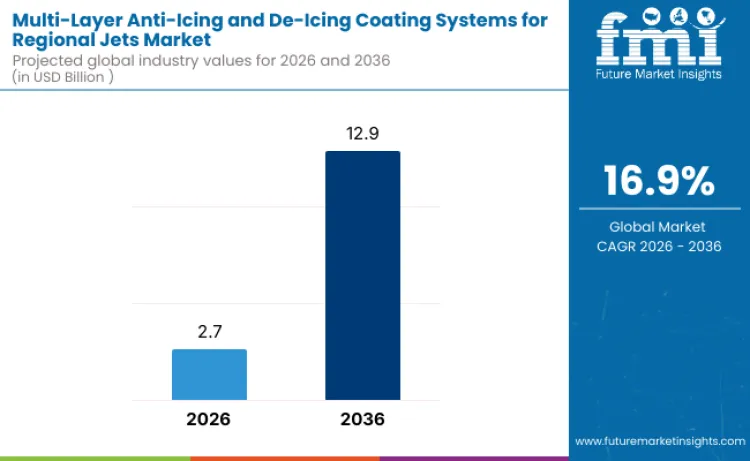
The multi-layer anti-icing and de-icing coating systems for regional jets market is valued at USD 2.7 billion in 2026 and is projected to reach USD 12.9 billion by 2036, reflecting a CAGR of 16.9%. Demand increases as regional jet fleets operate in diverse climatic zones requiring robust ice-mitigation solutions to maintain aerodynamic efficiency and reduce reliance on energy-intensive thermal systems. Airlines and OEMs adopt advanced coating architectures to lower operational costs and improve safety margins during winter operations.
Multi-layer hydrophobic + ice-phobic coating stacks lead coating-structure adoption because layered systems deliver enhanced water repellency, reduced ice adhesion, and improved durability under cyclic weather exposure. Nanostructured top layers minimize ice nucleation, while underlayers improve mechanical resilience and compatibility with composite and metallic substrates. Rapid-cure and spray-friendly chemistries enable efficient MRO application.
Quick Stats for Multi-Layer Anti-Icing and De-Icing Coating Systems for Regional Jets Market
- Market Value (2026): USD 2.7 billion
- Market Forecast Value (2036): USD 12.9 billion
- Market Forecast CAGR (2026-2036): 16.9%
- Leading Coating Structure in Global Demand: Multi-layer hydrophobic + ice-phobic coating stacks
- Key Growth Regions in Global Demand: China, India, USA, Japan
- Top Players in Global Demand: PPG Aerospace, AkzoNobel, Mankiewicz, 3M, BASF
China, India, USA, and Japan act as key growth regions due to expanding regional jet deployments, rising flight frequencies, and modernization initiatives across regional carriers. PPG Aerospace, AkzoNobel, Mankiewicz, 3M, and BASF drive competitive progress with multi-functional ice-phobic coatings, engineered surface textures, and advanced polymer systems designed to mitigate icing risks and maintain performance across high-cycle regional jet operations.
Multi-Layer Anti-Icing and De-Icing Coating Systems for Regional Jets Market Key Takeaways
| Metric | Value |
|---|---|
| Market Value (2026) | USD 2.7 billion |
| Market Forecast Value (2036) | USD 12.9 billion |
| Forecast CAGR (2026-2036) | 16.9% |
How Are the Segments Classified in the Multi-Layer Anti-Icing and De-Icing Coating Systems for Regional Jets Market?
Demand for advanced anti-icing and de-icing coatings for regional jets is shaped by safety requirements, efficiency targets, and the need to reduce reliance on traditional fluid-based de-icing. Buyers evaluate multi-layer architectures, passive ice-phobic performance, conductive heating capability, and durability in high-shear aerodynamic environments. Adoption patterns reflect operational exposure to icing conditions, regulatory compliance expectations, and interest in hybrid coatings that combine passive and active ice-management mechanisms.
Which Coating Structure Accounts for the Largest Share of Global Demand?
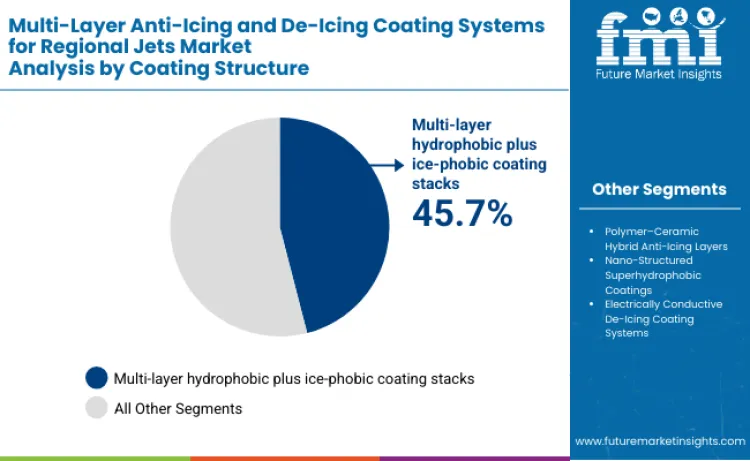
Multi-layer hydrophobic plus ice-phobic coating stacks hold 45.7%, making them the leading coating-structure segment globally. These stacks integrate surface-energy modification with layered durability to limit ice nucleation and reduce adhesion across wing and nacelle surfaces. Polymer-ceramic hybrid anti-icing layers provide improved abrasion resistance and temperature stability. Nano-structured superhydrophobic coatings support extreme water repellency but require protection from erosion in flight. Electrically conductive de-icing coatings support Joule heating for active ice removal in severe weather. Structure distribution reflects emphasis on multi-layer stacks that combine durability with reliable passive anti-icing performance.
Key Points:
- Multi-layer stacks combine hydrophobicity with structural durability.
- Polymer-ceramic hybrids improve abrasion and thermal resistance.
- Nano-structured coatings enhance repellency with erosion limits.
- Conductive coatings support active ice removal through heating.
Which Functional Mechanism Represents the Largest Share of Global Demand?
Passive anti-icing through surface-energy modification holds 43.9%, making it the largest functional mechanism segment. These coatings reduce the likelihood of ice formation by minimizing water adhesion and delaying freezing onset. Active de-icing systems using conductive or Joule heating support real-time ice removal during severe icing encounters. Phase-change assisted systems use embedded components that lower ice-adhesion strength when exposed to temperature shifts. Self-healing anti-icing coatings restore surface properties after microdamage from rain, debris, or operational wear. Mechanism distribution reflects operator interest in passive systems that reduce energy use and improve consistency.
Key Points:
- Passive systems reduce initial ice formation through surface-energy control.
- Active heating enables real-time de-icing in harsh conditions.
- Phase-change systems reduce bond strength for easier ice shedding.
- Self-healing systems maintain long-term coating performance.
Which Application Area Accounts for the Largest Share of Global Demand?
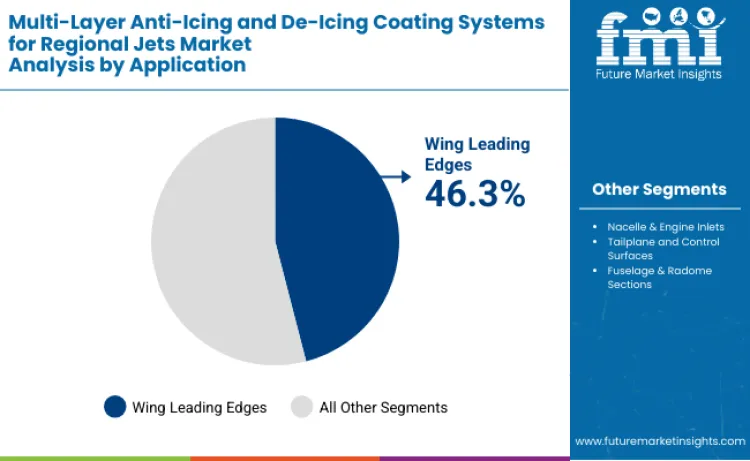
Wing leading edges hold 46.3%, making them the leading application-area segment globally. These surfaces experience highest aerodynamic sensitivity and icing exposure, requiring robust anti-icing and de-icing performance. Nacelle and engine inlets require coatings that support airflow integrity and prevent ice ingestion risks. Tailplane and control surfaces depend on coatings that maintain stability and prevent performance degradation during icing events. Fuselage and radome sections require coatings that reduce ice accumulation but face lower aerodynamic penalties. Application distribution reflects critical operational importance of wing leading-edge protection.
Key Points:
- Wing leading edges face highest icing exposure and aerodynamic risk.
- Nacelle and inlet coatings support airflow stability and safety.
- Tailplane surfaces require consistent anti-icing for control authority.
- Fuselage and radome coatings reduce accumulation with lower drag impact.
What are the Key Dynamics in the Multi-Layer Anti-Icing and De-Icing Coating Systems for Regional Jets Market?
Global demand rises as regional jet operators, OEMs, and maintenance providers evaluate advanced coating architectures designed to prevent ice accretion and reduce reliance on traditional thermal or pneumatic systems. Multi-layer coatings integrate hydrophobic, conductive, and abrasion-resistant layers that support continuous protection across varied climates. Interest grows as airlines seek operational efficiency, improved safety margins, and lower de-icing fluid consumption during winter operations at regional airports.
How are operational efficiency goals and icing risk management shaping adoption of multi-layer coating systems?
Regional jets face frequent exposure to icing conditions during ascent, descent, and low-altitude cruise phases. Operators evaluate coatings that combine passive ice-shedding layers with active conductive layers capable of low-energy heat generation. Engineers design systems to maintain aerodynamic smoothness while reducing ice buildup on wings, nacelles, and stabilisers. Airlines value reduced gate delays linked to de-icing processes. OEMs integrate coatings compatible with composite structures used in newer regional aircraft. Testing programs assess performance under freezing rain, frost events, and supercooled droplets. Interest increases as coatings demonstrate durability across repeated icing cycles typical of winter-intensive regional routes.
How do certification complexity, durability requirements, and maintenance integration influence scalability?
Aerospace certification demands extensive validation of coating performance under thermal, mechanical, and environmental loads, extending development timelines. Coatings must maintain adhesion, conductivity, and hydrophobicity after prolonged UV exposure, hydraulic fluid contact, and abrasion from particulate impacts. Maintenance organizations require application methods compatible with existing MRO cycles, including predictable recoat intervals. Electrical components in active layers must integrate safely with aircraft power systems. Regional airports with harsh winter climates create additional performance constraints. Cost considerations arise from specialized materials and labour-intensive application. Regulatory differences across jurisdictions influence adoption pathways for operators seeking multi-layer anti-icing upgrades.
How is Demand for Multi-Layer Anti-Icing and De-Icing Coating Systems for Regional Jets Market Evolving Across Key Countries?
Demand for the multi-layer anti-icing and de-icing coating systems for regional jets market is rising due to stricter aviation safety requirements, interest in energy-efficient ice-mitigation technologies, and broader adoption of advanced surface-engineering materials. China records a CAGR of 18.4% supported by rapid regional-aviation expansion. India shows a 17.8% CAGR driven by increased regional-route development. USA posts a 16.6% CAGR supported by strong aerospace R&D activity. Japan holds a 15.5% CAGR linked with precision coating capabilities. UK records a 14.9% CAGR supported by aviation-efficiency and safety-compliance initiatives.
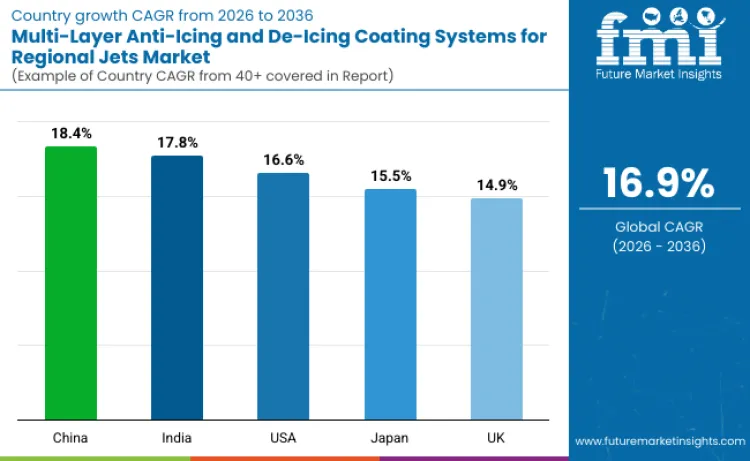
| Country | CAGR (%) |
|---|---|
| China | 18.4% |
| India | 17.8% |
| USA | 16.6% |
| Japan | 15.5% |
| UK | 14.9% |
How is China driving demand for Multi-Layer Anti-Icing and De-Icing Coating Systems for Regional Jets?
China drives demand due to expansion of regional aviation networks, increased aircraft-production activity, and interest in advanced ice-mitigation systems improving fuel and operational efficiency. The country’s CAGR of 18.4% reflects adoption of multi-layer coatings combining hydrophobic, thermal, and abrasion-resistant functionalities. Aerospace manufacturers integrate engineered coatings into wing and engine-inlet components to reduce reliance on traditional thermal de-icing systems. Research organizations develop polymer-nanocomposite structures supporting enhanced durability. Airlines evaluate coating-based approaches to improve performance during operations in humid, frost-prone regions. National aviation-technology programs reinforce long-term adoption.
- Increased regional-aircraft deployment
- Multi-layer coating integration improving operational efficiency
- R&D activity focused on nanocomposite coating structures
- Airline evaluation of coating-based anti-icing strategies
How is India driving demand for Multi-Layer Anti-Icing and De-Icing Coating Systems for Regional Jets?
India supports rising demand due to expansion of regional connectivity programs, operations in diverse climatic zones, and increased emphasis on aviation safety. The country’s CAGR of 17.8% reflects evaluation of multi-layer coatings designed to limit ice accretion on wing surfaces and leading edges. Aerospace institutions test hydrophobic-thermal hybrid coatings suitable for cold-region airports. Airlines examine coating-based mitigation to reduce energy use from conventional de-icing systems. Growth in domestic aircraft maintenance capabilities supports adoption of specialized coating technologies. Government aviation initiatives strengthen interest in reliability-enhancing surface treatments.
- Regional connectivity expansion increasing exposure to cold-weather routes
- Testing of hydrophobic-thermal hybrid coatings
- Airlines interested in reducing energy-intensive de-icing operations
- MRO expansion supporting integration of advanced coatings
How is the USA driving demand for Multi-Layer Anti-Icing and De-Icing Coating Systems for Regional Jets?
USA drives demand through strong aerospace R&D investment, advanced material-science capabilities, and high operational exposure to icing conditions. The country’s CAGR of 16.6% reflects extensive development of multi-layer coatings engineered for durability, ice-shedding efficiency, and compatibility with composite aircraft structures. Research programs refine hydrophobic, low-surface-energy, and thermally active layers. Regional carriers evaluate coatings to reduce turnaround delays in winter-intensive routes. Defense aviation programs test similar technologies, accelerating commercial transfer. Certification-focused development supports industry-wide adoption.
- Advanced multi-layer coating R&D
- Strong demand for improved winter-route performance
- Evaluation of coatings reducing turnaround delays
- Defense-commercial technology transfer supporting adoption
How is Japan driving demand for Multi-Layer Anti-Icing and De-Icing Coating Systems for Regional Jets?
Japan drives demand due to precision engineering standards, exposure to winter-weather operations, and increased emphasis on long-term coating durability. The country’s CAGR of 15.5% reflects controlled testing of multi-layer coatings designed to improve ice resistance while maintaining aerodynamics and structural integrity. Materials research institutes develop hybrid polymer-ceramic coatings suited for repeated freeze-thaw cycles. Regional airlines assess coating solutions for operations in northern regions. Aerospace manufacturers integrate durability testing protocols to validate long-term performance.
- Development of hybrid polymer-ceramic ice-resistant coatings
- Regional-airline operations requiring improved ice management
- Precision durability testing supporting adoption
- Focus on maintaining aerodynamic consistency under icing loads
How is the UK driving demand for Multi-Layer Anti-Icing and De-Icing Coating Systems for Regional Jets?
UK supports demand through national aerospace-innovation programs, research emphasis on energy-efficient ice-mitigation technologies, and operational exposure to moist, low-temperature environments. The country’s CAGR of 14.9% reflects adoption of multi-layer coatings improving ice-shedding and reducing reliance on legacy thermal systems. Research institutions evaluate environmentally robust formulations with improved adhesion control. Airlines consider coating-based systems to reduce operational delays in winter months. National aviation-efficiency targets reinforce development of advanced surface technologies for regional aircraft fleets.
- Aerospace-innovation programs strengthening coating development
- Evaluation of environmentally robust multi-layer coatings
- Airline interest in reducing winter-weather delays
- Efficiency and sustainability targets supporting adoption
What is the competitive landscape of demand for multi-layer anti-icing and de-icing coating systems for regional jets globally?
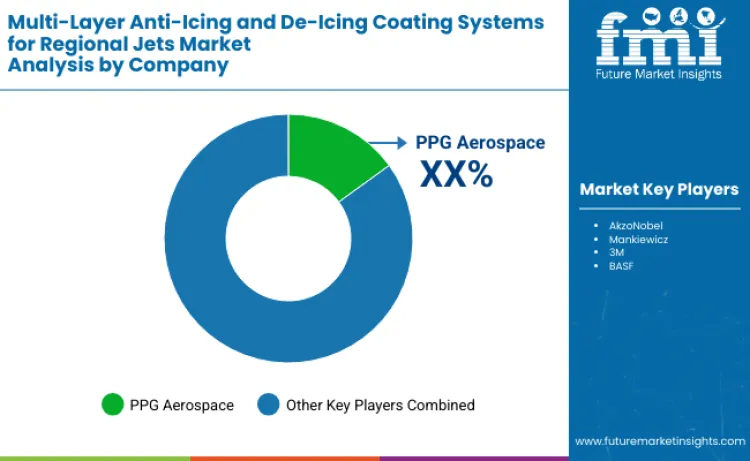
Demand for multi-layer anti-icing and de-icing coating systems for regional jets grows as operators and OEMs pursue reduced glycol usage, improved cold-weather reliability, and extended protection for exposed aerodynamic surfaces. Requirements center on hydrophobic and ice-phobic top layers, erosion-resistant intermediates, and adhesion-promoting primers compatible with composite and metallic substrates. Buyers evaluate coating durability under repeated freeze-thaw cycles, resistance to particulate erosion, and stability across varied humidity and temperature conditions. Procurement teams prioritize certification pathways, maintenance interval predictability, and application compatibility with MRO workflows. Trend in the global market reflects stronger interest in passive ice-mitigation systems supporting efficiency objectives and reduced ground de-icing dependence.
PPG Aerospace holds an estimated 25% share. Position strengthens through certified aerospace coatings integrating erosion resistance and controlled surface-energy behavior suitable for ice-mitigation applications. AkzoNobel participates with aviation coating systems offering anti-ice characteristics and proven exterior durability. Mankiewicz maintains visibility through multi-layer aerospace coatings designed for performance stability on regional jet fuselages and wing structures. 3M contributes engineered films and surface-modification materials supporting ice adhesion reduction. BASF supports demand with specialty polymers and functional coating components incorporated into multi-layer systems used by aerospace suppliers. Competitive positioning globally reflects coating system durability, ice adhesion reduction capability, certification status, and compatibility with regional jet maintenance programs.
Key Players in the Multi-Layer Anti-Icing and De-Icing Coating Systems for Regional Jets Market
- PPG Aerospace
- AkzoNobel
- Mankiewicz
- 3M
- BASF
Scope of the Report
| Items | Values |
|---|---|
| Quantitative Units | USD billion |
| Coating Structure | Multi-Layer Hydrophobic + Ice-Phobic Coating Stacks; Polymer-Ceramic Hybrid Anti-Icing Layers; Nano-Structured Superhydrophobic Coatings; Electrically Conductive De-Icing Coating Systems |
| Functional Mechanism | Passive Anti-Icing (Surface Energy Modification); Active De-Icing (Conductive / Joule Heating); Phase-Change Assisted Low-Ice Adhesion Systems; Self-Healing Anti-Icing Coatings |
| Application Area | Wing Leading Edges; Nacelle & Engine Inlets; Tailplane and Control Surfaces; Fuselage & Radome Sections |
| End-User | Regional Jet OEMs; Aircraft Maintenance & MRO Providers; Tier-1 Aerospace Component Manufacturers; Coating Material Producers |
| Regions Covered | Asia Pacific, Europe, North America, Latin America, Middle East & Africa |
| Countries Covered | India, China, USA, Germany, South Korea, Japan, Italy, and 40+ countries |
| Key Companies Profiled | PPG Aerospace, AkzoNobel, Mankiewicz, 3M, BASF |
| Additional Attributes | Dollar sales by coating structure and functional mechanism; technology readiness levels for active and passive anti-icing systems; adoption by regional jet OEM production lines and MRO retrofit programs; integration with thermal and electrothermal de-icing systems; performance evaluation under FAA/EASA icing certification protocols; advancements in nano-coating durability and erosion resistance for high-cycling regional aircraft operations. |
Multi-Layer Anti-Icing and De-Icing Coating Systems for Regional Jets Market by Segment
By Coating Structure:
- Multi-Layer Hydrophobic + Ice-Phobic Coating Stacks
- Polymer-Ceramic Hybrid Anti-Icing Layers
- Nano-Structured Superhydrophobic Coatings
- Electrically Conductive De-Icing Coating Systems
By Functional Mechanism:
- Passive Anti-Icing (Surface Energy Modification)
- Active De-Icing (Conductive / Joule Heating)
- Phase-Change Assisted Low-Ice Adhesion Systems
- Self-Healing Anti-Icing Coatings
By Application Area:
- Wing Leading Edges
- Nacelle & Engine Inlets
- Tailplane and Control Surfaces
- Fuselage & Radome Sections
By End-User:
- Regional Jet OEMs
- Aircraft Maintenance & MRO Providers
- Tier-1 Aerospace Component Manufacturers
- Coating Material Producers
Region:
- Asia Pacific
- China
- Japan
- South Korea
- India
- Australia & New Zealand
- ASEAN
- Rest of Asia Pacific
- Europe
- Germany
- United Kingdom
- France
- Italy
- Spain
- Nordic
- BENELUX
- Rest of Europe
- North America
- United States
- Canada
- Mexico
- Latin America
- Brazil
- Chile
- Rest of Latin America
- Middle East & Africa
- Kingdom of Saudi Arabia
- Other GCC Countries
- Turkey
- South Africa
- Other African Union
- Rest of Middle East & Africa
Frequently Asked Questions
What is the size of the multi-layer anti-icing and de-icing coating systems for regional jets market in 2026?
The market is valued at USD 2.7 billion in 2026 due to increased need for coatings that minimize ice formation on aircraft surfaces.
What will be the industry size by 2036?
Industry value will reach USD 12.9 billion by 2036 as airlines adopt advanced anti-icing coatings to improve operational reliability and reduce de-icing fluid usage.
What is the CAGR for 2026–2036?
The multi-layer anti-icing and de-icing coating systems for regional jets market expands at a 16.9% CAGR during the forecast period.
Which coating-structure segment leads in 2026?
Multi-layer hydrophobic plus ice-phobic coating stacks hold 45.7% share due to their layered performance benefits in minimizing ice adhesion.
Which functional-mechanism segment holds the highest share?
Passive anti-icing through surface-energy modification leads with 43.9% share, supported by reduced energy requirements and compatibility with existing airframe surfaces.
Preview the report firsthand - request a free sample
Get SampleGet the brochure for pricing and purchase details.
Get PDFTable of Content
- Executive Summary
- Market Overview
- Global Market Value, 2020-2026
- Global Market Forecast, 2026-2036
- Market Dynamics
- Drivers
- Restraints
- Opportunities
- Regulatory & Standards Landscape
- Anti-Icing and De-Icing Technology Outlook
- Market Segmentation Analysis
- By Coating Structure
- Multi-Layer Hydrophobic + Ice-Phobic Coating Stacks
- Polymer-Ceramic Hybrid Anti-Icing Layers
- Nano-Structured Superhydrophobic Coatings
- Electrically Conductive De-Icing Coating Systems
- By Functional Mechanism
- Passive Anti-Icing (Surface Energy Modification)
- Active De-Icing (Conductive / Joule Heating)
- Phase-Change Assisted Low-Ice Adhesion Systems
- Self-Healing Anti-Icing Coatings
- By Application Area
- Wing Leading Edges
- Nacelle & Engine Inlets
- Tailplane and Control Surfaces
- Fuselage & Radome Sections
- By Coating Structure
- Regional Outlook
- North America
- Latin America
- Western Europe
- Eastern Europe
- South Asia & Pacific
- East Asia
- Middle East & Africa
- Country-Level Outlook
- United States
- Canada
- Mexico
- Brazil
- Argentina
- Germany
- France
- United Kingdom
- Italy
- Spain
- Netherlands
- China
- India
- Japan
- South Korea
- ANZ
- GCC Countries
- South Africa
- Competitive Landscape
- Market Structure Overview
- Company Positioning
- Strategic Initiatives
- Key Player Profiles
- Scope of the Report
- Research Methodology
- Assumptions & Acronyms


