

- Industry Size (2026)
- USD 2.12 Bn
- Forecast (2036)
- USD 10.38 Bn
- CAGR (2026 to 2036)
- 17.2%
Skin Analysis Mobile Apps Market Size, Market Forecast and Outlook By FMI
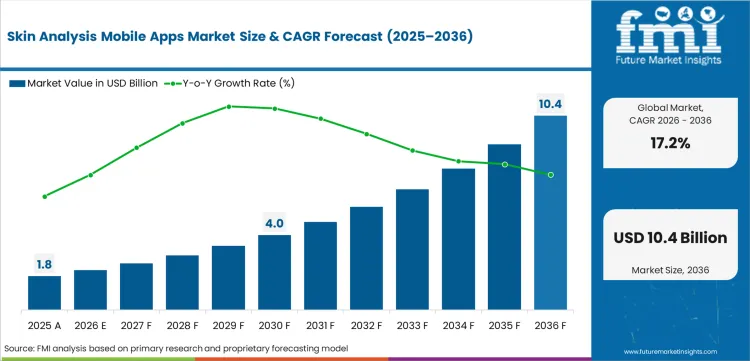
In 2025, the AI skin analysis market reached USD 1.82 billion. The sector is set to reach USD 2.12 billion in 2026, progressing at a 17.2% CAGR. By 2036, advancing algorithmic precision is projected to drive the market toward USD 10.38 billion, accelerating the transition away from traditional clinical imaging tools. Dermatology clinic directors respecifying their patient intake protocols are integrating teledermatology tools to eliminate non-critical physical consultations. This architectural pivot forces skincare brand executives to embed diagnostic capabilities into their direct-to-consumer portals. Consumers evaluating their daily routines reject generic skincare products that lack personalized efficacy data.
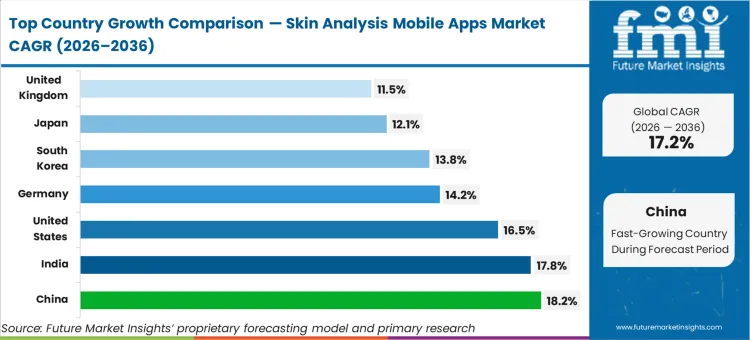
Rapid integration of AI diagnostic tools into dominant e-commerce ecosystems propels the China market at an 18.2% CAGR through 2036. India follows closely, exhibiting a 17.8% CAGR as increasing smartphone penetration democratizes rural access to crucial teledermatology services. High consumer spending dedicated to preventive skincare and wellness regimens sustains a 16.5% CAGR in the United States. Germany advances at a 14.2% rate, anchored strictly by rigorous data privacy standards governing its robust cosmetic dermatology sector. The South Korea market registers a 13.8% CAGR, resulting from its highly mature beauty tech ecosystem and the normalized early adoption of smart diagnostic mirrors.
Summary of Skin Analysis Mobile Apps Market
- Skin Analysis Mobile Apps Market Definition
- Skin Analysis Mobile Apps are digital software platforms utilizing artificial intelligence and machine learning to evaluate epidermal health through high-resolution smartphone imaging. These tools function as primary diagnostic filters to identify concerns such as acne, hyperpigmentation, and aging signs.
- Demand Drivers in the Market
- The convergence of retail and healthcare forces beauty brands to deploy mobile software capable of delivering clinical-grade analysis directly to the consumer.
- The high-speed production of personalized serums mandates low-latency API synchronization between skin scanning apps and automated formulation devices.
- Strict data privacy compliance timelines compel software developers to replace unsecured image processing networks with cryptographically protected application architectures.
- Key Segments Analyzed in the FMI Report
- Personalized Skincare Apps: 52.1% share in 2026, reflecting a massive consumer shift toward habit-tracking and data-backed cosmetic routines.
- Home Users: 48.5% share in 2026, as individuals standardize on mobile diagnostics to manage daily regimens without frequent professional consultations.
- China: 18.2% compound growth driven by major e-commerce platforms deploying unified AI diagnostic networking topologies from initial application blueprints.
- Analyst Opinion at FMI
- Ronak Shah, Principal Consultant for Consumer Product, opines: Digital dermatology product managers attempting to bridge the gap between cosmetic vanity filters and medical diagnostics face a severe algorithmic reality. Applications relying on generic facial recognition libraries rather than clinically annotated dermatological datasets consistently misclassify benign pigmentation as inflammatory acne. This false-positive rate directly destroys user retention. Software developers who do not secure proprietary, diverse dermatological image datasets for machine learning training will find their applications unable to clear impending FDA pre-certification thresholds. Brand executives prioritizing user interface design over diagnostic accuracy face complete disqualification from clinical-adjacent healthcare integrations before the next software update cycle.
- Strategic Implications / Executive Takeaways
- Mobile application developers must secure third-party clinical validation to qualify for impending integration contracts with Tier-1 dermatology clinic networks.
- Beauty brand strategy directors should phase out generic product quizzes and mandate native AI diagnostic support in all new direct-to-consumer application deployments.
- Systems integrators must develop specialized data encryption competencies to prove HIPAA compliance during the enterprise commissioning phase.
- Methodology
- Primary Research: FMI conducted detailed technical interviews with digital health product managers and clinical dermatology software engineers across 40 countries to validate diagnostic adoption timelines.
- Desk Research: Analysts aggregated public standards documentation from medical device compliance registries and national telehealth infrastructure grant programs.
- Market-Sizing and Forecasting: The model applies a bottom-up methodology starting with global installed base metrics for active health tracking users and projecting conversion rates to diagnostic platforms.
Skin Analysis Mobile Apps Market Key Takeaways
| Metric | Details |
|---|---|
| Industry Size (2026) | USD 2.12 billion |
| Industry Value (2036) | USD 10.38 billion |
| CAGR (2026-2036) | 17.2% |
Driven by an aging population seeking non-invasive anti-aging monitoring, Japan captures a 12.1% CAGR. The United Kingdom is poised for an 11.5% CAGR as eco-friendly, energy-efficient smart testers gain permanent traction in professional salons. Ultimately, grouped mature economies generate steady replacement demand primarily through advanced software updates rather than new application downloads, with regulatory scrutiny acting as the core structural constraint.
Skin Analysis Mobile Apps Market Definition
Skin Analysis Mobile Apps operate as advanced software platforms utilizing artificial intelligence and machine learning to evaluate epidermal health via high-resolution mobile imaging. These digital tools function as the primary diagnostic filter, accurately identifying acute concerns such as acne, hyperpigmentation, and visible aging signs. The primary industrial function of these platforms is to generate real-time, objective data that facilitates hyper-personalized product recommendations or expedites clinical triage protocols. Home users represent the dominant end-use demographic, routinely utilizing these applications to manage daily regimens and track longitudinal dermatological progress without requiring physical clinic visits.
Skin Analysis Mobile Apps Market Inclusions
The report details global and regional market sizing for mobile-integrated skin diagnostic tools throughout the 2026 to 2036 forecast period. The scope includes comprehensive breakdowns by application type (spanning wellness and medical orientations), operating platform (Android and iOS), and specific end-user segments. Critical analytical dimensions-including subscription pricing models, AI algorithm accuracy validation rates, and shifting teledermatology trade flows, are fully incorporated within the research scope.
Skin Analysis Mobile Apps Market Exclusions
The analytical scope explicitly excludes standard enterprise hardware networks and non-deterministic medical hardware that lacks native mobile synchronization capabilities. The valuation also completely omits downstream finished skincare products such as physical moisturizers or serums, focusing strictly on the digital diagnostic software and its immediate application interfaces. Furthermore, related but distinct product categories, such as hardware-only desktop skin analyzers, are omitted unless they feature verified native mobile application bridging protocols.
Skin Analysis Mobile Apps Market Research Methodology
- Primary Research: FMI analysts engaged directly with digital health specification leads, clinical software engineers, and principal automation architects to map the specific decision gates triggering application protocol upgrades across the beauty tech sector.
- Desk Research: The data collection phase aggregated compliance roadmaps from global health data foundations, medical software ratification schedules, and major cosmetic OEM vendor deployment guidelines.
- Market-Sizing and Forecasting: The baseline valuation derives from a rigorous bottom-up aggregation of diagnostic software deployments, applying region-specific digital modernization curves to project future adoption velocity accurately.
- Data Validation and Update Cycle: All forward-looking projections are rigorously stress-tested against publicly reported digital capital expenditure guidance from the leading discrete manufacturing and health-tech automation conglomerates.
Segmental Analysis
Skin Analysis Mobile Apps Market Analysis by App Type
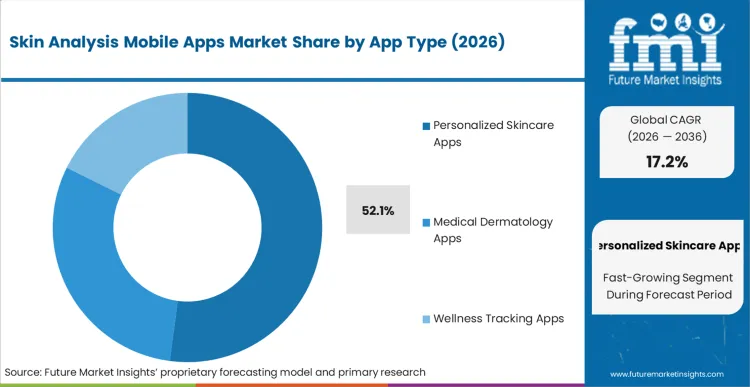
Personalized Skincare Apps emerge as the dominant application type, expected to represent 52.1% of total market share in 2026, by offering an immediate interface for consumers to manage chronic conditions like acne. Retail brand executives recognize that static product catalogs fail to convert data-driven younger demographics who demand empirical proof of efficacy. Incorporating digital health tracking apps directly into the purchasing flow eliminates the subjective guesswork that causes high product return rates. Software vendors unable to supply certified diagnostic accuracy risk exclusion from the next wave of corporate cosmetic application overhauls.
- Data ingestion capabilities: Health software engineers integrate real-time environmental APIs to adjust daily product recommendations based on local UV indices and pollution levels.
- Cross-platform ecosystem integration: Lead developers utilize advanced mobile application development platform tools to ensure seamless diagnostic parity across distinct operating systems.
- Monetization mechanics: Product managers deploy freemium subscription models to lock users into recurring revenue streams for premium dermatological progress tracking.
Skin Analysis Mobile Apps Market Analysis by End Use
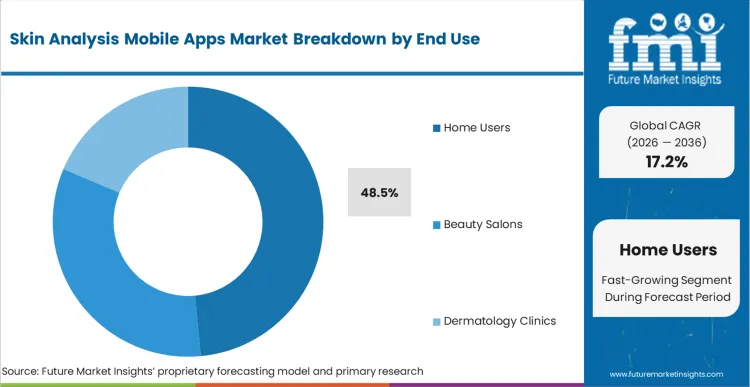
Every digital health product manager bidding on enterprise application contracts now faces strict adherence criteria for remote diagnostic accuracy. Home Users represent a leading 48.5% segment share in 2026. Individuals managing maintenance routines reject traditional physical clinic visits that introduce scheduling delays into their care cycles. FMI analysts opine that flattening the triage architecture directly enables real-time complexion analysis system interventions from residential bathrooms. Software suppliers failing to demonstrate intuitive user interfaces for non-technical home users lose priority status in critical retail partnership upgrade cycles.
- Augmented reality integration: Application architects embed smart mirror synchronization protocols to provide real-time facial analysis mapping without requiring handheld device manipulation.
- Clinical triage escalation: Developers establish secure communication bridges to allow high-risk diagnostic flags to route directly to certified dermatologists for professional secondary review.
- Hardware substitution: The deployment of sophisticated computer vision algorithms natively replaces bulky desktop dermatology lasers analysis units previously required for basic epidermal evaluation.
Skin Analysis Mobile Apps Market Analysis by Platform
Prior reliance on fragmented operating system architectures caused significant synchronization drift for users switching between devices. The standardization of cross-platform cloud processing resolves this fundamental disconnect. Android and iOS platforms capture the remaining market share by establishing unified analytical engines that process high-resolution images regardless of the local hardware limitations. As per FMI's projection, integrating telehealth and telemedicine backend infrastructure guarantees that patient data remains accessible across disparate operating ecosystems. Development teams operating without cross-platform parity face systemic adoption errors as user bases fracture along device lines.
- Cloud processing offload: Systems architects push heavy machine learning computational loads to remote servers to compensate for inherent hardware constraints on budget mobile devices.
- Camera API optimization: Software engineers write specific integration codes to extract raw, uncompressed image data directly from device sensors to prevent beauty filters from skewing diagnostic results.
- Security protocol compliance: Network leads encrypt local image storage to comply with international health data residency requirements before any cloud transmission occurs.
Skin Analysis Mobile Apps Market Drivers, Restraints, and Opportunities
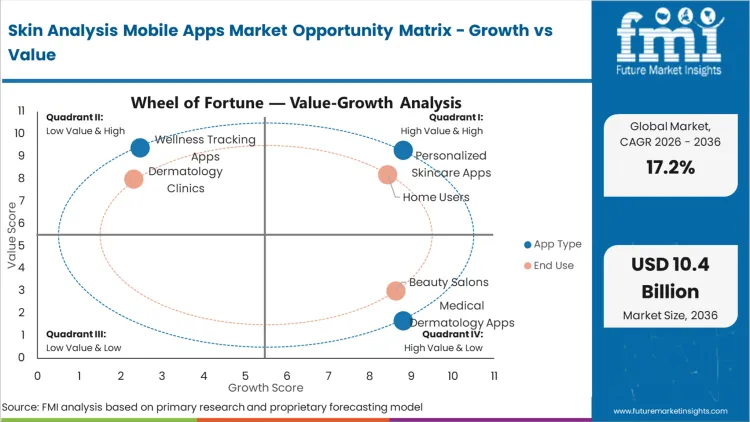
The convergence of clinical dermatology standards and consumer retail applications forces digital product managers to extract actionable health data directly from user smartphones. This architectural requirement renders generic augmented reality vanity filters obsolete. Skincare brands upgrading their digital presence face a strict binary choice between deploying complex diagnostic tools or overhauling their entire direct-to-consumer infrastructure. Transitioning to a unified ai dermatology imaging backbone simplifies user acquisition and enables direct cloud connectivity for advanced longitudinal analytics. Application publishers that fail to modernize their core analytical layers risk operational blind spots and reduced overall consumer lifetime value.
The intricate machine learning models required to optimize diagnostic accuracy across diverse skin tones create steep development learning curves for traditional cosmetic brands. Designing bias-free neural networks across global user bases demands specialized data science expertise that most retail beauty companies lack internally. FMI's analysis indicates that to mitigate this skill gap, digital transformation directors increasingly rely on established mobile application testing solutions to validate algorithm fairness before physical deployment.
- Robotic Formulation Synchronization: Next-generation diagnostic applications enable formulation chemists to transmit customized ingredient ratios directly to automated compounding machines. This capability prevents active ingredient degradation by ensuring 3d printed skincare products are manufactured precisely upon user demand.
- Environmental Data Overlay: Upgraded application programming interfaces permit data scientists to correlate localized atmospheric pollution metrics with individual epidermal barrier health. This diagnostic depth prevents environmental stressors from compromising daily treatment efficacy.
- Longitudinal Efficacy Tracking: Clinical research planners integrating distributed patient data require precise photographic progression metrics. Objective algorithmic scoring provides the microsecond accuracy necessary to validate new cosmetic active ingredients across decentralized trial populations.
Regional Analysis
Based on the regional analysis, the Skin Analysis Mobile Apps market is segmented into North America, Latin America, Europe, East Asia, South Asia, Oceania and Middle East & Africa across 40+ countries. The full report also offers market attractiveness analysis based on regional trends.
.webp "Top Country Growth Comparison Skin Analysis Mobile Apps Market Cagr (2026 2036)")
| Country | CAGR (2026 to 2036) |
|---|---|
| China | 18.2% |
| India | 17.8% |
| United States | 16.5% |
| Germany | 14.2% |
| South Korea | 13.8% |
| Japan | 12.1% |
| United Kingdom | 11.5% |
Source: Future Market Insights (FMI) analysis, based on proprietary forecasting model and primary research
Asia Pacific Skin Analysis Mobile Apps Market Analysis
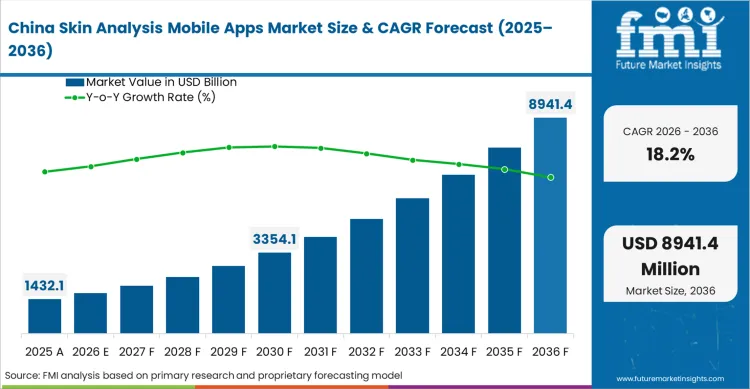
Greenfield digital infrastructure development across the Asia Pacific region accelerates the bypass of legacy physical dermatology constraints. Digital transformation directors constructing new retail ecosystems specify unified AI networking topologies in their initial application blueprints. As FMI's research confirms, this clean-slate approach entirely eliminates the costly and time-consuming physical clinic referral phase that plagues older healthcare systems. By building native diagnostic capabilities into the foundation, regional application publishers establish highly flexible commerce environments capable of rapid product matching.
- China: China's e-commerce sector deploys highly automated digital retail applications requiring seamless data exchange between user cameras and product recommendation algorithms. Platform architects bypass standard search protocols entirely, specifying native AI skin scanning features for all new beauty category landing pages. The sheer volume of active mobile users establishes a massive installed base of neural network training data across the eastern digital corridor. This aggressive modernization strategy drives a 18.2% CAGR for mobile diagnostic infrastructure in China through 2036. Vendors unable to demonstrate verified high-accuracy algorithms lose access to the most lucrative skincare sales channels in the region.
- India: India's push toward universal digital healthcare operates under frameworks requiring accessible triage tools for rural populations located far from urban dermatology centers. Public health engineers must deploy mobile applications capable of guaranteeing initial diagnostic screening on low-bandwidth smartphone networks. The national focus on digital inclusion triggers a wave of application upgrades prioritizing optimized, lightweight processing algorithms. This regulatory compliance pressure anchors India's 17.8% compound expansion of global mobile application diagnostic demand to 2036. Developers failing to provide software with built-in offline processing mechanisms face disqualification from major national health ministry tenders.
- South Korea: South Korea's advanced beauty sector operates to consumer expectation tolerances that exceed standard global aesthetic benchmarks by orders of magnitude. Digital product leads mandate sub-millimeter pore and wrinkle detection architectures to ensure targeted photoaging treatment recommendations perform flawlessly. The concentration of highly engaged beauty consumers necessitates continuous investment in ultra-precise imaging backbones to maximize retail conversion rates. This structural pressure positions South Korea's segment at a 13.8% compound growth rate through 2036 as this hyper-accurate standard becomes the universal procurement baseline. Application publishers targeting the next platform expansion cycle must prove 99% accuracy rates across full facial scans before entering the approved vendor list.
- Japan: Japan's aging demographic profile enforces strict non-invasive monitoring requirements through mobile health initiatives for continuous home-based care. Every new dermatological application architecture must validate its efficacy in tracking age-related skin degradation before receiving authorization for commercial health integration. The domestic technology sector embeds proprietary imaging APIs directly into consumer devices to maintain a global competitive advantage in geriatric wellness. Japan's diagnostic application demand is rising at a CAGR of 12.1% through 2036 as this remote-monitoring standard becomes the universal procurement baseline. Component suppliers lacking verified interoperable testing records forfeit access to the next generation of elder-care digital contracts.
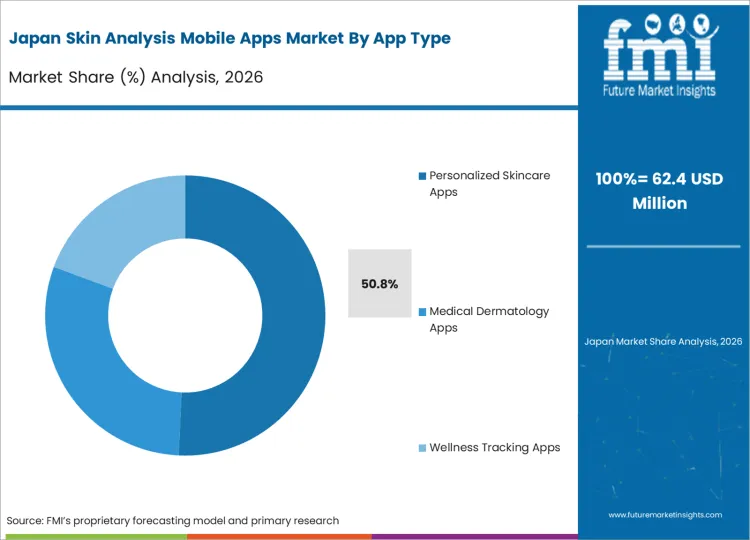
FMI's report includes extensive coverage of the Asia Pacific digital dermatology landscape. It incorporates detailed analysis of Australia, Indonesia, and the broader ASEAN region. A primary trend shaping these nations is the rapid localization of diagnostic algorithms to accurately assess regional phenotypic variations, forcing software developers to deploy inclusive data sets to satisfy stringent global fairness requirements.
North America Skin Analysis Mobile Apps Market Analysis
Healthcare modernization mandates across North America target the systematic eradication of isolated physical triage bottlenecks. Clinical systems engineers leading digital health overhauls face strict directives to unify disparate patient intake domains under a single manageable mobile architecture. The commercial healthcare sectors actively drive this consolidation to secure their patient data flows against sophisticated diagnostic delays. Implementing a standardized, mobile-first backbone enables medical networks to deploy advanced healthcare digital experience platform algorithms without compromising diagnostic accuracy.
- United States: The United States digital health sector enforces strict HIPAA cybersecurity and data visibility mandates across its entire multi-tier telemedicine ecosystem. Application specification leads replacing aging physical intake systems must deploy converged mobile architectures capable of supporting both real-time analytical precision and secure patient data extraction. Federal telehealth modernization initiatives actively fund the replacement of vulnerable legacy record systems with standardized, resilient algorithmic frameworks. The United States advances at a 16.5% compound rate across the forecast decade as healthcare providers unify their logical diagnostic topologies. Software vendors lacking documented compliance with rigorous medical data security standards face immediate exclusion from healthcare-adjacent commercial contracts.
FMI's report includes comprehensive evaluation of the North American mobile diagnostics sector. It features specific analysis of the Canadian and Mexican digital health markets. A defining dynamic in these countries involves the integration of cross-border telemedicine supply chains, which requires standardized software protocols to coordinate remote patient monitoring sequences across multiple regional health authorities.
Europe Skin Analysis Mobile Apps Market Analysis
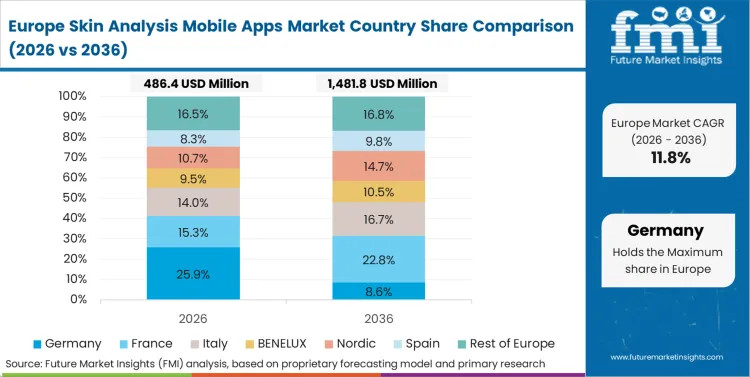
European data privacy policy actively penalizes the unauthorized processing of biometric information by isolated commercial applications. Software architects redesigning consumer beauty platforms must integrate continuous GDPR compliance tracking alongside critical diagnostic imaging capabilities. This dual-purpose software requirement forces the rapid adoption of edge-computing protocols to guarantee analytical privacy while transmitting heavy algorithmic payloads. The transition requires a complete overhaul of existing data storage topologies, shifting from centralized cloud repositories to localized device-level architectures.
- Germany: Germany's rigorous cosmetic and medical regulatory supply chain dictates stringent validation criteria for mixed-use diagnostic applications on advanced consumer platforms. Application engineering leads must demonstrate flawless execution of data anonymization flows before receiving authorization to connect new scanning modules to the main retail backbone. The national digital health sector operates under rigorous data protection certifications that mandate unified privacy layers, creating a recurring compliance cycle that accelerates software replacement. The strict regulatory environment sustains a 14.2% compound rate for certified diagnostic software in Germany as the standard proliferates. Application infrastructure providers targeting domestic pharmacy application retooling projects must guarantee zero-data-leakage performance prior to the finalization of procurement budgets.
- United Kingdom: The United Kingdom's national health modernization programs require precise remote triage data to balance increasingly volatile clinical caseload inputs. Digital network planners deploying advanced uneven skin tone solutions systems mandate application architectures capable of sub-millisecond data delivery across distributed geographic patient assets. The shift toward decentralized primary care forces clinical operators to abandon legacy physical referrals in favor of highly resilient, algorithmic mobile networks. The UK's diagnostic market expands at an 11.5% CAGR through 2036 as healthcare providers systematically upgrade their operational backbones. Systems integrators unable to demonstrate absolute diagnostic determinism under severe clinical load conditions forfeit qualification for national health expansion projects.
FMI's report includes thorough investigation of the European digital diagnostic framework. The analysis encompasses Italy, France, Spain, the Nordics, and the Benelux region. A prevailing structural condition across these nations is the mandatory compliance with strict medical device software directives, forcing application owners to specify diagnostic tools that can reliably document clinical safety signals alongside standard consumer data.
Competitive Aligners for Market Players
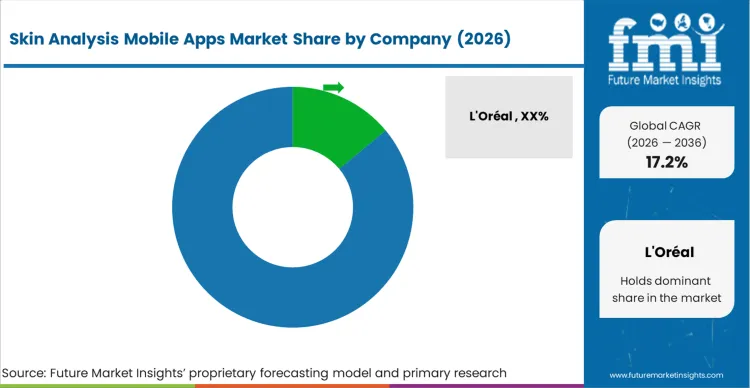
The introduction of standardized FDA pre-certification pathways for Software as a Medical Device (SaMD) establishes a rigid new baseline requirement that digital health buyers now enforce. Instead of accepting opaque proprietary diagnostic algorithms, healthcare procurement teams now demand certified, interoperable clinical evidence in all new software tenders. Based on FMI's assessment, this shift has raised the clinical performance bar across the industry, meaning application developers that continue to rely on closed, unvalidated neural networks risk being excluded from major enterprise modernization programs. Beauty brand executives seeking clinical credibility are now pushed to integrate native smart skincare diagnostic capabilities directly into their core applications instead of utilizing third-party web overlays. Application publishers failing to secure peer-reviewed clinical validation for their algorithms lose priority status during hospital network vendor shortlisting cycles.
High-definition smartphone camera sensors are not merely an iterative hardware update; they are a fundamental technology event that changes the computational cost of dermatological analysis. High-resolution input eliminates the need for expensive external macroscopic lenses, shifting the processing burden entirely to sophisticated mobile software algorithms. Integrating advanced ai formulated custom serums engines directly with native camera hardware allows companies to capture granular epidermal data without requiring user add-ons. This silicon-first approach accelerates the migration from physical clinics, allowing digital product leads to prioritize platforms that avoid the complexity associated with external peripheral devices. Mobile hardware manufacturers unable to provide low-level camera API access to third-party diagnostic developers face immediate exclusion from major corporate healthcare hardware procurement contracts.
The expansion of cross-vendor electronic health record (EHR) interoperability ecosystems mandates that consumer diagnostic data seamlessly integrates with professional medical databases. With more healthcare data layers becoming standardized, clinical systems integrators designing converged triage architectures can now extract patient imaging data via advanced healthcare api connections without worrying about data formatting failures. This expanded flexibility empowers dermatology clinic owners to optimize intake networks for analytical reliability instead of being constrained by closed proprietary diagnostic ecosystems. Independent application developers failing to build HL7 FHIR-compliant data export functionalities into their core software forfeit qualification for integration into major national health service platforms.
Key Players in Skin Analysis Mobile Apps Market
- L'Oréal
- Perfect Corp
- Coty Inc.
- Estée Lauder
- Neutrogena
- Skinive
- TroveSkin
- Vichy Laboratories
- La Roche-Posay
- GlamAR
- Amway
- Cetaphil
Scope of the Report
| Metric | Value |
|---|---|
| Quantitative Units | USD 2.12 billion to USD 10.38 billion, at a CAGR of 17.2% |
| Market Definition | Skin Analysis Mobile Apps are digital platforms using AI and machine learning to evaluate skin health via mobile imaging. |
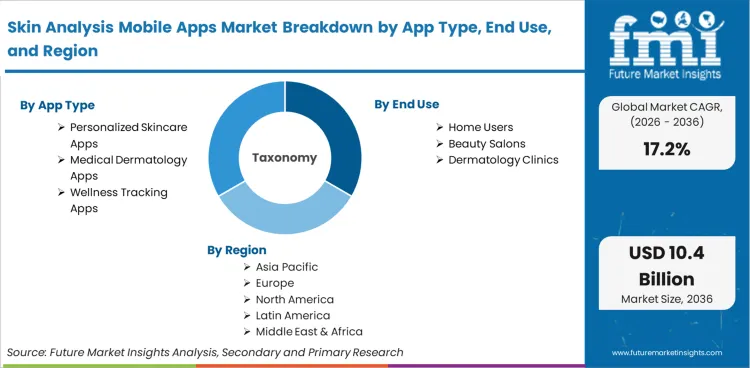
| App Type Segmentation | Personalized Skincare Apps, Medical Dermatology Apps, Wellness Tracking Apps |
| Platform Segmentation | Android, iOS |
| End Use Segmentation | Home Users, Beauty Salons, Dermatology Clinics |
| Regions Covered | North America, Latin America, Europe, East Asia, South Asia, Oceania, Middle East & Africa |
| Countries Covered | China, India, United States, Germany, South Korea, Japan, United Kingdom, and 40 plus countries |
| Key Companies Profiled | L'Oréal, Perfect Corp, Coty Inc., Estée Lauder, Neutrogena, Skinive, TroveSkin, Vichy Laboratories, La Roche-Posay, GlamAR, Amway, Cetaphil |
| Forecast Period | 2026 to 2036 |
| Approach | Bottom-up aggregation of active user bases and region-specific digital modernization curves to project diagnostic adoption velocity. |
Skin Analysis Mobile Apps Market Analysis by Segments
App Type:
- Personalized Skincare Apps
- Medical Dermatology Apps
- Wellness Tracking Apps
Platform:
- Android
- iOS
End Use:
- Home Users
- Beauty Salons
- Dermatology Clinics
Region:
- Asia Pacific
- China
- India
- Japan
- South Korea
- Indonesia
- Australia & New Zealand
- ASEAN
- Rest of Asia Pacific
- Europe
- Germany
- United Kingdom
- France
- Italy
- Spain
- Benelux
- Nordics
- Central & Eastern Europe
- Rest of Europe
- North America
- United States
- Canada
- Mexico
- Latin America
- Brazil
- Argentina
- Chile
- Rest of Latin America
- Middle East & Africa
- Kingdom of Saudi Arabia
- United Arab Emirates
- South Africa
- Turkey
- Rest of Middle East & Africa
Bibliography
- USA Food and Drug Administration (FDA). (2025, February). Clinical Evaluation of Software as a Medical Device (SaMD) (Guidance document).
- National Institute of Standards and Technology (NIST). (2024, November). Guidelines for Evaluating Artificial Intelligence Bias in Facial Analysis Systems (Technical report).
- IEEE Standards Association. (2025, January). IEEE 2801-2025: Standard for Quality Management of Datasets for Medical Artificial Intelligence (Standards publication).
- UK Medicines and Healthcare products Regulatory Agency (MHRA). (2025, January). Regulatory Framework for AI in Healthcare (Government report).
- American Academy of Dermatology (AAD). (2024, November). Position Statement on Teledermatology and Mobile Applications (Sector survey).
This bibliography is provided for reader reference. The full FMI report contains the complete reference list with primary research documentation.
This Report Addresses
- Market sizing metrics detailing the precise capital expenditure dedicated to digital skin analysis software development and deployment across major retail sectors through 2036.
- Segmentation analysis mapping the adoption velocity of specific AI diagnostic functions and evaluating the technical limitations driving algorithmic upgrades.
- Regional deployment intelligence comparing the aggressive greenfield digital construction strategies in Asia Pacific against the complex data privacy requirements prevalent in European healthcare hubs.
- Regulatory compliance assessment analyzing how stringent medical device software directives and HIPAA standards force the adoption of unified algorithmic architectures.
- Competitive posture evaluation tracking the mandatory shift toward third-party clinical interoperability certification and the resulting commoditization of basic facial scanning layers.
- Capital project strategic guidance defining the exact procurement specifications and diagnostic accuracy tolerances required to support next-generation remote triage integrations.
- Supply chain vulnerability analysis identifying the specific data network bottlenecks that extend application commissioning timelines.
- Custom data delivery formats encompassing interactive dashboards, raw Excel datasets, and comprehensive PDF narrative reports.
Frequently Asked Questions
How large is the demand for Skin Analysis Mobile Apps in the global market in 2026?
Demand for Skin Analysis Mobile Apps in the global market is estimated to be valued at USD 2.12 billion in 2026.
What will be the market size of Skin Analysis Mobile Apps in the global market by 2036?
Market size for Skin Analysis Mobile Apps is projected to reach USD 10.38 billion by 2036.
What is the expected demand growth for Skin Analysis Mobile Apps in the global market between 2026 and 2036?
Demand for Skin Analysis Mobile Apps is expected to grow at a CAGR of 17.2% between 2026 and 2036.
Which App Type is poised to lead global sales by 2026?
Personalized Skincare Apps accounts for 52.1% in 2026 as retail brand executives integrate diagnostic tracking directly into the purchasing flow to eliminate subjective guesswork.
How significant is the role of Home Users in driving Skin Analysis Mobile Apps adoption in 2026?
Home Users represents 48.5% of segment share as individuals managing maintenance routines reject traditional physical clinic visits that introduce scheduling delays.
What is driving demand in China?
China's e-commerce sector deploys highly automated digital retail applications, forcing platform architects to specify native AI skin scanning features for all new beauty landing pages.
What compliance standards or regulations are referenced for Germany?
The German digital health sector operates under rigorous data protection certifications that mandate unified privacy layers for continuous GDPR compliance tracking.
What is the China growth outlook in this report?
China is projected to grow at a CAGR of 18.2% during 2026 to 2036.
Why is North America described as a priority region in this report?
The North American commercial healthcare sectors actively drive network consolidation to secure patient diagnostic data flows against sophisticated delays.
What type of demand dominates in North America?
Demand heavily focuses on replacing vulnerable physical intake systems with standardized algorithmic frameworks that comply with strict federal telemedicine cybersecurity mandates.
What is India's growth outlook in this report?
India is projected to expand at a CAGR of 17.8% during 2026 to 2036.
Does the report cover USA in its regional analysis?
Yes, USA is included within North America under the regional scope of analysis.
What are the sources referred to for analyzing USA?
Federal telehealth modernization initiatives and HIPAA cybersecurity mandates form the analytical basis.
What is the main demand theme linked to USA in its region coverage?
Strict data visibility mandates across multi-tier telemedicine ecosystems force the deployment of converged mobile diagnostic architectures.
Does the report cover Germany in its regional analysis?
Yes, Germany is included within Europe under the regional coverage framework.
What is the main Germany related demand theme in its region coverage?
Stringent validation criteria for data anonymization flows on advanced consumer platforms compel the adoption of edge-computing privacy protocols.
Which product formats or configurations are strategically important for Asia Pacific supply chains?
Embedded diagnostic APIs integrated directly into consumer platforms are critical for streamlining localized cosmetic retail conversion.
What is Skin Analysis Mobile Apps and what is it mainly used for?
Skin Analysis Mobile Apps are digital platforms using AI to evaluate skin health. They are primarily used to identify concerns like acne and provide personalized skincare recommendations.
What does Skin Analysis Mobile Apps mean in this report?
The scope encompasses specialized software built on machine learning algorithms to guarantee accurate epidermal evaluation via mobile imaging.
What is included in the scope of this Skin Analysis Mobile Apps report?
The market covers personalized skincare apps, medical dermatology triage platforms, and integrated wellness tracking tools featuring native diagnostic capabilities.
What is excluded from the scope of this report?
Hardware-only desktop skin analyzers without mobile synchronization and downstream finished cosmetic products are explicitly excluded.
What does market forecast mean on this page?
The market forecast represents a model-based projection built on defined technology and active user adoption assumptions for strategic planning purposes.
How does FMI build and validate the Skin Analysis Mobile Apps forecast?
The model applies a bottom-up methodology starting with global installed base metrics and cross-validates projections against publicly reported digital health adoption guidance.
What does zero reliance on speculative third-party market research mean here?
Primary interviews, verified clinical software regulatory filings, and official digital health compliance registries are used exclusively instead of unverified syndicated estimates.
Preview the report firsthand - request a free sample
Get SampleGet the brochure for pricing and purchase details.
Get PDFTable of Content
- Executive Summary
- Global Market Outlook
- Demand-side Trends
- Supply-side Trends
- Technology Roadmap Analysis
- Analysis and Recommendations
- Market Overview
- Market Coverage / Taxonomy
- Market Definition / Scope / Limitations
- Research Methodology
- Chapter Orientation
- Analytical Lens and Working Hypotheses
- Market Structure, Signals, and Trend Drivers
- Company Annual and Sustainability Reports
- Peer-reviewed Journals and Academic Literature
- Corporate Websites, Product Literature, and Technical Notes
- Earnings Decks and Investor Briefings
- Statutory Filings and Regulatory Disclosures
- Technical White Papers and Standards Notes
- Trade Journals, Industry Magazines, and Analyst Briefs
- Conference Proceedings, Webinars, and Seminar Materials
- Government Statistics Portals and Public Data Releases
- Press Releases and Reputable Media Coverage
- Specialist Newsletters and Curated Briefings
- Sector Databases and Reference Repositories
- FMI Internal Proprietary Databases and Historical Market Datasets
- Subscription Datasets and Paid Sources
- Social Channels, Communities, and Digital Listening Inputs
- Additional Desk Sources
- Expert Input and Fieldwork (Primary Evidence)
- Primary Modes
- Qualitative Interviews and Expert Elicitation
- Quantitative Surveys and Structured Data Capture
- Blended Approach
- Why Primary Evidence is Used
- Field Techniques
- Interviews
- Surveys
- Focus Groups
- Observational and In-context Research
- Social and Community Interactions
- Stakeholder Universe Engaged
- C-suite Leaders
- Board Members
- Presidents and Vice Presidents
- R&D and Innovation Heads
- Technical Specialists
- Domain Subject-matter Experts
- Scientists
- Physicians and Other Healthcare Professionals
- Governance, Ethics, and Data Stewardship
- Research Ethics
- Data Integrity and Handling
- Primary Modes
- Tooling, Models, and Reference Databases
- Data Engineering and Model Build
- Data Acquisition and Ingestion
- Cleaning, Normalisation, and Verification
- Synthesis, Triangulation, and Analysis
- Quality Assurance and Audit Trail
- Market Background
- Market Dynamics
- Drivers
- Restraints
- Opportunity
- Trends
- Scenario Forecast
- Demand in Optimistic Scenario
- Demand in Likely Scenario
- Demand in Conservative Scenario
- Opportunity Map Analysis
- Product Life Cycle Analysis
- Supply Chain Analysis
- Investment Feasibility Matrix
- Value Chain Analysis
- PESTLE and Porter’s Analysis
- Regulatory Landscape
- Regional Parent Market Outlook
- Production and Consumption Statistics
- Import and Export Statistics
- Market Dynamics
- Global Market Analysis 2021 to 2025 and Forecast, 2026 to 2036
- Historical Market Size Value (USD Million) Analysis, 2021 to 2025
- Current and Future Market Size Value (USD Million) Projections, 2026 to 2036
- Y-o-Y Growth Trend Analysis
- Absolute $ Opportunity Analysis
- Global Market Pricing Analysis 2021 to 2025 and Forecast 2026 to 2036
- Global Market Analysis 2021 to 2025 and Forecast 2026 to 2036, By App Type
- Introduction / Key Findings
- Historical Market Size Value (USD Million) Analysis By App Type , 2021 to 2025
- Current and Future Market Size Value (USD Million) Analysis and Forecast By App Type , 2026 to 2036
- Personalized Skincare Apps
- Medical Dermatology Apps
- Wellness Tracking Apps
- Personalized Skincare Apps
- Y-o-Y Growth Trend Analysis By App Type , 2021 to 2025
- Absolute $ Opportunity Analysis By App Type , 2026 to 2036
- Global Market Analysis 2021 to 2025 and Forecast 2026 to 2036, By End Use
- Introduction / Key Findings
- Historical Market Size Value (USD Million) Analysis By End Use, 2021 to 2025
- Current and Future Market Size Value (USD Million) Analysis and Forecast By End Use, 2026 to 2036
- Home Users
- Beauty Salons
- Dermatology Clinics
- Home Users
- Y-o-Y Growth Trend Analysis By End Use, 2021 to 2025
- Absolute $ Opportunity Analysis By End Use, 2026 to 2036
- Global Market Analysis 2021 to 2025 and Forecast 2026 to 2036, By Region
- Introduction
- Historical Market Size Value (USD Million) Analysis By Region, 2021 to 2025
- Current Market Size Value (USD Million) Analysis and Forecast By Region, 2026 to 2036
- North America
- Latin America
- Western Europe
- Eastern Europe
- East Asia
- South Asia and Pacific
- Middle East & Africa
- Market Attractiveness Analysis By Region
- North America Market Analysis 2021 to 2025 and Forecast 2026 to 2036, By Country
- Historical Market Size Value (USD Million) Trend Analysis By Market Taxonomy, 2021 to 2025
- Market Size Value (USD Million) Forecast By Market Taxonomy, 2026 to 2036
- By Country
- USA
- Canada
- Mexico
- By App Type
- By End Use
- By Country
- Market Attractiveness Analysis
- By Country
- By App Type
- By End Use
- Key Takeaways
- Latin America Market Analysis 2021 to 2025 and Forecast 2026 to 2036, By Country
- Historical Market Size Value (USD Million) Trend Analysis By Market Taxonomy, 2021 to 2025
- Market Size Value (USD Million) Forecast By Market Taxonomy, 2026 to 2036
- By Country
- Brazil
- Chile
- Rest of Latin America
- By App Type
- By End Use
- By Country
- Market Attractiveness Analysis
- By Country
- By App Type
- By End Use
- Key Takeaways
- Western Europe Market Analysis 2021 to 2025 and Forecast 2026 to 2036, By Country
- Historical Market Size Value (USD Million) Trend Analysis By Market Taxonomy, 2021 to 2025
- Market Size Value (USD Million) Forecast By Market Taxonomy, 2026 to 2036
- By Country
- Germany
- UK
- Italy
- Spain
- France
- Nordic
- BENELUX
- Rest of Western Europe
- By App Type
- By End Use
- By Country
- Market Attractiveness Analysis
- By Country
- By App Type
- By End Use
- Key Takeaways
- Eastern Europe Market Analysis 2021 to 2025 and Forecast 2026 to 2036, By Country
- Historical Market Size Value (USD Million) Trend Analysis By Market Taxonomy, 2021 to 2025
- Market Size Value (USD Million) Forecast By Market Taxonomy, 2026 to 2036
- By Country
- Russia
- Poland
- Hungary
- Balkan & Baltic
- Rest of Eastern Europe
- By App Type
- By End Use
- By Country
- Market Attractiveness Analysis
- By Country
- By App Type
- By End Use
- Key Takeaways
- East Asia Market Analysis 2021 to 2025 and Forecast 2026 to 2036, By Country
- Historical Market Size Value (USD Million) Trend Analysis By Market Taxonomy, 2021 to 2025
- Market Size Value (USD Million) Forecast By Market Taxonomy, 2026 to 2036
- By Country
- China
- Japan
- South Korea
- By App Type
- By End Use
- By Country
- Market Attractiveness Analysis
- By Country
- By App Type
- By End Use
- Key Takeaways
- South Asia and Pacific Market Analysis 2021 to 2025 and Forecast 2026 to 2036, By Country
- Historical Market Size Value (USD Million) Trend Analysis By Market Taxonomy, 2021 to 2025
- Market Size Value (USD Million) Forecast By Market Taxonomy, 2026 to 2036
- By Country
- India
- ASEAN
- Australia & New Zealand
- Rest of South Asia and Pacific
- By App Type
- By End Use
- By Country
- Market Attractiveness Analysis
- By Country
- By App Type
- By End Use
- Key Takeaways
- Middle East & Africa Market Analysis 2021 to 2025 and Forecast 2026 to 2036, By Country
- Historical Market Size Value (USD Million) Trend Analysis By Market Taxonomy, 2021 to 2025
- Market Size Value (USD Million) Forecast By Market Taxonomy, 2026 to 2036
- By Country
- Kingdom of Saudi Arabia
- Other GCC Countries
- Turkiye
- South Africa
- Other African Union
- Rest of Middle East & Africa
- By App Type
- By End Use
- By Country
- Market Attractiveness Analysis
- By Country
- By App Type
- By End Use
- Key Takeaways
- Key Countries Market Analysis
- USA
- Pricing Analysis
- Market Share Analysis, 2025
- By App Type
- By End Use
- Canada
- Pricing Analysis
- Market Share Analysis, 2025
- By App Type
- By End Use
- Mexico
- Pricing Analysis
- Market Share Analysis, 2025
- By App Type
- By End Use
- Brazil
- Pricing Analysis
- Market Share Analysis, 2025
- By App Type
- By End Use
- Chile
- Pricing Analysis
- Market Share Analysis, 2025
- By App Type
- By End Use
- Germany
- Pricing Analysis
- Market Share Analysis, 2025
- By App Type
- By End Use
- UK
- Pricing Analysis
- Market Share Analysis, 2025
- By App Type
- By End Use
- Italy
- Pricing Analysis
- Market Share Analysis, 2025
- By App Type
- By End Use
- Spain
- Pricing Analysis
- Market Share Analysis, 2025
- By App Type
- By End Use
- France
- Pricing Analysis
- Market Share Analysis, 2025
- By App Type
- By End Use
- India
- Pricing Analysis
- Market Share Analysis, 2025
- By App Type
- By End Use
- ASEAN
- Pricing Analysis
- Market Share Analysis, 2025
- By App Type
- By End Use
- Australia & New Zealand
- Pricing Analysis
- Market Share Analysis, 2025
- By App Type
- By End Use
- China
- Pricing Analysis
- Market Share Analysis, 2025
- By App Type
- By End Use
- Japan
- Pricing Analysis
- Market Share Analysis, 2025
- By App Type
- By End Use
- South Korea
- Pricing Analysis
- Market Share Analysis, 2025
- By App Type
- By End Use
- Russia
- Pricing Analysis
- Market Share Analysis, 2025
- By App Type
- By End Use
- Poland
- Pricing Analysis
- Market Share Analysis, 2025
- By App Type
- By End Use
- Hungary
- Pricing Analysis
- Market Share Analysis, 2025
- By App Type
- By End Use
- Kingdom of Saudi Arabia
- Pricing Analysis
- Market Share Analysis, 2025
- By App Type
- By End Use
- Turkiye
- Pricing Analysis
- Market Share Analysis, 2025
- By App Type
- By End Use
- South Africa
- Pricing Analysis
- Market Share Analysis, 2025
- By App Type
- By End Use
- USA
- Market Structure Analysis
- Competition Dashboard
- Competition Benchmarking
- Market Share Analysis of Top Players
- By Regional
- By App Type
- By End Use
- Competition Analysis
- Competition Deep Dive
- L'Oréal
- Overview
- Product Portfolio
- Profitability by Market Segments (Product/Age /Sales Channel/Region)
- Sales Footprint
- Strategy Overview
- Marketing Strategy
- Product Strategy
- Channel Strategy
- Perfect Corp
- Coty Inc.
- Estée Lauder
- Neutrogena
- Skinive
- TroveSkin
- L'Oréal
- Competition Deep Dive
- Assumptions & Acronyms Used


