

- Industry Size (2026)
- USD 7.4 Bn
- Forecast (2036)
- USD 13.2 Bn
- CAGR (2026 to 2036)
- 6.6%
Photoaging Treatment Market Forecast and Outlook 2026 to 2036
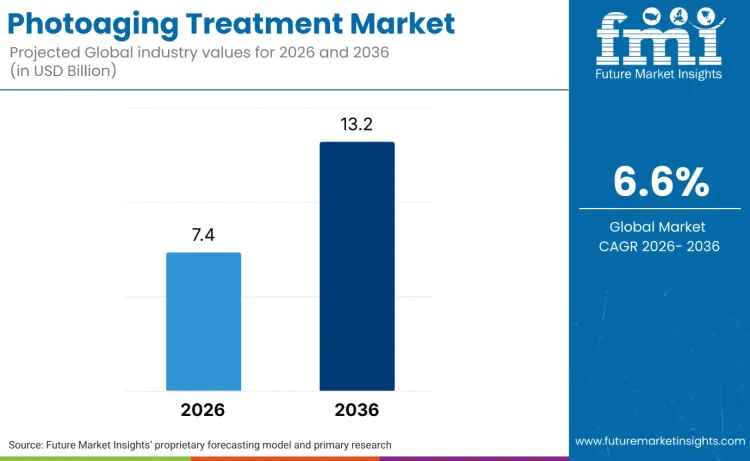
The global photoaging treatment market is forecasted to reach USD 7.4 billion in 2026, and expand to USD 13.2 billion by 2036, advancing at a CAGR of 6.6%. As per FMI, there will be a shift in dermatological care toward precision skincare approaches, where traditional anti-aging methods are transitioning toward targeted treatment platforms. Companies are also investing to serve targeted formulations. For instance, in June 2025, L'Oréal unveiled to acquire Medik8, a British skincare company, to broaden its dermatological portfolio across prescription retinoids, cosmeceutical formulations, and advanced device technologies. Market expansion is also driven by the rising complexity of photoaging presentations, with consumers and practitioners embracing multi-modal treatment protocols across clinical and retail settings globally.
These forces are elevating demand for evidence-based products, pushing cosmetic companies and dermatology practices to develop comprehensive photoaging treatment capabilities earlier in the product lifecycle. Beauty retailers and aesthetic providers increasingly view photoaging treatment portfolios as core revenue drivers rather than ancillary offerings. Companies are also coming up with advanced technologies to aggressively earn profits. For instance, Galderma has developed FACE by Galderma, an AR-powered app that allows both practitioners and patients to visualize likely treatment outcomes before undergoing aesthetic procedures, giving users a more personalized decision-making experience.
“Galderma’s strong performance in the first nine months of 2025 demonstrates the breadth of our portfolio and our ability to deliver growth through innovation, commercial excellence, and global expansion. We continue to meet evolving consumer and patient needs, with Nemluvio showing outstanding momentum and driving significant growth. To support this, we are deepening our investments in the USA, expanding our presence, and strengthening partnerships with healthcare professionals.With continued progress across science, education, and our full dermatology portfolio, Galderma is uniquely positioned to become the undisputed dermatology powerhouse.”- Flemming Ornskov, CEO, Galderma
The industry's focus is shifting from volume-based commodity sales toward precision-focused therapeutic positioning. Advanced treatment manufacturers are integrating comprehensive delivery techniques, streamlined application systems, and flexible platform designs to reduce treatment standardization challenges while improving target specificity. Research-positioned brands and specialized formulation developers are gaining preference, enabling direct consumer partnerships and customized treatment development across dermatological and aesthetic channels.
Summary of the Photoaging Treatment Market
What Is Growth Outlook on the Photoaging Treatment Market as per Future Market Insights Projection?
Future Market Insights projects the photoaging treatment market to grow at a CAGR of 6.6% from 2026 to 2036, expanding from USD 7.4 billion in 2026 to USD 13.2 billion by 2036.
FMI research approach: FMI proprietary forecasting model using bottom-up revenue estimation, Rising dermatological demand for precision and evidence-based photoaging therapies, Increasing adoption of multi-modal treatment protocols across clinical and retail channels, and Portfolio expansion by dermatology-focused and beauty tech-driven companies.
How Do FMI Analysts Perceive the Photoaging Treatment Market to Evolve?
FMI analysts perceive the market shifting from cosmetic anti-aging market toward precision dermatology platforms positioned as outcome-driven therapeutic solutions for sun-induced skin damage.
FMI research approach: Transition toward targeted retinoids, cosmeceutical ingredientss, and energy-based devices, Integration of AI-guided skin assessment and treatment visualization tools, Increased clinical positioning of photoaging treatments within dermatology practices, and Strategic investments by leading players in dermatology-focused portfolios.
Which Country Holds the Largest Share in the Global Photoaging Treatment Market?
The United States holds the largest share of the global photoaging treatment market by value.
FMI research approach: FMI country-level revenue modeling across dermatology clinics and aesthetic centers, High penetration of premium cosmeceuticals and device-based treatments, Strong adoption of evidence-backed dermatological protocols, and Concentration of advanced aesthetic technology providers.
How Large Will the Photoaging Treatment Market Be by 2036?
The global photoaging treatment market is estimated to reach USD 13.2 billion by 2036.
FMI research approach: Long-term revenue projections by treatment modality and target concern, Scaling assumptions for precision dermatology and combination therapy adoption, Rising use of professional-grade devices and prescription-strength formulations, and Cross-validation with historical growth patterns in advanced aesthetic care.
What Is the Definition of the Photoaging Treatment Market?
The photoaging treatment market comprises therapeutic and cosmetic platforms designed to manage sun-induced skin damage, including wrinkles, pigmentation, texture irregularities, and photo-induced laxity, across clinical and consumer settings.
FMI research approach: FMI market taxonomy and definition framework, Inclusion of prescription medications, cosmeceuticals, devices, and professional procedures, Application mapping across dermatology clinics, aesthetic centers, and retail channels, and Exclusion of non-photoaging skincare market and non-therapeutic cosmetic products.
What Are Globally Unique Trends Shaping the Photoaging Treatment Market?
Globally unique trends include the rise of precision dermatology, AI-assisted treatment selection, and the repositioning of photoaging solutions as clinically validated therapeutic platforms.
FMI research approach: Increased use of digital skin diagnostics and AR-based treatment visualization, Growth in combination therapy protocols addressing multiple photoaging concerns, Shift from volume-driven cosmetic sales toward outcome-based treatment positioning, and Strategic acquisitions and investments to strengthen dermatology-focused capabilities.
Photoaging Treatment Market Key Takeaways
| Metric | Value |
|---|---|
| Market Value (2026) | USD 7.4 billion |
| Market Forecast Value (2036) | USD 13.2 billion |
| Forecast CAGR (2026-2036) | 6.6% |
Source: Future Market Insights (FMI) analysis, based on proprietary forecasting model and primary research.
How Do Regulatory Standards and Ingredient Governance Shape Market Demand?
Tightening regulatory scrutiny across major markets is reshaping demand toward clinically validated and compliance-ready photoaging treatment platforms. Authorities in North America and Europe are raising evidence thresholds for active ingredients, device claims, and long-term safety, which is narrowing procurement toward treatments supported by clinical data and post-market surveillance. This environment favors manufacturers with vertically integrated R&D, validated delivery systems, and reformulation agility. As a result, brands are prioritizing fewer, higher-efficacy actives and dermatologist-approved standardized treatment platforms that can clear multi-region approvals without repeated redesign. For example, L’Oréal’s portfolio includes dermatological brands like CeraVe focused on essential, clinical actives rather than broad, multi-functional formulas.
How is the Photoaging Treatment Market Segmented?
The photoaging treatment market has been segmented based on treatment modality, target concern, sales channel, and region. In terms of treatment modality, the market is divided into prescription topical retinoids and dermatology medications, cosmeceuticals, energy-based devices, injectable rejuvenation, chemical peels and resurfacing, and sun protection products. By target concern, the market is divided into anti-wrinkle products, hyperpigmentation, texture and enlarged pores, actinic damage, and photo-induced skin laxity. By sales channel, the market is segmented into retail and e-commerce, dermatology clinics, aesthetic centers, pharmacies, and hospital outpatient departments. Regionally, the market is divided into North America, Europe, Asia Pacific, Latin America, and Middle East and Africa.
Why Do Cosmeceuticals Dominate the Photoaging Treatment Market?
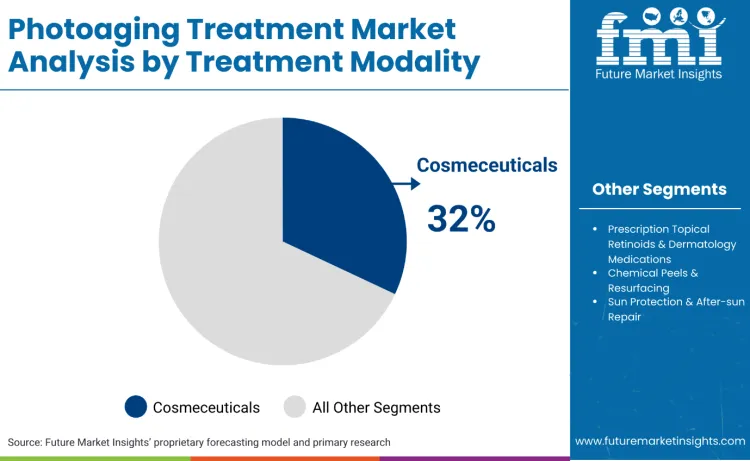
Cosmeceuticals continue to lead the market, accounting for 32.0% of the share. Photoaging treatment has become a dominant focus in the cosmeceutical industry because it directly targets the external factors responsible for the vast majority of visible skin changes over time. While natural aging is a slow and internal process, photoaging is caused by chronic exposure to ultraviolet radiation, which leads to the breakdown of essential structural proteins like collagen and elastin. Cosmeceuticals are favored in this space because they contain potent bioactive ingredients that can penetrate the skin barrier to address specific concerns such as deep wrinkles, irregular pigmentation, and loss of elasticity.
By providing a non-invasive way to repair cellular damage these products offer a middle ground between basic moisturizers and aggressive surgical procedures allowing individuals to maintain a youthful appearance through daily topical application. Companies such as L'Oréal Group extensively develop and market cosmeceutical-oriented anti-aging skincare products, including clinically inspired formulations like the Revitalift range that target fine lines, wrinkles and photoaging concerns. The widespread adoption of these treatments is also fueled by an increasing global awareness of environmental protection and skin health. Modern consumers are more educated about the damaging effects of the sun and environmental pollutants, which has driven a massive demand for products that offer both corrective and preventive benefits. Photoaging treatments often incorporate powerful antioxidants and DNA repair enzymes that neutralize the free radicals generated by sun exposure thereby preventing further damage while simultaneously improving existing skin texture. Moreover, the wide availability of injectable anti-wrinkle treatment options is giving a stiff competition to oral products.
How Do Target Concerns Influence Photoaging Treatment Selection?
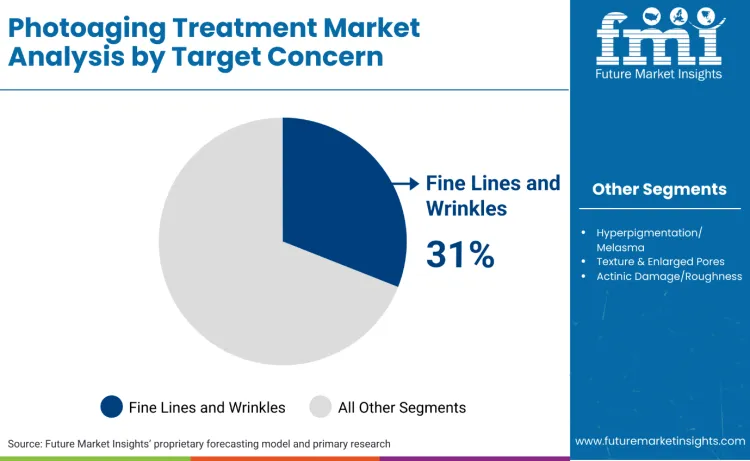
Fine lines and wrinkles stands as the dominant concern, commanding 31.0% of the market share. Photoaging treatment is a preferred approach for addressing fine lines and wrinkles because it targets the root cause of dermal degradation rather than just masking the symptoms. Most wrinkles are not merely a result of time but are caused by the cumulative destruction of the extracellular matrix by ultraviolet light. This exposure triggers the production of enzymes called matrix metalloproteinases, which chew through existing collagen fibers and prevent the synthesis of new ones. By utilizing photoaging treatments such as topical retinoids or specialized peptides, individuals can inhibit these destructive enzymes and stimulate the fibroblasts to rebuild a healthy structural foundation.
The popularity of these treatments also stems from their ability to improve skin elasticity and hydration, which are critical for preventing the deepening of expression lines. When skin is damaged by the sun it loses its ability to retain moisture and snap back into place leading to the formation of static wrinkles that remain visible even when the face is at rest. Photoaging therapies often include ingredients that reinforce the skin's lipid barrier and increase the density of elastic fibers. This comprehensive repair strategy ensures that the skin remains supple and resilient against the repetitive movements of facial expressions. Players including the Estée Lauder Companies Inc. offers cosmeceutical-oriented anti-aging skincare such as its Advanced Night Repair and Revitalizing Supreme lines that are specifically formulated to help reduce the appearance of fine lines and wrinkles over time.
How Are Next-Gen Biologics and Device Hybrids Reshaping Photoaging Treatment?
The photoaging treatment market is shifting toward combination biologic and device-based therapies that target cellular aging pathways and structural dermal damage simultaneously. In April 2025, Alastin introduced Restorative Skin Complex with Next Generation TriHex Technology, which supports the skin’s natural collagen and elastin production that declines from aging. This trend highlights a transition from standalone topical regimens or single-mode devices to integrated treatment systems that drive deeper repair with measurable outcomes.
Why Is the Adoption of AI-Guided Imaging Critical for Personalized Photoaging Care?
Innovation in diagnostic precision is unlocking tailored treatment pathways that improve response rates and reduce overtreatment. For instance, Canfield Scientific’s VISIA-AI Insight, is an AI-driven imaging platform that can quantify photodamage layers and predict optimal combination therapies for individual skin types. Such capabilities are prompting competitors to embed predictive analytics into standard imaging suites, accelerating personalized treatment adoption and positioning data intelligence as a differentiator in the market. This shift is encouraging clinicians and device manufacturers to treat diagnostic data as a continuous decision-support layer, guiding treatment selection, sequencing, and follow-up rather than serving as a one-time assessment tool.
How Is the Photoaging Treatment Market Evolving Globally?
Global demand for photoaging treatment products is increasing as consumers expand skincare capabilities while addressing precision targeting, efficacy validation, and safety requirements across age demographics. Growth demonstrates rising use of combination treatment approaches, evidence-based product positioning, and outcome-optimized formulation specifications across dermatological institutions, aesthetic practices, and consumer applications. Product selection focuses on ingredient efficacy, treatment tolerability, and platform performance under various skin conditions. China records 14.7% CAGR, India records 13.1% CAGR, Brazil records 11.5% CAGR, USA records 7.1% CAGR, and Germany records 5.1% CAGR. Adoption remains driven by efficacy requirements and safety profiles rather than price competition alone.
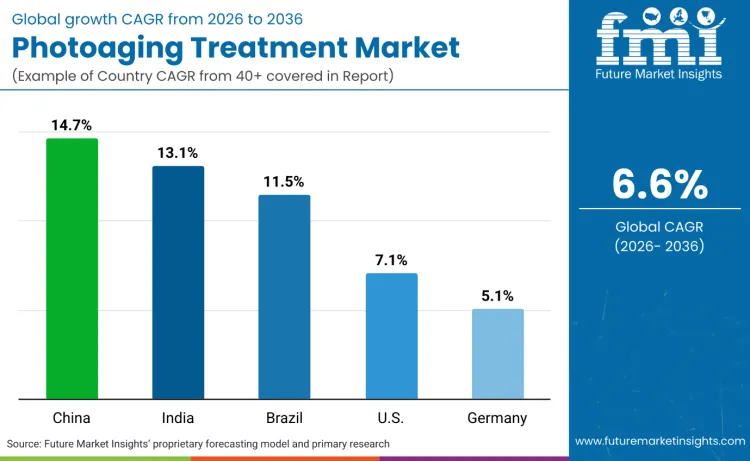
| Country | CAGR (2025-2035) |
|---|---|
| China | 14.7% |
| India | 13.1% |
| Brazil | 11.5% |
| USA | 7.1% |
| Germany | 5.1% |
Source: FMI historical analysis and forecast data.
China: How is the Rising Aesthetic Consciousness Driving Advanced Treatment Adoption?
The primary driver in China is the significant growth of domestic aesthetic awareness and premium skincare adoption among younger demographics. With the expansion of beauty consciousness, Chinese metropolitan areas are now experiencing millions of new treatment-seeking consumers, making traditional anti-aging approaches insufficient. This shift has promoted advanced treatment platform adoption for domestic aesthetic enhancement to ensure efficacy and safety innovation.
Driven by this national scale of aesthetic consciousness expansion and presence of high-end products such as dermatology lasers, the Chinese photoaging treatment market is set to grow at a 14.7% CAGR during the study period, led by massive demand in premium cosmeceuticals and professional device sectors. China is expected to transition into a world-class originator of bio-stimulation innovation, moving beyond its historical role as a high-volume manufacturing hub. The primary opportunity lies in the rapid development of biosynthetic biostimulants and bio-better assets that offer improved tolerability and clinical speed. Companies are also tapping Chinese markets to broaden their geographical presence. In April 2025, Galderma launched Sculptra, first-ever regenerative biostimulator with a unique poly-L-lactic acid (PLLA-SCA™) formulation in China to boost its presence in the Chinese aesthetic market.
India: Is the "Dermatological Awareness" Movement Elevating Treatment Standards?
In India, the market is dominated by the growing number of efficacy-positioned treatment categories. The launch of various beauty innovation programs is also boosting market growth. For instance, in May 2024, L’Oréal launched the Big Bang Beauty Tech Innovation Program in the South Asia Pacific, Middle East and North Africa (SAPMENA) region, including India. This "efficacy-first" approach is essential for Indian consumers currently seeking international treatment standards in domestic dermatological and aesthetic applications.
Reflecting this maturity, the Indian photoaging treatment market is projected to grow at a 13.1% CAGR during the study period. India’s photoaging treatment market is expanding as prolonged sun exposure, rising urban pollution, and higher UV awareness increase demand for corrective dermatology. Growing disposable incomes, wider access to aesthetic clinics, and dermatologist-led adoption of laser, peel, and retinoid-based therapies are driving sustained treatment uptake across urban populations.
Brazil: Will Expanding Beauty Culture Accelerate Treatment Integration?
Brazil's photoaging treatment market is uniquely shaped by beauty culture expansion and aesthetic treatment normalization. Brazilian consumers are increasingly adopting comprehensive skincare approaches, maintaining aesthetic positioning for appearance enhancement while using accessible pricing for broader market appeal. The Brazilian photoaging treatment market is expected to grow at a 11.5% CAGR during the study period, as beauty-focused organizations invest in validated treatment and outcome-driven categories.
Brazil presents a unique opportunity centered on its National Bio-inputs Program and its leadership in large-scale row crop production. The National Bio-inputs Program can boost the photoaging treatment market by encouraging the development and adoption of bio-based dermatologic actives and cosmeceuticals. Enhanced regulatory support, funding for clinical research, and streamlined approval pathways for biologically sourced ingredients will attract innovators, expand product portfolios, and increase clinician and consumer confidence in science-backed photoaging solutions.
Germany: Is the "Scientific Skincare" Strategy Revitalizing Treatment Approaches?
In Germany, the market is being driven by growing efforts of dermatological institutions and cosmetic companies toward upgrading scientifically-positioned treatment platforms that feature "research-heritage excellence" to compete against standard cosmetic methods in domestic aesthetic applications. As German institutions prioritize scientific validation and treatment efficacy, the German photoaging treatment market is set to grow at a 5.1% CAGR during the study period, focusing heavily on clinical evidence and outcome enhancement.
Germany offers an opportunity rooted in high-science validation and a robust research infrastructure that serves as Europe’s primary biotechnology hub. The market is characterized by a strong shift toward tissue engineering and sustainable food technologies, such as mycelium-based products and zero-waste fermentation. Investors and companies will find significant value in Germany's specialized regions, which facilitate collaboration between world-class research institutes and private firms to produce clinically proven, high-purity biostimulators that meet the rigorous standards of the European Medical Device Regulation.
USA: How is the "Precision Skincare Renaissance" Driving Treatment Innovation?
The USA market is increasingly focused on the innovation and diversity of precision dermatological applications. This transition aims at reducing dependence on standard cosmetic methods while improving domestic treatment platform competitiveness. Supported by these aesthetic development mandates, the USA photoaging treatment market is set to grow at a 7.1% CAGR during the study period. The USA photoaging treatment market continues to expand as rising awareness of sun-induced skin damage intersects with strong demand for preventive and corrective dermatology solutions.
High lifetime UV exposure, an aging population, and year-round outdoor lifestyles sustain demand for treatments addressing fine lines, wrinkles, hyperpigmentation, and texture irregularities. Consumer preference is shifting toward clinically validated cosmeceuticals, energy-based devices, and combination therapies supported by dermatologists and aesthetic clinics. Favorable reimbursement pathways for select dermatological procedures, widespread access to board-certified specialists, and rapid adoption of AI-enabled skin diagnostics further support treatment uptake. Continuous product innovation and regulatory clarity also reinforce long-term market momentum.
Who are the Major Players Active in the Photoaging Treatment Market?
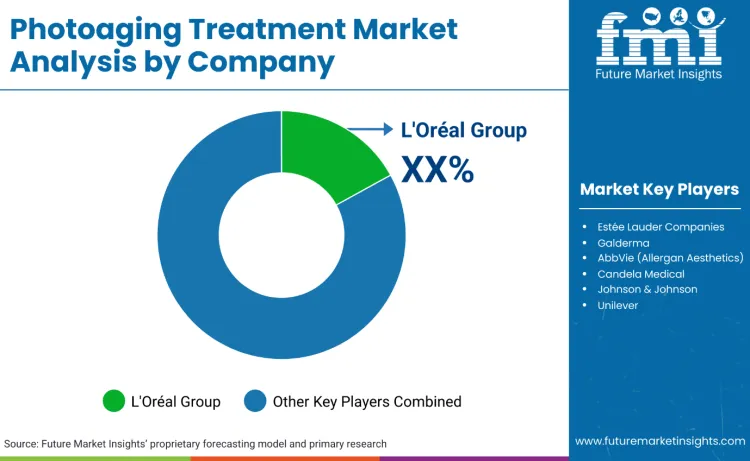
The competitive landscape for the photoaging treatment market is defined by a strategic transition toward AI-guided treatment selection and the integration of multi-modal therapy platforms to address comprehensive photoaging concerns. As aesthetic preferences prioritize natural-looking results and preventive care, the market features highly intensive competition focused on increasing the efficacy and accessibility of treatments. Analysis indicates that market leaders are aggressively pursuing vertical integration, acquiring specialized device manufacturers and ingredient suppliers to offer "assessment-to-outcome" workflows that minimize treatment complexity.
For instance, in October 2025, Kering and L’Oréal announced joined hands to boost positions in luxury beauty and wellness space. This binding agreement encompasses the acquisition of the House of Creed by L’Oréal, the beauty and fragrance licenses of iconic Houses of Kering. This shift is particularly evident in the rapid adoption of personalized formulation technology and targeted delivery systems, which have shortened product development cycles from years to months, allowing players to capture high-value applications in preventive care and precision treatment.
Market leader L'Oréal maintains dominance through the successful expansion of its scientific research capabilities and advanced ingredient development, which automate personalized formulation recommendations for diverse skin concerns. Estée Lauder Companies has strategically positioned its portfolio toward clinical-grade cosmeceuticals, launching dermatologist-recommended formulations to meet increasing efficacy expectations. Meanwhile, Galderma is gaining significant ground by integrating evidence-based treatment protocols into its prescription and aesthetic portfolios to streamline clinical outcomes. Specialized players like AbbVie and Candela Medical are competing on treatment modality, with AbbVie's injectable expertise providing comprehensive rejuvenation solutions, while Candela focuses on energy-based dermatology devices for professional applications. Bio-Rad continues to anchor its position in the diagnostic segment, using advanced skin analysis for precision treatment selection.
Key Industry Developments:
December 2025: L'Oréal announced it would increase its investment in Galderma by an additional 10%, bringing its total participation to 20%, further solidifying its "Beauty Tech" and medical aesthetics strategy. April 2023: Estée Lauder officially acquired the TOM FORD brand in a deal valuing the enterprise at USD 2.8 billion to boost its position in the skincare space.
Key Players in the Photoaging Treatment Market
- L'Oréal Group
- Estée Lauder Companies Inc.
- Galderma S.A.
- AbbVie Inc. (Allergan Aesthetics)
- Candela Medical Inc.
- Johnson & Johnson
- Unilever PLC
- Procter & Gamble Co.
- Beiersdorf AG
- Shiseido Company, Limited
Market Definition
The photoaging treatment market refers to the global therapeutic and cosmetic applications of skincare platforms designed to address sun-induced skin damage, age-related changes, and photodamage prevention. It includes both precision and standard treatment offerings, with segments that cater to various applications such as wrinkle reduction, pigmentation management, and texture improvement. The market size is measured in USD billion and analyzed over the 2026 to 2036 period. The photoaging treatment market includes treatment modalities such as prescription medications, cosmeceuticals, energy-based devices, and professional procedures, utilized through both clinical institutions and consumer applications. The market is expanding due to growing interest in preventive skincare, treatment platform innovations, and evolving consumer requirements toward higher-efficacy and more specialized photoaging management capabilities.
Market Inclusion
Included in the photoaging treatment market scope are therapeutic products categorized by modality (prescription, cosmeceutical, device-based, and professional procedures), with segmentation based on target concerns (wrinkles, pigmentation, texture, and prevention), application focus (clinical, professional, consumer), and treatment requirements (efficacy, safety, accessibility). The scope includes photoaging treatment platforms with a focus on clinical outcomes, consumer satisfaction, and innovation advancement, particularly those marketed through specialized providers, dermatological institutions, and beauty retail channels. Geographically, the market encompasses key regions such as North America, Europe, Asia Pacific, Latin America, and the Middle East and Africa, with country-level analysis for significant markets like China, India, Brazil, USA, and Germany.
Market Exclusion
Excluded from the photoaging treatment market scope are non-photoaging skincare platforms and treatment methods not designed for sun damage management, such as acne treatments, general moisturizers, and non-aesthetic medical procedures. Additionally, products not intended for photoaging or aesthetic applications are not included. The market excludes non-therapeutic beauty products, as well as photoaging-related products that are not marketed as treatment platforms, such as general sunscreen products or basic cleansing formulations. Furthermore, products with non-compliant safety specifications or those that do not meet regional regulatory standards for cosmetic or medical applications are outside the market's defined scope.
Scope of the Report
| Items | Values |
|---|---|
| Quantitative Units | USD billion |
| Treatment Modality | Prescription Topical Retinoids & Dermatology Medications; Cosmeceuticals; Energy-based Devices; Injectable Rejuvenation; Chemical Peels & Resurfacing; Sun Protection & After-sun Repair |
| Target Concern | Fine Lines & Wrinkles; Hyperpigmentation/Melasma; Texture & Enlarged Pores; Actinic Damage/Roughness; Photo-induced Skin Laxity |
| Sales Channel | Retail & E-commerce; Dermatology Clinics; Aesthetic Centers/Med-spas; Pharmacies; Hospital Outpatient |
| Regions Covered | North America, Europe, Asia Pacific, Latin America, Middle East & Africa |
| Countries Covered | China, India, Brazil, USA, Germany, and 40+ countries |
| Key Companies Profiled | L'Oréal; Estée Lauder Companies; Galderma; AbbVie; Candela Medical; Others |
| Additional Attributes | Revenue analysis by treatment modality, target concern, and sales channel; performance in clinical applications and aesthetic capabilities across dermatological institutions, aesthetic practices, and consumer applications; treatment efficacy enhancement, outcome optimization, and platform benefits under clinical applications; impact on patient satisfaction, aesthetic outcomes, and treatment differentiation during selection processes; compatibility with treatment protocols and consumer preferences; adoption dynamics driven by efficacy positioning, innovation programs, and long-term treatment partnerships. |
Photoaging Treatment Market by Segment
Treatment Modality:
- Prescription Topical Retinoids & Dermatology Medications
- Cosmeceuticals (Antioxidants/Peptides)
- Energy-based Devices (Laser/IPL)
- Injectable Rejuvenation (Clinical)
- Chemical Peels & Resurfacing
- Sun Protection & After-sun Repair
Target Concern:
- Fine Lines & Wrinkles
- Hyperpigmentation/Melasma
- Texture & Enlarged Pores
- Actinic Damage/Roughness
- Photo-induced Skin Laxity
Sales Channel:
- Retail & E-commerce (OTC)
- Dermatology Clinics
- Aesthetic Centers/Med-spas
- Pharmacies
- Hospital Outpatient
Region:
- Asia Pacific
- China
- Japan
- South Korea
- India
- Australia & New Zealand
- Thailand
- Rest of Asia Pacific
- Europe
- Germany
- United Kingdom
- France
- Italy
- Spain
- Nordic
- Netherlands
- Rest of Europe
- North America
- USA
- Canada
- Mexico
- Latin America
- Brazil
- Chile
- Colombia
- Argentina
- Rest of Latin America
- Middle East & Africa
- Kingdom of Saudi Arabia
- Other GCC Countries
- Turkey
- South Africa
- Other African Union
- Rest of Middle East & Africa
Bibliography
- International Dermatological Association. (2023). Treatment Standards for Photoaging Management: Clinical Guidelines. IDA.
- Global Aesthetic Research Council. (2023). Platform Specifications for Photoaging Treatment Products: Efficacy and Safety Requirements. GARC.
- Dermatological Research Institute. (2024). DRI Guidelines for Clinical Positioning in Photoaging Treatment (updated efficacy specifications for clinical and aesthetic applications). DRI.
- Martinez, D. L., et al. (2023). Efficacy positioning effects of photoaging treatment platforms on aesthetic outcome development: A comprehensive analysis of treatment outcomes and clinical applications. Journal of Aesthetic Dermatology, 28, 145-162.
- Thompson, R. K., et al. (2023). Sixth annual photoaging treatment market report: Special focus on treatment innovation and precision positioning in global aesthetic applications. International Aesthetic Industry Review, 31, 89-106.
Frequently Asked Questions
How big is the photoaging treatment market in 2026?
The global photoaging treatment market is estimated to be valued at USD 7.4 billion in 2026.
What will be the size of the photoaging treatment market in 2036?
The market size for the photoaging treatment market is projected to reach USD 13.2 billion by 2036.
How much will the photoaging treatment market grow between 2026 and 2036?
The photoaging treatment market is expected to grow at a 6.6% CAGR between 2026 and 2036.
What are the key treatment modalities in the photoaging treatment market?
The key treatment modalities in the photoaging treatment market include cosmeceuticals, energy-based devices, prescription topical medications, and injectable rejuvenation treatments.
Which sales channel will contribute a significant share in the photoaging treatment market in 2026?
In terms of sales channel, the retail and e-commerce segment is set to command a 44.0% share in the photoaging treatment market in 2026.
Preview the report firsthand - request a free sample
Get SampleGet the brochure for pricing and purchase details.
Get PDFTable of Content
- Executive Summary
- Global Market Overview
- Key Insights
- Market Forecast
- Strategic Recommendations
- Market Overview
- Market Definition
- Market Taxonomy
- Scope and Limitations
- Research Methodology
- Research Approach
- Data Sources
- Analytical Framework
- Market Dynamics
- Drivers
- Restraints
- Opportunities
- Trends
- Market Sizing and Forecast
- Market Value (2026–2036)
- Y-o-Y Growth Analysis
- Market Share by Treatment Modality
- Market Share by Target Concern
- Market Share by Sales Channel
- Market Segmentation Analysis
- Treatment Modality
- Prescription Topical Retinoids and Dermatology Medications
- Cosmeceuticals
- Energy-based Devices
- Injectable Rejuvenation
- Chemical Peels and Resurfacing
- Sun Protection and After-sun Repair
- Target Concern
- Fine Lines and Wrinkles
- Hyperpigmentation and Melasma
- Texture and Enlarged Pores
- Actinic Damage and Roughness
- Photo-induced Skin Laxity
- Sales Channel
- Retail and E-commerce
- Dermatology Clinics
- Aesthetic Centers and Med-spas
- Pharmacies
- Hospital Outpatient
- Treatment Modality
- Regional Market Analysis
- North America
- Europe
- Asia Pacific
- Latin America
- Middle East and Africa
- Competitive Landscape
- Market Share of Key Players
- Competitive Benchmarking
- Key Player Strategies
- Key Takeaways
- Market Summary
- Future Trends and Forecast
- Strategic Recommendations


