

- Industry Size (2026)
- USD 330 Mn
- Forecast (2036)
- USD 1050 Mn
- CAGR (2026 to 2036)
- 11.6%
Hydrophobic Runway Contaminant-Resistant Coatings for Nacelles Market Forecast and Outlook 2026 to 2036
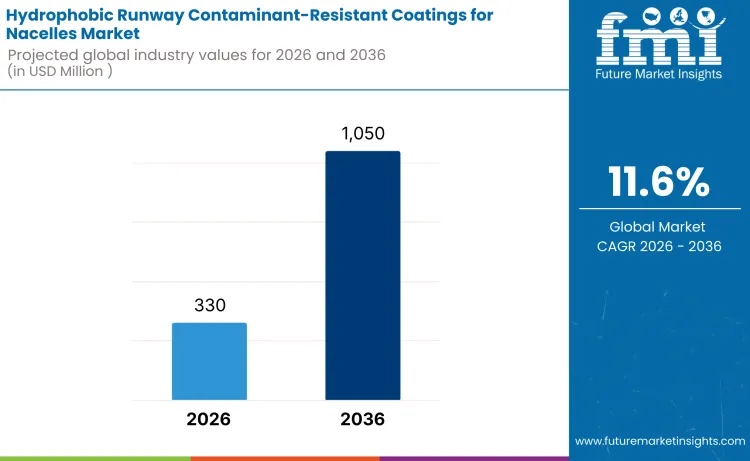
The hydrophobic runway contaminant-resistant coatings for nacelles market is expected to expand from USD 330 million in 2026 to USD 1,050 million by 2036, achieving a CAGR of 11.6%. The growing demand for coatings that can withstand harsh conditions and prevent contaminants from affecting aircraft performance is a key factor in driving this growth.
Nano-textured hydrophobic polymer coatings, making up 36% of the market share for coating technologies, are increasingly used for their ability to prevent water and contaminants from adhering to nacelle surfaces, enhancing both durability and functionality. With 49% of the application market share, commercial aircraft nacelles are the leading consumers of these coatings, as they help reduce maintenance needs and increase operational efficiency by protecting critical engine components. The expansion of this market is further fueled by the aerospace industry's push for more resilient, low-maintenance solutions that improve aircraft performance and minimize costs over time.
Quick Stats for Hydrophobic Runway Contaminant-Resistant Coatings for Nacelles Market
- Hydrophobic Runway Contaminant-Resistant Coatings for Nacelles Market Value (2026): USD 330 million
- Hydrophobic Runway Contaminant-Resistant Coatings for Nacelles Market Forecast Value (2036): USD 1,050 million
- Hydrophobic Runway Contaminant-Resistant Coatings for Nacelles Market Global Forecast CAGR (2026-2036): 11.6%
- Top Application by Share in Hydrophobic Runway Contaminant-Resistant Coatings for Nacelles Market: Commercial Aircraft Nacelles (49%)
- Key Growth Regions in Hydrophobic Runway Contaminant-Resistant Coatings for Nacelles Market: China, India, USA, UK, Japan
- Top Players in Hydrophobic Runway Contaminant-Resistant Coatings for Nacelles Market: PPG Aerospace, AkzoNobel Aerospace Coatings, 3M Company, Sherwin-Williams Aerospace, Henkel
Hydrophobic Runway Contaminant-Resistant Coatings for Nacelles Market Key Takeaways
| Metric | Value |
|---|---|
| Industry Sales Value (2025) | USD 330 million |
| Industry Forecast Value (2035) | USD 1,050 million |
| Industry Forecast CAGR (2025-2035) | 11.6% |
What Are the Key Segments in Hydrophobic Runway Contaminant-Resistant Coatings for Nacelles Market?
The hydrophobic runway contaminant-resistant coatings for nacelles market is segmented by coating technology and application. Nano-textured hydrophobic polymer coatings lead the coating technology segment with 36% of the market share, offering effective protection against runway contaminants. Commercial aircraft nacelles dominate the application segment, representing 49%, driven by the need for enhanced performance and protection in harsh environments. The market is growing as airlines and manufacturers seek innovative coatings to improve aircraft durability and reduce maintenance costs.
Which Coating Technology Drives Hydrophobic Runway Contaminant-Resistant Coatings for Nacelles Market Demand Globally?
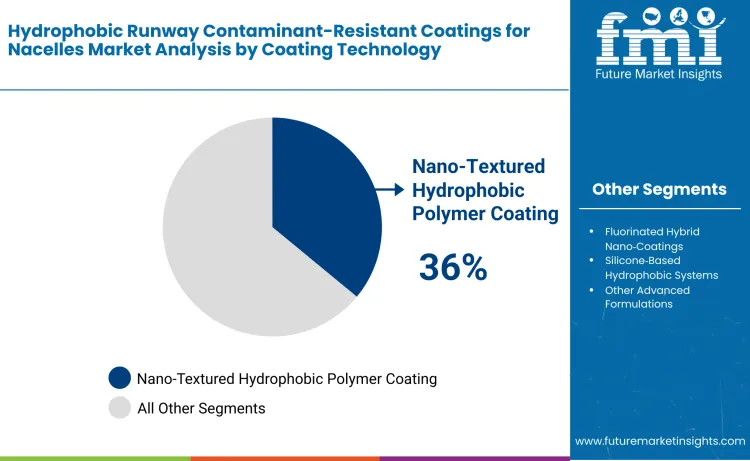
Nano-textured hydrophobic polymer coatings account for 36% of the market share. These coatings use advanced nano-texturing techniques to create surfaces that repel water, dirt, and other contaminants, ensuring that aircraft nacelles remain clean and perform optimally even under harsh environmental conditions. The application of these coatings to nacelles significantly reduces the buildup of contaminants such as ice, water, and dirt, which can negatively impact engine performance and aerodynamics. Nano-textured hydrophobic coatings are highly durable, providing long-lasting protection against corrosion, wear, and environmental damage. As the aviation industry continues to prioritize fuel efficiency and reduced maintenance costs, the adoption of nano-textured hydrophobic polymer coatings is increasing. These coatings are particularly useful for improving the efficiency and reliability of nacelles by preventing contamination that could lead to damage or performance degradation. The growing demand for more efficient, low-maintenance solutions in the aviation sector is driving the widespread use of these advanced coatings.
Which Application Drives Hydrophobic Runway Contaminant-Resistant Coatings for Nacelles Market Demand Globally?
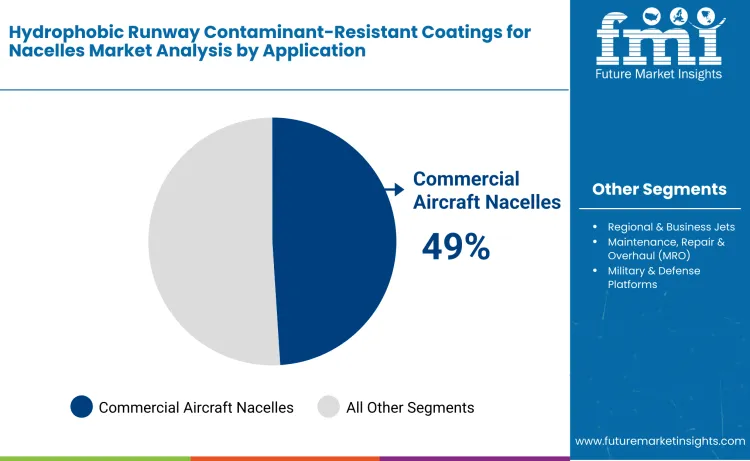
Commercial aircraft nacelles lead the application segment with 49% of the market share. Nacelles are critical components of aircraft, housing the engines and ensuring smooth airflow and protection against environmental elements. The application of hydrophobic coatings to commercial aircraft nacelles is essential for maintaining engine performance, improving fuel efficiency, and reducing the frequency of maintenance. Runway contaminants, such as water, ice, and dirt, can accumulate on nacelles, leading to reduced aerodynamic performance and potential engine damage. Hydrophobic coatings protect nacelles by preventing contaminants from adhering to surfaces, reducing the need for cleaning and maintenance. The growing focus on improving aircraft operational efficiency, reducing downtime, and enhancing performance is driving the demand for hydrophobic coatings in commercial aviation. While other applications, such as regional & business jets, MRO, and military & defense platforms, also contribute to the market, commercial aircraft remain the dominant application due to the size of the fleet and the need for optimal performance in the commercial aviation industry.
What is the Key Trends of the Global Hydrophobic Runway Contaminant Resistant Coatings for Nacelles Market?
The global hydrophobic runway contaminant‑resistant coatings for nacelles market is expanding as commercial and military aviation sectors seek solutions that improve engine reliability and safety in adverse weather conditions. These coatings are formulated to repel water, oil, rubber deposits and other runway contaminants that accumulate during takeoff and landing. They help maintain airflow integrity around nacelle surfaces, reduce corrosion risk and support easier cleaning. Growth reflects rising air travel demand, heightened focus on aircraft uptime, and adoption of advanced materials that improve nacelle resilience against operational contaminants worldwide.
What are the Key Drivers for the Global Hydrophobic Runway Contaminant‑Resistant Coatings for Nacelles Market?
A key driver is the need to enhance aircraft performance and reduce maintenance associated with buildup of water and debris on nacelle surfaces. Operators face frequent exposure to rain, slush, airport fluids and particulate matter that can affect aerodynamic efficiency and engine intake environments. Hydrophobic, contaminant‑resistant coatings help preserve surface function and structural integrity, reducing cleaning cycles and downtime. Aviation safety standards that prioritise reliable performance under diverse environmental conditions support adoption. Advances in coating chemistry that deliver robust adhesion and long‑lasting repellence on complex nacelle substrates further stimulate market interest.
What are the Restraints for the Global Hydrophobic Runway Contaminant‑Resistant Coatings for Nacelles Market?
One restraint is the technical challenge of developing coatings that sustain hydrophobic and contaminant resistance while withstanding environmental stress, thermal cycling and mechanical abrasion experienced in service. Formulations must balance repellence with adhesion and durability, which increases research and development effort. Qualification and certification by aviation authorities involve rigorous testing and validation, which extends development timelines and cost. Cost premiums for advanced surface systems compared with conventional coatings may restrict uptake in cost‑sensitive operations. Variability in application practices and maintenance protocols across operators may also affect uniform adoption.
What is the Country-Wise Outlook for Hydrophobic Runway Contaminant-Resistant Coatings for Nacelles?
The Hydrophobic Runway Contaminant-Resistant Coatings for Nacelles market is set to experience robust growth, driven by increasing demand for advanced coatings that enhance aircraft performance and reduce maintenance costs. Countries like India, China, and the USA are at the forefront of adopting these innovative coatings, which help prevent runway contaminants from adhering to nacelles, improving efficiency and safety. The growing focus on aerospace technology advancements and the need for high-performance, durable coatings are key factors driving the market’s expansion. As the global aviation industry seeks more reliable and cost-effective solutions, the market for hydrophobic coatings is expected to grow steadily across these regions.
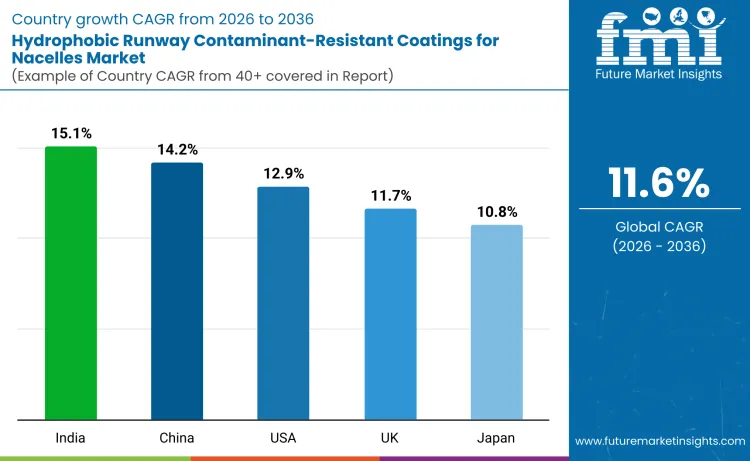
| Country | CAGR (2026-2036) |
|---|---|
| China | 14.2% |
| India | 15.1% |
| USA | 12.9% |
| UK | 11.7% |
| Japan | 10.8% |
What is Driving the Growth of Hydrophobic Runway Contaminant-Resistant Coatings for Nacelles in China?
The hydrophobic runway contaminant-resistant coatings for nacelles market in China is projected to grow at a CAGR of 14.2%. The rapid expansion of China’s aviation sector, coupled with a growing focus on enhancing aircraft safety and reducing maintenance costs, is driving the demand for hydrophobic coatings. These coatings help prevent contaminants from adhering to nacelles, thus improving aircraft performance and reducing the frequency of cleaning and maintenance. With China’s investment in modernizing its fleet and increasing its aircraft manufacturing capacity, the adoption of advanced coatings like hydrophobic, contaminant-resistant coatings is expected to accelerate, driving the market’s growth.
What is Contributing to the Growth of Hydrophobic Runway Contaminant-Resistant Coatings for Nacelles in India?
The hydrophobic runway contaminant-resistant coatings for nacelles market in India is expected to grow at a CAGR of 15.1%. As India’s aviation industry continues to expand, the demand for efficient and cost-effective solutions for aircraft maintenance is on the rise. Hydrophobic coatings that resist runway contaminants are becoming increasingly popular due to their ability to reduce maintenance requirements and enhance aircraft performance. With the growing fleet modernization efforts in India and a rising focus on fuel efficiency and safety, the market for hydrophobic coatings is expected to experience strong growth. Additionally, India’s increasing investment in aerospace technology further supports the adoption of advanced coatings in the aviation sector.
What is Driving the Hydrophobic Runway Contaminant-Resistant Coatings Market Growth in the USA?
The USA hydrophobic runway contaminant-resistant coatings for nacelles market is projected to grow at a CAGR of 12.9%. The USA, with its established aviation infrastructure and advanced aerospace technologies, is seeing an increasing demand for coatings that enhance aircraft durability and reduce maintenance costs. Hydrophobic coatings are highly effective in preventing runway contaminants from adhering to nacelles, improving fuel efficiency and safety. The USA’s continued investment in commercial aircraft and the growing emphasis on fuel-efficient and low-maintenance solutions are expected to further drive the adoption of hydrophobic coatings in the aviation industry, supporting the market’s expansion.
What is Influencing the Growth of Hydrophobic Runway Contaminant-Resistant Coatings for Nacelles in the UK?
The UK hydrophobic runway contaminant-resistant coatings for nacelles market is expected to grow at a CAGR of 11.7%. As the UK’s aviation industry places increasing emphasis on improving aircraft performance and reducing maintenance costs, hydrophobic coatings are gaining popularity for their ability to resist runway contaminants. The growing focus on enhancing the efficiency and longevity of aircraft, coupled with the UK’s investment in advanced aerospace technologies, is driving the demand for these coatings. The benefits of hydrophobic coatings in improving operational efficiency and safety are further contributing to the growth of the market in the UK.
What is Contributing to the Growth of Hydrophobic Runway Contaminant-Resistant Coatings for Nacelles in Japan?
The hydrophobic runway contaminant-resistant coatings for nacelles market in Japan is projected to grow at a CAGR of 10.8%. The country’s well-established aerospace sector and its focus on improving aircraft safety and performance are key drivers of market growth. Hydrophobic coatings, which help prevent runway contaminants from adhering to aircraft nacelles, are becoming increasingly important as Japan seeks to modernize its fleet and improve operational efficiency. The adoption of these advanced coatings is aligned with Japan’s broader goals of reducing maintenance costs and enhancing the longevity of aircraft. With continued investments in technology and a growing emphasis on safety and fuel efficiency, the market for hydrophobic coatings in Japan is expected to expand steadily.
What is the Competitive Landscape for the Hydrophobic Runway Contaminant Resistant Coatings for Nacelles Market?
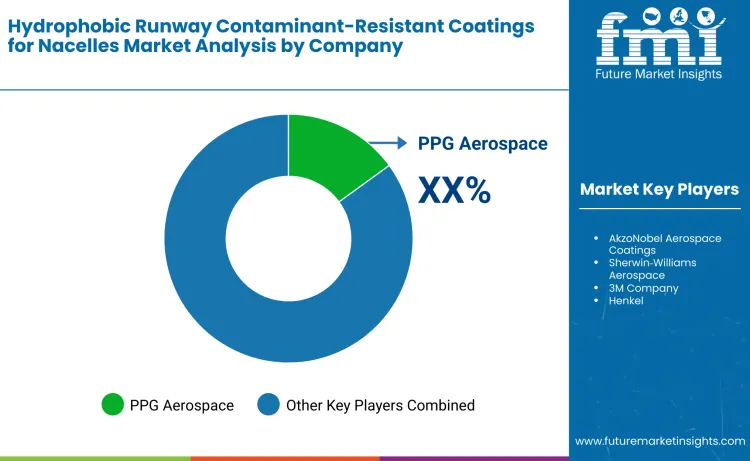
Global demand for hydrophobic runway contaminant‑resistant coatings for aircraft nacelles is increasing as airlines and original equipment manufacturers seek to minimise performance degradation and maintenance issues caused by exposure to water, ice, rubber deposits, fuel residues and other runway contaminants. Aircraft nacelles operate in highly variable environments, and contaminants that adhere to these surfaces can affect airflow, increase drag, and accelerate corrosion or surface wear. Hydrophobic coatings that repel water and resist adhesion of contaminants help maintain aerodynamic performance, improve fuel efficiency, and reduce cleaning frequency. Growth in global air travel, stricter safety and operational standards, and rising emphasis on lifecycle cost reduction drive adoption of advanced protective coatings. Operators in North America, Europe and Asia Pacific increasingly prioritise surface technologies that support on‑time operations and reduce maintenance downtime, especially at high‑use airports with frequent departures and landings.
On the supply side, a focused group of aerospace coatings and materials companies competes to lead this niche segment. PPG Aerospace is recognised as a leading provider of hydrophobic and contaminant‑resistant solutions for nacelle and engine surfaces. Other key competitors include AkzoNobel Aerospace Coatings, 3M Company, Sherwin‑Williams Aerospace and Henkel, each offering proprietary formulations designed to deliver water repellency, contaminant resistance, durability under thermal cycling, and adhesion to complex composite and metal substrates. Competition among these suppliers centres on coating longevity in harsh operational environments, ease of application or re‑application in maintenance settings, compatibility with aerospace‑grade materials, and support for certification requirements. Companies that combine strong formulation expertise, rigorous quality assurance and robust aerospace support networks are best positioned to capture growth as airlines and OEMs adopt advanced hydrophobic coatings to improve nacelle performance and reduce operational costs worldwide.
Key Players
- PPG Aerospace
- AkzoNobel Aerospace Coatings
- 3M Company
- Sherwin‑Williams Aerospace
- Henkel
Scope of the Report
| Items | Values |
|---|---|
| Quantitative Units (2025) | USD Million |
| Coating Technology | Nano-Textured Hydrophobic Polymer Coatings, Fluorinated Hybrid Nano-Coatings, Silicone-Based Hydrophobic Systems, Other Advanced Formulations |
| Application | Commercial Aircraft Nacelles, Regional & Business Jets, Maintenance, Repair & Overhaul (MRO), Military & Defense Platforms |
| Companies | PPG Aerospace, AkzoNobel Aerospace Coatings, 3M Company, Sherwin-Williams Aerospace, Henkel |
| Regions Covered | North America, Latin America, Western Europe, Eastern Europe, South Asia and Pacific, East Asia, Middle East & Africa |
| Countries Covered | United States, Canada, Mexico, Brazil, Argentina, Germany, France, United Kingdom, Italy, Spain, Netherlands, China, India, Japan, South Korea, ANZ, GCC Countries, South Africa |
| Additional Attributes | Dollar by sales by coating technology, application, and region. Includes market trends in hydrophobic runway contaminant-resistant coatings, performance in nacelles, regional and business jets, MRO applications, cost-effectiveness, sustainability practices, regulatory compliance, market share and competitive positioning of key companies, and the role of hydrophobic coatings in improving nacelle performance, reducing contaminants, and enhancing aircraft efficiency in diverse operating environments. |
Key Segments in the Hydrophobic Runway Contaminant-Resistant Coatings for Nacelles Market
Coating Technology:
- Nano‑Textured Hydrophobic Polymer Coatings
- Fluorinated Hybrid Nano‑Coatings
- Silicone‑Based Hydrophobic Systems
- Other Advanced Formulations
Application:
- Commercial Aircraft Nacelles
- Regional & Business Jets
- Maintenance, Repair & Overhaul (MRO)
- Military & Defense Platforms
Region:
- Asia Pacific
- China
- India
- Japan
- South Korea
- ASEAN
- Rest of Asia Pacific
- Europe
- Germany
- United Kingdom
- France
- Italy
- Spain
- Nordic
- BENELUX
- Rest of Europe
- North America
- United States
- Canada
- Mexico
- Latin America
- Brazil
- Chile
- Rest of Latin America
- Middle East & Africa
- Kingdom of Saudi Arabia
- Other GCC Countries
- Turkey
- South Africa
- Other African Union
- Rest of Middle East & Africa
Frequently Asked Questions
How big is the Hydrophobic Runway Contaminant-Resistant Coatings for Nacelles market?
The market is valued at USD 330 million in 2026 and is expected to grow at a CAGR of 11.6%, reaching USD 1.05 billion by 2036.
What is the growth outlook for the Hydrophobic Runway Contaminant-Resistant Coatings for Nacelles market?
The market is projected to grow at a CAGR of 11.6% from 2026 to 2036.
Which region is expected to experience the fastest growth in the Hydrophobic Runway Contaminant-Resistant Coatings for Nacelles market?
India is expected to lead with a growth rate of 15.1%, driven by the growing demand for advanced coatings in commercial aviation.
What are the key applications of Hydrophobic Runway Contaminant-Resistant Coatings for Nacelles?
These coatings are primarily used in commercial aircraft nacelles, which account for approximately 49% of the market share, to enhance protection against contaminants and improve performance.
Who are the major players in the Hydrophobic Runway Contaminant-Resistant Coatings for Nacelles market?
Key players include PPG Aerospace, AkzoNobel Aerospace Coatings, 3M Company, Sherwin-Williams Aerospace, and Henkel.
Preview the report firsthand - request a free sample
Get SampleGet the brochure for pricing and purchase details.
Get PDFTable of Content
- Executive Summary
- Market Overview
- Global Market Value, 2020–2026
- Global Market Forecast, 2026–2036
- Market Dynamics
- Drivers
- Restraints
- Opportunities
- Regulatory & Standards Landscape
- Coating Technology & Surface Engineering Outlook
- Market Segmentation Analysis
- By Coating Technology
- Nano-Textured Hydrophobic Polymer Coatings
- Fluorinated Hybrid Nano-Coatings
- Silicone-Based Hydrophobic Systems
- Other Advanced Formulations
- By Application
- Commercial Aircraft Nacelles
- Regional & Business Jets
- Maintenance, Repair & Overhaul (MRO)
- Military & Defense Platforms
- By Sales Channel
- Direct OEM Supply
- MRO & Repaint Facilities
- Aftermarket & Distributor Channels
- By Coating Technology
- Regional Outlook
- North America
- Latin America
- Western Europe
- Eastern Europe
- South Asia & Pacific
- East Asia
- Middle East & Africa
- Country-Level Outlook
- United States
- Canada
- Mexico
- Brazil
- Argentina
- Germany
- France
- United Kingdom
- Italy
- Spain
- Netherlands
- China
- India
- Japan
- South Korea
- ANZ
- GCC Countries
- South Africa
- Competitive Landscape
- Market Structure Overview
- Company Positioning
- Strategic Initiatives
- Key Player Profiles
- Scope of the Report
- Research Methodology
- Assumptions & Acronyms


