

- Industry Size (2026)
- USD 27.5 Bn
- Forecast (2036)
- USD 47.0 Bn
- CAGR (2026 to 2036)
- 5.5%
Oil and Gas Flow Control Equipment Market Forecast and Outlook 2026 to 2036
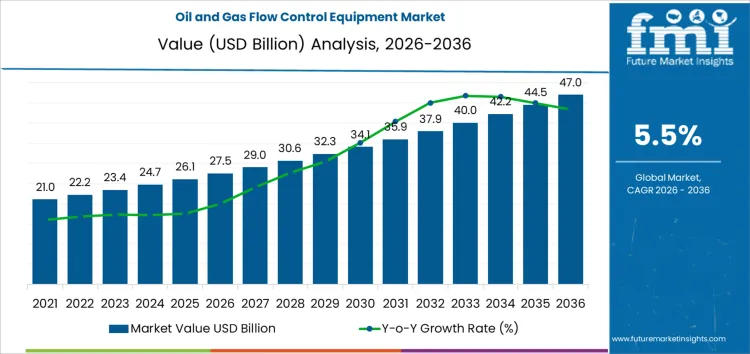
The oil and gas flow control equipment market is set to rise from USD 27.5 billion in 2026 toward USD 47.0 billion by 2036 with a CAGR of 5.5%. For manufacturers and suppliers, demand formation is governed by project phasing and contract packaging rather than by spot orders.
Large developments bundle valves, actuators, and control assemblies into engineered packages, which shifts competition toward early inclusion in front end engineering and design work. Winning positions at this stage determines years of follow on supply. Regional spending concentrates where new capacity and life extension programs run in parallel, which creates uneven order books across suppliers with different geographic footprints.
Commercial outcomes depend heavily on execution capability after contract award. Delivery reliability, documentation quality, and change management performance influence repeat business more than initial pricing. Operators place weight on standardization of part families across assets to reduce spares holdings and training complexity, which favors vendors able to support broad portfolios. Aftermarket service, refurbishment, and field modification work provide a stabilizing revenue layer that is less exposed to investment cycles. The market expands through project sequencing and installed base servicing, not through short cycle purchasing or broad substitution of existing equipment.
Quick Stats for Oil and Gas Flow Control Equipment Market
- Oil and Gas Flow Control Equipment Market Value (2026): USD 27.5 billion
- Oil and Gas Flow Control Equipment Market Forecast Value (2036): USD 47.0 billion
- Oil and Gas Flow Control Equipment Market Forecast CAGR 2026 to 2036: 5.5%
- Leading Type in Oil and Gas Flow Control Equipment Market: Valves
- Key Growth Regions in Oil and Gas Flow Control Equipment Market: Asia Pacific, North America, Europe
- Top Players in Oil and Gas Flow Control Equipment Market: Emerson Electric Co., SLB, Baker Hughes Company, Flowserve Corporation, Siemens Energy AG, Honeywell International Inc.
What is the Growth Forecast for the Oil and Gas Flow Control Equipment Market through 2036?
The oil and gas flow control equipment market develops in close connection with upstream, midstream, and downstream capital expenditure cycles and with the technical requirements of operating increasingly complex assets. In 2020, when the oil and gas flow control equipment market is approximately USD 21.0 billion, demand is largely driven by maintenance of existing production facilities and selective investments in pipeline and processing infrastructure. By 2023 and 2024, with spending around USD 23.4 to 24.7 billion, activity is increasingly supported by brownfield upgrades, integrity management programs, and the need to replace aging valves, actuators, and control systems in mature fields and transport networks. The oil and gas flow control equipment market reaches approximately USD 27.5 billion by 2026, reflecting a broader normalization of investment levels and the gradual resumption of larger field development and capacity expansion projects. At this stage, procurement decisions are strongly influenced by reliability, safety compliance, and lifecycle cost considerations rather than by initial equipment price alone.
Subsequent expansion is shaped more by asset complexity and regulatory requirements than by simple production volume growth. By 2030, the oil and gas flow control equipment market reaches approximately USD 32.3 billion as offshore developments, LNG infrastructure, and high-pressure, high-temperature projects require more sophisticated and higher-specification flow control solutions. In 2032, with spending around USD 35.9 billion, replacement demand and digitalization of control systems become increasingly important components of overall market activity. By 2034, at approximately USD 40.0 billion, investment is supported by continued development of gas infrastructure, energy security-driven projects, and stricter environmental and safety standards that raise the technical requirements for valves and control assemblies. The oil and gas flow control equipment market reaches about USD 47.0 billion by 2036, driven primarily by higher equipment value per project, broader deployment of automated and monitored flow control systems, and sustained reinvestment in existing assets rather than by a simple increase in the number of new fields. Purchasing priorities remain centered on operational reliability, safety certification, and long-term service support.
Oil & Gas Flow Control Equipment Market Key Takeaways
| Metric | Value |
|---|---|
| Market Value (2026) | USD 27.5 billion |
| Forecast Value (2036) | USD 47.0 billion |
| Forecast CAGR 2026 to 2036 | 5.5% |
How Is the Oil & Gas Flow Control Equipment Market Enabling Precision and Operational Insight?
Oil and gas operators are increasingly relying on advanced flow control equipment to manage fluid dynamics, improve process accuracy, and reduce operational risk across exploration, transport, and processing facilities. Traditional systems often required manual intervention and periodic inspection, leading to inefficiencies, process variability, and higher operational costs. Modern flow control solutions combine automated control valves, actuators, and integrated monitoring software to deliver real-time data on flow rates, pressure fluctuations, and system performance. Equipment manufacturers, pipeline operators, and engineering service providers prioritize modularity, durability under harsh conditions, and compatibility with existing SCADA or distributed control systems. Initial adoption targeted high-pressure pipelines and offshore platforms, while current demand spans refineries, chemical plants, and midstream transport, driven by efficiency targets, regulatory compliance, and predictive maintenance needs. System precision, digital integration capability, and maintenance predictability influence procurement decisions.
Operational intelligence, risk mitigation, and process optimization are shaping supplier strategies. Compared with conventional manual equipment, modern flow control systems provide actionable analytics, predictive alerts, and automated adjustments, helping companies reduce downtime and extend asset life. Cost considerations involve actuator performance, sensor reliability, and software integration, concentrating market opportunities among suppliers capable of delivering turnkey solutions with monitoring and diagnostics support. Operators implement these systems to optimize production efficiency, improve process reliability, and meet stringent environmental and safety standards. Looking ahead, flow control equipment is expected to serve as a central component in digitalized oil and gas operations, enabling data-driven decision-making, reduced operational variability, and measurable improvements in asset utilization.
What Factors Are Shaping the Demand for Oil and Gas Flow Control Equipment Market, Segment wise by Equipment Type and End Use, in 2026?
The Oil and Gas Flow Control Equipment Market is governed less by equipment performance specifications and more by capital project cycles, long qualification horizons, and the economic cost of changing approved hardware. Once a valve or actuator family is approved for a field, pipeline, or processing plant, it often remains in use for decades. This makes the Oil and Gas Flow Control Equipment Market structurally conservative and strongly biased toward installed-base continuity. By equipment type, the Oil and Gas Flow Control Equipment Market includes valves, actuators, flow meters, and control valves. By end use, the Oil and Gas Flow Control Equipment Market serves upstream exploration and production, midstream transportation and storage, downstream refining and petrochemicals, and LNG terminals. Each segment reflects different approval authorities, shutdown tolerances, and maintenance philosophies.
How Does Installed-Base Inertia, Not Unit Volume, Drive Equipment Type Economics in the Oil and Gas Flow Control Equipment Market?
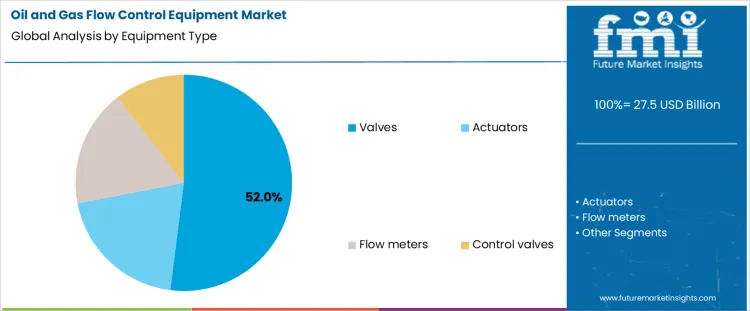
Valves represent about 52% of demand in the Oil and Gas Flow Control Equipment Market, not because they are the most complex product, but because they exist in very large numbers and are rarely redesigned once specified. Every project involves thousands of isolation and regulation points, and once a valve type is qualified for pressure class, metallurgy, and service condition, it becomes part of the site standard. Replacement demand therefore follows maintenance schedules and turnaround cycles rather than new project starts.
Actuators, control valves, and flow meters behave differently from a sales strategy perspective. Actuators and control valves are often bundled into control packages and sold through EPC scopes. Flow meters are sold through instrumentation budgets and are more exposed to technology substitution. For suppliers, the Oil and Gas Flow Control Equipment Market is therefore not a single equipment contest. It is a portfolio of installed-base franchises, each defended through specifications, spares contracts, and service relationships rather than through feature-level competition.
Why Does Upstream Continue to Dominate Spending Volatility in the Oil and Gas Flow Control Equipment Market?
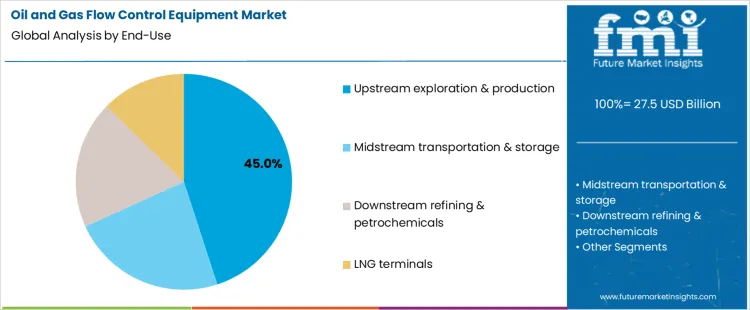
Upstream exploration and production account for about 45% of demand in the Oil and Gas Flow Control Equipment Market because this segment is where project sanctioning decisions translate directly into equipment orders. When upstream investment accelerates, equipment demand rises quickly. When capital discipline tightens, orders fall just as rapidly. This makes upstream the most cyclical but also the most lucrative segment for suppliers positioned on new field developments and capacity expansions.
Midstream and downstream segments behave more like infrastructure maintenance markets, with steadier spending tied to capacity utilization, regulatory inspections, and life extension programs. LNG terminals sit between these two models, combining project-like expansion cycles with long operational lifetimes. For manufacturers and EPC-aligned suppliers, success in the Oil and Gas Flow Control Equipment Market depends less on chasing short-term project spikes and more on embedding products into operator standards, approved vendor lists, and long-term service agreements, which secure revenue across multiple investment cycles.
How Are the Key Dynamics Reshaping the Oil and Gas Flow Control Equipment Market?
This market moves with risk tolerance, not with catalog cycles. Valves, actuators, chokes, and control systems decide whether a facility runs quietly for years or becomes a headline during an incident. Buying behavior is therefore conservative, episodic, and closely tied to project approvals, audits, and failure reviews. In some periods, investment is driven by expansion. In others, it is driven by near misses and regulatory pressure. The same equipment can be seen either as invisible infrastructure or as mission critical insurance. The oil and gas flow control equipment market advances when operators change how they think about control, not when they browse for newer hardware.
Why the Oil and Gas Flow Control Equipment Market Is Incident Driven?
Many purchases start after something goes wrong somewhere else. A leak, a blowout, or a near miss in the industry quickly turns into internal reviews and new requirements. Suddenly, isolation time, redundancy, and controllability become board level topics. Equipment that was considered adequate is reclassified as risky. This pattern repeats across upstream, midstream, and downstream. The trigger is rarely routine obsolescence. It is fear of being the next case study. Demand therefore comes in waves following incidents, investigations, and regulatory reactions, not in smooth replacement curves or predictable upgrade programs.
Why the Oil and Gas Flow Control Equipment Market Resists Change?
Once a valve type or control architecture is qualified, it tends to stay in place for decades. Changing it means redoing hazard studies, procedures, spares, training, and sometimes permits. Operators prefer known weaknesses to unknown ones. Even when better technology exists, the cost of revalidation and the risk of unintended consequences slow decisions. This creates a world where new designs mostly enter through new projects, not existing facilities. The oil and gas flow control equipment market is constrained less by technical limits and more by institutional memory and fear of destabilizing systems that, while imperfect, are understood.
Why the Oil and Gas Flow Control Equipment Market Follows Project Architecture?
Flow control is not bought as a collection of parts. It is embedded in how a facility is designed to start, stop, isolate, and fail safely. When project philosophies change, equipment choices change with them. Some operators favor highly segmented, automated control. Others prefer simpler, manually robust designs. As modular plants, standardized trains, and repeatable project templates spread, equipment selection becomes more programmatic. Suppliers that fit into these reference designs gain scale. The oil and gas flow control equipment market therefore follows how projects are conceived and repeated, not how many valves exist in the world.
What is the Demand for Oil and Gas Flow Control Equipment by Country?
| Country | CAGR (%) |
|---|---|
| USA | 5.0% |
| UK | 4.8% |
| China | 6.0% |
| India | 6.2% |
| Brazil | 5.3% |
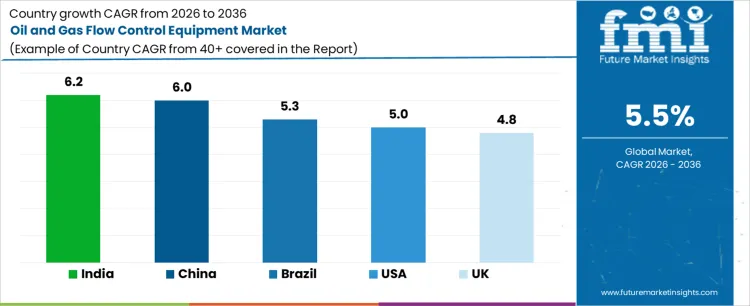
Demand for oil and gas flow control equipment is rising as upstream, midstream, and downstream operators adopt valves, regulators, and control systems to optimize production, ensure safety, and improve operational efficiency. India leads with a 6.2% CAGR, driven by expanding oil and gas exploration, increasing production capacity, and modernization of pipelines and processing facilities. China follows at 6.0%, supported by growing domestic energy demand and industrial infrastructure. Brazil records 5.3% growth, shaped by investments in oilfields and flow control upgrades. The USA grows at 5.0%, influenced by maintenance, replacement, and regulatory compliance in energy infrastructure. The UK shows 4.8% CAGR, reflecting steady adoption of flow control equipment in production and refining operations.
Where does commercial leverage actually sit for Oil and Gas Flow Control Equipment suppliers in the United States?
Spending in United States oil and gas flow control equipment follows long cycle maintenance and retrofit programs, with growth tracking at 5% under current investment plans. Revenue does not move in line with drilling counts or short cycle exploration budgets. Order flow comes from shale replacement programs, refinery reliability work, and pipeline integrity spending. EPC firms and operator maintenance teams influence specification lock in across most packages. Installed base compatibility determines repeat business more than technical novelty. Inventory stocking agreements shape share in MRO channels. Domestic manufacturing depth keeps pricing pressure persistent. Certification scope and delivery reliability decide access to safety critical loops. Qualification timelines remain long for critical components. Project announcements offer weak signals for revenue timing. Commercial success follows placement inside multi-year service frameworks, standard plant designs, and retrofit schedules that release volume in steady phases rather than single awards.
How do asset life extension programs govern sales structure in the United Kingdom?
Budget release in United Kingdom remains tied to offshore life extension and inspection programs, with equipment demand expanding at a 4.8% CAGR. New field development contributes limited annual volume compared with replacement and compliance driven work. Contractor frameworks and operator approval lists control access to supply positions. Documentation quality, certification acceptance, and service proximity near offshore assets shape supplier selection. A large share of packages moves through engineering contractors rather than direct operator sourcing. Pricing reflects warranty exposure and execution risk more than unit manufacturing cost. Refurbishment capability and spare availability protect share in late life assets. Order timing follows inspection schedules and shutdown planning cycles. Inventory planning influences replacement wins. Commercial visibility depends on framework inclusion and long term maintenance alignment rather than competitive bidding on isolated project packages.
What structural forces decide scale and margin position in China?
Centralized infrastructure budgets and state operator procurement plans keep China on a 6% CAGR path for oil and gas flow control equipment purchases. Volume concentrates in pipeline corridors, refinery expansions, and storage terminal construction programs. Domestic manufacturers dominate standard valve categories through pricing control and delivery speed. International suppliers retain positions in specialty pressure classes and complex control duties. EPC firms influence technical specification setting and brand access during early design stages. Order timing follows capital approvals rather than individual project awards. Localization status and reference installations outweigh marginal performance differences. Margin structure depends on mix between engineered systems and commodity hardware. Documentation readiness and production scale decide access. Commercial success depends on position inside approved supply ecosystems rather than repeated pursuit of single project wins across fragmented tenders.
Why does access strategy define revenue outcomes in India?
Infrastructure rollout across refineries, trunk pipelines, and city gas distribution networks keeps India on a 6.2% growth track for oil and gas flow control equipment spending. Public sector operators and their nominated EPC partners control most award flow. Entry barriers sit in qualification, local manufacturing presence, and documentation readiness. Import suppliers serve high specification duties while domestic vendors cover volume categories. A large share of revenue moves through bundled equipment packages rather than single component orders. Payment terms and execution risk influence supplier choice. Project pipelines operate on long approval cycles. Sales performance depends on panel inclusion and framework positioning. Inventory planning affects replacement wins. Expansion follows national energy infrastructure schedules rather than short cycle exploration activity or spot equipment tenders across individual facilities.
How do offshore development schedules shape supplier visibility in Brazil?
Offshore development timelines and FPSO programs shape Brazil demand patterns, with oil and gas flow control equipment expanding at a 5.3% CAGR under current investment plans. Contract value concentrates in high integrity valve systems and complex control assemblies. Operator approval lists and local content structures define access routes. EPC contractors control package sourcing and configuration decisions. Import dependence affects delivery planning and inventory strategy. Retrofit programs and life extension work generate recurring order flow. Commercial risk centers on certification acceptance and project timing shifts. Drilling counts alone do not predict equipment orders. Revenue visibility depends on placement inside multi-year offshore development and maintenance frameworks. Commercial outcomes follow long cycle project alignment rather than isolated project awards or short term capital releases.
How Are Major Suppliers Competing in the Oil & Gas Flow Control Equipment Market?
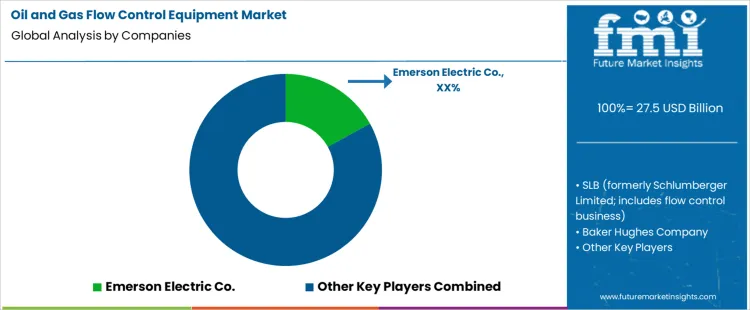
Emerson Electric Co. supplies a wide portfolio of valves, actuators, and flow automation tools designed for upstream, midstream, and downstream applications, with focus on digital integration and field diagnostics. SLB (formerly Schlumberger, including its flow control business) offers flow control systems engineered for subsea, wellhead, and reservoir environments, emphasising reliability under extreme pressure and temperature conditions. Baker Hughes Company provides control valves and choke systems that align with integrated drilling and production services, supporting equipment standardisation across complex projects. Flowserve Corporation delivers engineered valve solutions with custom trim designs for abrasion and multiphase flow, targeting both conventional and unconventional production. Siemens Energy AG develops flow control equipment that interfaces with broader energy automation platforms, aiding coordinated control in refining and LNG processing.
Honeywell International Inc. offers flow control valves and regulators with embedded sensing and automation that support safety and efficiency in petrochemical plants. Other regional and specialist manufacturers supply niche products such as severe service valves and compact control packages for modular process units. Differentiation arises from materials engineered for corrosion and erosive service, actuator and control compatibility, and global service support networks. Suppliers with extensive certification portfolios and field reliability data attract project engineers seeking predictable performance under regulatory scrutiny. Integration with digital condition monitoring and predictive diagnostics also influences buyer preference, as operators pursue reduced downtime and tighter process control across the oil and gas value chain.
Key Players in the Oil and Gas Flow Control Equipment Market
- Emerson Electric Co.
- SLB (formerly Schlumberger Limited; includes flow control business)
- Baker Hughes Company
- Flowserve Corporation
- Siemens Energy AG
- Honeywell International Inc.
Scope of the Report
| Items | Values |
|---|---|
| Quantitative Units (2026) | USD billion |
| Equipment Type | Valves, Actuators, Flow meters, Control valves |
| End-Use | Upstream exploration & production, Midstream transportation & storage, Downstream refining & petrochemicals, LNG terminals |
| Region | Asia Pacific, Europe, North America, Latin America, Middle East & Africa |
| Countries Covered | China, Japan, South Korea, India, Australia & New Zealand, ASEAN, Germany, United Kingdom, France, Italy, Spain, Nordic, BENELUX, United States, Canada, Mexico, Brazil, Chile, Saudi Arabia, Turkey, South Africa, and other regional markets |
| Key Companies Profiled | Emerson Electric Co., SLB, Baker Hughes Company, Flowserve Corporation, Siemens Energy AG, Honeywell International Inc. |
| Additional Attributes | Dollar by sales by equipment type and end-use; demand driven by project phasing and installed-base replacement; growth led by higher specification projects, LNG and offshore developments, and life extension programs; aftermarket service stabilizes revenue; purchasing driven by reliability, safety certification, standardization, and long-term service support rather than initial price. |
Oil and Gas Flow Control Equipment Market Segmentation
Equipment Type:
- Valves
- Actuators
- Flow meters
- Control valves
End-Use:
- Upstream exploration & production
- Midstream transportation & storage
- Downstream refining & petrochemicals
- LNG terminals
Region
- Asia Pacific
- China
- Japan
- South Korea
- India
- Australia & New Zealand
- ASEAN
- Rest of Asia Pacific
- Europe
- Germany
- United Kingdom
- France
- Italy
- Spain
- Nordic
- BENELUX
- Rest of Europe
- North America
- United States
- Canada
- Mexico
- Latin America
- Brazil
- Chile
- Rest of Latin America
- Middle East & Africa
- Kingdom of Saudi Arabia
- Other GCC Countries
- Turkey
- South Africa
- Other African Union
- Rest of Middle East & Africa
Bibliography
- International Energy Agency. (2024). World Energy Investment 2024. International Energy Agency.
- U.S. Energy Information Administration. (2024). Annual Energy Outlook 2024. U.S. Department of Energy.
- Pipeline and Hazardous Materials Safety Administration. (2024). Pipeline Safety Annual Report 2024. U.S. Department of Transportation.
- European Commission. (2024). EU energy infrastructure and security of supply policy. European Union.
- International Organization for Standardization. (2024). ISO standards for industrial valves and pipeline systems. International Organization for Standardization.
Frequently Asked Questions
How big is the oil and gas flow control equipment market in 2026?
The global oil and gas flow control equipment market is estimated to be valued at USD 27.5 billion in 2026.
What will be the size of oil and gas flow control equipment market in 2036?
The market size for the oil and gas flow control equipment market is projected to reach USD 47.0 billion by 2036.
How much will be the oil and gas flow control equipment market growth between 2026 and 2036?
The oil and gas flow control equipment market is expected to grow at a 5.5% CAGR between 2026 and 2036.
What are the key product types in the oil and gas flow control equipment market?
The key product types in oil and gas flow control equipment market are valves, actuators, flow meters and control valves.
Which end‑use segment to contribute significant share in the oil and gas flow control equipment market in 2026?
In terms of end‑use, upstream exploration & production segment to command 45.0% share in the oil and gas flow control equipment market in 2026.
Preview the report firsthand - request a free sample
Get SampleGet the brochure for pricing and purchase details.
Get PDFTable of Content
- Executive Summary
- Global Market Outlook
- Demand-side Trends
- Supply-side Trends
- Technology Roadmap Analysis
- Analysis and Recommendations
- Market Overview
- Market Coverage / Taxonomy
- Market Definition / Scope / Limitations
- Market Background
- Market Dynamics
- Drivers
- Restraints
- Opportunity
- Trends
- Scenario Forecast
- Demand in Optimistic Scenario
- Demand in Likely Scenario
- Demand in Conservative Scenario
- Opportunity Map Analysis
- Product Life Cycle Analysis
- Supply Chain Analysis
- Investment Feasibility Matrix
- Value Chain Analysis
- PESTLE and Porter’s Analysis
- Regulatory Landscape
- Regional Parent Market Outlook
- Production and Consumption Statistics
- Import and Export Statistics
- Market Dynamics
- Global Market Analysis 2021 to 2025 and Forecast, 2026 to 2036
- Historical Market Size Value (USD Million) Analysis, 2021 to 2025
- Current and Future Market Size Value (USD Million) Projections, 2026 to 2036
- Y-o-Y Growth Trend Analysis
- Absolute $ Opportunity Analysis
- Global Market Pricing Analysis 2021 to 2025 and Forecast 2026 to 2036
- Global Market Analysis 2021 to 2025 and Forecast 2026 to 2036, By Equipment Type
- Introduction / Key Findings
- Historical Market Size Value (USD Million) Analysis By Equipment Type , 2021 to 2025
- Current and Future Market Size Value (USD Million) Analysis and Forecast By Equipment Type , 2026 to 2036
- Valves
- Actuators
- Flow meters
- Control valves
- Valves
- Y-o-Y Growth Trend Analysis By Equipment Type , 2021 to 2025
- Absolute $ Opportunity Analysis By Equipment Type , 2026 to 2036
- Global Market Analysis 2021 to 2025 and Forecast 2026 to 2036, By End‑Use
- Introduction / Key Findings
- Historical Market Size Value (USD Million) Analysis By End‑Use, 2021 to 2025
- Current and Future Market Size Value (USD Million) Analysis and Forecast By End‑Use, 2026 to 2036
- Upstream exploration & production
- Midstream transportation & storage
- Downstream refining & petrochemicals
- LNG terminals
- Upstream exploration & production
- Y-o-Y Growth Trend Analysis By End‑Use, 2021 to 2025
- Absolute $ Opportunity Analysis By End‑Use, 2026 to 2036
- Global Market Analysis 2021 to 2025 and Forecast 2026 to 2036, By Region
- Introduction
- Historical Market Size Value (USD Million) Analysis By Region, 2021 to 2025
- Current Market Size Value (USD Million) Analysis and Forecast By Region, 2026 to 2036
- North America
- Latin America
- Western Europe
- Eastern Europe
- East Asia
- South Asia and Pacific
- Middle East & Africa
- Market Attractiveness Analysis By Region
- North America Market Analysis 2021 to 2025 and Forecast 2026 to 2036, By Country
- Historical Market Size Value (USD Million) Trend Analysis By Market Taxonomy, 2021 to 2025
- Market Size Value (USD Million) Forecast By Market Taxonomy, 2026 to 2036
- By Country
- USA
- Canada
- Mexico
- By Equipment Type
- By End‑Use
- By Country
- Market Attractiveness Analysis
- By Country
- By Equipment Type
- By End‑Use
- Key Takeaways
- Latin America Market Analysis 2021 to 2025 and Forecast 2026 to 2036, By Country
- Historical Market Size Value (USD Million) Trend Analysis By Market Taxonomy, 2021 to 2025
- Market Size Value (USD Million) Forecast By Market Taxonomy, 2026 to 2036
- By Country
- Brazil
- Chile
- Rest of Latin America
- By Equipment Type
- By End‑Use
- By Country
- Market Attractiveness Analysis
- By Country
- By Equipment Type
- By End‑Use
- Key Takeaways
- Western Europe Market Analysis 2021 to 2025 and Forecast 2026 to 2036, By Country
- Historical Market Size Value (USD Million) Trend Analysis By Market Taxonomy, 2021 to 2025
- Market Size Value (USD Million) Forecast By Market Taxonomy, 2026 to 2036
- By Country
- Germany
- UK
- Italy
- Spain
- France
- Nordic
- BENELUX
- Rest of Western Europe
- By Equipment Type
- By End‑Use
- By Country
- Market Attractiveness Analysis
- By Country
- By Equipment Type
- By End‑Use
- Key Takeaways
- Eastern Europe Market Analysis 2021 to 2025 and Forecast 2026 to 2036, By Country
- Historical Market Size Value (USD Million) Trend Analysis By Market Taxonomy, 2021 to 2025
- Market Size Value (USD Million) Forecast By Market Taxonomy, 2026 to 2036
- By Country
- Russia
- Poland
- Hungary
- Balkan & Baltic
- Rest of Eastern Europe
- By Equipment Type
- By End‑Use
- By Country
- Market Attractiveness Analysis
- By Country
- By Equipment Type
- By End‑Use
- Key Takeaways
- East Asia Market Analysis 2021 to 2025 and Forecast 2026 to 2036, By Country
- Historical Market Size Value (USD Million) Trend Analysis By Market Taxonomy, 2021 to 2025
- Market Size Value (USD Million) Forecast By Market Taxonomy, 2026 to 2036
- By Country
- China
- Japan
- South Korea
- By Equipment Type
- By End‑Use
- By Country
- Market Attractiveness Analysis
- By Country
- By Equipment Type
- By End‑Use
- Key Takeaways
- South Asia and Pacific Market Analysis 2021 to 2025 and Forecast 2026 to 2036, By Country
- Historical Market Size Value (USD Million) Trend Analysis By Market Taxonomy, 2021 to 2025
- Market Size Value (USD Million) Forecast By Market Taxonomy, 2026 to 2036
- By Country
- India
- ASEAN
- Australia & New Zealand
- Rest of South Asia and Pacific
- By Equipment Type
- By End‑Use
- By Country
- Market Attractiveness Analysis
- By Country
- By Equipment Type
- By End‑Use
- Key Takeaways
- Middle East & Africa Market Analysis 2021 to 2025 and Forecast 2026 to 2036, By Country
- Historical Market Size Value (USD Million) Trend Analysis By Market Taxonomy, 2021 to 2025
- Market Size Value (USD Million) Forecast By Market Taxonomy, 2026 to 2036
- By Country
- Kingdom of Saudi Arabia
- Other GCC Countries
- Turkiye
- South Africa
- Other African Union
- Rest of Middle East & Africa
- By Equipment Type
- By End‑Use
- By Country
- Market Attractiveness Analysis
- By Country
- By Equipment Type
- By End‑Use
- Key Takeaways
- Key Countries Market Analysis
- USA
- Pricing Analysis
- Market Share Analysis, 2025
- By Equipment Type
- By End‑Use
- Canada
- Pricing Analysis
- Market Share Analysis, 2025
- By Equipment Type
- By End‑Use
- Mexico
- Pricing Analysis
- Market Share Analysis, 2025
- By Equipment Type
- By End‑Use
- Brazil
- Pricing Analysis
- Market Share Analysis, 2025
- By Equipment Type
- By End‑Use
- Chile
- Pricing Analysis
- Market Share Analysis, 2025
- By Equipment Type
- By End‑Use
- Germany
- Pricing Analysis
- Market Share Analysis, 2025
- By Equipment Type
- By End‑Use
- UK
- Pricing Analysis
- Market Share Analysis, 2025
- By Equipment Type
- By End‑Use
- Italy
- Pricing Analysis
- Market Share Analysis, 2025
- By Equipment Type
- By End‑Use
- Spain
- Pricing Analysis
- Market Share Analysis, 2025
- By Equipment Type
- By End‑Use
- France
- Pricing Analysis
- Market Share Analysis, 2025
- By Equipment Type
- By End‑Use
- India
- Pricing Analysis
- Market Share Analysis, 2025
- By Equipment Type
- By End‑Use
- ASEAN
- Pricing Analysis
- Market Share Analysis, 2025
- By Equipment Type
- By End‑Use
- Australia & New Zealand
- Pricing Analysis
- Market Share Analysis, 2025
- By Equipment Type
- By End‑Use
- China
- Pricing Analysis
- Market Share Analysis, 2025
- By Equipment Type
- By End‑Use
- Japan
- Pricing Analysis
- Market Share Analysis, 2025
- By Equipment Type
- By End‑Use
- South Korea
- Pricing Analysis
- Market Share Analysis, 2025
- By Equipment Type
- By End‑Use
- Russia
- Pricing Analysis
- Market Share Analysis, 2025
- By Equipment Type
- By End‑Use
- Poland
- Pricing Analysis
- Market Share Analysis, 2025
- By Equipment Type
- By End‑Use
- Hungary
- Pricing Analysis
- Market Share Analysis, 2025
- By Equipment Type
- By End‑Use
- Kingdom of Saudi Arabia
- Pricing Analysis
- Market Share Analysis, 2025
- By Equipment Type
- By End‑Use
- Turkiye
- Pricing Analysis
- Market Share Analysis, 2025
- By Equipment Type
- By End‑Use
- South Africa
- Pricing Analysis
- Market Share Analysis, 2025
- By Equipment Type
- By End‑Use
- USA
- Market Structure Analysis
- Competition Dashboard
- Competition Benchmarking
- Market Share Analysis of Top Players
- By Regional
- By Equipment Type
- By End‑Use
- Competition Analysis
- Competition Deep Dive
- Emerson Electric Co.
- Overview
- Product Portfolio
- Profitability by Market Segments (Product/Age /Sales Channel/Region)
- Sales Footprint
- Strategy Overview
- Marketing Strategy
- Product Strategy
- Channel Strategy
- SLB (formerly Schlumberger Limited; includes flow control business)
- Baker Hughes Company
- Flowserve Corporation
- Siemens Energy AG
- Honeywell International Inc.
- Emerson Electric Co.
- Competition Deep Dive
- Assumptions & Acronyms Used
- Research Methodology


