

- Industry Size (2026)
- USD 1.9 Bn
- Forecast (2036)
- USD 18.5 Bn
- CAGR (2026 to 2036)
- 25.80%
In-Vehicle Generative AI Platforms Market Size, Market Forecast and Outlook By FMI
The in-vehicle generative ai platforms market was valued at USD 1.3 billion in 2025. The industry is poised to reach USD 1.9 billion in 2026 at a CAGR of 25.80% during the forecast period. Sustained investment propels the total valuation to USD 18.5 billion through 2036 as vehicle architectures transition from fragmented control units to centralized high-performance compute nodes capable of hosting neural networks for real-time human-machine orchestration.
Automotive chief technology officers are no longer deciding whether to include voice commands; they are deciding whether to surrender the cockpit experience to Big Tech ecosystems or build proprietary automotive genai copilot frameworks. The stakes for delay are the permanent loss of first-party driver data and the relegation of the vehicle to a mere hardware shell for third-party software. FMI analysts observe that the true bottleneck is not model intelligence but the thermal and power constraints of edge-based inference within the vehicle's electrical architecture. Integrating these platforms requires a complete decoupling of hardware and software lifecycles to prevent rapid cabin obsolescence through automotive intelligence.
Summary of In-Vehicle Generative AI Platforms Market
- In-Vehicle Generative AI Platforms Market Definition
- The market represents the shift from reactive to proactive vehicle interfaces, where generative models interpret driver intent and environmental context to automate complex tasks and personalize the in-cabin environment.
- Demand Drivers in the Market
- Consumer expectation for smartphone-parity interfaces forces infotainment designers to replace rigid menus with natural language fluid agents.
- Increasing complexity of vehicle features requires cognitive assistants to simplify driver interaction with ADAS and navigation settings.
- The transition toward software-defined vehicles necessitates generative platforms that can evolve through over-the-air updates without hardware changes.
- Key Segments Analyzed in the FMI Report
- In-Cabin Conversational AI: This segment is expected to hold 45.2% share in 2026, driven by the immediate consumer demand for intuitive, zero-latency in-car assistant technologies.
- Passenger Vehicles: This vehicle type is projected to account for 72.5% share in 2026 due to the high volume of tech-driven retail sales.
- L2/L2+: These platforms are estimated to garner 58.4% share as mass-market vehicles integrate semi-autonomous features requiring AI oversight.
- India: India leads growth with 32.4% compound growth, reflecting a structural shift toward tech-premiumization in emerging middle-class markets.
- Analyst Opinion at FMI
- Nikhil Kaitwade, Principal Analyst, Automotive, at FMI, opines, "The industry is currently caught in a practitioner paradox where OEMs are racing to integrate massive generative models to satisfy marketing demands, yet the actual hardware thermal envelope in the vehicle often cannot support sustained high-token inference. We are seeing a shift where the value is moving away from the model itself and toward the orchestration layer that determines when to process data at the edge for safety and when to offload to the cloud for complexity."
- Strategic Implications / Executive Takeaways
- Tier-1 suppliers must transition from component manufacturing to becoming platform orchestrators to avoid commoditization by Big Tech software providers.
- Fleet managers should prioritize vehicles with high-performance NPU architectures to ensure generative AI features remain compatible with 10-year vehicle lifecycles.
- Software developers face a critical need for localized small language models (SLMs) that can operate without a persistent data connection to ensure safety-critical reliability.
- Methodology
- The research leverages a bottom-up sizing model based on vehicle production tiers, validated through primary interviews with decision-makers responsible for digital cockpit procurement.
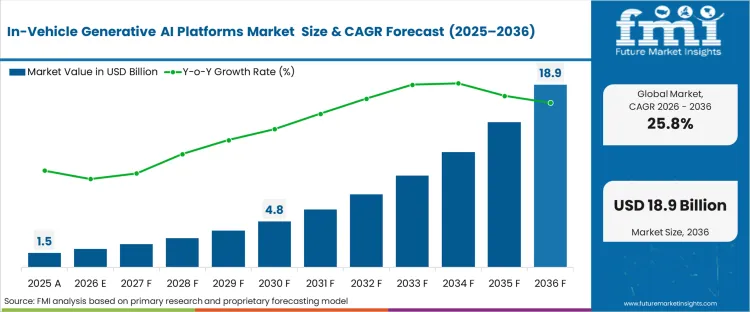
In-Vehicle Generative AI Platforms Market Key Takeaways
| Metric | Details |
|---|---|
| Industry Size (2026) | USD 1.9 billion |
| Industry Value (2036) | USD 18.5 billion |
| CAGR (2026-2036) | 25.80% |
Source: Future Market Insights (FMI) analysis, based on proprietary forecasting model and primary research
The structural gate for mass adoption is the stabilization of standardized software-defined vehicle protocols. Once the industry moves beyond proprietary middleware, the cost of deploying automotive ai agents across different vehicle models drops significantly. This transition is triggered by silicon providers offering dedicated neural processing units as standard equipment, making the next unit of AI integration an incremental software update rather than a hardware overhaul.
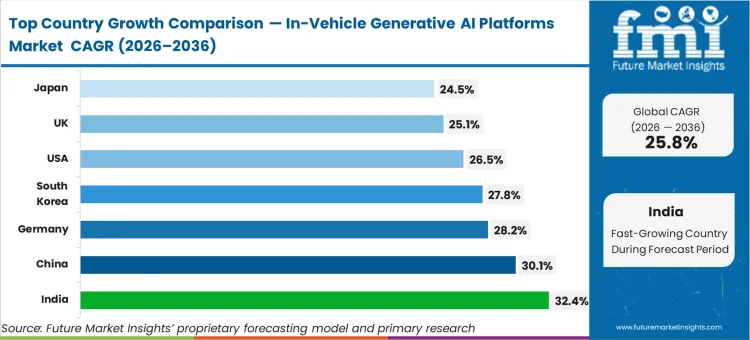
India is anticipated to advance at 32.4% as rapid digitization of the passenger fleet meets a tech-first buyer demographic. China is projected to track a 30.1% CAGR, driven by aggressive domestic competition among electric vehicle manufacturers. Germany follows at 28.2%, reflecting the premium segment's move toward cognitive cockpit features. South Korea is poised to record 27.8% expansion, while the United States tracks at 26.5% compound growth. The United Kingdom and Japan are predicted to garner 25.1% and 24.5% respectively. Structural divergence across these regions is defined by the varying maturity of 5G infrastructure required for hybrid edge-cloud processing.
In-Vehicle Generative AI Platforms Market Definition
The In-Vehicle Generative AI Platforms Market comprises the software environments, large language models, and hardware-accelerated inference engines integrated into automotive architectures to enable generative content creation. This includes systems that synthesize natural language, generate predictive vehicle health reports, or create dynamic visual interfaces. It is functionally distinct from legacy rule-based AI by its ability to process unstructured data and generate novel, context-aware responses without pre-programmed scripts.
In-Vehicle Generative AI Platforms Market Inclusions
This market includes onboard and cloud-based large language models, automotive ai agents designed for vehicle control, and localized generative models for privacy-centric processing. It covers software licenses, development kits for cabin personalization, and synthetic data engines used for real-time occupant monitoring. Also included are the integration services required to bridge generative platforms with existing vehicle bus systems through connected vehicle technology for telemetry-driven responses.
In-Vehicle Generative AI Platforms Market Exclusions
Specifically excluded are legacy rule-based voice recognition systems that lack generative capabilities and standard non-AI infotainment hardware. General-purpose consumer LLMs accessed via mobile mirroring (like basic CarPlay or Android Auto without deep vehicle integration) are excluded unless the vehicle's native platform explicitly utilizes generative AI for system-level control. Hardware components like sensors and cameras are excluded unless they are part of a dedicated automotive ai chipset bundle.
In-Vehicle Generative AI Platforms Market Research Methodology
- Primary Research: FMI conducted interviews with Automotive Software Architects, Chief Product Officers at Tier-1 Suppliers, and Digital Cabin Leads at global OEMs.
- Desk Research: Data was aggregated from silicon vendor roadmap filings, automotive software patent registries, and procurement specifications for next-generation infotainment systems.
- Market-Sizing and Forecasting: The baseline anchors to the production volume of L2+ and higher autonomy vehicles equipped with high-performance centralized computing units.
- Data Validation and Update Cycle: Forecasts were cross-validated against the capital expenditure announcements of major automotive tech incumbents and independent semiconductor shipment data.
Segmental Analysis
In-Vehicle Generative AI Platforms Market Analysis by Application
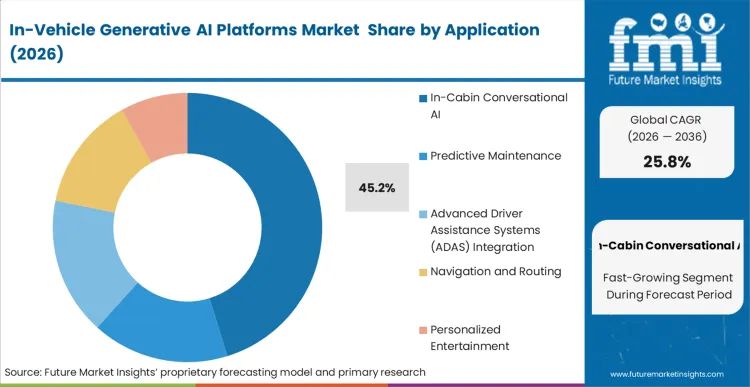
In-Cabin Conversational AI holds a dominant 45.2% share in 2026, owing to the immediate visibility of the ROI for both OEMs and consumers compared to deeper, safety-critical ADAS integrations. While autonomous driving AI requires years of regulatory validation, conversational agents can be deployed as an "experience layer" that significantly increases vehicle conquest rates in showrooms. According to FMI analysts, the adoption of software defined vehicle principles allows these agents to act as the primary interface for every vehicle function, from climate control to biometric health monitoring. Buyers choosing these platforms benefit from a simplified cockpit that reduces physical switchgear, though they face a steeper learning curve during the initial transition from tactile to verbal control through intelligent voice solutions. Manufacturers who fail to achieve natural language parity risk losing the tech-savvy younger demographic that views legacy voice commands as a legacy failure.
- Interaction validation: Generative agents provide immediate feedback loops that validate user intent through natural dialogue rather than binary error tones. Owners feel more connected to the vehicle ecosystem, which increases long-term brand loyalty and feature engagement.
- Contextual intent: The platform interprets vague requests like "I'm cold" to adjust specific HVAC zones and seat heaters simultaneously without multiple commands. This reduces cognitive load and allows the driver to maintain focus on the road during complex adjustments.
- Subscription expansion: Successful initial interactions build the trust required for buyers to opt into premium generative services like real-time travel concierge or creative entertainment. Fleet operators use these expansions to generate recurring revenue beyond the initial vehicle sale.
In-Vehicle Generative AI Platforms Market Analysis by Vehicle Type
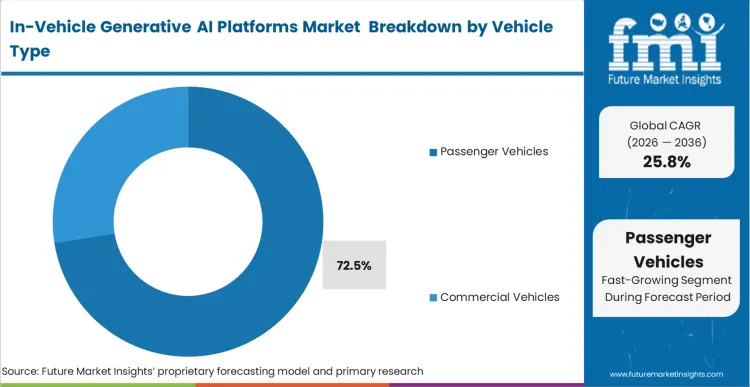
Companies in the sector approach to cabin design in Passenger Vehicles has reached its limits with touchscreens, leading to a displacement of traditional UI in favor of generative platforms. The reason Passenger Vehicles hold 72.5% of the market is that the retail consumer is willing to pay a premium for the "cool factor" of automotive software features that Commercial Vehicles often view as unnecessary overhead. However, this is changing as passenger cars become mobile offices, requiring generative platforms to manage productivity tasks like drafting emails or summarizing meetings on the move. FMI notes that the performance gradient in this segment is steep, with premium EVs setting a benchmark that internal combustion incumbents are struggling to replicate due to legacy electrical architectures. Buyers who opt for platforms without high-speed NPU integration find their vehicles' AI features lagging behind smartphone updates within 24 months.
- Resolution parity: High-end passenger cabins demand generative visual assets that match the refresh rates and clarity of modern gaming consoles. Designers use AI to generate dynamic ambient lighting and HUD overlays that react to the driver's emotional state.
- Substrate constraints: Lower-tier passenger models face performance gaps where generative features must be offloaded entirely to the cloud, resulting in latency. This creates a tiered experience where "premium" is defined by localized, zero-latency processing.
- Verification standards: Safety-conscious buyers prioritize platforms that have undergone rigorous "hallucination testing" to ensure the AI doesn't provide incorrect navigation or vehicle status data. Passing these tests determines which vendors become standard equipment across global platforms.
In-Vehicle Generative AI Platforms Market Analysis by Level of Autonomy
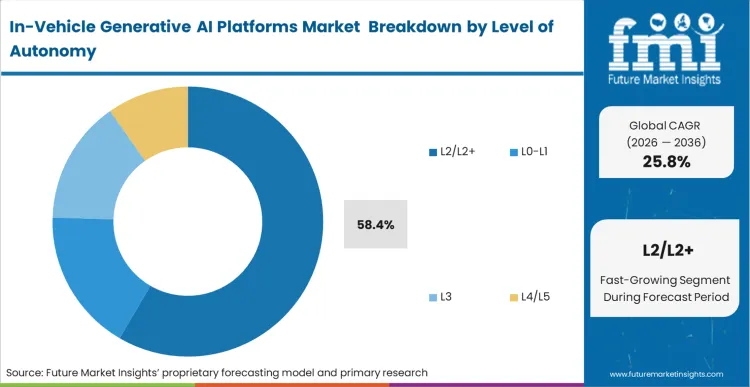
Tension in the Level of Autonomy segment exists between the L2/L2+ majority and the emerging L3/L4 tiers, where the role of generative AI shifts from assistant to supervisor. L2/L2+ holds 58.4% share because it represents the maximum capability currently supported by global insurance and regulatory frameworks. At this level, automotive ai chipset performance is optimized for monitoring the driver's readiness to take over, using generative models to explain why the car is making a specific maneuver. As per FMI’s assessment, the adoption sequence starts with premium luxury sedans and trickles down to mass-market crossovers as silicon costs deflate. Buyers who delay the transition to AI-integrated autonomy levels face higher insurance premiums as data shows generative supervision significantly reduces human error in semi-autonomous modes.
- Early adopter logic: High-net-worth buyers in the L3 segment adopt first to capture the time-saving benefits of "eyes-off" driving on highways. They value generative platforms that can summarize the environment and provide clear, reassuring updates on the vehicle's decision-making.
- Mass-market shift: The middle market follows once the generative "handover" process is standardized and proven safe. What changes is a move toward more cautious, explanatory AI that prioritizes trust-building over advanced performance features.
- Late stage conversion: Conservative buyers and commercial fleets arrive last, driven by insurance mandates and the undeniable safety record of AI-supervised fleets. For them, the conversion is a risk-mitigation strategy rather than a luxury purchase.
In-Vehicle Generative AI Platforms Market Drivers, Restraints, and Opportunities
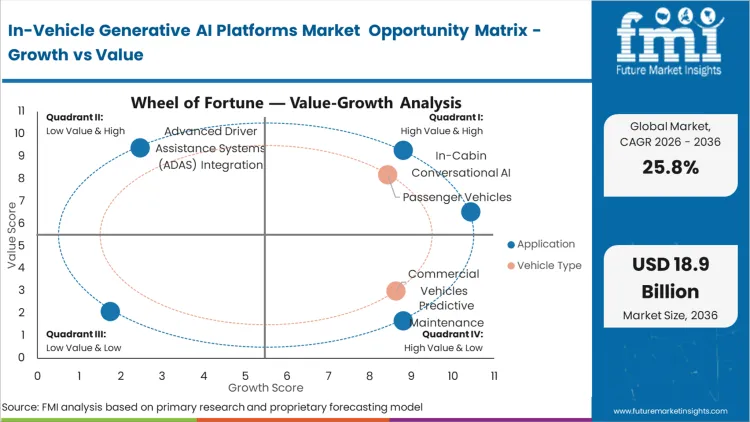
Primary factor driving this market is the "smartphone-ification" of the automotive cockpit, where consumers no longer tolerate a performance gap between their personal devices and their vehicles. This forces digital experience leads at major brands to integrate generative platforms to manage the increasing complexity of automotive software operations without overwhelming the driver with menus. The commercial stakes are high; a brand that fails to deliver a fluid, generative interface is increasingly seen as a legacy hardware provider, losing high-margin subscription revenue to competitors who successfully bridge the software gap.
The primary structural friction is the tension between cloud-based intelligence and edge-based latency. While cloud models are more capable, the 200–500 millisecond delay inherent in cellular networks is unacceptable for real-time cabin feedback. This friction is structural because it requires a massive overhaul of the vehicle's power and thermal management to support the silicon required for localized inference. Emerging localized small language models provide a partial solution, but they currently struggle with the breadth of knowledge that consumers have come to expect from general-purpose generative AI.
Opportunities in the In-Vehicle Generative AI Platforms Market
- Localized edge-inference: The move toward onboard processing creates an opportunity for silicon vendors to provide high-efficiency NPUs specifically for the automotive thermal envelope. Tier-1 suppliers who master localized processing capture the safety-critical segment of the market.
- Synthetic data generation: Manufacturers can use generative AI to create millions of "edge-case" driving scenarios for ADAS training. Software teams that utilize these platforms through autonomous vehicle simulation reduce their physical testing costs.
- Personalized cabin-as-a-service: Generative platforms allow for highly customized android automotive os skins and voice personas that can be sold as digital upgrades. This allows OEMs to capture secondary revenue from used vehicle buyers who want to refresh their cabin's digital identity.
Regional Analysis
Based on the regional analysis, the In-Vehicle Generative AI Platforms Market is segmented into North America, Europe, Asia Pacific, Latin America, Middle East, and Africa across 40 plus countries.
.webp "Top Country Growth Comparison In Vehicle Generative Ai Platforms Market Cagr (2026 2036)")
| Country | CAGR (2026 to 2036) |
|---|---|
| India | 32.4% |
| China | 30.1% |
| Germany | 28.2% |
| South Korea | 27.8% |
| United States | 26.5% |
| United Kingdom | 25.1% |
| Japan | 24.5% |
Source: Future Market Insights (FMI) analysis, based on proprietary forecasting model and primary research
Europe In-Vehicle Generative AI Platforms Market Analysis
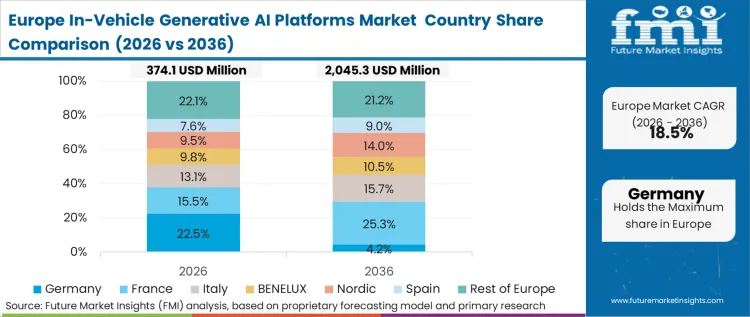
Europe’s adoption pattern is structurally policy-led, dictated by the stringent Data Act and GDPR frameworks that force AI developers to prioritize on-device processing over cloud-heavy models. This regulatory environment makes the European market more complex for US-based cloud giants, creating a vacuum that domestic automotive software firms and specialized silicon providers are rushing to fill. FMI analysts opine that the focus here is on "explainable AI" within the cabin, where the generative agent must be able to audit and explain its recommendations to comply with safety standards. European automotive navigation solutions are being completely rebuilt on generative backends to provide context-aware routing that accounts for low-emission zones and evolving urban charging infrastructure.
- Germany: German premium OEMs are integrating generative AI to maintain their "Vorsprung" in interior quality, using cognitive assistants to manage the transition from mechanical to digital luxury. The market is advancing at 28.2% compound between 2026 and 2036. Logistics operators and premium car owners capture a significant operational outcome through reduced interface friction, allowing for more complex vehicle configurations to be managed purely through natural dialogue.
- United Kingdom: The focus of UK on autonomous testing hubs creates a commercial opportunity for generative AI firms specializing in simulation and "digital twin" cabin environments. The market is projected to grow at 25.1% as fleet operators adopt AI-driven diagnostic tools to manage increasingly complex EV maintenance cycles. Buyers who act early secure preferred partnerships with regional smart-city projects that require integrated vehicle-to-everything generative communication.
- France: Market expansion in France is driven by a strong emphasis on Advanced Driver Assistance Systems (ADAS) Integration and government-backed initiatives for software-centric mobility. Domestic manufacturers are increasingly leveraging In-Vehicle AI to differentiate their compact EV lineups in the competitive European landscape.
- Italy: Italian automotive design houses are adopting Automotive AI Agents to streamline the prototyping process and enhance the Personalized Entertainment features of luxury sports vehicles. The focus remains on blending high-performance engineering with intuitive, context-aware digital interfaces.
Asia Pacific In-Vehicle Generative AI Platforms Market Analysis
Asia Pacific is infrastructure-led, characterized by the rapid deployment of 5G-V2X corridors that allow for more aggressive hybrid AI models than in other regions. In FMI's view, the leading countries in this region signal a move toward "The Third Space," where the vehicle is viewed as a primary location for digital life, often surpassing the home or office in tech-density. This creates a market dynamic where buyers prioritize the AI's ability to integrate with social media, e-commerce, and gaming ecosystems over traditional automotive metrics.
- India: The rapid digitization of India defines its 32.4% trajectory, as a new generation of buyers skips legacy infotainment entirely and demands full generative integration. Indian OEMs are using AI to bridge the linguistic diversity of the market, offering real-time generative translation and dialect-aware voice assistants as a core feature. This creates a massive commercial opportunity for software developers who can localize generative models for non-metro buyers.
- China: The competitive positioning of China is defined by the "EV War," where generative AI features are the primary tool for brand differentiation in a crowded market. The market tracks a 30.1% CAGR as domestic tech giants like Baidu and Alibaba deeply integrate their LLMs into the vehicle substrate. China is heading toward a structural state where the vehicle is a fully autonomous, generative node in a broader "smart city" neural network.
- South Korea: The trajectory of South Korea is shaped by its domestic silicon and battery giants, who are co-developing the hardware and software for generative cabins in a vertically integrated fashion. The 27.8% growth reflects a structural trajectory toward "living cabins" where generative AI manages wellness, mood-lighting, and productivity simultaneously.
- Japan: The CAGR of Japan, 24.5%, is driven by a focus on ultra-reliable In-Vehicle AI systems and safety-driven deployment. Manufacturers prioritize "anticipatory hospitality," using generative AI to predict passenger needs before they are voiced. This positioning allows Japanese brands to remain relevant in the high-tech export market while catering to an aging domestic population that requires intuitive interfaces.
North America In-Vehicle Generative AI Platforms Market Analysis
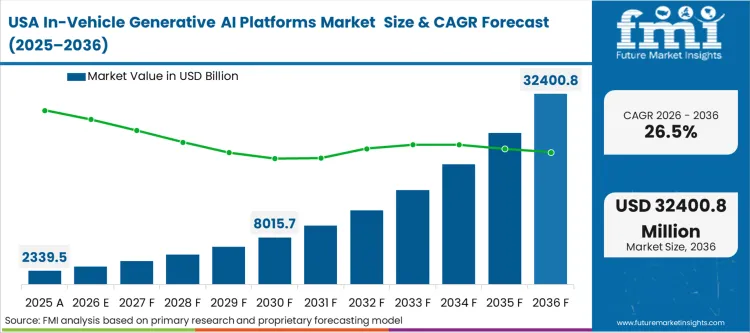
North American growth is buyer behavior-led, with a heavy emphasis on productivity and "connected lifestyle" continuity between the home and the vehicle. US buyers show the highest willingness to adopt cloud-integrated services, leading to a concentrated market for Big Tech players who can offer a seamless transition from a living room smart-speaker to the car cabin through digital assistant integration.
- United States: The USA market is set for 26.5% compound growth as buyers prioritize generative assistants that can manage complex multitasking during long commutes. Practitioner reality in the USA suggests that the most successful platforms are those that don't feel like "car software" but like an extension of the user's existing digital assistant. Those who move first in the commercial fleet space capture significant efficiency gains through AI-managed route and load optimization.
- Canada: In Canada, the adoption of Software-Defined Vehicle architectures is accelerating, particularly in the winter-testing hubs where AI is used to optimize battery performance and Predictive Maintenance in extreme weather conditions. The market benefits from strong cross-border collaboration with USA-based tech hubs.
FMI's report includes additional analysis for the Netherlands, Spain, Brazil, and over 30 other countries. A structural pattern across these additional markets is the move toward "Lite AI" packages that offer core generative benefits without the high silicon cost of premium platforms.
Competitive Aligners for Market Players
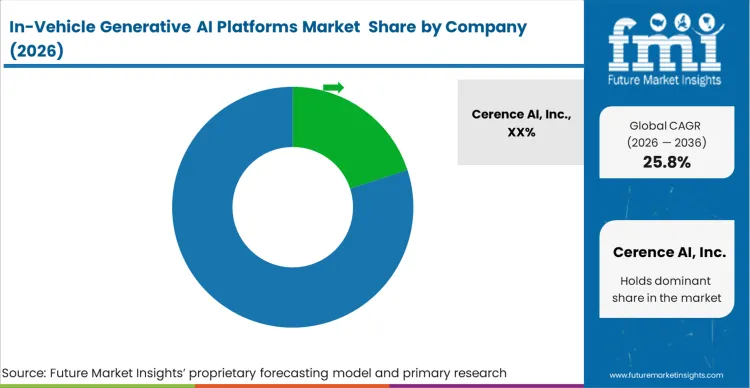
The In-Vehicle Generative AI Platforms Market is currently in a state of concentrated-moderate competition, where a handful of silicon providers and cloud incumbents hold the keys to the most capable models. The reason for this concentration is the massive capital requirement for training automotive-grade LLMs and the high technical barrier of ensuring silicon can survive the extreme vibration and temperature cycles of a vehicle engine bay. Buyers distinguish between vendors based on their "latency-to-intelligence" ratio; a platform that responds 100ms faster is often valued more than one with a slightly larger parameter count.
Incumbent players like Cerence and SoundHound hold a structural advantage through their deep, decade-long relationships with OEM procurement teams and their vast libraries of automotive-specific acoustic data. To replicate this, a challenger must build more than just a smart model; they must develop an automotive software middleware layer that can interface with hundreds of different legacy CAN-bus configurations. We see incumbents moving toward "multimodal" generative AI, where the system doesn't just listen but also "sees" through cabin cameras to interpret gestures and gaze, a capability that startups are struggling to validate for safety.
The structural tension heading toward 2036 will be defined by the "Sovereign AI" movement among large OEMs who want to resist Big Tech lock-in. Currently, companies like Google and Amazon have the upper hand due to their existing consumer ecosystems, but Tier-1 manufacturers are increasingly building their own localized neural architectures to keep their customers' data within their own firewalls. This trajectory suggests a market that will eventually diverge into two tiers: "Ecosystem Cars" that are fully integrated with Big Tech, and "Privateer Cars" that offer a completely proprietary, high-privacy generative experience.
Key Players in In-Vehicle Generative AI Platforms Market
- Cerence AI, Inc.
- SoundHound AI, Inc.
- Google LLC
- Amazon Web Services, Inc.
- Baidu, Inc.
- Microsoft Corporation
- NVIDIA Corporation
- Qualcomm Technologies, Inc.
- Harman International (Samsung)
- Wayve Technologies Ltd.
Scope of the Report
| Metric | Value |
|---|---|
| Quantitative Units | USD 1.9 billion in 2026 to USD 18.5 billion in 2036, at a CAGR of 25.80% |
| Market Definition | Functional software and hardware platforms enabling intent-based, context-aware generative content and control within automotive environments. |
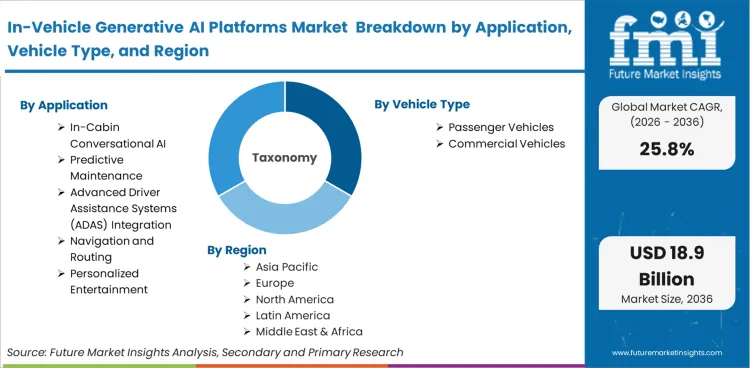
| Application Segmentation | In-Cabin Conversational AI, Predictive Maintenance, ADAS Integration, Navigation and Routing, Personalized Entertainment |
| Vehicle Type Segmentation | Passenger Vehicles, Commercial Vehicles |
| Level of Autonomy Segmentation | L0-L1, L2/L2+, L3, L4/L5 |
| Sales Channel Segmentation | OEM/Factory Fitted, Aftermarket |
| Regions Covered | North America, Europe, Asia Pacific, Latin America, Middle East, Africa |
| Countries Covered | India, China, Germany, South Korea, United States, United Kingdom, Japan, and 40 plus countries |
| Key Companies Profiled | Cerence AI, Inc., SoundHound AI, Inc., Google LLC, Amazon Web Services, Inc., Baidu, Inc., Microsoft Corporation, NVIDIA Corporation |
| Forecast Period | 2026 to 2036 |
| Approach | Primary interviews with OEM digital leads anchor the baseline demand, while silicon shipment data provides the hardware-side validation. |
Source: Future Market Insights (FMI) analysis, based on proprietary forecasting model and primary research
In-Vehicle Generative AI Platforms Market Analysis by Segments
Application:
- In-Cabin Conversational AI
- Predictive Maintenance
- Advanced Driver Assistance Systems (ADAS) Integration
- Navigation and Routing
- Personalized Entertainment
Vehicle Type:
- Passenger Vehicles
- Commercial Vehicles
Level of Autonomy:
- L0-L1
- L2/L2+
- L3
- L4/L5
Sales Channel:
- OEM/Factory Fitted
- Aftermarket
Region:
- North America
- United States
- Europe
- Germany
- United Kingdom
- Asia Pacific
- India
- China
- South Korea
- Japan
Bibliography
- NIST. (2024, May). Standards and Performance Metrics for On-Road Automated Vehicles: Workshop Report. NIST Publications.
- NVIDIA. (2024, March). NVIDIA DRIVE Thor: The Next Generation of Centralized Car Computing. NVIDIA Newsroom.
- Qualcomm. (2024, January). Snapdragon Digital Chassis Advancements in Generative AI for Automotive. Qualcomm Press.
- USA Department of Transportation. (2024, February). Automated Vehicles Comprehensive Plan: Advancing Safety and Innovation. USDOT Publications.
- Boston Consulting Group. (2024, February). Software‑Defined Vehicles and the Rise of AI‑Driven Automotive Platforms. BCG Industry Report.
This bibliography is provided for reader reference. The full FMI report contains the complete reference list with primary source documentation.
This Report Addresses
- Market intelligence to support strategic decision making across In-Cabin Conversational AI and autonomous supervision agents.
- Market size estimation and 10-year revenue forecasts from 2026 to 2036, supported by bottom-up silicon shipment triangulation.
- Growth opportunity mapping across localized edge-inference and synthetic data generation with emphasis on the stabilization of software-defined vehicle protocols.
- Segment and regional revenue forecasts covering L2+ autonomy tiers across 5G-V2X infrastructure corridors and high-privacy European regulatory environments.
- Competition strategy assessment including latency-to-intelligence ratios and the build-vs-buy tension between OEMs and Big Tech.
- Technology development tracking including neural processing unit (NPU) integration, localized small language models, and multimodal gaze interpretation.
- Market access analysis covering European Data Act compliance and North American connected lifestyle procurement pathways.
- Market report delivery in PDF, Excel, PPT, and interactive dashboard formats for executive strategy, digital cockpit planning, and operational benchmarking use.
Frequently Asked Questions
How large is the In-Vehicle Generative AI Platforms Market in 2026?
The market is projected to reach USD 1.9 billion in 2026. This figure signals the transition from R&D pilots to mass-production integration, as Tier-1 suppliers begin shipping standardized AI-capable compute modules.
What will it be valued at by 2036?
The market is expected to cross USD 18.5 billion by 2036. This valuation reflects a structural shift where the digital cockpit experience becomes the primary driver of vehicle residual value, rather than mechanical performance.
What CAGR is projected for the In-Vehicle Generative AI Platforms Market?
A CAGR of 25.80% is anticipated over the 10-year forecast period. This aggressive rate reflects the rapid replacement of legacy infotainment systems as OEMs rush to maintain smartphone-parity for a new generation of buyers.
Which application segment leads the market?
In-Cabin Conversational AI leads with a 45.2% share in 2026. This segment dominates because it provides the most visible and immediate consumer benefit, utilizing generative models to replace complex, menu-driven interfaces with natural intent-based dialogue.
Which vehicle type segment leads the market?
Passenger Vehicles lead with 72.5% share in 2026. This lead is driven by the retail consumer's willingness to pay for tech-premiumization, whereas commercial fleets are slower to adopt due to more rigid cost-per-mile economic models.
Which sales channel leads the market?
OEM/Factory Fitted sales account for 85.6% of the market. This dominance occurs because generative AI requires deep, secure access to vehicle telemetry that is difficult to replicate through aftermarket solutions without compromising cybersecurity.
What drives rapid growth in this market?
The primary driver is the structural move toward software-defined vehicles, where generative AI acts as the "orchestration layer" for vehicle functions. This allows manufacturers to update features over-the-air, extending the commercial life of the vehicle platform.
What is the primary restraint for In-Vehicle Generative AI Platforms?
The structural friction is the thermal and power limit of vehicle electrical architectures. High-performance generative inference generates significant heat, requiring a complete redesign of the cockpit's cooling systems before the most advanced models can be run locally.
Which country grows the fastest in this market?
India is the fastest-growing market at 32.4% CAGR. Compared to China (30.1%), India’s growth is driven by a massive "leapfrog" effect where consumers skip legacy systems entirely in favor of AI-first digital cabins in a rapidly expanding passenger car market.
How does 5G infrastructure impact generative AI in cars?
5G is the structural enabler for hybrid AI, allowing the vehicle to offload complex creative tasks to the cloud while handling safety-critical intent at the edge. Regions with lagging 5G rollout will see slower adoption of multimodal AI features.
What is the role of small language models (SLMs) in this market?
SLMs are becoming the preferred solution for safety-critical tasks because they can run entirely on the vehicle's edge hardware. This ensures that the voice assistant remains functional even in tunnels or remote areas with no data connection.
How do European regulations like GDPR affect market players?
European policy forces a structural shift toward "Privacy-by-Design," where generative platforms must process sensitive occupant data locally. This creates a competitive advantage for vendors who specialize in high-efficiency edge-silicon over those reliant on cloud processing.
Is the market becoming more concentrated or fragmented?
The market is becoming more concentrated at the silicon and model level due to the immense R&D costs. However, it is fragmenting at the application layer as different automotive brands develop unique "personas" and skins for their generative assistants.
Can generative AI improve vehicle safety?
Yes, by interpreting driver gaze and emotional state, generative platforms can proactively adjust ADAS sensitivity or initiate wellness interventions. This structural integration of "empathetic AI" is expected to be a major differentiator for premium safety brands.
What is the "practitioner paradox" in automotive AI?
It is the tension between the marketing-driven push for high-parameter LLMs and the engineering reality of limited compute power in the car. Success requires finding the "sweet spot" where the AI feels intelligent but doesn't drain the vehicle's battery or overheat the dashboard.
How does generative AI change the role of the Tier-1 supplier?
Tier-1s are moving from being hardware manufacturers to becoming "AI system integrators." They must now manage complex software stacks and ensure that the generative platform doesn't interfere with the vehicle's real-time safety systems.
Are there aftermarket generative AI options?
Aftermarket options exist but hold a small share (14.4%) due to integration challenges. They are primarily used to refresh older high-end vehicles that lack native high-performance compute modules but have a stable data connection.
What is the end-state for this market by 2036?
By 2036, the vehicle will be a fully autonomous server-on-wheels, where generative AI manages every aspect of the passenger's digital life, from meeting scheduling to localized entertainment creation, all during the commute.
How does generative AI affect navigation systems?
It moves navigation from "turn-by-turn" to "context-aware" guidance. The AI doesn't just show a map; it generates a narrative of the journey, identifying points of interest based on the driver's known preferences.
Who are the main silicon providers for this market?
NVIDIA and Qualcomm are the leading silicon providers, offering dedicated automotive platforms like DRIVE Thor and Snapdragon Digital Chassis that are specifically designed for high-throughput generative inference.
Does generative AI use the vehicle's cameras?
Yes, multimodal generative platforms use internal cameras to interpret hand gestures and eye movements. This allows the driver to point at a building and ask, "What is that?" with the AI generating an immediate response.
What is the biggest risk for OEMs in this market?
The biggest risk is "ecosystem lockout," where a third-party software provider becomes the primary point of contact for the driver. OEMs who lose this relationship also lose the ability to upsell digital services and monetize driver data.
Preview the report firsthand - request a free sample
Get SampleGet the brochure for pricing and purchase details.
Get PDFTable of Content
- Executive Summary
- Global Market Outlook
- Demand-side Trends
- Supply-side Trends
- Technology Roadmap Analysis
- Analysis and Recommendations
- Market Overview
- Market Coverage / Taxonomy
- Market Definition / Scope / Limitations
- Research Methodology
- Chapter Orientation
- Analytical Lens and Working Hypotheses
- Desk Research Programme (Secondary Evidence)
- Company Annual and Sustainability Reports
- Peer-reviewed Journals and Academic Literature
- Corporate Websites, Product Literature, and Technical Notes
- Earnings Decks and Investor Briefings
- Statutory Filings and Regulatory Disclosures
- Technical White Papers and Standards Notes
- Trade Journals, Industry Magazines, and Analyst Briefs
- Conference Proceedings, Webinars, and Seminar Materials
- Government Statistics Portals and Public Data Releases
- Press Releases and Reputable Media Coverage
- Specialist Newsletters and Curated Briefings
- Sector Databases and Reference Repositories
- FMI Internal Proprietary Databases and Historical Market Datasets
- Subscription Datasets and Paid Sources
- Social Channels, Communities, and Digital Listening Inputs
- Additional Desk Sources
- Expert Input and Fieldwork (Primary Evidence)
- Primary Modes
- Qualitative Interviews and Expert Elicitation
- Quantitative Surveys and Structured Data Capture
- Blended Approach
- Why Primary Evidence is Used
- Physicians and Other Healthcare Professionals
- Primary Modes
- Governance, Ethics, and Data Stewardship
- Research Ethics
- Data Integrity and Handling
- Desk Research Programme (Secondary Evidence)
- Tooling, Models, and Reference Databases
- Data Engineering and Model Build
- Data Acquisition and Ingestion
- Cleaning, Normalisation, and Verification
- Synthesis, Triangulation, and Analysis
- Quality Assurance and Audit Trail
- Market Background
- Market Dynamics
- Drivers
- Restraints
- Opportunity
- Trends
- Scenario Forecast
- Demand in Optimistic Scenario
- Demand in Likely Scenario
- Demand in Conservative Scenario
- Opportunity Map Analysis
- Product Life Cycle Analysis
- Supply Chain Analysis
- Investment Feasibility Matrix
- Value Chain Analysis
- PESTLE and Porter’s Analysis
- Regulatory Landscape
- Regional Parent Market Outlook
- Production and Consumption Statistics
- Import and Export Statistics
- Market Dynamics
- Global Market Analysis 2021 to 2025 and Forecast, 2026 to 2036
- Historical Market Size Value (USD Million) Analysis, 2021 to 2025
- Current and Future Market Size Value (USD Million) Projections, 2026 to 2036
- Y-o-Y Growth Trend Analysis
- Absolute $ Opportunity Analysis
- Global Market Pricing Analysis 2021 to 2025 and Forecast 2026 to 2036
- Global Market Analysis 2021 to 2025 and Forecast 2026 to 2036, By Application
- Introduction / Key Findings
- Historical Market Size Value (USD Million) Analysis By Application , 2021 to 2025
- Current and Future Market Size Value (USD Million) Analysis and Forecast By Application , 2026 to 2036
- In-Cabin Conversational AI
- Predictive Maintenance
- Advanced Driver Assistance Systems (ADAS) Integration
- Navigation and Routing
- Personalized Entertainment
- In-Cabin Conversational AI
- Y-o-Y Growth Trend Analysis By Application , 2021 to 2025
- Absolute $ Opportunity Analysis By Application , 2026 to 2036
- Global Market Analysis 2021 to 2025 and Forecast 2026 to 2036, By Vehicle Type
- Introduction / Key Findings
- Historical Market Size Value (USD Million) Analysis By Vehicle Type, 2021 to 2025
- Current and Future Market Size Value (USD Million) Analysis and Forecast By Vehicle Type, 2026 to 2036
- Passenger Vehicles
- Commercial Vehicles
- Passenger Vehicles
- Y-o-Y Growth Trend Analysis By Vehicle Type, 2021 to 2025
- Absolute $ Opportunity Analysis By Vehicle Type, 2026 to 2036
- Global Market Analysis 2021 to 2025 and Forecast 2026 to 2036, By Level of Autonomy
- Introduction / Key Findings
- Historical Market Size Value (USD Million) Analysis By Level of Autonomy, 2021 to 2025
- Current and Future Market Size Value (USD Million) Analysis and Forecast By Level of Autonomy, 2026 to 2036
- L2/L2+
- L0-L1
- L3
- L4/L5
- L2/L2+
- Y-o-Y Growth Trend Analysis By Level of Autonomy, 2021 to 2025
- Absolute $ Opportunity Analysis By Level of Autonomy, 2026 to 2036
- Global Market Analysis 2021 to 2025 and Forecast 2026 to 2036, By Region
- Introduction
- Historical Market Size Value (USD Million) Analysis By Region, 2021 to 2025
- Current Market Size Value (USD Million) Analysis and Forecast By Region, 2026 to 2036
- North America
- Latin America
- Western Europe
- Eastern Europe
- East Asia
- South Asia and Pacific
- Middle East & Africa
- Market Attractiveness Analysis By Region
- North America Market Analysis 2021 to 2025 and Forecast 2026 to 2036, By Country
- Historical Market Size Value (USD Million) Trend Analysis By Market Taxonomy, 2021 to 2025
- Market Size Value (USD Million) Forecast By Market Taxonomy, 2026 to 2036
- By Country
- USA
- Canada
- Mexico
- By Application
- By Vehicle Type
- By Level of Autonomy
- By Country
- Market Attractiveness Analysis
- By Country
- By Application
- By Vehicle Type
- By Level of Autonomy
- Key Takeaways
- Latin America Market Analysis 2021 to 2025 and Forecast 2026 to 2036, By Country
- Historical Market Size Value (USD Million) Trend Analysis By Market Taxonomy, 2021 to 2025
- Market Size Value (USD Million) Forecast By Market Taxonomy, 2026 to 2036
- By Country
- Brazil
- Chile
- Rest of Latin America
- By Application
- By Vehicle Type
- By Level of Autonomy
- By Country
- Market Attractiveness Analysis
- By Country
- By Application
- By Vehicle Type
- By Level of Autonomy
- Key Takeaways
- Western Europe Market Analysis 2021 to 2025 and Forecast 2026 to 2036, By Country
- Historical Market Size Value (USD Million) Trend Analysis By Market Taxonomy, 2021 to 2025
- Market Size Value (USD Million) Forecast By Market Taxonomy, 2026 to 2036
- By Country
- Germany
- UK
- Italy
- Spain
- France
- Nordic
- BENELUX
- Rest of Western Europe
- By Application
- By Vehicle Type
- By Level of Autonomy
- By Country
- Market Attractiveness Analysis
- By Country
- By Application
- By Vehicle Type
- By Level of Autonomy
- Key Takeaways
- Eastern Europe Market Analysis 2021 to 2025 and Forecast 2026 to 2036, By Country
- Historical Market Size Value (USD Million) Trend Analysis By Market Taxonomy, 2021 to 2025
- Market Size Value (USD Million) Forecast By Market Taxonomy, 2026 to 2036
- By Country
- Russia
- Poland
- Hungary
- Balkan & Baltic
- Rest of Eastern Europe
- By Application
- By Vehicle Type
- By Level of Autonomy
- By Country
- Market Attractiveness Analysis
- By Country
- By Application
- By Vehicle Type
- By Level of Autonomy
- Key Takeaways
- East Asia Market Analysis 2021 to 2025 and Forecast 2026 to 2036, By Country
- Historical Market Size Value (USD Million) Trend Analysis By Market Taxonomy, 2021 to 2025
- Market Size Value (USD Million) Forecast By Market Taxonomy, 2026 to 2036
- By Country
- China
- Japan
- South Korea
- By Application
- By Vehicle Type
- By Level of Autonomy
- By Country
- Market Attractiveness Analysis
- By Country
- By Application
- By Vehicle Type
- By Level of Autonomy
- Key Takeaways
- South Asia and Pacific Market Analysis 2021 to 2025 and Forecast 2026 to 2036, By Country
- Historical Market Size Value (USD Million) Trend Analysis By Market Taxonomy, 2021 to 2025
- Market Size Value (USD Million) Forecast By Market Taxonomy, 2026 to 2036
- By Country
- India
- ASEAN
- Australia & New Zealand
- Rest of South Asia and Pacific
- By Application
- By Vehicle Type
- By Level of Autonomy
- By Country
- Market Attractiveness Analysis
- By Country
- By Application
- By Vehicle Type
- By Level of Autonomy
- Key Takeaways
- Middle East & Africa Market Analysis 2021 to 2025 and Forecast 2026 to 2036, By Country
- Historical Market Size Value (USD Million) Trend Analysis By Market Taxonomy, 2021 to 2025
- Market Size Value (USD Million) Forecast By Market Taxonomy, 2026 to 2036
- By Country
- Kingdom of Saudi Arabia
- Other GCC Countries
- Turkiye
- South Africa
- Other African Union
- Rest of Middle East & Africa
- By Application
- By Vehicle Type
- By Level of Autonomy
- By Country
- Market Attractiveness Analysis
- By Country
- By Application
- By Vehicle Type
- By Level of Autonomy
- Key Takeaways
- Key Countries Market Analysis
- USA
- Pricing Analysis
- Market Share Analysis, 2025
- By Application
- By Vehicle Type
- By Level of Autonomy
- Canada
- Pricing Analysis
- Market Share Analysis, 2025
- By Application
- By Vehicle Type
- By Level of Autonomy
- Mexico
- Pricing Analysis
- Market Share Analysis, 2025
- By Application
- By Vehicle Type
- By Level of Autonomy
- Brazil
- Pricing Analysis
- Market Share Analysis, 2025
- By Application
- By Vehicle Type
- By Level of Autonomy
- Chile
- Pricing Analysis
- Market Share Analysis, 2025
- By Application
- By Vehicle Type
- By Level of Autonomy
- Germany
- Pricing Analysis
- Market Share Analysis, 2025
- By Application
- By Vehicle Type
- By Level of Autonomy
- UK
- Pricing Analysis
- Market Share Analysis, 2025
- By Application
- By Vehicle Type
- By Level of Autonomy
- Italy
- Pricing Analysis
- Market Share Analysis, 2025
- By Application
- By Vehicle Type
- By Level of Autonomy
- Spain
- Pricing Analysis
- Market Share Analysis, 2025
- By Application
- By Vehicle Type
- By Level of Autonomy
- France
- Pricing Analysis
- Market Share Analysis, 2025
- By Application
- By Vehicle Type
- By Level of Autonomy
- India
- Pricing Analysis
- Market Share Analysis, 2025
- By Application
- By Vehicle Type
- By Level of Autonomy
- ASEAN
- Pricing Analysis
- Market Share Analysis, 2025
- By Application
- By Vehicle Type
- By Level of Autonomy
- Australia & New Zealand
- Pricing Analysis
- Market Share Analysis, 2025
- By Application
- By Vehicle Type
- By Level of Autonomy
- China
- Pricing Analysis
- Market Share Analysis, 2025
- By Application
- By Vehicle Type
- By Level of Autonomy
- Japan
- Pricing Analysis
- Market Share Analysis, 2025
- By Application
- By Vehicle Type
- By Level of Autonomy
- South Korea
- Pricing Analysis
- Market Share Analysis, 2025
- By Application
- By Vehicle Type
- By Level of Autonomy
- Russia
- Pricing Analysis
- Market Share Analysis, 2025
- By Application
- By Vehicle Type
- By Level of Autonomy
- Poland
- Pricing Analysis
- Market Share Analysis, 2025
- By Application
- By Vehicle Type
- By Level of Autonomy
- Hungary
- Pricing Analysis
- Market Share Analysis, 2025
- By Application
- By Vehicle Type
- By Level of Autonomy
- Kingdom of Saudi Arabia
- Pricing Analysis
- Market Share Analysis, 2025
- By Application
- By Vehicle Type
- By Level of Autonomy
- Turkiye
- Pricing Analysis
- Market Share Analysis, 2025
- By Application
- By Vehicle Type
- By Level of Autonomy
- South Africa
- Pricing Analysis
- Market Share Analysis, 2025
- By Application
- By Vehicle Type
- By Level of Autonomy
- USA
- Market Structure Analysis
- Competition Dashboard
- Competition Benchmarking
- Market Share Analysis of Top Players
- By Regional
- By Application
- By Vehicle Type
- By Level of Autonomy
- Competition Analysis
- Competition Deep Dive
- Cerence AI, Inc.
- Overview
- Product Portfolio
- Profitability by Market Segments (Product/Age /Sales Channel/Region)
- Sales Footprint
- Strategy Overview
- Marketing Strategy
- Product Strategy
- Channel Strategy
- SoundHound AI, Inc.
- Google LLC
- Amazon Web Services, Inc.
- Baidu, Inc.
- Microsoft Corporation
- NVIDIA Corporation
- Qualcomm Technologies, Inc.
- Harman International (Samsung)
- Wayve Technologies Ltd.
- Cerence AI, Inc.
- Competition Deep Dive
- Assumptions & Acronyms Used


