

- Industry Size (2026)
- USD 2.3 Bn
- Forecast (2036)
- USD 16.4 Bn
- CAGR (2026 to 2036)
- 21.7%
AI Beauty Personalization Platforms Market Size, Market Forecast and Outlook By FMI
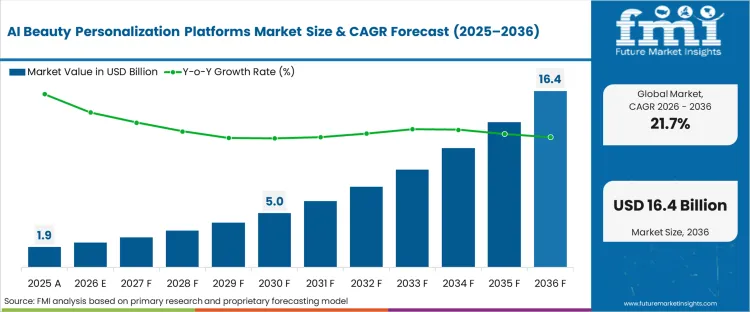
The AI beauty personalization platforms market stood at USD 1.9 billion in 2025, with enterprises expected to surpass USD 2.3 billion in 2026, expanding at a 21.7% CAGR. Trend analysis drives the sector toward USD 16.4 billion by 2036, supported by the shift from static retail consultations to fully automated, AI‑driven diagnostic ecosystems.
Digital commerce architects configuring ai makeup integrations are executing a transformational shift from mass-market visual merchandising to hyper-individualized diagnostic conversions. Replacing flat annual software licensing fees with performance-based enterprise contracts forces platform providers to tie software expenditures directly to verifiable incremental conversion metrics. Technical constraints surrounding global biometric data privacy laws force development teams to engineer localized edge-computing architectures to render realistic 3D facial models without violating cloud storage mandates.
Summary of AI Beauty Personalization Platforms Market
- AI Beauty Personalization Platforms Market Definition
- The market comprises the enterprise software applications, algorithmic programming interfaces, and machine learning models utilizing computer vision to deliver highly accurate cosmetic color matching and dermatological analysis for individual consumers.
- Demand Drivers in the Market
- E-commerce architecture directors deploy high-fidelity facial tracking modules to structurally lower the reverse logistics costs associated with returned color cosmetics.
- Digital retail aggregators integrate diagnostic scanning algorithms to transition consumer purchasing behavior from trial-and-error sampling to verifiable, ingredient-specific matching.
- Cosmetic manufacturers embed proprietary digital advisors to harvest zero-party biometric data while bypassing the tracking limitations imposed by generic digital advertising networks.
- Key Segments Analyzed in the FMI Report
- AR Virtual Try-On (VTO) Engines: 42.0% share in 2026 as multi-brand retail platforms establish interactive shade matching as the universal baseline for all digital storefronts.
- Skincare Personalization: 45.0% share in 2026 driven by consumer willingness to fund high-margin regimens verified by algorithmic dermatological scanning.
- Asia Pacific: Massive adoption rates fueled by domestic e-commerce giants integrating lightweight diagnostic tools natively into social commerce feeds.
- Analyst Opinion at FMI
- Ronak Shah, Principal Consultant for Consumer Products, opines: “Retail chief technology officers focus heavily on algorithmic accuracy while ignoring the looming biometric data storage liabilities attached to cloud-based facial scanning. The actual barrier scaling digital beauty advisors is not mapping precision, but the compliance cost of processing zero-party skin data across fragmented privacy frameworks like BIPA and GDPR. Beauty platforms failing to deploy localized edge-computing architectures to process scans directly on consumer devices face sudden operational halts during the next wave of regulatory audits.”
- Strategic Implications / Executive Takeaways
- Digital commerce directors must transition basic visual overlay applications into consultative generative AI interfaces capable of executing cross-category product recommendations.
- Software engineering leads should establish device-level edge processing for all facial scans to neutralize the severe legal risks associated with centralized biometric cloud storage.
- Machine learning architects must diversify training datasets across the complete spectrum of global skin tones to eliminate algorithmic bias and prevent brand-damaging diagnostic failures.
- Methodology
- Primary interviews target chief digital officers at major cosmetic conglomerates, enterprise software architects, and data privacy compliance officers defining the technical boundaries of facial analysis.
- Corporate capital expenditure disclosures, regional digital privacy regulatory filings, and cloud computing usage reports provide the baseline constraints for the valuation model.
- Sector projections derive from a bottom-up aggregation of enterprise software licensing revenues validated against regional e-commerce conversion benchmarks.
AI Beauty Personalization Platforms Market Key Takeaways
| Metric | Details |
|---|---|
| Industry Size (2026) | USD 2.3 billion |
| Industry Value (2036) | USD 16.4 billion |
| CAGR (2026-2036) | 21.7% |
Retail technology directors commanding these capital budgets are actively weaponizing hyper-personalized digital experiences to break the historic reliance on physical beauty counters. Sustaining this 21.7% compound expansion relies fundamentally on software providers proving that their integration modules directly lift average order values rather than functioning as marketing novelties. Transitioning facial mapping tools into core transactional infrastructure dictates the adoption timelines mapped across the regional forecasts below.
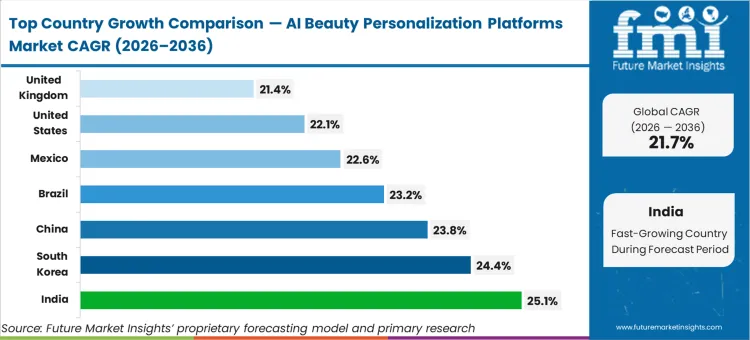
India accelerates at 25.1%, South Korea measures 24.4%, and China scales at 23.8% as mobile-first youth demographics bypass traditional retail channels in favor of native application diagnostics. Brazil expands at 23.2% alongside Mexico at 22.6%, reflecting geographical scale pressures forcing cosmetic brands to digitize the trial experience. The United States advances at 22.1% and the United Kingdom tracks at 21.4% as mature retail giants upgrade static interface tools to advanced generative advisory models amid strict biometric compliance constraints.
AI Beauty Personalization Platforms Market Definition
The AI beauty personalization platforms market encompasses the enterprise software, application programming interfaces, and machine learning models that execute customized cosmetic analysis and visualization. Technology architectures utilize precise facial mapping, augmented reality, and computer vision to analyze dermal conditions or simulate how specific formulations will interact with a user's unique complexion. The primary industrial function centers on bridging the physical trial gap in digital commerce by generating highly accurate product matches.
AI Beauty Personalization Platforms Market Inclusions
The market scope includes enterprise software licensing revenues, proprietary algorithm integration costs, and API utilization fees generated by AR and AI beauty technology providers. Analytical tools deployed across direct-to-consumer websites, retail aggregators, and in-clinic digital triage systems fall within these boundaries. Enterprise pricing models utilizing performance-based metrics and cloud hosting expenditures specifically dedicated to rendering 3D graphic simulations are fully incorporated.
AI Beauty Personalization Platforms Market Exclusions
Physical gross merchandise value generated by the actual cosmetics, formulations, or haircare products sold through these recommendation engines is explicitly omitted from the valuation. Hardware deployments including in-store smart mirrors, dermatological scanning wands, or consumer smartphones fall outside the defined parameters. Standard digital advertising expenditures unrelated to facial diagnostic integration are excluded.
AI Beauty Personalization Platforms Market Research Methodology
- Primary Research: Analysts engaged chief digital officers, AR development engineers, and biometric data compliance officers to map the specific decision gates triggering enterprise software licensing upgrades.
- Desk Research: Data aggregation compiled enterprise tech vendor earnings transcripts, global digital privacy regulatory filings, and open-source computer vision repository metrics to establish baseline model inputs.
- Market-Sizing and Forecasting: Baseline values derive from a bottom-up aggregation of AR beauty tech provider revenues, applying regional e-commerce penetration curves to project adoption velocity.
- Data Validation and Update Cycle: Segment forecasts undergo structured variance checks against digital capital expenditure disclosures from the top 20 global cosmetic conglomerates prior to publication.
Segmental Analysis
AI Beauty Personalization Platforms Market Analysis by Technology Type
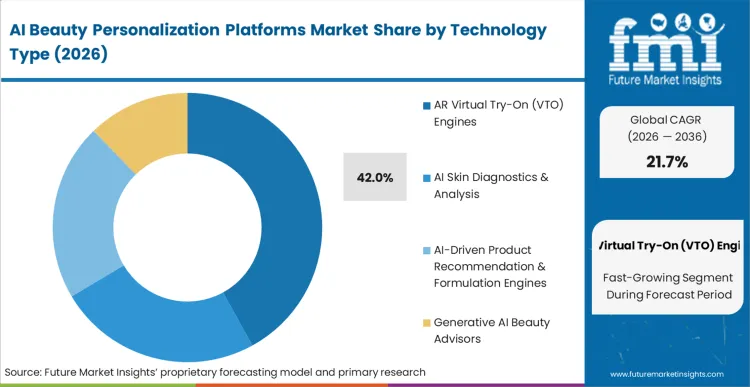
With static product imagery proving inadequate for resolving color uncertainty, digital commerce directors execute full-scale integration of AR Virtual Try-On (VTO) Engines. According to FMI's estimates, this sub-segment commands a dominant 42.0% share in 2026, reflecting the absolute requirement for interactive physical simulation in digital makeup sales. Replacing flat product catalogs with virtual try on platform modules enables users to instantly test dozens of foundation and eyeshadow shades through real-time facial mapping algorithms. This visual verification capability drastically reduces the costly reverse logistics generated by opened, mismatched cosmetic returns. Engineering teams continuously upgrade tracking technology to account for micro-movements and diverse lighting parameters, ensuring jitter-free graphic overlays. Software vendors unable to render complex cosmetic textures like gloss and shimmer with high fidelity lose integration priority before retail aggregator shortlists finalize.
- Fidelity rendering: Algorithmic adjustment for localized ambient lighting ensures virtual pigments behave identically to physical application under variable real-world conditions.
- Micro-movement synchronization: Advanced tracking networks anchor digital overlays to specific facial landmarks, preventing visual tearing when consumers alter their facial expressions during the simulation process.
- Texture replication: Rendering engines accurately differentiate the optical physics between matte powders and high-shine glosses, elevating the visual output from basic color tinting to true material simulation.
AI Beauty Personalization Platforms Market Analysis by Application Category
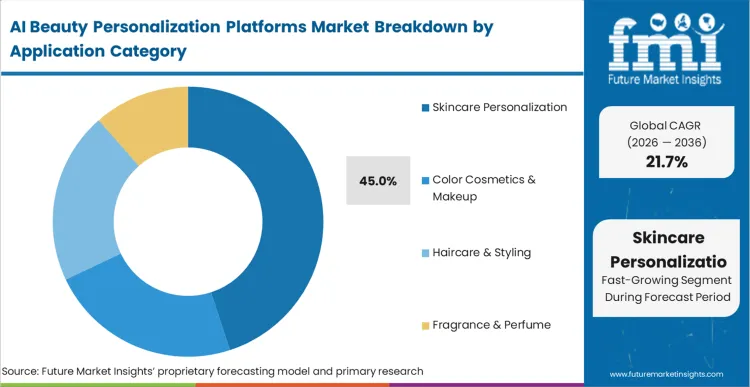
Every digital beauty architect configuring customer retention models now faces strict adherence criteria for scientific accuracy in routine generation. Skincare Personalization emerges as the dominant application category, expected to represent 45.0% of total market share in 2026. Consumers rejecting trial-and-error purchasing models demand clinical-grade regimens tailored to their exact dermatological needs. FMI analysts opine that algorithmic diagnostics resolve this tension by analyzing localized moisture levels and melanin distribution directly from smartphone imagery. Implementing customized skincare recommendation engines allows brands to channel buyers toward high-margin serum formulations based on empirical data rather than marketing claims. Advanced platforms utilizing generative models simulate the longitudinal effects of these specific routines, visually projecting skin health improvements months into the future. Cosmetic brands failing to offer verifiable diagnostic logic forfeit access to high-value consumers seeking data-backed dermatological outcomes.
- Diagnostic quantification: Computer vision models isolate and measure microscopic variables like pore density and localized hyperpigmentation to generate an empirical baseline for treatment recommendations.
- Longitudinal simulation: Predictive algorithms generate accurate visual projections of future skin states, directly tying expected physiological improvements to continuous product adherence.
- Formulation matching: Recommendation logic pairs the quantified diagnostic deficits with specific active ingredients, bridging the technical gap between clinical terminology and consumer purchasing decisions.
AI Beauty Personalization Platforms Market Analysis by End User / Deployment Model
Legacy distribution channels relying on third-party retailers restrict manufacturer access to vital consumer preference metrics. Beauty Brands & Cosmetic Manufacturers bypass these limitations by deploying proprietary diagnostic modules, representing a leading 48.0% share in 2026. Global cosmetic conglomerates possess the massive capital required to license enterprise-grade AI architecture across dozens of subsidiary brand domains. As per FMI's projection, executing a direct beauty subscription strategy through owned diagnostic tools forces consumers to interact directly with the brand's digital flagship environment. This direct interaction model allows the manufacturer to harvest granular zero-party biometric data while defending direct-to-consumer profit margins against aggregator dilution. Multi-brand conglomerates leverage interactive advisors to voluntarily solicit specific ingredient allergies and ethical preferences directly at the point of digital sale. Development teams prioritizing generic retailer integrations over proprietary brand platforms surrender the only mechanism available for capturing unfiltered consumer intelligence.
- Data sovereignty: Capturing facial scans and diagnostic outcomes within owned domains eliminates reliance on deteriorating third-party cookie architecture for behavioral targeting.
- Margin defense: Directing algorithmic matches specifically toward high-margin proprietary formulations shields revenue from aggregator commission structures and competitor cross-selling.
- Portfolio cross-pollination: Enterprise diagnostic layers seamlessly route a consumer seeking mass-market color cosmetics toward luxury skincare equivalents within the same corporate parent network.
AI Beauty Personalization Platforms Market Drivers, Restraints, and Opportunities
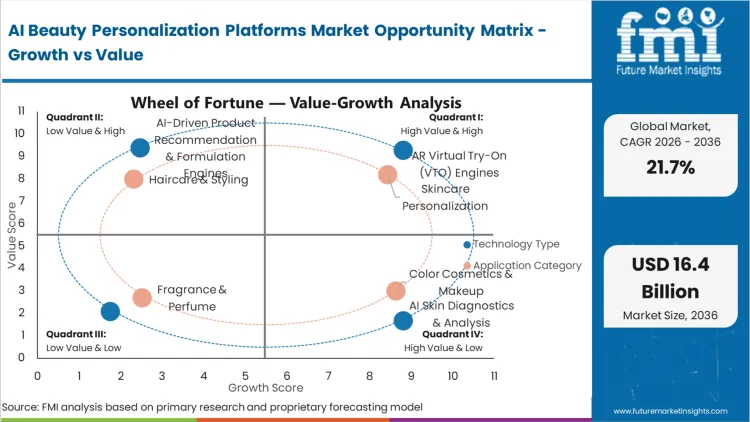
Structural limitations inherent to physical cosmetic sampling force e-commerce architecture directors to deploy interactive verification models at scale. FMI's analysis indicates that digitizing the physical tester solves a mathematically critical constraint for the beauty industry by aggressively reducing online cart abandonment. Integrating smart skincare diagnostic modules converts passive product browsing into an active, consultative evaluation process. Digital retail platforms failing to embed these verification mechanics risk operational blind spots and reduced overall conversion efficiency.
Severe global biometric data privacy frameworks create a profound legal barrier for platforms requiring persistent facial storage to train proprietary machine learning models. Retail CTOs face intense compliance costs managing granular user consent protocols under frameworks like the Illinois Biometric Information Privacy Act. Deploying personalized beauty devices that rely on cloud-based processing exposes operators to massive class-action liabilities. Software engineering leads mitigate this regulatory exposure by migrating computational workloads to device-level edge processing, immediately destroying the scan data after the recommendation is served.
- Diagnostic Edge Processing: Software architects developing localized processing protocols enable full-fidelity facial mapping without triggering cloud storage compliance violations. Consumers receive instantaneous product recommendations without sacrificing personal data sovereignty.
- Algorithmic Inclusivity Audits: Engineering teams prioritizing vast, diverse training datasets prevent brand-damaging misdiagnoses across different ages, genders, and melanin distributions. Verified algorithmic neutrality becomes the primary qualification standard for securing enterprise deployment contracts.
- Social Commerce API Integration: Platform developers embedding lightweight diagnostic kits directly into native social media feeds capture immediate impulse purchases. Eliminating the friction of navigating to a dedicated retail domain drastically shortens the digital conversion funnel.
Regional Analysis
Based on the regional analysis, the AI beauty personalization platforms market is segmented into North America, Latin America, Europe, East Asia, South Asia, Oceania and Middle East & Africa across 40+ countries. The full report also offers market attractiveness analysis based on regional trends.
.webp "Top Country Growth Comparison Ai Beauty Personalization Platforms Market Cagr (2026 2036)")
| Country | CAGR (2026 to 2036) |
|---|---|
| India | 25.1% |
| South Korea | 24.4% |
| China | 23.8% |
| Brazil | 23.2% |
| Mexico | 22.6% |
| United States | 22.1% |
| United Kingdom | 21.4% |
Source: Future Market Insights (FMI) analysis, based on proprietary forecasting model and primary research
Asia Pacific AI Beauty Personalization Platforms Market Analysis
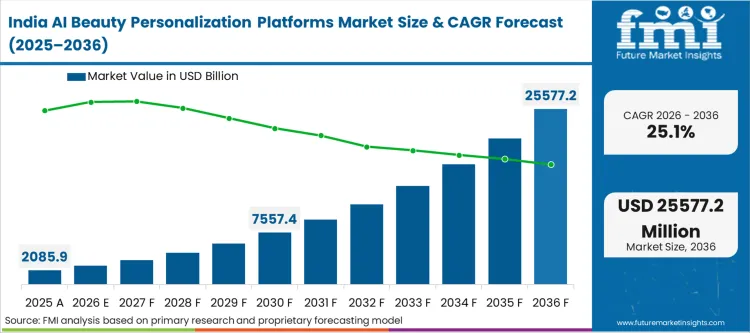
Hyper-connected digital ecosystems across the Asia Pacific region accelerate the bypass of traditional physical beauty counters. Digital commerce directors constructing social media retail environments specify unified diagnostic networking in their initial user interface blueprints. As FMI's research confirms, this native integration strategy entirely eliminates the multi-step navigation friction that plagues older e-commerce platforms. Embedding high-fidelity facial tracking capabilities directly into messaging and streaming applications establishes highly fluid purchasing environments. This aggressive social commerce expansion directly fuels the demand for low-latency facial rendering APIs.
- India: India's fragmented tier-2 retail geography prevents premium cosmetic brands from deploying physical beauty advisors at a national scale. D2C platform architects bypass this geographic bottleneck entirely by embedding lightweight mobile diagnostic algorithms directly into native retail applications. Domestic omnichannel beauty aggregators now require all newly onboarded skincare brands to supply API-ready product matching logic, converting the smartphone camera into the primary point of sale. This physical bypass strategy anchors India's 25.1% compound expansion of digital beauty diagnostic demand to 2036. Cosmetics manufacturers failing to provide verified ai formulated custom serums matching files lose shortlist position before the 2027 regional e-commerce festival cycles.
- South Korea: South Korea's advanced dermatological sector operates to clinical verification tolerances that exceed standard mass-market cosmetic claims by orders of magnitude. Skincare formulation leads mandate hyper-precise diagnostic architectures to ensure digital platforms recommend highly potent active ingredients without triggering adverse topical reactions. The concentration of premium K-beauty brands necessitates continuous investment in ultra-granular computer vision models capable of mapping localized pore density and moisture barriers. This clinical-grade verification standard drives a 24.4% CAGR for diagnostic rendering algorithms through 2036 as algorithmic proof becomes the universal procurement baseline. AI vendors targeting the next domestic retail expansion cycle must prove sub-millimeter analytic accuracy before entering the approved vendor list.
- China: China's luxury retail ecosystem demands highly automated, software-defined product discovery experiences requiring seamless data exchange between brand flagship stores and super-app environments. Digital retail architects bypass legacy standalone applications entirely, specifying native AR endpoints for all new luxury pavilion integration contracts. The sheer volume of high-net-worth consumer traffic establishes a massive installed base of interactive consultation infrastructure across major digital ecosystems. This aggressive super-app integration strategy is rising at a CAGR of 23.8% for interactive modeling software in China through 2036. Tech providers unable to demonstrate verified deep-fake compliance protocols lose access to the most lucrative brand partnership projects in the region.
FMI's report includes extensive coverage of the Asia Pacific beauty technology landscape. It incorporates detailed analysis of Japan, Indonesia, Australia, and the broader ASEAN region. A primary trend shaping these nations is the rapid localization of machine learning models to accurately analyze specific regional skin tones, forcing vendors to deploy highly specialized datasets to satisfy stringent consumer accuracy requirements.
North America AI Beauty Personalization Platforms Market Analysis
Stringent regulatory enforcement across North America targets the systematic limitation of centralized biometric data storage. E-commerce architecture directors leading digital retail overhauls face strict directives to unify product recommendation logic under highly secure, zero-retention architectures. Based on FMI's assessment, massive cosmetic conglomerates actively drive this consolidation to secure their consumer data flows against catastrophic class-action liabilities. Implementing standardized edge-computing rendering models enables retailers to deploy advanced diagnostic algorithms without violating localized privacy statutes. This strategic shift requires significant capital allocation toward complex device-level processing architectures capable of isolating sensitive facial scans.
- United States: The United States digital retail sector enforces strict biometric privacy and data visibility mandates across its entire consumer engagement ecosystem. Digital compliance leads replacing aging cloud-based scanning protocols must deploy localized architectures capable of supporting real-time rendering precision without capturing persistent facial records. Aggressive state-level privacy litigation actively forces the replacement of vulnerable centralized data models with standardized, zero-retention edge processing frameworks. The United States advances at a 22.1% compound rate across the forecast decade as multi-brand retailers unify their compliant diagnostic topologies. Tech vendors lacking documented compliance with rigorous Illinois biometric privacy standards face immediate exclusion from national retail modernization contracts.
FMI's report includes comprehensive evaluation of the North American digital cosmetic sector. It features specific analysis of the Canadian retail market. A defining dynamic in these countries involves the integration of advanced venture capital funding into specialized AI startups, which requires standardized algorithm architectures to coordinate rapid scaling across multi-brand e-commerce portfolios.
Europe AI Beauty Personalization Platforms Market Analysis
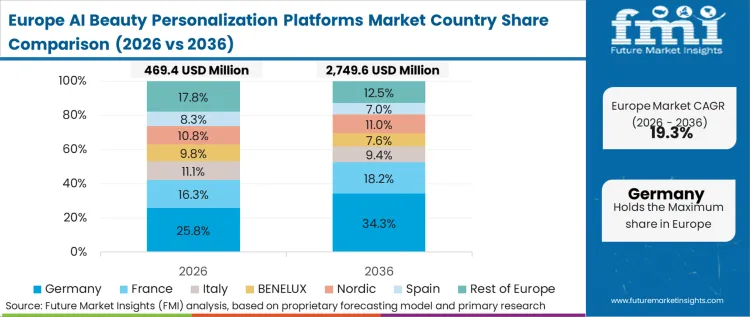
European data sovereignty policy actively penalizes the unauthorized processing of special category biometric information within commercial retail environments. Digital platform architects redesigning legacy brand websites must integrate continuous compliance verification protocols alongside critical rendering tasks. FMI's proprietary forecasting model projects that this dual-purpose operational requirement forces the rapid adoption of frictionless opt-in gateways to guarantee legal stability while generating complex product recommendations. The transition requires a complete overhaul of existing data capture topologies, shifting from passive tracking structures to explicit consent-driven deterministic architectures.
- United Kingdom: The United Kingdom's digital health and pharmacy modernization programs require precise clinical substantiation to balance increasingly stringent advertising regulations governing cosmetic claims. E-commerce network planners deploying advanced dermatological triage systems mandate diagnostic architectures capable of medical-grade accuracy across distributed digital pharmacy assets. The shift toward evidence-based skincare purchasing forces retail operators to abandon generic marketing surveys in favor of highly resilient, algorithmically verified facial analysis networks. This clinical infrastructure transition expands at a 21.4% CAGR to 2036 as major health retailers systematically upgrade their digital advisory backbones. AI system integrators unable to demonstrate absolute algorithmic neutrality under diverse demographic conditions forfeit qualification for national pharmacy integration projects.
FMI's report includes thorough investigation of the European algorithmic retail framework. The analysis encompasses Germany, France, Italy, Spain, and the Nordics. A prevailing structural condition across these nations is the mandatory compliance with strict General Data Protection Regulation directives, forcing brand owners to specify edge-computing networks that can reliably execute complex facial analysis without transmitting identifiable biometric payloads.
Latin America AI Beauty Personalization Platforms Market Analysis
Geographical vastness across Latin America structurally prevents total physical market penetration for premium cosmetic manufacturers. E-commerce strategy directors building decentralized retail networks utilize virtual try-on technology to bridge the massive distance between centralized distribution hubs and remote consumers. This digital substitution model entirely bypasses the prohibitive capital expenditure required to construct physical brick-and-mortar infrastructure outside of major metropolitan corridors.
- Brazil: Brazil's highly influential digital creator economy operates on deep consumer reliance upon social media validation for new cosmetic acquisitions. Regional beauty conglomerates modernizing their direct-selling models must deploy interactive networks capable of guaranteeing accurate shade matching directly through influencer-distributed links. The national push toward digital retail self-sufficiency triggers a wave of application upgrades prioritizing unified, interactive product discovery backbones. This geographical penetration strategy advances at a 23.2% compound rate for virtual rendering demand to 2036. Software suppliers failing to provide highly optimized algorithms capable of operating smoothly on mid-tier mobile hardware face disqualification from major regional e-commerce tenders.
- Mexico: Mexico's rapidly scaling domestic e-commerce sector commands highly localized cosmetic recommendation logic to service an expanding middle-class demographic entering the premium skincare category. Digital retail leads mandate highly efficient AR architectures to ensure interactive product discovery systems perform flawlessly despite inconsistent regional broadband connectivity. The concentration of new digital beauty consumers necessitates continuous investment in bandwidth-efficient computer vision models to maximize engagement rates. Mexico drives an annual expansion rate of 22.6% for diagnostic rendering software through 2036 as optimized mobile performance becomes the universal procurement baseline. Vendors targeting the next domestic digital expansion must prove sub-second rendering latency over standard cellular networks before securing enterprise integration contracts.
FMI's report includes deep analysis of the Latin American beauty technology environment. The coverage encompasses Argentina, Chile, and the broader regional digital commerce ecosystem. An underlying driver defining these markets involves the rapid digitization of legacy direct-selling networks, forcing independent representatives to deploy algorithmic matching tools to maintain standardized brand experiences across diverse geographical territories.
Competitive Aligners for Market Players
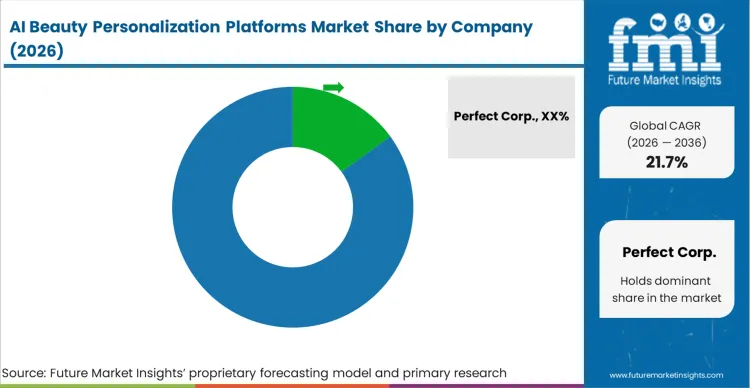
The transition from flat software licensing fees to performance-based enterprise contracts fundamentally restructures the valuation models for facial mapping vendors. E-commerce architecture directors analyzing diagnostic software ROI now demand verifiable conversion lift metrics rather than basic rendering capabilities. This capital alignment means software providers unable to definitively prove that their algorithmic recommendations directly accelerate checkout velocity lose critical negotiating leverage during annual contract renewals. Development teams embedding ai skin diagnostics directly into checkout flows establish the foundation for performance-based revenue scaling. Platform vendors failing to integrate precise conversion tracking dashboards alongside their rendering engines forfeit priority status in major retail aggregator modernization cycles.
Centralized cloud processing of facial scans is structurally obsolete in highly regulated mature markets. Localized edge-computing architecture executing diagnostic tasks directly on the consumer's mobile hardware neutralizes the severe class-action liabilities associated with biometric data transmission. Software engineers rebuilding their rendering engines for device-level processing drastically reduce cloud hosting expenditures while simultaneously achieving absolute GDPR compliance. Competitors delaying the transition away from centralized data storage architectures risk immediate exclusion from the next wave of North American and European corporate request for proposals.
Mandatory algorithmic inclusivity audits dictate vendor selection across global cosmetic conglomerate portfolios. Brand safety directors analyzing diagnostic failure rates mandate comprehensive demographic testing prior to deploying virtual try-on modules across diverse global populations. Providers utilizing machine learning models trained exclusively on narrow geographical datasets face severe algorithmic bias that generates inaccurate foundation matching and brand-damaging consumer experiences. Enterprise technology suppliers failing to demonstrate mathematically verified neutrality across the full spectrum of global skin tones lose access to premium multi-brand deployment contracts.
Key Players in AI Beauty Personalization Platforms Market
- Perfect Corp.
- ModiFace Inc.
- Revieve Oy
- Haut.AI OÜ
- L'Oréal S.A.
- Shiseido Company, Limited
- The Estée Lauder Companies Inc.
- The Procter & Gamble Company
- Sephora USA, Inc.
- Ulta Beauty, Inc.
Scope of the Report
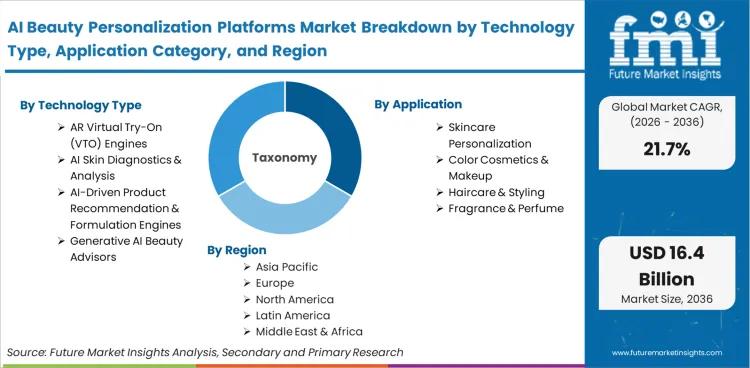
| Metric | Value |
|---|---|
| Quantitative Units | USD 2.3 billion to USD 16.4 billion, at a CAGR of 21.7% |
| Market Definition | The enterprise software applications, algorithmic programming interfaces, and machine learning models utilizing computer vision to deliver highly accurate cosmetic color matching and dermatological analysis for individual consumers. |
| Technology Type Segmentation | AI Skin Diagnostics & Analysis, AR Virtual Try-On (VTO) Engines, AI-Driven Product Recommendation & Formulation Engines, Generative AI Beauty Advisors |
| Application Category Segmentation | Skincare Personalization, Color Cosmetics & Makeup, Haircare & Styling, Fragrance & Perfume |
| End User / Deployment Model Segmentation | Beauty Brands & Cosmetic Manufacturers, E-commerce & Multi-Brand Retailers, Physical Salons, Clinics, and Spas, Direct-to-Consumer (D2C) Mobile Applications |
| Regions Covered | North America, Latin America, Europe, East Asia, South Asia, Oceania, Middle East and Africa |
| Countries Covered | United States, Canada, Brazil, Mexico, United Kingdom, Germany, France, Italy, Spain, China, Japan, India, Indonesia, South Korea, and 40 plus countries |
| Key Companies Profiled | Perfect Corp., ModiFace Inc., Revieve Oy, Haut.AI OÜ, L'Oréal S.A., Shiseido Company, Limited, The Estée Lauder Companies Inc., The Procter & Gamble Company, Sephora USA, Inc., Ulta Beauty, Inc. |
| Forecast Period | 2026 to 2036 |
| Approach | Baseline values derive from a bottom-up aggregation of AR beauty tech provider revenues, applying regional e-commerce penetration curves to project adoption velocity. |
AI Beauty Personalization Platforms Market Analysis by Segments
Technology Type:
- AI Skin Diagnostics & Analysis
- AR Virtual Try-On (VTO) Engines
- AI-Driven Product Recommendation & Formulation Engines
- Generative AI Beauty Advisors
Application Category:
- Skincare Personalization
- Color Cosmetics & Makeup
- Haircare & Styling
- Fragrance & Perfume
End User / Deployment Model:
- Beauty Brands & Cosmetic Manufacturers
- E-commerce & Multi-Brand Retailers
- Physical Salons, Clinics, and Spas
- Direct-to-Consumer (D2C) Mobile Applications
Region:
- North America
- United States
- Canada
- Latin America
- Brazil
- Mexico
- Rest of Latin America
- Europe
- United Kingdom
- Germany
- France
- Italy
- Spain
- Rest of Europe
- East Asia
- China
- Japan
- South Korea
- South Asia
- India
- Rest of South Asia
- Oceania
- Australia
- New Zealand
- Middle East and Africa
Bibliography
- National Institute of Standards and Technology. (2024). Artificial Intelligence Risk Management Framework: Generative Artificial Intelligence Profile.
- California Privacy Protection Agency. (2025). CCPA updates, cybersecurity audits, risk assessments, automated decisionmaking technology (ADMT), and insurance regulations.
- Colorado General Assembly. (2024). Senate Bill 24-205: Consumer protections for interactions with artificial intelligence systems.
- Personal Data Protection Commission. (2024). Advisory guidelines on use of personal data in AI recommendation and decision systems.
- Australian Government, Treasury. (2025). Final report: Review of AI and the Australian Consumer Law.
- Autoridade Nacional de Proteção de Dados. (2025). Regulatory agenda for the 2025-2026 biennium.
- International Organization for Standardization. (2025). ISO/IEC 42005:2025. Information technology Artificial intelligence (AI) AI system impact assessment.
- European Telecommunications Standards Institute. (2025). ETSI TR 103 910 V1.1.1: Methods for testing and specification (MTS); AI testing; Test methodology and test specification for ML-based systems.
This bibliography is provided for reader reference. The full FMI report contains the complete reference list with primary research documentation.
This Report Addresses
- Market sizing data defining the specific capital expenditure dedicated to digital diagnostic software licensing across major cosmetic sectors through 2036.
- Segmentation analysis mapping the adoption velocity of generative AI beauty advisors and evaluating the technical limitations driving edge-computing upgrades.
- Regional deployment intelligence comparing the aggressive super-app integration strategies in Asia Pacific against the complex biometric compliance requirements prevalent in North American retail hubs.
- Regulatory compliance assessment analyzing how stringent data sovereignty laws and biometric privacy frameworks force the adoption of zero-retention diagnostic architectures.
- Competitive posture evaluation tracking the mandatory shift toward performance-based enterprise contracts and the resulting commoditization of basic AR overlay features.
- Capital project strategic guidance defining the exact latency tolerances and algorithmic neutrality certifications required to support next-generation formulation matching.
- Supply chain vulnerability analysis identifying the specific integration bottlenecks that extend retail platform commissioning timelines.
- Custom data delivery formats encompassing interactive dashboards, raw Excel datasets, and comprehensive PDF narrative reports.
Frequently Asked Questions
How large is the demand for AI beauty personalization platforms in the global market in 2026?
Demand for AI beauty personalization platforms in the global market is estimated to be valued at USD 2.3 billion in 2026.
What will be the market size of AI beauty personalization platforms in the global market by 2036?
Market size for AI beauty personalization platforms is projected to reach USD 16.4 billion by 2036.
What is the expected demand growth for AI beauty personalization platforms in the global market between 2026 and 2036?
Demand for AI beauty personalization platforms is expected to grow at a CAGR of 21.7% between 2026 and 2036.
Which Technology Type is poised to lead global sales by 2026?
AR Virtual Try-On (VTO) Engines account for 42.0% in 2026 as digital commerce directors execute full-scale integration to structurally lower the reverse logistics costs associated with returned color cosmetics.
How significant is the role of Skincare Personalization in driving AI beauty personalization platforms adoption in 2026?
Skincare Personalization represents 45.0% of segment share as consumers rejecting trial-and-error purchasing models demand clinical-grade regimens tailored to their exact dermatological needs.
What is driving demand in India?
Fragmented tier-2 retail geography prevents premium cosmetic brands from deploying physical beauty advisors, forcing D2C platform architects to bypass this bottleneck entirely by embedding lightweight mobile diagnostic algorithms natively.
What compliance standards or regulations are referenced for the United States?
Digital retail modernization faces intense compliance constraints managed under strict frameworks like the Illinois Biometric Information Privacy Act regarding zero-retention edge processing.
What is the India growth outlook in this report?
India is projected to grow at a CAGR of 25.1% during 2026 to 2036.
Why is North America described as a priority region in this report?
Massive cosmetic conglomerates actively drive network consolidation to secure consumer data flows against catastrophic class-action liabilities associated with biometric cloud storage.
What type of demand dominates in North America?
Demand heavily focuses on replacing vulnerable cloud-based scanning protocols with standardized edge-computing frameworks that execute real-time rendering precision without capturing persistent facial records.
What is South Korea's growth outlook in this report?
South Korea is projected to expand at a CAGR of 24.4% during 2026 to 2036.
Does the report cover the United Kingdom in its regional analysis?
Yes, the United Kingdom is included within Europe under the regional scope of analysis.
What are the sources referred to for analyzing the United Kingdom?
Guidance documents from the Information Commissioner's Office and verified capital expenditure models for regional digital pharmacy networks form the analytical basis.
What is the main demand theme linked to the United Kingdom in its region coverage?
Strict clinical substantiation requirements force the adoption of highly resilient, algorithmically verified facial analysis networks across distributed digital pharmacy assets.
Does the report cover China in its regional analysis?
Yes, China is included within East Asia under the regional coverage framework.
What is the main China related demand theme in its region coverage?
Highly automated luxury retail ecosystems demand seamless data exchange between brand flagship stores and super-app environments through native AR endpoints.
Which product formats or configurations are strategically important for Asia Pacific supply chains?
Lightweight diagnostic algorithms embedded directly into native retail applications are critical for bypassing physical geographic bottlenecks.
What is AI beauty personalization platforms and what is it mainly used for?
It represents the software and APIs utilizing computer vision to map facial features. It is primarily used to generate highly accurate product recommendations and virtual simulations to improve digital cosmetic conversions.
What does AI beauty personalization platforms mean in this report?
The scope encompasses the global enterprise software licensing revenues and integration costs paid by beauty brands to technology providers.
What is included in the scope of this AI beauty personalization platforms report?
The market covers software revenues segmented by technology type, application category, end user deployment, and geographic region.
What is excluded from the scope of this report?
The physical gross merchandise value of cosmetics sold and the physical hardware used for diagnostics like smart mirrors and wands are explicitly excluded.
What does market forecast mean on this page?
The market forecast represents a model-based projection built on defined technological and digital adoption assumptions for strategic planning purposes.
How does FMI build and validate the AI beauty personalization platforms forecast?
Baseline values derive from a bottom-up aggregation of AR beauty tech provider revenues, undergoing structured variance checks against digital capital expenditure disclosures from major cosmetic conglomerates.
What does zero reliance on speculative third-party market research mean here?
Primary interviews, verified digital privacy regulatory filings, and corporate enterprise tech vendor earnings transcripts are used exclusively instead of unverified syndicated estimates.
Preview the report firsthand - request a free sample
Get SampleGet the brochure for pricing and purchase details.
Get PDFTable of Content
- Executive Summary
- Global Market Outlook
- Demand-side Trends
- Supply-side Trends
- Technology Roadmap Analysis
- Analysis and Recommendations
- Market Overview
- Market Coverage / Taxonomy
- Market Definition / Scope / Limitations
- Research Methodology
- Chapter Orientation
- Analytical Lens and Working Hypotheses
- Market Structure, Signals, and Trend Drivers
- Benchmarking and Cross-market Comparability
- Market Sizing, Forecasting, and Opportunity Mapping
- Research Design and Evidence Framework
- Desk Research Programme (Secondary Evidence)
- Company Annual and Sustainability Reports
- Peer-reviewed Journals and Academic Literature
- Corporate Websites, Product Literature, and Technical Notes
- Earnings Decks and Investor Briefings
- Government Statistics Portals and Public Data Releases
- Press Releases and Reputable Media Coverage
- Specialist Newsletters and Curated Briefings
- Sector Databases and Reference Repositories
- FMI Internal Proprietary Databases and Historical Market Datasets
- Subscription Datasets and Paid Sources
- Social Channels, Communities, and Digital Listening Inputs
- Additional Desk Sources
- Expert Input and Fieldwork (Primary Evidence)
- Primary Modes
- Qualitative Interviews and Expert Elicitation
- Quantitative Surveys and Structured Data Capture
- Blended Approach
- Why Primary Evidence is Used
- Field Techniques
- Interviews
- Surveys
- Focus Groups
- Observational and In-context Research
- Social and Community Interactions
- Stakeholder Universe Engaged
- C-suite Leaders
- Board Members
- Presidents and Vice Presidents
- R&D and Innovation Heads
- Technical Specialists
- Domain Subject-matter Experts
- Scientists
- Physicians and Other Healthcare Professionals
- Governance, Ethics, and Data Stewardship
- Research Ethics
- Data Integrity and Handling
- Primary Modes
- Tooling, Models, and Reference Databases
- Desk Research Programme (Secondary Evidence)
- Data Engineering and Model Build
- Data Acquisition and Ingestion
- Cleaning, Normalisation, and Verification
- Synthesis, Triangulation, and Analysis
- Quality Assurance and Audit Trail
- Market Background
- Market Dynamics
- Drivers
- Restraints
- Opportunity
- Trends
- Scenario Forecast
- Demand in Optimistic Scenario
- Demand in Likely Scenario
- Demand in Conservative Scenario
- Opportunity Map Analysis
- Product Life Cycle Analysis
- Supply Chain Analysis
- Investment Feasibility Matrix
- Value Chain Analysis
- PESTLE and Porter’s Analysis
- Regulatory Landscape
- Regional Parent Market Outlook
- Production and Consumption Statistics
- Import and Export Statistics
- Market Dynamics
- Global Market Analysis 2021 to 2025 and Forecast, 2026 to 2036
- Historical Market Size Value (USD Million) Analysis, 2021 to 2025
- Current and Future Market Size Value (USD Million) Projections, 2026 to 2036
- Y-o-Y Growth Trend Analysis
- Absolute $ Opportunity Analysis
- Global Market Pricing Analysis 2021 to 2025 and Forecast 2026 to 2036
- Global Market Analysis 2021 to 2025 and Forecast 2026 to 2036, By Technology Type
- Introduction / Key Findings
- Historical Market Size Value (USD Million) Analysis By Technology Type , 2021 to 2025
- Current and Future Market Size Value (USD Million) Analysis and Forecast By Technology Type , 2026 to 2036
- AR Virtual Try-On (VTO) Engines
- AI Skin Diagnostics & Analysis
- AI-Driven Product Recommendation & Formulation Engines
- Generative AI Beauty Advisors
- AR Virtual Try-On (VTO) Engines
- Y-o-Y Growth Trend Analysis By Technology Type , 2021 to 2025
- Absolute $ Opportunity Analysis By Technology Type , 2026 to 2036
- Global Market Analysis 2021 to 2025 and Forecast 2026 to 2036, By Application Category
- Introduction / Key Findings
- Historical Market Size Value (USD Million) Analysis By Application Category, 2021 to 2025
- Current and Future Market Size Value (USD Million) Analysis and Forecast By Application Category, 2026 to 2036
- Skincare Personalization
- Color Cosmetics & Makeup
- Haircare & Styling
- Fragrance & Perfume
- Skincare Personalization
- Y-o-Y Growth Trend Analysis By Application Category, 2021 to 2025
- Absolute $ Opportunity Analysis By Application Category, 2026 to 2036
- Global Market Analysis 2021 to 2025 and Forecast 2026 to 2036, By Region
- Introduction
- Historical Market Size Value (USD Million) Analysis By Region, 2021 to 2025
- Current Market Size Value (USD Million) Analysis and Forecast By Region, 2026 to 2036
- North America
- Latin America
- Western Europe
- Eastern Europe
- East Asia
- South Asia and Pacific
- Middle East & Africa
- Market Attractiveness Analysis By Region
- North America Market Analysis 2021 to 2025 and Forecast 2026 to 2036, By Country
- Historical Market Size Value (USD Million) Trend Analysis By Market Taxonomy, 2021 to 2025
- Market Size Value (USD Million) Forecast By Market Taxonomy, 2026 to 2036
- By Country
- USA
- Canada
- Mexico
- By Technology Type
- By Application Category
- By Country
- Market Attractiveness Analysis
- By Country
- By Technology Type
- By Application Category
- Key Takeaways
- Latin America Market Analysis 2021 to 2025 and Forecast 2026 to 2036, By Country
- Historical Market Size Value (USD Million) Trend Analysis By Market Taxonomy, 2021 to 2025
- Market Size Value (USD Million) Forecast By Market Taxonomy, 2026 to 2036
- By Country
- Brazil
- Chile
- Rest of Latin America
- By Technology Type
- By Application Category
- By Country
- Market Attractiveness Analysis
- By Country
- By Technology Type
- By Application Category
- Key Takeaways
- Western Europe Market Analysis 2021 to 2025 and Forecast 2026 to 2036, By Country
- Historical Market Size Value (USD Million) Trend Analysis By Market Taxonomy, 2021 to 2025
- Market Size Value (USD Million) Forecast By Market Taxonomy, 2026 to 2036
- By Country
- Germany
- UK
- Italy
- Spain
- France
- Nordic
- BENELUX
- Rest of Western Europe
- By Technology Type
- By Application Category
- By Country
- Market Attractiveness Analysis
- By Country
- By Technology Type
- By Application Category
- Key Takeaways
- Eastern Europe Market Analysis 2021 to 2025 and Forecast 2026 to 2036, By Country
- Historical Market Size Value (USD Million) Trend Analysis By Market Taxonomy, 2021 to 2025
- Market Size Value (USD Million) Forecast By Market Taxonomy, 2026 to 2036
- By Country
- Russia
- Poland
- Hungary
- Balkan & Baltic
- Rest of Eastern Europe
- By Technology Type
- By Application Category
- By Country
- Market Attractiveness Analysis
- By Country
- By Technology Type
- By Application Category
- Key Takeaways
- East Asia Market Analysis 2021 to 2025 and Forecast 2026 to 2036, By Country
- Historical Market Size Value (USD Million) Trend Analysis By Market Taxonomy, 2021 to 2025
- Market Size Value (USD Million) Forecast By Market Taxonomy, 2026 to 2036
- By Country
- China
- Japan
- South Korea
- By Technology Type
- By Application Category
- By Country
- Market Attractiveness Analysis
- By Country
- By Technology Type
- By Application Category
- Key Takeaways
- South Asia and Pacific Market Analysis 2021 to 2025 and Forecast 2026 to 2036, By Country
- Historical Market Size Value (USD Million) Trend Analysis By Market Taxonomy, 2021 to 2025
- Market Size Value (USD Million) Forecast By Market Taxonomy, 2026 to 2036
- By Country
- India
- ASEAN
- Australia & New Zealand
- Rest of South Asia and Pacific
- By Technology Type
- By Application Category
- By Country
- Market Attractiveness Analysis
- By Country
- By Technology Type
- By Application Category
- Key Takeaways
- Middle East & Africa Market Analysis 2021 to 2025 and Forecast 2026 to 2036, By Country
- Historical Market Size Value (USD Million) Trend Analysis By Market Taxonomy, 2021 to 2025
- Market Size Value (USD Million) Forecast By Market Taxonomy, 2026 to 2036
- By Country
- Kingdom of Saudi Arabia
- Other GCC Countries
- Turkiye
- South Africa
- Other African Union
- Rest of Middle East & Africa
- By Technology Type
- By Application Category
- By Country
- Market Attractiveness Analysis
- By Country
- By Technology Type
- By Application Category
- Key Takeaways
- Key Countries Market Analysis
- USA
- Pricing Analysis
- Market Share Analysis, 2025
- By Technology Type
- By Application Category
- Canada
- Pricing Analysis
- Market Share Analysis, 2025
- By Technology Type
- By Application Category
- Mexico
- Pricing Analysis
- Market Share Analysis, 2025
- By Technology Type
- By Application Category
- Brazil
- Pricing Analysis
- Market Share Analysis, 2025
- By Technology Type
- By Application Category
- Chile
- Pricing Analysis
- Market Share Analysis, 2025
- By Technology Type
- By Application Category
- Germany
- Pricing Analysis
- Market Share Analysis, 2025
- By Technology Type
- By Application Category
- UK
- Pricing Analysis
- Market Share Analysis, 2025
- By Technology Type
- By Application Category
- Italy
- Pricing Analysis
- Market Share Analysis, 2025
- By Technology Type
- By Application Category
- Spain
- Pricing Analysis
- Market Share Analysis, 2025
- By Technology Type
- By Application Category
- France
- Pricing Analysis
- Market Share Analysis, 2025
- By Technology Type
- By Application Category
- India
- Pricing Analysis
- Market Share Analysis, 2025
- By Technology Type
- By Application Category
- ASEAN
- Pricing Analysis
- Market Share Analysis, 2025
- By Technology Type
- By Application Category
- Australia & New Zealand
- Pricing Analysis
- Market Share Analysis, 2025
- By Technology Type
- By Application Category
- China
- Pricing Analysis
- Market Share Analysis, 2025
- By Technology Type
- By Application Category
- Japan
- Pricing Analysis
- Market Share Analysis, 2025
- By Technology Type
- By Application Category
- South Korea
- Pricing Analysis
- Market Share Analysis, 2025
- By Technology Type
- By Application Category
- Russia
- Pricing Analysis
- Market Share Analysis, 2025
- By Technology Type
- By Application Category
- Poland
- Pricing Analysis
- Market Share Analysis, 2025
- By Technology Type
- By Application Category
- Hungary
- Pricing Analysis
- Market Share Analysis, 2025
- By Technology Type
- By Application Category
- Kingdom of Saudi Arabia
- Pricing Analysis
- Market Share Analysis, 2025
- By Technology Type
- By Application Category
- Turkiye
- Pricing Analysis
- Market Share Analysis, 2025
- By Technology Type
- By Application Category
- South Africa
- Pricing Analysis
- Market Share Analysis, 2025
- By Technology Type
- By Application Category
- USA
- Market Structure Analysis
- Competition Dashboard
- Competition Benchmarking
- Market Share Analysis of Top Players
- By Regional
- By Technology Type
- By Application Category
- Competition Analysis
- Competition Deep Dive
- Perfect Corp.
- Overview
- Product Portfolio
- Profitability by Market Segments (Product/Age /Sales Channel/Region)
- Sales Footprint
- Strategy Overview
- Marketing Strategy
- Product Strategy
- Channel Strategy
- ModiFace Inc.
- Revieve Oy
- Haut.AI OÜ
- L'Oréal S.A.
- Shiseido Company, Limited
- Perfect Corp.
- Competition Deep Dive
- Assumptions & Acronyms Used


