

- Industry Size (2026)
- USD 2.3 Bn
- Forecast (2036)
- USD 6.5 Bn
- CAGR (2026 to 2036)
- 11%
Mail-to-Lab Testing Kits Market Forecast and Outlook 2026 to 2036
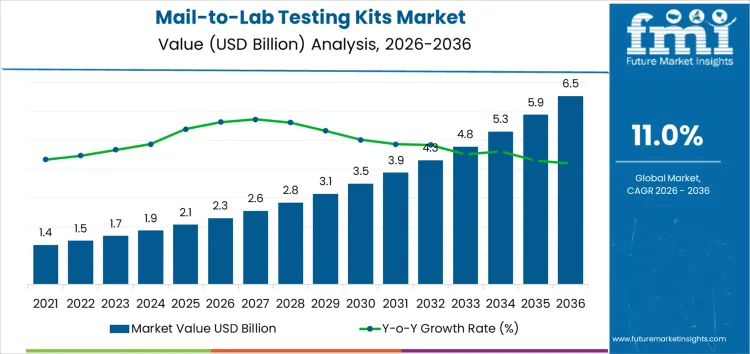
The mail-to-lab testing kits market is expected to experience significant growth from 2026 to 2036. In 2026, the market value is projected to be USD 2.3 billion, with steady growth anticipated, reaching USD 6.5 billion by 2036. The compound annual growth rate (CAGR) for the market is forecasted at 11%, driven by the increasing demand for at-home testing solutions that provide convenience and accessibility. Mail-to-lab testing kits allow users to collect samples at home and send them to laboratories for analysis, providing a non-invasive, private, and efficient method for health monitoring.
The market growth is supported by rising consumer demand for easy access to diagnostic testing, advancements in testing technologies, and an increasing emphasis on personalized healthcare. As telemedicine and remote healthcare solutions continue to grow in popularity, the demand for mail-to-lab testing kits will likely increase. Over the forecast period, the market is expected to expand steadily, with increasing applications in areas such as genetic testing, infectious disease detection, and wellness monitoring.
Quick Stats of the Mail-to-Lab Testing Kits Market
- Mail-to-Lab Testing Kits Market Value (2026): USD 2.3 billion
- Mail-to-Lab Testing Kits Market Forecast Value (2036): USD 6.5 billion
- Mail-to-Lab Testing Kits Market Global Forecast CAGR (2026 to 2036): 11%
- Mail-to-Lab Testing Kits Market Leading Segment: End User (Direct-to-consumer) 55%
- Key Growth Regions in Mail-to-Lab Testing Kits Market: India
- Top Players in Mail-to-Lab Testing Kits Market: 23andMe, Everlywell, LetsGetChecked, Color Health, MyHeritage, Others
What is the Growth Forecast for the Mail-to-Lab Testing Kits Market through 2036?
The growth forecast for the mail-to-lab testing kits market shows strong expansion, with a projected CAGR of 11%. Starting at USD 2.3 billion in 2026, the market is expected to grow steadily year-on-year, reaching USD 2.6 billion in 2027, USD 2.9 billion in 2028, and USD 3.2 billion in 2029. By 2030, the market value is projected to rise to USD 3.5 billion, continuing its growth throughout the forecast period.
From 2031 to 2036, the market will continue to see consistent growth, reaching USD 3.9 billion in 2031, USD 4.4 billion in 2032, and USD 4.8 billion in 2033. The market will further expand, reaching USD 5.4 billion in 2034, USD 6 billion in 2035, and finally USD 6.5 billion by 2036. The absolute dollar opportunity highlights the substantial market growth over the next decade, driven by increasing consumer adoption and the expansion of mail-to-lab testing applications.
Mail-to-Lab Testing Kits Market Key Takeaways
| Metric | Value |
|---|---|
| Industry Sales Value (2026) | USD 2.3 billion |
| Industry Forecast Value (2036) | USD 6.5 billion |
| Industry Forecast CAGR (2026 to 2036) | 11% |
What Is Driving the Demand for the Mail-to-Lab Testing Kits Market Globally?
The global demand for mail-to-lab testing kits is driven by increased emphasis on accessible diagnostics, convenience, and the decentralization of healthcare. These kits enable individuals to collect biological samples-such as saliva, blood spots, urine, or swabs-at home or in non clinical settings and then send them to accredited laboratories for professional analysis. Growing pressures on traditional healthcare systems, including long wait times, limited clinic access in rural areas, and rising chronic disease prevalence, have encouraged both consumers and providers to adopt remote sample collection options.
The COVID 19 pandemic accelerated adoption by demonstrating the value of contact free testing and reinforcing demand for remote diagnostics across infectious disease, metabolic, hormonal, and genetic markers. Advances in logistics and secure tracking also make it feasible to transport sensitive biological materials reliably, supporting broader use in preventive healthcare, workplace health screening, and population health initiatives. Expansion of telehealth services and e commerce distribution further reinforces uptake by integrating diagnostic testing into digital care pathways.
Future demand for mail-to-lab testing kits is expected to grow as technological innovation, regulatory frameworks, and consumer behavior continue to evolve. Improvements in assay sensitivity and robustness will increase confidence in remote collection methods, enabling more complex biomarker panels and disease monitoring beyond simple single analyte tests. Growth in personalized medicine and preventive care models will support adoption as clinicians utilize remote testing to tailor treatment plans, monitor chronic conditions, and adjust interventions in real time. Integration of mail-to-lab results into electronic health records and clinician workflows will help bridge gaps between remote collection and in person care, supporting continuity and data integrity.
Regulatory clarity around quality standards, sample stability, and data privacy will influence how quickly new kit types enter mainstream use across regions. Expansion of global logistics infrastructure and international harmonization of lab accreditation may further lower barriers to adoption, especially in low and middle income countries where access to laboratory services is limited. As patients increasingly prioritize convenience, timely insights, and empowerment in their health journeys, mail-to-lab testing solutions are poised to expand steadily across diagnostic categories and care settings worldwide.
What are the Leading Segments in the Global Mail-to-Lab Testing Kits Market?
The global mail-to-lab testing kits market is segmented by application and end user. Among applications, preventive health leads the market, capturing 45% of the share, followed by chronic disease monitoring and wellness. Preventive health is a dominant segment due to the increasing consumer focus on proactive health management and early detection of potential health issues. On the end-user side, direct-to-consumer is the largest segment, holding 55% of the share, followed by e-commerce and clinics & telehealth. Direct-to-consumer sales are growing rapidly as consumers seek more convenient, at-home healthcare solutions.
What Drives the Growth of Preventive Health in the Mail-to-Lab Testing Kits Market?
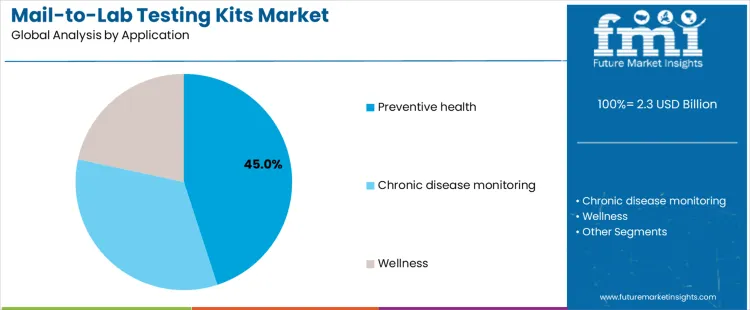
Preventive health is the leading application in the mail-to-lab testing kits market, holding 45% of the share. This growth is driven by the increasing consumer awareness of the importance of early detection and proactive health management. Preventive health tests, such as genetic testing, nutritional analysis, and general wellness checks, allow individuals to monitor their health and take preventive actions before developing chronic conditions. The rising trend of personalized health and wellness, alongside the growing emphasis on maintaining long-term health, has contributed to the demand for mail-to-lab testing kits in preventive health. Additionally, the ease of use, convenience, and non-invasive nature of mail-to-lab kits make them an attractive option for individuals looking for cost-effective and accessible healthcare solutions. As preventive health becomes a priority for more people, this segment is expected to remain a key driver in the market.
What is Driving the Demand for Direct-to-Consumer in the Mail-to-Lab Testing Kits Market?
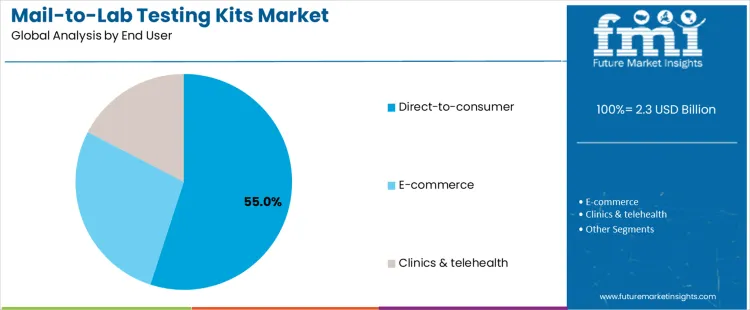
Direct-to-consumer (DTC) is the leading end-user segment in the mail-to-lab testing kits market, capturing 55% of the share. The growth of this segment is driven by the increasing consumer desire for convenient, at-home testing solutions that provide quick, reliable health insights. DTC testing kits offer individuals the ability to take control of their health and obtain test results without needing to visit a healthcare provider or lab. This ease of access, combined with the increasing availability of specialized testing kits for a wide range of health conditions, from genetic testing to hormone levels and allergy testing, has made DTC testing kits highly popular. The growth of e-commerce and online health platforms has further fueled the demand for DTC mail-to-lab testing kits, making them easily accessible to a global audience. As consumer preferences for personalized, self-directed health solutions continue to rise, the DTC segment is expected to maintain its dominance in the market.
What are the Key Dynamics in the Global Mail-to-Lab Testing Kits Market?
The global mail-to-lab testing kits market is expanding as consumers, healthcare providers and employers seek convenient, accurate diagnostic solutions without requiring clinic visits. These kits allow individuals to collect biological samples at home-such as saliva, blood spots, or swabs-and send them to laboratories for analysis. Growth reflects rising demand for preventive health monitoring, increased comfort with remote healthcare, and advancements in laboratory automation and logistics that support rapid turnaround. Adoption spans chronic disease screening, infectious disease testing, genetic analysis and wellness panels, with broader use across developed and emerging markets driven by ease of use and scalability.
What are the Key Drivers for the Global Mail-to-Lab Testing Kits Market?
A key driver is increasing preference for non invasive, patient centric diagnostic options that reduce barriers to access and improve participation in health monitoring. Busy lifestyles, mobility constraints and a desire to avoid clinic wait times encourage use of kits that can be completed at home. Technological advancements in sample preservation, temperature stable reagents and lab analytic platforms enable accurate results from mailed specimens. Rising awareness of early disease detection and preventive care fuels demand for tests covering metabolic conditions, hormones, microbiome profiles and infectious agents. Direct to consumer health trends, telehealth proliferation and employer sponsored wellness programs further propel market growth as stakeholders prioritize convenience, transparency and personalized health insights.
What are the Restraints for the Global Mail-to-Lab Testing Kits Market?
One restraint is variability in regulatory frameworks and reimbursement policies across regions, which can influence adoption and pricing of mail-to-lab kits. In some markets, stringent requirements for laboratory accreditation, test validation and privacy protection extend development timelines and increase compliance costs for manufacturers. Logistics and sample stability challenges-especially for temperature sensitive specimens-require robust packaging and tracking systems that add operational complexity. Consumer concerns about data security and trust in remote testing accuracy may limit uptake among certain populations. Additionally, integration of test results into clinical care pathways often depends on provider acceptance and follow up protocols, which can vary by healthcare setting.
What are the Key Trends in the Global Mail-to-Lab Testing Kits Market?
A key trend is integration of digital health technologies that support end to end user experiences, from online ordering and instructional guidance to secure results delivery and teleconsultation. Mobile apps and portals provide step by step collection assistance, reminders and educational content that improve compliance and sample quality. Expansion of multi analyte panels that combine genomic, metabolic and microbiome markers enhances the value of mailed testing for comprehensive health insights. Partnerships between kit providers, laboratories and logistics firms are improving speed, tracking and sample handling reliability. There is also increasing focus on equitable access, with initiatives aimed at expanding affordability and availability of mail-to-lab testing in rural and underserved communities.
What is the Country-Wise Analysis of the Mail-to-Lab Testing Kits Market?
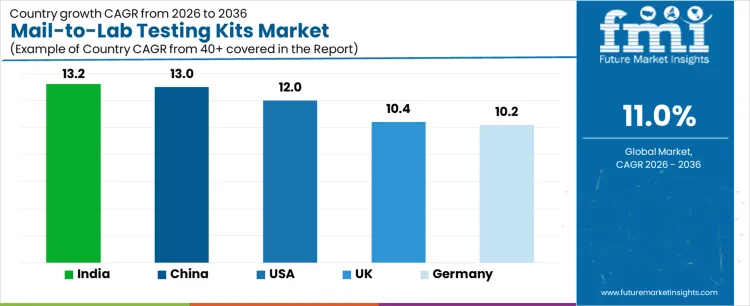
The mail-to-lab testing kits market is expected to grow significantly, driven by the increasing demand for convenient, non-invasive, and accessible diagnostic solutions. These kits allow individuals to collect samples from the comfort of their homes and send them to accredited labs for analysis, making them popular in healthcare sectors such as diagnostics, personalized medicine, and preventive care. High-growth markets like India and China are seeing strong demand due to large populations, expanding healthcare access, and increasing awareness of preventive health and self-diagnosis. Developed markets such as the USA, UK, and Germany are also experiencing steady growth, supported by rising healthcare costs, an increased focus on convenience, and advancements in telemedicine and remote diagnostics.
| Country | CAGR (2026 to 2036) |
|---|---|
| India | 13.2% |
| China | 13% |
| United States | 12% |
| United Kingdom | 10.4% |
| Germany | 10.2% |
What is the Growth Outlook for the Mail-to-Lab Testing Kits Market in India?
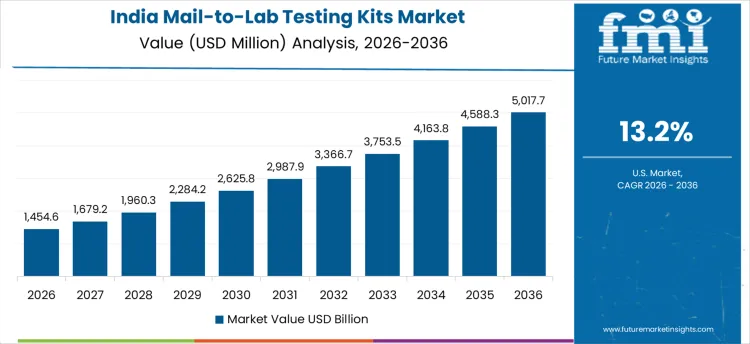
The mail-to-lab testing kits market in India is expected to grow at the highest rate, with a projected CAGR of 13.2%. India’s rapidly expanding healthcare sector, coupled with increasing awareness about health monitoring, is driving the demand for convenient, at-home testing solutions. The country’s large population, growing middle class, and increased internet access have made home testing kits more accessible. Additionally, the rising prevalence of chronic diseases, along with the Indian government's efforts to improve healthcare access, further contribute to the market’s growth. As individuals seek more affordable, private, and accessible diagnostic options, the mail-to-lab testing kits market is positioned for substantial growth in India.
What is the Market Outlook for the Mail-to-Lab Testing Kits Market in China?
The mail-to-lab testing kits market in China is projected to grow at a strong pace, with a projected CAGR of 13%. China’s rapidly advancing healthcare infrastructure and the growing adoption of digital health solutions are driving demand for convenient, non-invasive testing methods. As the country’s population becomes more health-conscious and as the healthcare system becomes more accessible, more consumers are turning to mail-to-lab testing kits for diagnostics. With the rise in chronic conditions and a growing focus on preventive care, these testing kits are becoming a crucial tool in China's healthcare landscape. Additionally, China's government’s focus on improving healthcare services is expected to drive continued growth in the market.
What is the Growth Forecast for the Mail-to-Lab Testing Kits Market in the United States?
The mail-to-lab testing kits market in the United States is expected to grow steadily, with a projected CAGR of 12%. The increasing demand for convenient, at-home testing solutions, combined with advancements in telemedicine and remote healthcare, is driving growth in the U.S. market. As healthcare consumers seek more accessible, private, and affordable diagnostic options, the popularity of mail-to-lab testing kits is increasing, particularly for testing chronic diseases, genetic conditions, and preventive health measures. The rise of personalized medicine and the growing trend toward digital health are also supporting market growth. The U.S. market’s strong focus on healthcare innovation and consumer-driven health management is expected to contribute to steady growth in this sector.
What is the Market Outlook for the Mail-to-Lab Testing Kits Market in the United Kingdom?
The mail-to-lab testing kits market in the United Kingdom is projected to grow steadily, with a projected CAGR of 10.4%. The UK’s healthcare system has seen a shift towards more accessible and personalized healthcare solutions, with mail-to-lab testing kits playing a key role in this transformation. The increasing demand for convenient and private diagnostic solutions, combined with growing healthcare costs, is driving the adoption of at-home testing kits. As the population becomes more health-conscious and seeks proactive healthcare management, the demand for mail-to-lab testing kits is rising. The UK’s robust healthcare infrastructure and increasing interest in preventive care are expected to continue supporting growth in the mail-to-lab testing kits market.
What are the Growth Prospects for the Mail-to-Lab Testing Kits Market in Germany?
The mail-to-lab testing kits market in Germany is expected to grow at a steady pace, with a projected CAGR of 10.2%. Germany’s healthcare system is increasingly focused on preventive care, patient convenience, and digital health solutions, all of which are driving the demand for mail-to-lab testing kits. With a growing interest in home diagnostics and the rising adoption of telemedicine, these kits are becoming an attractive option for consumers who want to manage their health more independently. As the German healthcare system continues to prioritize quality care and efficiency, the market for mail-to-lab testing kits is set to experience steady expansion. Additionally, Germany’s strong healthcare infrastructure and increasing consumer awareness about self-care and diagnostics are likely to further support market growth.
What is the Competitive Landscape for the Mail-to-Lab Testing Kits Market?
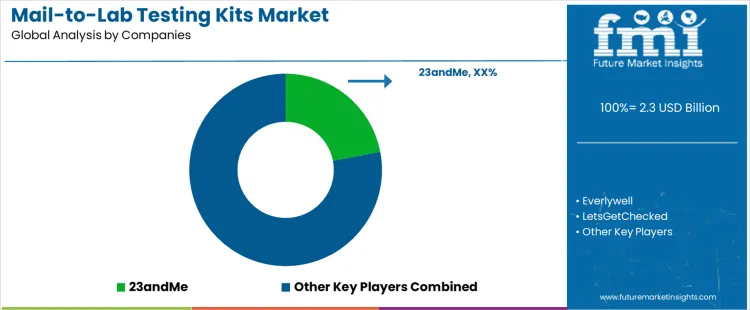
The mail-to-lab testing kits market is experiencing significant growth, driven by consumers’ increasing demand for convenient, at-home diagnostic solutions. These testing kits offer a straightforward way to monitor various health parameters and genetic factors, without the need for in-person visits to a medical facility. 23andMe leads the market, known for its genetic testing services, which provide valuable insights into ancestry, health risks, and wellness. Their strong brand recognition, reliable testing methods, and user-friendly approach have positioned them as the dominant player in the market. The company’s ability to offer detailed genetic reports, including information about potential genetic health risks, has made it a popular choice for consumers seeking personalized insights into their health and heritage.
Everlywell, LetsGetChecked, and Color Health are significant competitors, each offering specialized mail-to-lab testing kits for a variety of health conditions. Everlywell stands out with its broad range of tests, covering areas such as food sensitivities, hormones, and vitamins, providing consumers with the ability to manage and monitor their health from home. LetsGetChecked provides personalized health tests, including tests for conditions like diabetes, thyroid health, and sexual health, allowing users to take control of their healthcare journey. Color Health offers genetic testing with a focus on assessing health risks and helping individuals make informed decisions about their healthcare. Their services cater to a growing demand for health risk assessment and preventive care.
MyHeritage, traditionally known for its ancestry services, has entered the health testing space, combining ancestry and health tests to provide consumers with a comprehensive view of their genetic makeup. Their focus on integrating genetic health insights with family history appeals to individuals interested in both ancestry and wellness. Others refers to a variety of regional and emerging players that provide affordable, accessible, and niche-focused testing solutions, catering to a broad range of health needs. These companies compete by focusing on innovation, convenience, and the ability to offer accurate, actionable health data to consumers in a way that is easy to use and cost-effective. The market's growth is fueled by the increasing consumer preference for self-administered, non-invasive testing methods that provide valuable health information and empower individuals to make informed decisions about their well-being.
Key Players of the Mail-to-Lab Testing Kits Market
- 23andMe
- Everlywell
- LetsGetChecked
- Color Health
- MyHeritage
- Others
Scope of the Report
| Items | Values |
|---|---|
| Quantitative Units (2026) | USD Billion |
| Product | Genetic Test Kits, Hormone & Fertility Kits, Microbiome Kits, Others |
| Application | Preventive Health, Chronic Disease Monitoring, Wellness |
| End User | Direct-to-Consumer, E-Commerce, Clinics & Telehealth |
| Companies | 23andMe, Everlywell, LetsGetChecked, Color Health, MyHeritage, Others |
| Regions Covered | North America, Latin America, Western Europe, Eastern Europe, South Asia and Pacific, East Asia, Middle East & Africa |
| Countries Covered | United States, Canada, Mexico, Brazil, Argentina, Germany, France, United Kingdom, Italy, Spain, Netherlands, China, India, Japan, South Korea, ANZ, GCC Countries, South Africa |
| Additional Attributes | Dollar sales by product, application, end user, and region. Includes market trends in mail-to-lab testing kits, focusing on genetic tests, hormone & fertility kits, and microbiome kits. Highlights the role of direct-to-consumer, e-commerce, and clinics in preventive health, disease monitoring, and wellness. Focus on cost-effectiveness, performance, regulatory compliance, and market share of key companies in the at-home health testing market. |
Mail-to-Lab Testing Kits Market Segmentation
By Product:
- Genetic test kits
- Hormone & fertility kits
- Microbiome kits
- Others
By Application:
- Preventive health
- Chronic disease monitoring
- Wellness
By End User:
- Direct-to-consumer
- E-commerce
- Clinics & telehealth
By Region:
- Asia Pacific
- China
- Japan
- South Korea
- India
- Australia & New Zealand
- ASEAN
- Rest of Asia Pacific
- Europe
- Germany
- United Kingdom
- France
- Italy
- Spain
- Nordic
- BENELUX
- Rest of Europe
- North America
- United States
- Canada
- Mexico
- Latin America
- Brazil
- Chile
- Rest of Latin America
- Middle East & Africa
- Kingdom of Saudi Arabia
- Other GCC Countries
- Turkey
- South Africa
- Other African Union
- Rest of Middle East & Africa
Frequently Asked Questions
How big is the mail-to-lab testing kits market in 2026?
The global mail-to-lab testing kits market is estimated to be valued at USD 2.3 billion in 2026.
What will be the size of mail-to-lab testing kits market in 2036?
The market size for the mail-to-lab testing kits market is projected to reach USD 6.5 billion by 2036.
How much will be the mail-to-lab testing kits market growth between 2026 and 2036?
The mail-to-lab testing kits market is expected to grow at a 11.0% CAGR between 2026 and 2036.
What are the key product types in the mail-to-lab testing kits market?
The key product types in mail-to-lab testing kits market are genetic test kits, hormone & fertility kits, microbiome kits and others.
Which application segment to contribute significant share in the mail-to-lab testing kits market in 2026?
In terms of application, preventive health segment to command 45.0% share in the mail-to-lab testing kits market in 2026.
Preview the report firsthand - request a free sample
Get SampleGet the brochure for pricing and purchase details.
Get PDFTable of Content
- Executive Summary
- Global Market Outlook
- Demand-side Trends
- Supply-side Trends
- Technology Roadmap Analysis
- Analysis and Recommendations
- Market Overview
- Market Coverage / Taxonomy
- Market Definition / Scope / Limitations
- Market Background
- Market Dynamics
- Drivers
- Restraints
- Opportunity
- Trends
- Scenario Forecast
- Demand in Optimistic Scenario
- Demand in Likely Scenario
- Demand in Conservative Scenario
- Opportunity Map Analysis
- Product Life Cycle Analysis
- Supply Chain Analysis
- Investment Feasibility Matrix
- Value Chain Analysis
- PESTLE and Porter’s Analysis
- Regulatory Landscape
- Regional Parent Market Outlook
- Production and Consumption Statistics
- Import and Export Statistics
- Market Dynamics
- Global Market Analysis 2021 to 2025 and Forecast, 2026 to 2036
- Historical Market Size Value (USD Million) Analysis, 2021 to 2025
- Current and Future Market Size Value (USD Million) Projections, 2026 to 2036
- Y-o-Y Growth Trend Analysis
- Absolute $ Opportunity Analysis
- Global Market Pricing Analysis 2021 to 2025 and Forecast 2026 to 2036
- Global Market Analysis 2021 to 2025 and Forecast 2026 to 2036, By Product
- Introduction / Key Findings
- Historical Market Size Value (USD Million) Analysis By Product , 2021 to 2025
- Current and Future Market Size Value (USD Million) Analysis and Forecast By Product , 2026 to 2036
- Genetic test kits
- Hormone & fertility kits
- Microbiome kits
- Others
- Genetic test kits
- Y-o-Y Growth Trend Analysis By Product , 2021 to 2025
- Absolute $ Opportunity Analysis By Product , 2026 to 2036
- Global Market Analysis 2021 to 2025 and Forecast 2026 to 2036, By Application
- Introduction / Key Findings
- Historical Market Size Value (USD Million) Analysis By Application, 2021 to 2025
- Current and Future Market Size Value (USD Million) Analysis and Forecast By Application, 2026 to 2036
- Preventive health
- Chronic disease monitoring
- Wellness
- Preventive health
- Y-o-Y Growth Trend Analysis By Application, 2021 to 2025
- Absolute $ Opportunity Analysis By Application, 2026 to 2036
- Global Market Analysis 2021 to 2025 and Forecast 2026 to 2036, By End User
- Introduction / Key Findings
- Historical Market Size Value (USD Million) Analysis By End User, 2021 to 2025
- Current and Future Market Size Value (USD Million) Analysis and Forecast By End User, 2026 to 2036
- Direct-to-consumer
- E-commerce
- Clinics & telehealth
- Direct-to-consumer
- Y-o-Y Growth Trend Analysis By End User, 2021 to 2025
- Absolute $ Opportunity Analysis By End User, 2026 to 2036
- Global Market Analysis 2021 to 2025 and Forecast 2026 to 2036, By Region
- Introduction
- Historical Market Size Value (USD Million) Analysis By Region, 2021 to 2025
- Current Market Size Value (USD Million) Analysis and Forecast By Region, 2026 to 2036
- North America
- Latin America
- Western Europe
- Eastern Europe
- East Asia
- South Asia and Pacific
- Middle East & Africa
- Market Attractiveness Analysis By Region
- North America Market Analysis 2021 to 2025 and Forecast 2026 to 2036, By Country
- Historical Market Size Value (USD Million) Trend Analysis By Market Taxonomy, 2021 to 2025
- Market Size Value (USD Million) Forecast By Market Taxonomy, 2026 to 2036
- By Country
- USA
- Canada
- Mexico
- By Product
- By Application
- By End User
- By Country
- Market Attractiveness Analysis
- By Country
- By Product
- By Application
- By End User
- Key Takeaways
- Latin America Market Analysis 2021 to 2025 and Forecast 2026 to 2036, By Country
- Historical Market Size Value (USD Million) Trend Analysis By Market Taxonomy, 2021 to 2025
- Market Size Value (USD Million) Forecast By Market Taxonomy, 2026 to 2036
- By Country
- Brazil
- Chile
- Rest of Latin America
- By Product
- By Application
- By End User
- By Country
- Market Attractiveness Analysis
- By Country
- By Product
- By Application
- By End User
- Key Takeaways
- Western Europe Market Analysis 2021 to 2025 and Forecast 2026 to 2036, By Country
- Historical Market Size Value (USD Million) Trend Analysis By Market Taxonomy, 2021 to 2025
- Market Size Value (USD Million) Forecast By Market Taxonomy, 2026 to 2036
- By Country
- Germany
- UK
- Italy
- Spain
- France
- Nordic
- BENELUX
- Rest of Western Europe
- By Product
- By Application
- By End User
- By Country
- Market Attractiveness Analysis
- By Country
- By Product
- By Application
- By End User
- Key Takeaways
- Eastern Europe Market Analysis 2021 to 2025 and Forecast 2026 to 2036, By Country
- Historical Market Size Value (USD Million) Trend Analysis By Market Taxonomy, 2021 to 2025
- Market Size Value (USD Million) Forecast By Market Taxonomy, 2026 to 2036
- By Country
- Russia
- Poland
- Hungary
- Balkan & Baltic
- Rest of Eastern Europe
- By Product
- By Application
- By End User
- By Country
- Market Attractiveness Analysis
- By Country
- By Product
- By Application
- By End User
- Key Takeaways
- East Asia Market Analysis 2021 to 2025 and Forecast 2026 to 2036, By Country
- Historical Market Size Value (USD Million) Trend Analysis By Market Taxonomy, 2021 to 2025
- Market Size Value (USD Million) Forecast By Market Taxonomy, 2026 to 2036
- By Country
- China
- Japan
- South Korea
- By Product
- By Application
- By End User
- By Country
- Market Attractiveness Analysis
- By Country
- By Product
- By Application
- By End User
- Key Takeaways
- South Asia and Pacific Market Analysis 2021 to 2025 and Forecast 2026 to 2036, By Country
- Historical Market Size Value (USD Million) Trend Analysis By Market Taxonomy, 2021 to 2025
- Market Size Value (USD Million) Forecast By Market Taxonomy, 2026 to 2036
- By Country
- India
- ASEAN
- Australia & New Zealand
- Rest of South Asia and Pacific
- By Product
- By Application
- By End User
- By Country
- Market Attractiveness Analysis
- By Country
- By Product
- By Application
- By End User
- Key Takeaways
- Middle East & Africa Market Analysis 2021 to 2025 and Forecast 2026 to 2036, By Country
- Historical Market Size Value (USD Million) Trend Analysis By Market Taxonomy, 2021 to 2025
- Market Size Value (USD Million) Forecast By Market Taxonomy, 2026 to 2036
- By Country
- Kingdom of Saudi Arabia
- Other GCC Countries
- Turkiye
- South Africa
- Other African Union
- Rest of Middle East & Africa
- By Product
- By Application
- By End User
- By Country
- Market Attractiveness Analysis
- By Country
- By Product
- By Application
- By End User
- Key Takeaways
- Key Countries Market Analysis
- USA
- Pricing Analysis
- Market Share Analysis, 2025
- By Product
- By Application
- By End User
- Canada
- Pricing Analysis
- Market Share Analysis, 2025
- By Product
- By Application
- By End User
- Mexico
- Pricing Analysis
- Market Share Analysis, 2025
- By Product
- By Application
- By End User
- Brazil
- Pricing Analysis
- Market Share Analysis, 2025
- By Product
- By Application
- By End User
- Chile
- Pricing Analysis
- Market Share Analysis, 2025
- By Product
- By Application
- By End User
- Germany
- Pricing Analysis
- Market Share Analysis, 2025
- By Product
- By Application
- By End User
- UK
- Pricing Analysis
- Market Share Analysis, 2025
- By Product
- By Application
- By End User
- Italy
- Pricing Analysis
- Market Share Analysis, 2025
- By Product
- By Application
- By End User
- Spain
- Pricing Analysis
- Market Share Analysis, 2025
- By Product
- By Application
- By End User
- France
- Pricing Analysis
- Market Share Analysis, 2025
- By Product
- By Application
- By End User
- India
- Pricing Analysis
- Market Share Analysis, 2025
- By Product
- By Application
- By End User
- ASEAN
- Pricing Analysis
- Market Share Analysis, 2025
- By Product
- By Application
- By End User
- Australia & New Zealand
- Pricing Analysis
- Market Share Analysis, 2025
- By Product
- By Application
- By End User
- China
- Pricing Analysis
- Market Share Analysis, 2025
- By Product
- By Application
- By End User
- Japan
- Pricing Analysis
- Market Share Analysis, 2025
- By Product
- By Application
- By End User
- South Korea
- Pricing Analysis
- Market Share Analysis, 2025
- By Product
- By Application
- By End User
- Russia
- Pricing Analysis
- Market Share Analysis, 2025
- By Product
- By Application
- By End User
- Poland
- Pricing Analysis
- Market Share Analysis, 2025
- By Product
- By Application
- By End User
- Hungary
- Pricing Analysis
- Market Share Analysis, 2025
- By Product
- By Application
- By End User
- Kingdom of Saudi Arabia
- Pricing Analysis
- Market Share Analysis, 2025
- By Product
- By Application
- By End User
- Turkiye
- Pricing Analysis
- Market Share Analysis, 2025
- By Product
- By Application
- By End User
- South Africa
- Pricing Analysis
- Market Share Analysis, 2025
- By Product
- By Application
- By End User
- USA
- Market Structure Analysis
- Competition Dashboard
- Competition Benchmarking
- Market Share Analysis of Top Players
- By Regional
- By Product
- By Application
- By End User
- Competition Analysis
- Competition Deep Dive
- 23andMe
- Overview
- Product Portfolio
- Profitability by Market Segments (Product/Age /Sales Channel/Region)
- Sales Footprint
- Strategy Overview
- Marketing Strategy
- Product Strategy
- Channel Strategy
- Everlywell
- LetsGetChecked
- Color Health
- MyHeritage
- Others
- 23andMe
- Competition Deep Dive
- Assumptions & Acronyms Used
- Research Methodology


