

- Industry Size (2026)
- USD 1.3 Bn
- Forecast (2036)
- USD 3.7 Bn
- CAGR (2026 to 2036)
- 10.90%
Edge AI High-Bandwidth Memory Chips Market Forecast and Outlook 2026 to 2036
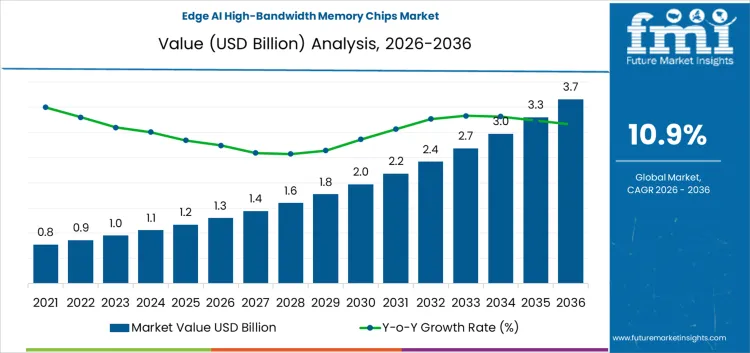
The edge AI high-bandwidth memory chips market is valued at USD 1.3 billion in 2026 and is forecast to reach USD 3.7 billion by 2036, expanding at a CAGR of 10.90% over the forecast period. Growth quality in this market is closely tied to application concentration in performance-critical edge workloads rather than broad-based volume expansion. Demand is heavily anchored in AI inference, edge servers, and industrial AI, where consistent bandwidth, low latency, and deterministic performance are non-negotiable requirements.
This creates strong end-use dependency, as purchasing decisions are driven by system architects and platform designers rather than price-sensitive buyers. Volume stability is reinforced by long product qualification cycles, extended deployment timelines, and tight coupling between HBM chips and specific edge AI accelerators. Once designed into an edge platform, memory configurations are rarely changed mid-cycle, supporting predictable demand patterns. Reliance on a narrow set of high-performance applications also concentrates risk, making market outcomes sensitive to shifts in edge AI adoption priorities and silicon roadmap alignment.
Quick Stats for Edge AI High-Bandwidth Memory Chips Market
- Edge AI High-Bandwidth Memory Chips Market Value (2026): USD 1.3 Billion
- Edge AI High-Bandwidth Memory Chips Market Forecast Value (2036): USD 3.7 Billion
- Edge AI High-Bandwidth Memory Chips Market Forecast CAGR 2026 to 2036: 10.90%
- Leading HBM Generation in Edge AI High-Bandwidth Memory Chips Market: HBM3 / HBM3E
- Leading Application in Edge AI High-Bandwidth Memory Chips Market: AI Inference
- Key Growth Regions in Edge AI High-Bandwidth Memory Chips Market: Asia Pacific, North America
- Top Key Players in Edge AI High-Bandwidth Memory Chips Market: SK hynix, Samsung Electronics, Micron Technology, Kioxia, Winbond, Nanya
Edge AI High-Bandwidth Memory Chips Market Key Takeaways
| Metric | Value |
|---|---|
| Industry Value (2026) | USD 1.3 Billion |
| Forecast Value (2036) | USD 3.7 Billion |
| Forecast CAGR 2026 to 2036 | 10.90% |
How Is the Global Edge AI High-Bandwidth Memory Chips Market Advancing?
The global edge AI high-bandwidth memory (HBM) chips market is advancing rapidly, driven by the growing deployment of edge-based artificial intelligence applications that require high data throughput and low latency. Edge AI systems used in autonomous machines, industrial automation, smart cameras, and telecommunications infrastructure rely on HBM chips to support real-time data processing and complex neural network workloads close to the data source.
A key driver fueling market growth is the increasing demand for compact and power-efficient memory solutions capable of handling intensive AI workloads at the edge. Compared to conventional memory architectures, HBM chips offer significantly higher bandwidth and improved energy efficiency, enabling faster inference and reduced data transfer bottlenecks. This makes them well-suited for edge devices where performance constraints and space limitations are critical considerations.
Continuous advancements in semiconductor packaging, memory stacking technologies, and interconnect architectures are further strengthening market adoption. Innovations such as advanced 2.5D and 3D integration are improving memory density and thermal management, supporting higher processing performance in edge AI systems. As edge computing adoption expands across multiple industries and AI workloads become more complex, the high-bandwidth memory chips market is expected to maintain strong growth throughout the forecast period.
What Is the Segment-Wise Analysis for the Edge AI High-Bandwidth Memory Chips Market?
The edge AI high-bandwidth memory chips market is segmented by HBM generation and application, reflecting performance and deployment requirements of edge-based AI workloads. By HBM generation, HBM3 or HBM3E leads with a 44% share, driven by its ultra-high bandwidth, lower latency, and ability to support advanced AI processing at the edge. HBM2E, custom stacked HBM, and low-power HBM variants follow, addressing varying power, cost, and customization needs. By application, AI inference accounts for the largest share at 39%, supported by growing deployment of real-time analytics, vision processing, and decision-making at the edge.
Why Do HBM3 and HBM3E Lead the Edge AI High-Bandwidth Memory Chips Market?
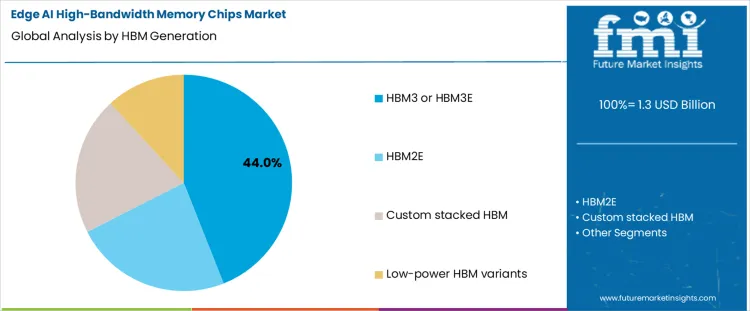
HBM3 and HBM3E account for 44% of the HBM generation segment in the edge AI high-bandwidth memory chips market due to their superior bandwidth, low latency, and high energy efficiency required for advanced edge AI workloads. These next-generation memory chips support faster data transfer rates and higher memory capacity, making them well suited for real-time AI processing at the edge. Applications such as computer vision, natural language processing, and autonomous decision systems rely on rapid access to large datasets, which HBM3 and HBM3E enable effectively. Their ability to support compact system designs while maintaining performance advantages makes them attractive for edge servers and embedded AI platforms. As edge computing architectures evolve toward higher-performance inference capabilities, adoption of HBM3-class memory continues to accelerate.
How Does AI Inference Drive Demand in the Edge AI High-Bandwidth Memory Chips Market?
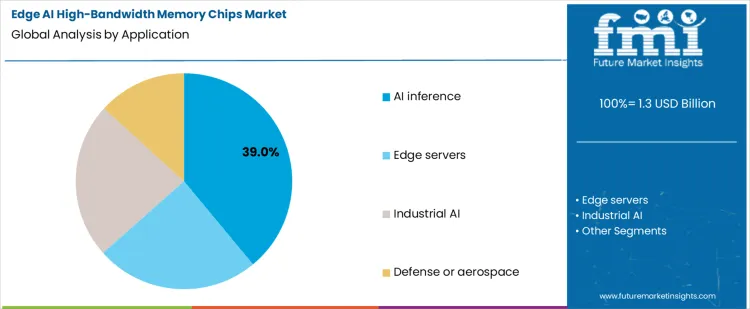
AI inference represents 39% of total application demand, positioning it as the leading use case in the edge AI high-bandwidth memory chips market. Edge-based AI inference requires rapid processing of data streams from sensors, cameras, and connected devices, creating strong demand for high-bandwidth, low-latency memory solutions. HBM-enabled systems allow AI models to execute inference tasks locally, reducing dependence on cloud infrastructure and improving response times. This is particularly critical in applications such as industrial automation, smart surveillance, and real-time analytics. The growing deployment of edge AI accelerators in compact form factors further increases reliance on advanced memory technologies. As organizations prioritize faster decision-making and reduced data transfer delays, AI inference continues to be a key driver of HBM chip adoption at the edge.
What Are the Key Dynamics for the Edge AI High-Bandwidth Memory Chips Market?
The edge AI high-bandwidth memory chips market is driven by the increasing deployment of edge AI applications that require rapid data processing with minimal latency. High-bandwidth memory chips support large-scale data throughput needed for real-time inference and analytics at the edge, including in autonomous systems, industrial IoT, smart cameras, and telecom infrastructure. Key market dynamics include growing demand for edge processing performance, rising volumes of data generated at the edge, and the need for memory solutions that can handle high-speed compute workloads efficiently. As enterprises push AI compute closer to data sources, HBM chips play a critical role in enabling efficient edge AI systems with better performance and energy profiles.
Why Is the Edge AI High-Bandwidth Memory Chips Market Growing?
The market is expanding as edge computing adoption accelerates across multiple verticals, driven by requirements for faster decision-making, reduced network dependency, and enhanced data privacy. HBM chips are increasingly integrated into AI accelerators, edge servers, and autonomous devices where traditional memory architectures cannot deliver the requisite bandwidth. Growth is further supported by rising investments in edge AI infrastructure, adoption of advanced chiplets and heterogeneous computing architectures, and the need to manage large AI model workloads locally. The proliferation of 5G and next-generation networks also increases demand for high-performance memory that supports real-time processing at network edges.
How Are the Key Drivers Shaping the Edge AI High-Bandwidth Memory Chips Market?
Key drivers shaping the market include the rising complexity of AI models and the demand for local, low-latency inference for applications such as predictive maintenance, autonomous navigation, and smart surveillance. The increasing deployment of connected edge devices is generating large volumes of data that must be processed quickly, creating a need for memory chips with high throughput and bandwidth. Technology advancements in memory stacking, thermal efficiency, and power-optimized designs are enabling higher performance in constrained edge environments. Partnerships between chip makers and AI platform developers are also fostering optimized solutions that leverage HBM for improved computational efficiency and system interoperability.
What Is the Growth Outlook for the Edge AI High-Bandwidth Memory (HBM) Chips Market by Country?
| Country | CAGR (%) |
|---|---|
| Taiwan | 10.5% |
| South Korea | 10.0% |
| USA | 9.8% |
| China | 9.5% |
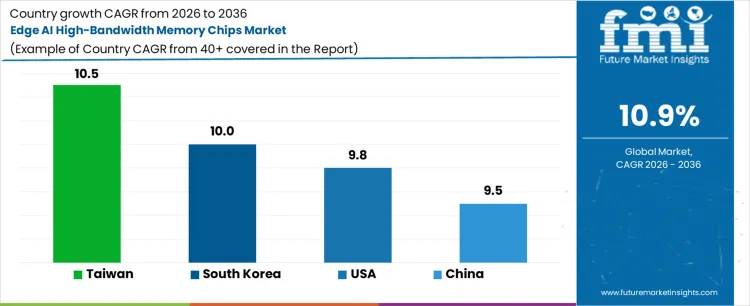
The edge AI high-bandwidth memory chips market is expanding rapidly as data-intensive AI workloads move closer to the edge. Taiwan leads at 10.5%, supported by advanced semiconductor manufacturing and packaging capabilities. South Korea follows at 10.0%, driven by its global leadership in memory chip production and HBM innovation. The USA grows at 9.8%, fueled by strong AI hardware development and expanding edge computing deployments. China expands at 9.5%, supported by large-scale edge AI adoption and investments in domestic semiconductor capabilities. As edge AI applications continue to proliferate, demand for high-bandwidth memory chips is expected to increase across all major regions.
What Is Driving the Growth of the Edge AI High-Bandwidth Memory Chips Market in Taiwan?
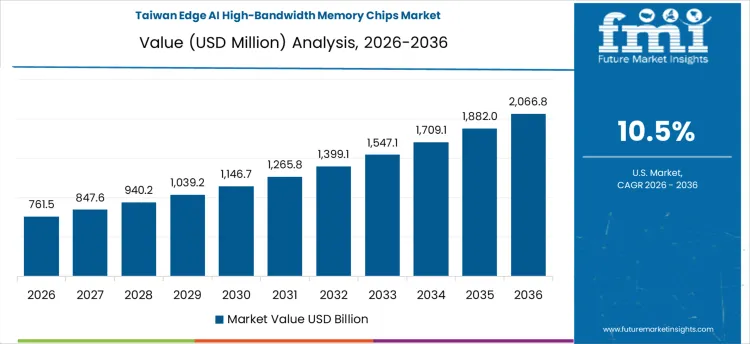
The edge AI high-bandwidth memory chips market in Taiwan is growing at a CAGR of 10.5%, driven by the country’s dominant position in advanced semiconductor manufacturing and packaging technologies. Taiwan plays a central role in global chip fabrication, including leading-edge nodes and advanced memory integration required for high-bandwidth memory solutions. Growing deployment of edge AI applications such as smart cameras, industrial automation systems, and edge servers is increasing demand for memory solutions that deliver high data throughput with low latency. Taiwan’s strong ecosystem of foundries, OSAT providers, and fabless chip designers supports rapid commercialization of HBM-enabled edge AI processors. In addition, continuous investment in advanced packaging technologies, including 2.5D and 3D integration, enhances HBM performance and scalability. As edge AI workloads become more data-intensive, Taiwan’s leadership in semiconductor manufacturing is expected to sustain strong growth in the HBM chips market.
How Is the Edge AI High-Bandwidth Memory Chips Market Expanding in South Korea?
The edge AI high-bandwidth memory chips market in South Korea is expanding at a CAGR of 10.0%, supported by the country’s strong memory semiconductor manufacturing base. South Korea is a global leader in DRAM and HBM production, making it a critical supplier of high-performance memory solutions for AI and edge computing applications. Increasing adoption of edge AI across automotive systems, smart factories, and telecommunications infrastructure is driving demand for memory chips capable of handling large data volumes efficiently. South Korean manufacturers are investing heavily in next-generation HBM architectures to improve bandwidth, power efficiency, and thermal performance. Close collaboration between memory producers and AI processor developers is further accelerating innovation.Government-backed initiatives supporting semiconductor competitiveness and R&D are strengthening the market. As edge AI deployments scale across industries, South Korea’s role as a key HBM supplier is expected to drive continued market expansion.
How Is the Edge AI High-Bandwidth Memory Chips Market Developing in the USA?
The edge AI high-bandwidth memory chips market in the USA is growing at a CAGR of 9.8%, driven by strong demand for advanced AI hardware across data centers, edge servers, and intelligent devices. USA-based technology companies are actively developing edge AI solutions for applications such as autonomous systems, smart infrastructure, healthcare imaging, and defense electronics. These workloads require high-bandwidth, low-latency memory solutions to process data efficiently at the edge. Growing investment in AI accelerators and custom silicon is increasing integration of HBM into edge-focused processors. In addition, policy initiatives aimed at strengthening domestic semiconductor capabilities are supporting local development and adoption of advanced memory technologies. Collaboration between chip designers, system integrators, and memory suppliers is further accelerating innovation. As edge AI use cases continue to expand, demand for high-bandwidth memory chips in the USA is expected to grow steadily.
How Is the Edge AI High-Bandwidth Memory Chips Market Expanding in China?
The edge AI high-bandwidth memory chips market in China is expanding at a CAGR of 9.5%, supported by rapid deployment of edge AI across smart cities, surveillance systems, industrial automation, and consumer electronics. China’s large-scale adoption of AI-enabled devices is increasing demand for memory solutions that can handle real-time data processing with high efficiency. Domestic semiconductor firms are investing in memory design, advanced packaging, and AI chip development to reduce reliance on imports and strengthen local supply chains. Government initiatives promoting AI adoption and semiconductor self-sufficiency are further supporting market growth. In addition, expansion of 5G networks and edge computing infrastructure is accelerating deployment of AI workloads closer to data sources, increasing the need for high-bandwidth memory. As China continues to scale edge AI applications across sectors, demand for HBM chips is expected to rise steadily.
How Are Companies Competing in the Edge AI High-Bandwidth Memory Chips Market?
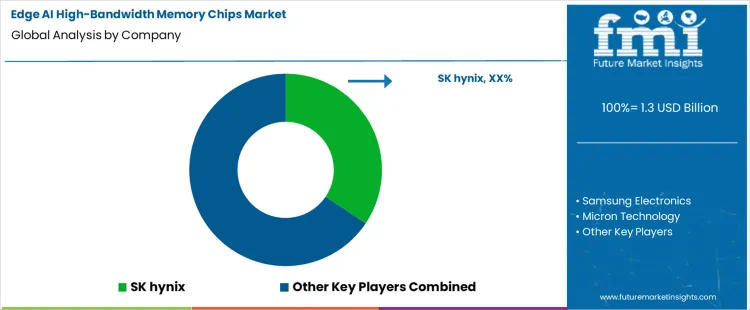
Competition in the edge AI high-bandwidth memory (HBM) chips market is defined by the ability to deliver extremely high data throughput within tight power, thermal, and form-factor constraints. As edge AI applications such as real-time inference, machine vision, and industrial analytics expand, memory suppliers compete on stack density, interface speed, energy efficiency, and reliability under continuous operation. Advanced packaging, TSV stacking, and close integration with edge AI processors are central to differentiation, as customers seek memory solutions that can sustain high bandwidth while maintaining predictable thermal behavior in compact edge systems.
SK hynix, Samsung Electronics, and Micron Technology lead competition through advanced HBM roadmaps and large-scale manufacturing capabilities. SK hynix focuses on higher-generation HBM solutions with increased bandwidth per stack and optimized power efficiency to support AI acceleration at the edge. Samsung Electronics leverages vertical integration across memory, logic, and packaging to align HBM products closely with edge AI SoCs and accelerators, emphasizing system-level optimization. Micron competes by prioritizing signal integrity, consistent latency, and power-efficient designs that perform reliably across diverse edge deployment conditions.
Kioxia, Winbond, and Nanya compete by addressing specialized and cost-sensitive segments of the edge AI ecosystem. Kioxia applies its strengths in memory process technology and packaging to support emerging edge AI workloads that require balanced performance and endurance. Winbond and Nanya focus on dependable, energy-efficient memory offerings for industrial, embedded, and regional edge AI applications where long lifecycle support, thermal stability, and supply assurance are more critical than maximum bandwidth. Across the market, competitive advantage is shaped by bandwidth scalability, power efficiency, packaging innovation, and the ability to align memory architectures with evolving edge AI system requirements.
Key Players in Edge AI High-Bandwidth Memory Chips Market
- SK hynix
- Samsung Electronics
- Micron Technology
- Kioxia
- Winbond
- Nanya
Scope of Report
| Attributes | Description |
|---|---|
| Quantitative Unit (2026) | USD Billion |
| HBM Generation | HBM3 or HBM3E, HBM2E, Custom Stacked HBM, Low-Power HBM Variants |
| Application | AI Inference, Edge Servers, Industrial AI, Defense or Aerospace |
| Regions Covered | Asia Pacific, Europe, North America, Latin America, Middle East & Africa |
| Countries Covered | China, Japan, South Korea, India, Australia & New Zealand, ASEAN, Rest of Asia Pacific, Germany, United Kingdom, France, Italy, Spain, Nordic, BENELUX, Rest of Europe, United States, Canada, Mexico, Brazil, Chile, Rest of Latin America, Kingdom of Saudi Arabia, Other GCC Countries, Turkey, South Africa, Other African Union, Rest of Middle East & Africa |
| Key Companies Profiled | SK hynix, Samsung Electronics, Micron Technology, Kioxia, Winbond, Nanya |
| Additional Attributes | Dollar sales by HBM generation and application; regional market size and forecast analysis; growth outlook across major regions; adoption trends of high-bandwidth memory solutions in edge AI workloads; assessment of performance density requirements, power efficiency considerations, and demand patterns across inference, edge computing, industrial automation, and defense applications. |
Edge AI High-Bandwidth Memory Chips Market by Key Segments
HBM Generation
- HBM3 or HBM3E
- HBM2E
- Custom stacked HBM
- Low-power HBM variants
Application
- AI inference
- Edge servers
- Industrial AI
- Defense or aerospace
Region
- Asia Pacific
- China
- Japan
- South Korea
- India
- Australia & New Zealand
- ASEAN
- Rest of Asia Pacific
- Europe
- Germany
- United Kingdom
- France
- Italy
- Spain
- Nordic
- BENELUX
- Rest of Europe
- North America
- United States
- Canada
- Mexico
- Latin America
- Brazil
- Chile
- Rest of Latin America
- Middle East & Africa
- Kingdom of Saudi Arabia
- Other GCC Countries
- Turkey
- South Africa
- Other African Union
- Rest of Middle East & Africa
Bibliography
Samsung Electronics. (n.d.). HBM (High Bandwidth Memory). Samsung Semiconductor.
SK hynix Inc. (2024, March 19). SK hynix begins volume production of industry’s first HBM3E. SK hynix Newsroom.
Micron Technology, Inc. (2024). Micron’s HBM3E: Powering the future of AI with high-bandwidth memory. Micron Blog.
Kioxia Corporation. (2025, August 20). Kioxia achieves successful prototyping of 5TB large-capacity and 64GB/s high-bandwidth flash memory module.
Winbond Electronics Corporation. (n.d.). Customized memory solutions. Winbond.
Frequently Asked Questions
How big is the edge ai high-bandwidth memory chips market in 2026?
The global edge ai high-bandwidth memory chips market is estimated to be valued at USD 1.3 billion in 2026.
What will be the size of edge ai high-bandwidth memory chips market in 2036?
The market size for the edge ai high-bandwidth memory chips market is projected to reach USD 3.7 billion by 2036.
How much will be the edge ai high-bandwidth memory chips market growth between 2026 and 2036?
The edge ai high-bandwidth memory chips market is expected to grow at a 10.9% CAGR between 2026 and 2036.
What are the key product types in the edge ai high-bandwidth memory chips market?
The key product types in edge ai high-bandwidth memory chips market are hbm3 or hbm3e, hbm2e, custom stacked hbm and low-power hbm variants.
Which application segment to contribute significant share in the edge ai high-bandwidth memory chips market in 2026?
In terms of application, ai inference segment to command 39.0% share in the edge ai high-bandwidth memory chips market in 2026.
Preview the report firsthand - request a free sample
Get SampleGet the brochure for pricing and purchase details.
Get PDFTable of Content
- Executive Summary
- Global Market Outlook
- Demand-side Trends
- Supply-side Trends
- Technology Roadmap Analysis
- Analysis and Recommendations
- Market Overview
- Market Coverage / Taxonomy
- Market Definition / Scope / Limitations
- Market Background
- Market Dynamics
- Drivers
- Restraints
- Opportunity
- Trends
- Scenario Forecast
- Demand in Optimistic Scenario
- Demand in Likely Scenario
- Demand in Conservative Scenario
- Opportunity Map Analysis
- Product Life Cycle Analysis
- Supply Chain Analysis
- Investment Feasibility Matrix
- Value Chain Analysis
- PESTLE and Porter’s Analysis
- Regulatory Landscape
- Regional Parent Market Outlook
- Production and Consumption Statistics
- Import and Export Statistics
- Market Dynamics
- Global Market Analysis 2021 to 2025 and Forecast, 2026 to 2036
- Historical Market Size Value (USD Million) Analysis, 2021 to 2025
- Current and Future Market Size Value (USD Million) Projections, 2026 to 2036
- Y-o-Y Growth Trend Analysis
- Absolute $ Opportunity Analysis
- Global Market Pricing Analysis 2021 to 2025 and Forecast 2026 to 2036
- Global Market Analysis 2021 to 2025 and Forecast 2026 to 2036, By HBM Generation
- Introduction / Key Findings
- Historical Market Size Value (USD Million) Analysis By HBM Generation , 2021 to 2025
- Current and Future Market Size Value (USD Million) Analysis and Forecast By HBM Generation , 2026 to 2036
- HBM3 or HBM3E
- HBM2E
- Custom stacked HBM
- Low-power HBM variants
- HBM3 or HBM3E
- Y-o-Y Growth Trend Analysis By HBM Generation , 2021 to 2025
- Absolute $ Opportunity Analysis By HBM Generation , 2026 to 2036
- Global Market Analysis 2021 to 2025 and Forecast 2026 to 2036, By Application
- Introduction / Key Findings
- Historical Market Size Value (USD Million) Analysis By Application, 2021 to 2025
- Current and Future Market Size Value (USD Million) Analysis and Forecast By Application, 2026 to 2036
- AI inference
- Edge servers
- Industrial AI
- Defense or aerospace
- AI inference
- Y-o-Y Growth Trend Analysis By Application, 2021 to 2025
- Absolute $ Opportunity Analysis By Application, 2026 to 2036
- Global Market Analysis 2021 to 2025 and Forecast 2026 to 2036, By Region
- Introduction
- Historical Market Size Value (USD Million) Analysis By Region, 2021 to 2025
- Current Market Size Value (USD Million) Analysis and Forecast By Region, 2026 to 2036
- North America
- Latin America
- Western Europe
- Eastern Europe
- East Asia
- South Asia and Pacific
- Middle East & Africa
- Market Attractiveness Analysis By Region
- North America Market Analysis 2021 to 2025 and Forecast 2026 to 2036, By Country
- Historical Market Size Value (USD Million) Trend Analysis By Market Taxonomy, 2021 to 2025
- Market Size Value (USD Million) Forecast By Market Taxonomy, 2026 to 2036
- By Country
- USA
- Canada
- Mexico
- By HBM Generation
- By Application
- By Country
- Market Attractiveness Analysis
- By Country
- By HBM Generation
- By Application
- Key Takeaways
- Latin America Market Analysis 2021 to 2025 and Forecast 2026 to 2036, By Country
- Historical Market Size Value (USD Million) Trend Analysis By Market Taxonomy, 2021 to 2025
- Market Size Value (USD Million) Forecast By Market Taxonomy, 2026 to 2036
- By Country
- Brazil
- Chile
- Rest of Latin America
- By HBM Generation
- By Application
- By Country
- Market Attractiveness Analysis
- By Country
- By HBM Generation
- By Application
- Key Takeaways
- Western Europe Market Analysis 2021 to 2025 and Forecast 2026 to 2036, By Country
- Historical Market Size Value (USD Million) Trend Analysis By Market Taxonomy, 2021 to 2025
- Market Size Value (USD Million) Forecast By Market Taxonomy, 2026 to 2036
- By Country
- Germany
- UK
- Italy
- Spain
- France
- Nordic
- BENELUX
- Rest of Western Europe
- By HBM Generation
- By Application
- By Country
- Market Attractiveness Analysis
- By Country
- By HBM Generation
- By Application
- Key Takeaways
- Eastern Europe Market Analysis 2021 to 2025 and Forecast 2026 to 2036, By Country
- Historical Market Size Value (USD Million) Trend Analysis By Market Taxonomy, 2021 to 2025
- Market Size Value (USD Million) Forecast By Market Taxonomy, 2026 to 2036
- By Country
- Russia
- Poland
- Hungary
- Balkan & Baltic
- Rest of Eastern Europe
- By HBM Generation
- By Application
- By Country
- Market Attractiveness Analysis
- By Country
- By HBM Generation
- By Application
- Key Takeaways
- East Asia Market Analysis 2021 to 2025 and Forecast 2026 to 2036, By Country
- Historical Market Size Value (USD Million) Trend Analysis By Market Taxonomy, 2021 to 2025
- Market Size Value (USD Million) Forecast By Market Taxonomy, 2026 to 2036
- By Country
- China
- Japan
- South Korea
- By HBM Generation
- By Application
- By Country
- Market Attractiveness Analysis
- By Country
- By HBM Generation
- By Application
- Key Takeaways
- South Asia and Pacific Market Analysis 2021 to 2025 and Forecast 2026 to 2036, By Country
- Historical Market Size Value (USD Million) Trend Analysis By Market Taxonomy, 2021 to 2025
- Market Size Value (USD Million) Forecast By Market Taxonomy, 2026 to 2036
- By Country
- India
- ASEAN
- Australia & New Zealand
- Rest of South Asia and Pacific
- By HBM Generation
- By Application
- By Country
- Market Attractiveness Analysis
- By Country
- By HBM Generation
- By Application
- Key Takeaways
- Middle East & Africa Market Analysis 2021 to 2025 and Forecast 2026 to 2036, By Country
- Historical Market Size Value (USD Million) Trend Analysis By Market Taxonomy, 2021 to 2025
- Market Size Value (USD Million) Forecast By Market Taxonomy, 2026 to 2036
- By Country
- Kingdom of Saudi Arabia
- Other GCC Countries
- Turkiye
- South Africa
- Other African Union
- Rest of Middle East & Africa
- By HBM Generation
- By Application
- By Country
- Market Attractiveness Analysis
- By Country
- By HBM Generation
- By Application
- Key Takeaways
- Key Countries Market Analysis
- USA
- Pricing Analysis
- Market Share Analysis, 2025
- By HBM Generation
- By Application
- Canada
- Pricing Analysis
- Market Share Analysis, 2025
- By HBM Generation
- By Application
- Mexico
- Pricing Analysis
- Market Share Analysis, 2025
- By HBM Generation
- By Application
- Brazil
- Pricing Analysis
- Market Share Analysis, 2025
- By HBM Generation
- By Application
- Chile
- Pricing Analysis
- Market Share Analysis, 2025
- By HBM Generation
- By Application
- Germany
- Pricing Analysis
- Market Share Analysis, 2025
- By HBM Generation
- By Application
- UK
- Pricing Analysis
- Market Share Analysis, 2025
- By HBM Generation
- By Application
- Italy
- Pricing Analysis
- Market Share Analysis, 2025
- By HBM Generation
- By Application
- Spain
- Pricing Analysis
- Market Share Analysis, 2025
- By HBM Generation
- By Application
- France
- Pricing Analysis
- Market Share Analysis, 2025
- By HBM Generation
- By Application
- India
- Pricing Analysis
- Market Share Analysis, 2025
- By HBM Generation
- By Application
- ASEAN
- Pricing Analysis
- Market Share Analysis, 2025
- By HBM Generation
- By Application
- Australia & New Zealand
- Pricing Analysis
- Market Share Analysis, 2025
- By HBM Generation
- By Application
- China
- Pricing Analysis
- Market Share Analysis, 2025
- By HBM Generation
- By Application
- Japan
- Pricing Analysis
- Market Share Analysis, 2025
- By HBM Generation
- By Application
- South Korea
- Pricing Analysis
- Market Share Analysis, 2025
- By HBM Generation
- By Application
- Russia
- Pricing Analysis
- Market Share Analysis, 2025
- By HBM Generation
- By Application
- Poland
- Pricing Analysis
- Market Share Analysis, 2025
- By HBM Generation
- By Application
- Hungary
- Pricing Analysis
- Market Share Analysis, 2025
- By HBM Generation
- By Application
- Kingdom of Saudi Arabia
- Pricing Analysis
- Market Share Analysis, 2025
- By HBM Generation
- By Application
- Turkiye
- Pricing Analysis
- Market Share Analysis, 2025
- By HBM Generation
- By Application
- South Africa
- Pricing Analysis
- Market Share Analysis, 2025
- By HBM Generation
- By Application
- USA
- Market Structure Analysis
- Competition Dashboard
- Competition Benchmarking
- Market Share Analysis of Top Players
- By Regional
- By HBM Generation
- By Application
- Competition Analysis
- Competition Deep Dive
- SK hynix
- Overview
- Product Portfolio
- Profitability by Market Segments (Product/Age /Sales Channel/Region)
- Sales Footprint
- Strategy Overview
- Marketing Strategy
- Product Strategy
- Channel Strategy
- Samsung Electronics
- Micron Technology
- Kioxia
- Winbond
- Nanya
- SK hynix
- Competition Deep Dive
- Assumptions & Acronyms Used
- Research Methodology


