

- Industry Size (2026)
- USD 900.5 Mn
- Forecast (2036)
- USD 1804.8 Mn
- CAGR (2026 to 2036)
- 7.2%
Dry Yogurt Market Size, Market Forecast and Outlook By FMI
The Dry Yogurt market was valued at USD 839.8 million in 2025, projected to reach USD 900.5 million in 2026, and is forecast to expand to USD 1804.8 million by 2036 at a 7.2% CAGR. Dry yogurt powder, produced through spray-drying or freeze-drying of fermented dairy cultures, retains the probiotic profile and nutritional composition of fresh yogurt in a stable, shelf-extended ingredient format. Growing application across bakery, confectionery, nutraceutical, and cosmetic manufacturing is expanding the addressable market beyond traditional food ingredient use into personal care and functional supplement categories, broadening the commercial base relative to the decade prior.
Absolute dollar growth of USD 904.3 million across the forecast period reflects above-average expansion relative to the broader dairy ingredient category. FMI is of the opinion that the nutraceutical application segment, accounting for 22.4% of Application demand in 2026, represents the fastest-growing end use over the forecast period, as supplement formulators increasingly specify probiotic-standardised dry yogurt as a bioavailable calcium and live culture delivery matrix in tablet and pill formats. The conventional nature segment's 72.0% share in 2026 reflects the cost and scale advantages of conventional dairy processing relative to organic-certified production, though organic specifications are growing at above-market rates in European markets.
Summary of Dry Yogurt Market
- Dry Yogurt Market Definition
- The Dry Yogurt market covers spray-dried and freeze-dried yogurt powder retaining active bacterial cultures, calcium, and protein in a shelf-stable format for food manufacturing, nutraceutical, cosmetic, and functional food applications.
- Demand Drivers in the Market
- Growing consumer awareness of probiotic health benefits across gut health, immune function, and metabolic wellness categories is driving food and supplement manufacturers to specify probiotic-active dry yogurt ingredients in product reformulations.
- Cosmetic ingredient formulators are incorporating dry yogurt powder in skin-care product lines as a source of lactic acid and bioactive peptides with documented skin barrier and exfoliation properties.
- Bakery and confectionery manufacturers are adding dry yogurt to product formulations to deliver clean-label fermented dairy credentials and tanginess that consumer trend research identifies as premiumisation drivers in snack and baked goods categories.
- Key Segments Analyzed in the FMI Report
- Whole Dry Yogurt holds 30.2% of Type segment demand in 2026, providing the highest fat-content and richest flavour profile for confectionery and premium bakery applications.
- Conventional Nature commands 72.0% of Nature segment demand in 2026, reflecting dairy processing scale advantages and the cost sensitivity of ingredient procurement at B2B manufacturing scale.
- Hypermarkets and Supermarkets account for 36.0% of Distribution Channel demand in 2026, representing the primary retail access point for consumer-facing dry yogurt products.
- Analyst Opinion at FMI
- Nandini Roy Choudhury, Principal Consultant for Food & Beverage opinin is Dry Yogurt market's above-average growth rate relative to conventional dairy ingredients reflects the convergence of probiotic health consumer demand and industrial ingredient functionality that dry yogurt uniquely delivers. Manufacturers that can standardise and certify probiotic culture viability in spray-dried formats to pharmacopoeial standards will access the highest-margin nutraceutical and pharmaceutical excipient application channels, unlocking per-unit economics that commodity dairy ingredient positioning cannot achieve.
- Strategic Implications / Executive Takeaways
- Dairy ingredient manufacturers should invest in spray-drying line upgrades that maintain probiotic culture viability to enable qualification for nutraceutical and pharmaceutical excipient supply chains where culture activity certification is a mandatory procurement specification.
- Cosmetic ingredient buyers should request standardised lactic acid and bioactive peptide content certificates alongside conventional dairy quality parameters when sourcing dry yogurt for skin-care formulation applications.
- Bakery and snack manufacturers entering the functional fermented dairy positioning should partner with ingredient suppliers that can provide proprietary probiotic strain documentation to substantiate front-of-pack health claims in European and North American regulatory frameworks.
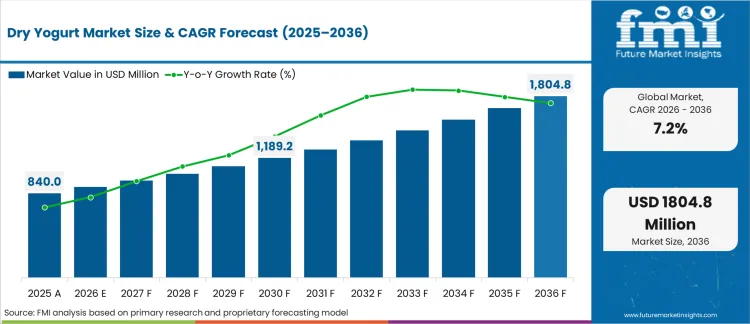
Dry Yogurt Market Key Takeaways
| Metric | Details |
|---|---|
| Industry Size (2026) | USD 900.5 Million |
| Industry Value (2036) | USD 1804.8 Million |
| CAGR (2026-2036) | 7.2% |
| Source | Future Market Insights, 2026 |
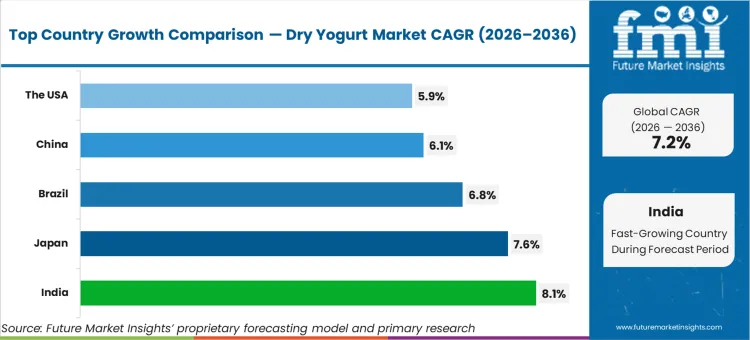
Based on FMI analysis, Brazil leads country-level growth at a 6.8% CAGR through 2036, supported by expanding food processing industry investment and a large domestic dairy consumption base. India follows at 5.5%, driven by growing awareness of probiotic health benefits and expanding functional food manufacturing capacity. Germany registers 4.7% growth, anchored by pharmaceutical-grade dry yogurt applications in probiotic capsule manufacturing and premium bakery ingredient supply. The USA advances at 5.9%, driven by bakery and snack segment reformulations incorporating probiotic-active yogurt powder as a functional label claim ingredient. Japan records 5.1% growth, supported by a mature functional dairy ingredient market and established nutraceutical manufacturing sector.
Dry Yogurt Market Definition
The Dry Yogurt market encompasses spray-dried and freeze-dried yogurt powder products derived from fermented dairy cultures, preserving active bacterial cultures, calcium content, and protein profile in a stable dry format. Applications extend from food ingredient use in bakery, confectionery, and snack manufacturing to pharmaceutical excipient and probiotic supplement applications, cosmetic skin-care formulations, and functional food fortification programmes.
Dry Yogurt Market Inclusions
Market scope covers global and regional revenue estimates for dry yogurt powder across type variants, nature specifications, application categories, distribution channels, and flavour formats. The forecast period spans 2026 to 2036, with country-level CAGR analysis. Probiotic culture viability standards and labelling regulatory requirements are incorporated as analytical dimensions.
Dry Yogurt Market Exclusions
Fresh and refrigerated yogurt products, yogurt beverages, and liquid fermented dairy products are excluded from dry yogurt market sizing. Probiotic supplements using bacterial culture isolates without yogurt matrix composition fall outside the defined scope. Flavoured yogurt confections, yogurt-coated snack products, and finished consumer supplements incorporating dry yogurt as a component ingredient are not included in the ingredient market valuation.
Dry Yogurt Market Research Methodology
- Primary Research: Primary Research: FMI analysts conducted interviews with spray-drying processing engineers at dairy ingredient manufacturers, product development managers at nutraceutical supplement companies, and category buyers at cosmetic ingredient suppliers across Germany, the United States, Brazil, India, and Japan.
- Desk Research: Desk Research: European Food Safety Authority probiotic health claims register, CODEX standards for dried dairy products, national dairy ingredient trade statistics, and peer-reviewed literature on probiotic viability in spray-drying processes were reviewed.
- Market-Sizing and Forecasting: Market-Sizing and Forecasting: A bottom-up model aggregates production capacity at dairy ingredient processing facilities, weighted against application-specific demand forecasts and probiotic specification premium factors.
- Data Validation and Update Cycle: Data Validation and Update Cycle: Projections were validated against dairy ingredient volume statistics from national milk producer associations and distributor sell-through data from primary research.
Key Industry Highlights
Innovations in Flavor Profiles and Customization Propel the Market Growth
Growing emphasis on product personalization and the quick evolution of taste profiles are two of the most important factors influencing the dry yogurt industry. As consumers demand unique flavor experiences and are vastly diverse, manufacturers innovate to offer a wide range of flavors that span a wide range of palates.
They offer exotic flavors and regional fusion-inspired options, such as passion fruit, lychee, matcha, and chai spice has created this new flavor offering to appeal not only to dieters but also to health-conscious consumers who associate such flavors with wellness products, which those inspired by global cuisine or surplus food will also appeal.
Customization has considerably enhanced client engagement in the dry yogurt market. Technological advancements in food processing and manufacturing have allowed firms to personalize their goods to the specific demands of each client.
A variety of companies provide dry yogurt with added ingredients such as protein, vitamins, or dietary fiber to meet the nutritional demands of athletes, the elderly, or individuals in good health. Many companies specialize in offering products with specific texture preferences, such as very creamy or slightly grainy varieties, for use in a variety of recipes or applications.
The trend of personalization goes beyond individual customers to B2B applications. Food service companies, snack producers, and confectionary companies are constantly looking for customizable dry yogurt products to develop distinctive offerings or product lines.
For instance, bakers might seek a tangy yogurt powder to enhance the flavor of frostings and fillings, but health bar producers may need a protein-enhanced dry yogurt mix to cater to fitness aficionados.
Increasing Popularity of Functional Foods and Probiotic-Enriched Products Driving Market Growth
The increased demand for probiotic-enriched products and functional meals is also influencing the dry yogurt market growth. Functional meals, which provide health benefits in addition to basic sustenance, are gaining popularity as consumers prioritize wellness and preventative healthcare.
In this regard, dried yogurt is an example of a product that is both helpful and high in proteins, calcium, and live bacterial cultures that improve intestinal health. Dry yogurt has become a key component of products aimed at boosting well-being, digestive health, and immunity due to the use of probiotics.
Probiotics are one of the most important selling factors for dry yogurt: beneficial bacteria that help create a healthy gut microbiome. Increased consumer awareness and heightened interest in gut health, in general, has been related to broader aspects of physical and mental well-being in scientific research, so live and active culture products help in digestion, reduce inflammation, and boost the immune system.
Manufacturers of dry yogurt have taken advantage of this by coming up with formulations that retain or reintroduce probiotics during the production process to ensure that the health benefits associated with fresh yogurt are preserved in its powdered form.
Dry yogurt is a popular choice in the functional food industry due to its convenience. Unlike fresh yogurt, which is perishable and must be refrigerated, dried yogurt is shelf-stable and may be readily integrated into a variety of food and beverage items.
Protein bars, meal replacement shakes, and powdered drink mixes are among the fastest-growing categories including dry yogurt as a main ingredient. These are convenient, ready-to-go, or ready-to-consume products for the time-strapped and increasingly busy lifestyle.
Growing Demand for Ready-to-Mix and On-the-go Food Solutions Shapes the Market
The modern consumer environment is increasingly defined by hectic lives, which has increased demand for quick, ready-to-mix, and on-the-go food options. Dry yogurt has evolved as a flexible component that is well adapted to meet these changing demands.
Its long shelf life, easy portability, and ability to rehydrate quickly make it an ideal choice for consumers seeking nutritious yet convenient options. Concerning whether single-serve is found in ready-to-drink, meal kits or snack packs, dry yogurt cuts a niche into this fast-paced food industry which is rapidly emerging.
The ready-to-mix category is further enabled by the ease with which dry yogurt can be added to powder food and drink formulations. An example of these products are powdered meal replacement shakes and smoothie mixes that contain dry yogurt because of the high protein it contains a sour taste, and thickening ability that adds creaminess.
These products are perfect for busy professionals, fitness enthusiasts, and people who are always on the move and need fast food. The trend extends to quick breakfast alternatives like granola mixed with dry yogurt powder, giving consumers a convenient and nutritious start to the day.
On-the-go snacks are another area where dried yogurt has gained a lot of traction. Single-serve snacks such as those containing dried fruits, nuts, and yogurt powder dip are gaining popularity among health-conscious consumers.
These trends are associated with the preference for portion sizes that are easy to carry and have been eaten around. Also, dried yogurt is used in the snacks and chips containing probiotic cultures, to blend the convenience and health benefits of this portion of nutrients and portable areas.
2021 to 2026 Global Dry Yogurt Sales Analysis Compared to Demand Forecasts for 2026 to 2036
Global sales increased at a CAGR of 6.6% from 2021 to 2026. For the next ten years (2025 to 2035), projections are that expenditure on such products will rise at 7.2% CAGR.
Between 2021 and 2026 owing to its association with health and nutrition, which gained heightened importance during the historical period. It has become a popular home pantry staple due to its high nutritious content and ease of incorporation into regular recipes. E-commerce sales grew, while lockdowns and social distancing measures limited access to traditional retail outlets.
The growing popularity of functional foods, paired with advances in drying methods that retain probiotics and nutrients, has boosted sales in both established and emerging economies. During this time, key industries such as bakery, confectionery, ready-to-mix meals, and sports nutrition all played a vital role in market growth.
Growing consumer preferences for clean-label, high-protein, and probiotic-enriched products are expected to drive the worldwide market's growth between 2025 and 2035. The increased popularity of e-commerce and advancements in plant-based dry yogurt are expected to open up new market growth prospects.
Emerging markets in Asia-Pacific, the Middle East, and Latin America are anticipated to be significant due to urbanization and rising disposable incomes. Demand is also expected to rise in the restaurant and business-to-business sectors as manufacturers explore new recipes for packaged snacks, beverages, and meal kits.
Market Concentration
Tier 1 companies are the essential factors in the market for Dry Yogurt, accounting for a significant share of the global market. These industry leaders are at the cutting edge of innovation, continually establishing trends with their superior research and development skills.
They invest heavily in innovation and set the standard for clean, additive-free labels that meet growing consumer needs for safe and reliable solutions For these businesses they are leading the way in innovative drying techniques which retain the nutrients and probiotics of yogurt, extend the shelf life Guaranteeing premium goods they also have a lead in sustainability projects in several, focusing on residue testing services and the use of environmentally friendly manufacturing processes to improve product safety and consumers assurance.
Tier 2 companies are local companies that focus on meeting the needs of local customers and have a broad market reach. These companies offering specialized products for certain geographic requirements include Epi Ingredients and Glanbia Plc.
For example, some make products that are enriched with beneficial ingredients such as protein or nutritional fibers or traditionally produce dried yogurt powders with appealing flavors for their target audience's special interest Compete, especially in countries with different cultures and nutritional preferences, because to match their local practices Power supply is strong regionally To continue to maintain a presence and influence, these players work extensively with local distributors and grocers their suppliers.
Tier 3 Companies are smaller players who are usually limited to the local or regional areas. These companies specialize in creating genuinely interesting products and cultural sense while devoting less money to R&D and smaller markets than larger competitors their products are often targeted by consumers looking for hands-on solutions made or crafts, small-scale production methods or locally sourced materials appeal.
Country-wise Insights
The following table shows the estimated growth rates of the top three territories. China and Japan are set to exhibit high consumption, recording CAGRs of 6.6% and 7.6%, respectively, through 2036.
.webp "Top Country Growth Comparison Dry Yogurt Market Cagr (2026 2036)")
| Countries | CAGR 2026 to 2036 |
|---|---|
| The USA | 5.9% |
| Brazil | 6.8% |
| India | 8.1% |
| Japan | 7.6% |
| China | 6.1% |
Increased Adoption of High-Protein Diets and Meal Replacements is Surging in the USA
Dry yogurt consumption is skyrocketing in the United States as high-protein diets and meal replacement concepts gain traction. Protein-rich meals have become a staple for weight loss, muscle rehabilitation, and overall well-being as consumers place a higher value on fitness.
Dry yogurt, with its high protein content, is ideal for these diets since it is a practical, shelf-stable alternative that can be readily included in regular meals.
It is used in protein smoothies, smoothie bowls, or as meal replacement snacks, and provides a variety of options for meeting your daily protein requirements.
Dry yogurt is becoming increasingly popular as a snack or meal component, thanks to the growing popularity of ketogenic diets and intermittent fasting, both of which stress nutrient-dense, low-carb meals. Its appeal stems from the fact that it provides the advantages of fresh yogurt without the need for refrigeration, making it ideal for busy customers looking for quick and nutritious meal alternatives.
Incorporation of Dry Yogurt for Enhancing Texture and Flavor in Baked and Confectionery Products in the UK
In the UK, companies are widely using dry yogurt in baked goods and confectionery for adding texture as well as flavor profiles. The tangy taste of the creaminess of dry yogurt adds a unique depth to such baked products as muffins, cookies, and cakes, setting them aside from the competition.
In addition, the moisture-retaining properties enhance the softness and freshness of these products, and they do not require artificial preservatives for extended shelf life.
The yogurt is being used in the confectionery sector as a coating for nuts, fruit, and chocolate to give a rich, velvety finish with a nutritional twist. It is used as an additive in fillings and toppings which give a signature tartness counterbalancing candies and dessert bar sweetness.
High demand for newer baked and confectionery innovations, especially considered healthier or premium ones, has nudged UK's manufacturers to create yogurt the versatile ingredient it is, from elevating flavor and texture to consumer preferences for functional and indulgent treats. This strategic use of yogurt reflects its growing importance in delivering differentiated products in the UK market.
Category-Wise Insights
Consumer Shift toward Full-Fat Nutrition and Premium Taste
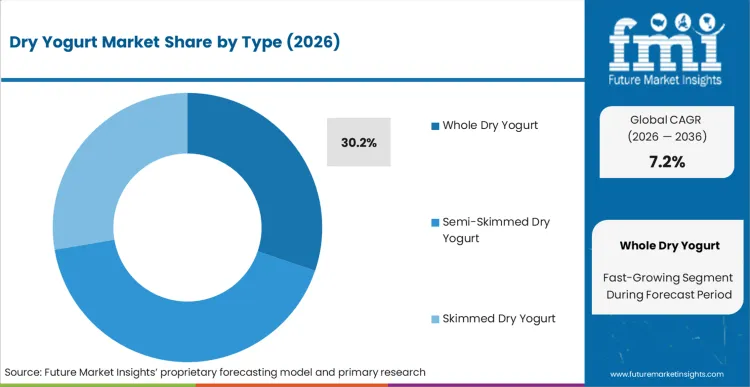
| Segment | Value Share (2026) |
|---|---|
| Whole Dry Yogurt (By Type) | 30.2% |
Whole Dry Yogurt has emerged as the dominant kind in the global market, owing to its excellent nutritional profile and adaptability across several applications.
Whole dry yogurt, unlike skimmed and semi-skimmed varieties, keeps the entire fat content, which improves its creamy texture and rich flavor, making it very popular for both customers and manufacturers. This variety is very popular in luxury and decadent products like candy coatings, dessert mixes, and high-end bread items, where flavor and texture are important.
Furthermore, whole dry yogurt is gaining popularity in the functional foods and nutraceutical industries since its fat content promotes the absorption of fat-soluble vitamins, which contributes to a healthy diet.
Consumers are also gravitating toward whole dry yogurt for its clean-label appeal since it frequently requires little additions to get the right taste and consistency.
The rising appreciation for natural and healthful ingredients, along with the belief that full-fat goods are less processed, has increased demand. Additionally, whole dry yogurt is very much used in the foodservice and HoReCa (hotel, restaurant, and catering) sectors.
Health and Wellness Revolution Fuels Dominance of Nutraceutical Applications in the Global Market
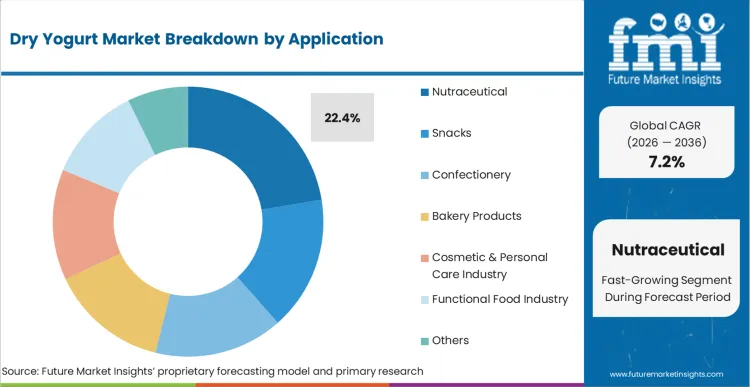
| Segment | Value Share (2026) |
|---|---|
| Nutraceutical (By Application) | 22.4% |
Nutraceutical and Functional Foods will be the dominant application category in the worldwide dry yogurt market by 2024, driven by consumers' growing interest in health and well-being.
This category benefits from dried yogurt's rising recognition as a high-quality source of probiotics, proteins, and critical nutrients, making it a popular ingredient in nutritional supplements, protein powders, and fortified meal replacements.
With growing knowledge of gut health and its relationship to general well-being, people are actively seeking goods that provide both nutritional advantages and convenience, which is boosting demand for this application.
Manufacturers in the nutraceutical space are finding the flexibility of dry yogurt obliging in producing products that are probiotic capsules, functional bars, and high-functionality drink mixes made for the fitness-person-loving crowds and the more mature who need that little bit of fun on their busy days as well. Clean-label further accelerates interest in dry yogurt as a natural, minimally processed food ingredient that fits consumer desire for openness and authenticity.
Competition Outlook
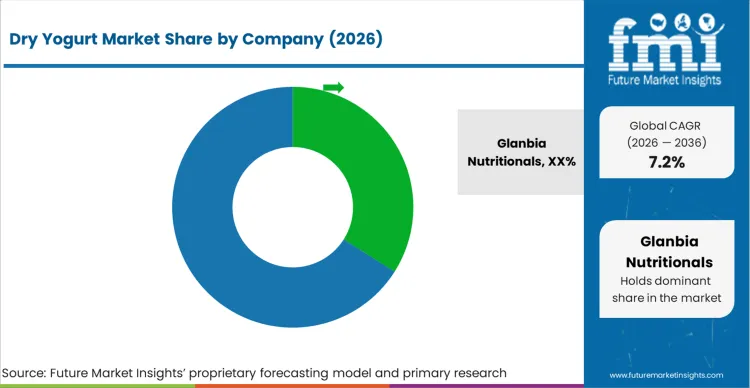
The competition landscape of the dry yogurt market is intense. Glanbia Nutritionals, Epi Ingredients, Ace International LLP, and Almil AG companies lead the industry owing to their significant research & development investments, cutting-edge product advancements, and powerful distribution networks.
Dry yogurt is one of the numerous functional ingredients offered by Glanbia Nutritionals as part of their broader protein and probiotic-enriched product range. With its global supply chains and cutting-edge research, the company, which specializes in functional food and nutraceuticals, positions itself as a leader in health-oriented formulations.
Similarly, Epi products concentrate on premium dairy products like dry yogurt to address the growing demand for clean-label and high-protein meals in the bakery, snack, and supplement industries.
Ace International LLP and Almil AG maintain their competitive edge by offering a diverse range of dairy powders, including dry yogurt while focusing on meeting the specific needs of regional markets.
Leading Brands
- Glanbia Nutritionals
- Epi Ingredients
- Ace International LLP
- Almil AG
- PreGel America
- C.P. Ingredients Ltd.
- Bluegrass Dairy & Food
- Dr. Suwelack
- Armor Protéines
- Prolactal GmbH
- Others
Scope of the Report
| Metric | Value |
|---|---|
| Quantitative Units | USD 900.5 Million to USD 1804.8 Million, at a CAGR of 7.2% |
| Market Definition | Spray-dried and freeze-dried yogurt powder retaining active bacterial cultures, calcium, and protein in shelf-stable format for food, nutraceutical, cosmetic, and functional food applications. |
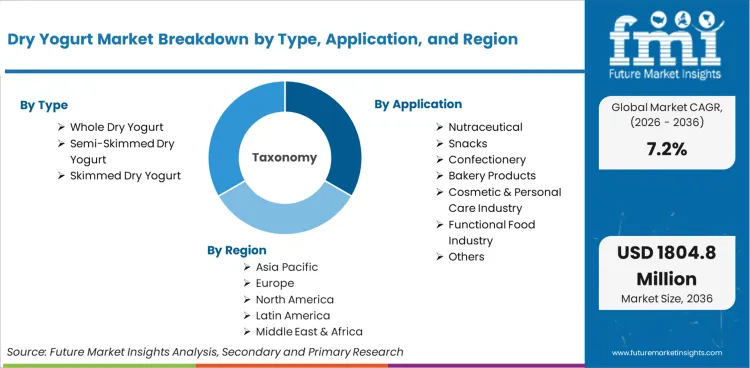
| Type Segmentation | Whole Dry Yogurt, Semi-Skimmed Dry Yogurt, Skimmed Dry Yogurt |
| Nature Segmentation | Conventional, Organic |
| Application Segmentation | Nutraceutical, Snacks, Confectionery, Bakery Products, Cosmetic and Personal Care Industry, Functional Food Industry, Others |
| Form Segmentation | Pills, Others |
| Distribution Channel | Hypermarkets/Supermarkets, Online Retail, Convenience Stores, Others |
| Regions Covered | North America, Latin America, Europe, East Asia, South Asia, Oceania, Middle East & Africa |
| Countries Covered | USA, Brazil, India, Japan, China, Germany, and 40 plus countries |
| Key Companies Profiled | Glanbia Nutritionals, Epi Ingredients, Ace International LLP, Almil AG, PreGel America, C.P. Ingredients Ltd., Bluegrass Dairy & Food, Dr. Suwelack, Armor Proteines, Prolactal GmbH |
| Forecast Period | 2026 to 2036 |
| Approach | Bottom-up aggregation of dairy ingredient processing capacity, weighted against application-specific demand forecasts and probiotic specification premium factors |
Key Segments of the Report
By Type:
As per Type, the industry has been categorized into Skimmed Dry Yogurt, Semi-Skimmed Dry Yogurt, and Whole Dry Yogurt.
By Application:
As per Application, the industry has been categorized into Bakery Products, Snacks, Confectionery, Nutraceutical and Functional Food Industry, Cosmetic & Personal Care Industry, and Others.
By Distribution Channel:
As per the Distribution Channel, the industry has been categorized into Hypermarkets/Supermarkets, Online Retail, Convenience Stores, and Others.
By Region:
Industry analysis has been carried out in key countries of North America, Latin America, Western Europe, Eastern Europe, East Asia, South Asia & Pacific, Central Asia, Russia and Belarus, Balkan & Baltics, and the Middle East & Africa.
Bibliography
- Codex Alimentarius Commission. (2024). Standard for Dried Whey and Related Products: Codex STAN 289-1995 (Amended). FAO/WHO.
- European Food Safety Authority. (2024). Scientific Opinion on Health Claims Related to Live Yogurt Cultures. EFSA Panel on Dietetic Products, Nutrition and Allergies.
- International Dairy Federation. (2024). Dairy Market Review: Annual Global Production and Trade Statistics. IDF.
- Food Safety and Standards Authority of India. (2024). Food Safety and Standards (Food Products Standards and Food Additives) Regulations: Dairy Products. FSSAI.
- USA Food and Drug Administration. (2024). Code of Federal Regulations Title 21: Standards of Identity for Yogurt and Dried Yogurt. FDA.
This bibliography is provided for reader reference. The full FMI report contains the complete reference list with primary research documentation.
Frequently Asked Questions
How large is the Dry Yogurt market in 2026?
The Dry Yogurt market is estimated at USD 900.5 million in 2026.What will the Dry Yogurt market reach by 2036?
What will the Dry Yogurt market reach by 2036?
The Dry Yogurt market is projected to reach USD 1804.8 million by 2036.
What CAGR is projected for the Dry Yogurt market?
The Dry Yogurt market is expected to grow at a CAGR of 7.2% from 2026 to 2036.
Which Type is largest in 2026?
Whole Dry Yogurt holds 30.2% of Type segment demand in 2026, offering the highest fat content and richest flavour profile for confectionery and premium bakery applications.
Which Nature segment dominates in 2026?
Conventional Nature commands 72.0% of Nature segment demand in 2026, driven by dairy processing scale advantages and cost sensitivity at B2B manufacturing procurement scale.
Which Distribution Channel leads in 2026?
Hypermarkets and Supermarkets account for 36.0% of Distribution Channel demand in 2026, representing the primary retail access point for consumer-facing dry yogurt products.
Which country is growing fastest?
Brazil is projected to grow at a 6.8% CAGR through 2036, supported by food processing industry investment and a large domestic dairy consumption base.
What is excluded from this report?
Fresh refrigerated yogurt, yogurt beverages, probiotic isolate supplements without yogurt matrix, flavoured yogurt confections, and finished consumer supplements incorporating dry yogurt as a component are excluded.
How does FMI build this forecast?
FMI applies a bottom-up model aggregating dairy ingredient processing capacity, weighted against application-specific demand forecasts and probiotic specification premium factors, validated against national dairy ingredient trade statistics.
Preview the report firsthand - request a free sample
Get SampleGet the brochure for pricing and purchase details.
Get PDFTable of Content
- Executive Summary
- Global Market Outlook
- Demand-side Trends
- Supply-side Trends
- Technology Roadmap Analysis
- Analysis and Recommendations
- Market Overview
- Market Coverage / Taxonomy
- Market Definition / Scope / Limitations
- Research Methodology
- Chapter Orientation
- Analytical Lens and Working Hypotheses
- Market Structure, Signals, and Trend Drivers
- Benchmarking and Cross-market Comparability
- Market Sizing, Forecasting, and Opportunity Mapping
- Research Design and Evidence Framework
- Desk Research Programme (Secondary Evidence)
- Company Annual and Sustainability Reports
- Peer-reviewed Journals and Academic Literature
- Corporate Websites, Product Literature, and Technical Notes
- Earnings Decks and Investor Briefings
- Statutory Filings and Regulatory Disclosures
- Technical White Papers and Standards Notes
- Trade Journals, Industry Magazines, and Analyst Briefs
- Conference Proceedings, Webinars, and Seminar Materials
- Government Statistics Portals and Public Data Releases
- Press Releases and Reputable Media Coverage
- Specialist Newsletters and Curated Briefings
- Sector Databases and Reference Repositories
- FMI Internal Proprietary Databases and Historical Market Datasets
- Subscription Datasets and Paid Sources
- Social Channels, Communities, and Digital Listening Inputs
- Additional Desk Sources
- Expert Input and Fieldwork (Primary Evidence)
- Primary Modes
- Qualitative Interviews and Expert Elicitation
- Quantitative Surveys and Structured Data Capture
- Blended Approach
- Why Primary Evidence is Used
- Field Techniques
- Interviews
- Surveys
- Focus Groups
- Observational and In-context Research
- Social and Community Interactions
- Stakeholder Universe Engaged
- C-suite Leaders
- Board Members
- Presidents and Vice Presidents
- R&D and Innovation Heads
- Technical Specialists
- Domain Subject-matter Experts
- Scientists
- Physicians and Other Healthcare Professionals
- Governance, Ethics, and Data Stewardship
- Research Ethics
- Data Integrity and Handling
- Primary Modes
- Tooling, Models, and Reference Databases
- Desk Research Programme (Secondary Evidence)
- Data Engineering and Model Build
- Data Acquisition and Ingestion
- Cleaning, Normalisation, and Verification
- Synthesis, Triangulation, and Analysis
- Quality Assurance and Audit Trail
- Market Background
- Market Dynamics
- Drivers
- Restraints
- Opportunity
- Trends
- Scenario Forecast
- Demand in Optimistic Scenario
- Demand in Likely Scenario
- Demand in Conservative Scenario
- Opportunity Map Analysis
- Product Life Cycle Analysis
- Supply Chain Analysis
- Investment Feasibility Matrix
- Value Chain Analysis
- PESTLE and Porter’s Analysis
- Regulatory Landscape
- Regional Parent Market Outlook
- Production and Consumption Statistics
- Import and Export Statistics
- Market Dynamics
- Global Market Analysis 2021 to 2025 and Forecast, 2026 to 2036
- Historical Market Size Value (USD Million) Analysis, 2021 to 2025
- Current and Future Market Size Value (USD Million) Projections, 2026 to 2036
- Y-o-Y Growth Trend Analysis
- Absolute $ Opportunity Analysis
- Global Market Pricing Analysis 2021 to 2025 and Forecast 2026 to 2036
- Global Market Analysis 2021 to 2025 and Forecast 2026 to 2036, By Type
- Introduction / Key Findings
- Historical Market Size Value (USD Million) Analysis By Type , 2021 to 2025
- Current and Future Market Size Value (USD Million) Analysis and Forecast By Type , 2026 to 2036
- Whole Dry Yogurt
- Semi-Skimmed Dry Yogurt
- Skimmed Dry Yogurt
- Whole Dry Yogurt
- Y-o-Y Growth Trend Analysis By Type , 2021 to 2025
- Absolute $ Opportunity Analysis By Type , 2026 to 2036
- Global Market Analysis 2021 to 2025 and Forecast 2026 to 2036, By Application
- Introduction / Key Findings
- Historical Market Size Value (USD Million) Analysis By Application, 2021 to 2025
- Current and Future Market Size Value (USD Million) Analysis and Forecast By Application, 2026 to 2036
- Nutraceutical
- Snacks
- Confectionery
- Bakery Products
- Cosmetic & Personal Care Industry
- Functional Food Industry
- Others
- Nutraceutical
- Y-o-Y Growth Trend Analysis By Application, 2021 to 2025
- Absolute $ Opportunity Analysis By Application, 2026 to 2036
- Global Market Analysis 2021 to 2025 and Forecast 2026 to 2036, By Distribution Channel
- Introduction / Key Findings
- Historical Market Size Value (USD Million) Analysis By Distribution Channel, 2021 to 2025
- Current and Future Market Size Value (USD Million) Analysis and Forecast By Distribution Channel, 2026 to 2036
- Hypermarkets/Supermarkets
- Online Retail
- Convenience Stores
- Others
- Hypermarkets/Supermarkets
- Y-o-Y Growth Trend Analysis By Distribution Channel, 2021 to 2025
- Absolute $ Opportunity Analysis By Distribution Channel, 2026 to 2036
- Global Market Analysis 2021 to 2025 and Forecast 2026 to 2036, By Region
- Introduction
- Historical Market Size Value (USD Million) Analysis By Region, 2021 to 2025
- Current Market Size Value (USD Million) Analysis and Forecast By Region, 2026 to 2036
- North America
- Latin America
- Western Europe
- Eastern Europe
- East Asia
- South Asia and Pacific
- Middle East & Africa
- Market Attractiveness Analysis By Region
- North America Market Analysis 2021 to 2025 and Forecast 2026 to 2036, By Country
- Historical Market Size Value (USD Million) Trend Analysis By Market Taxonomy, 2021 to 2025
- Market Size Value (USD Million) Forecast By Market Taxonomy, 2026 to 2036
- By Country
- USA
- Canada
- Mexico
- By Type
- By Application
- By Distribution Channel
- By Country
- Market Attractiveness Analysis
- By Country
- By Type
- By Application
- By Distribution Channel
- Key Takeaways
- Latin America Market Analysis 2021 to 2025 and Forecast 2026 to 2036, By Country
- Historical Market Size Value (USD Million) Trend Analysis By Market Taxonomy, 2021 to 2025
- Market Size Value (USD Million) Forecast By Market Taxonomy, 2026 to 2036
- By Country
- Brazil
- Chile
- Rest of Latin America
- By Type
- By Application
- By Distribution Channel
- By Country
- Market Attractiveness Analysis
- By Country
- By Type
- By Application
- By Distribution Channel
- Key Takeaways
- Western Europe Market Analysis 2021 to 2025 and Forecast 2026 to 2036, By Country
- Historical Market Size Value (USD Million) Trend Analysis By Market Taxonomy, 2021 to 2025
- Market Size Value (USD Million) Forecast By Market Taxonomy, 2026 to 2036
- By Country
- Germany
- UK
- Italy
- Spain
- France
- Nordic
- BENELUX
- Rest of Western Europe
- By Type
- By Application
- By Distribution Channel
- By Country
- Market Attractiveness Analysis
- By Country
- By Type
- By Application
- By Distribution Channel
- Key Takeaways
- Eastern Europe Market Analysis 2021 to 2025 and Forecast 2026 to 2036, By Country
- Historical Market Size Value (USD Million) Trend Analysis By Market Taxonomy, 2021 to 2025
- Market Size Value (USD Million) Forecast By Market Taxonomy, 2026 to 2036
- By Country
- Russia
- Poland
- Hungary
- Balkan & Baltic
- Rest of Eastern Europe
- By Type
- By Application
- By Distribution Channel
- By Country
- Market Attractiveness Analysis
- By Country
- By Type
- By Application
- By Distribution Channel
- Key Takeaways
- East Asia Market Analysis 2021 to 2025 and Forecast 2026 to 2036, By Country
- Historical Market Size Value (USD Million) Trend Analysis By Market Taxonomy, 2021 to 2025
- Market Size Value (USD Million) Forecast By Market Taxonomy, 2026 to 2036
- By Country
- China
- Japan
- South Korea
- By Type
- By Application
- By Distribution Channel
- By Country
- Market Attractiveness Analysis
- By Country
- By Type
- By Application
- By Distribution Channel
- Key Takeaways
- South Asia and Pacific Market Analysis 2021 to 2025 and Forecast 2026 to 2036, By Country
- Historical Market Size Value (USD Million) Trend Analysis By Market Taxonomy, 2021 to 2025
- Market Size Value (USD Million) Forecast By Market Taxonomy, 2026 to 2036
- By Country
- India
- ASEAN
- Australia & New Zealand
- Rest of South Asia and Pacific
- By Type
- By Application
- By Distribution Channel
- By Country
- Market Attractiveness Analysis
- By Country
- By Type
- By Application
- By Distribution Channel
- Key Takeaways
- Middle East & Africa Market Analysis 2021 to 2025 and Forecast 2026 to 2036, By Country
- Historical Market Size Value (USD Million) Trend Analysis By Market Taxonomy, 2021 to 2025
- Market Size Value (USD Million) Forecast By Market Taxonomy, 2026 to 2036
- By Country
- Kingdom of Saudi Arabia
- Other GCC Countries
- Turkiye
- South Africa
- Other African Union
- Rest of Middle East & Africa
- By Type
- By Application
- By Distribution Channel
- By Country
- Market Attractiveness Analysis
- By Country
- By Type
- By Application
- By Distribution Channel
- Key Takeaways
- Key Countries Market Analysis
- USA
- Pricing Analysis
- Market Share Analysis, 2025
- By Type
- By Application
- By Distribution Channel
- Canada
- Pricing Analysis
- Market Share Analysis, 2025
- By Type
- By Application
- By Distribution Channel
- Mexico
- Pricing Analysis
- Market Share Analysis, 2025
- By Type
- By Application
- By Distribution Channel
- Brazil
- Pricing Analysis
- Market Share Analysis, 2025
- By Type
- By Application
- By Distribution Channel
- Chile
- Pricing Analysis
- Market Share Analysis, 2025
- By Type
- By Application
- By Distribution Channel
- Germany
- Pricing Analysis
- Market Share Analysis, 2025
- By Type
- By Application
- By Distribution Channel
- UK
- Pricing Analysis
- Market Share Analysis, 2025
- By Type
- By Application
- By Distribution Channel
- Italy
- Pricing Analysis
- Market Share Analysis, 2025
- By Type
- By Application
- By Distribution Channel
- Spain
- Pricing Analysis
- Market Share Analysis, 2025
- By Type
- By Application
- By Distribution Channel
- France
- Pricing Analysis
- Market Share Analysis, 2025
- By Type
- By Application
- By Distribution Channel
- India
- Pricing Analysis
- Market Share Analysis, 2025
- By Type
- By Application
- By Distribution Channel
- ASEAN
- Pricing Analysis
- Market Share Analysis, 2025
- By Type
- By Application
- By Distribution Channel
- Australia & New Zealand
- Pricing Analysis
- Market Share Analysis, 2025
- By Type
- By Application
- By Distribution Channel
- China
- Pricing Analysis
- Market Share Analysis, 2025
- By Type
- By Application
- By Distribution Channel
- Japan
- Pricing Analysis
- Market Share Analysis, 2025
- By Type
- By Application
- By Distribution Channel
- South Korea
- Pricing Analysis
- Market Share Analysis, 2025
- By Type
- By Application
- By Distribution Channel
- Russia
- Pricing Analysis
- Market Share Analysis, 2025
- By Type
- By Application
- By Distribution Channel
- Poland
- Pricing Analysis
- Market Share Analysis, 2025
- By Type
- By Application
- By Distribution Channel
- Hungary
- Pricing Analysis
- Market Share Analysis, 2025
- By Type
- By Application
- By Distribution Channel
- Kingdom of Saudi Arabia
- Pricing Analysis
- Market Share Analysis, 2025
- By Type
- By Application
- By Distribution Channel
- Turkiye
- Pricing Analysis
- Market Share Analysis, 2025
- By Type
- By Application
- By Distribution Channel
- South Africa
- Pricing Analysis
- Market Share Analysis, 2025
- By Type
- By Application
- By Distribution Channel
- USA
- Market Structure Analysis
- Competition Dashboard
- Competition Benchmarking
- Market Share Analysis of Top Players
- By Regional
- By Type
- By Application
- By Distribution Channel
- Competition Analysis
- Competition Deep Dive
- Glanbia Nutritionals
- Overview
- Product Portfolio
- Profitability by Market Segments (Product/Age /Sales Channel/Region)
- Sales Footprint
- Strategy Overview
- Marketing Strategy
- Product Strategy
- Channel Strategy
- Epi Ingredients
- Ace International LLP
- Almil AG
- PreGel America
- C.P. Ingredients Ltd.
- Bluegrass Dairy & Food
- Dr. Suwelack
- Armor Protéines
- Prolactal GmbH
- Others
- Glanbia Nutritionals
- Competition Deep Dive
- Assumptions & Acronyms Used


