

- Industry Size (2026)
- USD 2.4 Bn
- Forecast (2036)
- USD 4.9 Bn
- CAGR (2026 to 2036)
- 7.4%
Mono-PP Laminates Market Size, Market Forecast and Outlook By FMI
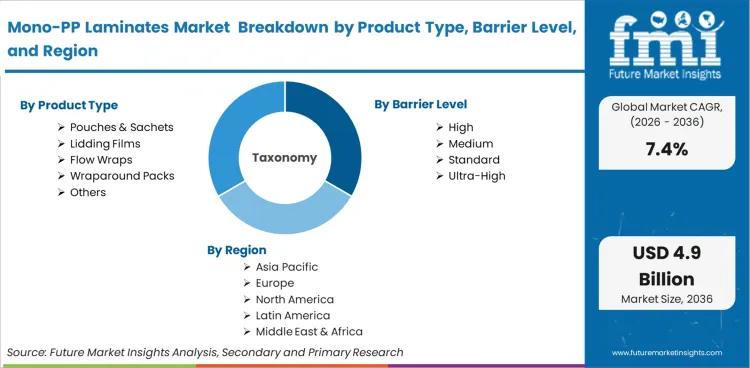
The mono-pp laminates market was valued at USD 2.2 billion in 2025. The market is projected to reach USD 2.4 billion in 2026 and USD 4.9 billion by 2036, expanding at a CAGR of 7.4% during the forecast period. The Pouches & Sachets segment leads product type with a 32.4% share in 2026. The High segment is projected to remain the leading barrier level segment with a 35.6% share in 2026. The Food & Beverage segment is expected to lead end-use demand with a 57.1% share in 2026.
Key Drivers
- PP stiffness advantage: Polypropylene brings pack stiffness and presentation qualities that make it attractive in premium flexible formats.
- Food-pack redesign: High-value food packs are being reworked to maintain barrier performance inside more recyclable PP-centred structures.
- Recycling pathway interest: PP-stream compatible design is receiving more attention as recyclability frameworks for flexible packaging mature.
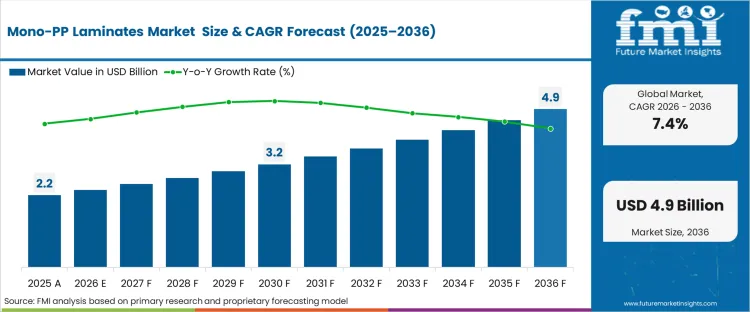
Key Segments Analyzed in the Report
- Product Type: Pouches & Sachets, Lidding Films, Flow Wraps, Wraparound Packs, and Others
- Barrier Level: Standard, Medium, High, and Ultra-high
- End Use Industry: Food & Beverage, Personal Care, Healthcare, Tobacco & Specialty, and Others
- Region: North America, Latin America, Europe, Asia Pacific, and Middle East & Africa
Analyst Opinion
- Ismail Sutaria, Senior Consultant at Future Market Insights says, "Mono-PP laminates as a category rises in demand when stiffness, heat resistance, and premium shelf presentation matter as much as recyclability. The market is rewarding solutions that keep polypropylene-stream compatibility while preserving the feel and converting behaviour that brands expect from conventional packs."
Mono-PP Laminates Market Definition
The mono-PP laminates market includes laminate structures built primarily from polypropylene films to support recyclable-packaging design within the PP family. It covers pouch webs, lidding films, flow wraps, and specialty wraps with standard to high barrier levels for food, personal care, healthcare, and other packaged goods. Mono-PP laminates are used where converters want the stiffness, gloss, heat resistance, and dead-fold behaviour associated with polypropylene while reducing dependence on incompatible multi-material structures.
Mono-PP Laminates Market Inclusions
- Mono-PP laminates used in pouches, lidding, wraps, and specialty flexible packaging.
- Revenue from food, personal care, healthcare, and specialty applications using PP-centred laminate structures.
- Regional demand across North America, Latin America, Europe, Asia Pacific, and the Middle East & Africa.
Mono-PP Laminates Market Exclusions
- Multi-material laminates where polypropylene is not the dominant material family.
- Finished packaged products sold by brand owners.
- Commodity BOPP or CPP films used without laminate conversion or barrier purpose.
Mono-PP Laminates Market Research Methodology
This study evaluates the mono-pp laminates market across product type, barrier level, end use industry, and region, using 2025 as the base year and 2026 to 2036 as the forecast period. Market value is expressed in USD billion. Evidence inputs include RecyClass and CEFLEX materials, first-party mono-PP product launches, company technical pages, and recyclability approvals tied to PP structures. Triangulation combines end-use demand, pack conversion intensity, barrier-function value density, material substitution rates, and supplier positioning to derive the segment and regional estimates.
Key Drivers, Restraints, and Trends in Mono-PP Laminates Market
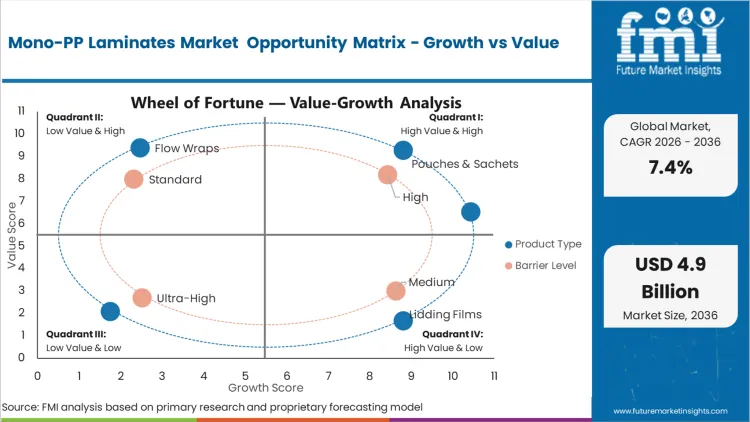
Drivers
Mono-PP laminates are expanding because some packaging applications want more than polyethylene can comfortably deliver. Polypropylene offers stiffness, gloss, temperature resistance, and shelf impact that make it attractive for snacks, confectionery, dairy, and premium consumer goods. At the same time, recyclability pressure is forcing those categories to reconsider mixed-material structures. Mono-PP laminates therefore become the design route when converters want a more circular pack without losing the handling and aesthetics associated with PP. As high-barrier mono-PP solutions gain credibility, the market is moving from isolated launches into broader category adoption.
Restraints
The market remains constrained by stream maturity and structure complexity. Flexible PP recycling pathways are less uniformly developed than many brand owners would like. Barrier performance can still require compromises in optics or processability. Laminate compatibility depends on adhesives, inks, and barrier components, not just the base film. Some converters also have more installed experience with mono-PE than mono-PP. Cost pressure rises when mono-PP must compete against both legacy laminates and polyethylene-based recycle-ready alternatives.
Trends
High-barrier mono-PP is the strongest trend because it targets the categories with the hardest packaging redesign problems. Suppliers are pairing mono-PP films with easy-open, reclose, and lidding functionality to widen the commercial scope. Certification and approval language has become more important in sales conversations, which favours suppliers that can show recyclability evidence. The market is also seeing more collaboration between film producers, polymer suppliers, and packaging converters rather than isolated material launches.
Segmental Analysis
Mono-PP Laminates Analysis by Product Type
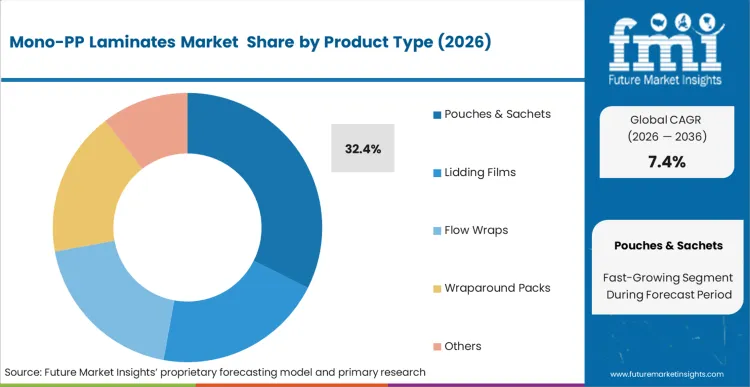
The Pouches & Sachets segment is expected to lead the product type segment with a 32.4% share in 2026. Pouches and sachets lead because they account for a large share of the packaging formats where PP's stiffness and print appearance create an advantage. They also offer a visible replacement opportunity for legacy laminates in high-value food and consumer products. Mondi's mono-material barrier packaging portfolio and WalletPack format show how mono-PP is being pushed into food applications that need barrier, presentation quality, and convenient opening features.
Mono-PP Laminates Analysis by Barrier Level
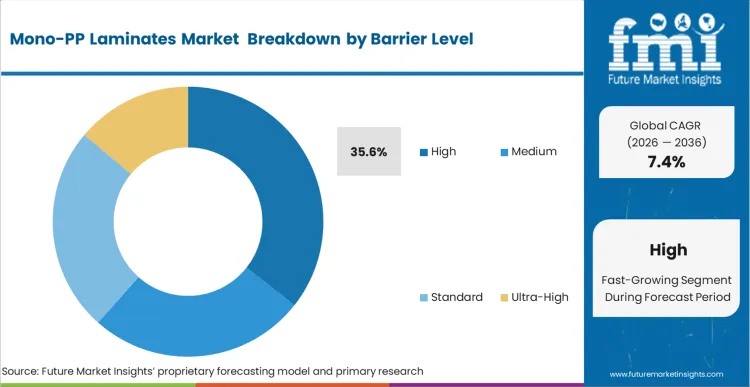
The High segment is expected to lead the barrier level segment with a 35.6% share in 2026. High barrier leads because mono-PP is being adopted mainly where conventional structures are difficult to replace. Customers are not paying a premium for basic PP laminates. They are paying to keep barrier protection while improving design-for-recycling performance. Borealis and Mondi have jointly advanced more easily recyclable polypropylene-based food packaging, while Borealis separately showcased a pouch with over 95% PP content, reinforcing the focus on high-function mono-PP structures.
Competitive Aligners for Market Players
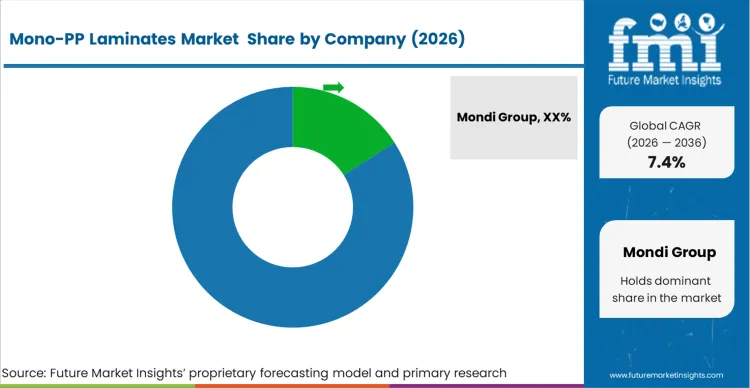
Competition in mono-PP laminates begins at the application level, where technical performance decides whether a structure is commercially viable. Buyers first look for proof that the laminate can deliver the required oxygen and moisture barrier, sealability, print performance, and recyclability fit in the target format. That keeps much of the market grounded in execution rather than in broad mono-material claims.
From there, differentiation moves upward into pack design and validation capability. Suppliers that can tailor mono-PP structures to specific end uses, while also supporting qualification and conversion, are in a stronger position than those offering a generic recyclable laminate proposition. This is where category-specific know-how starts to separate leaders from followers.
At the top of the market, competition is defined by companies that can convert technical credibility into scalable commercial platforms. Mondi has used mono-PP formats such as WalletPack to demonstrate that high oxygen and moisture barrier can be retained within a predominantly PP structure. Borealis has promoted mono-material PP pouches designed for compatibility with polypropylene recycling streams, while Jindal Films continues to position mono-PP around printability, barrier performance, and sealability. The share winners will be the firms that can connect validated structure performance with end-market relevance. Others are more likely to remain confined to narrower specialty pockets.
Key Players in Mono-PP Laminates Market
- Mondi Group
- Borealis
- Jindal Films
- Toray Plastics
- Taghleef Industries
- Amcor
- Constantia Flexibles
- Cosmo Films
- Berry Global
- Treofan
Strategic Outlook by FMI on Mono-PP Laminates Market
FMI expects mono-PP laminates to gain importance in premium flexible packaging formats where rigidity, heat resistance, and shelf appeal matter. Growth will depend on better recyclability evidence, wider sorting and recycling acceptance, and continued barrier gains within PP-centred structures. Suppliers that can turn mono-PP into a reliable commercial platform, not just a demonstration pack, are positioned to lead this market.
Scope of the Report
| Metric | Value |
|---|---|
| Market Value | USD 2.2 billion in 2025 to USD 4.9 billion by 2036 |
| CAGR | 7.4% from 2026 to 2036 |
| Base Year | 2025 |
| Forecast Period | 2026 to 2036 |
| Product Type Segmentation | Pouches & Sachets, Lidding Films, Flow Wraps, Wraparound Packs, Others |
| Barrier Level Segmentation | Standard, Medium, High, Ultra-high |
| End Use Industry Segmentation | Food & Beverage, Personal Care, Healthcare, Tobacco & Specialty, Others |
| Regions Covered | North America, Latin America, Europe, Asia Pacific, Middle East & Africa |
Bibliography
- Mondi Group. 2024. Mondi takes another slice of sustainable packaging by teaming up with Scan Sverige.
- Mondi Group. Mono-material barrier packaging.
- Borealis. 2023. Borealis showcases a new PP monomaterial pouch that is fully compatible for mechanical recycling of polypropylene at PRSE 2023.
- Borealis and Mondi. 2019. Borealis and Mondi collaboration generates more easily recyclable polypropylene-based food packaging.
- Jindal Films. 2026. Mono PP - Improved Flexible Packaging Solutions.
Frequently Asked Questions
What is the projected size of the Mono-PP Laminates market by 2036? The
mono-pp laminates market is projected to reach USD 4.9 billion by 2036.
What is the CAGR of the Mono-PP Laminates market from 2026 to 2036? The
mono-pp laminates market is projected to expand at a CAGR of 7.4% from 2026 to 2036.
Which product type segment leads the Mono-PP Laminates market? The
Pouches & Sachets segment leads the mono-pp laminates market with a 32.4% share in 2026.
Which barrier level segment dominates the Mono-PP Laminates market? The
High segment holds the leading position in the mono-pp laminates market with a 35.6% share in 2026.
Which end use industry leads the Mono-PP Laminates market? The Food &
Beverage segment is expected to account for the largest share of the mono-pp laminates market at 57.1% in 2026.
Who are the key companies in the Mono-PP Laminates market? Key
companies active in the mono-pp laminates market include Mondi Group, Borealis, Jindal Films, Toray Plastics, Taghleef Industries, and other packaging-material and converter specialists.
What is driving demand in the Mono-PP Laminates market? Demand in the
mono-pp laminates market is being driven by packaging redesign toward better recyclability, stronger barrier performance, and improved line economics.
Preview the report firsthand - request a free sample
Get SampleGet the brochure for pricing and purchase details.
Get PDFTable of Content
- Executive Summary
- Global Market Outlook
- Demand-side Trends
- Supply-side Trends
- Technology Roadmap Analysis
- Analysis and Recommendations
- Market Overview
- Market Coverage / Taxonomy
- Market Definition / Scope / Limitations
- Research Methodology
- Chapter Orientation
- Analytical Lens and Working Hypotheses
- Market Structure, Signals, and Trend Drivers
- Benchmarking and Cross-market Comparability
- Market Sizing, Forecasting, and Opportunity Mapping
- Research Design and Evidence Framework
- Desk Research Programme (Secondary Evidence)
- Company Annual and Sustainability Reports
- Peer-reviewed Journals and Academic Literature
- Corporate Websites, Product Literature, and Technical Notes
- Earnings Decks and Investor Briefings
- Statutory Filings and Regulatory Disclosures
- Technical White Papers and Standards Notes
- Trade Journals, Industry Magazines, and Analyst Briefs
- Conference Proceedings, Webinars, and Seminar Materials
- Government Statistics Portals and Public Data Releases
- Press Releases and Reputable Media Coverage
- Specialist Newsletters and Curated Briefings
- Sector Databases and Reference Repositories
- FMI Internal Proprietary Databases and Historical Market Datasets
- Subscription Datasets and Paid Sources
- Social Channels, Communities, and Digital Listening Inputs
- Additional Desk Sources
- Expert Input and Fieldwork (Primary Evidence)
- Primary Modes
- Qualitative Interviews and Expert Elicitation
- Quantitative Surveys and Structured Data Capture
- Blended Approach
- Why Primary Evidence is Used
- Field Techniques
- Interviews
- Surveys
- Focus Groups
- Observational and In-context Research
- Social and Community Interactions
- Stakeholder Universe Engaged
- C-suite Leaders
- Board Members
- Presidents and Vice Presidents
- R&D and Innovation Heads
- Technical Specialists
- Domain Subject-matter Experts
- Scientists
- Physicians and Other Healthcare Professionals
- Governance, Ethics, and Data Stewardship
- Research Ethics
- Data Integrity and Handling
- Primary Modes
- Tooling, Models, and Reference Databases
- Desk Research Programme (Secondary Evidence)
- Data Engineering and Model Build
- Data Acquisition and Ingestion
- Cleaning, Normalisation, and Verification
- Synthesis, Triangulation, and Analysis
- Quality Assurance and Audit Trail
- Market Background
- Market Dynamics
- Drivers
- Restraints
- Opportunity
- Trends
- Scenario Forecast
- Demand in Optimistic Scenario
- Demand in Likely Scenario
- Demand in Conservative Scenario
- Opportunity Map Analysis
- Product Life Cycle Analysis
- Supply Chain Analysis
- Investment Feasibility Matrix
- Value Chain Analysis
- PESTLE and Porter’s Analysis
- Regulatory Landscape
- Regional Parent Market Outlook
- Production and Consumption Statistics
- Import and Export Statistics
- Market Dynamics
- Global Market Analysis 2021 to 2025 and Forecast, 2026 to 2036
- Historical Market Size Value (USD Million) Analysis, 2021 to 2025
- Current and Future Market Size Value (USD Million) Projections, 2026 to 2036
- Y-o-Y Growth Trend Analysis
- Absolute $ Opportunity Analysis
- Global Market Pricing Analysis 2021 to 2025 and Forecast 2026 to 2036
- Global Market Analysis 2021 to 2025 and Forecast 2026 to 2036, By Product Type
- Introduction / Key Findings
- Historical Market Size Value (USD Million) Analysis By Product Type , 2021 to 2025
- Current and Future Market Size Value (USD Million) Analysis and Forecast By Product Type , 2026 to 2036
- Pouches & Sachets
- Lidding Films
- Flow Wraps
- Wraparound Packs
- Others
- Pouches & Sachets
- Y-o-Y Growth Trend Analysis By Product Type , 2021 to 2025
- Absolute $ Opportunity Analysis By Product Type , 2026 to 2036
- Global Market Analysis 2021 to 2025 and Forecast 2026 to 2036, By Barrier Level
- Introduction / Key Findings
- Historical Market Size Value (USD Million) Analysis By Barrier Level, 2021 to 2025
- Current and Future Market Size Value (USD Million) Analysis and Forecast By Barrier Level, 2026 to 2036
- High
- Medium
- Standard
- Ultra-High
- High
- Y-o-Y Growth Trend Analysis By Barrier Level, 2021 to 2025
- Absolute $ Opportunity Analysis By Barrier Level, 2026 to 2036
- Global Market Analysis 2021 to 2025 and Forecast 2026 to 2036, By Region
- Introduction
- Historical Market Size Value (USD Million) Analysis By Region, 2021 to 2025
- Current Market Size Value (USD Million) Analysis and Forecast By Region, 2026 to 2036
- North America
- Latin America
- Western Europe
- Eastern Europe
- East Asia
- South Asia and Pacific
- Middle East & Africa
- Market Attractiveness Analysis By Region
- North America Market Analysis 2021 to 2025 and Forecast 2026 to 2036, By Country
- Historical Market Size Value (USD Million) Trend Analysis By Market Taxonomy, 2021 to 2025
- Market Size Value (USD Million) Forecast By Market Taxonomy, 2026 to 2036
- By Country
- USA
- Canada
- Mexico
- By Product Type
- By Barrier Level
- By Country
- Market Attractiveness Analysis
- By Country
- By Product Type
- By Barrier Level
- Key Takeaways
- Latin America Market Analysis 2021 to 2025 and Forecast 2026 to 2036, By Country
- Historical Market Size Value (USD Million) Trend Analysis By Market Taxonomy, 2021 to 2025
- Market Size Value (USD Million) Forecast By Market Taxonomy, 2026 to 2036
- By Country
- Brazil
- Chile
- Rest of Latin America
- By Product Type
- By Barrier Level
- By Country
- Market Attractiveness Analysis
- By Country
- By Product Type
- By Barrier Level
- Key Takeaways
- Western Europe Market Analysis 2021 to 2025 and Forecast 2026 to 2036, By Country
- Historical Market Size Value (USD Million) Trend Analysis By Market Taxonomy, 2021 to 2025
- Market Size Value (USD Million) Forecast By Market Taxonomy, 2026 to 2036
- By Country
- Germany
- UK
- Italy
- Spain
- France
- Nordic
- BENELUX
- Rest of Western Europe
- By Product Type
- By Barrier Level
- By Country
- Market Attractiveness Analysis
- By Country
- By Product Type
- By Barrier Level
- Key Takeaways
- Eastern Europe Market Analysis 2021 to 2025 and Forecast 2026 to 2036, By Country
- Historical Market Size Value (USD Million) Trend Analysis By Market Taxonomy, 2021 to 2025
- Market Size Value (USD Million) Forecast By Market Taxonomy, 2026 to 2036
- By Country
- Russia
- Poland
- Hungary
- Balkan & Baltic
- Rest of Eastern Europe
- By Product Type
- By Barrier Level
- By Country
- Market Attractiveness Analysis
- By Country
- By Product Type
- By Barrier Level
- Key Takeaways
- East Asia Market Analysis 2021 to 2025 and Forecast 2026 to 2036, By Country
- Historical Market Size Value (USD Million) Trend Analysis By Market Taxonomy, 2021 to 2025
- Market Size Value (USD Million) Forecast By Market Taxonomy, 2026 to 2036
- By Country
- China
- Japan
- South Korea
- By Product Type
- By Barrier Level
- By Country
- Market Attractiveness Analysis
- By Country
- By Product Type
- By Barrier Level
- Key Takeaways
- South Asia and Pacific Market Analysis 2021 to 2025 and Forecast 2026 to 2036, By Country
- Historical Market Size Value (USD Million) Trend Analysis By Market Taxonomy, 2021 to 2025
- Market Size Value (USD Million) Forecast By Market Taxonomy, 2026 to 2036
- By Country
- India
- ASEAN
- Australia & New Zealand
- Rest of South Asia and Pacific
- By Product Type
- By Barrier Level
- By Country
- Market Attractiveness Analysis
- By Country
- By Product Type
- By Barrier Level
- Key Takeaways
- Middle East & Africa Market Analysis 2021 to 2025 and Forecast 2026 to 2036, By Country
- Historical Market Size Value (USD Million) Trend Analysis By Market Taxonomy, 2021 to 2025
- Market Size Value (USD Million) Forecast By Market Taxonomy, 2026 to 2036
- By Country
- Kingdom of Saudi Arabia
- Other GCC Countries
- Turkiye
- South Africa
- Other African Union
- Rest of Middle East & Africa
- By Product Type
- By Barrier Level
- By Country
- Market Attractiveness Analysis
- By Country
- By Product Type
- By Barrier Level
- Key Takeaways
- Key Countries Market Analysis
- USA
- Pricing Analysis
- Market Share Analysis, 2025
- By Product Type
- By Barrier Level
- Canada
- Pricing Analysis
- Market Share Analysis, 2025
- By Product Type
- By Barrier Level
- Mexico
- Pricing Analysis
- Market Share Analysis, 2025
- By Product Type
- By Barrier Level
- Brazil
- Pricing Analysis
- Market Share Analysis, 2025
- By Product Type
- By Barrier Level
- Chile
- Pricing Analysis
- Market Share Analysis, 2025
- By Product Type
- By Barrier Level
- Germany
- Pricing Analysis
- Market Share Analysis, 2025
- By Product Type
- By Barrier Level
- UK
- Pricing Analysis
- Market Share Analysis, 2025
- By Product Type
- By Barrier Level
- Italy
- Pricing Analysis
- Market Share Analysis, 2025
- By Product Type
- By Barrier Level
- Spain
- Pricing Analysis
- Market Share Analysis, 2025
- By Product Type
- By Barrier Level
- France
- Pricing Analysis
- Market Share Analysis, 2025
- By Product Type
- By Barrier Level
- India
- Pricing Analysis
- Market Share Analysis, 2025
- By Product Type
- By Barrier Level
- ASEAN
- Pricing Analysis
- Market Share Analysis, 2025
- By Product Type
- By Barrier Level
- Australia & New Zealand
- Pricing Analysis
- Market Share Analysis, 2025
- By Product Type
- By Barrier Level
- China
- Pricing Analysis
- Market Share Analysis, 2025
- By Product Type
- By Barrier Level
- Japan
- Pricing Analysis
- Market Share Analysis, 2025
- By Product Type
- By Barrier Level
- South Korea
- Pricing Analysis
- Market Share Analysis, 2025
- By Product Type
- By Barrier Level
- Russia
- Pricing Analysis
- Market Share Analysis, 2025
- By Product Type
- By Barrier Level
- Poland
- Pricing Analysis
- Market Share Analysis, 2025
- By Product Type
- By Barrier Level
- Hungary
- Pricing Analysis
- Market Share Analysis, 2025
- By Product Type
- By Barrier Level
- Kingdom of Saudi Arabia
- Pricing Analysis
- Market Share Analysis, 2025
- By Product Type
- By Barrier Level
- Turkiye
- Pricing Analysis
- Market Share Analysis, 2025
- By Product Type
- By Barrier Level
- South Africa
- Pricing Analysis
- Market Share Analysis, 2025
- By Product Type
- By Barrier Level
- USA
- Market Structure Analysis
- Competition Dashboard
- Competition Benchmarking
- Market Share Analysis of Top Players
- By Regional
- By Product Type
- By Barrier Level
- Competition Analysis
- Competition Deep Dive
- Mondi Group
- Overview
- Product Portfolio
- Profitability by Market Segments (Product/Age /Sales Channel/Region)
- Sales Footprint
- Strategy Overview
- Marketing Strategy
- Product Strategy
- Channel Strategy
- Borealis
- Jindal Films
- Toray Plastics
- Taghleef Industries
- Amcor
- Constantia Flexibles
- Cosmo Films
- Berry Global
- Treofan
- Mondi Group
- Competition Deep Dive
- Assumptions & Acronyms Used


