

- Industry Size (2026)
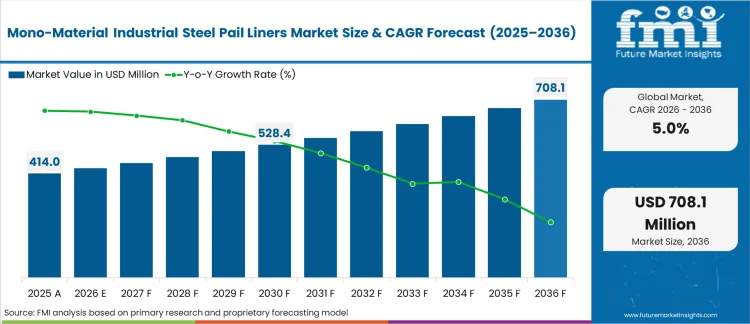
- USD 434.7 Mn
- Forecast (2036)
- USD 708.1 Mn
- CAGR (2026 to 2036)
- 5.0%
Mono-Material Industrial Steel Pail Liners Market Size, Market Forecast and Outlook By FMI
The mono-material industrial steel pail liners market was valued at USD 412.5 million in 2025 and is projected to reach USD 434.7 million in 2026, reflecting a CAGR of 5.0%. The market is expected to grow to USD 708.1 million by 2036 as circular-economy initiatives drive broader adoption across mid‑market chemical manufacturers. Supply chain sustainability leads executing packaging compliance audits now reject traditional multi-material inserts that contaminate single-stream recycling channels. This material pivot forces incumbent flexible packaging converters to engineer high-density, single-resin structures capable of surviving aggressive solvent permeation during long-haul transit.
Vendors entering 2027 industrial supply tenders without certified barrier films replacement data face disqualification windows they cannot overcome once enterprise contracts are awarded. The true inflection point in bulk packaging circularity occurs when the extrusion cost of specialized mono-polymers drops below the escalating rate of regional plastic disposal taxes. Packaging procurement directors must secure high-density single-resin supply contracts before the 2028 European waste directives fully activate. Once this cost-parity threshold is crossed, legacy composite films become economically unviable for long-haul solvent transport.
Summary of Mono-Material Industrial Steel Pail Liners Market
- Mono-Material Industrial Steel Pail Liners Market Definition
- Mono-material industrial steel pail liners encompass single-resin protective inserts engineered to separate aggressive chemical payloads from metal shipping containers. This architecture guarantees the functional barrier properties of traditional multi-layer films while ensuring complete compatibility with single-stream industrial recycling protocols.
- Demand Drivers in the Market
- Escalating Extended Producer Responsibility taxes force packaging procurement directors to specify single-resin container inserts that eliminate the costly separation of mixed-plastic industrial waste.
- Strict chemical transport safety protocols compel resin science engineers to develop high-density mono-polymers capable of preventing aggressive solvent permeation during extensive global transit routes.
- Corporate sustainability mandates at Tier-1 chemical manufacturers require the systematic replacement of legacy nylon-blend liners with certified recyclable mono-material alternatives.
- Key Segments Analyzed in the FMI Report
- Mono-HDPE: 62.0% share in 2026, reflecting the absolute requirement for rigid, high-barrier resistance against corrosive industrial solvents.
- 5 to 10 Gallons: 48.0% share in 2026, as this capacity represents the dominant standard for mid-volume adhesive and coating distribution channels.
- China: 6.5% CAGR value driven by massive greenfield chemical export facilities standardizing on internationally compliant recyclable packaging formats.
- Analyst Opinion at FMI
- Ismail Sutaria, Principal Consultant for Packaging Materials, opines, "In my analysis, I have observed that the true friction point in transitioning to circular industrial packaging is not raw resin cost, but the extended qualification testing required for new single-polymer barriers. Supply chain sustainability leads attempting to swap legacy multi-layer films for untested mono-materials face severe leak-failure risks during transit vibrations. Chemical transport directors who delay standardizing on verified mono-polymer liners will find themselves absorbing punitive packaging taxes that completely erase their container procurement margins by 2028."
- Strategic Implications / Executive Takeaways
- Resin science engineers must prioritize the optimization of molecular orientation in single-polymer extrusions to achieve the drop-impact parity demanded by industrial chemical distributors.
- Packaging procurement directors should phase out multi-layer barrier film dependency and mandate native mono-material recyclability in all new bulk container liner specifications.
- Industrial recycling facility managers must establish dedicated intake protocols to verify the homogenous resin composition of incoming steel pail inserts prior to mechanical processing.
- Market Research Methodology
- Primary Research: FMI conducted detailed technical interviews with principal packaging architects, chemical transport directors, and resin compounders across 40 countries to validate material transition timelines.
- Desk Research: Analysts aggregated public standards documentation from international packaging compliance registries, corporate sustainability reports, and national circular economy grant programs.
- Market-Sizing and Forecasting: The model applies a bottom-up methodology starting with global installed base metrics for rigid steel containers and projecting the conversion rate to mono-material liners.
- Data Validation and Update Cycle: Segment forecasts undergo cross-validation against quarterly polymer shipment volumes specifically allocated for industrial packaging applications.
China tracks at a 6.5% rate supported by aggressive greenfield chemical manufacturing expansions demanding unified recycling streams. India advances at a 6.2% CAGR as export-driven solvent producers align with international packaging compliance frameworks. South Korea posts a 5.5% CAGR value driven by strict national circular economy mandates forcing bulk container standardization. Germany registers a 5.1% trajectory anchored by rigorous industrial waste taxation policies. The United States grows at a 4.8% pace as domestic resin suppliers innovate polyethylene packaging solutions. Japan expands at 4.5% while the UK follows at 4.0%, both driven by the systemic eradication of mixed-plastic industrial waste. The geographic dispersion of this growth reflects varying national timelines for implementing industrial packaging producer responsibility laws.
Mono-Material Industrial Steel Pail Liners Market Definition
Mono-material industrial steel pail liners represent the removable, single-polymer protective inserts designed specifically to separate aggressive bulk liquids from the interior walls of rigid metal shipping containers. The ecosystem relies on unblended thermoplastic extrusion technologies that guarantee zero chemical interaction with the payload while ensuring the entire liner can be processed through single-stream mechanical recycling facilities without delamination.
Mono-Material Industrial Steel Pail Liners Market Inclusions
The sector scope includes single-resin high-density polyethylene, linear low-density polyethylene, and polypropylene inserts engineered specifically for steel bulk containers. Seamless thermoformed liners, anti-static mono-polymer bags, and industrial packaging solutions featuring homogeneous resin formulations fall within the boundaries. Products utilizing purely physical structural modifications rather than chemical barrier layers to achieve solvent resistance are fully incorporated.
Mono-Material Industrial Steel Pail Liners Market Exclusions
Standard multi-layer composite films utilizing nylon or ethylene vinyl alcohol barrier layers are excluded. Standalone metal drums without internal liners, plastic pails, standalone jerry cans, and liquid intermediate bulk containers bladders fall outside the defined parameters. Flexible inner liners incorporating metallic foil laminations or incompatible adhesive tie layers are explicitly omitted from the valuation.
Mono-Material Industrial Steel Pail Liners Market Research Methodology
- Primary Research: Analysts engaged with resin science engineers, packaging procurement directors, and industrial recycling facility managers to map the specific decision gates triggering mono-material adoption.
- Desk Research: The data collection phase aggregated compliance roadmaps from the European Disposables and Nonwovens Association, national packaging tax registries, and major chemical vendor guidelines.
- Market-Sizing and Forecasting: The baseline value derives from a bottom-up aggregation of mono-polymer extrusion shipments, applying region-specific regulatory timelines to project the future adoption velocity.
- Data Validation and Update Cycle: Projections are rigorously tested against publicly reported capital expenditure guidance from the leading rigid packaging and chemical distribution conglomerates.
Segmental Analysis
Mono-Material Industrial Steel Pail Liners Market Analysis by Material Type
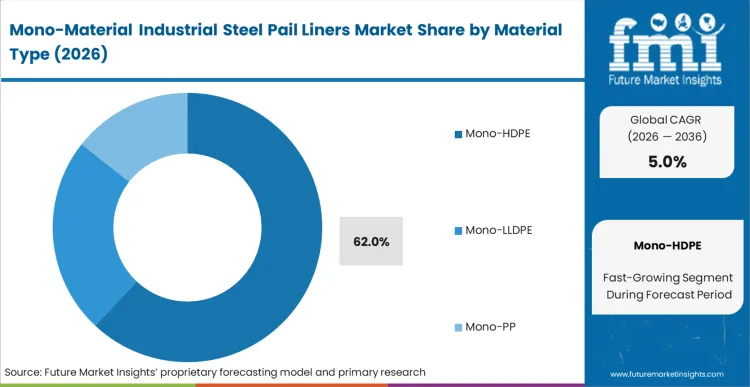
FMI analysts opine that supply chains transitioning to native mono-HDPE hardware realize measurable reductions in bulk packaging taxation liabilities. Converter facilities unable to supply verified homogenous rigid steel pails liners risk immediate exclusion from the next wave of chemical distributor RFPs. Chemical transport directors specifying these unblended structures guarantee safe containment while satisfying aggressive corporate sustainability mandates. With legacy multi-layer films triggering substantial disposal penalties, packaging procurement directors execute full-scale material replacement programs. Mono-HDPE commands a dominant 62.0% share in 2026, reflecting the absolute requirement for superior chemical resistance before widespread circularity can be achieved. Resin science engineers specifying these high-density polyethylene polymers establish the foundation for unified, single-stream industrial recycling environments. This molecular-level standardization eliminates the need for expensive mechanical delamination processes at the end of the container's lifecycle. Facility operators deploying these durable inserts streamline their waste management workflows and significantly reduce overall environmental compliance costs.
- Permeability Resistance: High-crystalline polymer architectures naturally block aggressive solvent migration, shifting the protective burden away from unrecyclable nylon barrier layers.
- Recycling Integration: Homogeneous material compositions natively match existing mechanical recycling infrastructure, eliminating the contamination issues plaguing traditional composite films.
- Impact Durability: Advanced extrusion techniques enhance the tear strength of pure polyethylene, preventing catastrophic container ruptures during aggressive warehouse handling sequences.
Mono-Material Industrial Steel Pail Liners Market Analysis by Capacity
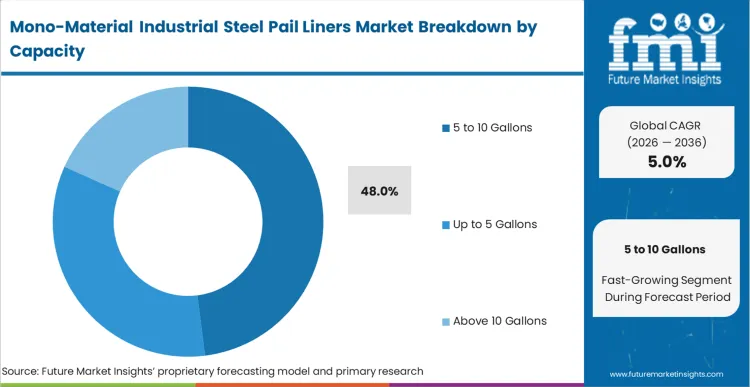
The 5 to 10 Gallons capacity emerges as the dominant volume segment, expected to represent 48.0% of total market share in 2026. Modern adhesive and coating distribution networks are increasingly built around this specific form factor, removing the handling inefficiencies caused by oversized industrial drums or fragmented small-batch containers. As per FMI's projection, standardizing this mid-tier capacity directly enables automated filling and sealing operations on the factory floor. Plant automation leads must validate the dimensional stability of these mono-material inserts during high-speed insertion testing to authorize final production line sign-off. The convergence of strict weight limits and optimal solvent ratios forces logistics coordinators to rethink traditional shipping pallet configurations. Adhesives manufacturers deploy these standardized liners to optimize their cargo density and significantly reduce dead transit space.
- Automated Insertion: Precise thermoformed dimensions to ensure seamless integration with high-speed robotic container assembly equipment.
- Ergonomic Handling: Mid-volume payload capacities allow warehouse personnel to manually maneuver filled pails without requiring specialized heavy lifting machinery.
- Batch Optimization: Standardized container volumes match the exact mixing ratios required by commercial construction contractors utilizing adhesives and sealants.
Mono-Material Industrial Steel Pail Liners Market Analysis by End Use
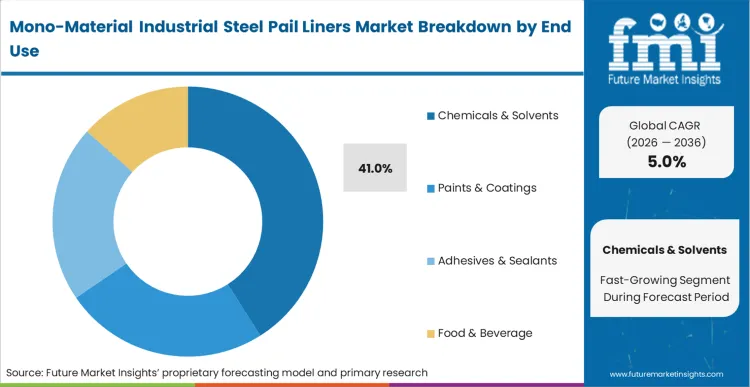
Suppliers failing to demonstrate seamless chemical compatibility with established solvent profiles lose priority status in critical infrastructure procurement cycles. Refinery dispatch managers mandating these inserts protect their transport fleets from catastrophic leak liabilities. Every supply chain sustainability lead bidding on chemical supply contracts now faces strict adherence criteria for recyclable packaging protocols. Chemicals & Solvents accounts for a leading 41.0% segment share in 2026. Process engineers operating aggressive fluid filling lines reject liner designs introducing variable degradation risks into the transit loop. Incorporating certified mono-polymer protective layers guarantees that highly reactive industrial solvents arrive at their destination without compromising the structural integrity of the steel exterior. Based on FMI's assessment, the integration of advanced anti-static agents with core mono-materials amplifies the demand for safe, combustible fluid containment.
- Solvent Containment: Tailored molecular weight distributions prevent aggressive industrial thinners from degrading the inner protective surface over long-haul transit durations.
- Static Dissipation: Specially formulated homogenous resin blends safely discharge accumulated electrical energy when transferring highly flammable chemical payloads.
- Purity Preservation: Unblended thermoplastic structures ensure zero molecular leaching, maintaining the absolute chemical purity required for semiconductor-grade solvent applications.
Mono-Material Industrial Steel Pail Liners Market Drivers, Restraints, and Opportunities
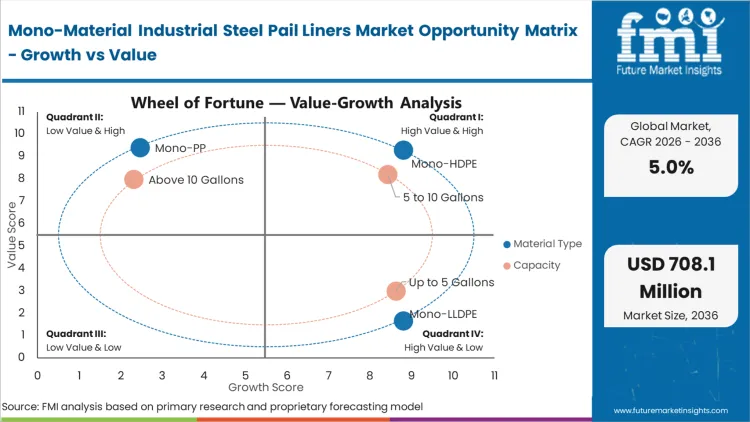
The strict enforcement of Extended Producer Responsibility frameworks forces packaging procurement directors to extract unrecyclable composite films directly from the industrial supply chain. This regulatory pressure renders fragmented, multi-layer nylon architectures obsolete. Distributors upgrading their shipping protocols face a strict binary choice between absorbing punitive disposal taxes or overhauling their baseline container specifications. Transitioning to a unified mono-material liner simplifies chemical packaging regulations compliance and enables direct integration with single-stream mechanical recycling infrastructure. Logistics coordinators who fail to modernize their core packaging layers risk severe financial penalties and reduced overall supply chain efficiency.
The intricate extrusion parameters required to optimize single-polymer drop-impact strength create steep learning curves for traditional flexible packaging converters. Designing tear-resistant mono-materials that match the performance of legacy multi-layer films demands specialized resin compounding expertise that most mid-tier manufacturers lack internally. To mitigate this capability gap, corporate sustainability leads increasingly rely on advanced molecular simulation tools that automate the polymer orientation process and validate structural integrity before physical extrusion begins.
Opportunities in the Mono-Material Industrial Steel Pail Liners Market
- Closed-Loop Reclamation Programs: Progressive resin compounders establish dedicated reverse logistics networks to reclaim used mono-material liners directly from chemical end-users. This consolidation eliminates third-party waste brokers and drastically simplifies the procurement of high-quality recycled feedstocks.
- High-Temperature Filling Compatibility: Upgraded polymer crystallization techniques permit process engineers to deploy hot-fill adhesive applications without melting the protective mono-material insert. This capability prevents production bottlenecks during rapid assembly line sequences.
- Smart Tracer Integration: Advanced extrusion lines embedding fluorescent molecular markers provide recycling facility managers the automated sorting accuracy necessary to separate distinct mono-polymer grades. This technology ensures maximum material purity during the final mechanical flaking process.
Regional Analysis
Based on the regional analysis, the Mono-Material Industrial Steel Pail Liners market is segmented into North America, Latin America, Europe, East Asia, South Asia, Oceania and Middle East & Africa across 40 plus countries.
.webp "Top Country Growth Comparison Mono Material Industrial Steel Pail Liners Market Cagr (2026 2036)")
| Country | CAGR (2026 to 2036) |
|---|---|
| China | 6.5% |
| India | 6.2% |
| South Korea | 5.5% |
| Germany | 5.1% |
| USA | 4.8% |
| Japan | 4.5% |
| UK | 4.0% |
Source: Future Market Insights (FMI) analysis, based on proprietary forecasting model and primary research
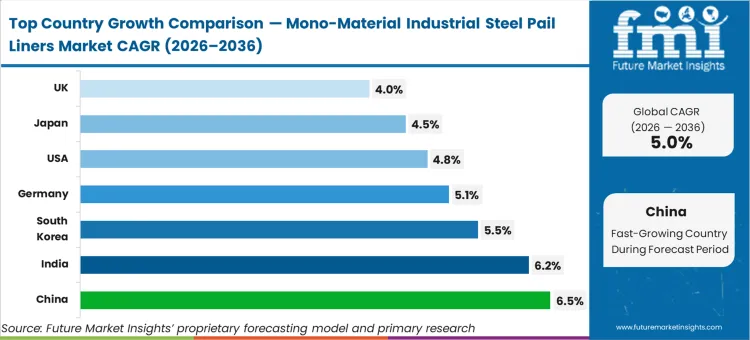
Asia Pacific Mono-Material Industrial Steel Pail Liners Market Analysis
Supply chain sustainability leads constructing new solvent export facilities specify unified mono-material transit containers in their initial operational blueprints as greenfield chemical manufacturing expansion across the Asia Pacific region accelerates the bypass of legacy packaging constraints. This aggressive greenfield strategy directly fuels the demand for high-performance mono-polymer extrusion capabilities, establishing highly flexible distribution networks capable of rapid regulatory adaptation. FMI's analysis indicates that this clean-slate approach eliminates the costly and time-consuming material retrofit phase that plagues older European production centers.
- China: China’s mono-material liner market is projected to grow at a 6.5% CAGR through 2036, driven by extensive new chemical plant construction that is rapidly expanding the country’s circular packaging infrastructure. Greenfield facility architects bypass legacy multi-layer films entirely by specifying native mono-HDPE inserts for all new bulk liquid procurement contracts, supporting an aggressive industrial solvent sector that requires seamless compliance with complex international recycling standards. Flexible packaging converters unable to demonstrate verified high-barrier mono-polymer capabilities lose access to the most lucrative greenfield export projects in the region.
- India: Process engineers must deploy container liners capable of guaranteeing volatile chemical containment without relying on prohibited mixed-plastic barrier layers, driving India's 6.2% CAGR of mono-material demand to 2036. This regulatory compliance pressure anchors the market as the national push toward sustainable industrial manufacturing triggers a wave of packaging upgrades prioritizing unified, single-resin material backbones. Resin compounders failing to provide materials with built-in impact resistance mechanisms face disqualification from major chemical facility tenders.
- South Korea: Plant automation leads mandate zero-leaching architectures to ensure highly sensitive semiconductor-grade chemicals remain uncontaminated during extensive global transit, with South Korea's mono-material liner demand rising at a CAGR of 5.5% through 2036. Continuous investment in ultra-pure mono-polymer inserts is necessitated by the concentration of advanced logic foundries to maximize manufacturing yield rates, making this zero-tolerance standard the universal procurement baseline. Container hardware suppliers targeting the next chemical expansion cycle must prove absolute polymer stability before entering the approved vendor list.
- Japan: Every new bulk packaging architecture must validate single-stream recycling compliance before receiving authorization for series production integration, sustaining a 4.5% CAGR for mono-material upgrades in Japan's chemical corridor. The domestic materials manufacturing sector embeds advanced molecular barrier technology directly into pure polyethylene structures to maintain a global competitive advantage in sustainable packaging, enforced by strict material qualification through localized extended producer responsibility mandates. Extrusion equipment providers lacking verified drop-impact testing records forfeit access to the next generation of industrial coatings contracts.
FMI's report includes extensive coverage of the Asia Pacific packaging material landscape. It incorporates detailed analysis of Taiwan, Indonesia, Australia, and the broader ASEAN chemical distribution network.
Europe Mono-Material Industrial Steel Pail Liners Market Analysis
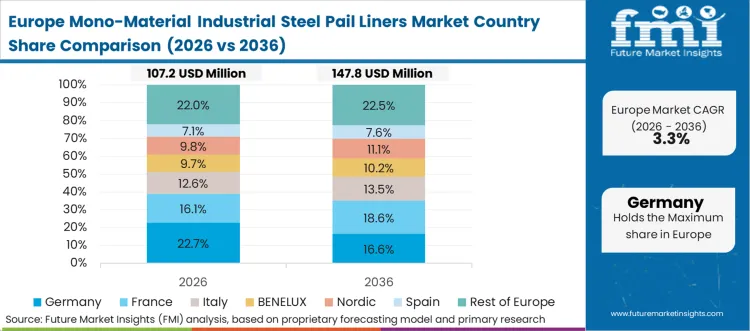
This stringent regulatory requirement forces the rapid adoption of advanced extrusion protocols to guarantee chemical resistance while eliminating problematic nylon barrier layers as European industrial policy actively penalizes the continued utilization of unrecyclable composite packaging materials. Facility directors recognize that maintaining outdated multi-layer standards severely limits their ability to compete in highly regulated European markets, as upgrading the core material infrastructure provides the necessary physical durability to support advanced sustainable industrial practices. The transition requires a complete overhaul of existing packaging topologies, shifting from performance-only metrics to total lifecycle circularity architectures.
- Germany: The certified mono‑material liners demand in Germany is expanding at an annual rate of 5.1%, driven by the national adhesives export sector’s strict circular‑economy requirements mandating uniform material compositions. Packaging procurement directors must demonstrate flawless recyclability of all steel pail inserts before receiving authorization to ship products across national borders, satisfying a rigorous industrial waste taxation system that dictates stringent financial penalties for chemical distributors utilizing mixed-polymer transit containers. Resin science engineers targeting domestic chemical plant retooling projects must guarantee high-barrier permeation performance prior to the finalization of corporate procurement budgets.
- UK: Logistics coordinators deploying advanced chemical distribution systems mandate packaging architectures capable of 100% mechanical recyclability across distributed geographic networks, anchoring the UK's 4.0% CAGR trajectory to 2036. This critical regulatory transition forces grid operators and chemical providers to abandon legacy composite liners in favor of highly resilient, pure polyethylene structures as the plastic packaging tax programs require precise material composition data to exempt industrial shipping hardware. Independent packaging consultants unable to demonstrate absolute material homogeneity under severe chemical load conditions forfeit qualification for national supply chain modernization projects.
FMI's report includes thorough investigation of the European industrial packaging framework. The analysis encompasses Italy, France, Spain, the Nordics, and the Benelux region.
North America Mono-Material Industrial Steel Pail Liners Market Analysis
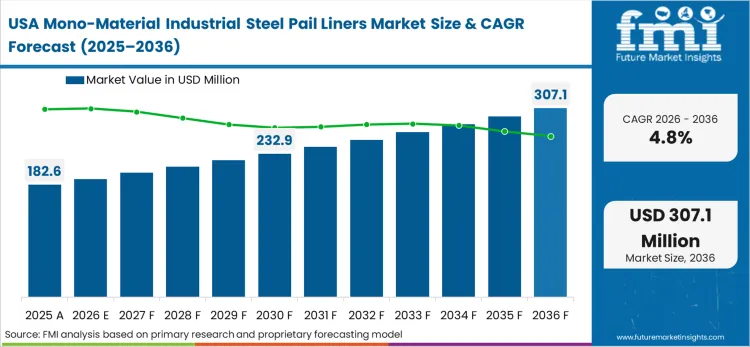
Supply chain sustainability leads directing critical chemical infrastructure overhauls face strict directives to unify disparate packaging materials under a single manageable recycling stream as industrial modernization mandates across North America target the systematic eradication of landfill-destined industrial plastic waste. This strategic shift requires significant capital allocation toward robust extrusion technologies capable of producing high-density, single-resin barrier layers, enabling facilities to deploy advanced automated filling algorithms without compromising real-time transit stability. FMI's research confirms that the paints and coatings manufacturing sectors actively drive this consolidation to align their distribution networks with emerging state-level producer responsibility legislation.
- USA: Packaging procurement directors replacing aging composite liner systems must deploy converged material architectures capable of supporting both volatile solvent resistance and zero-landfill corporate objectives, resulting in the United States advancing at a 4.8% CAGR value across the forecast decade. State-level sustainability initiatives and federal frameworks actively force the replacement of problematic multi-layer films with standardized, resilient mono-polymer structures as chemical manufacturers unify their physical packaging profiles. Rigid container vendors lacking documented compliance with rigorous mechanical recycling standards face immediate exclusion from major corporate modernization contracts.
FMI's report includes comprehensive evaluation of the North American mono-material packaging sector. It features specific analysis of the Canadian and Mexican industrial chemical markets.
Competitive Aligners for Market Players
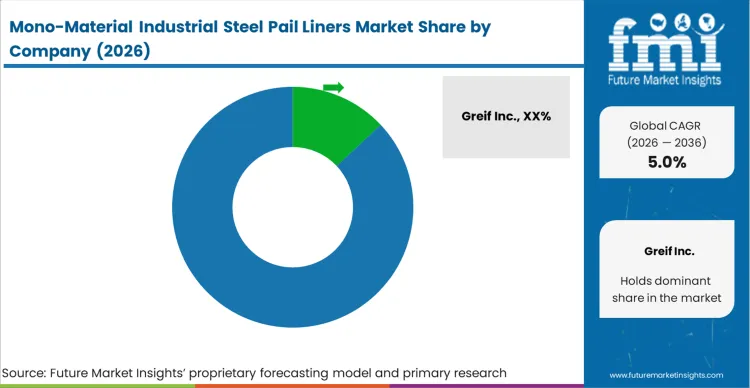
The introduction of standardized circular economy testing profiles under the European Plastics Pact is fundamentally reshaping how industrial buyers evaluate chemical transit packaging. Instead of accepting traditional multi-layer nylon blends, procurement teams now demand certified, single-resin extrusion data in all new tenders. This shift has raised the performance bar across the industry, meaning flexible packaging converters that continue to rely on unrecyclable composite films risk being excluded from major sustainability-driven supply programs.
Industry leaders have already begun adapting by heavily investing in advanced molecular orientation technology. For example, manufacturers such as Greif Inc., Mauser Packaging Solutions, and Schütz GmbH & Co. KGaA have aligned portions of their portfolios with strict mono-material sustainable rigid packaging standards, setting a new competitive baseline for others to follow. Vendors engineering high-density polyethylene structures that natively block aggressive solvent migration gain a significant architectural advantage over firms still utilizing chemical adhesives to bond disparate polymers. Specialized players like CDF Corporation and ILC Dover, which increasingly incorporate advanced crystallization techniques at the extrusion level, help reduce material failure rates during transit and shrink the total environmental footprint of industrial shipping.
Large chemical distributors, supported by versatile suppliers like The Cary Company and Vestil Manufacturing, actively prevent lock-in by mandating open-source material testing data and qualifying multiple mono-material sources. This structural dynamic severely limits vendor pricing power even within a moderately consolidated supplier ecosystem. A core structural tension exists between facility owners demanding lower-cost commodity resins and dominant packaging vendors pushing premium, highly engineered mono-polymers. Ultimately, the requirement to validate drop-impact performance forces the competitive structure to favor massive multinational resin compounders and technically adept niche specialists over the forecast period.
Key Players in Mono-Material Industrial Steel Pail Liners Market
- Greif Inc.
- Mauser Packaging Solutions
- Schütz GmbH & Co. KGaA
- CDF Corporation
- ILC Dover
- Vestil Manufacturing
- The Cary Company
Scope of the Report
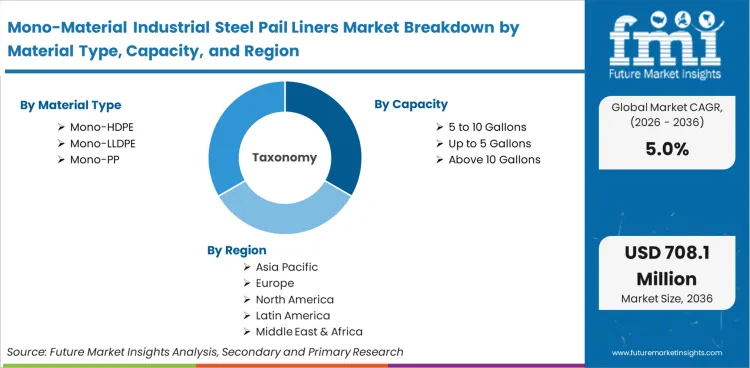
| Metric | Value |
|---|---|
| Quantitative Units | USD 434.7 million to USD 708.1 million, at a CAGR of 5.0% |
| Market Definition | Mono-material industrial steel pail liners encompass single-resin protective inserts engineered to separate aggressive chemical payloads from metal shipping containers, ensuring complete single-stream mechanical recyclability. |
| Material Type Segmentation | Mono-HDPE, Mono-LLDPE, Mono-PP |
| Capacity Segmentation | Up to 5 Gallons, 5 to 10 Gallons, Above 10 Gallons |
| End Use Segmentation | Chemicals & Solvents, Paints & Coatings, Adhesives & Sealants, Food & Beverage |
| Regions Covered | North America, Latin America, Europe, East Asia, South Asia, Oceania, Middle East & Africa |
| Countries Covered | China, India, USA, Germany, South Korea, Japan, UK, and 40 plus countries |
| Key Companies Profiled | Greif Inc., Mauser Packaging Solutions, Schütz GmbH & Co. KGaA, CDF Corporation, ILC Dover, Vestil Manufacturing, The Cary Company |
| Forecast Period | 2026 to 2036 |
| Approach | The baseline value derives from a bottom-up aggregation of mono-polymer extrusion shipments, utilizing the FMI rigid packaging database as a foundation. Projections are rigorously cross-validated against publicly reported capital expenditure guidance from major chemical distribution conglomerates. |
Source: Future Market Insights (FMI) analysis, based on proprietary forecasting model and primary research
Segments
Material Type:
- Mono-HDPE
- Mono-LLDPE
- Mono-PP
Capacity:
- Up to 5 Gallons
- 5 to 10 Gallons
- Above 10 Gallons
End Use:
- Chemicals & Solvents
- Paints & Coatings
- Adhesives & Sealants
- Food & Beverage
Regions:
- North America
- USA
- Canada
- Mexico
- Latin America
- Brazil
- Argentina
- Chile
- Rest of Latin America
- Europe
- Germany
- UK
- Italy
- France
- Spain
- Benelux
- Nordics
- Central & Eastern Europe
- Rest of Europe
- East Asia
- China
- Japan
- South Korea
- South Asia
- India
- Indonesia
- ASEAN
- Rest of South Asia
- Oceania
- Australia & New Zealand
- Middle East & Africa
- Kingdom of Saudi Arabia
- United Arab Emirates
- South Africa
- Turkey
- Rest of Middle East & Africa
Bibliography
- European Disposables and Nonwovens Association. (2024, February). Circular economy mandates for industrial polymer packaging. Packaging Compliance Journal.
- Association of Plastic Recyclers. (2024, August). Design guide for single-stream recyclable industrial films. Plastics Engineering Monthly.
- UK Department for Environment, Food & Rural Affairs. (2024, November). Plastic packaging tax thresholds for industrial shipping hardware. UK Government Press.
- German Environment Agency. (2024, October). Rigid container waste diversion targets and taxation models. UBA Regulatory Directives.
- Flexible Packaging Association. (2025, February). Transitioning from multi-layer barriers to pure mono-polymers. FPA Industry Insights.
- CDF Corporation. (2024, December). Drop-impact parity in thermoformed single-resin inserts. CDF Engineering Data.
- Japan Ministry of the Environment. (2024, July). Zero-leaching mandates for semiconductor-grade chemical transport. MOE Chemical Safety Board.
This bibliography is provided for reader reference. The full FMI report contains the complete reference list with primary source documentation.
This Report Addresses
Market intelligence to support strategic decision‑making across established and emerging mono‑material industrial steel pail liner applications
Market size estimation and 10‑year demand forecasts from 2026 to 2036, grounded in extrusion shipment analysis and validated through primary industry research
Growth opportunity mapping across single‑resin material types—including Mono‑HDPE, Mono‑LLDPE, and Mono‑PP with emphasis on barrier performance and recyclability compliance
Segment and regional demand forecasts covering Up to 5 Gallons, 5 to 10 Gallons, and Above 10 Gallons liner capacities in alignment with global chemical distribution frameworks
Competitive strategy assessment including material purity differentiation, extrusion technology advancements, and converter capability benchmarking within circular‑economy procurement cycles
Revenue opportunity evaluation tied to closed‑loop reclamation programs, recycler‑verified mono‑material streams, and high‑value chemical container recovery networks
Market access and strategic implications for procurement directors and sustainability leads navigating EPR‑driven regulations, recyclable packaging mandates, and supply‑chain modernization requirements
Frequently Asked Questions
How large is the Mono-Material Industrial Steel Pail Liners in 2026?
The market is estimated to reach USD 434.7 million in 2026. Packaging procurement directors execute full-scale material replacement programs to avoid escalating industrial waste disposal taxes.
What will the Mono-Material Industrial Steel Pail Liners be valued at by 2036?
The market valuation is projected to achieve USD 707.7 million by 2036. The systemic eradication of multi-layer composite films across global chemical supply chains sustains this long-term growth.
What CAGR is projected for Mono-Material Industrial Steel Pail Liners from 2026 to 2036?
The market is expected to expand at a 5.0% CAGR over the forecast decade. The mandatory transition to single-stream mechanical recycling protocols anchors this steady compound rate.
Which Material Type leads the mono-material industrial steel pail liners market?
Mono-HDPE commands a dominant 62.0% share in 2026. Resin science engineers specify these high-density polymers to guarantee superior solvent resistance without compromising absolute circularity.
What capacity segment dominates industrial shipping demands?
The 5 to 10 Gallons category represents 48.0% of total market share in 2026. Adhesives manufacturers deploy these standardized liners to optimize cargo density and streamline automated filling operations.
Which end use sector dictates the primary material specifications?
Chemicals & Solvents accounts for a 41.0% segment share in 2026. Process engineers mandate zero-leaching mono-polymer architectures to prevent aggressive industrial thinners from degrading during transit.
What is the fastest-growing region in the market?
East Asia leads global expansion driven by aggressive greenfield chemical manufacturing construction. Supply chain sustainability leads bypass legacy multi-layer films entirely in favor of native circular packaging.
Why does China represent the primary growth engine?
China posts a 6.5% CAGR value as massive export volumes demand seamless compliance with complex international recycling frameworks. Facility architects specify native mono-HDPE inserts for all new bulk liquid procurement contracts.
What policy framework has accelerated India's packaging material upgrades?
Stringent domestic waste management rules demanding verifiable end-of-life recycling pathways force the adoption of unified material layers. This regulatory pressure anchors India's 6.2% annual growth trajectory.
What structural constraint defines the Japanese market?
Strict material qualification through localized extended producer responsibility mandates forces extrusion equipment providers to validate drop-impact performance continuously. This systemic qualification pressure drives a 4.5% CAGR.
Why does South Korea require highly specialized mono-material inserts?
The advanced electronics materials complex operates to zero-leaching solvent tolerances that exceed standard industrial packaging specifications. This requirement sustains a 5.5% CAGR as foundries demand ultra-pure transit solutions.
What operational challenge complicates the transition to single-resin liners?
Designing tear-resistant mono-materials that match the drop-impact performance of legacy nylon-blended films demands highly specialized resin compounding expertise. Mid-tier converters struggle to achieve this structural parity without compromising chemical resistance.
How do Extended Producer Responsibility taxes shape the market?
These strict financial levies penalize chemical distributors utilizing mixed-polymer transit containers. This pressure forces a structural pivot toward 100% mechanically recyclable mono-material architectures.
What makes the 5.0% CAGR defensible over a full decade?
The absolute necessity of standardizing global chemical distribution networks against converging international circular economy targets creates a continuous, irreversible material replacement cycle.
What distinguishes Germany's growth from the broader European region?
Germany's rigorous industrial waste taxation system dictates immediate financial penalties for non-compliant shipping containers. This systemic pressure drives a specific 5.1% CAGR as domestic adhesives exporters rapidly retool.
What buyer evaluation criteria shifted recently?
Procurement teams now demand certified, single-resin extrusion data in all new tenders instead of accepting traditional physical barrier performance alone.
How is the USA market responding to sustainability mandates?
State-level initiatives actively force the replacement of problematic multi-layer films with standardized mono-polymer structures. The USA advances at a 4.8% pace as chemical manufacturers unify their physical packaging profiles.
What role does the UK's plastic packaging tax play?
The tax requires precise material composition data to exempt industrial shipping containers from heavy levies. This policy anchors the UK's 4.0% trajectory as distributors abandon legacy composite liners.
Why are closed-loop reclamation programs a major opportunity?
Progressive resin compounders establishing dedicated reverse logistics networks bypass third-party waste brokers. This consolidation secures direct access to high-quality recycled industrial feedstocks.
How does automated filling impact container liner design?
High-speed robotic assembly equipment requires precise thermoformed dimensions to prevent process jamming. Mid-volume mono-material pails natively support these rapid production line sequences.
What specific items are excluded from the market scope?
Standard multi-layer composite films utilizing nylon or ethylene vinyl alcohol barrier layers, rigid plastic pails, and standalone steel drums without internal liners are explicitly omitted.
What primary research anchor confirms the FMI forecast?
Analysts conducted detailed technical interviews with principal packaging architects and resin compounders to map specific decision gates.
What is the strategic implication for packaging procurement directors?
Directors must immediately phase out multi-layer barrier film dependency and mandate native mono-material recyclability in all new bulk container liner specifications.
How do large chemical distributors prevent vendor lock-in?
Distributors actively mandate open-source material testing data and qualify multiple mono-material suppliers simultaneously during the enterprise tender process.
Preview the report firsthand - request a free sample
Get SampleGet the brochure for pricing and purchase details.
Get PDFTable of Content
- Key Takeaways
- Market Size and CAGR
- Top Growth Driver
- Fastest Growing Segment
- Leading Region
- Key Companies
- Emerging Opportunities
- Executive Summary
- Global Market Outlook
- Demand-side Trends
- Supply-side Trends
- Technology Roadmap Analysis
- Analysis and Recommendations
- Analyst Perspective (What is happening? Why now? What should investors know?)
- Key Questions Answered
- How large is the market?
- What is the CAGR?
- What are key trends?
- Which region dominates?
- Who are the leaders?
- Market Overview
- Market Coverage / Taxonomy
- Market Definition / Scope / Limitations
- Research Methodology
- Chapter Orientation
- Analytical Lens and Working Hypotheses
- Market Structure, Signals, and Trend Drivers
- Benchmarking and Cross-market Comparability
- Market Sizing, Forecasting, and Opportunity Mapping
- Research Design and Evidence Framework
- Desk Research Programme (Secondary Evidence)
- Expert Input and Fieldwork (Primary Evidence)
- Tooling, Models, and Reference Databases
- Data Engineering and Model Build
- Quality Assurance and Audit Trail
- Market Background
- Market Dynamics (Drivers, Restraints, Opportunity, Trends)
- Scenario Forecast (Optimistic, Likely, Conservative)
- Impact Analysis
- AI Impact
- Sustainability Impact
- Regulatory Impact
- Technology Impact
- Consumer / Buyer Analysis
- Purchase Drivers
- Adoption Barriers
- Buyer Journey
- Opportunity Map Analysis
- Product Life Cycle Analysis
- Supply Chain Analysis
- Investment Feasibility Matrix
- Value Chain Analysis
- PESTLE and Porter's Analysis
- Regulatory Landscape
- Regional Parent Market Outlook
- Production and Consumption Statistics
- Import and Export Statistics
- Global Market Analysis and Forecast, 2021 to 2036
- Historical Market Size Value (USD Million) & Volume (Unit) Analysis, 2021 to 2025
- Current and Future Market Size Value (USD Million) & Volume (Unit) Projections, 2026 to 2036
- Y-o-Y Growth Trend Analysis
- Absolute $ Opportunity Analysis
- Global Market Pricing Analysis, 2021 to 2036
- Global Market Analysis and Forecast, By Material Type, 2021 to 2036
- Introduction / Key Findings
- Historical Market Size Value (USD Million) & Volume (Unit) Analysis By Material Type, 2021 to 2025
- Current and Future Market Size Value (USD Million) & Volume (Unit) Analysis and Forecast By Material Type, 2026 to 2036
- Mono-HDPE
- Mono-LLDPE
- Mono-PP
- Mono-HDPE
- Y-o-Y Growth Trend Analysis By Material Type, 2021 to 2025
- Absolute $ Opportunity Analysis By Material Type, 2026 to 2036
- Global Market Analysis and Forecast, By Capacity, 2021 to 2036
- Introduction / Key Findings
- Historical Market Size Value (USD Million) & Volume (Unit) Analysis By Capacity, 2021 to 2025
- Current and Future Market Size Value (USD Million) & Volume (Unit) Analysis and Forecast By Capacity, 2026 to 2036
- 5 to 10 Gallons
- Up to 5 Gallons
- Above 10 Gallons
- 5 to 10 Gallons
- Y-o-Y Growth Trend Analysis By Capacity, 2021 to 2025
- Absolute $ Opportunity Analysis By Capacity, 2026 to 2036
- Global Market Analysis and Forecast, By End Use, 2021 to 2036
- Introduction / Key Findings
- Historical Market Size Value (USD Million) & Volume (Unit) Analysis By End Use, 2021 to 2025
- Current and Future Market Size Value (USD Million) & Volume (Unit) Analysis and Forecast By End Use, 2026 to 2036
- Chemicals & Solvents
- Paints & Coatings
- Adhesives & Sealants
- Food & Beverage
- Chemicals & Solvents
- Y-o-Y Growth Trend Analysis By End Use, 2021 to 2025
- Absolute $ Opportunity Analysis By End Use, 2026 to 2036
- Global Market Analysis and Forecast, By Region, 2021 to 2036
- Introduction
- Historical Market Size Value (USD Million) & Volume (Unit) Analysis By Region, 2021 to 2025
- Current Market Size Value (USD Million) & Volume (Unit) Analysis and Forecast By Region, 2026 to 2036
- North America
- Latin America
- Western Europe
- Eastern Europe
- East Asia
- South Asia and Pacific
- Middle East & Africa
- Market Attractiveness Analysis By Region
- North America Market Analysis and Forecast, By Country, 2021 to 2036
- Historical Market Size Value (USD Million) & Volume (Unit) Trend Analysis By Market Taxonomy, 2021 to 2025
- Market Size Value (USD Million) & Volume (Unit) Forecast By Market Taxonomy, 2026 to 2036
- By Country
- USA
- Canada
- Mexico
- By Material Type
- By Capacity
- By End Use
- By Country
- Market Attractiveness Analysis
- By Country
- By Material Type
- By Capacity
- By End Use
- Key Takeaways
- Latin America Market Analysis and Forecast, By Country
- Historical Market Size Value (USD Million) & Volume (Unit) Trend Analysis By Market Taxonomy, 2021 to 2025
- Market Size Value (USD Million) & Volume (Unit) Forecast By Market Taxonomy, 2026 to 2036
- By Country
- Brazil
- Chile
- Rest of Latin America
- By Material Type
- By Capacity
- By End Use
- By Country
- Market Attractiveness Analysis
- By Country
- By Material Type
- By Capacity
- By End Use
- Key Takeaways
- Western Europe Market Analysis and Forecast, By Country
- Historical Market Size Value (USD Million) & Volume (Unit) Trend Analysis By Market Taxonomy, 2021 to 2025
- Market Size Value (USD Million) & Volume (Unit) Forecast By Market Taxonomy, 2026 to 2036
- By Country
- Germany
- UK
- Italy
- Spain
- France
- Nordic
- BENELUX
- Rest of Western Europe
- By Material Type
- By Capacity
- By End Use
- By Country
- Market Attractiveness Analysis
- By Country
- By Material Type
- By Capacity
- By End Use
- Key Takeaways
- Eastern Europe Market Analysis and Forecast, By Country
- Historical Market Size Value (USD Million) & Volume (Unit) Trend Analysis By Market Taxonomy, 2021 to 2025
- Market Size Value (USD Million) & Volume (Unit) Forecast By Market Taxonomy, 2026 to 2036
- By Country
- Russia
- Poland
- Hungary
- Balkan & Baltic
- Rest of Eastern Europe
- By Material Type
- By Capacity
- By End Use
- By Country
- Market Attractiveness Analysis
- By Country
- By Material Type
- By Capacity
- By End Use
- Key Takeaways
- East Asia Market Analysis and Forecast, By Country
- Historical Market Size Value (USD Million) & Volume (Unit) Trend Analysis By Market Taxonomy, 2021 to 2025
- Market Size Value (USD Million) & Volume (Unit) Forecast By Market Taxonomy, 2026 to 2036
- By Country
- China
- Japan
- South Korea
- By Material Type
- By Capacity
- By End Use
- By Country
- Market Attractiveness Analysis
- By Country
- By Material Type
- By Capacity
- By End Use
- Key Takeaways
- South Asia and Pacific Market Analysis and Forecast, By Country
- Historical Market Size Value (USD Million) & Volume (Unit) Trend Analysis By Market Taxonomy, 2021 to 2025
- Market Size Value (USD Million) & Volume (Unit) Forecast By Market Taxonomy, 2026 to 2036
- By Country
- India
- ASEAN
- Australia & New Zealand
- Rest of South Asia and Pacific
- By Material Type
- By Capacity
- By End Use
- By Country
- Market Attractiveness Analysis
- By Country
- By Material Type
- By Capacity
- By End Use
- Key Takeaways
- Middle East & Africa Market Analysis and Forecast, By Country
- Historical Market Size Value (USD Million) & Volume (Unit) Trend Analysis By Market Taxonomy, 2021 to 2025
- Market Size Value (USD Million) & Volume (Unit) Forecast By Market Taxonomy, 2026 to 2036
- By Country
- Kingdom of Saudi Arabia
- Other GCC Countries
- Türkiye
- South Africa
- Other African Union
- Rest of Middle East & Africa
- By Material Type
- By Capacity
- By End Use
- By Country
- Market Attractiveness Analysis
- By Country
- By Material Type
- By Capacity
- By End Use
- Key Takeaways
- Key Countries Market Analysis
- USA
- Pricing Analysis
- Market Share Analysis, 2025
- By Material Type
- By Capacity
- By End Use
- Canada
- Pricing Analysis
- Market Share Analysis, 2025
- By Material Type
- By Capacity
- By End Use
- Mexico
- Pricing Analysis
- Market Share Analysis, 2025
- By Material Type
- By Capacity
- By End Use
- Brazil
- Pricing Analysis
- Market Share Analysis, 2025
- By Material Type
- By Capacity
- By End Use
- Chile
- Pricing Analysis
- Market Share Analysis, 2025
- By Material Type
- By Capacity
- By End Use
- Germany
- Pricing Analysis
- Market Share Analysis, 2025
- By Material Type
- By Capacity
- By End Use
- UK
- Pricing Analysis
- Market Share Analysis, 2025
- By Material Type
- By Capacity
- By End Use
- Italy
- Pricing Analysis
- Market Share Analysis, 2025
- By Material Type
- By Capacity
- By End Use
- Spain
- Pricing Analysis
- Market Share Analysis, 2025
- By Material Type
- By Capacity
- By End Use
- France
- Pricing Analysis
- Market Share Analysis, 2025
- By Material Type
- By Capacity
- By End Use
- India
- Pricing Analysis
- Market Share Analysis, 2025
- By Material Type
- By Capacity
- By End Use
- ASEAN
- Pricing Analysis
- Market Share Analysis, 2025
- By Material Type
- By Capacity
- By End Use
- Australia & New Zealand
- Pricing Analysis
- Market Share Analysis, 2025
- By Material Type
- By Capacity
- By End Use
- China
- Pricing Analysis
- Market Share Analysis, 2025
- By Material Type
- By Capacity
- By End Use
- Japan
- Pricing Analysis
- Market Share Analysis, 2025
- By Material Type
- By Capacity
- By End Use
- South Korea
- Pricing Analysis
- Market Share Analysis, 2025
- By Material Type
- By Capacity
- By End Use
- Russia
- Pricing Analysis
- Market Share Analysis, 2025
- By Material Type
- By Capacity
- By End Use
- Poland
- Pricing Analysis
- Market Share Analysis, 2025
- By Material Type
- By Capacity
- By End Use
- Hungary
- Pricing Analysis
- Market Share Analysis, 2025
- By Material Type
- By Capacity
- By End Use
- Kingdom of Saudi Arabia
- Pricing Analysis
- Market Share Analysis, 2025
- By Material Type
- By Capacity
- By End Use
- Türkiye
- Pricing Analysis
- Market Share Analysis, 2025
- By Material Type
- By Capacity
- By End Use
- South Africa
- Pricing Analysis
- Market Share Analysis, 2025
- By Material Type
- By Capacity
- By End Use
- USA
- Market Structure Analysis
- Competition Dashboard
- Competition Benchmarking
- Market Share Analysis of Top Players
- By Regional
- By Material Type
- By Capacity
- By End Use
- Emerging Startups
- Innovation Benchmarking
- Competition Analysis
- Competition Deep Dive
- Greif Inc.
- Overview
- Product Portfolio
- Profitability by Market Segments (Product/Region/Sales Channel)
- Sales Footprint
- Strategy Overview
- Marketing Strategy
- Product Strategy
- Channel Strategy
- Mauser Packaging Solutions
- Schütz GmbH & Co. KGaA
- CDF Corporation
- ILC Dover
- Vestil Manufacturing
- The Cary Company
- Greif Inc.
- Case Studies
- Success Stories
- Recent Developments
- Competition Deep Dive
- Assumptions & Acronyms Used


