

- Industry Size (2026):
- USD 1.5 Bn
- Forecast (2036)
- USD 2.9 Bn
- CAGR (2026 to 2036)
- 6.8%
Food-Contact Surface Sanitizers Market Forecast and Outlook 2026 to 2036
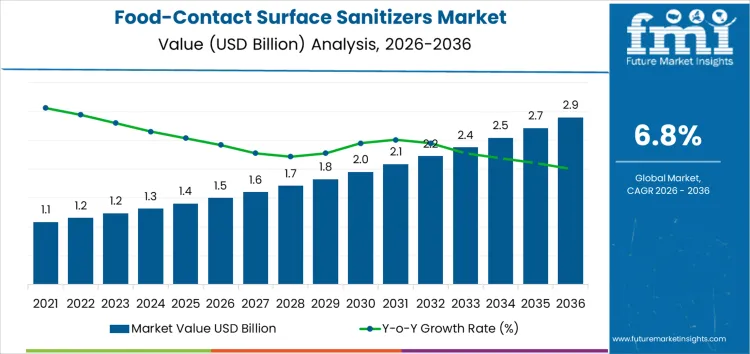
The Food-Contact Surface Sanitizers market is projected to expand from USD 1.5 billion in 2026 to USD 2.9 billion by 2036, at a CAGR of 6.8%. Growth is fueled by increasing regulatory requirements for hygiene in food processing, dairy, and commercial kitchen environments. Rising consumer demand for safe, contamination-free products drives adoption of effective sanitizing chemistries. Quats, peracetic acid, and hydrogen peroxide-based solutions dominate, while formats such as CIP systems, spray/foam applications, wipes, and immersion sanitizers are widely used to ensure efficient microbial control across facilities.
Food processing plants account for the largest end-use share, followed by dairy, beverage, and commercial kitchens. Procurement relies on integrated service contracts, distributor networks, and direct plant purchases. Leading companies focus on improving compliance, optimizing dosing and efficiency, and offering ready-to-use and concentrate formulations. North America, Europe, China, and Brazil remain key regions, supported by growing industrialization and stringent food safety standards. The market is poised for steady expansion driven by hygiene regulations and increasing industrial food production globally.
Quick Stats of the Food-Contact Surface Sanitizers Market:
- Food-Contact Surface Sanitizers Market Value (2026): USD 1.5 billion
- Food-Contact Surface Sanitizers Forecast Value (2036): USD 2.9 billion
- Food-Contact Surface Sanitizers Market Forecast CAGR (2026–2036): 6.8%
- Leading Active Chemistry in the Market: Quats 38%
- Key Growth Regions in the Market: China, Brazil, USA, Germany, UK
- Top Players in the Market: Ecolab, Kersia Group, Neogen Corporation, Solenis (Diversey), Virox Technologies, Christeyns, SC Johnson Professional, Reckitt, Lanxess, 3M
What is the Growth Forecast for the Food-Contact Surface Sanitizers Market through 2036?
From 2026 to 2031, the food-contact surface sanitizers market grows from USD 1.5 billion to approximately USD 2.1 billion, reflecting the early adoption phase. Annual value additions increase from USD 0.12 billion in 2026 to USD 0.18 billion in 2031. Growth is driven by adoption in commercial kitchens, food processing facilities, and institutional foodservice operations where sanitation compliance, microbial control, and food safety are critical. North America and Europe account for roughly 65% of early demand, with uptake concentrated in chain restaurants, high-volume food processing plants, and pilot programs validating product efficacy and surface compatibility.
Between 2031 and 2036, the market expands from roughly USD 2.1 billion to USD 2.9 billion, illustrating the late adoption phase characterized by broader commercialization. Annual increments rise steadily from USD 0.18 billion to USD 0.25 billion, supported by portfolio-wide adoption, multi-site deployments, and repeat procurement. Growth is reinforced by regulatory mandates for hygiene, integration into automated sanitation systems, and increasing adoption in emerging markets. Early growth relied on selective high-value sites, whereas later expansion reflects normalized structural deployment across global foodservice and industrial operations.
Food Contact Surface Sanitizers Market Key Takeaways
| Metric | Value |
|---|---|
| Market Value (2026) | USD 1.5 billion |
| Forecast Value (2036) | USD 2.9 billion |
| Forecast CAGR (2026–2036) | 6.8% |
Why Are Food-Contact Surface Sanitizers Becoming a Core Requirement in Food Safety Regimes?
Early use of food-contact surface sanitizers stemmed from practical food safety failures rather than proactive specification. Traditional cleaning agents often removed visible soils but did not reliably eliminate pathogens on preparation surfaces, cutting boards, and equipment used for ready-to-eat foods. Foodborne illness outbreaks traced to surface contamination led operators in commercial kitchens and processing facilities to supplement cleaning with sanitizers designed to reduce microbial counts to defined safety thresholds. Adoption was driven by inspection failures, documented contamination incidents, and immediate risk of regulatory action rather than by broad hygiene protocols. Use was situational and reactive, focused where contamination consequences were highest.
Future demand for food-contact surface sanitizers will be shaped by formalised sanitation standards and compliance expectations that extend beyond ad hoc pathogen control. Global food safety codes increasingly require documented sanitization outcomes tied to microbial log-reduction criteria on surfaces that contact food. Procurement decisions now specify sanitizers with validated efficacy against a defined spectrum of bacteria and viruses, compatibility with surface materials, and minimal residue. Formulations are selected for consistent performance under typical kitchen conditions rather than as corrective agents after contamination events.
What Factors Are Affecting the Demand for Food Contact Surface Sanitizers Market in Terms of Active Chemistry and Application Format?
Demand for food contact surface sanitizers is structured around active chemistry and application format across food processing, preparation, and packaging environments. Quats compliant for food contact use account for about 38% of total demand, making them the leading active chemistry. Peracetic acid systems, hydrogen peroxide based formulations, and other actives represent additional chemistries without disclosed share splits. These chemistries differ in kill spectrum, residue profile, and material compatibility.
Application format reflects sanitation workflow and equipment design. CIP sanitizing solutions account for about 24% of demand, followed by spray or foam sanitizers, ready to use products and wipes, immersion or dip sanitizers, and dosing concentrates. Together, these segments explain demand formation shaped by hygiene assurance requirements and process integration rather than sanitation frequency alone.
What Drives Demand by Active Chemistry in the Food Contact Surface Sanitizers Market?
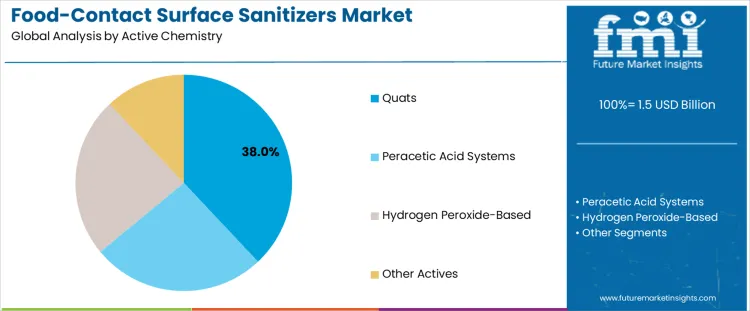
Food contact compliant quats lead demand with a 38% share because they provide reliable antimicrobial performance with controlled residue behavior. These chemistries are widely specified for routine sanitation of processing surfaces and equipment. Peracetic acid systems are adopted where rapid action and broad efficacy are required, particularly against resistant microorganisms. Hydrogen peroxide based sanitizers are applied where decomposition into benign byproducts is preferred. Other actives address specialized surface or regulatory requirements. Active chemistry selection reflects balance between efficacy, surface safety, and operational practicality rather than maximum biocidal strength. Demand therefore aligns with validated sanitation protocols and regulatory acceptance.
Active chemistry demand remains stable because sanitation programs are standardized and audited. Quat systems are embedded in daily cleaning schedules. PAA and peroxide products are deployed where process conditions justify their use. Alternative actives remain limited to defined applications. These patterns restrict rapid chemistry substitution. Active chemistry segmentation highlights reliance on proven disinfectant performance within food safety compliance frameworks rather than short term shifts in sanitizer preferences.
How Does Application Format Shape Demand for Food Contact Surface Sanitizers Market?
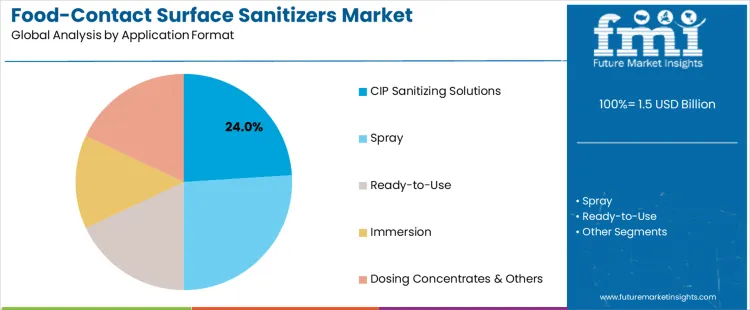
CIP sanitizing solutions account for about 24% of total demand, making them the leading application format. Their use reflects widespread adoption of automated cleaning systems in food and beverage processing. Spray and foam sanitizers are applied where manual surface coverage and contact time control are required. Ready to use formats and wipes support spot sanitation and rapid response needs. Immersion and dip sanitizers are used for tools and removable components. Dosing concentrates support centralized sanitation control. Application format selection depends on equipment design, labor structure, and validation requirements. Demand follows sanitation system configuration rather than chemistry potency.
CIP formats maintain leadership due to integration with closed processing systems. Spray and foam products remain essential for open surfaces. RTU formats persist in low volume tasks. Immersion systems serve specific hygiene steps. Operators avoid frequent format changes to maintain compliance consistency. This stabilizes demand by format. Application format segmentation therefore reinforces concentration in CIP based sanitation solutions.
How Are Food-Contact Surface Sanitizers Being Applied Across Commercial and Institutional Kitchens?
Use appears in environments where hygiene and microbial control are critical on surfaces that come into direct contact with food. Restaurants, cafeterias, food processing plants, and catering facilities apply sanitizers on countertops, cutting boards, equipment, and utensils to prevent contamination and comply with food safety standards. Packaging and storage areas also rely on these products to maintain sanitation. These applications reflect operational and safety priorities rather than aesthetic purposes, with adoption driven by microbial reduction, regulatory compliance, and food safety assurance.
What Operational and Material Conditions Support Adoption of Food-Contact Surface Sanitizers?
Selection aligns with products that achieve rapid microbial reduction without leaving harmful residues. Formulations are optimized for compatibility with stainless steel, plastics, and coated surfaces while being safe for food contact. Cleaning protocols incorporate manual or automated application, ensuring coverage and contact time. Health and safety teams favor products compliant with local food safety regulations and approved for routine use. These conditions emerge from operational efficiency, surface protection, and regulatory adherence priorities in structured foodservice and processing workflows.
Which Practical Considerations Limit Wider Use of Food-Contact Surface Sanitizers?
Effectiveness depends on proper application, contact time, and surface cleanliness. Overuse or misuse can lead to chemical residues or corrosion on sensitive materials. Cost per use may influence adoption in high-volume operations. Regulatory approval and labeling requirements can vary by region. Training is required for staff to ensure correct application and safety. These factors lead to selective deployment where microbial control, surface integrity, and compliance justify incremental cost and procedural oversight.
What is the Demand for Food Contact Surface Sanitizers by Country?
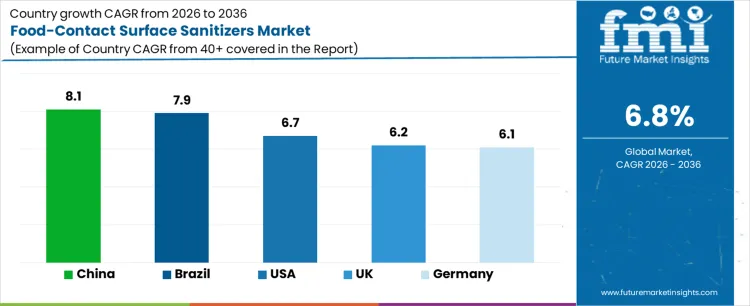
| Country | CAGR (%) |
|---|---|
| USA | 6.7% |
| Germany | 6.1% |
| China | 8.1% |
| UK | 6.2% |
| Brazil | 7.9% |
The demand for food contact surface sanitizers varies across countries, driven by food safety regulations, hygiene standards, and growth in the foodservice and processing sectors. China leads with an 8.1% CAGR, supported by expanding food processing, retail, and foodservice industries requiring effective sanitization solutions. Brazil follows at 7.9%, driven by commercial kitchens, food production facilities, and regulatory compliance. The USA grows at 6.7%, reflecting steady adoption in restaurants, food processing, and institutional facilities. Germany records 6.1%, shaped by strict hygiene standards and mature cleaning markets. The UK posts 6.2%, supported by consistent demand in commercial food preparation and processing environments.
How Is Food-Contact Surface Sanitization Driving Growth in the United States?
In the United States, revenue from the Food-Contact Surface Sanitizers Market is expanding at a CAGR of 6.7% through 2036, driven by adoption of chemical formulations that ensure microbial control on surfaces in direct contact with food. Manufacturers are integrating sanitizers in commercial kitchens, food processing facilities, and institutional foodservice operations to maintain hygiene, prevent contamination, and comply with regulatory standards. Demand is concentrated in restaurants, industrial kitchens, hospitals, and retail foodservice. Domestic suppliers provide high-performance, surface-compatible chemical solutions suitable for manual and automated sanitation processes. Recurring cleaning schedules, hygiene standards, and regulatory compliance are sustaining predictable procurement nationwide.
- Restaurants, industrial kitchens, hospitals, and retail foodservice drive adoption
- Chemicals provide microbial control on food-contact surfaces
- Domestic suppliers provide surface-compatible, high-performance sanitizers
- Recurring cleaning schedules sustain predictable procurement
How Are Hygiene Standards Supporting Growth in Germany?
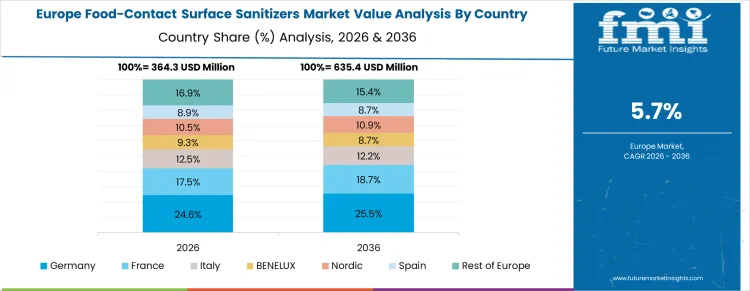
Germany continues to record steady growth in the Food-Contact Surface Sanitizers Market at a CAGR of 6.1% through 2036, supported by stringent food safety regulations and industrial hygiene requirements. Manufacturers are adopting surface sanitizers to prevent microbial contamination in commercial kitchens, food processing, and industrial foodservice facilities. Demand is concentrated in restaurants, hotels, hospitals, and institutional kitchens. Domestic suppliers provide high-quality, surface-compatible chemical solutions suitable for automated and manual sanitation systems. Compliance with hygiene regulations and recurring cleaning programs are sustaining measured adoption nationwide.
- Restaurants, hotels, hospitals, and industrial kitchens anchor demand
- Sanitizers prevent microbial contamination on food-contact surfaces
- Domestic suppliers provide surface-compatible, high-quality chemical solutions
- Recurring cleaning programs sustain steady adoption
How Is Foodservice and Industrial Expansion Accelerating Adoption in China?
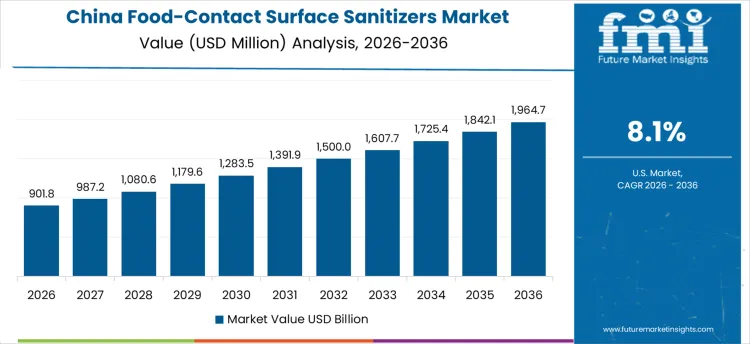
In China, revenue from the Food-Contact Surface Sanitizers Market is growing at a CAGR of 8.1% through 2036, driven by rapid growth in foodservice operations, industrial kitchens, and institutional facilities. Manufacturers are integrating chemical sanitizers to maintain hygiene, prevent contamination, and ensure compliance with food safety standards. Demand is strong across restaurants, hotels, industrial kitchens, and catering services. Domestic suppliers are scaling production of high-performance, surface-compatible sanitizers suitable for manual and automated cleaning systems. Expansion of foodservice infrastructure and recurring sanitation schedules are sustaining rapid adoption nationwide.
- Restaurants, hotels, industrial kitchens, and catering services drive adoption
- Sanitizers maintain hygiene and prevent contamination
- Domestic suppliers scale high-performance, surface-compatible formulations
- Recurring sanitation schedules sustain consistent adoption
How Is Hygiene and Foodservice Operations Supporting Growth in the United Kingdom?
In the United Kingdom, revenue from the Food-Contact Surface Sanitizers Market is expanding at a CAGR of 6.2% through 2036, supported by adoption of chemical sanitizers in commercial kitchens, institutional facilities, and industrial foodservice operations. Manufacturers are integrating sanitizers to remove microbes, maintain surface hygiene, and ensure compliance with food safety standards. Demand is concentrated in restaurants, hotels, schools, and industrial kitchens. Domestic suppliers provide high-quality, surface-compatible sanitizers suitable for automated and manual sanitation processes. Recurring cleaning schedules, regulatory compliance, and hygiene monitoring are sustaining predictable procurement nationwide.
- Restaurants, hotels, schools, and industrial kitchens anchor demand
- Sanitizers remove microbes and maintain surface hygiene
- Domestic suppliers provide surface-compatible, high-quality formulations
- Recurring cleaning schedules sustain predictable procurement
How Is Foodservice and Industrial Expansion Supporting Adoption in Brazil?
Brazil is seeing strong growth in the Food-Contact Surface Sanitizers Market at a CAGR of 7.9% through 2036, supported by increasing adoption in commercial kitchens, industrial foodservice, and institutional facilities. Manufacturers are adopting chemical sanitizers to prevent microbial contamination, maintain hygiene, and comply with food safety regulations. Demand is concentrated in restaurants, hotels, hospitals, and industrial kitchens. Domestic suppliers are expanding production of high-performance, surface-compatible chemical solutions suitable for manual and automated sanitation systems. Growth in hygiene compliance and recurring sanitation schedules are sustaining robust procurement nationwide.
- Restaurants, hotels, hospitals, and industrial kitchens drive adoption
- Sanitizers prevent microbial contamination and maintain hygiene
- Domestic suppliers expand surface-compatible, high-performance chemical solutions
- Recurring sanitation schedules sustain robust procurement
Which Companies Compete in the Food Contact Surface Sanitizers Market Based On Validation Protocols and On Site Use Conditions?
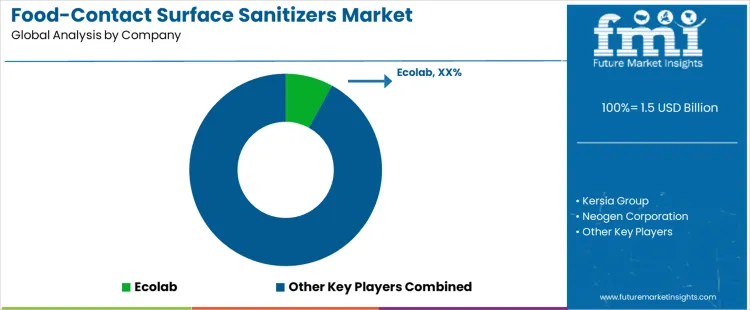
Food contact surface sanitizers are selected through verification against regulatory test methods and their performance during repeated daily use. In food processing and commercial kitchens, acceptance depends on whether products achieve required microbial reduction without leaving residues that interfere with production. Ecolab and Kersia Group influence this market through sanitation programs embedded in processing operations, where chemicals are specified alongside procedures, contact times, and verification routines. Solenis, through the Diversey platform, supplies surface sanitizers aligned with standardized hygiene frameworks used across foodservice and institutional facilities. Neogen Corporation and Virox Technologies participate through solutions positioned for controlled sanitation environments, including ready to use and accelerated hydrogen peroxide based systems. Product choice reflects efficacy under real soil loads, surface compatibility, and repeatability under frequent application.
Competitive outcomes are shaped by how sanitizers fit within broader hygiene workflows rather than by active chemistry alone. Christeyns maintains a strong role in professional food environments where sanitation is integrated with cleaning and rinse sequences. SC Johnson Professional and Reckitt supply formulations used where simplicity of application and clear labeling support staff compliance. LANXESS contributes upstream through biocidal active substances supplied into formulated sanitizers rather than finished products. 3M participates selectively through surface care systems and ancillary sanitation solutions. Local distributors and quality managers influence adoption by aligning products with inspection regimes, training practices, and documentation requirements. Competitive positioning depends on regulatory acceptance, operational reliability, and consistency during audits rather than formulation breadth or branding.
Key Players in the Food Contact Surface Sanitizers Market
- Ecolab
- Kersia Group
- Neogen Corporation
- Solenis (Diversey)
- Virox Technologies
- Christeyns
- SC Johnson Professional
- Reckitt
- Lanxess
- 3M
Scope of the Report
| Items | Values |
|---|---|
| Quantitative Units (2026) | USD billion |
| Active Chemistry | Quats (food-contact compliant), Peracetic Acid Systems, Hydrogen Peroxide-Based, Other Actives |
| Application Format | CIP Sanitizing Solutions, Spray / Foam Sanitizers, Ready-to-Use / Wipes, Immersion / Dip Sanitizers, Dosing Concentrates & Others |
| End-Use / Application | Food Processing Plants, Dairy & Beverage, Commercial Kitchens, Retail & Other |
| Procurement Model | Integrated Service Contracts, Distributor Purchase, Direct Plant Procurement, Online / Small Accounts |
| Region | Asia Pacific (China, Japan, South Korea, India, Australia & New Zealand, ASEAN, Rest of Asia Pacific), Europe (Germany, United Kingdom, France, Italy, Spain, Nordic, BENELUX, Rest of Europe), North America (United States, Canada, Mexico), Latin America (Brazil, Chile, Rest of Latin America), Middle East & Africa (KSA, Other GCC Countries, Turkey, South Africa, Other African Union, Rest of Middle East & Africa) |
| Key Companies Profiled | Ecolab, Kersia Group, Neogen Corporation, Solenis (Diversey), Virox Technologies, Christeyns, SC Johnson Professional, Reckitt, Lanxess, 3M |
| Additional Attributes | Dollar by sales by active chemistry, Dollar by sales by application format, Dollar by sales by end-use, Dollar by sales by procurement model, Dollar by sales by region, Efficacy under real-use surface conditions, Compliance with food-contact regulations, Repeat application reliability, Compatibility with cleaning and automation systems, Safety and residue performance |
Food Contact Surface Sanitizers Market Segmentation
Active Chemistry:
- Quats (food-contact compliant)
- Peracetic Acid Systems
- Hydrogen Peroxide-Based
- Other Actives
Application Format:
- CIP Sanitizing Solutions
- Spray / Foam Sanitizers
- Ready-to-Use / Wipes
- Immersion / Dip Sanitizers
- Dosing Concentrates & Others
End-Use:
- Food Processing Plants
- Dairy & Beverage
- Commercial Kitchens
- Retail & Other
Procurement Model:
- Integrated Service Contracts
- Distributor Purchase
- Direct Plant Procurement
- Online / Small Accounts
Region
Asia Pacific
- China
- Japan
- South Korea
- India
- Australia & New Zealand
- ASEAN
- Rest of Asia Pacific
Europe
- Germany
- United Kingdom
- France
- Italy
- Spain
- Nordic
- BENELUX
- Rest of Europe
North America
- United States
- Canada
- Mexico
Latin America
- Brazil
- Chile
- Rest of Latin America
Middle East & Africa
- Kingdom of Saudi Arabia
- Other GCC Countries
- Turkey
- South Africa
- Other African Union
- Rest of Middle East & Africa
Frequently Asked Questions
How big is the food-contact surface sanitizers market in 2026?
The global food-contact surface sanitizers market is valued at USD 1.5 billion in 2026.
What will be the size of the food-contact surface sanitizers market in 2036?
The market is projected to reach USD 2.9 billion by 2036.
How fast will the food-contact surface sanitizers market grow between 2026 and 2036?
The market will grow at a CAGR of 6.8% from 2026 to 2036.
Which active chemistry leads the food-contact surface sanitizers market in 2026?
Food-contact compliant quats lead the market with a 38.0% share in 2026.
Who are the major players in the food-contact surface sanitizers market?
Key players include Ecolab, Kersia Group, Neogen Corporation, Solenis (Diversey), Virox Technologies, Christeyns, SC Johnson Professional, Reckitt, Lanxess, and 3M.
Preview the report firsthand - request a free sample
Get SampleGet the brochure for pricing and purchase details.
Get PDFTable of Content
- Executive Summary
- Global Market Outlook
- Demand-side Trends
- Supply-side Trends
- Technology Roadmap Analysis
- Analysis and Recommendations
- Market Overview
- Market Coverage / Taxonomy
- Market Definition / Scope / Limitations
- Market Background
- Market Dynamics
- Drivers
- Restraints
- Opportunity
- Trends
- Scenario Forecast
- Demand in Optimistic Scenario
- Demand in Likely Scenario
- Demand in Conservative Scenario
- Opportunity Map Analysis
- Product Life Cycle Analysis
- Supply Chain Analysis
- Investment Feasibility Matrix
- Value Chain Analysis
- PESTLE and Porter’s Analysis
- Regulatory Landscape
- Regional Parent Market Outlook
- Production and Consumption Statistics
- Import and Export Statistics
- Market Dynamics
- Global Market Analysis 2021 to 2025 and Forecast, 2026 to 2036
- Historical Market Size Value (USD Million) Analysis, 2021 to 2025
- Current and Future Market Size Value (USD Million) Projections, 2026 to 2036
- Y-o-Y Growth Trend Analysis
- Absolute $ Opportunity Analysis
- Global Market Pricing Analysis 2021 to 2025 and Forecast 2026 to 2036
- Global Market Analysis 2021 to 2025 and Forecast 2026 to 2036, By Active Chemistry
- Introduction / Key Findings
- Historical Market Size Value (USD Million) Analysis By Active Chemistry , 2021 to 2025
- Current and Future Market Size Value (USD Million) Analysis and Forecast By Active Chemistry , 2026 to 2036
- Quats
- Peracetic Acid Systems
- Hydrogen Peroxide-Based
- Other Actives
- Quats
- Y-o-Y Growth Trend Analysis By Active Chemistry , 2021 to 2025
- Absolute $ Opportunity Analysis By Active Chemistry , 2026 to 2036
- Global Market Analysis 2021 to 2025 and Forecast 2026 to 2036, By Application Format
- Introduction / Key Findings
- Historical Market Size Value (USD Million) Analysis By Application Format, 2021 to 2025
- Current and Future Market Size Value (USD Million) Analysis and Forecast By Application Format, 2026 to 2036
- CIP Sanitizing Solutions
- Spray
- Ready-to-Use
- Immersion
- Dosing Concentrates & Others
- CIP Sanitizing Solutions
- Y-o-Y Growth Trend Analysis By Application Format, 2021 to 2025
- Absolute $ Opportunity Analysis By Application Format, 2026 to 2036
- Global Market Analysis 2021 to 2025 and Forecast 2026 to 2036, By End-Use
- Introduction / Key Findings
- Historical Market Size Value (USD Million) Analysis By End-Use, 2021 to 2025
- Current and Future Market Size Value (USD Million) Analysis and Forecast By End-Use, 2026 to 2036
- Food Processing Plants
- Dairy & Beverage
- Commercial Kitchens
- Retail & Other
- Food Processing Plants
- Y-o-Y Growth Trend Analysis By End-Use, 2021 to 2025
- Absolute $ Opportunity Analysis By End-Use, 2026 to 2036
- Global Market Analysis 2021 to 2025 and Forecast 2026 to 2036, By Procurement Model
- Introduction / Key Findings
- Historical Market Size Value (USD Million) Analysis By Procurement Model, 2021 to 2025
- Current and Future Market Size Value (USD Million) Analysis and Forecast By Procurement Model, 2026 to 2036
- Integrated Service Contracts
- Distributor Purchase
- Direct Plant Procurement
- Online or Small Accounts
- Integrated Service Contracts
- Y-o-Y Growth Trend Analysis By Procurement Model, 2021 to 2025
- Absolute $ Opportunity Analysis By Procurement Model, 2026 to 2036
- Global Market Analysis 2021 to 2025 and Forecast 2026 to 2036, By Region
- Introduction
- Historical Market Size Value (USD Million) Analysis By Region, 2021 to 2025
- Current Market Size Value (USD Million) Analysis and Forecast By Region, 2026 to 2036
- North America
- Latin America
- Western Europe
- Eastern Europe
- East Asia
- South Asia and Pacific
- Middle East & Africa
- Market Attractiveness Analysis By Region
- North America Market Analysis 2021 to 2025 and Forecast 2026 to 2036, By Country
- Historical Market Size Value (USD Million) Trend Analysis By Market Taxonomy, 2021 to 2025
- Market Size Value (USD Million) Forecast By Market Taxonomy, 2026 to 2036
- By Country
- USA
- Canada
- Mexico
- By Active Chemistry
- By Application Format
- By End-Use
- By Procurement Model
- By Country
- Market Attractiveness Analysis
- By Country
- By Active Chemistry
- By Application Format
- By End-Use
- By Procurement Model
- Key Takeaways
- Latin America Market Analysis 2021 to 2025 and Forecast 2026 to 2036, By Country
- Historical Market Size Value (USD Million) Trend Analysis By Market Taxonomy, 2021 to 2025
- Market Size Value (USD Million) Forecast By Market Taxonomy, 2026 to 2036
- By Country
- Brazil
- Chile
- Rest of Latin America
- By Active Chemistry
- By Application Format
- By End-Use
- By Procurement Model
- By Country
- Market Attractiveness Analysis
- By Country
- By Active Chemistry
- By Application Format
- By End-Use
- By Procurement Model
- Key Takeaways
- Western Europe Market Analysis 2021 to 2025 and Forecast 2026 to 2036, By Country
- Historical Market Size Value (USD Million) Trend Analysis By Market Taxonomy, 2021 to 2025
- Market Size Value (USD Million) Forecast By Market Taxonomy, 2026 to 2036
- By Country
- Germany
- UK
- Italy
- Spain
- France
- Nordic
- BENELUX
- Rest of Western Europe
- By Active Chemistry
- By Application Format
- By End-Use
- By Procurement Model
- By Country
- Market Attractiveness Analysis
- By Country
- By Active Chemistry
- By Application Format
- By End-Use
- By Procurement Model
- Key Takeaways
- Eastern Europe Market Analysis 2021 to 2025 and Forecast 2026 to 2036, By Country
- Historical Market Size Value (USD Million) Trend Analysis By Market Taxonomy, 2021 to 2025
- Market Size Value (USD Million) Forecast By Market Taxonomy, 2026 to 2036
- By Country
- Russia
- Poland
- Hungary
- Balkan & Baltic
- Rest of Eastern Europe
- By Active Chemistry
- By Application Format
- By End-Use
- By Procurement Model
- By Country
- Market Attractiveness Analysis
- By Country
- By Active Chemistry
- By Application Format
- By End-Use
- By Procurement Model
- Key Takeaways
- East Asia Market Analysis 2021 to 2025 and Forecast 2026 to 2036, By Country
- Historical Market Size Value (USD Million) Trend Analysis By Market Taxonomy, 2021 to 2025
- Market Size Value (USD Million) Forecast By Market Taxonomy, 2026 to 2036
- By Country
- China
- Japan
- South Korea
- By Active Chemistry
- By Application Format
- By End-Use
- By Procurement Model
- By Country
- Market Attractiveness Analysis
- By Country
- By Active Chemistry
- By Application Format
- By End-Use
- By Procurement Model
- Key Takeaways
- South Asia and Pacific Market Analysis 2021 to 2025 and Forecast 2026 to 2036, By Country
- Historical Market Size Value (USD Million) Trend Analysis By Market Taxonomy, 2021 to 2025
- Market Size Value (USD Million) Forecast By Market Taxonomy, 2026 to 2036
- By Country
- India
- ASEAN
- Australia & New Zealand
- Rest of South Asia and Pacific
- By Active Chemistry
- By Application Format
- By End-Use
- By Procurement Model
- By Country
- Market Attractiveness Analysis
- By Country
- By Active Chemistry
- By Application Format
- By End-Use
- By Procurement Model
- Key Takeaways
- Middle East & Africa Market Analysis 2021 to 2025 and Forecast 2026 to 2036, By Country
- Historical Market Size Value (USD Million) Trend Analysis By Market Taxonomy, 2021 to 2025
- Market Size Value (USD Million) Forecast By Market Taxonomy, 2026 to 2036
- By Country
- Kingdom of Saudi Arabia
- Other GCC Countries
- Turkiye
- South Africa
- Other African Union
- Rest of Middle East & Africa
- By Active Chemistry
- By Application Format
- By End-Use
- By Procurement Model
- By Country
- Market Attractiveness Analysis
- By Country
- By Active Chemistry
- By Application Format
- By End-Use
- By Procurement Model
- Key Takeaways
- Key Countries Market Analysis
- USA
- Pricing Analysis
- Market Share Analysis, 2025
- By Active Chemistry
- By Application Format
- By End-Use
- By Procurement Model
- Canada
- Pricing Analysis
- Market Share Analysis, 2025
- By Active Chemistry
- By Application Format
- By End-Use
- By Procurement Model
- Mexico
- Pricing Analysis
- Market Share Analysis, 2025
- By Active Chemistry
- By Application Format
- By End-Use
- By Procurement Model
- Brazil
- Pricing Analysis
- Market Share Analysis, 2025
- By Active Chemistry
- By Application Format
- By End-Use
- By Procurement Model
- Chile
- Pricing Analysis
- Market Share Analysis, 2025
- By Active Chemistry
- By Application Format
- By End-Use
- By Procurement Model
- Germany
- Pricing Analysis
- Market Share Analysis, 2025
- By Active Chemistry
- By Application Format
- By End-Use
- By Procurement Model
- UK
- Pricing Analysis
- Market Share Analysis, 2025
- By Active Chemistry
- By Application Format
- By End-Use
- By Procurement Model
- Italy
- Pricing Analysis
- Market Share Analysis, 2025
- By Active Chemistry
- By Application Format
- By End-Use
- By Procurement Model
- Spain
- Pricing Analysis
- Market Share Analysis, 2025
- By Active Chemistry
- By Application Format
- By End-Use
- By Procurement Model
- France
- Pricing Analysis
- Market Share Analysis, 2025
- By Active Chemistry
- By Application Format
- By End-Use
- By Procurement Model
- India
- Pricing Analysis
- Market Share Analysis, 2025
- By Active Chemistry
- By Application Format
- By End-Use
- By Procurement Model
- ASEAN
- Pricing Analysis
- Market Share Analysis, 2025
- By Active Chemistry
- By Application Format
- By End-Use
- By Procurement Model
- Australia & New Zealand
- Pricing Analysis
- Market Share Analysis, 2025
- By Active Chemistry
- By Application Format
- By End-Use
- By Procurement Model
- China
- Pricing Analysis
- Market Share Analysis, 2025
- By Active Chemistry
- By Application Format
- By End-Use
- By Procurement Model
- Japan
- Pricing Analysis
- Market Share Analysis, 2025
- By Active Chemistry
- By Application Format
- By End-Use
- By Procurement Model
- South Korea
- Pricing Analysis
- Market Share Analysis, 2025
- By Active Chemistry
- By Application Format
- By End-Use
- By Procurement Model
- Russia
- Pricing Analysis
- Market Share Analysis, 2025
- By Active Chemistry
- By Application Format
- By End-Use
- By Procurement Model
- Poland
- Pricing Analysis
- Market Share Analysis, 2025
- By Active Chemistry
- By Application Format
- By End-Use
- By Procurement Model
- Hungary
- Pricing Analysis
- Market Share Analysis, 2025
- By Active Chemistry
- By Application Format
- By End-Use
- By Procurement Model
- Kingdom of Saudi Arabia
- Pricing Analysis
- Market Share Analysis, 2025
- By Active Chemistry
- By Application Format
- By End-Use
- By Procurement Model
- Turkiye
- Pricing Analysis
- Market Share Analysis, 2025
- By Active Chemistry
- By Application Format
- By End-Use
- By Procurement Model
- South Africa
- Pricing Analysis
- Market Share Analysis, 2025
- By Active Chemistry
- By Application Format
- By End-Use
- By Procurement Model
- USA
- Market Structure Analysis
- Competition Dashboard
- Competition Benchmarking
- Market Share Analysis of Top Players
- By Regional
- By Active Chemistry
- By Application Format
- By End-Use
- By Procurement Model
- Competition Analysis
- Competition Deep Dive
- Ecolab
- Overview
- Product Portfolio
- Profitability by Market Segments (Product/Age /Sales Channel/Region)
- Sales Footprint
- Strategy Overview
- Marketing Strategy
- Product Strategy
- Channel Strategy
- Kersia Group
- Neogen Corporation
- Solenis (Diversey)
- Virox Technologies
- Christeyns
- SC Johnson Professional
- Reckitt
- Lanxess
- 3M
- Ecolab
- Competition Deep Dive
- Assumptions & Acronyms Used
- Research Methodology


