

- Market Size (2026)
- USD 1.05 Bn
- Forecast (2036)
- USD 8.42 Bn
- CAGR (2026 to 2036)
- 23.1%
Smart Shopping Cart Market Size, Market Forecast and Outlook by FMI
Summary of the Smart Shopping Cart Market
- Demand and Growth Drivers
- Checkout friction keeps smart carts relevant as shoppers want running totals before they reach payment.
- Retail shrink pressure supports cart-level scanning and product recognition in grocery stores.
- In-store retail media is expected to raise cart value as screens become coupon and ad surfaces.
- Amazon’s Dash Cart data in Q1 2024 showed 80% repeat use among Dash Cart shoppers.
- Product and Segment View
- Computer vision carts are projected to account for 48.0% share in 2026 as product recognition becomes central to cart value.
- Full smart carts are estimated to represent 58.0% share in 2026 as retailers favor built-in screens and payment flow.
- Grocery stores are expected to hold 64.0% share in 2026 since basket size and repeat trips fit smart-cart economics.
- Geography and Competitive Outlook
- Israel is projected to record 28.4% CAGR by 2036 as local suppliers and retailer pilots create a dense test market.
- China is expected to expand at 26.5% CAGR by 2036 as large grocery chains test automated checkout formats.
- Instacart, Amazon, A2Z Cust2Mate and Shopic hold the clearest supplier positions through smart-cart rollouts and retailer partnerships.
- A2Z Cust2Mate listed 3,000 smart carts ordered by Latin American partner Trixo in June 2025 and 4,000 carts planned with Carrefour Israel in April 2026.
- Analyst Opinion
- Sudip Saha, Managing Director at FMI, observes, “Smart shopping carts are no longer a pure checkout-speed product. I see the market shifting toward three measurable retailer outcomes. Clients should watch whether carts lower self-checkout shrink without adding staff burden. They should also track whether retail-media revenue can reduce the payback period for grocers.”
- Smart Shopping Cart Market Value Analysis
- Grocery adoption supports revenue as food stores generate repeat trips and larger weekly baskets.
- Computer vision raises average selling price as cameras and AI recognition are built into the cart.
- Retail-media screens create recurring revenue beyond hardware sales and monthly service contracts.
- Store integration cost limits adoption in smaller retailers that cannot support charging stations and fleet maintenance.
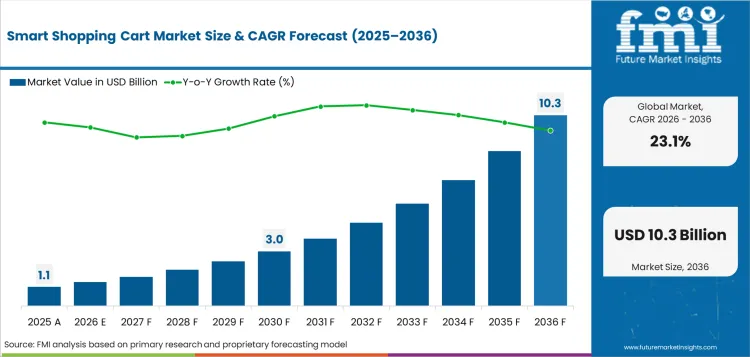
Key Takeaways, Market Size, and Forecast
- The smart shopping cart market value is estimated at USD 875.0 million in 2025.
- Global smart shopping cart market is projected to reach USD 8.42 billion by 2036 as grocers move checkout, payment and retail-media functions closer to the shopper.
- The market is expected to expand at 23.1% CAGR from 2026 to 2036 across grocery stores, hypermarkets and selected specialty retail formats.
- The market is projected to create an incremental opportunity of USD 7.37 billion between 2026 and 2036.
- Computer vision carts are expected to account for 48.0% share in 2026 due to product recognition and loss-prevention use.
- Full smart carts are estimated to represent 58.0% share in 2026 as larger grocers prefer integrated checkout screens and payment modules.
- Israel at 28.4% CAGR and China at 26.5% CAGR are expected to record the fastest country-level pace by 2036.
Smart carts are moving from checkout replacement into store operating systems. Instacart said in June 2024 that 11 ShopRite stores had added Caper Carts and Wakefern expected wider member adoption over the next year. Amazon reported in June 2024 that 80% of Dash Cart shoppers were repeat users, with 98% customer satisfaction and 10% higher spend than non-Dash Cart shoppers. The practical market signal is clear. Retailers are testing carts where basket value and loss control can be measured at the aisle level.
Smart Shopping Cart Market Definition
The sector covers connected shopping carts used inside physical retail stores for scanning, product recognition, basket tracking, digital payment, navigation, couponing and in-store advertising. Included products cover full smart carts, clip-on smart modules and retrofit systems attached to standard carts. The scope includes grocery stores, hypermarkets, supermarkets, club stores and selected specialty retail formats.
Standard metal shopping carts without digital features, handheld barcode scanners, mobile scan-and-go apps without cart hardware and fully camera-based ceiling checkout systems fall outside this study.
Smart Shopping Cart Market Inclusions
The study includes computer vision carts, RFID-enabled carts, barcode-scanning carts, hybrid recognition carts, full smart carts, clip-on modules, retrofit kits, grocery-store use, hypermarket use, direct sales, integrator-led installation, hardware leasing, software service revenue and retail-media revenue.
Market scope covers commercially traded smart shopping cart systems by technology, including computer vision and RFID; cart type, including full carts and clip-on modules; application, including grocery stores and hypermarkets; and revenue model, including direct purchase, leasing and media services.
Revenue scope covers 2026 to 2036. The key stakeholders include smart cart manufacturers, grocery chains, supermarket cooperatives, retail technology integrators, payment firms, cloud service providers, computer vision vendors, in-store media networks, loss-prevention teams and retail operations teams.
Smart Shopping Cart Market Exclusions
The study excludes ordinary shopping carts, mobile-only scan-and-go apps, handheld scanners, self-checkout kiosks, cashierless ceiling-camera systems, warehouse picking carts and autonomous delivery robots.
Smart Shopping Cart Market Research Methodology
- Primary Research: FMI analysts reviewed grocery technology buyers, supermarket operations teams, checkout-equipment integrators and retail-media planners. Interviews focused on cart accuracy, store layout fit, shopper acceptance, payment flow and fleet maintenance.
- Desk Research: The desk review used official company releases, retailer rollout statements, retail sales data, patent information and public retail technology disclosures. Store-format data supported the country-level demand checks.
- Market Sizing and Forecasting: The forecast combined estimated cart fleet additions, average hardware value, software fees and media-service revenue. Segment shares were checked against supplier portfolios and public rollout patterns.
- Data Validation: Final values were checked against grocery-store counts, retailer pilot activity, smart-checkout substitution trends and supplier order disclosures.
Why is the Smart Shopping Cart Market Growing?
- Smart carts reduce checkout wait time by moving scanning and basket totals to the aisle.
- Grocers use cart screens to show running totals and reduce payment surprises for budget-sensitive shoppers.
- Computer vision supports loss prevention when stores need item recognition before checkout.
- Retail-media income gives smart carts a second commercial use case inside the store.
- Grocery chains test carts before wider rollouts as fleet maintenance and shopper behavior must be proven locally.
Market Segmentation Analysis
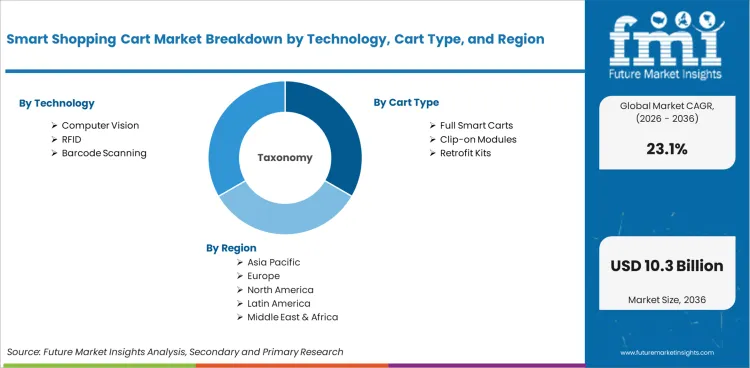
The smart shopping cart market is segmented by technology into computer vision, RFID, barcode scanning and hybrid recognition. By cart type, the market is divided into full smart carts, clip-on modules and retrofit kits.
Based on application, the market is segmented into grocery stores, hypermarkets, club stores and specialty retail. By revenue model, the market is categorized into hardware purchase, hardware leasing and retail-media services. By sales channel, the market is divided into direct sales and system integrators.
Amazon’s shift from Just Walk Out technology toward Dash Cart in USA Fresh stores shows why carts are gaining attention. AP reported in April 2024 that Amazon replaced the store-level system in Fresh stores with smart carts after customers said they wanted to see receipts and savings while shopping. This turns the cart into a budgeting screen as much as a checkout device. It also explains why grocers prefer pilots before full fleet replacement.
Smart Shopping Cart Market Analysis by Technology
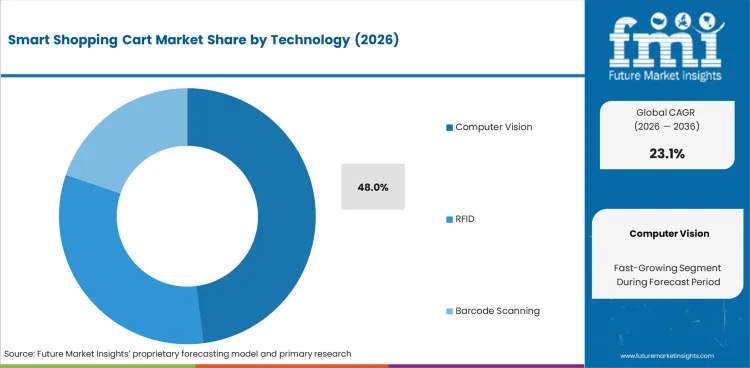
- Computer vision is expected to account for 48.0% share in 2026 as grocers value item recognition without depending only on barcode discipline.
- RFID gains use in controlled retail formats where product tagging is easier and item-level inventory visibility supports operations.
Insights into Computer Vision Segment
- Computer vision carts are expected to gain share as suppliers improve recognition for packaged items, loose produce and product removals.
- Tracxpoint states that its Daivi system uses eight onboard cameras and claims over 99% accuracy for product-package recognition.
Smart Shopping Cart Market Analysis by Cart Type
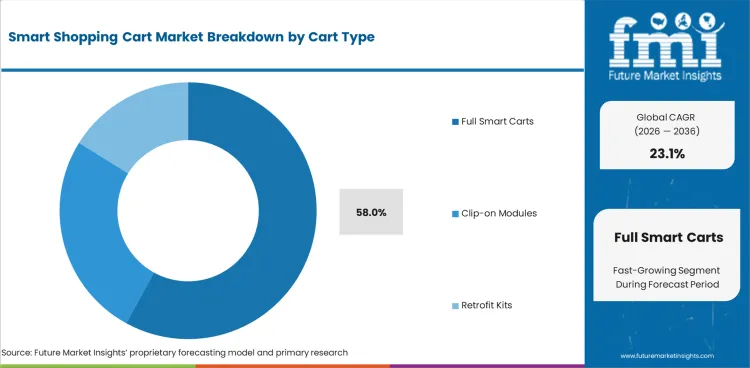
- Full smart carts are estimated to represent 58.0% share in 2026 as larger stores prefer integrated screens, scanners and payment modules.
- Clip-on modules serve retailers that want faster retrofit cycles without replacing existing cart fleets.
Insights into Clip-on Modules Segment
- Clip-on modules gain relevance where retailers want smart-cart functions without buying a new cart fleet.
- Shopic positions its product as a one-click attachment that turns standard carts into AI-powered smart carts with live totals and checkout flow.
Smart Shopping Cart Market Analysis by Application
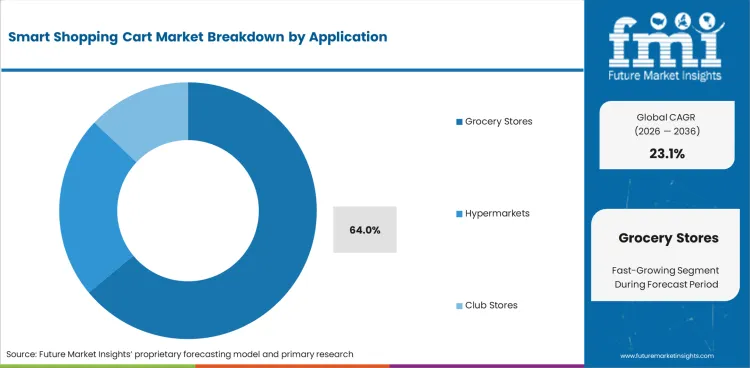
- Grocery stores are projected to hold 64.0% share in 2026 as weekly basket behavior creates frequent cart use.
- Hypermarkets create demand for navigation and in-aisle offers because shoppers move across larger store footprints.
Insights into Hypermarket Segment
- Hypermarkets use smart carts for path guidance and basket management across larger aisles.
- Amazon’s redesigned Dash Cart includes an interactive store map and real-time receipt updates through computer vision and sensor fusion.
Smart Shopping Cart Market Analysis by Revenue Model
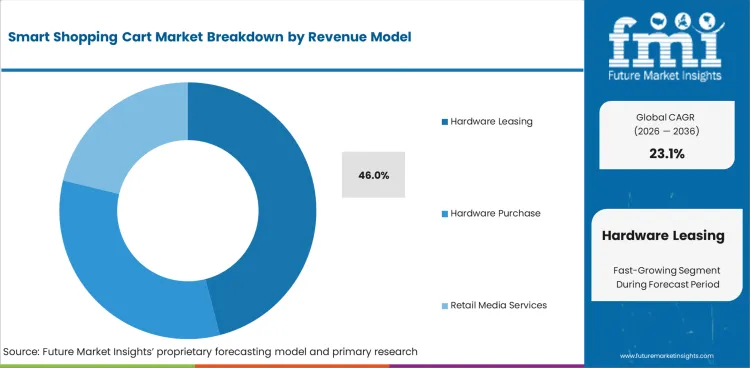
- Hardware leasing is expected to hold 46.0% share in 2026 as retailers avoid heavy upfront cart-fleet replacement.
- Retail-media services gain attention as cart screens create a direct ad surface beside the shopper’s basket.
Insights into Retail Media Services Segment
- Retail media is expected to gain share as cart screens move product discovery closer to the shelf.
- Instacart launched Caper Cart quests, location-based coupons and aisle-aware advertising formats in October 2024.
Smart Shopping Cart Market Analysis by Sales Channel
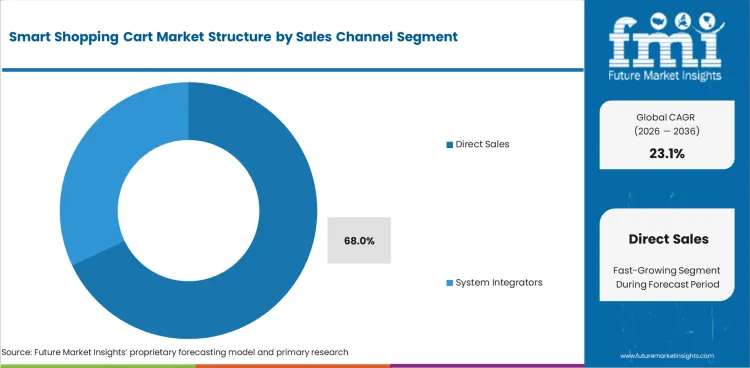
- Direct sales are expected to hold 68.0% share in 2026 as retailers need supplier support for pilots and store integration.
- System integrators serve multi-store rollouts where payment, loyalty and point-of-sale systems need local setup.
Insights into System Integrators Segment
- Integrators are important when carts must connect with loyalty systems, payment flow and existing checkout hardware.
- Shopic’s March 2025 partnership with Dimar and Retex shows how technology vendors use retail digital partners to enter grocery chains.
Smart Shopping Cart Market Drivers, Restraints, and Opportunities
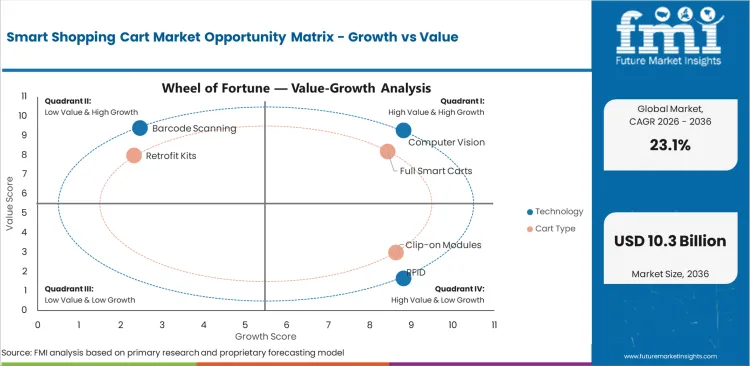
- Checkout visibility drives use as shoppers want running totals before reaching payment.
- Shrink control supports computer vision carts as retailers search for alternatives to unattended self-checkout.
- Retail-media screens create a monetization route that improves hardware payback.
- Store-level maintenance restrains adoption because carts need charging, cleaning and support.
- SNAP tracking and couponing create opportunities for carts in value-focused grocery formats.
Cart-Level Checkout Visibility
Smart carts solve a specific weakness in self-checkout. Shoppers want speed and also want to know the bill before payment. Amazon says Dash Cart screens show prices, spending and real-time receipt changes as items are added or removed. The cart functions as a budgeting device during the trip. Retailers benefit when fewer shoppers abandon baskets or dispute prices at the register. Grocery represents the strongest use case because price visibility matters on weekly household baskets.
Self-Checkout Shrink Pressure
Retailers are rethinking unattended checkout because theft and scanning errors remain difficult to control. Smart carts shift item capture earlier in the trip, which gives stores a chance to detect problems before payment. Computer vision suppliers pitch this as a loss-prevention layer rather than a simple convenience feature. Tracxpoint’s product claims use onboard cameras to read packaging and reduce theft risk. The commercial test is whether recognition accuracy holds under real grocery conditions. Fresh produce, multi-pack items and shopper removals are the hardest cases.
Retail-Media Screen Economics
Smart carts are becoming in-store media surfaces. Instacart’s October 2024 Caper Cart update added gamified quests, location-based coupons and aisle-aware ad formats. That changes the economics from one-time hardware sale to recurring media yield. Retailers already sell online sponsored placements, but carts bring sponsored prompts into the aisle. This favors suppliers with cart screens, location awareness and brand-ad systems. If media income offsets lease cost, cart adoption becomes easier for retailers with tight store-equipment budgets.
Regional Analysis
.webp "Top Country Growth Comparison Smart Shopping Cart Market Cagr (2026 2036)")
| Country | CAGR 2026 to 2036 |
|---|---|
| Israel | 28.4% |
| China | 26.5% |
| United Kingdom | 25.6% |
| United States | 24.8% |
| France | 22.8% |
| Germany | 22.4% |
| Japan | 18.9% |
Source: Future Market Insights analysis based on grocery technology rollout activity, retailer pilot evidence and public retail source checks in 2026.
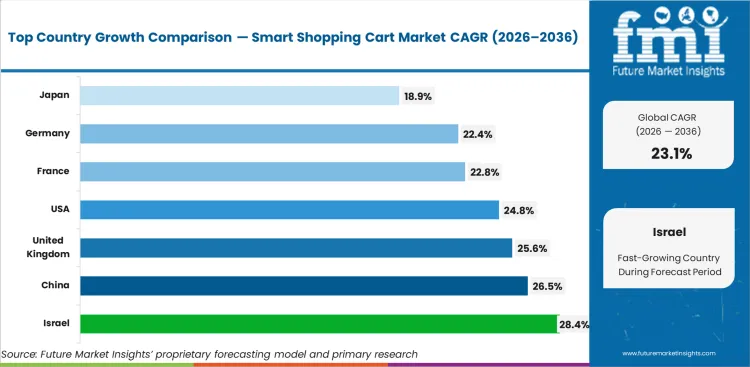
Analysis of Smart Shopping Cart Market by Key Countries
- China is projected to follow at 26.5% CAGR by 2036 as large store networks test automated retail formats.
- The United Kingdom is expected to expand at 25.6% CAGR by 2036 as grocery chains trial smart-cart checkout and payment systems.
- The United States demand is expected to advance at 24.8% CAGR by 2036 as Amazon, Instacart and regional grocers scale pilots.
- France is forecast at 22.8% CAGR by 2036 through supermarket modernization and retail-media interest.
- Germany is expected to record 22.4% CAGR by 2036 as disciplined store operations favor measurable checkout pilots.
- Japan is forecast at 18.9% CAGR by 2036 as labor pressure supports automation but store format discipline limits rapid rollout.
Country growth differs by retailer structure and supplier activity. Israel and China lead because local technology ecosystems and large retail groups support fast trials. The United States and United Kingdom follow with strong grocery technology activity. Germany, France and Japan grow from larger retail bases but move with stricter cost tests.
Demand Outlook for Smart Shopping Cart Market in China
The sector in China is expected to expand at 26.5% CAGR by 2036, supported by large retail chains and high digital-payment familiarity. Chinese grocers can test smart carts where shoppers already use mobile payments and loyalty apps. The near-term opportunity is strongest in premium supermarkets and large urban hypermarkets. Adoption depends on hardware cost and product-recognition accuracy in local packaged-food categories. China follows Israel because the addressable store network is much larger but supplier proof is more fragmented.
- Shanghai and Shenzhen support early smart-retail pilots through high digital-payment use and dense supermarket networks.
- Large hypermarkets in tier-one cities can justify cart screens for navigation and basket visibility.
- Local electronics manufacturing can reduce hardware cost if smart-cart demand moves beyond pilots.
Demand Outlook for Smart Shopping Cart Market in the United Kingdom
The sector in the United Kingdom is expected to expand at 25.6% CAGR by 2036 as supermarket chains test checkout upgrades. ONS reported that Great Britain retail sales volumes fell 0.3% in December 2024, with supermarket falls partly offset by non-food stores. This weak volume backdrop makes store productivity more important. Smart carts can support basket control and checkout speed without changing the whole store. Adoption is likely to stay pilot-heavy until retailers prove better basket value or lower shrink.
- Waitrose’s Shopic trial gives the United Kingdom a premium-grocery use case for smart cart checkout.
- Morrisons is linked with Caper Cart trials that bring smart trolleys into the UK grocery channel from 2026.
- London and South East stores are likely early test areas because basket size and labor costs are higher.
Demand Outlook for Smart Shopping Cart Market in the United States
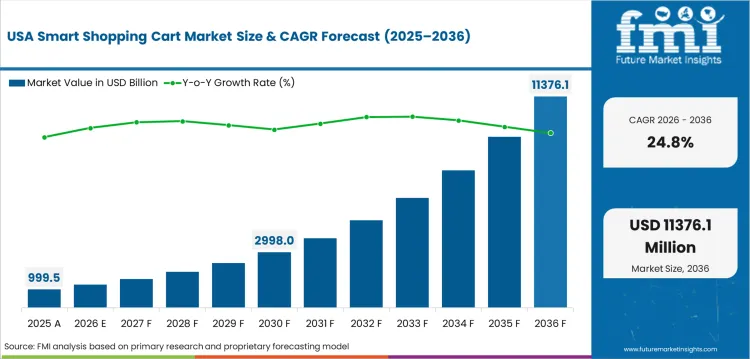
Sales of smart shopping carts in the United States are projected to increase at 24.8% CAGR by 2036 as grocers test cart-based checkout. The USA Census Bureau reported in April 2026 that retail trade sales were up 4.2% from the previous year. This retail scale gives smart-cart suppliers a large addressable base. Amazon and Instacart are the strongest visible deployment anchors. Value growth depends on whether regional grocers move from 10-store pilots into broader fleet orders.
- ShopRite adoption gives Caper Cart a regional supermarket proof point in New Jersey and Pennsylvania.
- Amazon Fresh shifted focus toward Dash Cart after customers asked for real-time receipt visibility.
- Wakefern’s member-owned structure can support wider rollout if early ShopRite locations prove store-level economics.
Demand Outlook for Smart Shopping Cart Market in France
France is expected to record 22.8% CAGR by 2036 as supermarket modernization and retail-media use expand together. The country has strong grocery groups and a mature hypermarket culture. These conditions create a fit for carts that combine basket tracking, offers and checkout. Adoption will depend on how retailers manage privacy expectations and payment integration. France is likely to favor tested systems with clear retailer control over shopper data and promotion rules.
- Carrefour’s wider store technology work gives France a natural route for testing connected cart formats.
- Paris and Lyon hypermarkets provide high-footfall locations where smart carts can prove time saving.
- Retail-media growth in French grocery supports cart screens as brand promotion moves closer to shelf decisions.
Demand Outlook for Smart Shopping Cart Market in Germany
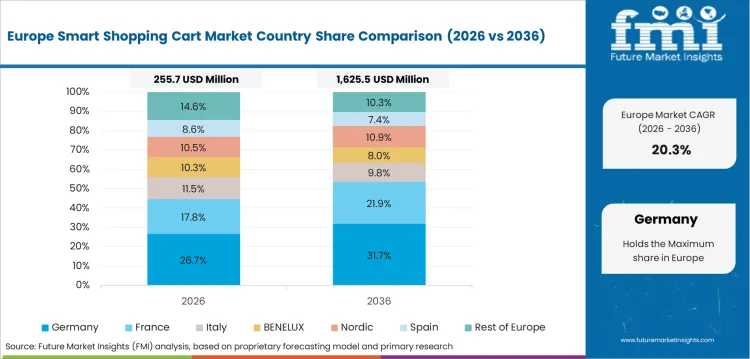
Smart shopping cart demand in Germany is projected to record 22.4% CAGR by 2036 as retailers assess checkout automation with strict cost control. Eurostat reported in February 2026 that EU retail trade volume rose 2.3% in 2025 compared with 2024. This points to stable retail activity but not easy volume growth. German retailers therefore need operational savings or measurable basket lift before large cart commitments. Store integration and data protection will remain central buying checks.
- Munich is relevant for smart-cart demonstrations through Shopic’s earlier presence at the Microsoft Experience Center EMEA.
- German grocery discounters will likely favor retrofit modules over full smart carts if cost pressure stays high.
- Metro-style wholesale stores create a use case for larger baskets and faster business-customer checkout.
Demand Outlook for Smart Shopping Cart Market in Japan
The sector in Japan is expected to expand at 18.9% CAGR by 2036 due to labor pressure and mature retail discipline. Japan has a strong convenience-store culture, but many stores are too small for full cart fleets. Supermarkets and general merchandise stores are more suitable because baskets are larger. Adoption will depend on compact designs, reliability and payment integration. Growth remains below China and the United States because store formats are tighter and capital spending is carefully staged.
- Tokyo supermarkets provide the clearest testing ground for smart carts due to higher labor costs.
- Osaka retail groups can test smart carts in larger suburban grocery and general merchandise stores.
- Japan’s aging shopper base creates demand for clear screens and simple payment flow.
Competitive Landscape
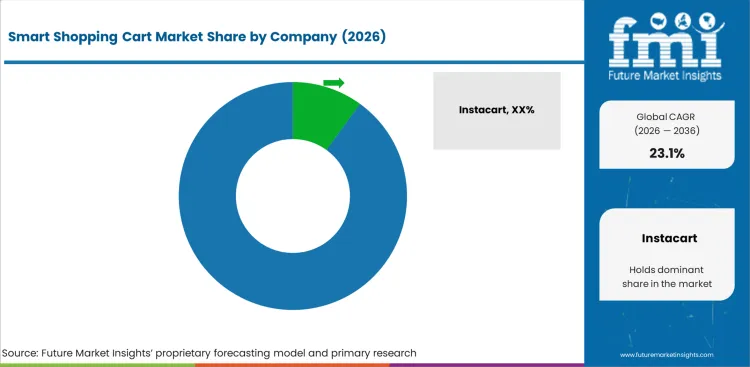
- The market remains early-stage with a small group of visible suppliers and many pilot-stage retailers.
- Instacart leads on Caper Cart grocery adoption and in-store media capability.
- Amazon holds a strong closed-ecosystem position through Dash Cart in Amazon Fresh and Whole Foods.
- A2Z Cust2Mate competes through large announced cart orders and recurring monthly contract models.
- Entry barriers include recognition accuracy, payment integration, fleet maintenance and retailer trust.
Competition in smart shopping carts is defined by real store performance. Suppliers must prove that carts scan accurately, survive daily use and connect with existing point-of-sale systems. Instacart has an advantage through grocery relationships and Caper Cart media features. Its 2024 updates added quests, nearby coupons and aisle-aware ad formats. These features give grocers a revenue argument beyond checkout speed. Retailers may hesitate to scale unless cart utilization stays high across normal shopping weeks.
Amazon’s role is different because Dash Cart operates inside its own grocery network. The company says the redesigned cart shows running totals, maps stores and lets shoppers bypass checkout lanes. Amazon's grocery network creates a controlled testing environment where the company can refine hardware before wider use. The shift away from Just Walk Out in USA Fresh stores illustrates a broader insight: fully invisible checkout can be too opaque for grocery shoppers who want price visibility during the trip.
A2Z Cust2Mate is trying to turn smart carts into recurring retail infrastructure. Its investor page lists a June 2025 order for 3,000 smart carts from Latin American partner Trixo and an April 2026 plan with Carrefour Israel for 4,000 carts. These orders matter because they show movement from small pilots into fleet economics. The question is execution. Retailers need charging, software uptime, repair support and staff training before carts can become normal store equipment.
Specialist suppliers compete by solving one hard problem better than larger platforms. Shopic focuses on clip-on computer vision modules that attach to existing carts. Tracxpoint promotes modular AI carts with onboard cameras and product recognition. These firms can win where retailers do not want full cart replacement. Their challenge is scale. Large grocers often want vendor stability, integration support and service coverage across many stores.
Competitive Benchmarking: Smart Shopping Cart Market
| Company | Product Recognition Depth | Retail-Media Capability | Store Integration Strength | Geographic Footprint |
|---|---|---|---|---|
| Instacart Caper | High | High | Strong | North America and Europe |
| Amazon Dash Cart | High | Medium | Strong | United States |
| A2Z Cust2Mate | Medium to High | High | Medium | Israel, Europe and Latin America |
| Shopic | High | Medium | Medium | Europe and Israel |
| Veeve | Medium | High | Medium | United States |
| Tracxpoint | High | Medium | Medium | Europe and North America |
| Superhii | Medium | Medium | Medium | China and Asia |
Source: Future Market Insights competitive analysis, 2026. Ratings reflect relative positioning based on product recognition depth, retail-media capability and store integration strength.
Key Developments in Smart Shopping Cart Market
- In June 2024, Wakefern expanded Caper Carts to more ShopRite stores with Instacart. The rollout showed regional supermarket interest beyond one-store pilots.
- In October 2024, Instacart launched gamified quests, location-based coupons and aisle-aware advertising on Caper Carts. The update shifted carts toward in-store retail media.
- In March 2025, Shopic announced a partnership with Dimar and Retex for computer vision-powered Smart Cart use in Dimar’s Mercato stores.
- In September 2025, Instacart added EBT SNAP tracking to Caper Cart screens. The feature supports budget visibility for eligible grocery shoppers.
- In April 2026, A2Z Cust2Mate listed a plan with Carrefour Israel to deploy 4,000 smart shopping carts nationwide. The order points to larger fleet-scale adoption.
Key Companies in the Smart Shopping Cart Market
- Instacart
- Amazon
- A2Z Cust2Mate
- Shopic
- Veeve
- Tracxpoint
- Superhii
Regional Smart Cart Specialists
- Caper by Instacart
- Cust2Mate
- Shopic
- Tracxpoint
Report Scope and Coverage
| Parameter | Details |
|---|---|
| Quantitative Units | USD 1.05 billion in 2026 to USD 8.42 billion in 2036, at a CAGR of 23.1% |
| Market Definition | Connected shopping carts used inside physical retail stores for scanning, product recognition, basket tracking, digital payment, navigation, couponing and in-store advertising. |
| Regions Covered | North America, Latin America, Europe, East Asia, South Asia and Pacific, Middle East and Africa |
| Countries Covered | Israel, China, United Kingdom, United States, France, Germany, Japan and 30+ countries |
| Key Companies Profiled | Instacart, Amazon, A2Z Cust2Mate, Shopic, Veeve, Tracxpoint and Superhii |
| Forecast Period | 2026 to 2036 |
| Approach | Hybrid bottom-up and top-down methodology based on cart fleet additions, software fees, retailer pilot activity and country store-format readiness |
Smart Shopping Cart Market by Segments
Smart Shopping Cart Market Segmented by Technology:
- Computer Vision
- RFID
- Barcode Scanning
- Hybrid Recognition
Smart Shopping Cart Market Segmented by Cart Type:
- Full Smart Carts
- Clip-on Modules
- Retrofit Kits
Smart Shopping Cart Market Segmented by Application:
- Grocery Stores
- Hypermarkets
- Club Stores
- Specialty Retail
Smart Shopping Cart Market Segmented by Revenue Model:
- Hardware Purchase
- Hardware Leasing
- Retail Media Services
Smart Shopping Cart Market Segmented by Sales Channel:
- Direct Sales
- System Integrators
Smart Shopping Cart Market by Region:
- North America
- United States
- Canada
- Mexico
- Latin America
- Brazil
- Chile
- Rest of Latin America
- Western Europe
- Germany
- UK
- France
- Italy
- Spain
- BENELUX
- Nordic
- Rest of Western Europe
- Eastern Europe
- Russia
- Poland
- Hungary
- Balkan and Baltic
- Rest of Eastern Europe
- East Asia
- China
- Japan
- South Korea
- South Asia and Pacific
- India
- ASEAN
- Australia and New Zealand
- Rest of South Asia and Pacific
- Middle East and Africa
- Kingdom of Saudi Arabia
- Other GCC Countries
- Turkiye
- South Africa
- Other African Union
- Rest of Middle East and Africa
Research Sources and Bibliography
- Instacart. 2024. More ShopRites adding Caper Carts powered by Instacart.
- Instacart. 2024. Instacart launches new gamified capabilities maximizing in-store rewards and savings on Caper Carts.
- Instacart. 2025. Instacart Caper Carts roll out new omnichannel capabilities for more savings in every aisle.
- Amazon. 2026. 5 ways Amazon’s newest Dash Cart can save you time and money.
- Amazon Web Services. 2024. Amazon Fresh saves shoppers time and drives satisfaction with Dash Cart.
- A2Z Cust2Mate. 2026. Investor relations smart cart platform updates.
- Shopic. 2025. Revolutionizing retail: How Shopic’s Smart Cart is leading the digital transformation.
- Tracxpoint. 2024. Artificial intelligence shopping cart product information.
- USA Census Bureau. 2026. Monthly retail trade sales report.
- Office for National Statistics. 2025. Retail sales, Great Britain: December 2024.
- Eurostat. 2026. Volume of retail trade down by 0.5% in both the euro area and the EU.
- Associated Press. 2024. Amazon is removing Just Walk Out technology from its Fresh grocery stores in the US.
This Report Answers
- How large is the smart shopping cart market in 2026 and how much incremental value is expected by 2036?
- What factors are shaping demand for computer vision carts, RFID carts and barcode-scanning carts?
- Which cart types are expected to lead adoption across full carts, clip-on modules and retrofit kits?
- How are retail-media screens changing the revenue model for smart shopping cart suppliers?
- Which countries are forecast to grow faster than the global average and why?
- How are checkout friction, shrink control and basket visibility affecting smart-cart adoption?
- Which companies are best positioned across product recognition, cart hardware and store integration?
Frequently Asked Questions
What is the current value of the smart shopping cart market?
The smart shopping cart market is estimated at USD 1.05 billion in 2026.
What is the projected value of the smart shopping cart market by 2036?
The market is forecast to reach USD 8.42 billion by 2036.
What CAGR is expected for the smart shopping cart market?
The market is projected to expand at 23.1% CAGR from 2026 to 2036.
Which technology is expected to lead the smart shopping cart market?
Computer vision is expected to lead with 48.0% share in 2026.
Which cart type is expected to lead the market?
Full smart carts are projected to lead with 58.0% share in 2026.
Which country is expected to grow fastest?
Israel is projected to grow fastest at 28.4% CAGR by 2036.
What is the main competitive shift in this market?
The main competitive shift is the move from checkout-only carts to cart-based retail media, couponing and basket analytics.
How do smart shopping carts work?
Smart shopping carts use cameras, barcode scanners, weight sensors, RFID or hybrid recognition to identify items and update the basket total during shopping.
What are the disadvantages of smart shopping carts?
The main disadvantages are high hardware cost, battery charging needs, cart maintenance, product-recognition errors and integration work with existing checkout systems.
Preview the report firsthand - request a free sample
Get SampleGet the brochure for pricing and purchase details.
Get PDFTable of Content
- Executive Summary
- Global Market Outlook
- Demand-side Trends
- Supply-side Trends
- Technology Roadmap Analysis
- Analysis and Recommendations
- Market Overview
- Market Coverage / Taxonomy
- Market Definition / Scope / Limitations
- Research Methodology
- Chapter Orientation
- Analytical Lens and Working Hypotheses
- Market Structure, Signals, and Trend Drivers
- Benchmarking and Cross-market Comparability
- Market Sizing, Forecasting, and Opportunity Mapping
- Research Design and Evidence Framework
- Desk Research Programme (Secondary Evidence)
- Company Annual and Sustainability Reports
- Peer-reviewed Journals and Academic Literature
- Corporate Websites, Product Literature, and Technical Notes
- Earnings Decks and Investor Briefings
- Statutory Filings and Regulatory Disclosures
- Technical White Papers and Standards Notes
- Trade Journals, Industry Magazines, and Analyst Briefs
- Conference Proceedings, Webinars, and Seminar Materials
- Government Statistics Portals and Public Data Releases
- Press Releases and Reputable Media Coverage
- Specialist Newsletters and Curated Briefings
- Sector Databases and Reference Repositories
- FMI Internal Proprietary Databases and Historical Market Datasets
- Subscription Datasets and Paid Sources
- Social Channels, Communities, and Digital Listening Inputs
- Additional Desk Sources
- Expert Input and Fieldwork (Primary Evidence)
- Primary Modes
- Qualitative Interviews and Expert Elicitation
- Quantitative Surveys and Structured Data Capture
- Blended Approach
- Why Primary Evidence is Used
- Field Techniques
- Interviews
- Surveys
- Focus Groups
- Observational and In-context Research
- Social and Community Interactions
- Stakeholder Universe Engaged
- C-suite Leaders
- Board Members
- Presidents and Vice Presidents
- R&D and Innovation Heads
- Technical Specialists
- Domain Subject-matter Experts
- Scientists
- Physicians and Other Healthcare Professionals
- Governance, Ethics, and Data Stewardship
- Research Ethics
- Data Integrity and Handling
- Primary Modes
- Tooling, Models, and Reference Databases
- Desk Research Programme (Secondary Evidence)
- Data Engineering and Model Build
- Data Acquisition and Ingestion
- Cleaning, Normalisation, and Verification
- Synthesis, Triangulation, and Analysis
- Quality Assurance and Audit Trail
- Market Background
- Market Dynamics
- Drivers
- Restraints
- Opportunity
- Trends
- Scenario Forecast
- Demand in Optimistic Scenario
- Demand in Likely Scenario
- Demand in Conservative Scenario
- Opportunity Map Analysis
- Product Life Cycle Analysis
- Supply Chain Analysis
- Investment Feasibility Matrix
- Value Chain Analysis
- PESTLE and Porter’s Analysis
- Regulatory Landscape
- Regional Parent Market Outlook
- Production and Consumption Statistics
- Import and Export Statistics
- Market Dynamics
- Global Market Analysis 2021 to 2025 and Forecast, 2026 to 2036
- Historical Market Size Value (USD Million) Analysis, 2021 to 2025
- Current and Future Market Size Value (USD Million) Projections, 2026 to 2036
- Y-o-Y Growth Trend Analysis
- Absolute $ Opportunity Analysis
- Global Market Pricing Analysis 2021 to 2025 and Forecast 2026 to 2036
- Global Market Analysis 2021 to 2025 and Forecast 2026 to 2036, By Technology
- Introduction / Key Findings
- Historical Market Size Value (USD Million) Analysis By Technology , 2021 to 2025
- Current and Future Market Size Value (USD Million) Analysis and Forecast By Technology , 2026 to 2036
- Computer Vision
- RFID
- Barcode Scanning
- Computer Vision
- Y-o-Y Growth Trend Analysis By Technology , 2021 to 2025
- Absolute $ Opportunity Analysis By Technology , 2026 to 2036
- Global Market Analysis 2021 to 2025 and Forecast 2026 to 2036, By Cart Type
- Introduction / Key Findings
- Historical Market Size Value (USD Million) Analysis By Cart Type, 2021 to 2025
- Current and Future Market Size Value (USD Million) Analysis and Forecast By Cart Type, 2026 to 2036
- Full Smart Carts
- Clip-on Modules
- Retrofit Kits
- Full Smart Carts
- Y-o-Y Growth Trend Analysis By Cart Type, 2021 to 2025
- Absolute $ Opportunity Analysis By Cart Type, 2026 to 2036
- Global Market Analysis 2021 to 2025 and Forecast 2026 to 2036, By Application
- Introduction / Key Findings
- Historical Market Size Value (USD Million) Analysis By Application, 2021 to 2025
- Current and Future Market Size Value (USD Million) Analysis and Forecast By Application, 2026 to 2036
- Grocery Stores
- Hypermarkets
- Club Stores
- Grocery Stores
- Y-o-Y Growth Trend Analysis By Application, 2021 to 2025
- Absolute $ Opportunity Analysis By Application, 2026 to 2036
- Global Market Analysis 2021 to 2025 and Forecast 2026 to 2036, By Revenue Model
- Introduction / Key Findings
- Historical Market Size Value (USD Million) Analysis By Revenue Model, 2021 to 2025
- Current and Future Market Size Value (USD Million) Analysis and Forecast By Revenue Model, 2026 to 2036
- Hardware Leasing
- Hardware Purchase
- Retail Media Services
- Hardware Leasing
- Y-o-Y Growth Trend Analysis By Revenue Model, 2021 to 2025
- Absolute $ Opportunity Analysis By Revenue Model, 2026 to 2036
- Global Market Analysis 2021 to 2025 and Forecast 2026 to 2036, By Sales Channel
- Introduction / Key Findings
- Historical Market Size Value (USD Million) Analysis By Sales Channel, 2021 to 2025
- Current and Future Market Size Value (USD Million) Analysis and Forecast By Sales Channel, 2026 to 2036
- Direct Sales
- System Integrators
- Direct Sales
- Y-o-Y Growth Trend Analysis By Sales Channel, 2021 to 2025
- Absolute $ Opportunity Analysis By Sales Channel, 2026 to 2036
- Global Market Analysis 2021 to 2025 and Forecast 2026 to 2036, By Region
- Introduction
- Historical Market Size Value (USD Million) Analysis By Region, 2021 to 2025
- Current Market Size Value (USD Million) Analysis and Forecast By Region, 2026 to 2036
- North America
- Latin America
- Western Europe
- Eastern Europe
- East Asia
- South Asia and Pacific
- Middle East & Africa
- Market Attractiveness Analysis By Region
- North America Market Analysis 2021 to 2025 and Forecast 2026 to 2036, By Country
- Historical Market Size Value (USD Million) Trend Analysis By Market Taxonomy, 2021 to 2025
- Market Size Value (USD Million) Forecast By Market Taxonomy, 2026 to 2036
- By Country
- USA
- Canada
- Mexico
- By Technology
- By Cart Type
- By Application
- By Revenue Model
- By Sales Channel
- By Country
- Market Attractiveness Analysis
- By Country
- By Technology
- By Cart Type
- By Application
- By Revenue Model
- By Sales Channel
- Key Takeaways
- Latin America Market Analysis 2021 to 2025 and Forecast 2026 to 2036, By Country
- Historical Market Size Value (USD Million) Trend Analysis By Market Taxonomy, 2021 to 2025
- Market Size Value (USD Million) Forecast By Market Taxonomy, 2026 to 2036
- By Country
- Brazil
- Chile
- Rest of Latin America
- By Technology
- By Cart Type
- By Application
- By Revenue Model
- By Sales Channel
- By Country
- Market Attractiveness Analysis
- By Country
- By Technology
- By Cart Type
- By Application
- By Revenue Model
- By Sales Channel
- Key Takeaways
- Western Europe Market Analysis 2021 to 2025 and Forecast 2026 to 2036, By Country
- Historical Market Size Value (USD Million) Trend Analysis By Market Taxonomy, 2021 to 2025
- Market Size Value (USD Million) Forecast By Market Taxonomy, 2026 to 2036
- By Country
- Germany
- UK
- Italy
- Spain
- France
- Nordic
- BENELUX
- Rest of Western Europe
- By Technology
- By Cart Type
- By Application
- By Revenue Model
- By Sales Channel
- By Country
- Market Attractiveness Analysis
- By Country
- By Technology
- By Cart Type
- By Application
- By Revenue Model
- By Sales Channel
- Key Takeaways
- Eastern Europe Market Analysis 2021 to 2025 and Forecast 2026 to 2036, By Country
- Historical Market Size Value (USD Million) Trend Analysis By Market Taxonomy, 2021 to 2025
- Market Size Value (USD Million) Forecast By Market Taxonomy, 2026 to 2036
- By Country
- Russia
- Poland
- Hungary
- Balkan & Baltic
- Rest of Eastern Europe
- By Technology
- By Cart Type
- By Application
- By Revenue Model
- By Sales Channel
- By Country
- Market Attractiveness Analysis
- By Country
- By Technology
- By Cart Type
- By Application
- By Revenue Model
- By Sales Channel
- Key Takeaways
- East Asia Market Analysis 2021 to 2025 and Forecast 2026 to 2036, By Country
- Historical Market Size Value (USD Million) Trend Analysis By Market Taxonomy, 2021 to 2025
- Market Size Value (USD Million) Forecast By Market Taxonomy, 2026 to 2036
- By Country
- China
- Japan
- South Korea
- By Technology
- By Cart Type
- By Application
- By Revenue Model
- By Sales Channel
- By Country
- Market Attractiveness Analysis
- By Country
- By Technology
- By Cart Type
- By Application
- By Revenue Model
- By Sales Channel
- Key Takeaways
- South Asia and Pacific Market Analysis 2021 to 2025 and Forecast 2026 to 2036, By Country
- Historical Market Size Value (USD Million) Trend Analysis By Market Taxonomy, 2021 to 2025
- Market Size Value (USD Million) Forecast By Market Taxonomy, 2026 to 2036
- By Country
- India
- ASEAN
- Australia & New Zealand
- Rest of South Asia and Pacific
- By Technology
- By Cart Type
- By Application
- By Revenue Model
- By Sales Channel
- By Country
- Market Attractiveness Analysis
- By Country
- By Technology
- By Cart Type
- By Application
- By Revenue Model
- By Sales Channel
- Key Takeaways
- Middle East & Africa Market Analysis 2021 to 2025 and Forecast 2026 to 2036, By Country
- Historical Market Size Value (USD Million) Trend Analysis By Market Taxonomy, 2021 to 2025
- Market Size Value (USD Million) Forecast By Market Taxonomy, 2026 to 2036
- By Country
- Kingdom of Saudi Arabia
- Other GCC Countries
- Turkiye
- South Africa
- Other African Union
- Rest of Middle East & Africa
- By Technology
- By Cart Type
- By Application
- By Revenue Model
- By Sales Channel
- By Country
- Market Attractiveness Analysis
- By Country
- By Technology
- By Cart Type
- By Application
- By Revenue Model
- By Sales Channel
- Key Takeaways
- Key Countries Market Analysis
- USA
- Pricing Analysis
- Market Share Analysis, 2025
- By Technology
- By Cart Type
- By Application
- By Revenue Model
- By Sales Channel
- Canada
- Pricing Analysis
- Market Share Analysis, 2025
- By Technology
- By Cart Type
- By Application
- By Revenue Model
- By Sales Channel
- Mexico
- Pricing Analysis
- Market Share Analysis, 2025
- By Technology
- By Cart Type
- By Application
- By Revenue Model
- By Sales Channel
- Brazil
- Pricing Analysis
- Market Share Analysis, 2025
- By Technology
- By Cart Type
- By Application
- By Revenue Model
- By Sales Channel
- Chile
- Pricing Analysis
- Market Share Analysis, 2025
- By Technology
- By Cart Type
- By Application
- By Revenue Model
- By Sales Channel
- Germany
- Pricing Analysis
- Market Share Analysis, 2025
- By Technology
- By Cart Type
- By Application
- By Revenue Model
- By Sales Channel
- UK
- Pricing Analysis
- Market Share Analysis, 2025
- By Technology
- By Cart Type
- By Application
- By Revenue Model
- By Sales Channel
- Italy
- Pricing Analysis
- Market Share Analysis, 2025
- By Technology
- By Cart Type
- By Application
- By Revenue Model
- By Sales Channel
- Spain
- Pricing Analysis
- Market Share Analysis, 2025
- By Technology
- By Cart Type
- By Application
- By Revenue Model
- By Sales Channel
- France
- Pricing Analysis
- Market Share Analysis, 2025
- By Technology
- By Cart Type
- By Application
- By Revenue Model
- By Sales Channel
- India
- Pricing Analysis
- Market Share Analysis, 2025
- By Technology
- By Cart Type
- By Application
- By Revenue Model
- By Sales Channel
- ASEAN
- Pricing Analysis
- Market Share Analysis, 2025
- By Technology
- By Cart Type
- By Application
- By Revenue Model
- By Sales Channel
- Australia & New Zealand
- Pricing Analysis
- Market Share Analysis, 2025
- By Technology
- By Cart Type
- By Application
- By Revenue Model
- By Sales Channel
- China
- Pricing Analysis
- Market Share Analysis, 2025
- By Technology
- By Cart Type
- By Application
- By Revenue Model
- By Sales Channel
- Japan
- Pricing Analysis
- Market Share Analysis, 2025
- By Technology
- By Cart Type
- By Application
- By Revenue Model
- By Sales Channel
- South Korea
- Pricing Analysis
- Market Share Analysis, 2025
- By Technology
- By Cart Type
- By Application
- By Revenue Model
- By Sales Channel
- Russia
- Pricing Analysis
- Market Share Analysis, 2025
- By Technology
- By Cart Type
- By Application
- By Revenue Model
- By Sales Channel
- Poland
- Pricing Analysis
- Market Share Analysis, 2025
- By Technology
- By Cart Type
- By Application
- By Revenue Model
- By Sales Channel
- Hungary
- Pricing Analysis
- Market Share Analysis, 2025
- By Technology
- By Cart Type
- By Application
- By Revenue Model
- By Sales Channel
- Kingdom of Saudi Arabia
- Pricing Analysis
- Market Share Analysis, 2025
- By Technology
- By Cart Type
- By Application
- By Revenue Model
- By Sales Channel
- Turkiye
- Pricing Analysis
- Market Share Analysis, 2025
- By Technology
- By Cart Type
- By Application
- By Revenue Model
- By Sales Channel
- South Africa
- Pricing Analysis
- Market Share Analysis, 2025
- By Technology
- By Cart Type
- By Application
- By Revenue Model
- By Sales Channel
- USA
- Market Structure Analysis
- Competition Dashboard
- Competition Benchmarking
- Market Share Analysis of Top Players
- By Regional
- By Technology
- By Cart Type
- By Application
- By Revenue Model
- By Sales Channel
- Competition Analysis
- Competition Deep Dive
- Instacart
- Overview
- Product Portfolio
- Profitability by Market Segments (Product/Age /Sales Channel/Region)
- Sales Footprint
- Strategy Overview
- Marketing Strategy
- Product Strategy
- Channel Strategy
- Amazon
- A2Z Cust2Mate
- Shopic
- Veeve
- Tracxpoint
- Superhii
- Instacart
- Competition Deep Dive
- Assumptions & Acronyms Used


