

- Industry Size (2026)
- USD 26.1 Bn
- Forecast (2036)
- USD 48.7 Bn
- CAGR (2026 to 2036)
- 6.40%
Cartoon-Themed Kidswear Market Size, Market Forecast and Outlook By FMI
The cartoon-themed kidswear market was valued at USD 24.5 billion in 2025. The sector is expected to reach USD 26.1 billion in 2026 at a CAGR of 6.40% during the forecast period. Revenue expansion lifts the total opportunity to USD 48.7 billion through 2036 as the compression of content release windows forces a transition from seasonal inventory planning to high-velocity franchise dropping.
Retail buyers in this category are being forced to shift their procurement frameworks from traditional seasonal buying to content-aligned inventory dropping. Merchandising managers must now synchronize their floor sets with licensed sports merchandise streaming platform release schedules rather than weather patterns. Delaying this synchronization leaves retailers with obsolete IP inventory that requires steep markdown cycles to clear. The real margin expansion happens when brands capture the secondary nostalgia cycle, where millennial parents purchase legacy IP for their infants. According to FMI's estimates, aligning production with these micro-cycles allows apparel merchandisers to maintain full-price sell-through rates.
Summary of Cartoon-Themed Kidswear Market
- Cartoon-Themed Kidswear Market Definition:
- The sector is defined by the intersection of textile manufacturing and intellectual property monetization. It operates on a structural boundary where the value of the garment is derived primarily from the licensed character it displays rather than its material composition, requiring operators to master both apparel logistics and franchise lifecycle management.
- Demand Drivers in the Market:
- Content proliferation across streaming platforms compels apparel merchandisers to shorten their product lifecycles to match rapid shifts in character popularity.
- The generational nostalgia cycle drives millennial parents to prioritize legacy franchise purchases for their infants over unbranded alternatives.
- Peer-validation dynamics within the 6-12 age bracket push retail buyers to stock highly visible character IP to capture back-to-school spending allocations.
- Key Segments Analyzed in the FMI Report:
- T-shirts & Shirts: T-shirts & Shirts are expected to hold 34.2% share in 2026, as they act as the most visible canvas for character IP while requiring the lowest financial commitment from parents.
- Kids (6-12 years): Kids (6-12 years) are projected to garner 42.8% share in 2026, reflecting the age bracket where independent media consumption and peer influence directly dictate wardrobe preferences.
- Online Retailers: Online Retailers are estimated to account for 45.5% share in 2026, capturing demand through algorithmic cross-selling tied to streaming platform viewing habits.
- India: 8.5% CAGR, driven by the conversion of unorganized retail spending into branded, licensed apparel purchases among an expanding middle class.
- Analyst Opinion at FMI:
- Ronak Shah, Principal Analyst, Consumer Product, at FMI, opines, "The standard assumption is that box office success dictates apparel sales. However, the most profitable segment of this industry operates on a completely different clock. The highest-margin operators don't chase the newest movie release; they mine 20-year-old IP libraries for the infant segment. A parent buying for a toddler isn't buying what the toddler watches, they are buying the character they loved themselves in 1995. When brands understand this generational offset, they stop overpaying for unproven new licenses and start monetizing evergreen archives."
- Strategic Implications / Executive Takeaways:
- Licensing directors must negotiate agile, short-term IP contracts to capture viral streaming trends before audience attention pivots.
- Production managers should localize blank garment staging to enable rapid screen-printing and deployment within a four-week franchise popularity window.
- Retail category heads face inventory obsolescence risks that require rigorous markdown algorithms to clear out-of-favor characters before they consume warehouse space.
- Methodology:
- Primary Research: Interviews with licensing directors, retail category managers, and textile procurement heads.
- Desk Research: Aggregation of studio royalty filings, IP registrations, and import data.
- Market-Sizing and Forecasting: Anchored to regional birth rates and organized retail penetration.
- Data Validation and Update Cycle: Triangulated against streaming demographic data and franchise revenue reports.
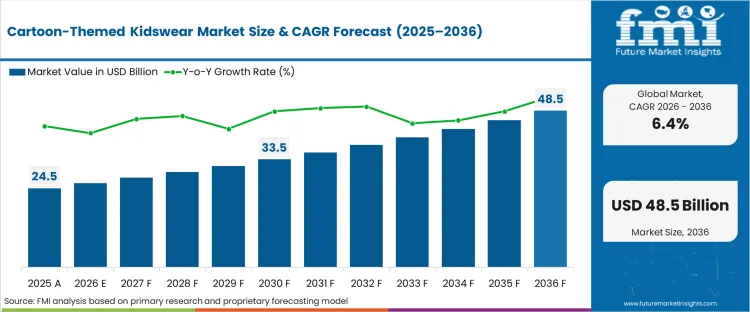
Before this growth becomes self-reinforcing, category managers must solve the IP fragmentation problem. Once a retailer establishes a rapid-response supply chain capable of rotating franchise licenses within a six-week lead time, they transition from reactive stocking to proactive demand capture. Specialty apparel networks trigger this shift when they integrate their point-of-sale data directly with licensing partners, allowing them to scale production on trending characters before the broader retail tier recognizes the demand spike.
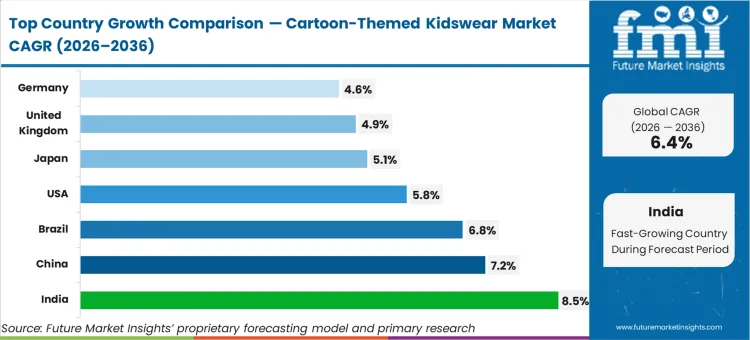
India is estimated to expand at 8.5%, reflecting a massive demographic dividend entering the organized retail tier. China follows at 7.2%, driven by aggressive domestic IP development displacing imported franchise dominance. Brazil is poised to advance at 6.8%, supported by expanding middle-class discretionary spending on licensed goods. The United States is projected to register a CAGR of 5.8%, while Japan tracks at 5.1%. The United Kingdom is likely to grow at 4.9%, and Germany follows at 4.6%. The variance across this range reflects the structural gap between markets still transitioning from unbranded neighborhood tailoring and those executing hyper-segmented streaming franchise strategies.
Cartoon-Themed Kidswear Market Key Takeaways
| Metric | Details |
|---|---|
| Industry Size (2026) | USD 26.1 billion |
| Industry Value (2036) | USD 48.7 billion |
| CAGR (2026 to 2036) | 6.40% |
Source: Future Market Insights (FMI) analysis, based on proprietary forecasting model and primary research
Cartoon-Themed Kidswear Market Definition
The cartoon-themed kidswear industry encompasses the commercial ecosystem of designing, manufacturing, and distributing children's apparel that features licensed intellectual property from animated entertainment franchises. This sector is functionally distinguished from general children's apparel by its reliance on IP licensing agreements, royalty structures, and the requirement to synchronize product lifecycles with media consumption trends rather than purely functional or seasonal clothing needs.
Cartoon-Themed Kidswear Market Inclusions
This sector includes all primary and secondary apparel categories for children aged 0 to 12 years that integrate character IP, including tops, bottoms, outerwear, sleepwear, and swimwear. It covers kids apparel produced under official licensing agreements from studios, streaming platforms, and independent creators. The scope captures sales across all organized retail tiers, including specialty licensed stores, mass merchandisers, and direct-to-consumer digital channels.
Cartoon-Themed Kidswear Market Exclusions
The analysis explicitly excludes counterfeit or unlicensed character apparel, as these operate outside the formal royalty structures that define the industry's economic baseline. General graphic tees featuring generic illustrations, animals, or non-franchise artwork are excluded because they do not carry the IP acquisition costs or media-driven demand spikes of licensed properties. Footwear and hardline accessories like kids toys are also excluded to maintain strict focus on the textile apparel supply chain.
Cartoon-Themed Kidswear Market Research Methodology
- Primary Research: Licensing directors at entertainment studios, category managers at mass apparel retailers, and procurement heads at textile manufacturing firms.
- Desk Research: Publicly filed royalty and licensing revenue reports from major entertainment conglomerates, IP registration databases, and retail inventory import manifests.
- Market-Sizing and Forecasting: The baseline anchors to regional birth rate data cross-referenced with organized apparel retail penetration and average household discretionary spending metrics.
- Data Validation and Update Cycle: Forecasts are cross-validated against streaming platform subscriber growth trends and box office demographic performance data in key regional markets.
Segmental Analysis
Cartoon-Themed Kidswear Market Analysis by Product Type
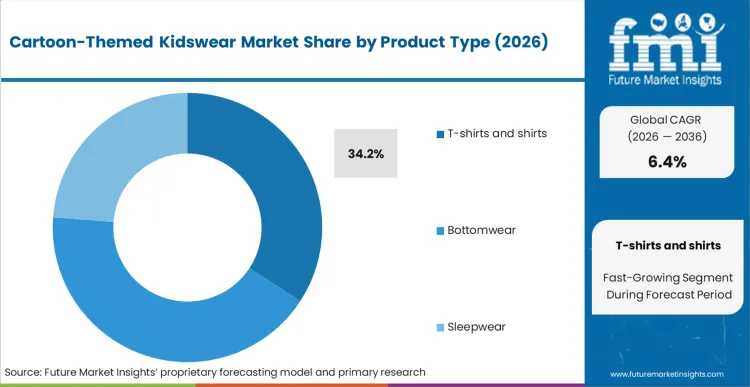
The structural reason T-shirts and shirts hold a 34.2% share comes down to their function as the primary billboard for franchise affinity. Parents and children prioritize this segment because it offers the highest visual impact per dollar spent. While outerwear or bottomwear requires higher technical construction and material costs, a basic cotton tee serves as a highly efficient carrier for screen-printed IP. As per FMI's projection, this dynamic creates a continuous churn cycle; a child may wear the same unbranded jacket all season, but they will demand multiple character shirts to align with different daily preferences. Manufacturers optimize their margins here by utilizing blank apparel supply chains, applying the licensing value at the final printing stage. Brands that attempt to force high-margin IP onto complex, low-visibility garments often face severe inventory overhang as buyers refuse to pay character premiums for items where the franchise is obscured.
- Visibility Premium: T-shirts place the licensed character at eye level. This satisfies the child's need for peer recognition and the parent's desire for a low-cost franchise purchase.
- Production Agility: Flat-panel printing allows for rapid graphic changes without altering garment construction. Manufacturers capture emerging character trends weeks before complex apparel can be engineered.
- Replacement Velocity: High stain rates and rapid physical growth in the upper-body quadrant force frequent repurchasing. Retailers capture recurring revenue as parents replace outgrown character tees.
Cartoon-Themed Kidswear Market Analysis by Age Group
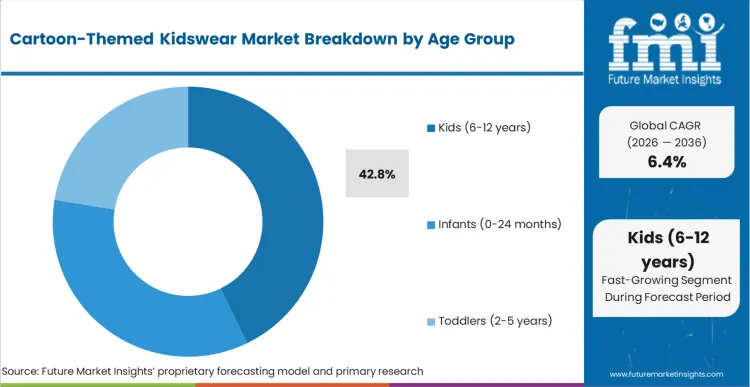
The specific choice facing a retail buyer right now is how to allocate floor space across the demographic spectrum, knowing that the Kids (6-12 years) segment commands a 42.8% share. This bracket dominates because it is the exact window where independent media discovery intersects with vocal purchasing power. Infants wear toddler wear chosen by parents; toddlers are guided by limited exposure; but the 6-12 demographic actively curates their identity through algorithmic streaming recommendations and peer validation. In FMI's view, this shifts the procurement risk profile entirely. A retailer buying for this segment is no longer predicting fashion, they are predicting content virality. The operational consequence is a complete restructuring of the open-to-buy budget, holding cash in reserve to chase micro-trends rather than committing entirely at the start of the season. Retailers who lock in their 6-12 inventory too early invariably end up discounting heavily when the target demographic pivots to a new digital franchise mid-season.
- Algorithmic Discovery: Children in this bracket consume content across fragmented digital platforms. Merchandisers must track digital engagement metrics to identify viable licensing targets.
- Identity Curation: Apparel transitions from functional covering to social signaling. Retail buyers capture higher margins by treating these garments as wearable entertainment rather than clothing.
- Independent Veto: The child gains the ability to reject parental choices. Brands must design marketing campaigns that speak directly to the end-user while maintaining parental price approval.
Cartoon-Themed Kidswear Market Analysis by Sales Channel
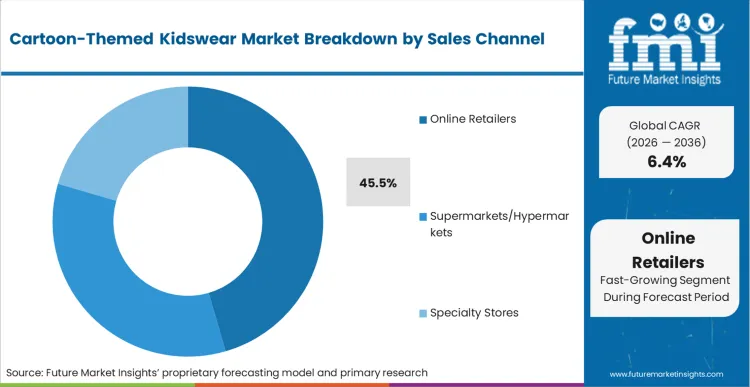
Online retailers have structurally disrupted the distribution model, capturing 45.5% of the sector by collapsing the distance between content consumption and product purchase. The legacy model required a parent to see a character on screen and subsequently find it in a physical aisle weeks later. Digital channels embed the purchase point directly into the content ecosystem, using targeted ads alongside streaming platforms to trigger immediate conversions. FMI analysts opine that this architecture fundamentally changes inventory economics. E-commerce operators centralize their highly fragmented cosplay clothing long-tail IP inventory in regional fulfillment centers, avoiding the catastrophic markdown costs physical stores face when a specific character fails to sell in a localized geographic pocket. Physical retailers who fail to build an endless-aisle digital integration are left fighting over the top three blockbuster licenses, structurally locked out of the profitable niche franchise revenue streams.
- Proximity To Content: Digital platforms link the viewing experience to the buying experience. E-commerce operators capture impulse purchases driven by immediate post-viewing affinity.
- Long-Tail Aggregation: Centralized warehousing allows the stocking of thousands of character variants. Buyers find niche franchise apparel that physical stores cannot justify stocking.
- Algorithmic Cross-selling: Recommendation engines pair apparel with related franchise toys and media. Retailers expand basket sizes automatically without manual merchandising intervention.
Cartoon-Themed Kidswear Market Drivers, Restraints, and Opportunities
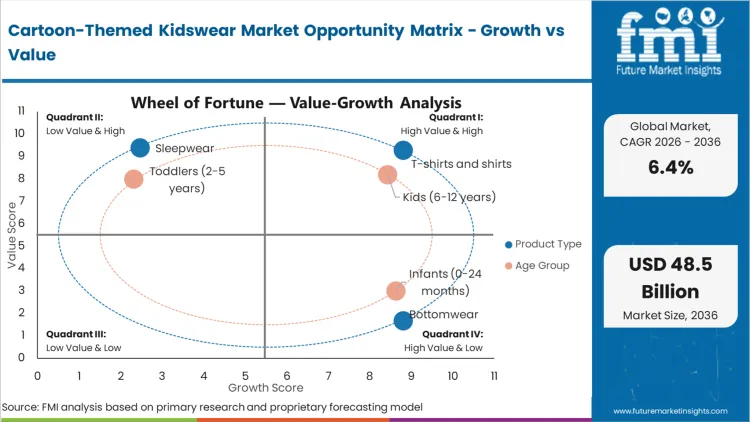
Content proliferation across global streaming platforms forces apparel merchandisers to completely restructure their product qualification timelines. The traditional six-month fashion calendar breaks down when a digital series achieves viral status over a weekend. Category managers at major retail chains are now required to maintain flexible production capacity, allowing them to push trending IP into the market within four weeks. This compression of the supply chain separates the agile operators from legacy brands. A procurement director who fails to align sourcing speed with digital consumption cycles will consistently miss the peak pricing window, arriving at market only when the franchise has already entered its markdown phase.
The primary operational obstacle dragging down sector efficiency is the complex, multi-layered IP approval process enforced by legacy entertainment studios. Licensing directors operate under strict brand guideline mandates, requiring physical sample approvals for color matching, character scaling, and fabric quality before a single unit enters mass production. This friction is structural, embedded in the legal necessity of protecting billion-dollar franchise equities. While digital 3D rendering and remote approval software are emerging as partial solutions, they often fail to satisfy quality control teams evaluating tactile print finishes, leaving supply chains vulnerable to multi-week delays at the final approval gate.
Opportunities in the Cartoon-Themed Kidswear Market
- Direct-To-Garment Agility: Digital printing technologies eliminate the setup times of traditional screen printing. Production managers capture localized micro-trends by printing character apparel on-demand.
- Legacy Vault Mining: Decades of unutilized IP sit dormant in studio archives. Licensing directors capture decorated apparel high-margin adult-purchaser nostalgia by reissuing vintage character designs for the infant category.
- Eco-compliant IP: Strict chemical regulations penalize traditional plastisol inks. Sourcing directors who qualify water-based, non-toxic print methods capture premium shelf space in environmentally conscious European retail networks.
Regional Analysis
Based on the regional analysis, the Cartoon-Themed Kidswear market is segmented into North America, Latin America, Europe, East Asia, South Asia, Oceania, and Middle East & Africa across 40 plus countries.
.webp "Top Country Growth Comparison Cartoon Themed Kidswear Market Cagr (2026 2036)")
| Country | CAGR (2026 to 2036) |
|---|---|
| India | 8.5% |
| China | 7.2% |
| Brazil | 6.8% |
| United States | 5.8% |
| Japan | 5.1% |
| United Kingdom | 4.9% |
| Germany | 4.6% |
Source: Future Market Insights (FMI) analysis, based on proprietary forecasting model and primary research
North and Latin America Cartoon-Themed Kidswear Market Analysis
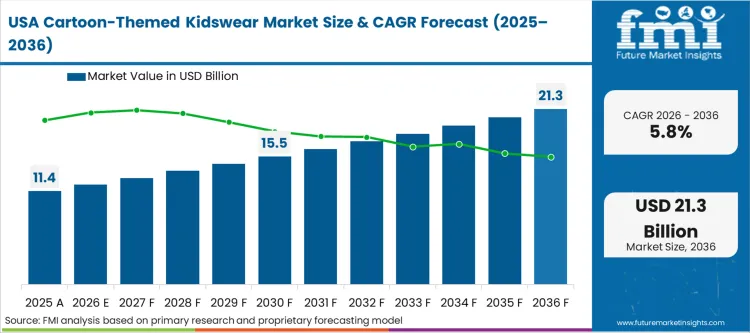
Based on FMI's assessment, a predictable but highly competitive procurement environment emerges across the Americas, where mass merchandisers secure exclusive character sub-licenses to differentiate their floor sets. Retailers here do not merely sell garments; they execute coordinated, cross-channel franchise events dictated by the major studios headquartered in California, while aggressively expanding their reach southward into the rapidly formalizing Latin American licensing ecosystem. The assumption is that North America is a mature, slow-growth environment, but the underlying reality is a rapid rotation of premium franchise apparel driving unit margins upward even as volume growth stabilizes across the broader hemispheric footprint. A category manager operating in this combined region plans inventory allocation years in advance based on confidential studio theatrical slates, a practice less common in fragmented overseas markets. Ultimately, the intense concentration of IP ownership and the resulting hyper-efficiency of the licensing ecosystem remains the structural condition shaping both North and Latin America.
- United States: The United States is estimated to expand at a 5.8% compound annual rate through 2036. Securing exclusive art assets requires immense upfront volume commitments, which structurally locks smaller regional retailers out of the most lucrative tier-1 blockbuster releases. Category buyers in the United States retail environment are forced to navigate the aggressive exclusivity demands of major big-box chains to maintain market share. To prevent direct price comparison, a mass merchandiser cannot simply stock the same franchise IP as their competitor; they must secure unique character artwork or entirely different sub-franchises.
- Brazil: Expanding middle-class discretionary spending on licensed goods acts as a major catalyst for organized retail adoption across South America's largest economy. Brazil is poised to sustain a 6.8% CAGR to 2036. Global franchise operators are increasingly bypassing local distributors to set up direct licensing partnerships with Brazilian textile conglomerates, capturing higher margins. Domestic buyers who previously relied on unbranded apparel market imports as a result must now align their procurement strategies with global streaming trends to stay relevant.
FMI's report includes Canada, Mexico, and Argentina. The integration of the North American supply chain allows US-based IP holders to test localized franchise apparel drops in adjacent markets before committing to full-scale domestic production runs, a strategy increasingly applied to major Latin American metropolitan hubs.
Asia Pacific Cartoon-Themed Kidswear Market Analysis
According to FMI's estimates, global apparel brands operating in Asia are forced to completely rewrite their standardized global assortments due to a massive market transition. A merchandising strategy that relies entirely on Hollywood exports fails to capture the massive volume available in regional streaming hits. Procurement directors in this region are actively diversifying their licensing portfolios, shifting open-to-buy budgets toward homegrown animation properties that resonate more deeply with local cultural nuances. The underlying dynamic is a decoupling of the global licensing calendar, requiring brands to manage dual supply chains: one for international blockbusters and a highly agile secondary chain for regional viral content. The rapid commercialization of domestic IP ecosystems as a result, challenging historical Western franchise dominance essentially defines Asia Pacific's trajectory.
- India: Parents actively seek out verifiable franchise apparel as a status marker as middle-class discretionary income crosses the threshold for branded goods. Brands that establish early licensing partnerships with domestic streaming platforms capture a newly formalized consumer base that is fiercely loyal to culturally specific animated properties. FMI estimates the cartoon-themed kidswear market in India to expand at a CAGR of 8.5% through 2036. India's retail transition from unorganized, unbranded street markets to structured e-commerce and mall-based shopping provides the primary catalyst for licensed apparel adoption.
- China: China sales are projected to rise at 7.2% compound growth over the forecast period. Global apparel brands that fail to secure licenses for these domestic properties find themselves relegated to secondary retail positions, unable to compete with the algorithmic push of local digital ecosystems. Retail buyers in major urban centers prioritize local character franchises because they integrate seamlessly into the dominant domestic social commerce platforms. Aggressive investment in state-backed and private domestic animation studios structurally displaces imported Western IP.
- Japan: Japan's highly mature manga and anime infrastructure creates the most sophisticated licensing environment globally, where character apparel is deeply segmented by micro-demographics. The market for cartoon-themed kidswear in Japan is forecast to track 5.1% annual growth to 2036. The operational rigor required to clear these approval gates creates an immense barrier to entry, protecting incumbent domestic manufacturers from low-cost regional competitors. A procurement director here must navigate dozens of highly specialized franchise committees, managing approvals down to the exact pantone shade of a character's uniform.
FMI's report includes South Korea and ASEAN nations. Across these markets, the expansion of localized mobile gaming platforms is creating a new pipeline of character IP, shifting licensing dollars away from traditional television animation.
Europe Cartoon-Themed Kidswear Market Analysis
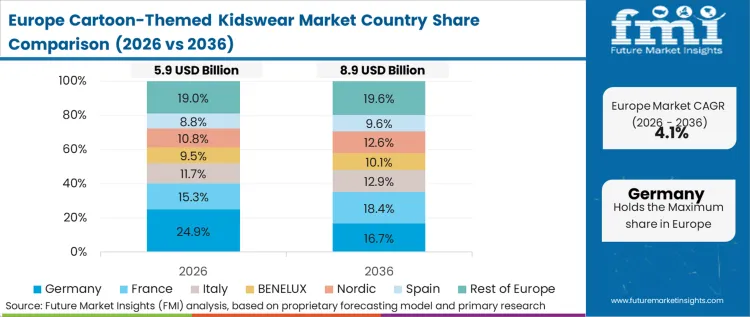
As per FMI's projection, the regulatory baseline of the region makes the European licensing market structurally more expensive to supply than North America. Operations heads sourcing for European retail networks must first qualify their supply base against REACH regulations for plastisol inks and heavy metals in screen printing. The assumption that European consumers are less responsive to character apparel is false; rather, the European buyer requires the franchise application to meet a baseline of environmental and safety compliance that filters out low-tier suppliers entirely. Europe's adoption pattern is heavily shaped by the region's stringent chemical compliance and extended producer responsibility (EPR) frameworks, which dictate the physical construction of the garment long before the IP is applied. The leading markets demonstrate that success here requires marrying high-value franchise IP with sustainable, verifiable material inputs.
- United Kingdom: Category managers use aggressive promotional pricing on blockbuster franchise tees to capture the broader back-to-school basket. Suppliers that secure placement in these supermarket frameworks gain access to immense, predictable volume, provided they can hit the rigorous margin requirements dictated by grocery procurement teams. A CAGR of 4.9% is expected for cartoon-themed kidswear in the United Kingdom over the forecast period. The UK's highly consolidated grocery supermarket sector controls an outsized proportion of the children's apparel volume, treating licensed clothing as an essential footfall driver alongside food purchases.
- Germany: Germany's updated extended producer responsibility requirements create a direct cost differential between standard mixed-material prints and eco-compliant alternatives, making the transition an economic calculation rather than a compliance gesture. Merchandisers running German distribution routes have already begun requalification processes for their primary print vendors. The German landscape is set to achieve a CAGR of 4.6% between 2026 and 2036. Companies that move first capture preferred supplier status in procurement frameworks that are unlikely to reopen once initial bamboo apparel vendors are locked in.
FMI's report includes France, Italy, and Spain. These markets exhibit a distinct preference for subtle, integrated character placements over loud, full-chest graphics, requiring brands to develop region-specific design language for the same global IP.
Competitive Aligners for Market Players
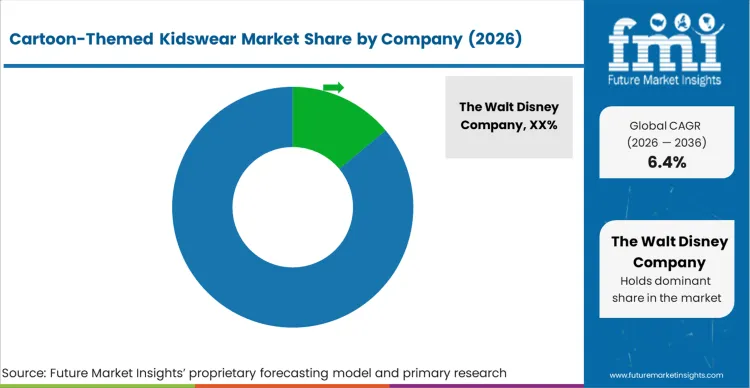
The structural reason this sector remains heavily concentrated at the top is the immense upfront capital requirement necessary to secure minimum royalty guarantees. Licensing juggernauts like The Walt Disney Company and Warner Bros. Discovery Global Consumer Products dictate the ecosystem's pace, partnering primarily with massive vertically integrated apparel aggregators like Hennes & Mauritz AB (H&M) and Zara Kids (Inditex). Buyers use a vendor's ability to clear these stringent, multi-tiered studio audits as the absolute baseline variable to distinguish qualified supply partners from the highly fragmented lower tier. This acts as a purely financial moat. A supplier cannot simply purchase a blockbuster character license; they must demonstrate the sheer financial liquidity to guarantee multi-year royalty minimums, while simultaneously proving the operational transparency to pass global labor and chemical safety audits.
The structural advantage held by legacy IP owners like Sanrio Co., Ltd., Mattel Inc., and Hasbro Inc. is their capacity to monetize deep, multi-generational character archives across entirely new demographic categories. This advantage persists because these companies do not merely sell the right to print an isolated logo. They secure total wardrobe integration. They negotiate complex, multi-territory rights that cover an entire lifestyle collection from infant sleepwear to pre-teen outerwear. To replicate this level of market penetration, an emerging digital creator must build a unified global film and tv ip peripherals compliance architecture that moves beyond regional sub-licensing to offer retailers a single point of control for brand equity. This requires immense capital investment in digital royalty tracking systems, automated design approval portals, and multi-region legal enforcement capabilities.
Large retail buyers actively resist total margin surrender to the dominant studios by deliberately cultivating portfolios of independent, digital-first IP and highly curated artist collaborations. Operators like Fast Retailing Co., Ltd. (UNIQLO) demonstrate how a retailer can master this dynamic. By using their massive global store footprint, they elevate niche retro franchises into blockbuster apparel events on their own terms, thereby regaining pricing power from traditional Hollywood licensors. Procurement directors mitigate supply risk by pitting established entertainment conglomerates against highly agile gaming IP creators to negotiate better royalty tiers. The overall sector is structurally polarizing through 2036. Premium end-cap shelf space is concentrating tighter around a few proven mega-franchises, while the digital-first apparel tier fragments into thousands of micro-licenses driven by individual content creators.
Key Players in Cartoon-Themed Kidswear Market
- The Walt Disney Company
- Warner Bros. Discovery Global Consumer Products
- Sanrio Co., Ltd.
- Mattel Inc.
- Hasbro Inc.
- Hennes & Mauritz AB (H&M)
- Zara Kids (Inditex)
- Fast Retailing Co., Ltd. (UNIQLO)
Scope of the Report
| Metric | Value |
|---|---|
| Quantitative Units | USD 26.1 billion to USD 48.7 billion, at a CAGR of 6.40% |
| Market Definition | The commercial ecosystem of designing, manufacturing, and distributing children's apparel that features licensed intellectual property from animated entertainment franchises. |
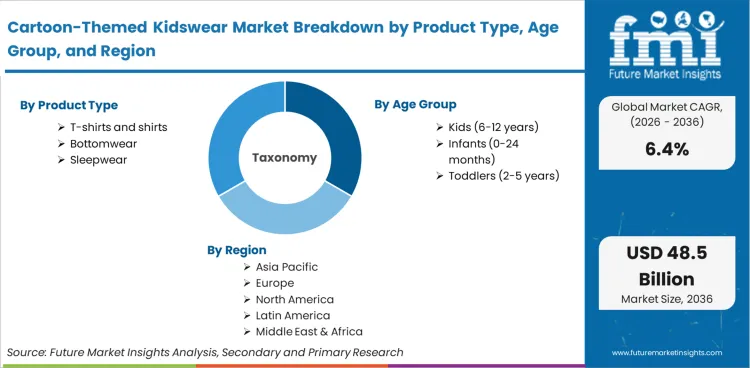
| Product Type Segmentation | T-shirts & Shirts, Bottomwear, Sleepwear, Outerwear |
| Age Group Segmentation | Infants (0-24 months), Toddlers (2-5 years), Kids (6-12 years) |
| Sales Channel Segmentation | Supermarkets/Hypermarkets, Specialty Stores, Online Retailers |
| Regions Covered | North America, Latin America, Europe, East Asia, South Asia, Oceania, Middle East & Africa |
| Countries Covered | United States, China, India, United Kingdom, Germany, Japan, Brazil, and 40 plus countries |
| Key Companies Profiled | The Walt Disney Company, Warner Bros. Discovery Global Consumer Products, Sanrio Co., Ltd., Mattel Inc., Hasbro Inc., Hennes & Mauritz AB (H&M), Zara Kids (Inditex), Fast Retailing Co., Ltd. (UNIQLO) |
| Forecast Period | 2026 to 2036 |
| Approach | Interviews with licensing directors and retail category managers provided qualitative anchors. Baseline sizing utilized regional birth rates and organized retail penetration data. |
Source: Future Market Insights (FMI) analysis, based on proprietary forecasting model and primary research
Cartoon-Themed Kidswear Market Analysis by Segments
Product Type:
- T-shirts & Shirts
- Bottomwear
- Sleepwear
- Outerwear
Age Group:
- Infants (0-24 months)
- Toddlers (2-5 years)
- Kids (6-12 years)
Sales Channel:
- Supermarkets/Hypermarkets
- Specialty Stores
- Online Retailers
Region:
- North America
- United States
- Canada
- Mexico
- Latin America
- Brazil
- Argentina
- Europe
- Germany
- United Kingdom
- France
- Italy
- Spain
- East Asia
- China
- Japan
- South Korea
- South Asia
- India
- ASEAN
- Oceania
- Australia
- New Zealand
- Middle East & Africa
- GCC
- South Africa
Bibliography
- Ofcom. (2024, April 19). Children and parents: Media use and attitudes report 2024.
- USA Census Bureau. (2025). Quarterly retail e-commerce sales report.
- USA Consumer Product Safety Commission. (2024, July 11). Children’s pajama sets recalled due to burn hazard and violation of federal flammability standards.
- Health Canada. (2025). Children’s sleepwear: Guidelines for the flammability requirement.
- European Union Intellectual Property Office. (2024). Economic impact of counterfeiting in the clothing, cosmetics and toy sectors in the EU.
- Office of the Controller General of Patents, Designs and Trade Marks. (2025). Annual report 2024–2025. Intellectual Property India.
This bibliography is provided for reader reference. The full FMI report contains the complete reference list with primary source documentation.
This Report Addresses
- Market intelligence to support strategic decision making across licensed tops, bottoms, and infant wear categories.
- Market size estimation and 10-year revenue forecasts from 2026 to 2036, supported by regional birth rate cross-referencing and retail penetration models.
- Growth opportunity mapping across age groups and sales channels with emphasis on the structural gate of IP fragmentation and rapid-response supply chains.
- Segment and regional revenue forecasts covering specialty stores and e-commerce across stringent European REACH compliance environments.
- Competition strategy assessment including minimum royalty guarantees, global cross-category IP rights, and studio audit clearance capabilities.
- Supply chain development tracking including direct-to-garment digital printing, water-based inks, and eco-compliant plastisol alternatives.
- Market access analysis covering European EPR frameworks, US exclusivity demands, and Japanese micro-demographic approval committees.
- Market report delivery in PDF, Excel, PPT, and interactive dashboard formats for executive strategy, licensing negotiation, and operational benchmarking use.
Frequently Asked Questions
How large is the Cartoon-Themed Kidswear in 2026?
The valuation reaches USD 26.1 billion in 2026. This figure reflects not just the volume of garments produced, but the premium margins extracted by successfully attaching high-demand streaming IP to basic textile canvases.
What will it be valued at by 2036?
It is projected to reach USD 48.7 billion by 2036. This scale indicates a structural shift where unbranded basics are increasingly marginalized by the deep integration of digital content ecosystems into physical retail.
What CAGR is projected?
A 6.4% CAGR is anticipated. This rate tracks the velocity of the licensing turnover cycle, reflecting how quickly retailers can transition floor space from a fading franchise to an emerging viral hit.
Which Product Type segment leads?
T-shirts & Shirts hold a 34.2% share. This segment leads because flat-panel construction allows manufacturers to execute rapid screen-printing changes, catching micro-trends weeks before complex outerwear can be engineered.
Which Age Group segment leads?
Kids (6-12 years) capture 42.8% of the space. Buyers focus on this bracket because it represents the exact window where a child's independent digital discovery translates directly into vocal purchasing demands that parents fulfill.
Which Sales Channel segment leads?
Online Retailers account for 45.5% of distribution. They dominate by collapsing the distance between content viewing and product purchase, using algorithmic cross-selling to trigger impulse buys immediately after a child watches a specific show.
What drives rapid growth?
The proliferation of global streaming platforms forces merchandisers into content-aligned dropping. This continuous churn of new characters creates artificial obsolescence, driving parents to replace perfectly functional garments simply because the featured IP is no longer socially relevant.
What is the primary restraint?
The multi-layered IP approval process enforced by legacy studios creates massive supply chain friction. Because studios mandate physical sample checks for color and character scaling, manufacturers face severe delays at the final gate before mass production can begin.
Which country grows fastest?
India advances at 8.5%, significantly outpacing the US rate of 5.8%. This divergence occurs because India is converting massive volumes of unorganized street-tailoring into formalized, licensed purchases, whereas the US market is largely saturated and relying on premium price increases.
How do European EPR regulations affect licensing?
Extended producer responsibility frameworks in Europe penalize the use of mixed-material plastisol prints. This forces licensing directors to qualify more expensive eco-compliant vendors, structurally raising the baseline cost of character apparel in the region compared to North America.
What changes are digital printing technologies bringing?
Direct-to-garment digital printing eliminates the setup delays inherent in traditional screen printing. This allows agile manufacturers to produce limited runs of trending streaming characters on-demand, bypassing the inventory risk associated with massive seasonal commitments.
How do major buyers leverage cross-category IP rights?
Global fast-fashion giants negotiate multi-territory rights that cover an entire lifestyle collection rather than a single shirt design. This capability allows them to offer studios a unified global brand execution, structurally locking smaller regional retailers out of tier-1 blockbuster licensing deals.
Why is the infant segment highly profitable despite lack of media consumption?
The real margin driver here is the secondary nostalgia cycle. Brands mine 20-year-old studio archives because millennial parents willingly pay premium prices for the character IP they loved in their own childhood, creating a highly stable revenue stream independent of current box office results.
How does inventory obsolescence threaten retail margins?
When a retailer locks in seasonal inventory too early, they risk betting on a franchise that loses digital relevance mid-season. Because licensed goods cannot be easily repurposed, this obsolete inventory requires aggressive markdowns, destroying the premium margin the IP was supposed to generate.
What role do specialty stores play in this ecosystem?
Specialty apparel networks integrate their point-of-sale data directly with licensing partners. This allows them to function as early indicators, scaling production on trending characters before mass-market supermarkets recognize the demand spike.
Why do supermarkets in the UK hold such high volume?
UK grocery chains treat character apparel as a high-margin footfall driver adjacent to essential food purchases. By aggressively pricing blockbuster franchise tees, they capture the back-to-school apparel basket from traditional clothing retailers.
How is China displacing imported Western franchises?
Massive state and private investment in domestic animation creates localized IP that integrates seamlessly into Chinese social commerce platforms. Retailers prioritize these local characters because their algorithmic reach far exceeds what imported Hollywood properties can achieve.
What makes the Japanese licensing environment unique?
Japan's mature anime infrastructure requires procurement directors to navigate highly specialized franchise committees that approve minute details down to pantone shades. This rigor protects incumbent domestic manufacturers by creating immense operational barriers for foreign challengers.
How do retailers test new franchise apparel?
North American IP holders utilize integrated supply chains to launch localized test drops in adjacent markets like Canada or Mexico. This real-world volume testing informs the inventory commitments for full-scale US domestic production runs.
What prevents smaller retailers from securing major licenses?
Studios require massive upfront minimum royalty guarantees to protect their brand equity. Smaller retailers lack the financial liquidity to underwrite these guarantees, forcing them to rely on secondary IP or generic graphics instead.
How do retailers manage the transition from toddlers to kids?
As children move from the 2-5 bracket into the 6-12 demographic, apparel transitions from functional covering to social signaling. Brands restructure their marketing to bypass the parent and speak directly to the end-user's desire for peer validation.
What defines the forecasting methodology for this sector?
The baseline sizing anchors to regional birth rates and organized retail penetration. FMI then cross-validates this baseline against streaming platform subscriber growth and studio royalty filings to project actual licensing turnover rates.
Preview the report firsthand - request a free sample
Get SampleGet the brochure for pricing and purchase details.
Get PDFTable of Content
- Executive Summary
- Global Market Outlook
- Demand-side Trends
- Supply-side Trends
- Technology Roadmap Analysis
- Analysis and Recommendations
- Market Overview
- Market Coverage / Taxonomy
- Market Definition / Scope / Limitations
- Research Methodology
- Chapter Orientation
- Analytical Lens and Working Hypotheses
- Market Structure, Signals, and Trend Drivers
- Benchmarking and Cross-market Comparability
- Market Sizing, Forecasting, and Opportunity Mapping
- Research Design and Evidence Framework
- Desk Research Programme (Secondary Evidence)
- Company Annual and Sustainability Reports
- Peer-reviewed Journals and Academic Literature
- Corporate Websites, Product Literature, and Technical Notes
- Earnings Decks and Investor Briefings
- Statutory Filings and Regulatory Disclosures
- Technical White Papers and Standards Notes
- Trade Journals, Industry Magazines, and Analyst Briefs
- Conference Proceedings, Webinars, and Seminar Materials
- Government Statistics Portals and Public Data Releases
- Sector Databases and Reference Repositories
- FMI Internal Proprietary Databases and Historical Market Datasets
- Subscription Datasets and Paid Sources
- Social Channels, Communities, and Digital Listening Inputs
- Additional Desk Sources
- Expert Input and Fieldwork (Primary Evidence)
- Primary Modes
- Qualitative Interviews and Expert Elicitation
- Quantitative Surveys and Structured Data Capture
- Blended Approach
- Why Primary Evidence is Used
- Field Techniques
- Interviews
- Surveys
- Focus Groups
- Observational and In-context Research
- Social and Community Interactions
- Stakeholder Universe Engaged
- C-suite Leaders
- Board Members
- Presidents and Vice Presidents
- R&D and Innovation Heads
- Technical Specialists
- Domain Subject-matter Experts
- Scientists
- Physicians and Other Healthcare Professionals
- Governance, Ethics, and Data Stewardship
- Research Ethics
- Data Integrity and Handling
- Primary Modes
- Tooling, Models, and Reference Databases
- Desk Research Programme (Secondary Evidence)
- Data Engineering and Model Build
- Data Acquisition and Ingestion
- Cleaning, Normalisation, and Verification
- Synthesis, Triangulation, and Analysis
- Quality Assurance and Audit Trail
- Market Background
- Market Dynamics
- Drivers
- Restraints
- Opportunity
- Trends
- Scenario Forecast
- Demand in Optimistic Scenario
- Demand in Likely Scenario
- Demand in Conservative Scenario
- Opportunity Map Analysis
- Product Life Cycle Analysis
- Supply Chain Analysis
- Investment Feasibility Matrix
- Value Chain Analysis
- PESTLE and Porter’s Analysis
- Regulatory Landscape
- Regional Parent Market Outlook
- Production and Consumption Statistics
- Import and Export Statistics
- Market Dynamics
- Global Market Analysis 2021 to 2025 and Forecast, 2026 to 2036
- Historical Market Size Value (USD Million) Analysis, 2021 to 2025
- Current and Future Market Size Value (USD Million) Projections, 2026 to 2036
- Y-o-Y Growth Trend Analysis
- Absolute $ Opportunity Analysis
- Global Market Pricing Analysis 2021 to 2025 and Forecast 2026 to 2036
- Global Market Analysis 2021 to 2025 and Forecast 2026 to 2036, By Product Type
- Introduction / Key Findings
- Historical Market Size Value (USD Million) Analysis By Product Type , 2021 to 2025
- Current and Future Market Size Value (USD Million) Analysis and Forecast By Product Type , 2026 to 2036
- T-shirts and shirts
- Bottomwear
- Sleepwear
- T-shirts and shirts
- Y-o-Y Growth Trend Analysis By Product Type , 2021 to 2025
- Absolute $ Opportunity Analysis By Product Type , 2026 to 2036
- Global Market Analysis 2021 to 2025 and Forecast 2026 to 2036, By Age Group
- Introduction / Key Findings
- Historical Market Size Value (USD Million) Analysis By Age Group, 2021 to 2025
- Current and Future Market Size Value (USD Million) Analysis and Forecast By Age Group, 2026 to 2036
- Kids (6-12 years)
- Infants (0-24 months)
- Toddlers (2-5 years)
- Kids (6-12 years)
- Y-o-Y Growth Trend Analysis By Age Group, 2021 to 2025
- Absolute $ Opportunity Analysis By Age Group, 2026 to 2036
- Global Market Analysis 2021 to 2025 and Forecast 2026 to 2036, By Sales Channel
- Introduction / Key Findings
- Historical Market Size Value (USD Million) Analysis By Sales Channel, 2021 to 2025
- Current and Future Market Size Value (USD Million) Analysis and Forecast By Sales Channel, 2026 to 2036
- Online Retailers
- Supermarkets/Hypermarkets
- Specialty Stores
- Online Retailers
- Y-o-Y Growth Trend Analysis By Sales Channel, 2021 to 2025
- Absolute $ Opportunity Analysis By Sales Channel, 2026 to 2036
- Global Market Analysis 2021 to 2025 and Forecast 2026 to 2036, By Region
- Introduction
- Historical Market Size Value (USD Million) Analysis By Region, 2021 to 2025
- Current Market Size Value (USD Million) Analysis and Forecast By Region, 2026 to 2036
- North America
- Latin America
- Western Europe
- Eastern Europe
- East Asia
- South Asia and Pacific
- Middle East & Africa
- Market Attractiveness Analysis By Region
- North America Market Analysis 2021 to 2025 and Forecast 2026 to 2036, By Country
- Historical Market Size Value (USD Million) Trend Analysis By Market Taxonomy, 2021 to 2025
- Market Size Value (USD Million) Forecast By Market Taxonomy, 2026 to 2036
- By Country
- USA
- Canada
- Mexico
- By Product Type
- By Age Group
- By Sales Channel
- By Country
- Market Attractiveness Analysis
- By Country
- By Product Type
- By Age Group
- By Sales Channel
- Key Takeaways
- Latin America Market Analysis 2021 to 2025 and Forecast 2026 to 2036, By Country
- Historical Market Size Value (USD Million) Trend Analysis By Market Taxonomy, 2021 to 2025
- Market Size Value (USD Million) Forecast By Market Taxonomy, 2026 to 2036
- By Country
- Brazil
- Chile
- Rest of Latin America
- By Product Type
- By Age Group
- By Sales Channel
- By Country
- Market Attractiveness Analysis
- By Country
- By Product Type
- By Age Group
- By Sales Channel
- Key Takeaways
- Western Europe Market Analysis 2021 to 2025 and Forecast 2026 to 2036, By Country
- Historical Market Size Value (USD Million) Trend Analysis By Market Taxonomy, 2021 to 2025
- Market Size Value (USD Million) Forecast By Market Taxonomy, 2026 to 2036
- By Country
- Germany
- UK
- Italy
- Spain
- France
- Nordic
- BENELUX
- Rest of Western Europe
- By Product Type
- By Age Group
- By Sales Channel
- By Country
- Market Attractiveness Analysis
- By Country
- By Product Type
- By Age Group
- By Sales Channel
- Key Takeaways
- Eastern Europe Market Analysis 2021 to 2025 and Forecast 2026 to 2036, By Country
- Historical Market Size Value (USD Million) Trend Analysis By Market Taxonomy, 2021 to 2025
- Market Size Value (USD Million) Forecast By Market Taxonomy, 2026 to 2036
- By Country
- Russia
- Poland
- Hungary
- Balkan & Baltic
- Rest of Eastern Europe
- By Product Type
- By Age Group
- By Sales Channel
- By Country
- Market Attractiveness Analysis
- By Country
- By Product Type
- By Age Group
- By Sales Channel
- Key Takeaways
- East Asia Market Analysis 2021 to 2025 and Forecast 2026 to 2036, By Country
- Historical Market Size Value (USD Million) Trend Analysis By Market Taxonomy, 2021 to 2025
- Market Size Value (USD Million) Forecast By Market Taxonomy, 2026 to 2036
- By Country
- China
- Japan
- South Korea
- By Product Type
- By Age Group
- By Sales Channel
- By Country
- Market Attractiveness Analysis
- By Country
- By Product Type
- By Age Group
- By Sales Channel
- Key Takeaways
- South Asia and Pacific Market Analysis 2021 to 2025 and Forecast 2026 to 2036, By Country
- Historical Market Size Value (USD Million) Trend Analysis By Market Taxonomy, 2021 to 2025
- Market Size Value (USD Million) Forecast By Market Taxonomy, 2026 to 2036
- By Country
- India
- ASEAN
- Australia & New Zealand
- Rest of South Asia and Pacific
- By Product Type
- By Age Group
- By Sales Channel
- By Country
- Market Attractiveness Analysis
- By Country
- By Product Type
- By Age Group
- By Sales Channel
- Key Takeaways
- Middle East & Africa Market Analysis 2021 to 2025 and Forecast 2026 to 2036, By Country
- Historical Market Size Value (USD Million) Trend Analysis By Market Taxonomy, 2021 to 2025
- Market Size Value (USD Million) Forecast By Market Taxonomy, 2026 to 2036
- By Country
- Kingdom of Saudi Arabia
- Other GCC Countries
- Turkiye
- South Africa
- Other African Union
- Rest of Middle East & Africa
- By Product Type
- By Age Group
- By Sales Channel
- By Country
- Market Attractiveness Analysis
- By Country
- By Product Type
- By Age Group
- By Sales Channel
- Key Takeaways
- Key Countries Market Analysis
- USA
- Pricing Analysis
- Market Share Analysis, 2025
- By Product Type
- By Age Group
- By Sales Channel
- Canada
- Pricing Analysis
- Market Share Analysis, 2025
- By Product Type
- By Age Group
- By Sales Channel
- Mexico
- Pricing Analysis
- Market Share Analysis, 2025
- By Product Type
- By Age Group
- By Sales Channel
- Brazil
- Pricing Analysis
- Market Share Analysis, 2025
- By Product Type
- By Age Group
- By Sales Channel
- Chile
- Pricing Analysis
- Market Share Analysis, 2025
- By Product Type
- By Age Group
- By Sales Channel
- Germany
- Pricing Analysis
- Market Share Analysis, 2025
- By Product Type
- By Age Group
- By Sales Channel
- UK
- Pricing Analysis
- Market Share Analysis, 2025
- By Product Type
- By Age Group
- By Sales Channel
- Italy
- Pricing Analysis
- Market Share Analysis, 2025
- By Product Type
- By Age Group
- By Sales Channel
- Spain
- Pricing Analysis
- Market Share Analysis, 2025
- By Product Type
- By Age Group
- By Sales Channel
- France
- Pricing Analysis
- Market Share Analysis, 2025
- By Product Type
- By Age Group
- By Sales Channel
- India
- Pricing Analysis
- Market Share Analysis, 2025
- By Product Type
- By Age Group
- By Sales Channel
- ASEAN
- Pricing Analysis
- Market Share Analysis, 2025
- By Product Type
- By Age Group
- By Sales Channel
- Australia & New Zealand
- Pricing Analysis
- Market Share Analysis, 2025
- By Product Type
- By Age Group
- By Sales Channel
- China
- Pricing Analysis
- Market Share Analysis, 2025
- By Product Type
- By Age Group
- By Sales Channel
- Japan
- Pricing Analysis
- Market Share Analysis, 2025
- By Product Type
- By Age Group
- By Sales Channel
- South Korea
- Pricing Analysis
- Market Share Analysis, 2025
- By Product Type
- By Age Group
- By Sales Channel
- Russia
- Pricing Analysis
- Market Share Analysis, 2025
- By Product Type
- By Age Group
- By Sales Channel
- Poland
- Pricing Analysis
- Market Share Analysis, 2025
- By Product Type
- By Age Group
- By Sales Channel
- Hungary
- Pricing Analysis
- Market Share Analysis, 2025
- By Product Type
- By Age Group
- By Sales Channel
- Kingdom of Saudi Arabia
- Pricing Analysis
- Market Share Analysis, 2025
- By Product Type
- By Age Group
- By Sales Channel
- Turkiye
- Pricing Analysis
- Market Share Analysis, 2025
- By Product Type
- By Age Group
- By Sales Channel
- South Africa
- Pricing Analysis
- Market Share Analysis, 2025
- By Product Type
- By Age Group
- By Sales Channel
- USA
- Market Structure Analysis
- Competition Dashboard
- Competition Benchmarking
- Market Share Analysis of Top Players
- By Regional
- By Product Type
- By Age Group
- By Sales Channel
- Competition Analysis
- Competition Deep Dive
- The Walt Disney Company
- Overview
- Product Portfolio
- Profitability by Market Segments (Product/Age /Sales Channel/Region)
- Sales Footprint
- Strategy Overview
- Marketing Strategy
- Product Strategy
- Channel Strategy
- Warner Bros. Discovery Global Consumer Products
- Sanrio Co., Ltd.
- Mattel Inc.
- Hasbro Inc.
- Hennes & Mauritz AB (H&M)
- The Walt Disney Company
- Competition Deep Dive
- Assumptions & Acronyms Used


