

- Industry Size (2026)
- USD 260.10 Mn
- Forecast (2036)
- USD 720.28 Mn
- CAGR (2026 to 2036)
- 10.7%
RFID-Enabled Dental Printing Market Size, Market Forecast and Outlook By FMI
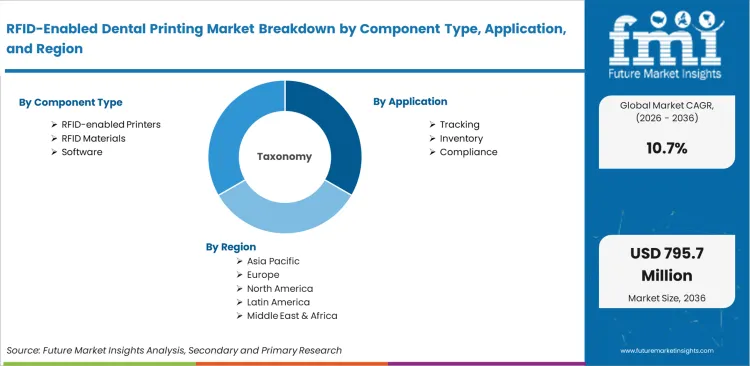
In 2026, the RFID-enabled dental printing market was valued at USD 260.10 million. Based on Future Market Insights analysis, demand for RFID-enabled dental printing is estimated to grow to USD 720.28 million by 2036. FMI projects a CAGR of 10.7% during the forecast period.
Absolute dollar growth of USD 460.18 million over the decade points to structural expansion rather than a simple equipment refresh cycle. As per FMI, demand is expected to rise supported by the use of digital case workflows in dental labs and the need for tighter control over printed parts and materials, while integration cost, software compatibility gaps, and uneven digitization across smaller clinics are expected to keep adoption paced. "This partnership with Circle perfectly reflects our vision of making chairside 3D printing more accessible, intuitive, and efficient for dental professionals. By seamlessly connecting Circle One’s cloud-based, AI-driven design capabilities with Rapid Shape’s proven printing ecosystem, we are removing barriers between design and manufacturing. The result is a streamlined, reliable workflow that empowers dental teams to deliver high-quality restorations faster and with greater confidence,” said Sébastien Lenoir, CEO of Circle. [1]
Summary of RFID-Enabled Dental Printing Market
- Market Definition
- The market covers dental printing workflows that integrate RFID-enabled hardware, materials, and software to improve identification, traceability, inventory visibility, and process control across digitally manufactured dental products. These solutions are being adopted across dental labs, clinics, and related production environments where workflow accuracy, material tracking, and compliance support are becoming more important in high-throughput restorative and appliance manufacturing.
- Demand Drivers in the Market
- Growing digitization of dental production is supporting demand for RFID-enabled systems that improve item-level visibility and reduce workflow errors.
- Dental labs and clinics are placing greater emphasis on traceability, inventory control, and process standardization as case volumes and material variety increase.
- Wider use of connected production systems encourages the adoption of RFID-enabled components that support better tracking of printed parts, materials, and workflow stages.
- Key Segments Analyzed in the FMI Report
- By Component Type: RFID-enabled Printers lead at 50% share in 2026, followed by RFID materials at 30% share.
- By Application: Tracking leads at 40% share in 2026, followed by inventory at 35% share.
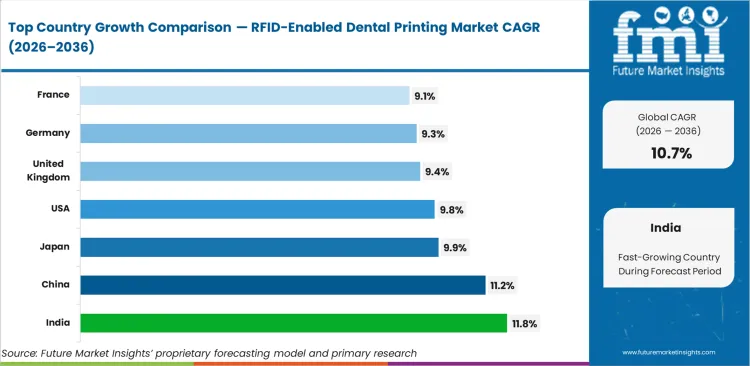
- Geography: India and China show the fastest growth at 11.8% and 11.2% CAGR, supported by rising digital dentistry adoption, expanding lab infrastructure, and stronger interest in automated workflow control.
- Analyst Opinion at FMI
- “Supplier preference is increasingly being shaped by workflow connectivity, traceability value, and production visibility, as dental providers seek RFID-enabled solutions that can reduce manual errors, improve material accountability, and support more controlled digital printing operations.”- observes Anurag Sharma, Principal Consultant at Future Market Insights.
- Strategic Implications and Executive Takeaways
- Build product positioning around traceability, workflow control, and production transparency, especially for high-volume lab environments.
- Prioritize printer-led solutions where RFID functionality can be embedded directly into day-to-day digital manufacturing operations.
- Expand commercial efforts in fast-growing dental markets where digital production, automation, and lab modernization are accelerating together.
- Methodology
- As per FMI, sizing and splits were reconciled using company-level product mapping, component-level demand allocation, and workflow assessment across RFID-enabled dental production environments.
- Segment shares were validated by linking component adoption with operational needs such as tracking, inventory control, and compliance support.
- Pricing sensitivity was stress tested under component mix and application mix shifts to confirm revenue response under realistic dental lab and clinic purchasing scenarios.
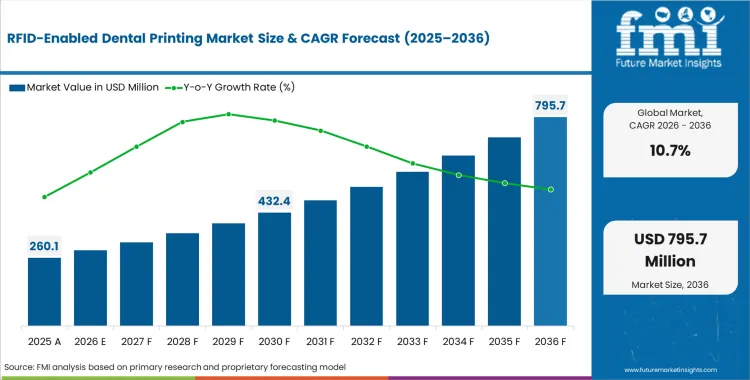
Procurement is being shaped by traceability requirements and operational control, with buyers giving weight to printer-software connectivity, RFID material compatibility, and the ability to reduce manual tracking errors across high-volume production. Dental labs remain the main demand center because they manage larger restoration and appliance workflows, while clinics are increasing adoption where inventory visibility and case tracking support faster turnaround and fewer workflow interruptions.
India (11.8% CAGR, supported by rising digital dentistry adoption and lab modernization) and China (11.2% CAGR, driven by growing demand for connected production workflows) are expected to lead growth. Japan (9.9% CAGR) is expected to remain supported by precision-led dental manufacturing practices. The USA (9.8% CAGR) is expected to remain the largest market due to stronger digital infrastructure and broader lab investment. Mature markets including the UK (9.4%), Germany (9.3%), and France (9.1%) are expected to contribute more through replacement purchases and software-led upgrades, constrained by integration review cycles and cautious capital allocation.
RFID-Enabled Dental Printing Market Definition
The market includes dental printing systems and associated components that incorporate RFID capabilities to strengthen product identification, tracking, inventory visibility, and process control across digital dental production workflows. It includes RFID-enabled printers, RFID materials, and software used to support case tracking, inventory management, and compliance processes in dental labs and clinics. These solutions are used to reduce manual handling errors, improve workflow transparency, and support better coordination between production steps and delivery points. Demand is shaped by lab throughput, digitization maturity, and the need for traceable, organized dental manufacturing environments.
RFID-Enabled Dental Printing Market Inclusions
The report includes global and regional market sizing and a 10-year forecast for 2026 to 2036. Segment-level sizing is provided by component type, application, and end user, with country-level CAGR comparisons across key markets. Coverage also includes assessment of replacement demand, workflow digitization trends, and procurement priorities such as traceability, software integration, and material visibility, alongside competitive positioning of major dental printing and RFID-related suppliers, based on FMI analysis.
RFID-Enabled Dental Printing Market Exclusions
The scope excludes conventional dental printers that do not use RFID as a functional part of workflow management or product tracking. It also omits standalone RFID infrastructure sold outside dental printing use, including broad warehouse tags, readers, and enterprise asset systems not tied to dental production value. Clinical procedure revenue, imaging systems, and non-printing dental software are excluded unless directly linked to RFID-enabled printing workflows. The focus remains on RFID-enabled dental printing solutions aligned to the listed component types, applications, end users, and supplier participation.
RFID-Enabled Dental Printing Market Research Methodology
- Primary Research: Interviews were carried out with dental lab owners, digital workflow managers, clinic administrators, printer suppliers, and software stakeholders to understand how these solutions are being used, what factors influence purchasing decisions, and which workflow needs matter most.
- Desk Research: Public information was reviewed from dental industry references, standards sources, company primary disclosures, and workflow-related publications to benchmark adoption trends, product positioning, and supplier activity.
- Market-Sizing and Forecasting: A hybrid model was applied using digital dental production demand, end-user workflow adoption, and connected printing penetration by geography, then reconciled through segment shares across component type, application, and care setting.
- Data Validation and Update Cycle: Outputs were checked through consistency review across segment totals and country growth rates, with variance review applied before finalization.
Segmental Analysis
RFID-Enabled Dental Printing Market Analysis by Component Type
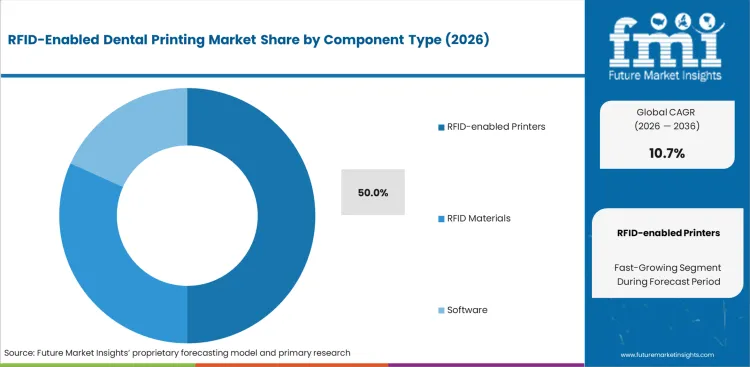
Based on FMI’s report, RFID-enabled printers are estimated to hold 50% share in 2026. This lead position is supported by their central role in integrating RFID capability directly into the production workflow, where printing remains the core operational step in digital dental manufacturing. RFID materials account for 30% share, while software contributes 20%. RFID-enabled printers remain the leading segment because they sit at the point where traceability, production control, and printing execution converge, making them the most commercially visible and functionally central component in the ecosystem.
- Highest installed-base across dental laboratories: RFID-enabled printers are expected to lead the Component Type because the printer is the core production asset that must be installed before RFID-linked materials or software can be used at scale. Industry survey data show that 72% of dental labs reported using an in-house 3D printer in 2025, up from 11% in 2014, which indicates that printer adoption is already deep within digital dental workflows. In an RFID-enabled setup, this installed hardware layer remains the largest revenue anchor within the component stack. [2]
- Printers are the primary capital investment in the workflow: RFID-enabled printers hold the major share because they represent the main capital purchase in the component ecosystem, whereas software is typically a lower-ticket layer and RFID materials are recurring consumables. ADA survey findings show that among nonusers, high financial investment was cited by 39% as a reason for not adopting a 3D printer, which directly reflects the heavier cost burden attached to printer hardware. [3]
- Printer platforms handle the heaviest production load: RFID-enabled printers also dominate because production throughput sits at the printer level, not at the software or material level. The same NADL survey shows that 67% of labs using 3D printers were producing 10 or more printed cases per day in 2025, while 27% were producing 50 or more cases per day. This kind of output concentration strengthens the economic weight of printers in the workflow.
RFID-Enabled Dental Printing Market Analysis by Application
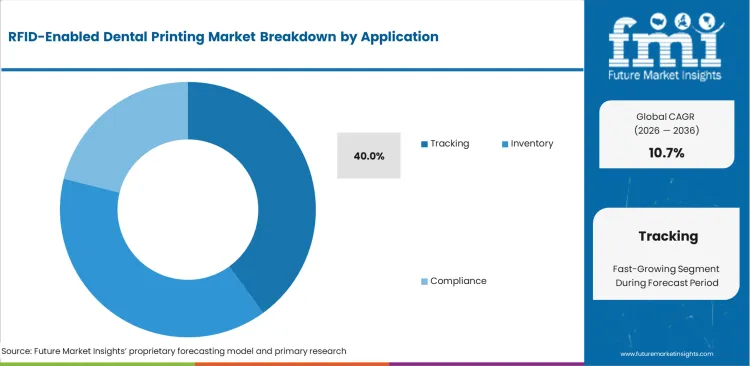
Tracking accounts for 40% share in 2026, based on FMI’s report, reflecting its position as the largest application segment in the market. This leadership is supported by the need to monitor parts, jobs, and materials across multiple workflow stages in dental printing environments where accuracy and turnaround time matter. Inventory holds 35% share, while compliance contributes 25%. Tracking leads because it addresses the most immediate operational need in digital dental production, namely knowing where a case, material lot, or printed output is at any given step in the workflow.
- Tracking is the Foundational RFID Use Case: Tracking tends to lead the application mix because it is the first function that activates value across the workflow. In dental and broader healthcare environments, RFID is primarily adopted to identify where an item is, who used it, and what stage it is in. LM-Dental’s GS1/EPC-RFID case shows instruments being tracked from dispensing through utilization, processing, sterilization, and return to storage, while the University of Copenhagen case reported roughly 10% lower inventory costs after implementation. [4]
- Tracking Delivers the Clearest Measurable Operational Gains: Tracking usually captures the highest application share because it produces the most visible workflow return. Avery Dennison’s healthcare RFID white paper states that RFID-based sample tracking can provide end-to-end chain of custody, automate documentation, save up to 26.5 hours of work per week, and reduce lost samples to zero in the cited laboratory quality-control case.
RFID-Enabled Dental Printing Market Drivers, Restraints, and Opportunities
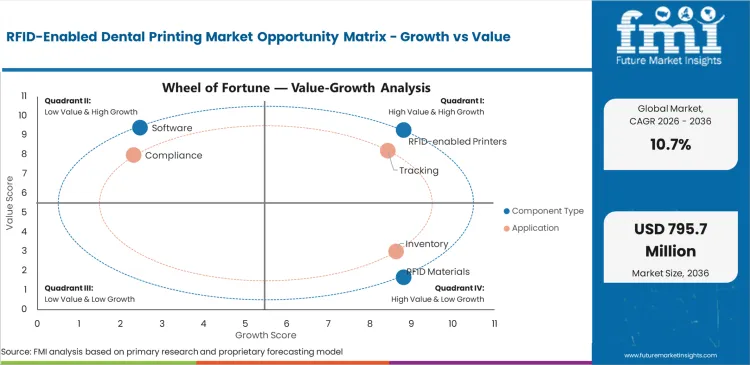
Future Market Insights analysis indicates that this market is expanding as dental production becomes more digital, more connected, and more dependent on traceable workflows. Estimated valuation in 2026 is being supported by growing need for item-level visibility, material accountability, and process control in environments where personalized dental products are manufactured at increasing speed and scale. Demand is being shaped by the practical need to reduce manual handling errors, improve workflow transparency, and support more structured management of jobs and consumables across dental printing operations.
At the same time, market expansion is being moderated by integration complexity, upfront system costs, and variable readiness across smaller labs and clinics. Even so, forecast growth remains supported by continued dental digitization, broader automation adoption, and stronger interest in connected lab operations. Based on FMI’s report, the outlook reflects a market where component choice influences workflow depth, tracking remains the leading application, and supplier differentiation increasingly depends on integration value rather than standalone product features.
- Workflow Visibility Driver: Demand is being supported as dental providers increasingly seek better traceability and control across digital production processes.
- Integration Complexity Restraint: Adoption can be slowed where RFID systems require workflow changes, software coordination, or new operational training.
- Connected Lab Opportunity: Demand is being supported as more labs and clinics invest in automated, data-driven dental manufacturing environments.
Regional Analysis
Based on the regional analysis, helium free MRI scanners market is segmented into North America, East Asia, South Asia & Pacific, and Western Europe across 40+ countries. Regional performance is interpreted through replacement of legacy MRI infrastructure, preference for sealed magnet architecture, and adoption across hospitals and diagnostic centres, as per FMI. The full report also offers market attractiveness analysis based on regional trends.
.webp "Top Country Growth Comparison Rfid Enabled Dental Printing Market Cagr (2026 2036)")
| Country | CAGR |
|---|---|
| United States | 9.8% |
| Germany | 9.3% |
| France | 9.1% |
| United Kingdom | 9.4% |
| Japan | 9.9% |
| China | 11.2% |
| India | 11.8% |
Source: Future Market Insights (FMI) analysis and primary research
North America RFID-Enabled Dental Printing Market Analysis
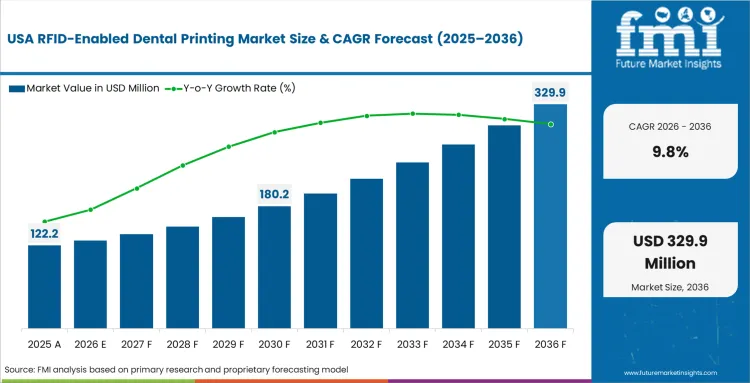
North America is being shaped by workflow digitisation in dental labs, where tracking accuracy, printer utilisation, and material traceability are increasingly tied to commercial efficiency. Stratasys remains strongly positioned through printer-led digital manufacturing workflows, while 3D Systems and Formlabs retain relevance in lab environments that balance throughput, material flexibility, and software integration. Dentsply Sirona also remains visible where broader digital dentistry ecosystems support adoption. FMI analysts note that dental labs continue to represent the largest demand base, while clinics adopt selectively where in-house production is being expanded.
- United States: In the United States, RFID-enabled dental printing is expected to advance at 9.8% CAGR through 2036, supported by stronger emphasis on case tracking, workflow visibility, and inventory control inside high-throughput dental labs. RFID-enabled printers remain the leading component because hardware deployment usually comes first, with software and materials expanding as workflows mature. Tracking remains the largest application area, particularly in environments handling multiple restorative or orthodontic cases at the same time, while inventory management becomes more important as material cost control tightens.
FMI’s report includes a detailed analysis of the growth in the North American region, along with a country-wise assessment that includes the USA, Canada and Mexico. Readers can also find regional trends, regulations, and market growth based on different segments and countries in the North America region.
East Asia RFID-Enabled Dental Printing Market Analysis
East Asia is moving quickly as digital dentistry becomes more operationally structured, with labs placing more value on traceability, workflow control, and better visibility over materials and production status. Stratasys, Formlabs, and Dentsply Sirona remain relevant where printer-linked workflows are expanding, while Zebra Technologies and Honeywell add importance through the broader RFID and tagging ecosystem. FMI is of the opinion that this region is benefiting from a combination of lab modernization and rising demand for organised digital production.
- China: China leads among the countries assessed at 11.2% CAGR through 2036, with growth supported by expansion of organised dental labs and increasing use of RFID-enabled printers to improve workflow visibility. Tracking remains the lead application because larger labs need more dependable movement control across printed cases, while inventory usage is also strengthening as material planning becomes more disciplined. Hardware-led adoption still accounts for the largest share, yet software is becoming more important as labs try to connect printer status, case identification, and production logs into one system.
- Japan: Japan is projected to rise at 9.9% CAGR through 2036, supported by a quality-focused lab environment and growing interest in process traceability rather than volume expansion alone. RFID-enabled printing fits well in settings where consistency, compliance, and case identification are closely monitored, especially in higher-value production. Software-linked traceability is gaining relevance, but adoption still tends to move in controlled steps because users prefer proven workflows and predictable returns.
FMI’s report includes a detailed analysis of the growth in the East Asia region, along with a country-wise assessment that includes China, Japan and South Korea. Readers can also find regional trends, regulations, and market growth based on different segments and countries in the East Asia region.
South Asia & Pacific RFID-Enabled Dental Printing Market Analysis
South Asia & Pacific is emerging as a faster-growth opportunity, where digital lab expansion and rising case volumes are creating a stronger case for traceable production. Printer-led adoption is usually the entry point, but the real value increasingly comes from connecting tracking and inventory functions into daily lab operations. Formlabs, Stratasys, Dentsply Sirona, and Envista remain relevant where labs and advanced clinics are building digital manufacturing capacity. FMI analysts note that demand in this region is being driven more by workflow efficiency and scaling needs than by technology novelty alone.
- India: India is forecast at 11.8% CAGR through 2036, making it the fastest-growing country among those assessed. Growth is being driven by expanding organised dental labs, rising restorative and aligner-related case volumes, and stronger demand for systems that help monitor job flow and material use. RFID-enabled printers remain the main commercial driver because labs typically upgrade hardware first, while software adoption follows as teams seek better tracking and compliance support. Inventory management is becoming more important in larger labs that want tighter control over resin and material usage, especially where margins are under pressure.
FMI’s report includes a detailed analysis of the growth in the South Asia & Pacific region, along with a country-wise assessment that includes India, ASEAN Countries, Australia & New Zealand and Rest of South Asia. Readers can also find regional trends, regulations, and market growth based on different segments and countries in the South Asia & Pacific region.
Western Europe RFID-Enabled Dental Printing Market Analysis
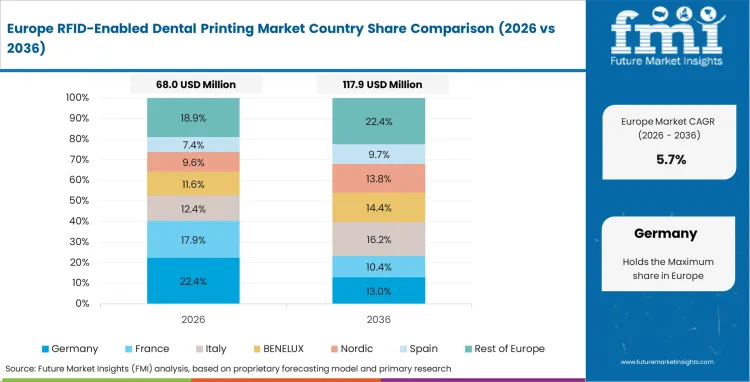
Western Europe remains a structured digital dentistry market, where demand for RFID-enabled printing is shaped by operational control, compliance needs, and the growing importance of workflow transparency in dental labs. Stratasys, 3D Systems, HP, and Dentsply Sirona remain relevant where printer ecosystems and software-linked production are already familiar to users. Zebra Technologies and SATO also matter in the broader traceability layer, especially where labs need dependable tagging and identification workflows. FMI opines that growth in this region is being supported by practical workflow improvement rather than experimental adoption.
- Germany: Germany is expected to expand at 9.3% CAGR through 2036, supported by steady investment in digitally managed dental lab production and increasing interest in linking print jobs with inventory and compliance records. RFID-enabled printers remain the largest component category, while RFID materials and software gain share as workflows become more mature.
- France: France is expected to rise at 9.1% CAGR through 2036, supported by gradual but steady movement toward more structured dental manufacturing processes. RFID-enabled printing is gaining relevance where labs want better coordination between printers, materials, and case tracking without adding unnecessary operational complexity.
- UK: The UK is projected to post 9.4% CAGR through 2036, with demand supported by a stronger focus on case traceability, digital workflow coordination, and lab productivity. Tracking remains the lead application because it directly improves job visibility and reduces handling errors in multi-case environments. Software and compliance functions are also becoming more important as users seek better reporting and audit readiness. A practical limitation is that some labs still rely on fragmented software systems, which can slow full RFID integration even when the operational case is strong.
FMI’s analysis of RFID-Enabled Dental Printing Market in Western Europe consists of country-wise assessment that includes Germany, UK, France, Italy, Spain, BENELUX, Nordic Countries and Rest of Western Europe. Readers can know various regulations and latest trends in the regional market.
Competitive aligners for market players
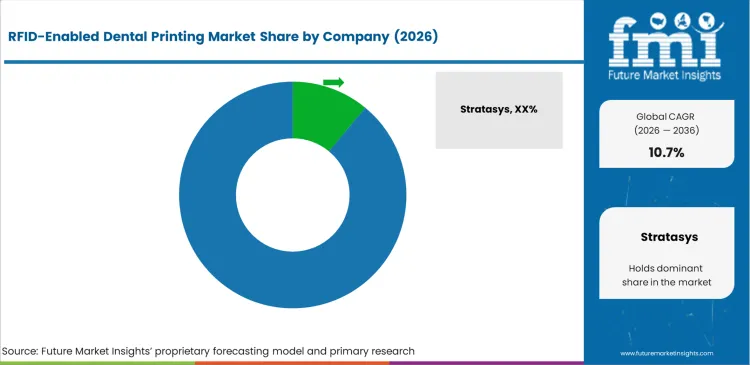
Market structure remains fragmented, yet practical competition is concentrated among a limited set of suppliers that can deliver reliable RFID integration across printers, consumables, and software, while meeting traceability and documentation expectations in regulated dental production workflows. FMI analysis indicates a clear scale leader at about 18.5% share, while the remaining demand is distributed across printer OEMs, automation and identification vendors, and dental workflow companies. The main competitive factor is traceability performance inside daily production, not short-cycle price movement, because labs value fewer remakes, tighter inventory control, and cleaner audit trails over marginal hardware savings. Component mix influences rivalry since RFID-enabled printers remain the dominant offering type, with supporting materials and software defining how usable the tracking layer becomes, as per FMI.
Companies with structural advantages typically combine established printer ecosystems with software capability that can link job IDs, material lots, and production steps without adding manual burden. Vendors that can provide stable tag readability, validated material handling, and integration with lab management software tend to win larger lab accounts where throughput is high and process discipline is enforced. Suppliers with broader portfolios across both hardware and identification workflows can reduce implementation friction by offering standardized interfaces and support. Players that rely on third-party integrations can face slower adoption when labs demand single-vendor accountability for downtime, misreads, or compliance documentation gaps, based on FMI’s report.
Customer concentration reinforces buyer leverage. Dental labs remain the main buyers and commonly manage supplier dependency by keeping alternate printers qualified, maintaining non-RFID fallback workflows, and negotiating service response terms tied to production continuity. Clinics adopt through partner labs and tend to value turnaround and case tracking transparency, which reinforces lab-driven vendor selection rather than direct clinic purchasing. This procurement behavior limits pricing power for base printer hardware, while measured premiums are retained mainly where RFID capability reduces inventory loss, prevents material mix-ups, and supports documentation needs that lower rework and compliance effort, Future Market Insights analysis.
Recent Developments
The report includes full coverage of key trends from competitive benchmarking. Some of the recent developments covered in the reports:
- In October 2025, Rapid Shape, a leading German manufacturer of high-precision 3D printing solutions, announced the launch of the PRO 30, the desktop MVP for dental laboratories. The PRO 30 is the Most Valuable Player because it is engineered specifically for dental labs requiring highly productive desktop printing, enabling scalable batch production with up to 6 full arch dental models per build, allowing laboratories to achieve 24-hour turnaround times with unprecedented productivity gains. [6]
- In July 2025, Novenda Technologies, announced that the company has secured US$ 6.1m in funding to transform dental product manufacturing with its revolutionary multi-material 3D printing technology. This innovative solution aims to make high-quality dental care better, more aesthetically pleasing, accessible and affordable. The $6.1m Series A funding round was led by Brightlands Venture Partners with participation from KBC Focus Fund (Belgium), Borski Fund (NL) and Limburg Business Development Fund/LIOF (NL) as well as a group of angel investors and an Innovation Credit from RVO. [7]
- In March 2025, Raise3D has launched the DF2+, a next-generation DLP 3D printer integrated with Würth Additive’s Digital Inventory Services. Featuring RFID traceability, encrypted file management, and support for high-performance resins, it enables secure, on-demand production. The system enhances scalability, reduces inventory needs, and strengthens IP protection in digital manufacturing workflows.
Key players in RFID-Enabled Dental Printing Market
- Stratasys
- 3D Systems
- Formlabs
- HP
- SprintRay Inc.
- Zebra Technologies
- Honeywell
- Dentsply Sirona
- Envista
- Straumann
- SATO
Scope of the report
| Metric | Value |
|---|---|
| Quantitative Units | USD 260.10 Mn (2026) to USD 720.28 Mn (2036), at a CAGR of 10.7% |
| Market Definition | The RFID-enabled dental printing market comprises the global production and trade of RFID-enabled printers, RFID-tagged materials, and related software used to track dental printing workflows, manage inventory, and support compliance in labs and clinics, where demand is shaped by traceability needs, material authentication, and digitised production in dental laboratories and chairside environments. |
| Component Type Segmentation | RFID-enabled Printers, RFID Materials, and Software |
| Application Segmentation | Tracking, Inventory and Compliance |
| End User Coverage | Dental Labs, Clinics, and Others |
| Regions Covered | North America, Latin America, East Asia, South Asia & Pacific, Western Europe, Eastern Europe, and Middle East & Africa. |
| Countries Covered | United States, Canada, Mexico, Brazil, Argentina, Germany, France, United Kingdom, Italy, Spain, China, India, Japan, South Korea, Indonesia, Australia and 40+ countries |
| Key Companies Profiled | Stratasys, 3D Systems, Formlabs, HP, SprintRay Inc., Zebra Technologies, Honeywell, Dentsply Sirona, Envista, Straumann and SATO |
| Forecast Period | 2026 to 2036 |
| Approach | Hybrid top down and bottom up market modeling validated through primary interviews with dental labs, OEMs, and workflow software providers, supported by adoption benchmarking for traceability systems and material usage tracking, as per FMI. |
RFID-Enabled Dental Printing Market Analysis by Segments
Component Type
- RFID-enabled Printers
- RFID Materials
- Software
Application
- Tracking
- Inventory
- Compliance
End user
- Dental Labs
- Clinics
- Others
Region
- North America
- USA
- Canada
- Mexico
- Latin America
- Brazil
- Argentina
- Rest of Latin America
- East Asia
- China
- Japan
- South Korea
- South Asia & Pacific
- India
- ASEAN Countries
- Australia & New Zealand
- Rest of South Asia
- Western Europe
- Germany
- UK
- France
- Italy
- Spain
- BENELUX
- Nordic Countries
- Rest of Western Europe
- Eastern Europe
- Russia
- Hungary
- Poland
- Rest of Eastern Europe
- Middle East & Africa
- Saudi Arabia
- Türkiye
- South Africa
- Other African Union
- Rest of Middle East & Africa
Bibliography
- [1] Rapid Shape GmbH (2026). Rapid Shape and CIRCLE Announce a Partnership to Streamline the Transition from Design to Chairside Printing.
- [2] Journal of Dental Technology (2025). Three Out of Four Labs Now Use 3D Printers: New Results from NADL’s Dental Technology Survey
- [3] Augusta University Research Profiles (2023). Prevalence and applications of 3-dimensional printers in dental practice: An American Dental Association Clinical Evaluators Panel survey
- [4] LM-Instruments Oy (2019). LM-Dental moving to GS1 standards for dental product traceability with EPC/RFID
- [5] Avery Dennison Corporation (2021). RFID empowering Healthcare experts in clinical laboratories
- [6] Rapid Shape GmbH (2025). Rapid Shape Launches PRO 30: The Most Powerful Desktop 3D Printer for Dental Labs
- [7] Novenda Technologies. (2025) Novenda Technologies secures $6.1M to revolutionize dental products with breakthrough 3D printing
This bibliography is provided for reader reference and is not exhaustive. The full report contains the complete reference list and detailed citations.
This Report Addresses
- Market intelligence to enable structured decision making across traceability adoption and digital production planning in dental labs and clinics
- Market size estimation and 10 year revenue forecasts from 2026 to 2036 for RFID-enabled dental printing demand
- Growth opportunity mapping across component type, application requirements, and end user adoption pools
- Segment and regional revenue forecasts aligned to the stated taxonomy and covered geographies
- Competition strategy assessment including positioning by ecosystem integration, material authentication, and channel coverage benchmarking
- Product and compliance tracking focused on traceability expectations, documentation discipline, and workflow governance in regulated dental manufacturing
- Regulatory impact analysis covering UDI-aligned traceability practices and medical device compliance requirements influencing RFID adoption
- Market report delivery in PDF, Excel, PPT, and interactive dashboard formats for executive and operational use
Frequently Asked Questions
How large is the demand for RFID-Enabled Dental Printing in the global market in 2026?
Demand for RFID-Enabled Dental Printing in the global market is estimated to be valued at USD 260.10 Mn in 2026, as per FMI.
What will be the market size of RFID-Enabled Dental Printing in the global market by 2036?
Market size for RFID-Enabled Dental Printing is projected to reach USD 720.28 Mn by 2036.
What is the expected demand growth for RFID-Enabled Dental Printing in the global market between 2026 and 2036?
Demand for RFID-Enabled Dental Printing in the global market is expected to grow at a CAGR of 10.7% between 2026 and 2036.
Which Component Type is poised to lead global demand by 2026?
RFID-enabled Printers are expected to be the dominant Component Type, capturing 50% share in 2026.
Which Application is expected to account for the largest share in 2026?
Tracking is expected to hold the highest share at 40% in 2026.
How significant is Dental Labs demand in the 2026 End User mix?
Dental Labs are projected to account for 55% share of end user demand in 2026.
Preview the report firsthand - request a free sample
Get SampleGet the brochure for pricing and purchase details.
Get PDFTable of Content
- Executive Summary
- Global Market Outlook
- Demand-side Trends
- Supply-side Trends
- Technology Roadmap Analysis
- Analysis and Recommendations
- Market Overview
- Market Coverage / Taxonomy
- Market Definition / Scope / Limitations
- Research Methodology
- Chapter Orientation
- Analytical Framework
- Market Structure, Signals, and Trend Drivers
- Benchmarking and Cross-market Comparability
- Market Sizing, Forecasting, and Opportunity Mapping
- Research Design and Evidence Framework
- Desk Research Programme (Secondary Evidence)
- Company Annual and Sustainability Reports
- Peer-reviewed Journals and Academic Literature
- Corporate Websites, Product Literature, and Technical Notes
- Earnings Decks and Investor Briefings
- Statutory Filings and Regulatory Disclosures
- Technical White Papers and Standards Notes
- Trade Journals, Industry Magazines, and Analyst Briefs
- Conference Proceedings, Webinars, and Seminar Materials
- Government Statistics Portals and Public Data Releases
- Press Releases and Reputable Media Coverage
- Specialist Newsletters and Curated Briefings
- Sector Databases and Reference Repositories
- FMI Proprietary Databases and Historical Market Data
- Subscription Datasets and Paid Sources
- Social Channels, Communities, and Digital Listening Inputs
- Additional Desk Sources
- Expert Input and Fieldwork (Primary Evidence)
- Primary Modes
- Qualitative Interviews and Expert Elicitation
- Quantitative Surveys and Structured Data Capture
- Blended Approach
- Why Primary Evidence is Used
- Field Techniques
- Interviews
- Surveys
- Focus Groups
- Observational and In-context Research
- Social and Community Interactions
- Stakeholder Universe Engaged
- C-suite Leaders
- Board Members
- Presidents and Vice Presidents
- R&D and Innovation Heads
- Technical Specialists
- Domain Subject-matter Experts
- Scientists
- Physicians and Other Healthcare Professionals
- Governance, Ethics, and Data Stewardship
- Research Ethics
- Data Integrity and Handling
- Primary Modes
- Research Methods and Reference Sources
- Desk Research Programme (Secondary Evidence)
- Market Data Analysis and Forecast Development
- Data Collection
- Data Review and Validation
- Synthesis, Triangulation, and Analysis
- Research Quality and Validation
- Market Background
- Market Dynamics
- Drivers
- Restraints
- Opportunity
- Trends
- Scenario Forecast
- Demand in Optimistic Scenario
- Demand in Likely Scenario
- Demand in Conservative Scenario
- Opportunity Map Analysis
- Product Life Cycle Analysis
- Supply Chain Analysis
- Investment Feasibility Matrix
- Value Chain Analysis
- PESTLE and Porter’s Analysis
- Regulatory Landscape
- Regional Parent Market Outlook
- Production and Consumption Statistics
- Import and Export Statistics
- Market Dynamics
- Global Market Analysis 2021 to 2025 and Forecast, 2026 to 2036
- Historical Market Size Value (USD Million) Analysis, 2021 to 2025
- Current and Future Market Size Value (USD Million) Projections, 2026 to 2036
- Y-o-Y Growth Trend Analysis
- Absolute $ Opportunity Analysis
- Global Market Pricing Analysis 2021 to 2025 and Forecast 2026 to 2036
- Global Market Analysis 2021 to 2025 and Forecast 2026 to 2036, By Component Type
- Introduction / Key Findings
- Historical Market Size Value (USD Million) Analysis By Component Type , 2021 to 2025
- Current and Future Market Size Value (USD Million) Analysis and Forecast By Component Type , 2026 to 2036
- RFID-enabled Printers
- RFID Materials
- Software
- RFID-enabled Printers
- Y-o-Y Growth Trend Analysis By Component Type , 2021 to 2025
- Absolute $ Opportunity Analysis By Component Type , 2026 to 2036
- Global Market Analysis 2021 to 2025 and Forecast 2026 to 2036, By Application
- Introduction / Key Findings
- Historical Market Size Value (USD Million) Analysis By Application, 2021 to 2025
- Current and Future Market Size Value (USD Million) Analysis and Forecast By Application, 2026 to 2036
- Tracking
- Inventory
- Compliance
- Tracking
- Y-o-Y Growth Trend Analysis By Application, 2021 to 2025
- Absolute $ Opportunity Analysis By Application, 2026 to 2036
- Global Market Analysis 2021 to 2025 and Forecast 2026 to 2036, By Region
- Introduction
- Historical Market Size Value (USD Million) Analysis By Region, 2021 to 2025
- Current Market Size Value (USD Million) Analysis and Forecast By Region, 2026 to 2036
- North America
- Latin America
- Western Europe
- Eastern Europe
- East Asia
- South Asia and Pacific
- Middle East & Africa
- Market Attractiveness Analysis By Region
- North America Market Analysis 2021 to 2025 and Forecast 2026 to 2036, By Country
- Historical Market Size Value (USD Million) Trend Analysis By Market Taxonomy, 2021 to 2025
- Market Size Value (USD Million) Forecast By Market Taxonomy, 2026 to 2036
- By Country
- USA
- Canada
- Mexico
- By Component Type
- By Application
- By Country
- Market Attractiveness Analysis
- By Country
- By Component Type
- By Application
- Key Takeaways
- Latin America Market Analysis 2021 to 2025 and Forecast 2026 to 2036, By Country
- Historical Market Size Value (USD Million) Trend Analysis By Market Taxonomy, 2021 to 2025
- Market Size Value (USD Million) Forecast By Market Taxonomy, 2026 to 2036
- By Country
- Brazil
- Chile
- Rest of Latin America
- By Component Type
- By Application
- By Country
- Market Attractiveness Analysis
- By Country
- By Component Type
- By Application
- Key Takeaways
- Western Europe Market Analysis 2021 to 2025 and Forecast 2026 to 2036, By Country
- Historical Market Size Value (USD Million) Trend Analysis By Market Taxonomy, 2021 to 2025
- Market Size Value (USD Million) Forecast By Market Taxonomy, 2026 to 2036
- By Country
- Germany
- UK
- Italy
- Spain
- France
- Nordic
- BENELUX
- Rest of Western Europe
- By Component Type
- By Application
- By Country
- Market Attractiveness Analysis
- By Country
- By Component Type
- By Application
- Key Takeaways
- Eastern Europe Market Analysis 2021 to 2025 and Forecast 2026 to 2036, By Country
- Historical Market Size Value (USD Million) Trend Analysis By Market Taxonomy, 2021 to 2025
- Market Size Value (USD Million) Forecast By Market Taxonomy, 2026 to 2036
- By Country
- Russia
- Poland
- Hungary
- Balkan & Baltic
- Rest of Eastern Europe
- By Component Type
- By Application
- By Country
- Market Attractiveness Analysis
- By Country
- By Component Type
- By Application
- Key Takeaways
- East Asia Market Analysis 2021 to 2025 and Forecast 2026 to 2036, By Country
- Historical Market Size Value (USD Million) Trend Analysis By Market Taxonomy, 2021 to 2025
- Market Size Value (USD Million) Forecast By Market Taxonomy, 2026 to 2036
- By Country
- China
- Japan
- South Korea
- By Component Type
- By Application
- By Country
- Market Attractiveness Analysis
- By Country
- By Component Type
- By Application
- Key Takeaways
- South Asia and Pacific Market Analysis 2021 to 2025 and Forecast 2026 to 2036, By Country
- Historical Market Size Value (USD Million) Trend Analysis By Market Taxonomy, 2021 to 2025
- Market Size Value (USD Million) Forecast By Market Taxonomy, 2026 to 2036
- By Country
- India
- ASEAN
- Australia & New Zealand
- Rest of South Asia and Pacific
- By Component Type
- By Application
- By Country
- Market Attractiveness Analysis
- By Country
- By Component Type
- By Application
- Key Takeaways
- Middle East & Africa Market Analysis 2021 to 2025 and Forecast 2026 to 2036, By Country
- Historical Market Size Value (USD Million) Trend Analysis By Market Taxonomy, 2021 to 2025
- Market Size Value (USD Million) Forecast By Market Taxonomy, 2026 to 2036
- By Country
- Kingdom of Saudi Arabia
- Other GCC Countries
- Turkiye
- South Africa
- Other African Union
- Rest of Middle East & Africa
- By Component Type
- By Application
- By Country
- Market Attractiveness Analysis
- By Country
- By Component Type
- By Application
- Key Takeaways
- Key Countries Market Analysis
- USA
- Pricing Analysis
- Market Share Analysis, 2025
- By Component Type
- By Application
- Canada
- Pricing Analysis
- Market Share Analysis, 2025
- By Component Type
- By Application
- Mexico
- Pricing Analysis
- Market Share Analysis, 2025
- By Component Type
- By Application
- Brazil
- Pricing Analysis
- Market Share Analysis, 2025
- By Component Type
- By Application
- Chile
- Pricing Analysis
- Market Share Analysis, 2025
- By Component Type
- By Application
- Germany
- Pricing Analysis
- Market Share Analysis, 2025
- By Component Type
- By Application
- UK
- Pricing Analysis
- Market Share Analysis, 2025
- By Component Type
- By Application
- Italy
- Pricing Analysis
- Market Share Analysis, 2025
- By Component Type
- By Application
- Spain
- Pricing Analysis
- Market Share Analysis, 2025
- By Component Type
- By Application
- France
- Pricing Analysis
- Market Share Analysis, 2025
- By Component Type
- By Application
- India
- Pricing Analysis
- Market Share Analysis, 2025
- By Component Type
- By Application
- ASEAN
- Pricing Analysis
- Market Share Analysis, 2025
- By Component Type
- By Application
- Australia & New Zealand
- Pricing Analysis
- Market Share Analysis, 2025
- By Component Type
- By Application
- China
- Pricing Analysis
- Market Share Analysis, 2025
- By Component Type
- By Application
- Japan
- Pricing Analysis
- Market Share Analysis, 2025
- By Component Type
- By Application
- South Korea
- Pricing Analysis
- Market Share Analysis, 2025
- By Component Type
- By Application
- Russia
- Pricing Analysis
- Market Share Analysis, 2025
- By Component Type
- By Application
- Poland
- Pricing Analysis
- Market Share Analysis, 2025
- By Component Type
- By Application
- Hungary
- Pricing Analysis
- Market Share Analysis, 2025
- By Component Type
- By Application
- Kingdom of Saudi Arabia
- Pricing Analysis
- Market Share Analysis, 2025
- By Component Type
- By Application
- Turkiye
- Pricing Analysis
- Market Share Analysis, 2025
- By Component Type
- By Application
- South Africa
- Pricing Analysis
- Market Share Analysis, 2025
- By Component Type
- By Application
- USA
- Market Structure Analysis
- Competition Dashboard
- Competition Benchmarking
- Market Share Analysis of Top Players
- By Regional
- By Component Type
- By Application
- Competition Analysis
- Competition Deep Dive
- Stratasys
- Overview
- Product Portfolio
- Profitability by Market Segments (Product/Age /Sales Channel/Region)
- Sales Footprint
- Strategy Overview
- Marketing Strategy
- Product Strategy
- Channel Strategy
- 3D Systems
- Formlabs
- HP
- SprintRay Inc.
- Zebra Technologies
- Honeywell
- Stratasys
- Competition Deep Dive
- Assumptions & Acronyms Used


