

- Industry Size (2026)
- USD 310.0 Mn
- Forecast (2036)
- USD 820.0 Mn
- CAGR (2026 to 2036)
- 10.2%
Dental 3D Educational Tools Market size, market forecast and outlook By FMI
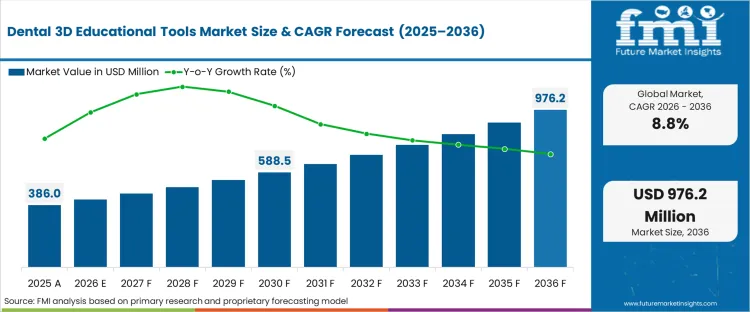
In 2026, the dental 3D educational tools market was valued at USD 420.0 million. Based on Future Market Insights analysis, demand for dental 3D educational tools is estimated to grow to USD 459.2 million in 2027 and USD 976.2 million by 2036. FMI projects a CAGR of 8.8% during the forecast period.
Absolute dollar growth of USD 37.0 million over the decade signals a scale-up phase rather than a routine curriculum refresh. As per FMI, growth is expected to be supported by wider use of simulation to standardize pre-clinical competency, while procurement cycles, faculty adoption capacity, and lab infrastructure constraints are expected to keep deployment paced in public institutions.
“With this preset for dental anatomical models, we are entering a new segment of digital dental education and clinical simulation, helping customers move beyond traditional training methods toward more standardised, technology-driven learning environments,” said Erez Ben Zvi, VP Medical at Stratasys”. “By combining anatomical realism with repeatability and customization, we’re enabling educators, clinicians, and device manufacturers to prepare for real-world procedures with greater confidence and consistency.” [1]
Summary of Dental 3D Educational Tools Market
- Dental 3D Educational Tools Market Definition
- The industry covers physical and digital training tools used in dental education to simulate clinical procedures, including 3D printed models, VR and AR simulators, haptic trainers, digital curriculum content, and visualization or planning education software.
- Demand Drivers in the Market
- Dental schools are increasing use of simulation to expand student hands-on time without relying only on live patient exposure.
- Competency-based training models are pushing institutions to adopt repeatable, measurable practice tools that standardize skill assessment.
- Remote and blended education programs are expanding digital content and immersive training demand to support scalable learning delivery.
- Key Segments Analyzed in the FMI Report
- By Product Type: 3D printed models and typodonts lead at 29.0% share in 2026, followed by VR and AR dental simulators at 22.7% share.
- By Learning Modality: In-lab hands-on leads at 38.6% share in 2026, followed by VR and AR immersive at 28.3% share.
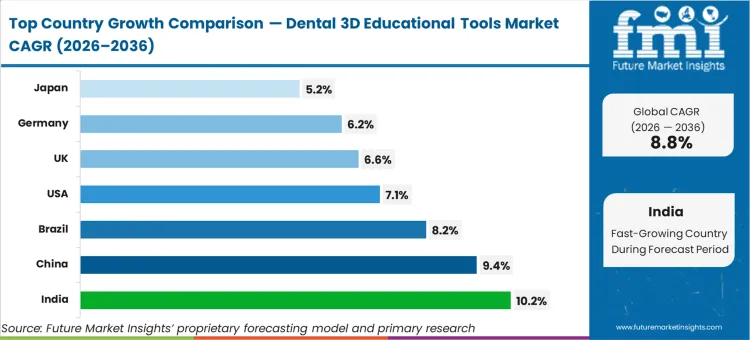
- Geography: India and China show the fastest growth at 10.2% and 9.4% CAGR, supported by expanding dental education intake and higher investment in skills labs.
- Analyst Opinion at FMI
- Anurag Sharma, Principal Consultant at Future Market Insights, opines, ‘Adoption is being decided by curriculum fit, measurable skill scoring, and maintenance practicality, since faculty time and lab utilization are the binding constraints in simulation-led training.’
- Strategic Implications and Executive Takeaways
- Anchor portfolios around typodont and model ecosystems that support repeat purchasing, then layer immersive modules as premium upgrades.
- Build purchasing proposals around measurable competency outcomes and reduced faculty supervision load to strengthen institutional conversion.
- Prioritize India and China expansion through local distribution and service support, since deployment readiness influences tender awards.
- Methodology
- As per FMI, sizing and splits were reconciled using provider portfolio mapping and institutional buying patterns across product and modality categories.
- Segment shares were validated by linking tool adoption to dental school lab capacity, curriculum requirements, and training hours per student.
- Sensitivity checks were run across modality substitution to confirm revenue movement under realistic blended-learning adoption.
India (10.2% CAGR), supported by expanding dental education capacity) and China (9.4% CAGR), driven by higher institutional investment in simulation are expected to lead growth. Brazil (8.3% CAGR) is expected to expand through private education and clinic training demand. The U.S. (7.1% CAGR) and the UK (6.6% CAGR) are expected to grow through structured curriculum upgrades and continuing education uptake. Germany (6.2% CAGR) and Japan (5.5% CAGR) are expected to contribute more through replacement demand, constrained by budget approval cycles and conservative curriculum change governance.
Dental 3D Educational Tools Market Definition
The market covers educational tools used to teach and assess dental skills through physical 3D models and digital simulation. It includes 3D printed models and typodonts, VR/AR dental systems, haptic simulation trainers, digital curriculum content, and visualization or planning education software used in structured training. Buyers consist of dental schools and universities, teaching hospitals, continuing education providers, private clinics that provide training and lab training centers. Demand is influenced by limitations on skills standardization, faculty-managed assessment workflows, and lab-based practice versus remote delivery. Hardware systems, printed training models (e.g. cameras) and recurring content or software access provide revenue.
Dental 3D Educational Tools Market Inclusions
The report includes global and regional market sizing and a forecast for 2026 to 2036. Segment-level sizing is provided by product type, learning modality, end user, and specialty focus, with country-level CAGR comparisons across key markets. Coverage includes assessment of procurement and adoption dynamics in dental education, including how curriculum alignment, training throughput requirements, and platform standardization influence buying decisions, as per FMI.
Dental 3D Educational Tools Market Exclusions
The scope excludes clinical dental equipment used for patient treatment, including dental chairs, imaging systems, lasers, and restorative instruments. It also omits general-purpose e-learning platforms that are not specific to dental skills training, and excludes revenue from degree programs and clinical service delivery. Consumable dental materials used in patient care are excluded. The focus remains on education-specific tools and content used for training and assessment across the listed end users and specialties.
Dental 3D Educational Tools Market research methodology
- Primary Research: Interviews were conducted with dental school administrators, simulation lab directors, faculty trainers, continuing education program managers, and supplier commercial teams to validate adoption priorities and purchasing criteria.
- Desk Research: Public information from education bodies, professional associations, standards references, and company primary disclosures was reviewed to benchmark training requirements and product positioning.
- Market-sizing and Forecasting: A hybrid model was applied using segment shares by product type and learning modality, then reconciled through value build-up across institutional and continuing education demand.
- Data validation and update cycle: Outputs were checked through internal consistency screening across segments and country growth rates, with variance review applied before finalization.
Segmental Analysis
Dental 3D Educational Tools Market Analysis by Product Type
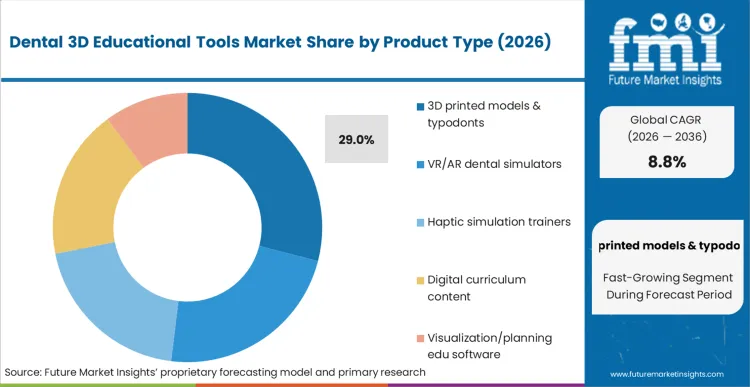
Based on FMI’s report, 3D printed models and typodonts are estimated to hold 29.0% share in 2026, followed by VR and AR dental simulators at 22.7% share. Model and typodont leadership is supported by daily lab use, straightforward integration into pre-clinical courses, and repeat replacement cycles tied to wear and student throughput. VR and AR simulators hold the second position because they support standardized scenario training and allow faculty to track performance, though adoption is paced by capex budgets and the need for technical support.
- Curriculum Alignment: Physical practice tools form the basis for standard operative and restorative modules, enabling institutional continuity. The notion is also supported by increasing academic confirmation 94 studies were analyzed qualitatively across eleven dental specialties, which show that 3D-printed models are progressively being employed to supplement anatomical learning and clinical procedure training, indicating their incorporation into structured curricula in dentistry and frameworks for practical skills assessment. [2]
- Upgrade Pathway: VR and AR tools are used in contexts where some type of measurable scoring is needed, or when it’s necessary to go through a structured scenario as many times as possible without increasing chair time or material consumption. Free, standardized cases can be running across student cohorts, with performance tracking enabled via built-in assessment functionality. Adoption is generally gradual and requires institutional readiness to execute as well as technical support.
- Closing Prevention and Adherence Gaps to Mitigate Resistance Development: Typodonts and 3D-printed models are used routinely in pre-clinical and operative training, making them core components of skills laboratories. Repeated practice across modules leads to regular replacement and steady procurement cycles. Their straightforward integration into existing curricula supports continued institutional reliance.
Dental 3D Educational Tools Market Analysis by Learning Modality
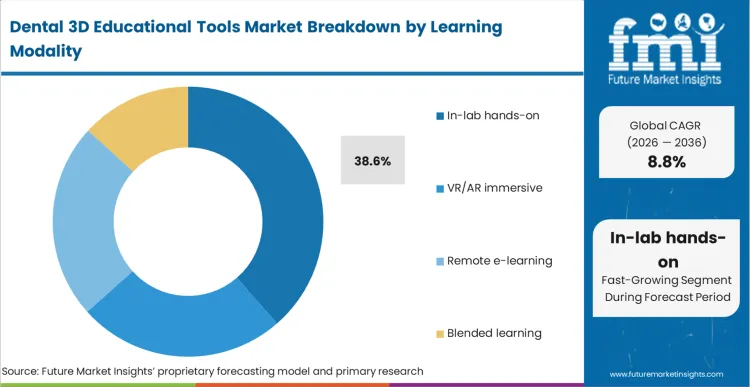
In-lab hands-on accounts for 38.6% share in 2026, followed by VR and AR immersive at 28.3% share, based on FMI’s report. In-lab dominance reflects the need for tactile practice and instrument handling training, which remains central to competency building in dentistry. VR and AR immersive learning is gaining share because it allows repeatable procedure walkthroughs and performance feedback, while reducing dependence on instructor-to-student ratios during early training stages.
- Capacity Relief: VR and AR modules are incorporated to ease operational constraints within skills laboratories. When bench space, equipment access, or faculty supervision time is limited, virtual simulations can be deployed to maintain training continuity. This allows learning to be extended beyond physical lab capacity while preserving structured instructional delivery.
- Scoring and Feedback: Specialized digital training initiatives are your way to reinforce an already structured learning ecosystem. For example, Formlabs launched the Formlabs Dental Academy as an education-focused platform aimed at equipping both clinicians and students to become proficient in dental 3D printing workflows. These initiatives promote consistency in instruction, facilitated skills training and repeatable learning pathways thereby strengthening the position of digital tools as spectators in providing structured feedback to process with less variance.
- Manufacturing Scalability and Cost Efficiency Advantage: There are still no substitutes for direct physical engagement with tools or materials to develop things like manual dexterity and instrument handling. Technical skills training remains crucial to dental education, as fine motor skills, pressure control and hand positioning are best learned through hands-on repetition. Physical models, on the other hand, still offer realistic resistance and spatial awareness critical for teaching basic skills.
Dental 3D Educational Tools Market Drivers, Restraints, and Opportunities
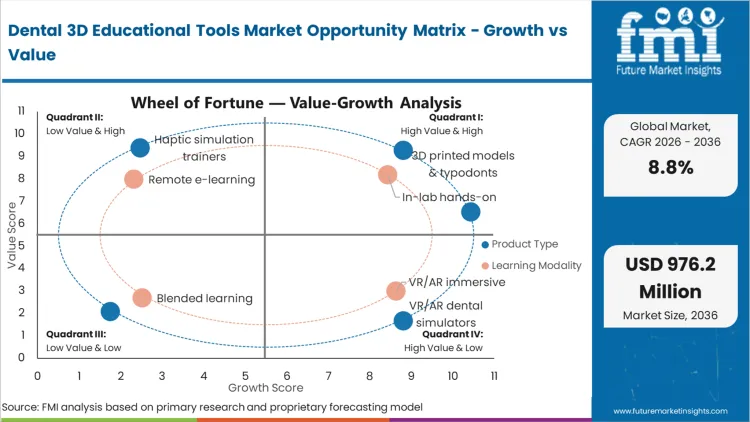
Future Market Insights analysis that historical patterns point at an education tools category where demand is anchored in simulation-led teaching, standardized competency assessment, and rising training capacity requirements. Program leaders are using simulation to expand practice hours, reduce reliance on variable patient availability, and improve consistency of instruction across large cohorts, as per FMI.
While adoption is being restrained by budget approval cycles, maintenance burden for advanced systems, and uneven faculty readiness to integrate new tools, value growth is being supported by steady replacement of high-use physical models and wider deployment of immersive modules as curriculum capacity expanders. Based on FMI’s report, supplier selection is increasingly being filtered by curriculum fit, uptime support, and measurable learning outcomes rather than by catalog breadth alone.
- Competency-driven Scaling: Growth is shifting toward tools that support repeatable scoring and consistent case difficulty across student cohorts.
- Budget and Service Restraint: Capex approval timing and service dependence slow rollouts of immersive and haptic systems across campuses.
- Blended Training Mechanism: Mix is moving toward combined lab practice and immersive rehearsal to reduce faculty bottlenecks and increase practice repetition.
Regional Analysis
.webp "Top Country Growth Comparison Dental 3d Educational Tools Market Cagr (2026 2036)")
Based on the regional analysis, oral microbiome products market is segmented into North America, Latin America, Western Europe, Eastern Europe, East Asia, South Asia and Middle East & Africa across 30+ countries. Regional performance is assessed using country-level demand signals linked to resistance surveillance, treatment guideline adoption, payer coverage, and public programme procurement, as per FMI. The full report also offers market attractiveness analysis based on regional trends.
| Country | CAGR |
|---|---|
| USA | 7.10% |
| Brazil | 8.20% |
| China | 9.40% |
| India | 10.20% |
| Japan | 5.20% |
| Germany | 6.20% |
| UK | 6.60% |
Source: Future Market Insights (FMI) analysis, based on proprietary forecasting model and primary research
North America Dental 3D Educational Tools Market Analysis
Structured pre-clinical training and higher use of paid digital learning resources, where 3D printed models and VR modules are adopted to standardize skill assessment and reduce chairside training variability, shape North America. Planmeca and KaVo Dental remain visible through education-linked equipment ecosystems that connect simulation, imaging, and training workflows. 3D Systems supports institutions that produce models internally or source lab-grade prints through partners. FMI analysts note that dental schools remain the core buyers, with private training centres adding incremental volume.
- United States: Dental 3D educational tools in the USA are expected to expand at 7.10% CAGR through 2036, supported by growing simulation lab utilization and steady replacement ordering of printed teaching aids. Uptake is reinforced by VR and digital courseware adoption in pre-clinical curricula, while larger institutions increasingly pair physical models with software-based assessment.
FMI’s report includes a detailed analysis of the growth in the North American region, along with a country-wise assessment that includes the USA, Canada and Mexico. Readers can also find regional trends, regulations, and market growth based on different segments and countries in the North America region.
East Asia Dental 3D Educational Tools Market Analysis
East Asia is led by rapid digitization of dental training and higher acceptance of mixed learning formats, where VR modules and digital simulation tools are increasingly bundled with physical teaching aids. Planmeca and KaVo Dental remain relevant in institutional channels that modernize simulation labs. 3D Systems and similar suppliers support model output where schools adopt printing workflows. Based on FMI’s report, growth is strongest where large training cohorts and centralized procurement accelerate rollouts.
- China: Dental 3D educational tools in China are projected to rise at 9.40% CAGR through 2036, supported by expanding dental education intake and faster adoption of VR and simulator-led teaching formats. Procurement remains weighted toward high-usage training aids, with broader deployment in larger university systems.
- India: Dental 3D educational tools in India are set to grow at 10.20% CAGR through 2036, supported by rising student intake and wider use of structured teaching aids to standardize pre-clinical outcomes. Growth is expected to be strongest in private institutions and urban clusters where simulation labs and digital modules are funded more consistently.
- Japan: Japan is expected to post 5.20% CAGR through 2036, with growth sustained by replacement demand and selective upgrades to digital learning tools in established dental programs. Adoption remains measured, with preference for proven training formats and consistent product quality.
The full report analyzes the oral microbiome products market across East and South Asia from 2021-2036, covering pricing, trends, and growth drivers in China, Japan, South Korea, India, Australia & New Zealand. The assessment highlights trends that dictate regional demand and procurement behavior.
Latin America Dental 3D Educational Tools Market Analysis
Latin America remains distributor-led, where buying decisions are influenced by import availability, institutional budgets, and the ability of channel partners to support training, installation, and replenishment. Planmeca and KaVo Dental participate through regional partners serving universities and private teaching hubs. FMI opines that adoption is concentrated in larger urban education clusters, with periodic procurement patterns rather than continuous purchasing.
- Brazil: Dental 3D educational tools in Brazil are forecast to grow at 8.20% CAGR through 2036, driven by rising private dental education capacity and stronger use of structured training aids in teaching labs. Orders tend to focus on core modules first, while VR and higher-end simulation tools scale where funding and distributor support are stronger.
The report consists of a detailed analysis for the market in Brazil, Argentina and Rest of Latin America. Readers can find detailed information about several factors, such as the pricing analysis and regional trends, which are affecting growth in the Latin America region.
Europe Dental 3D Educational Tools Market Analysis
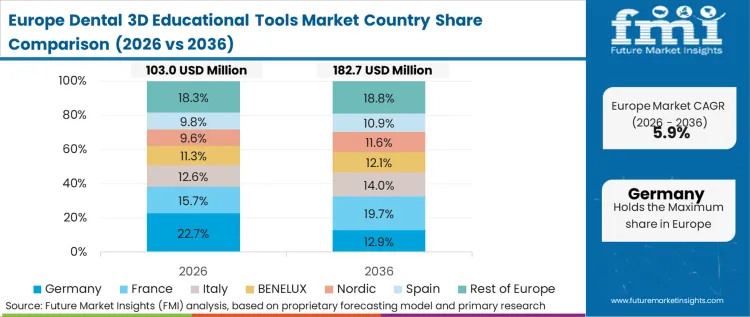
Structured competency-based teaching and steady institutional procurement support Europe, with demand anchored in dental schools that standardize modules across cohorts. Planmeca and KaVo Dental remain well placed through long-standing academic relationships and training-linked product ecosystems. FMI is of the opinion that growth remains replacement-led, with incremental value coming from higher use of digital simulation and VR-assisted teaching.
- Germany: Germany is anticipated to expand at 6.20% CAGR through 2036, supported by steady university procurement and continued use of printed teaching aids in pre-clinical training. Adoption of VR and simulator-led modules rises selectively, driven by institutional modernization programs.
- United Kingdom: The UK is projected to rise at 6.60% CAGR through 2036, with growth tied to wider use of blended learning in dental education and ongoing investment in simulation-led assessment. Purchasing remains structured through institutional buying, which supports repeat orders for standard modules and periodic upgrades in digital tools.
FMI’s analysis of oral microbiome products market in Europe consists of country-wise assessment that includes the Germany, Italy, France, United Kingdom, Spain, Russia, Nordic, Benelux and Rest of Europe. Readers can know various regulations and latest trends in the regional market.
Competitive aligners for market players
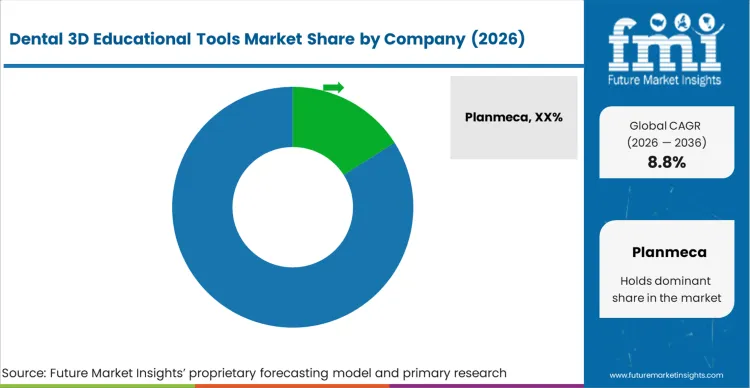
Market structure remains fragmented, yet practical competition is concentrated among a limited set of suppliers that can deliver curriculum-ready content, maintain consistent model accuracy across cohorts, and support institutional deployment through training and faculty enablement. Competition is shaped by learning outcome fit and implementation effort rather than short-cycle price movement, since most purchases are reviewed as program investments and renewed on academic cycles. Product positioning is also influenced by how well tools align to pre-clinical simulation needs and chairside skill development, with buyers prioritizing repeatable use, ease of setup, and reliable replenishment workflows, as per FMI.
Companies with structural advantages tend to combine broad educational libraries with dependable production and software workflows that reduce adoption friction. Suppliers that can offer integrated pathways across digital content, printable models, and guided training modules are better positioned where institutions prefer one accountable vendor for setup, updates, and support. Strong channel coverage into universities, training centers, and dental labs also supports continuity because local service capacity and delivery lead times influence repeat ordering. Vendors with narrow catalogs or limited support coverage tend to face faster switching when schools refresh teaching modules or standardize tools across campuses, based on FMI’s report.
Customer concentration reinforces buyer advantage. Dental schools and universities commonly run side-by-side evaluations, maintain approved alternates, and use staged rollouts across cohorts to keep switching options open. Private clinics and training centers purchase more opportunistically, yet they still compare vendors on turnaround time and compatibility with existing printers and software workflows. Contract terms often include content update expectations, replacement policies for damaged models, and support response commitments, which keeps pricing discipline tight. Pricing power is therefore limited for standard training kits, while measured premiums are retained mainly where a tool reduces faculty workload and improves repeatability of hands-on training delivery, Future Market Insights analysis.
Recent Developments
The report includes full coverage of key trends from competitive benchmarking. Some of the recent developments covered in the reports:
- In February 2026, Stratasys has introduced a new dental anatomical model preset aiming to advance simulation-based training and clinical education with multi-material 3D printing. [3]
- In December 2025, Medit one of the key leader within digital dentistry solutions provider today announced the launch of a next generation visualization and consultation platform that integrates AI powered analytics to deliver real time diagnostic insights, streamline chairside case discussions, and improve patient understanding of treatment needs. [4]
- In December 2025, Murdoch Children’s Research Institute (MCRI) and the University of Melbourne highlighted how Cutting-edge 3D AI technology can identify early childhood tooth decay as accurately as visual exams. [5]
Key Players in Dental 3D Educational Tools Market
- Planmeca
- Moog (Simodont)
- Dentsply Sirona
- KaVo Dental
- 3Shape
- Align Technology
- Straumann Group
- Formlabs
- Stratasys
- Anatomage
- Others
Scope of the Report
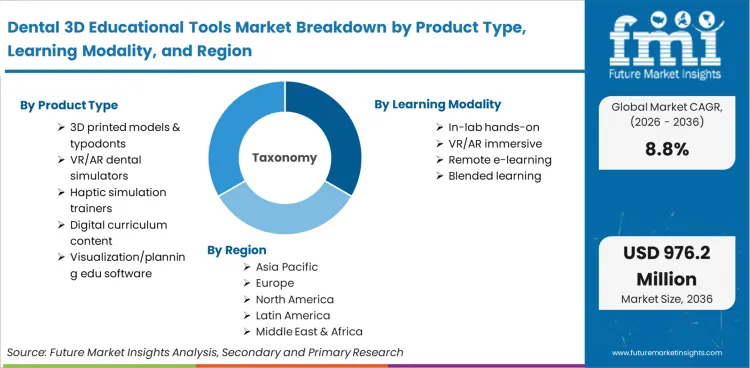
| Metric | Value |
|---|---|
| Quantitative units | USD 420.0 million (2026) to US$ 976.2 million (2036), at a CAGR of 8.8% |
| Market definition | The 3D dental pathology models market comprises the global production and trade of physical dental pathology training and simulation models manufactured using additive and molded methods, used for education, pre-clinical skills building, patient communication, and procedure rehearsal, where demand is driven by training throughput, model realism needs, and material and handling requirements across academic and clinical settings. |
| Product Type Segmentation | 3D printed models & typodonts, VR/AR dental simulators, Haptic simulation trainers, Digital curriculum content, Visualization/planning edu software |
| Learning Modality Segmentation | In-lab hands-on, VR/AR immersive, Remote e-learning, Blended learning |
| Specialty Focus Coverage | Restorative / operative, Implantology, Prosthodontics, Endodontics, Orthodontics, Periodontics |
| End User Coverage | Dental schools / universities, Teaching hospitals, Continuing education providers, Private clinics (training), Lab training centers |
| Regions covered | North America, Latin America, East Asia, South Asia, Western Europe, Eastern Europe, Middle East and Africa |
| Countries covered | United States, Canada, Mexico, Brazil, Argentina, Germany, France, United Kingdom, Italy, Spain, China, India, Japan, South Korea, Indonesia, Australia and 40 plus countries |
| Key companies profiled | Planmeca, Moog (Simodont), Dentsply Sirona, KaVo Dental, 3Shape, Align Technology, Straumann Group, Formlabs, Stratasys, Anatomage |
| Forecast period | 2026 to 2036 |
| Approach | Hybrid top down and bottom up market modeling validated through primary interviews with dental schools, simulation lab managers, and model suppliers, supported by product portfolio mapping and channel benchmarking, as per FMI. |
Key Segments
Product Type
- 3D printed models & typodonts
- VR/AR dental simulators
- Haptic simulation trainers
- Digital curriculum content
- Visualization/planning edu software
Learning Modality
- In-lab hands-on
- VR/AR immersive
- Remote e-learning
- Blended learning
Specialty Focus
- Restorative / operative
- Implantology
- Prosthodontics
- Endodontics
- Orthodontics
- Periodontics
End User
- Dental schools / universities
- Teaching hospitals
- Continuing education providers
- Private clinics (training)
- Lab training centers
Region
- Asia Pacific
- India
- China
- Japan
- South Korea
- Indonesia
- Australia & New Zealand
- ASEAN
- Rest of Asia Pacific
- Europe
- Germany
- Italy
- France
- United Kingdom
- Spain
- Benelux
- Nordics
- Central & Eastern Europe
- Rest of Europe
- North America
- United States
- Canada
- Mexico
- Latin America
- Brazil
- Argentina
- Chile
- Rest of Latin America
- Middle East & Africa
- Kingdom of Saudi Arabia
- United Arab Emirates
- South Africa
- Turkey
- Rest of Middle East & Africa
Bibliography
- [1] 3D Printing Industry. (Feb, 2026). Interview: Stratasys Introduces Dental Anatomical Model Preset for Education and Clinical Training.
- [2] Karger Publishers. (September 2025). 3D Printing in Dental Education: A Scoping Review. Medical Principles and Practice.
- [3] 3D Mag. (February 2026). Stratasys reveals 3D-printed dental model for next-gen clinical education. 3D Mag.
- [4] Overjet. (December 2025). Overjet Partners with Medit to Launch AuraVue: A Unified 3D Intraoral Scan and X-Ray Visualization Tool. Overjet News.
- [5] Murdoch Children’s Research Institute. (December 2025). Cutting-edge 3D AI technology transforming dental care for children. Murdoch Children’s Research Institute News.
This report addresses
- Market intelligence to enable structured strategic decision making across dental education procurement and simulation program planning
- Market size estimation and 10 year revenue forecasts from 2026 to 2036 for 3D dental pathology model demand
- Growth opportunity mapping across model type, manufacturing method, application, material, and end user demand pools
- Segment and regional revenue forecasts aligned to the stated taxonomy and covered geographies
- Competition strategy assessment including portfolio positioning, realism focus, and channel coverage benchmarking
- Product and compliance tracking focused on material handling, training use requirements, and quality system expectations for suppliers
- Regulatory and standards impact analysis covering additive manufacturing controls and documentation discipline relevant to model production
- Market report delivery in PDF, Excel, PPT, and interactive dashboard formats for executive and operational use
Frequently Asked Questions
How large is the demand for 3D dental pathology models in the global market in 2026?
Demand for 3D dental pathology models in the global market is estimated to be valued at USD 310.0 Mn in 2026, as per FMI.
What will be the market size of 3D dental pathology models in the global market by 2036?
Market size for 3D dental pathology models is projected to reach USD 820.0 Mn by 2036.
What is the expected demand growth for 3D dental pathology models in the global market between 2026 and 2036?
Demand for 3D dental pathology models in the global market is expected to grow at a CAGR of 10.2% between 2026 and 2036.
Which manufacturing method is poised to lead global demand by 2026?
SLA or DLP 3D-printed resin is expected to be the dominant method, capturing 46% share in 2026.
Which application is expected to account for the largest share in 2026?
Dental education and training is expected to hold the highest share at 42% in 2026.
Which material is expected to dominate the mix in 2026?
Photopolymer resin is expected to lead material use with 54% share in 2026.
Preview the report firsthand - request a free sample
Get SampleGet the brochure for pricing and purchase details.
Get PDFTable of Content
- Executive Summary
- Global Market Outlook
- Demand-side Trends
- Supply-side Trends
- Technology Roadmap Analysis
- Analysis and Recommendations
- Market Overview
- Market Coverage / Taxonomy
- Market Definition / Scope / Limitations
- Research Methodology
- Chapter Orientation
- Analytical Lens and Working Hypotheses
- Market Structure, Signals, and Trend Drivers
- Benchmarking and Cross-market Comparability
- Market Sizing, Forecasting, and Opportunity Mapping
- Research Design and Evidence Framework
- Desk Research Programme (Secondary Evidence)
- Company Annual and Sustainability Reports
- Peer-reviewed Journals and Academic Literature
- Corporate Websites, Product Literature, and Technical Notes
- Earnings Decks and Investor Briefings
- Statutory Filings and Regulatory Disclosures
- Technical White Papers and Standards Notes
- Trade Journals, Industry Magazines, and Analyst Briefs
- Conference Proceedings, Webinars, and Seminar Materials
- Government Statistics Portals and Public Data Releases
- Press Releases and Reputable Media Coverage
- Specialist Newsletters and Curated Briefings
- Sector Databases and Reference Repositories
- FMI Internal Proprietary Databases and Historical Market Datasets
- Subscription Datasets and Paid Sources
- Social Channels, Communities, and Digital Listening Inputs
- Additional Desk Sources
- Expert Input and Fieldwork (Primary Evidence)
- Primary Modes
- Qualitative Interviews and Expert Elicitation
- Quantitative Surveys and Structured Data Capture
- Blended Approach
- Why Primary Evidence is Used
- Field Techniques
- Interviews
- Surveys
- Focus Groups
- Observational and In-context Research
- Social and Community Interactions
- Stakeholder Universe Engaged
- C-suite Leaders
- Board Members
- Presidents and Vice Presidents
- R&D and Innovation Heads
- Technical Specialists
- Domain Subject-matter Experts
- Scientists
- Physicians and Other Healthcare Professionals
- Governance, Ethics, and Data Stewardship
- Research Ethics
- Data Integrity and Handling
- Primary Modes
- Tooling, Models, and Reference Databases
- Desk Research Programme (Secondary Evidence)
- Data Engineering and Model Build
- Data Acquisition and Ingestion
- Cleaning, Normalisation, and Verification
- Synthesis, Triangulation, and Analysis
- Quality Assurance and Audit Trail
- Market Background
- Market Dynamics
- Drivers
- Restraints
- Opportunity
- Trends
- Scenario Forecast
- Demand in Optimistic Scenario
- Demand in Likely Scenario
- Demand in Conservative Scenario
- Opportunity Map Analysis
- Product Life Cycle Analysis
- Supply Chain Analysis
- Investment Feasibility Matrix
- Value Chain Analysis
- PESTLE and Porter’s Analysis
- Regulatory Landscape
- Regional Parent Market Outlook
- Production and Consumption Statistics
- Import and Export Statistics
- Market Dynamics
- Global Market Analysis 2021 to 2025 and Forecast, 2026 to 2036
- Historical Market Size Value (USD Million) Analysis, 2021 to 2025
- Current and Future Market Size Value (USD Million) Projections, 2026 to 2036
- Y-o-Y Growth Trend Analysis
- Absolute $ Opportunity Analysis
- Global Market Pricing Analysis 2021 to 2025 and Forecast 2026 to 2036
- Global Market Analysis 2021 to 2025 and Forecast 2026 to 2036, By Product Type
- Introduction / Key Findings
- Historical Market Size Value (USD Million) Analysis By Product Type , 2021 to 2025
- Current and Future Market Size Value (USD Million) Analysis and Forecast By Product Type , 2026 to 2036
- 3D printed models & typodonts
- VR/AR dental simulators
- Haptic simulation trainers
- Digital curriculum content
- Visualization/planning edu software
- 3D printed models & typodonts
- Y-o-Y Growth Trend Analysis By Product Type , 2021 to 2025
- Absolute $ Opportunity Analysis By Product Type , 2026 to 2036
- Global Market Analysis 2021 to 2025 and Forecast 2026 to 2036, By Learning Modality
- Introduction / Key Findings
- Historical Market Size Value (USD Million) Analysis By Learning Modality, 2021 to 2025
- Current and Future Market Size Value (USD Million) Analysis and Forecast By Learning Modality, 2026 to 2036
- In-lab hands-on
- VR/AR immersive
- Remote e-learning
- Blended learning
- In-lab hands-on
- Y-o-Y Growth Trend Analysis By Learning Modality, 2021 to 2025
- Absolute $ Opportunity Analysis By Learning Modality, 2026 to 2036
- Global Market Analysis 2021 to 2025 and Forecast 2026 to 2036, By Region
- Introduction
- Historical Market Size Value (USD Million) Analysis By Region, 2021 to 2025
- Current Market Size Value (USD Million) Analysis and Forecast By Region, 2026 to 2036
- North America
- Latin America
- Western Europe
- Eastern Europe
- East Asia
- South Asia and Pacific
- Middle East & Africa
- Market Attractiveness Analysis By Region
- North America Market Analysis 2021 to 2025 and Forecast 2026 to 2036, By Country
- Historical Market Size Value (USD Million) Trend Analysis By Market Taxonomy, 2021 to 2025
- Market Size Value (USD Million) Forecast By Market Taxonomy, 2026 to 2036
- By Country
- USA
- Canada
- Mexico
- By Product Type
- By Learning Modality
- By Country
- Market Attractiveness Analysis
- By Country
- By Product Type
- By Learning Modality
- Key Takeaways
- Latin America Market Analysis 2021 to 2025 and Forecast 2026 to 2036, By Country
- Historical Market Size Value (USD Million) Trend Analysis By Market Taxonomy, 2021 to 2025
- Market Size Value (USD Million) Forecast By Market Taxonomy, 2026 to 2036
- By Country
- Brazil
- Chile
- Rest of Latin America
- By Product Type
- By Learning Modality
- By Country
- Market Attractiveness Analysis
- By Country
- By Product Type
- By Learning Modality
- Key Takeaways
- Western Europe Market Analysis 2021 to 2025 and Forecast 2026 to 2036, By Country
- Historical Market Size Value (USD Million) Trend Analysis By Market Taxonomy, 2021 to 2025
- Market Size Value (USD Million) Forecast By Market Taxonomy, 2026 to 2036
- By Country
- Germany
- UK
- Italy
- Spain
- France
- Nordic
- BENELUX
- Rest of Western Europe
- By Product Type
- By Learning Modality
- By Country
- Market Attractiveness Analysis
- By Country
- By Product Type
- By Learning Modality
- Key Takeaways
- Eastern Europe Market Analysis 2021 to 2025 and Forecast 2026 to 2036, By Country
- Historical Market Size Value (USD Million) Trend Analysis By Market Taxonomy, 2021 to 2025
- Market Size Value (USD Million) Forecast By Market Taxonomy, 2026 to 2036
- By Country
- Russia
- Poland
- Hungary
- Balkan & Baltic
- Rest of Eastern Europe
- By Product Type
- By Learning Modality
- By Country
- Market Attractiveness Analysis
- By Country
- By Product Type
- By Learning Modality
- Key Takeaways
- East Asia Market Analysis 2021 to 2025 and Forecast 2026 to 2036, By Country
- Historical Market Size Value (USD Million) Trend Analysis By Market Taxonomy, 2021 to 2025
- Market Size Value (USD Million) Forecast By Market Taxonomy, 2026 to 2036
- By Country
- China
- Japan
- South Korea
- By Product Type
- By Learning Modality
- By Country
- Market Attractiveness Analysis
- By Country
- By Product Type
- By Learning Modality
- Key Takeaways
- South Asia and Pacific Market Analysis 2021 to 2025 and Forecast 2026 to 2036, By Country
- Historical Market Size Value (USD Million) Trend Analysis By Market Taxonomy, 2021 to 2025
- Market Size Value (USD Million) Forecast By Market Taxonomy, 2026 to 2036
- By Country
- India
- ASEAN
- Australia & New Zealand
- Rest of South Asia and Pacific
- By Product Type
- By Learning Modality
- By Country
- Market Attractiveness Analysis
- By Country
- By Product Type
- By Learning Modality
- Key Takeaways
- Middle East & Africa Market Analysis 2021 to 2025 and Forecast 2026 to 2036, By Country
- Historical Market Size Value (USD Million) Trend Analysis By Market Taxonomy, 2021 to 2025
- Market Size Value (USD Million) Forecast By Market Taxonomy, 2026 to 2036
- By Country
- Kingdom of Saudi Arabia
- Other GCC Countries
- Turkiye
- South Africa
- Other African Union
- Rest of Middle East & Africa
- By Product Type
- By Learning Modality
- By Country
- Market Attractiveness Analysis
- By Country
- By Product Type
- By Learning Modality
- Key Takeaways
- Key Countries Market Analysis
- USA
- Pricing Analysis
- Market Share Analysis, 2025
- By Product Type
- By Learning Modality
- Canada
- Pricing Analysis
- Market Share Analysis, 2025
- By Product Type
- By Learning Modality
- Mexico
- Pricing Analysis
- Market Share Analysis, 2025
- By Product Type
- By Learning Modality
- Brazil
- Pricing Analysis
- Market Share Analysis, 2025
- By Product Type
- By Learning Modality
- Chile
- Pricing Analysis
- Market Share Analysis, 2025
- By Product Type
- By Learning Modality
- Germany
- Pricing Analysis
- Market Share Analysis, 2025
- By Product Type
- By Learning Modality
- UK
- Pricing Analysis
- Market Share Analysis, 2025
- By Product Type
- By Learning Modality
- Italy
- Pricing Analysis
- Market Share Analysis, 2025
- By Product Type
- By Learning Modality
- Spain
- Pricing Analysis
- Market Share Analysis, 2025
- By Product Type
- By Learning Modality
- France
- Pricing Analysis
- Market Share Analysis, 2025
- By Product Type
- By Learning Modality
- India
- Pricing Analysis
- Market Share Analysis, 2025
- By Product Type
- By Learning Modality
- ASEAN
- Pricing Analysis
- Market Share Analysis, 2025
- By Product Type
- By Learning Modality
- Australia & New Zealand
- Pricing Analysis
- Market Share Analysis, 2025
- By Product Type
- By Learning Modality
- China
- Pricing Analysis
- Market Share Analysis, 2025
- By Product Type
- By Learning Modality
- Japan
- Pricing Analysis
- Market Share Analysis, 2025
- By Product Type
- By Learning Modality
- South Korea
- Pricing Analysis
- Market Share Analysis, 2025
- By Product Type
- By Learning Modality
- Russia
- Pricing Analysis
- Market Share Analysis, 2025
- By Product Type
- By Learning Modality
- Poland
- Pricing Analysis
- Market Share Analysis, 2025
- By Product Type
- By Learning Modality
- Hungary
- Pricing Analysis
- Market Share Analysis, 2025
- By Product Type
- By Learning Modality
- Kingdom of Saudi Arabia
- Pricing Analysis
- Market Share Analysis, 2025
- By Product Type
- By Learning Modality
- Turkiye
- Pricing Analysis
- Market Share Analysis, 2025
- By Product Type
- By Learning Modality
- South Africa
- Pricing Analysis
- Market Share Analysis, 2025
- By Product Type
- By Learning Modality
- USA
- Market Structure Analysis
- Competition Dashboard
- Competition Benchmarking
- Market Share Analysis of Top Players
- By Regional
- By Product Type
- By Learning Modality
- Competition Analysis
- Competition Deep Dive
- Planmeca
- Overview
- Product Portfolio
- Profitability by Market Segments (Product/Age /Sales Channel/Region)
- Sales Footprint
- Strategy Overview
- Marketing Strategy
- Product Strategy
- Channel Strategy
- Moog (Simodont)
- Dentsply Sirona
- KaVo Dental
- 3Shape
- Align Technology
- Straumann Group
- Formlabs
- Stratasys
- Anatomage
- Others
- Planmeca
- Competition Deep Dive
- Assumptions & Acronyms Used


