

- Industry Size (2026)
- USD 852.2 Mn
- Forecast (2036)
- USD 1839.9 Mn
- CAGR (2026 to 2036)
- 8.0%
Dental Floss Market Size, Market Forecast and Outlook By FMI
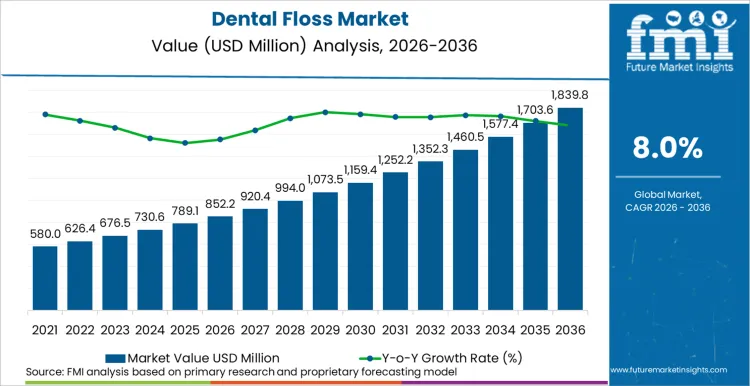
In 2025, the dental floss market was valued at USD 789.1 million. Based on Future Market Insights' analysis, demand for dental floss is estimated to grow to USD 852.2 million in 2026 and USD 1,839.9 million by 2036. FMI projects a CAGR of 8.0% during the forecast period. Absolute dollar growth of USD 987.7 million over the decade reflects a category expansion driven by two converging trends: the viral adoption of water flossers among Gen Z and millennial consumers through social media platforms, and rising dental insurance coverage in emerging markets that encourages preventive oral care. The shift from traditional string floss to powered water flossers raises the average transaction value per consumer, while biodegradable floss products command premium pricing over conventional nylon and PTFE alternatives.
Quick Stats for Dental Floss Market
- Market Snapshot
- The Dental Floss Market was valued at USD 789.1 million in 2025.
- The Dental Floss Market is projected treach USD 1,839.9 million by 2036 from USD 852.2 million in 2026.
- The market is expected texpand at a CAGR of 8.0% during 2026 t2036.
- Demand and Growth Drivers
- Absolute dollar growth of USD 987.7 million is expected between 2026 and 2036.
- Social media-driven adoption of water flossers contributed ta 32% increase in consumer conversion from traditional floss.
- Expansion of dental insurance coverage in emerging markets is increasing preventive oral care adoption.
- Product and Segment View
- Waxed dental floss accounted for 52.3% of total market value share in 2026.
- Home care settings represented 78.4% of total demand in 2026.
- Water flossers are priced between USD 30 and USD 150, increasing per-consumer revenue.
- Geography and Competitive Outlook
- Asia Pacific is the fastest-growing region with a CAGR of 9.5% during the forecast period.
- China is projected tgrow at a CAGR of 8.2% between 2025 and 2035.
- Tier 1 companies hold 41.3% market share, led by Procter & Gamble, Colgate-Palmolive, and Johnson & Johnson.
As Winnie, Digital Marketing Manager at MySmile, stated regarding the 2026 water flosser collection, 'MySmile water flossers remain one of the top choices for 2026. Whether at home or on the go, users can count on MySmile for a cleaner, fresher, and healthier oral care routine.
Asia Pacific (9.5% CAGR) leads growth through expanding dental insurance coverage and water flosser adoption in China and South Korea. North America (7.8% CAGR) benefits from social media-driven water flosser conversion and premium biodegradable floss sales. Europe (7.2% CAGR) grows through sustainability-driven product switching and dental hygiene awareness campaigns. Latin America (8.5% CAGR) benefits from rising preventive dental care spending.
Dental Floss Market Market Definition
The dental floss market covers the manufacture, sale, and distribution of interdental cleaning products including waxed and unwaxed string floss, dental tape, PTFE-based floss, natural and biodegradable alternatives, and powered water flossers. The market spans retail, online, and professional dental clinic distribution channels.
Dental Floss Market Market Inclusions
The report covers global and regional market sizes by revenue for the 2026 to 2036 forecast period. It includes segmental breakdowns by product type, distribution channel, and end user. Pricing analysis by product category, social commerce conversion tracking, and sustainability certification benchmarking are included.
Dental Floss Market Market Exclusions
The scope excludes toothbrushes, toothpaste, mouthwash, and other oral care products not classified as interdental cleaning devices. Professional dental scaling and cleaning services performed by dentists are outside scope.
Dental Floss Market Research Methodology
- Primary Research: Interviews were conducted with oral care product manufacturers, dental professionals, retail pharmacy buyers, e-commerce platform managers, and consumer behaviour researchers across the United States, Europe, China, and India.
- Desk Research: Dental association guidelines on interdental cleaning, retail scanner data, e-commerce sales tracking, and social media trend analytics supported demand benchmarking.
- Market-Sizing and Forecasting: A hybrid model combined top-down oral care category analysis with bottom-up product SKU sales data and water flosser unit shipments, validated against manufacturer revenue disclosures.
- Data Validation and Update Cycle: Outputs undergo anomaly screening, variance checks across retail sales and e-commerce transaction datasets, and structured peer review prior to release.
Summary of Dental Floss Market
- Power in the dental floss value chain is held by large CPG companies with dental category shelf-space dominance. Procter and Gamble (Oral-B), Colgate-Palmolive, and Johnson and Johnson (Listerine) control the majority of traditional string floss distribution through pharmacy and supermarket relationships. As per FMI, water flosser manufacturers like Waterpik (Church and Dwight) and MySmile are building parallel power through direct-to-consumer e-commerce and social media marketing, bypassing traditional retail gatekeepers.
- Pricing asymmetry is wide across the product spectrum. A spool of conventional waxed floss retails at USD 2 to 4, while a premium biodegradable floss subscription costs USD 6 to 10 per refill. Water flossers carry device prices of USD 30 to 150, with replacement tip refills generating recurring revenue. FMI analysts note that the category's per-consumer revenue is rising as consumers trade up from disposable string floss to powered devices, though replacement tip attachment rates remain a challenge for device manufacturers.
- Sourcing fragility is concentrated in PTFE supply for premium floss products and miniature pump motor supply for water flossers. PTFE floss depends on fluoropolymer supply from a limited number of global producers. Water flosser pump motors and battery cells are sourced from the same Chinese manufacturing base that supplies other consumer electronics, creating allocation competition during demand peaks.
- Brand and compliance risks centre on PFAS regulation and sustainability claims. PTFE-based dental floss contains per- and polyfluoroalkyl substances (PFAS), which face growing regulatory scrutiny in the EU and several US states. FMI opines that brands that transition to plant-based fibres and biodegradable materials will avoid PFAS-related reputational risk, though fibre performance parity with PTFE remains a technical challenge.
- Geographic leverage varies by oral care maturity. North America has the highest per-capita flossing rate and leads water flosser adoption. Europe is sustainability-driven, with biodegradable floss gaining share. Asia Pacific is volume-growth-driven, with China and South Korea leading water flosser adoption through social commerce. Latin America and the Middle East are early-stage markets where dental insurance expansion is the primary growth trigger.
- For C-suite executives in oral care and consumer health, the dental floss market through 2036 rewards companies that build social media-native brands for water flossers, invest in plant-based fibre technology to replace PTFE, and create subscription models that drive recurring revenue from replacement tips and refill floss.
Analyzing Dental Floss Market by Top Investment Segments
A description of the leading segments in the industry is provided in this section. The waxed dental floss segment held 52.3% of the value share in 2026. Based on the end user, home care setting held 78.4% of the market in 2026.
Waxed Dental Floss Majorly Preferred Due To Their Ease of Handling and Durability
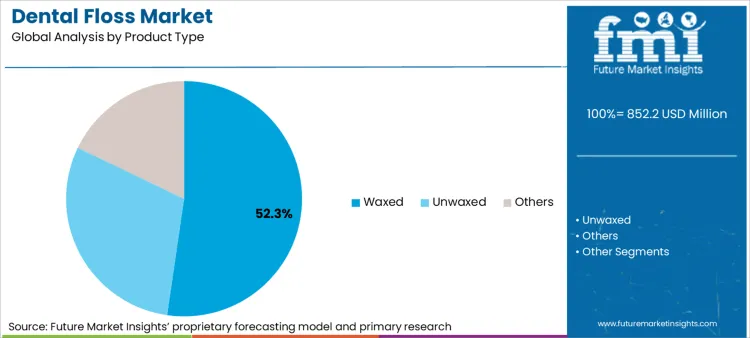
| Product Type | Value Share (2026) |
|---|---|
| Waxed dental floss | 52.3% |
Waxed dental floss has a thin layer of wax coating allowing the floss to glide smoothly between teeth. Individuals having closed spaced teeth can also use it conveniently. Similar is the case for individual with braces. This ease of use encourages consistent daily flossing which is a crucial practice for maintaining oral health.
The waxed surface make the floss durable this reduces the likelihood of breaking. This reliability ensures a thorough cleaning experience. Individual can effectively remove plaque and food particles from interdental spaces. Many waxed flosses are also infused with flavors like mint. This provides a refreshing sensation that enhances the overall flossing experience.
Manufacturers have leveraged the versatility of waxed floss to introduce variations that cater to specific needs. Dental tape for wider gaps and floss designed for sensitive gums. This adaptability has broadened its appeal across diverse consumer groups. Due to the multitude of the advantages the waxed dental floss are dominating the market.
Dental Floss are widely used in Home Care Setting as It Doesn’t Require Professional Expertise
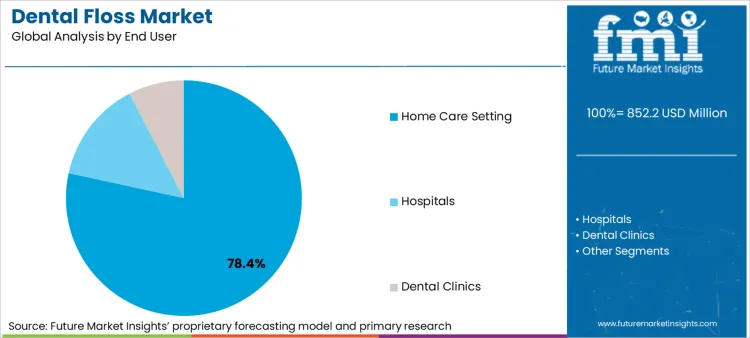
| End User | Value Share (2026) |
|---|---|
| Home Care Setting | 78.4% |
The convenience of flossing at home empower individuals to incorporate flossing into their daily oral hygiene routines. Since flossing doesn’t need professional assistance home care setting is ideal. This autonomy encourages consistent use which contribute to the market's dominance in home care.
Apart from convenience the usage of floss in home setting is cost effective. Regular dental visits for professional cleaning is expensive. Individuals can reduce the frequency of dental issues by adopting dental floss as a preventive measure. This economic advantage makes home flossing an attractive option for a broad consumer base.
The increasing awareness of oral health's importance further propels the home care segment. Educational initiatives have highlighted the benefits of maintaining oral hygiene. Flossing is a pivotal component for the same. More individuals are motivated to adopt flossing as a daily practice, which reinforces the dominance of home care in the market.
Key Industry Highlights
Rising Prevalence of Dental Problems Drive Growth of Dental Floss Industry
Cavities, gum diseases, and bad breath are common dental problems. Consumers are adopting preventive measures for maintain oral health. Dental floss can cleans the areas between the teeth that a brush cannot reach.
The increasing cases of dental caries among young populations have increased conscious about oral hygiene. Greater importance is being attached to daily practice of flossing. The public health organizations through education campaigns have greatly increased public awareness. There is a rise in the population who are getting themselves aware of the benefits of flossing and thus add it to their daily routine.
The geriatric population is more prone to periodontal diseases. If left unmanaged, these diseases may cause loss of teeth. As the elderly population increases, so does the maintenance of oral health. This has increased the demand for specific dental flosses, which are aimed at sensitive teeth and gums in seniors.
The increased intake of sugar that contribute to the development of dental problems. Most fast food diets contain a lot of sugar, which increases the risk of cavities and gum disease. People are more motivated to embrace comprehensive oral care routines.
Rising consumption of tobacco products fuels Dental Floss Industry Growth
Tobacco usage contributes to a wide variety of oral disorders. It starts from gum infection up to oral cancer. These problems require adopting good oral hygiene measures. Frequent flossing needs to be done to curb the negative effects of tobacco usage on oral health.
All tobacco usage introduces chemical substances to the mouth. This chemical results in periodontal disease. The condition triggers redness and infections to the gum tissue. When untreated, it eventually leads to teeth loss. The use of tobacco reduces the proper flow of blood to the gum. Impaired flow affects the healing aspect, hence becomes difficult to remedy the oral diseases.
Tobacco products contribute to the formation of plaque and tartar on teeth. The risk of cavities and gum disease is increased as a result. The presence of tobacco in the mouth can also lead to bad breath and teeth staining.
Increased awareness regarding oral health risk from tobacco consumption increases the importance of preventive dental care for smokers. In this scenario, dentists always suggest routine flossing for fighting the damaging effect of tobacco with a whole dental hygiene package. Professional advice about incorporating flossing into a regular routine, smoking is leading people to a product of dental floss.
Developing Sustainable Product Offers an Untapped Opportunity for Market Growth
There is a growing demand for eco-friendly products to minimize environmental impact. The demand for sustainable products has increased across multiple sectors lately. Consumers wants to have minimal impact on the environment. Dental floss products made from nylon or Teflon, contribute to plastic waste. By offering sustainable alternatives companies can attract a segment of consumers who prioritize environmental responsibility.
Sustainable dental floss options include products made from biodegradable materials. This includes silk, bamboo, or cornstarch-based fibers. These materials decompose more readily and reduce long-term environmental impact. Another step toward leveraging this trend is to focus on packaging material. Packing of these products in compostable materials.
By adopting sustainable practices, companies meet consumer demand along with contributing to broader environmental conservation efforts. This differentiation can lead to increased brand loyalty. Customer retention has also increased as a result. Consumers support brands that align with their environmental values.
This inclination toward sustainability can also aid in the marketing efforts of the company and improve the firm's reputation. Adoption sustainable practice have many benefits from brand loyalty to marketing advantage though which market players can increase their revenue.
Market Competition from Alternative Oral Hygiene Product Hinder the Market Growth
Floss picks have gained traction among consumers seeking ease of use. Their ergonomic design simplifies the flossing process. Similarly, interdental brushes effectively clean between teeth and are often perceived as more efficient. These products cater to the demand for user-friendly oral care solutions. They divert consumer attention from dental floss.
Another class of products are Mouthwashes and rinses. They provide a means for quick oral hygiene maintenance. Mouthwashes are marketed to reduce plaque and gingivitis. Hence providing an alternative to the manual effort of flossing.
Many individuals perceive alternative oral care products as more effective to incorporate into their routines. This change in consumer behavior poses a challenge for the dental floss market. The proliferation of alternative oral care products has intensified competition in the oral hygiene market.
Alternative products companies are investing in product development. Marketing efforts are directed to overshadow the adoption of dental floss. further hampering its market growth. In response to this competition market players are focusing on making products that target a niche consumer segment. It can be demographic-wise or depending on the oral health problems.
2021 to 2025 Dental Floss Industry Outlook Compared to Demand Forecast from 2026 to 2036
Initially, dental floss was available in basic forms. There were waxed and unwaxed varieties. The market was dominated by a few brands. Flossing was considered an optional part of dental care. The adoption of dental floss was low.
There is a shift towards preventive dental care. Consumers recognize the important of daily flossing to prevent oral problems. Educational campaigns by dental professionals and media outlets have elevated public awareness of oral care.
The growing awareness has led to demand for dental floss products. Manufacturers are introducing a variety of floss types targeted for diverse consumer preferences. Product innovation has become a key to success in the market. An increased number of smartphone users has led to more online sales. Due to the convenience factor.
The growing number of consumer demand for eco-friendly dental floss products. Manufacturers are developing floss that is 100% biodegradable. Personalized oral care is also in **trend. Companies are offering products tailored to specific consumer needs. It can be floss-designed for children or individuals with sensitive gums. The dental floss market is transitioning from a basic product offering to a dynamic industry characterized by innovation.
Market Concentration
Companies in the Tier 1 sector account for 41.3% of the global market, ranking them as the dominant players in the industry. Tier 1 players’ offer a wide range of product and have established industry presence. Having financial resources enables them to enhance their research and development efforts and expand into new markets.
A strong brand recognition and a loyal customer base provide them with a competitive advantage. Prominent companies within Tier 1 include Procter & Gamble Company, Johnson & Johnson, Colgate-Palmolive and others
Tier 2 players dominate the industry with a 27.6% market share. Tier 2 firms have a strong focus on a specific Product and a substantial presence in the industry, but they have less influence than Tier 1 firms. The players are more competitive when it comes to pricing and target niche markets. New Product and services will also be introduced into the industry by Tier 2 companies. Tier 2 companies include Sunstar Suisse SA, Prestige Consumer (DenTek Oral Care Inc.), DR. Fresh Inc. and others.
Compared to Tiers 1 and 2, Tier 3 companies have smaller revenue spouts and less influence. Those in Tier 3 have smaller work force and limited presence across the globe. Prominent players in the tier 3 category are Lion Corporation, Church & Dwight Co., Inc., Shantou Oral Health Co. Ltd, and others.
Country-wise Insights
The section below covers the industry analysis for the dental floss for different countries. Market demand analysis on key countries in several regions of the globe, including North America, Latin America, East Asia, South Asia and Pacific, Western Europe, Eastern Europe, and Middle East and Africa (MEA), is provided. The United States is anticipated to remain at the forefront in North America through 2035. India is projected to witness a CAGR of 5.6% from 2025 to 2035.
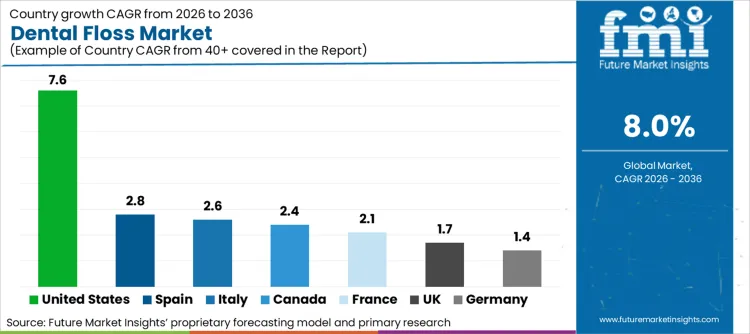
| Countries | Value CAGR (2025 to 2035) |
|---|---|
| United States | 7.6% |
| Canada | 2.4% |
| Germany | 1.4% |
| France | 2.1% |
| Italy | 2.6% |
| UK | 1.7% |
| Spain | 2.8% |
| China | 8.2% |
Rising prevalence of Gum Disease and Cavities Drives Demand for Dental Floss in the United States
In United States more focus in placed on adopting preventive measures. The increasing emphasis on preventive healthcare led to a greater focus on oral hygiene practices. This shift encourages individuals to adopt daily flossing habits.
The rising prevalence of gum disease and cavities has heightened public awareness. This awareness has been further amplified by educational campaigns. There are wide range of products are available in the market. This includes waxed and unwaxed floss, dental tapes, and floss picks.
Having availability of diverse product segment ensure that all the consumer needs are meet. This variety not only attracts a broader customer base but also encourages regular use. Individuals can select products that best suit their oral care routines.
The expansion of distribution channels, both offline and online, has made dental floss more accessible to consumers. Consumers can conveniently purchase these products during their regular shopping trips or online orders. Technological advancements and product innovations have also played a role in market growth. The growth of the dental floss market in the United States is propelled by a combination of above factor.
Supportive Government Policies and Consumer Awareness is Fueling adoption of Dental Floss in Germany
Germany's healthcare system encourage preventive measure to maintain oral health. The main goal is to reduce the need for extensive dental treatments. Such proactive approach lead to increased consumer interest in products like dental floss. Dental care products are important to maintain daily oral hygiene routines.
Germany offers statutory health insurance covering basic dental treatments for all its citizens. Many individuals also opt for additional private dental insurance to cover more comprehensive procedures. This dual-insurance system results in higher out-of-pocket expenses for dental care.
Germany has a large aging proportion that requires oral care to maintain dental health. With increasing elderly population the emphasis on maintaining oral hygiene also increases. The growing demand for oral care boosts the demand for dental floss products. Supportive government policies and growing aging population contribute to the growth of the dental floss market in Germany.
Government Awareness Campaigns are fueling the Adoption of Dental Floss in Japan
Japan has a large aging population. The country have been actively working toward the oral health. Many initiatives were taken to increase the oral hygiene awareness. 8020 Campaign encouraged Japanese people to keep more than 20 of their own teeth till the age of 80 years. Results have shown an overall improvement in oral hygiene across all age groups.
The aging demographic necessitates enhanced oral care to preserve dental health. This lead to increased demand for dental floss products. More emphasis was put on preventive measures for maintain oral hygiene. Dental floss is an effective way to avoid periodontal diseases.
Japan's universal health insurance system includes dental care. This further supports preventive oral health measures. The Insurance system facilitates access to dental services to elderly patient. They can receive the necessary treatments. The supportive government policy reduces the incidence of tooth loss and promotes the use of dental floss.
Competitive Landscape of the Dental Floss Industry
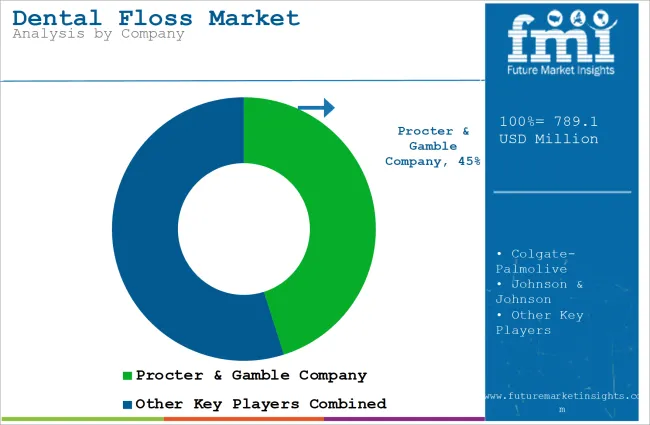
Competitors in the dental floss market are implementing several strategic initiatives. They are expanding product lines to include eco-friendly. Biodegradable dental floss caters to the growing consumer demand for sustainable oral care solutions. Companies are broadening their distribution networks.
This approach secures placements in major retail chains and online platforms. Product accessibility increases as a result giving greater market penetration. Specialized product with new technology main for children are being developed. The innovative product encourage early adoption of flossing habit in kids. These strategies collectively aim to attract a wider consumer base.
Recent Developments:
- The report includes full coverage of key trends from competitive benchmarking. Some of the recent developments covered in the report
- In January 2026, MySmile announced its 2026 water flosser collection, reinforcing daily water flossing as a new oral health standard.
- In January 2026, TikTok-driven social commerce was identified as the primary driver for a 32% increase in consumer conversion from traditional string floss to water flossers.
- In February 2026, manufacturers integrated AI to optimize the tension and shred-resistance of new plant-based dental floss fibres to match PTFE performance.
- In 2025, Dental Lace launched a refillable silk dental floss system in compostable packaging, targeting zero-waste consumers.
- In 2025, Waterpik (Church and Dwight) expanded its cordless water flosser line with USB-C charging and travel-optimized form factors.
Key Players of the Dental Floss Industry
- Procter & Gamble Company
- Colgate-Palmolive
- Johnson & Johnson
- Sunstar Suisse SA
- Prestige Consumer (DenTek Oral Care Inc.)
- DR. Fresh Inc.
- Lion Corporation (Japan)
- Church & Dwight Co., Inc.
- Shantou Oral Health Co. Ltd
- Others
Scope of the Report
| Items | Values |
|---|---|
| Quantitative Units | USD 852.2 million (2026) to USD 1,839.9 million (2036), at a CAGR of 8.0% |
| Market Definition | Covers manufacture, sale, and distribution of interdental cleaning products including string floss, dental tape, PTFE floss, biodegradable alternatives, and powered water flossers. |
| Product Type Segmentation | Waxed Floss, Unwaxed Floss, Dental Tape, PTFE Floss, Natural/Biodegradable Floss, Water Flossers |
| Distribution Channel Segmentation | Retail Pharmacies, Supermarkets/Hypermarkets, Online, Dental Clinics |
| Regions Covered | North America, Latin America, Europe, East Asia, South Asia, Oceania, Middle East and Africa |
| Countries Covered | United States, Canada, Germany, France, United Kingdom, China, Japan, South Korea, India, Brazil, Australia and 30 plus countries |
| Key Companies Profiled | Procter and Gamble, Colgate-Palmolive, Church and Dwight (Waterpik), MySmile, Johnson and Johnson, Sunstar, Lion Corporation, Dental Lace, Cocofloss, Dr. Tung's |
| Forecast Period | 2026 to 2036 |
| Approach | Hybrid top-down and bottom-up modeling validated through primary interviews with oral care manufacturers, dental professionals, and e-commerce platform managers |
Dental Floss Market Segmentation
By Product Type:
In terms of product type, the industry is segmented into waxed dental floss, unwaxed dental floss, and other dental floss product types
By End User:
In terms of end user, the industry is bifurcated into hospitals, dental clinics, and home care settings
By Region:
Key countries of North America, Latin America, Western Europe, Eastern Europe, South Asia and Pacific, East Asia, the Middle East, and Africa have been covered in the report.
Bibliography
- MySmile. (2026). 2026 Water Flosser Collection Announcement. PR Newswire, January 2026.
- NBC Select. (2026). Best Water Flossers 2026.
- American Dental Association. (2025). ADA Guidelines on Interdental Cleaning.
- Dental Lace. (2025). Refillable Silk Dental Floss System.
- Church and Dwight. (2025). Waterpik Cordless Water Flosser Line Expansion.
- WHO. (2025). Global Oral Health Status Report.
- FDI World Dental Federation. (2025). Oral Health Atlas.
- Euromonitor. (2025). Oral Care Category Global Market Size.
- EPA. (2025). PFAS Strategic Roadmap.
- Statista. (2025). E-commerce Revenue in Oral Care.
This Report Addresses
- Market intelligence for oral care product development and retail distribution
- Market size estimation and 10-year revenue forecasts from 2026 to 2036
- Growth opportunity mapping across string floss, dental tape, and water flosser categories
- Segment and regional revenue forecasts covering pharmacies, supermarkets, online, and dental clinics
- Competition strategy assessment including social commerce positioning and subscription models
- Sustainability tracking including PFAS regulation, plant-based fibre development, and biodegradable packaging
- Regulatory impact analysis covering PFAS restrictions and dental device classification standards
- Market report delivery in PDF, Excel, PPT, and interactive dashboard formats
Frequently Asked Questions
How large is the dental floss market in 2026?
The global dental floss market is estimated at USD 852.2 million in 2026.
What will the market size be by 2036?
The market is projected to reach USD 1,839.9 million by 2036.
What is the expected CAGR?
Demand is expected to grow at a CAGR of 8.0% between 2026 and 2036.
Which product type is growing fastest?
Water flossers are the fastest-growing product type, driven by social media adoption and convenience preferences.
Which region leads?
North America holds the largest revenue share, with Asia Pacific growing fastest at 9.5% CAGR.
What sustainability trend is affecting the market?
PFAS regulatory scrutiny on PTFE floss is accelerating the shift toward plant-based and biodegradable alternatives.
Preview the report firsthand - request a free sample
Get SampleGet the brochure for pricing and purchase details.
Get PDFTable of Content
- Executive Summary
- Global Market Outlook
- Demand-side Trends
- Supply-side Trends
- Technology Roadmap Analysis
- Analysis and Recommendations
- Market Overview
- Market Coverage / Taxonomy
- Market Definition / Scope / Limitations
- Research Methodology
- Chapter Orientation
- Analytical Lens and Working Hypotheses
- Market Structure, Signals, and Trend Drivers
- Benchmarking and Cross-market Comparability
- Market Sizing, Forecasting, and Opportunity Mapping
- Research Design and Evidence Framework
- Desk Research Programme (Secondary Evidence)
- Company Annual and Sustainability Reports
- Peer-reviewed Journals and Academic Literature
- Corporate Websites, Product Literature, and Technical Notes
- Earnings Decks and Investor Briefings
- Statutory Filings and Regulatory Disclosures
- Technical White Papers and Standards Notes
- Trade Journals, Industry Magazines, and Analyst Briefs
- Conference Proceedings, Webinars, and Seminar Materials
- Government Statistics Portals and Public Data Releases
- Press Releases and Reputable Media Coverage
- Specialist Newsletters and Curated Briefings
- Sector Databases and Reference Repositories
- FMI Internal Proprietary Databases and Historical Market Datasets
- Subscription Datasets and Paid Sources
- Social Channels, Communities, and Digital Listening Inputs
- Additional Desk Sources
- Expert Input and Fieldwork (Primary Evidence)
- Primary Modes
- Qualitative Interviews and Expert Elicitation
- Quantitative Surveys and Structured Data Capture
- Blended Approach
- Why Primary Evidence is Used
- Field Techniques
- Interviews
- Surveys
- Focus Groups
- Observational and In-context Research
- Social and Community Interactions
- Stakeholder Universe Engaged
- C-suite Leaders
- Board Members
- Presidents and Vice Presidents
- R&D and Innovation Heads
- Technical Specialists
- Domain Subject-matter Experts
- Scientists
- Physicians and Other Healthcare Professionals
- Governance, Ethics, and Data Stewardship
- Research Ethics
- Data Integrity and Handling
- Primary Modes
- Tooling, Models, and Reference Databases
- Desk Research Programme (Secondary Evidence)
- Data Engineering and Model Build
- Data Acquisition and Ingestion
- Cleaning, Normalisation, and Verification
- Synthesis, Triangulation, and Analysis
- Quality Assurance and Audit Trail
- Market Background
- Market Dynamics
- Drivers
- Restraints
- Opportunity
- Trends
- Scenario Forecast
- Demand in Optimistic Scenario
- Demand in Likely Scenario
- Demand in Conservative Scenario
- Opportunity Map Analysis
- Product Life Cycle Analysis
- Supply Chain Analysis
- Investment Feasibility Matrix
- Value Chain Analysis
- PESTLE and Porter’s Analysis
- Regulatory Landscape
- Regional Parent Market Outlook
- Production and Consumption Statistics
- Import and Export Statistics
- Market Dynamics
- Global Market Analysis 2021 to 2025 and Forecast, 2026 to 2036
- Historical Market Size Value (USD Million) Analysis, 2021 to 2025
- Current and Future Market Size Value (USD Million) Projections, 2026 to 2036
- Y-o-Y Growth Trend Analysis
- Absolute $ Opportunity Analysis
- Global Market Pricing Analysis 2021 to 2025 and Forecast 2026 to 2036
- Global Market Analysis 2021 to 2025 and Forecast 2026 to 2036, By Product Type
- Introduction / Key Findings
- Historical Market Size Value (USD Million) Analysis By Product Type , 2021 to 2025
- Current and Future Market Size Value (USD Million) Analysis and Forecast By Product Type , 2026 to 2036
- Waxed
- Unwaxed
- Others
- Waxed
- Y-o-Y Growth Trend Analysis By Product Type , 2021 to 2025
- Absolute $ Opportunity Analysis By Product Type , 2026 to 2036
- Global Market Analysis 2021 to 2025 and Forecast 2026 to 2036, By End User
- Introduction / Key Findings
- Historical Market Size Value (USD Million) Analysis By End User, 2021 to 2025
- Current and Future Market Size Value (USD Million) Analysis and Forecast By End User, 2026 to 2036
- Home Care Setting
- Hospitals
- Dental Clinics
- Home Care Setting
- Y-o-Y Growth Trend Analysis By End User, 2021 to 2025
- Absolute $ Opportunity Analysis By End User, 2026 to 2036
- Global Market Analysis 2021 to 2025 and Forecast 2026 to 2036, By Region
- Introduction
- Historical Market Size Value (USD Million) Analysis By Region, 2021 to 2025
- Current Market Size Value (USD Million) Analysis and Forecast By Region, 2026 to 2036
- North America
- Latin America
- Western Europe
- Eastern Europe
- East Asia
- South Asia and Pacific
- Middle East & Africa
- Market Attractiveness Analysis By Region
- North America Market Analysis 2021 to 2025 and Forecast 2026 to 2036, By Country
- Historical Market Size Value (USD Million) Trend Analysis By Market Taxonomy, 2021 to 2025
- Market Size Value (USD Million) Forecast By Market Taxonomy, 2026 to 2036
- By Country
- USA
- Canada
- Mexico
- By Product Type
- By End User
- By Country
- Market Attractiveness Analysis
- By Country
- By Product Type
- By End User
- Key Takeaways
- Latin America Market Analysis 2021 to 2025 and Forecast 2026 to 2036, By Country
- Historical Market Size Value (USD Million) Trend Analysis By Market Taxonomy, 2021 to 2025
- Market Size Value (USD Million) Forecast By Market Taxonomy, 2026 to 2036
- By Country
- Brazil
- Chile
- Rest of Latin America
- By Product Type
- By End User
- By Country
- Market Attractiveness Analysis
- By Country
- By Product Type
- By End User
- Key Takeaways
- Western Europe Market Analysis 2021 to 2025 and Forecast 2026 to 2036, By Country
- Historical Market Size Value (USD Million) Trend Analysis By Market Taxonomy, 2021 to 2025
- Market Size Value (USD Million) Forecast By Market Taxonomy, 2026 to 2036
- By Country
- Germany
- UK
- Italy
- Spain
- France
- Nordic
- BENELUX
- Rest of Western Europe
- By Product Type
- By End User
- By Country
- Market Attractiveness Analysis
- By Country
- By Product Type
- By End User
- Key Takeaways
- Eastern Europe Market Analysis 2021 to 2025 and Forecast 2026 to 2036, By Country
- Historical Market Size Value (USD Million) Trend Analysis By Market Taxonomy, 2021 to 2025
- Market Size Value (USD Million) Forecast By Market Taxonomy, 2026 to 2036
- By Country
- Russia
- Poland
- Hungary
- Balkan & Baltic
- Rest of Eastern Europe
- By Product Type
- By End User
- By Country
- Market Attractiveness Analysis
- By Country
- By Product Type
- By End User
- Key Takeaways
- East Asia Market Analysis 2021 to 2025 and Forecast 2026 to 2036, By Country
- Historical Market Size Value (USD Million) Trend Analysis By Market Taxonomy, 2021 to 2025
- Market Size Value (USD Million) Forecast By Market Taxonomy, 2026 to 2036
- By Country
- China
- Japan
- South Korea
- By Product Type
- By End User
- By Country
- Market Attractiveness Analysis
- By Country
- By Product Type
- By End User
- Key Takeaways
- South Asia and Pacific Market Analysis 2021 to 2025 and Forecast 2026 to 2036, By Country
- Historical Market Size Value (USD Million) Trend Analysis By Market Taxonomy, 2021 to 2025
- Market Size Value (USD Million) Forecast By Market Taxonomy, 2026 to 2036
- By Country
- India
- ASEAN
- Australia & New Zealand
- Rest of South Asia and Pacific
- By Product Type
- By End User
- By Country
- Market Attractiveness Analysis
- By Country
- By Product Type
- By End User
- Key Takeaways
- Middle East & Africa Market Analysis 2021 to 2025 and Forecast 2026 to 2036, By Country
- Historical Market Size Value (USD Million) Trend Analysis By Market Taxonomy, 2021 to 2025
- Market Size Value (USD Million) Forecast By Market Taxonomy, 2026 to 2036
- By Country
- Kingdom of Saudi Arabia
- Other GCC Countries
- Turkiye
- South Africa
- Other African Union
- Rest of Middle East & Africa
- By Product Type
- By End User
- By Country
- Market Attractiveness Analysis
- By Country
- By Product Type
- By End User
- Key Takeaways
- Key Countries Market Analysis
- USA
- Pricing Analysis
- Market Share Analysis, 2025
- By Product Type
- By End User
- Canada
- Pricing Analysis
- Market Share Analysis, 2025
- By Product Type
- By End User
- Mexico
- Pricing Analysis
- Market Share Analysis, 2025
- By Product Type
- By End User
- Brazil
- Pricing Analysis
- Market Share Analysis, 2025
- By Product Type
- By End User
- Chile
- Pricing Analysis
- Market Share Analysis, 2025
- By Product Type
- By End User
- Germany
- Pricing Analysis
- Market Share Analysis, 2025
- By Product Type
- By End User
- UK
- Pricing Analysis
- Market Share Analysis, 2025
- By Product Type
- By End User
- Italy
- Pricing Analysis
- Market Share Analysis, 2025
- By Product Type
- By End User
- Spain
- Pricing Analysis
- Market Share Analysis, 2025
- By Product Type
- By End User
- France
- Pricing Analysis
- Market Share Analysis, 2025
- By Product Type
- By End User
- India
- Pricing Analysis
- Market Share Analysis, 2025
- By Product Type
- By End User
- ASEAN
- Pricing Analysis
- Market Share Analysis, 2025
- By Product Type
- By End User
- Australia & New Zealand
- Pricing Analysis
- Market Share Analysis, 2025
- By Product Type
- By End User
- China
- Pricing Analysis
- Market Share Analysis, 2025
- By Product Type
- By End User
- Japan
- Pricing Analysis
- Market Share Analysis, 2025
- By Product Type
- By End User
- South Korea
- Pricing Analysis
- Market Share Analysis, 2025
- By Product Type
- By End User
- Russia
- Pricing Analysis
- Market Share Analysis, 2025
- By Product Type
- By End User
- Poland
- Pricing Analysis
- Market Share Analysis, 2025
- By Product Type
- By End User
- Hungary
- Pricing Analysis
- Market Share Analysis, 2025
- By Product Type
- By End User
- Kingdom of Saudi Arabia
- Pricing Analysis
- Market Share Analysis, 2025
- By Product Type
- By End User
- Turkiye
- Pricing Analysis
- Market Share Analysis, 2025
- By Product Type
- By End User
- South Africa
- Pricing Analysis
- Market Share Analysis, 2025
- By Product Type
- By End User
- USA
- Market Structure Analysis
- Competition Dashboard
- Competition Benchmarking
- Market Share Analysis of Top Players
- By Regional
- By Product Type
- By End User
- Competition Analysis
- Competition Deep Dive
- Procter & Gamble Company
- Overview
- Product Portfolio
- Profitability by Market Segments (Product/Age /Sales Channel/Region)
- Sales Footprint
- Strategy Overview
- Marketing Strategy
- Product Strategy
- Channel Strategy
- Colgate-Palmolive
- Johnson & Johnson
- Sunstar Suisse SA
- Prestige Consumer (DenTek Oral Care Inc.)
- DR. Fresh Inc.
- Lion Corporation (Japan)
- Church & Dwight Co., Inc.
- Procter & Gamble Company
- Competition Deep Dive
- Assumptions & Acronyms Used


