

- Industry Size (2026)
- USD 72 Mn
- Forecast (2036)
- USD 168.9 Mn
- CAGR (2026 to 2036)
- 8.9%
Smart Contact Lens Optical and Telemetry Test Equipment Market size, market forecast and outlook by FMI
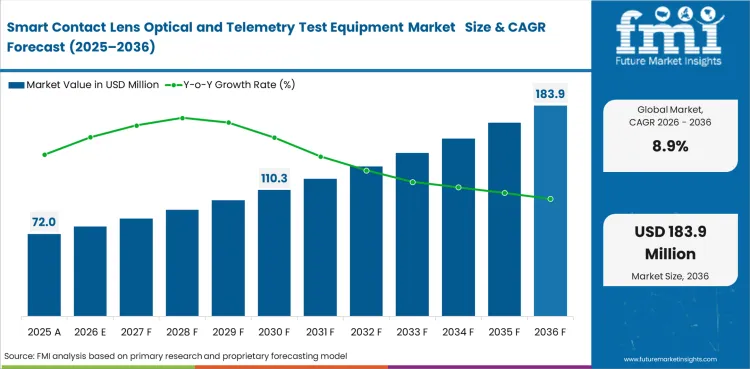
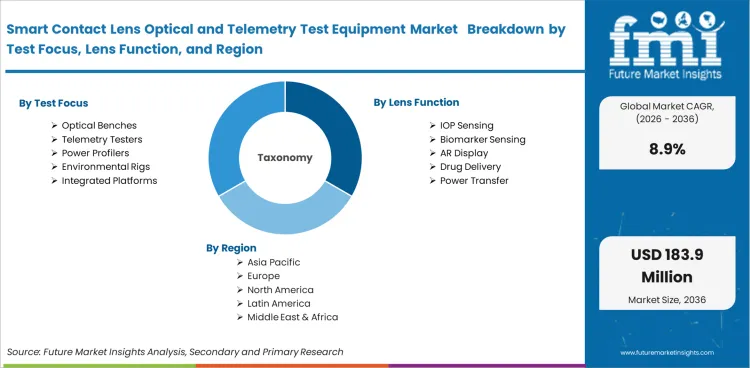
The smart contact lens optical and telemetry test equipment market was valued at USD 66.1 million in 2025. It is estimated at USD 72 million in 2026 and is projected to reach USD 168.9 million by 2036, expanding at a CAGR of 8.9% during 2026 to 2036. Optical benches are expected to remain the leading test focus segment with a 34% share, while IOP sensing leads the lens function segment with a 36% share.
Summary of the Smart Contact Lens Optical and Telemetry Test Equipment Market
- Demand and Growth Drivers
- Clinical and prototype work on smart contact lenses is expected to support demand for optical and telemetry test systems as developers need tighter validation of signal quality and lens performance.
- Pressure monitoring programs are likely to stay a major demand driver, as IOP sensing projects require repeatable optical checks and stable telemetry verification before wider product progression.
- Growth through the forecast period is expected to come from added work on wireless power use and miniaturized electronics, which raises the need for more precise bench testing.
- Product and Segment View
- Optical benches are expected to lead the test focus segment, supported by their central role in alignment, imaging accuracy, and repeatable lens performance evaluation.
- IOP sensing is likely to hold the lead across lens function, as pressure-monitoring use cases continue to account for a large share of current smart lens development work.
- Direct sales are expected to lead the main channel, as developers in this space usually need custom configuration, technical support, and closer validation input before purchase.
- Geography and Competitive Outlook
- The United States is likely to stay a key market due to its research base, device development activity, and stronger concentration of ophthalmic innovation programs.
- Belgium is expected to record faster expansion during the study period, supported by active microelectronics capability and continued work around advanced health technology development.
- Companies with strength in precision optical testing and telemetry measurement are likely to benefit most, especially those able to support early development programs and precommercial validation needs.
- Analyst Opinion
- Sabyasachi Ghosh, Associate Vice President at FMI, says, “A larger share of near-term demand is likely to come from test platforms built for repeatable optical validation and stable telemetry measurement, since smart contact lens programs still face strict performance checks before moving beyond prototype work.”
- Smart Contact Lens Optical and Telemetry Test Equipment Market Value Analysis
- The smart contact lens optical and telemetry test equipment market is moving from early laboratory work toward a more defined testing category within advanced ophthalmic device development.
- Adoption is being supported by continued work on IOP sensing lenses, which require reliable optical checks and stable telemetry validation during development.
- The market is also benefiting from broader interest in miniaturized electronics and wireless performance testing for lens-based systems.
- Demand remains supported by the need for test platforms that can improve measurement accuracy, reduce validation risk, and support progress from prototype stages into pilot production.
Key Takeaways
- The Smart Contact Lens Optical and Telemetry Test Equipment Market was valued at USD 66.1 million in 2025.
- By 2036, the Smart Contact Lens Optical and Telemetry Test Equipment Market is projected to reach USD 168.9 million.
- From 2026 to 2036, the market is expected to expand at a CAGR of 8.9%.
- The market is estimated to create an incremental opportunity of USD 96.9 million over the forecast period.
- In 2026, IOP sensing is expected to account for 36% of the lens function segment, supported by continued work around smart lenses for pressure monitoring.
- The United States (9.6%) and Belgium (9.2%) are likely to be the two fastest growing markets during the study period.
Smart contact lens optical and telemetry test equipment market definition
This market covers equipment and software used to test the optical behavior, telemetry performance, power stability, and environmental reliability of smart contact lenses. Included tools support benchtop characterization, prototype verification, preclinical validation, and pilot production qualification.
Smart contact lens optical and telemetry test equipment market inclusions
Included in scope are optical alignment systems, wavefront and modulation transfer function measurement tools, telemetry testers for Bluetooth, NFC, RF, and custom low-power links, power profiling instruments, environmental and wear-simulation rigs, calibration software, and engineering support tied to smart lens validation.
Smart contact lens optical and telemetry test equipment market exclusions
Excluded from scope are finished smart contact lenses sold to end users, standard soft contact lens inspection lines that do not address embedded electronics, routine ophthalmic clinic instruments, and general consumer electronics test systems sold without adaptation to lens validation workflows.
Smart contact lens optical and telemetry test equipment market research methodology
- Primary Research: Supplier capability pages, official press releases, and public project records were used to map active equipment families and current validation priorities across optics and telemetry.
- Desk Research: Government and public organization sources were reviewed for eye research budgets, medical device traceability rules, post-market surveillance changes, smart lens projects, and clinical study activity.
- Market Sizing and Forecasting: A niche allocation model translated smart lens program intensity into expected purchases of optical benches, telemetry testers, power tools, and integrated software-led validation systems.
- Data Validation and Update Cycle: Forecasts were checked against comparable equipment categories, known pilot development patterns, and public activity updates current through April 2026.
Why is the smart contact lens optical and telemetry test equipment market growing?
- Development work in smart contact lenses is increasing the need for test equipment built for optical accuracy and telemetry stability. Lens programs aimed at pressure sensing, biomarker tracking, and connected vision functions require careful validation before they can move further in the development cycle.
- IOP sensing remains one of the main demand anchors for this market, as developers need repeatable test systems to check signal transmission, lens behavior, and measurement consistency under controlled conditions.
- The United States is expected to lead growth at 9.6%, supported by its strong research base, device development activity, and continued work in advanced ophthalmic technologies.
The market is advancing as smart lens developers move from concept work toward more structured validation requirements. Optical and telemetry test platforms help developers assess imaging performance and wireless communication in a format suited to miniature lens electronics.
Lens developers represent the largest end-user group in this space. Their demand stays high because early-stage programs need repeated bench testing before prototype refinement and preclinical work can move ahead with lower technical risk.
Progress in microelectronics and wireless power design is increasing demand. As smart lens systems become more compact and functionally complex, test equipment must deliver tighter measurement control and reliable data across optical and telemetry parameters.
Market Segmental analysis
- Optical benches account for 34% of market share, reflecting their central role in image alignment, lens inspection, and repeatable optical performance testing across smart lens development programs.
- Lens developers represent the largest share of demand at 38%, as in-house engineering teams rely on dedicated test systems through early validation and prototype refinement stages.
- Direct sales lead the market with a 64% share, which reflects the need for customized system setup, application support, and closer coordination during equipment selection.
The market for smart contact lens optical and telemetry test equipment is divided into groups based on test focus, lens function, end user, validation stage, sales channel, and region. There are optical benches, telemetry testers, power profilers, environmental rigs, and integrated platforms by test focus. By lens function, the market includes IOP sensing, biomarker sensing, AR display, drug delivery, and power transfer. By end user, the market covers lens developers, ophthalmic OEMs, research institutes, contract labs, and pilot manufacturers. Based on validation stage, it is segmented into R&D validation, prototype verification, preclinical, pilot production, and release testing. By sales channel, the market includes direct sales, system integrators, distributors, service contracts, and software licenses.
Insights into the Optical Benches Test Focus Segment
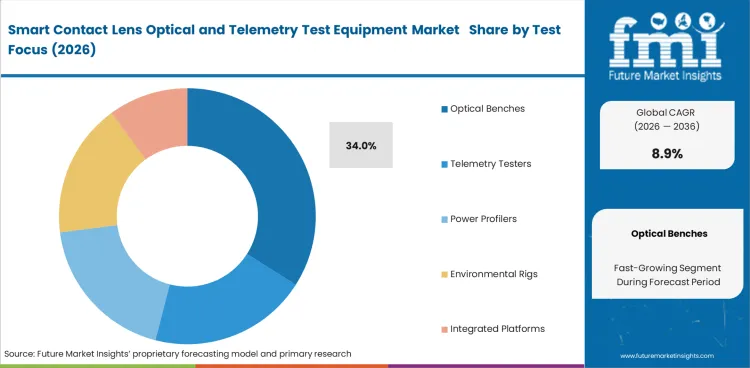
- In 2026, optical benches are expected to account for 34% of the market. This segment stays ahead because smart lens programs need careful work on alignment and optical consistency before developers can rely on sensing output or data transmission results.
- Manufacturers in this market usually look for systems that can support repeatable lens evaluation through early development and refinement work.
Insights into the IOP Sensing Lens Function Segment
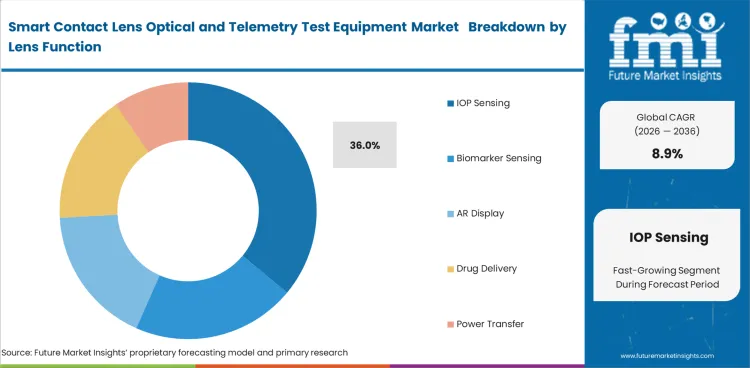
- IOP sensing is projected to represent 36% of the lens function segment in 2026. Its lead comes from the pressure monitoring one of the clearest near-term use cases in smart contact lens development. This keeps testing demand tied to stable optical readout and dependable telemetry performance.
- Programs in this area need validation tools that can check signal behavior over longer wear periods with less measurement drift.
Insights into the Lens Developers End User Segment
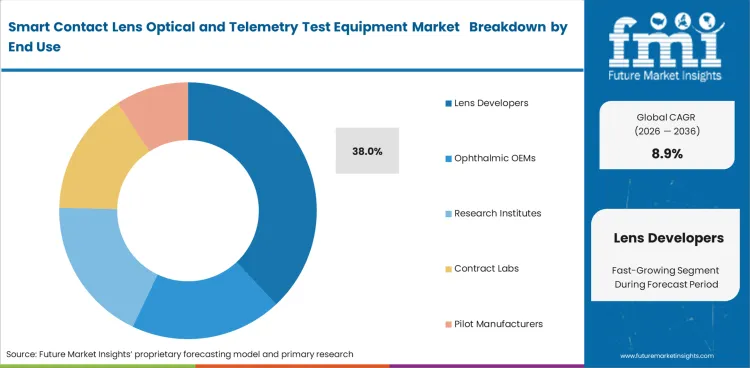
- Lens developers are expected to contribute 38% of total market share in 2026. Spending concentrated in this group since most smart lens activity is still centered in design and early validation work instead of scaled production settings.
- Lens developers usually prefer flexible test platforms that can adjust to prototype changes, new sensing layouts, and evolving material designs during development.
Insights into the R&D Validation Stage Segment
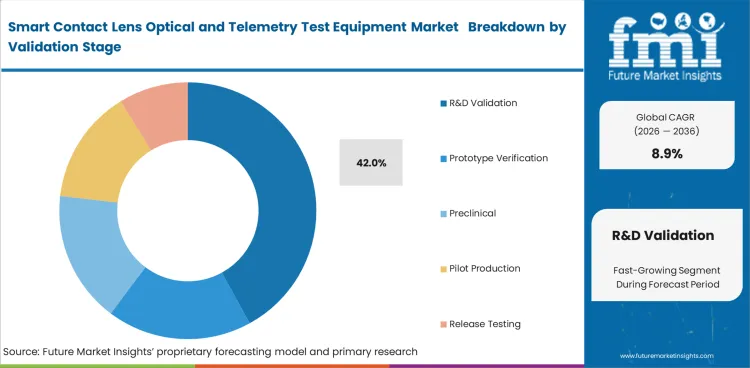
- R&D validation is likely to hold 42% of the validation stage segment in 2026. This reflects the current state of the market, where most smart lens programs are working through core questions around optical accuracy, telemetry stability and hydration behavior.
- Demand in this segment is strongest for systems that can support repeated testing across changing prototype conditions.
Insights into the Direct Sales Channel Segment
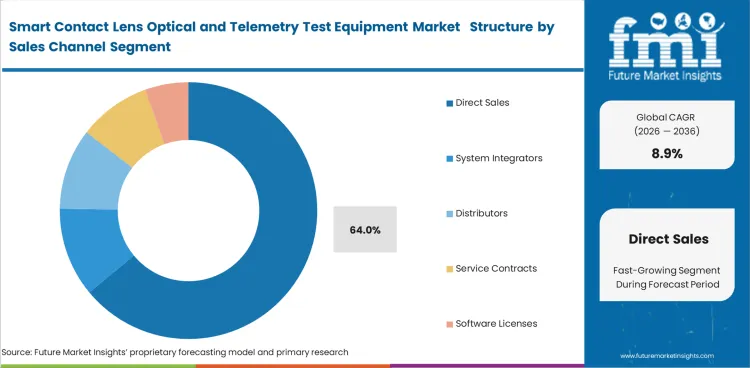
- Direct sales are expected to account for 64% of the sales channel segment in 2026. The share stays high because manufacturers in this sector usually need custom setup, calibration support, software integration, and closer technical guidance before equipment can be used effectively.
- This keeps supplier relationships more consultative and makes direct engagement more common than standard distributor-led purchases.
Smart Contact Lens Optical and Telemetry Test Equipment Market Drivers, Restraints, and Opportunities
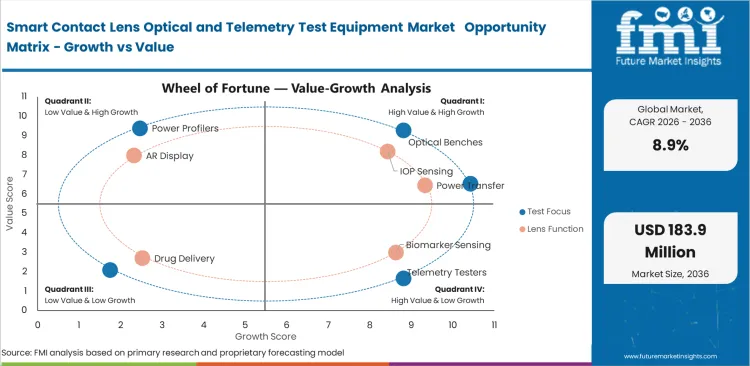
- Continued work on smart contact lenses for pressure sensing and connected vision functions is increasing demand for test equipment built for optical accuracy and telemetry verification.
- High system cost and the custom nature of many test setups can slow adoption, especially for smaller development teams working with limited prototype budgets.
- Progress in miniaturized sensors and wireless power design is raising the need for more advanced validation tools across early-stage lens development programs.
The smart contact lens optical and telemetry test equipment market is moving ahead as lens developers place greater focus on measurement reliability and signal stability before preclinical and pilot-stage work. Cost remains a limiting factor for wider equipment adoption. The market continues to offer opportunities in IOP sensing, integrated test platforms, and specialized systems designed for next-generation ophthalmic device programs.
Optical Accuracy Requirements in Smart Lens Development
Demand is rising as smart contact lens developers place greater attention on optical precision during prototype work. Small shifts in alignment or signal capture can change test outcomes. This keeps optical validation central to early development. Programs linked with pressure sensing and connected vision functions are adding to this need, especially in projects that require repeatable performance checks before moving further. Interest in ophthalmic diagnostic equipment also supports the relevance of this testing layer.
High System Cost and Custom Setup Limits
Adoption remains constrained by the cost of advanced test systems and the level of customization many manufacturers require. Smaller developers often work with tighter development budgets. This can delay adoption or reduce internal testing capacity. This keeps demand more concentrated among lens developers, research groups, and specialist programs with longer product timelines. Similar behavior appears in wearable medical device connectivity and cybersecurity test systems, where technical support is part of the system selection.
Telemetry and Power Testing Create New Opportunities
Opportunity is expanding as smart contact lenses incorporate wireless communication and compact power systems. These features increase the need for equipment that can assess telemetry performance under controlled conditions and track signal behavior with greater precision. Suppliers with integrated platforms are likely to benefit, particularly those able to support both optical evaluation and electronic performance testing within one workflow. Adjacent demand in wearable medical devices and pressure-related applications such as ophthalmic tonometers adds context to this opportunity.
Analysis of smart contact lens optical and telemetry test equipment market by key countries
.webp "Top Country Growth Comparison Smart Contact Lens Optical And Telemetry Test Equipment Market Cagr (2026 2036)")
| Country | CAGR |
|---|---|
| United States | 9.6% |
| Belgium | 9.2% |
| Spain | 9.0% |
| United Kingdom | 8.7% |
| Singapore | 8.3% |
| India | 7.8% |
| Australia | 7.5% |
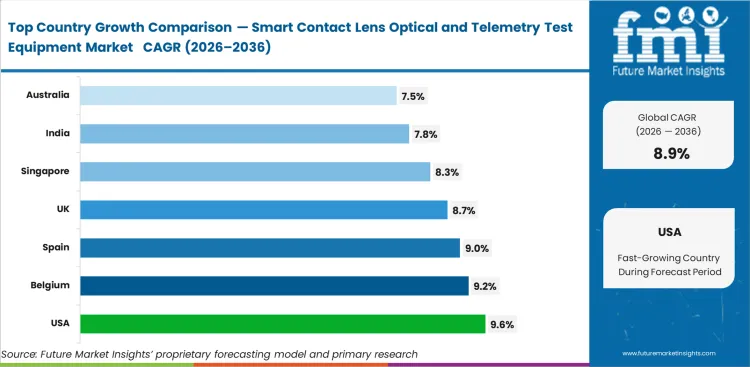
Analysis of smart contact lens optical and telemetry test equipment market by countries
- The United States leads with a 9.6% CAGR through 2036, while Belgium follows at 9.2% on the back of funded smart ophthalmic research.
- Spain is expected to grow at 9%, and the United Kingdom is projected at 8.7%, supported by EU-linked development work and stronger validation requirements.
- Singapore is likely to record 8.3% CAGR, while India is expected to expand at 7.8% through 2036 due to research-led adoption.
- Australia is projected to post 7.5% CAGR, with demand remaining selective and centered on specialist institutional purchases.
The global smart contact lens optical and telemetry test equipment market is expected to expand at a CAGR of 8.9% from 2026 to 2036. The study covers the key national markets listed below.
Demand Outlook for Smart Contact Lens Optical and Telemetry Test Equipment Market in the United States
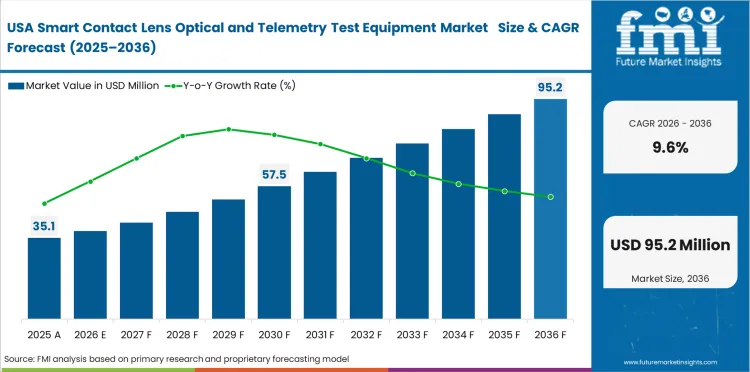
The U.S. smart contact lens optical and telemetry test equipment market is projected to grow at a CAGR of 9.6% through 2036. Demand is supported by public eye research and clinical validation activity. Funding depth in this country helps sustain higher-specification testing programs and longer validation cycles than in many other markets.
- Public eye research supports advanced validation spending.
- Clinical smart lens work lifts demand for long-duration testing.
- Manufacturers in this market prefer traceable and reviewable data output.
Future Outlook for Smart Contact Lens Optical and Telemetry Test Equipment Market in Belgium
Belgium is forecast to grow at a CAGR of 9.2% through 2036. Demand is supported by funded smart ophthalmic programs and by concentrated sensing research tied to lens development. Belgium holds importance in this niche because project-led engineering activity creates direct demand for optical metrology and telemetry validation systems.
- Funded sensing projects support specialist test equipment demand.
- Concentrated development activity improves buying intensity per program.
- Optical validation tools benefit first during early engineering stages.
Opportunity Analysis of Smart Contact Lens Optical and Telemetry Test Equipment Market in Spain
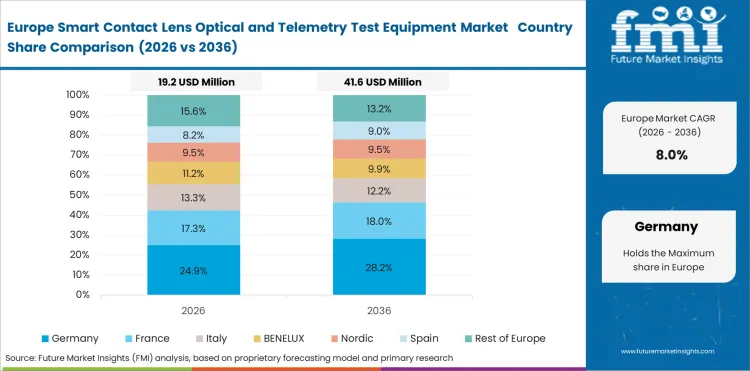
Spain is expected to expand at a CAGR of 9% through 2036. Country demand is linked with EU-backed smart lens development and nanotechnology participation in funded programs. This gives Spain value for suppliers selling precision optical benches and related validation systems used in early functional lens work.
- EU project activity supports recurring validation requirements.
- Nanotechnology work increases the need for careful optical testing.
- Demand stays strongest in research-led and prototype-focused settings.
In-depth Analysis of Smart Contact Lens Optical and Telemetry Test Equipment Market in the United Kingdom
The United Kingdom smart contact lens optical and telemetry test equipment market is projected to grow at a CAGR of 8.7% through 2036. Growth is supported by stronger post-market surveillance discipline and by rising attention to traceable device validation. Developers in the country place higher value on systems that can support organized records and repeatable reporting during development.
- Surveillance rules raise the need for formal validation records.
- Traceable workflows support buying of software-linked test systems.
- Reviewable documentation improves equipment relevance in development programs.
Sales Analysis of Smart Contact Lens Optical and Telemetry Test Equipment Market in Singapore
Singapore is projected to witness 8.3% CAGR through 2036. Demand is tied to translational medtech capability and its funded clinician-scientist base, which supports advanced research programs with ophthalmic relevance. Local demand stays small. Specialist institutions still make impiortant purchases in this niche.
- Translational medtech activity supports specialist validation purchases.
- Funded clinician-scientist programs improve research equipment demand.
- Manufacturers remain focused on advanced tools rather than production-scale systems.
In-depth Analysis of Smart Contact Lens Optical and Telemetry Test Equipment Market in India
India is expected to register a CAGR of 7.8% through 2036. Growth is supported by eye-care modernization and by institutional interest in better clinical infrastructure. Demand is centered more on research activity than commercial production in the near term. Medium-term opportunity improves as translational ophthalmic work expands.
- Eye-care modernization supports future validation capacity.
- Research-led demand remains stronger than commercial production demand.
- Modular systems should see better acceptance in cost-aware settings.
Demand Outlook for Smart Contact Lens Optical and Telemetry Test Equipment Market in Australia
Australia is projected to grow at a CAGR of 7.5% through 2036. Demand remains moderate, though strong contact lens safety research continues to support selective adoption of specialist validation systems. Institutions in this market are more likely to invest for translational research needs than for local pilot production.
- Research quality supports steady specialist equipment demand.
- Translational eye-care programs remain the main buying base.
- Service support and application fit matter more than volume pricing.
Competitive landscape and strategic positioning
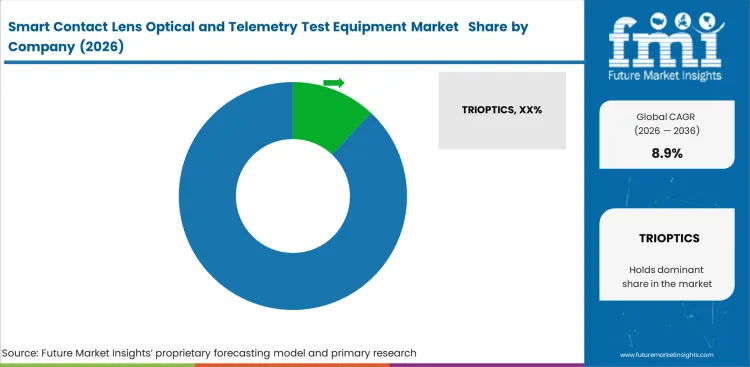
- Keysight Technologies remains one of the better-positioned names in this market due to its strength in precision measurement, signal testing, and advanced electronic validation used in connected device development.
- ZEISS, Luna Innovations, and National Instruments offer capabilities that align well with this space, especially in optical inspection, photonics testing, and data-driven validation workflows.
- Specialist suppliers are building their position through custom bench systems, telemetry verification tools, and application support tailored to smart lens development programs.
Competition is shaped by capability overlap rather than by direct one-to-one rivalry. Optical metrology specialists such as TRIOPTICS and Lambda-X win on lens characterization, alignment, and image or wavefront quality. Connectivity and electronics firms such as Keysight, Rohde & Schwarz, Anritsu, and Emerson support telemetry, power, and data-layer validation. Radiant Vision Systems sits closer to display and optical uniformity work. Smart lens developers often combine these tools instead of purchasing a single turnkey stack. That keeps the market fragmented and places a premium on application knowledge and interoperability.
Leading suppliers are usually better placed when they can support both optical testing and telemetry measurement within the same workflow. Companies with experience in ophthalmic instruments, photonics, sensors, and medical electronics testing are more likely to win demand from lens developers and research institutes working on next-generation smart lens programs.
Key companies in Smart Contact Lens Optical and Telemetry Test Equipment Market
The supplier field includes global test and measurement companies as well as ophthalmic metrology specialists.
- TRIOPTICS, Keysight Technologies, Rohde & Schwarz, and Emerson fit this group because they combine broad measurement portfolios, established engineering support, and cross-region customer access.
- Lambda-X Ophthalmics and Radiant Vision Systems fit a regional-specialist profile in this niche because they are highly credible in optical measurement and visual characterization.
- Anritsu and smaller project-led integration partners sit in the emerging set for this niche. They are active and technically relevant, especially for wireless validation, but their role in smart lens projects remains more selective than that of the largest cross-disciplinary vendors. Success depends on modular deployment and collaboration with optics specialists.
Competitive benchmarking: Smart Contact Lens Optical and Telemetry Test Equipment Market
| Company | Optical Metrology | Telemetry Validation | Workflow Depth | Geographic Footprint |
|---|---|---|---|---|
| TRIOPTICS | High | Medium | Strong | Global |
| Lambda-X Ophthalmics | High | Low | Strong | Multi-region |
| Keysight Technologies | Medium | High | Strong | Global |
| Rohde & Schwarz | Medium | High | Strong | Global |
| Anritsu | Low | High | Moderate | Global |
| Emerson (NI) | Low | High | Moderate | Global |
| Radiant Vision Systems | High | Low | Moderate | Multi-region |
| XPANCEO | Low | Low | Low | Regional |
| Smartlens, Inc. | Low | Medium | Low | Regional |
| imec-linked labs | Medium | Medium | Moderate | Europe |
Source: Future Market Insights competitive analysis, 2026.
Key developments in smart contact lens optical and telemetry test equipment market
- In March 2025, Keysight Technologies Keysight announced new DCA-M sampling oscilloscopes for 1.6T transceiver optical testing with integrated clock recovery up to 120 GBaud.
- In March 2026, Rohde & Schwarz Rohde & Schwarz said NETGEAR adopted the CMP180 radio communication tester for Wi-Fi 8 and 5G validation up to 8 GHz and bandwidths up to 500 MHz..
- In July 2025, XPANCEO said it closed a USD 250 million Series A round to advance smart contact lens development and path to market.
Key players in the smart contact lens optical and telemetry test equipment market
Major global players
- TRIOPTICS
- Keysight Technologies
- Rohde & Schwarz
- Anritsu
- Emerson (NI)
Key emerging players/startups
- Lambda-X Ophthalmics
- Radiant Vision Systems
- XPANCEO
- Smartlens, Inc.
Scope of the report
| Parameter | Details |
|---|---|
| Quantitative Units | USD 72 million to USD 168.9 million, at a CAGR of 8.9% |
| Market Definition | The smart contact lens optical and telemetry test equipment market covers test systems used to evaluate optical performance, telemetry stability, signal behavior, and power characteristics in smart contact lens development programs. |
| Regions Covered | North America, Latin America, Europe, East Asia, South Asia and Pacific, Middle East and Africa |
| Countries Covered | United States, Belgium, Spain, United Kingdom, Singapore, India, Australia, and additional countries covered in the study |
| Key Companies Profiled | Keysight Technologies, ZEISS, Rohde & Schwarz, Luna Innovations, National Instruments, Thorlabs, Anritsu, Viavi Solutions, EXFO, Yokogawa Test & Measurement, Teledyne LeCroy, XPANCEO |
| Forecast Period | 2026 to 2036 |
| Approach | Hybrid bottom-up and top-down methodology based on public research activity, validation demand, end-user adoption patterns, and segment-level forecasting across regions |
Smart contact lens optical and telemetry test equipment market by segments
Smart Contact Lens Optical and Telemetry Test Equipment Market segmented as Test Focus
- Optical Benches
- Telemetry Testers
- Power Profilers
- Environmental Rigs
- Integrated Platforms
Smart Contact Lens Optical and Telemetry Test Equipment Market segmented as Lens Function
- IOP Sensing
- Biomarker Sensing
- AR Display
- Drug Delivery
- Power Transfer
Smart Contact Lens Optical and Telemetry Test Equipment Market segmented as End User
- Lens Developers
- Ophthalmic OEMs
- Research Institutes
- Contract Labs
- Pilot Manufacturers
Smart Contact Lens Optical and Telemetry Test Equipment Market segmented as Validation Stage
- R&D Validation
- Prototype Verification
- Preclinical
- Pilot Production
- Release Testing
Smart Contact Lens Optical and Telemetry Test Equipment Market segmented as Sales Channel
- Direct Sales
- System Integrators
- Distributors
- Service Contracts
- Software Licenses
Smart Contact Lens Optical and Telemetry Test Equipment Market segmented by region
- North America
- USA
- Canada
- Mexico
- Latin America
- Brazil
- Chile
- Rest of Latin America
- Western Europe
- Germany
- UK
- Italy
- Spain
- France
- Nordic
- BENELUX
- Rest of Western Europe
- Eastern Europe
- Russia
- Poland
- Hungary
- Balkan & Baltic
- Rest of Eastern Europe
- East Asia
- China
- Japan
- South Korea
- South Asia and Pacific
- India
- ASEAN
- Australia & New Zealand
- Rest of South Asia and Pacific
- Middle East & Africa
- Kingdom of Saudi Arabia
- Other GCC Countries
- Turkiye
- South Africa
- Other African Union
- Rest of Middle East & Africa
Bibliography
- Keysight Technologies, Inc. (2025, March 25). Keysight’s new sampling oscilloscopes revolutionize 1.6T transceiver optical testing for AI data centers.
- Rohde & Schwarz. (2026, March 9). Rohde & Schwarz and NETGEAR collaborate for next generation Wi-Fi 8 access point testing.
- XPANCEO. (2025, July 8). XPANCEO becomes a unicorn with $250M raise to create ultimate form factor for AI-powered XR computing.
- U.S. Food and Drug Administration. (2026, April). Examples of Real-World Evidence Used in Medical Device Regulatory Decisions (Fiscal Years 2020-2025).
The bibliography is provided for reader reference.
This report addresses
- Current market size and forecast trajectory for smart contact lens optical and telemetry test systems.
- Segment shares across test focus, lens function, end user, validation stage, and sales channel.
- Country and region demand patterns tied to public research and regulatory structure.
- Competitive assessment of optical metrology and telemetry validation suppliers.
- Traceability and post-market surveillance changes relevant to connected lens development.
- Investment whitespace linked to pilot validation and integrated workflow demand.
- Value chain scope from public research programs to pilot development and supplier support.
- Deliverables covering article narrative, summary tables, benchmarking, and data record.
Frequently Asked Questions
How big is the smart contact lens optical and telemetry test equipment market in 2026?
The market is estimated at USD 72.0 million in 2026.
What will the market be worth by 2036?
The forecast points to USD 168.9 million by 2036.
What is the CAGR from 2026 to 2036?
The base forecast implies an 8.9% CAGR over the assessment period.
Which segment leads by test focus?
Optical benches lead with an estimated 34.0% share in 2026.
Which end user leads demand?
Lens developers are expected to account for 38.0% of total demand in 2026.
Which country grows the fastest in this study?
The United States leads current demand while Belgium and Spain grow slightly faster than the global average.
Preview the report firsthand - request a free sample
Get SampleGet the brochure for pricing and purchase details.
Get PDFTable of Content
- Executive Summary
- Global Market Outlook
- Demand-side Trends
- Supply-side Trends
- Technology Roadmap Analysis
- Analysis and Recommendations
- Market Overview
- Market Coverage / Taxonomy
- Market Definition / Scope / Limitations
- Research Methodology
- Chapter Orientation
- Analytical Lens and Working Hypotheses
- Market Structure, Signals, and Trend Drivers
- Benchmarking and Cross-market Comparability
- Market Sizing, Forecasting, and Opportunity Mapping
- Research Design and Evidence Framework
- Desk Research Programme (Secondary Evidence)
- Company Annual and Sustainability Reports
- Peer-reviewed Journals and Academic Literature
- Corporate Websites, Product Literature, and Technical Notes
- Earnings Decks and Investor Briefings
- Statutory Filings and Regulatory Disclosures
- Technical White Papers and Standards Notes
- Trade Journals, Industry Magazines, and Analyst Briefs
- Conference Proceedings, Webinars, and Seminar Materials
- Government Statistics Portals and Public Data Releases
- Press Releases and Reputable Media Coverage
- Specialist Newsletters and Curated Briefings
- Sector Databases and Reference Repositories
- FMI Internal Proprietary Databases and Historical Market Datasets
- Subscription Datasets and Paid Sources
- Social Channels, Communities, and Digital Listening Inputs
- Additional Desk Sources
- Expert Input and Fieldwork (Primary Evidence)
- Primary Modes
- Qualitative Interviews and Expert Elicitation
- Quantitative Surveys and Structured Data Capture
- Blended Approach
- Why Primary Evidence is Used
- Field Techniques
- Interviews
- Surveys
- Focus Groups
- Observational and In-context Research
- Social and Community Interactions
- Stakeholder Universe Engaged
- C-suite Leaders
- Board Members
- Presidents and Vice Presidents
- R&D and Innovation Heads
- Technical Specialists
- Domain Subject-matter Experts
- Scientists
- Physicians and Other Healthcare Professionals
- Governance, Ethics, and Data Stewardship
- Research Ethics
- Data Integrity and Handling
- Primary Modes
- Tooling, Models, and Reference Databases
- Desk Research Programme (Secondary Evidence)
- Data Engineering and Model Build
- Data Acquisition and Ingestion
- Cleaning, Normalisation, and Verification
- Synthesis, Triangulation, and Analysis
- Quality Assurance and Audit Trail
- Market Background
- Market Dynamics
- Drivers
- Restraints
- Opportunity
- Trends
- Scenario Forecast
- Demand in Optimistic Scenario
- Demand in Likely Scenario
- Demand in Conservative Scenario
- Opportunity Map Analysis
- Product Life Cycle Analysis
- Supply Chain Analysis
- Investment Feasibility Matrix
- Value Chain Analysis
- PESTLE and Porter’s Analysis
- Regulatory Landscape
- Regional Parent Market Outlook
- Production and Consumption Statistics
- Import and Export Statistics
- Market Dynamics
- Global Market Analysis 2021 to 2025 and Forecast, 2026 to 2036
- Historical Market Size Value (USD Million) Analysis, 2021 to 2025
- Current and Future Market Size Value (USD Million) Projections, 2026 to 2036
- Y-o-Y Growth Trend Analysis
- Absolute $ Opportunity Analysis
- Global Market Pricing Analysis 2021 to 2025 and Forecast 2026 to 2036
- Global Market Analysis 2021 to 2025 and Forecast 2026 to 2036, By Test Focus
- Introduction / Key Findings
- Historical Market Size Value (USD Million) Analysis By Test Focus , 2021 to 2025
- Current and Future Market Size Value (USD Million) Analysis and Forecast By Test Focus , 2026 to 2036
- Optical Benches
- Telemetry Testers
- Power Profilers
- Environmental Rigs
- Integrated Platforms
- Optical Benches
- Y-o-Y Growth Trend Analysis By Test Focus , 2021 to 2025
- Absolute $ Opportunity Analysis By Test Focus , 2026 to 2036
- Global Market Analysis 2021 to 2025 and Forecast 2026 to 2036, By Lens Function
- Introduction / Key Findings
- Historical Market Size Value (USD Million) Analysis By Lens Function, 2021 to 2025
- Current and Future Market Size Value (USD Million) Analysis and Forecast By Lens Function, 2026 to 2036
- IOP Sensing
- Biomarker Sensing
- AR Display
- Drug Delivery
- Power Transfer
- IOP Sensing
- Y-o-Y Growth Trend Analysis By Lens Function, 2021 to 2025
- Absolute $ Opportunity Analysis By Lens Function, 2026 to 2036
- Global Market Analysis 2021 to 2025 and Forecast 2026 to 2036, By End Use
- Introduction / Key Findings
- Historical Market Size Value (USD Million) Analysis By End Use, 2021 to 2025
- Current and Future Market Size Value (USD Million) Analysis and Forecast By End Use, 2026 to 2036
- Lens Developers
- Ophthalmic OEMs
- Research Institutes
- Contract Labs
- Pilot Manufacturers
- Lens Developers
- Y-o-Y Growth Trend Analysis By End Use, 2021 to 2025
- Absolute $ Opportunity Analysis By End Use, 2026 to 2036
- Global Market Analysis 2021 to 2025 and Forecast 2026 to 2036, By Validation Stage
- Introduction / Key Findings
- Historical Market Size Value (USD Million) Analysis By Validation Stage, 2021 to 2025
- Current and Future Market Size Value (USD Million) Analysis and Forecast By Validation Stage, 2026 to 2036
- R&D Validation
- Prototype Verification
- Preclinical
- Pilot Production
- Release Testing
- R&D Validation
- Y-o-Y Growth Trend Analysis By Validation Stage, 2021 to 2025
- Absolute $ Opportunity Analysis By Validation Stage, 2026 to 2036
- Global Market Analysis 2021 to 2025 and Forecast 2026 to 2036, By Sales Channel
- Introduction / Key Findings
- Historical Market Size Value (USD Million) Analysis By Sales Channel, 2021 to 2025
- Current and Future Market Size Value (USD Million) Analysis and Forecast By Sales Channel, 2026 to 2036
- Direct Sales
- System Integrators
- Distributors
- Service Contracts
- Software Licenses
- Direct Sales
- Y-o-Y Growth Trend Analysis By Sales Channel, 2021 to 2025
- Absolute $ Opportunity Analysis By Sales Channel, 2026 to 2036
- Global Market Analysis 2021 to 2025 and Forecast 2026 to 2036, By Region
- Introduction
- Historical Market Size Value (USD Million) Analysis By Region, 2021 to 2025
- Current Market Size Value (USD Million) Analysis and Forecast By Region, 2026 to 2036
- North America
- Latin America
- Western Europe
- Eastern Europe
- East Asia
- South Asia and Pacific
- Middle East & Africa
- Market Attractiveness Analysis By Region
- North America Market Analysis 2021 to 2025 and Forecast 2026 to 2036, By Country
- Historical Market Size Value (USD Million) Trend Analysis By Market Taxonomy, 2021 to 2025
- Market Size Value (USD Million) Forecast By Market Taxonomy, 2026 to 2036
- By Country
- USA
- Canada
- Mexico
- By Test Focus
- By Lens Function
- By End Use
- By Validation Stage
- By Sales Channel
- By Country
- Market Attractiveness Analysis
- By Country
- By Test Focus
- By Lens Function
- By End Use
- By Validation Stage
- By Sales Channel
- Key Takeaways
- Latin America Market Analysis 2021 to 2025 and Forecast 2026 to 2036, By Country
- Historical Market Size Value (USD Million) Trend Analysis By Market Taxonomy, 2021 to 2025
- Market Size Value (USD Million) Forecast By Market Taxonomy, 2026 to 2036
- By Country
- Brazil
- Chile
- Rest of Latin America
- By Test Focus
- By Lens Function
- By End Use
- By Validation Stage
- By Sales Channel
- By Country
- Market Attractiveness Analysis
- By Country
- By Test Focus
- By Lens Function
- By End Use
- By Validation Stage
- By Sales Channel
- Key Takeaways
- Western Europe Market Analysis 2021 to 2025 and Forecast 2026 to 2036, By Country
- Historical Market Size Value (USD Million) Trend Analysis By Market Taxonomy, 2021 to 2025
- Market Size Value (USD Million) Forecast By Market Taxonomy, 2026 to 2036
- By Country
- Germany
- UK
- Italy
- Spain
- France
- Nordic
- BENELUX
- Rest of Western Europe
- By Test Focus
- By Lens Function
- By End Use
- By Validation Stage
- By Sales Channel
- By Country
- Market Attractiveness Analysis
- By Country
- By Test Focus
- By Lens Function
- By End Use
- By Validation Stage
- By Sales Channel
- Key Takeaways
- Eastern Europe Market Analysis 2021 to 2025 and Forecast 2026 to 2036, By Country
- Historical Market Size Value (USD Million) Trend Analysis By Market Taxonomy, 2021 to 2025
- Market Size Value (USD Million) Forecast By Market Taxonomy, 2026 to 2036
- By Country
- Russia
- Poland
- Hungary
- Balkan & Baltic
- Rest of Eastern Europe
- By Test Focus
- By Lens Function
- By End Use
- By Validation Stage
- By Sales Channel
- By Country
- Market Attractiveness Analysis
- By Country
- By Test Focus
- By Lens Function
- By End Use
- By Validation Stage
- By Sales Channel
- Key Takeaways
- East Asia Market Analysis 2021 to 2025 and Forecast 2026 to 2036, By Country
- Historical Market Size Value (USD Million) Trend Analysis By Market Taxonomy, 2021 to 2025
- Market Size Value (USD Million) Forecast By Market Taxonomy, 2026 to 2036
- By Country
- China
- Japan
- South Korea
- By Test Focus
- By Lens Function
- By End Use
- By Validation Stage
- By Sales Channel
- By Country
- Market Attractiveness Analysis
- By Country
- By Test Focus
- By Lens Function
- By End Use
- By Validation Stage
- By Sales Channel
- Key Takeaways
- South Asia and Pacific Market Analysis 2021 to 2025 and Forecast 2026 to 2036, By Country
- Historical Market Size Value (USD Million) Trend Analysis By Market Taxonomy, 2021 to 2025
- Market Size Value (USD Million) Forecast By Market Taxonomy, 2026 to 2036
- By Country
- India
- ASEAN
- Australia & New Zealand
- Rest of South Asia and Pacific
- By Test Focus
- By Lens Function
- By End Use
- By Validation Stage
- By Sales Channel
- By Country
- Market Attractiveness Analysis
- By Country
- By Test Focus
- By Lens Function
- By End Use
- By Validation Stage
- By Sales Channel
- Key Takeaways
- Middle East & Africa Market Analysis 2021 to 2025 and Forecast 2026 to 2036, By Country
- Historical Market Size Value (USD Million) Trend Analysis By Market Taxonomy, 2021 to 2025
- Market Size Value (USD Million) Forecast By Market Taxonomy, 2026 to 2036
- By Country
- Kingdom of Saudi Arabia
- Other GCC Countries
- Turkiye
- South Africa
- Other African Union
- Rest of Middle East & Africa
- By Test Focus
- By Lens Function
- By End Use
- By Validation Stage
- By Sales Channel
- By Country
- Market Attractiveness Analysis
- By Country
- By Test Focus
- By Lens Function
- By End Use
- By Validation Stage
- By Sales Channel
- Key Takeaways
- Key Countries Market Analysis
- USA
- Pricing Analysis
- Market Share Analysis, 2025
- By Test Focus
- By Lens Function
- By End Use
- By Validation Stage
- By Sales Channel
- Canada
- Pricing Analysis
- Market Share Analysis, 2025
- By Test Focus
- By Lens Function
- By End Use
- By Validation Stage
- By Sales Channel
- Mexico
- Pricing Analysis
- Market Share Analysis, 2025
- By Test Focus
- By Lens Function
- By End Use
- By Validation Stage
- By Sales Channel
- Brazil
- Pricing Analysis
- Market Share Analysis, 2025
- By Test Focus
- By Lens Function
- By End Use
- By Validation Stage
- By Sales Channel
- Chile
- Pricing Analysis
- Market Share Analysis, 2025
- By Test Focus
- By Lens Function
- By End Use
- By Validation Stage
- By Sales Channel
- Germany
- Pricing Analysis
- Market Share Analysis, 2025
- By Test Focus
- By Lens Function
- By End Use
- By Validation Stage
- By Sales Channel
- UK
- Pricing Analysis
- Market Share Analysis, 2025
- By Test Focus
- By Lens Function
- By End Use
- By Validation Stage
- By Sales Channel
- Italy
- Pricing Analysis
- Market Share Analysis, 2025
- By Test Focus
- By Lens Function
- By End Use
- By Validation Stage
- By Sales Channel
- Spain
- Pricing Analysis
- Market Share Analysis, 2025
- By Test Focus
- By Lens Function
- By End Use
- By Validation Stage
- By Sales Channel
- France
- Pricing Analysis
- Market Share Analysis, 2025
- By Test Focus
- By Lens Function
- By End Use
- By Validation Stage
- By Sales Channel
- India
- Pricing Analysis
- Market Share Analysis, 2025
- By Test Focus
- By Lens Function
- By End Use
- By Validation Stage
- By Sales Channel
- ASEAN
- Pricing Analysis
- Market Share Analysis, 2025
- By Test Focus
- By Lens Function
- By End Use
- By Validation Stage
- By Sales Channel
- Australia & New Zealand
- Pricing Analysis
- Market Share Analysis, 2025
- By Test Focus
- By Lens Function
- By End Use
- By Validation Stage
- By Sales Channel
- China
- Pricing Analysis
- Market Share Analysis, 2025
- By Test Focus
- By Lens Function
- By End Use
- By Validation Stage
- By Sales Channel
- Japan
- Pricing Analysis
- Market Share Analysis, 2025
- By Test Focus
- By Lens Function
- By End Use
- By Validation Stage
- By Sales Channel
- South Korea
- Pricing Analysis
- Market Share Analysis, 2025
- By Test Focus
- By Lens Function
- By End Use
- By Validation Stage
- By Sales Channel
- Russia
- Pricing Analysis
- Market Share Analysis, 2025
- By Test Focus
- By Lens Function
- By End Use
- By Validation Stage
- By Sales Channel
- Poland
- Pricing Analysis
- Market Share Analysis, 2025
- By Test Focus
- By Lens Function
- By End Use
- By Validation Stage
- By Sales Channel
- Hungary
- Pricing Analysis
- Market Share Analysis, 2025
- By Test Focus
- By Lens Function
- By End Use
- By Validation Stage
- By Sales Channel
- Kingdom of Saudi Arabia
- Pricing Analysis
- Market Share Analysis, 2025
- By Test Focus
- By Lens Function
- By End Use
- By Validation Stage
- By Sales Channel
- Turkiye
- Pricing Analysis
- Market Share Analysis, 2025
- By Test Focus
- By Lens Function
- By End Use
- By Validation Stage
- By Sales Channel
- South Africa
- Pricing Analysis
- Market Share Analysis, 2025
- By Test Focus
- By Lens Function
- By End Use
- By Validation Stage
- By Sales Channel
- USA
- Market Structure Analysis
- Competition Dashboard
- Competition Benchmarking
- Market Share Analysis of Top Players
- By Regional
- By Test Focus
- By Lens Function
- By End Use
- By Validation Stage
- By Sales Channel
- Competition Analysis
- Competition Deep Dive
- TRIOPTICS
- Overview
- Product Portfolio
- Profitability by Market Segments (Product/Age /Sales Channel/Region)
- Sales Footprint
- Strategy Overview
- Marketing Strategy
- Product Strategy
- Channel Strategy
- Keysight Technologies
- Rohde & Schwarz
- Anritsu
- Emerson (NI)
- Lambda-X Ophthalmics
- Radiant Vision Systems
- XPANCEO
- Smartlens, Inc.
- TRIOPTICS
- Competition Deep Dive
- Assumptions & Acronyms Used


