

- Industry Size (2026)
- USD 114.07 Mn
- Forecast (2036)
- USD 577.10 Mn
- CAGR (2026 to 2036)
- 17.6%
Telemetry-Linked Smart Fertilizer Program Market Size, Market Forecast and Outlook By FMI
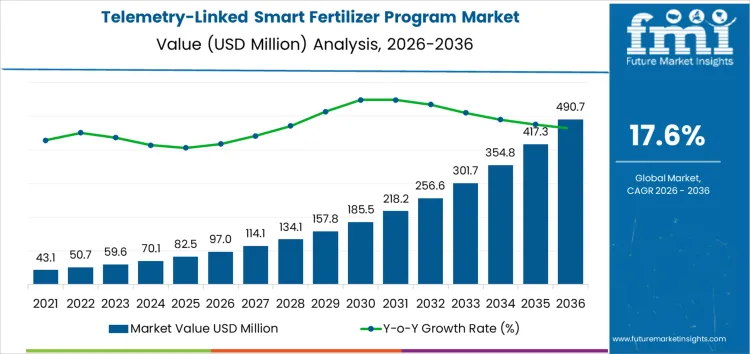
The telemetry-linked smart fertilizer program market was valued at USD 97.08 million in 2025, projected to reach USD 114.07 million in 2026, and is forecast to expand to USD 577.10 million by 2036 at a 17.6% CAGR. Fertiliser regulation tightening across the European Union, India, and China is converting precision nutrient management from an agronomic best practice into a compliance requirement, with farm operators facing subsidy clawbacks and export documentation failures when they cannot produce digitally verified application records. Agri-input distributors entering new supply agreements with food processors are now routinely required to demonstrate digital traceability capability as a contract qualification condition.
Summary of Telemetry-Linked Smart Fertilizer Program Market
- Market Snapshot
- The market is valued at USD 97.08 Million in 2025 and is projected to reach USD 577.10 Million by 2036.
- The industry is expected to grow at a 17.6% CAGR from 2026 to 2036, creating an incremental opportunity of USD 463.03 Million.
- This is a high-growth, technology-driven market where regulatory alignment and platform certification define competitive positioning for long-term contract capture.
- Demand and Growth Drivers
- Regulatory mandates and compliance frameworks in key end-use sectors are converting discretionary adoption into structured procurement obligations across the telemetry-linked smart fertilizer program value chain.
- Technology advancement in platform integration, data connectivity, and certified system performance is broadening addressable applications and increasing per-deployment contract values.
- Government-backed infrastructure and digital transformation programmes are generating funded procurement pipelines that provide multi-year revenue visibility for established market participants.
- Among key countries, India leads at 17.8% CAGR, followed by USA at 16.9%, China at 15.9%, and Germany at 15.4%.
- Product and Segment View
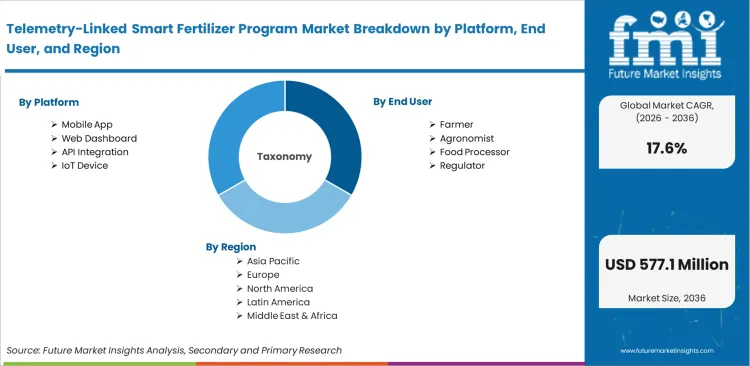
- The market includes Mobile App, Web Dashboard, API Integration, IoT Device as core platform categories.
- End User sub-segments include Farmer, Agronomist, Food Processor, Regulator.
- Mobile App leads by platform with 50.0% share in 2026.
- Farmer leads by end user with 45.0% share in 2026.
- The scope includes certified and integrated platform configurations while excluding general-purpose systems without specialised functional capabilities specific to this market.
- Geography and Competitive Outlook
- India and USA represent the fastest-growing markets, supported by government investment programmes and regulatory mandates driving accelerated adoption.
- North America and Europe represent established procurement markets where upgrade cycles and compliance-driven replacement purchasing sustain consistent demand volumes.
- Competition is shaped by regulatory certification credentials, platform integration breadth, and service network depth, with leading positions held by vendors who have secured multi-year institutional supply agreements.
- Key companies include Nutrien Ltd., Bayer AG, Corteva Agriscience, Syngenta Group, Yara International ASA, Trimble Inc..
Telemetry-Linked Smart Fertilizer Program Market Key Takeaways
| Metric | Details |
|---|---|
| Industry Size (2026) | USD 114.07 Million |
| Industry Value (2036) | USD 577.10 Million |
| CAGR (2026-2036) | 17.6% |
| Source | Future Market Insights, 2026 |
Source: Future Market Insights, 2026
The incremental opportunity of USD 463.03 million over the forecast decade reflects the compounding effect of regulatory compliance pressure, commodity input cost volatility, and the widening availability of affordable IoT sensor hardware enabling real-time soil nutrient monitoring at per-hectare economics that are viable even on smallholder holdings. Farm management software vendors that achieve certified integration with national soil health databases and government subsidy verification portals are capturing multi-year platform licences from cooperative networks that consolidate procurement across thousands of member farms. Platforms without regulatory data submission capability face exclusion from the institutional agri-input channel as food supply chain traceability standards elevate the minimum digital infrastructure threshold for commercial farm operations.
India leads at a 17.8% CAGR through 2036, driven by the PM-KISAN digital agriculture mission integrating soil health card data with government-subsidised precision input advisory services across 140 million farmer beneficiary accounts. The USA advances at 16.9%, supported by USDA Environmental Quality Incentives Programme payments requiring digitally documented conservation practice compliance for participating farm operators. China registers 15.9% growth aligned with the Ministry of Agriculture and Rural Affairs digital farming strategy, which mandates smart nutrient management platforms in major grain-producing provinces under the Black Soil Protection Law framework. Germany at 15.4% reflects the DuengV fertilisation regulation enforcement cycle, where farm operators must maintain digital nutrient balance records to satisfy Landwirtschaftskammer compliance audits.
Telemetry-Linked Smart Fertilizer Program Market Definition
The telemetry-linked smart fertilizer program market encompasses digital platforms, IoT sensor networks, and agronomic advisory software systems that collect real-time soil nutrient, moisture, and crop health data to generate precision fertiliser application recommendations, automate dosing equipment, and produce regulatory-compliant nutrient management documentation. The market spans mobile applications, web-based farm dashboards, API-integrated machinery control interfaces, and IoT device ecosystems serving farmers, agronomists, food processors, and regulatory bodies across commercial and smallholder agricultural operations.
Telemetry-Linked Smart Fertilizer Program Market Inclusions
The scope covers global and regional revenue from smart fertiliser platform software licences, IoT soil sensor hardware integrated with nutrient advisory systems, telemetry data management subscriptions, agronomist-facing analytical tools, and professional implementation service contracts. Forecast includes all platform types, all end-user categories, and all sales channel configurations serving commercial grain, horticulture, and specialty crop producers through 2036.
Telemetry-Linked Smart Fertilizer Program Market Exclusions
The scope excludes standalone general-purpose farm management software without telemetry-linked fertiliser dosing functionality, conventional soil testing laboratory services without digital advisory platform integration, bulk fertiliser product revenues, and agricultural machinery hardware not specifically configured for precision variable-rate fertiliser application. General remote sensing and satellite imagery services that do not produce fertiliser-specific agronomic recommendations are excluded from the valuation.
Telemetry-Linked Smart Fertilizer Program Market Research Methodology
Primary Research
Analysts engaged with procurement leads, operations directors, and technical specialists across the telemetry-linked smart fertilizer program value chain to identify adoption drivers, specification requirements, and contract structures that govern purchasing decisions.
Desk Research
Data collection phases aggregated regulatory filings, government programme announcements, standards body publications, company investor presentations, and trade association reports to establish the policy and commercial context framing demand trajectories.
Market-Sizing and Forecasting
Baseline values derive from a bottom-up aggregation of segment-level deployment volumes calibrated against publicly disclosed procurement data, with region-specific adoption velocity curves applied to project demand through 2036.
Data Validation and Update Cycle
Projections are cross-validated against quarterly publicly reported revenue guidance from leading market participants and retested against regulatory calendar milestones that structurally alter adoption timelines within each geographic segment.
What Is Driving Demand in the Telemetry-Linked Smart Fertilizer Program Market?
Demand for telemetry-linked smart fertilizer programs has emerged from persistent gaps between planned nutrient strategies and actual field conditions rather than from fertilizer chemistry alone. Traditional fertilization relied on calendar schedules and soil tests taken before planting, yet dynamic soil moisture, temperature, and crop uptake influence nutrient availability throughout the season. Growers observed that static plans frequently misaligned with in-season conditions, creating inefficiencies and yield variability. Telemetry systems that link soil sensors, weather stations, and application equipment provide real-time data feeds. When integrated with smart fertilizer programs, these systems enable on-the-fly adjustments to rate and timing based on observed conditions, improving nutrient use efficiency and crop response. Early demand was strongest in high-value and risk-managed crops where documented performance improvements justified investment rather than in commodity crops with uniform application norms.
Future growth in this market will be shaped by integration into broader precision ag frameworks and documented return on investment rather than by novelty alone. As sensor networks become lower cost and more reliable, routine collection of soil electrical conductivity, moisture, and temperature data allows algorithms to recommend nutrient adjustments that match crop demand curves. Satellite and drone imagery add plant health indicators that refine nutrient prescriptions. Smart fertilizer programs tied to telemetry reduce wasted inputs by minimizing over-application and aligning supply with real-time crop needs. Regulatory pressures that link nutrient runoff to environmental outcomes also support adoption where telemetry documentation can demonstrate compliance. Demand will grow where agronomic decisions are evaluated on consistency, environmental impact, and economic return rather than fixed schedules, embedding smart fertilizer programs into standard nutrient management planning.
What Factors Are Affecting the Demand for Telemetry Linked Smart Fertilizer Program Market in Terms of Platform and End User?
The telemetry linked smart fertilizer program market is driven by higher fertilizer costs, growing precision agriculture adoption, and the need to document nutrient use efficiency. Demand centers on digital systems that connect field data with fertilizer decisions in near real time. Adoption depends on usability, data reliability, and relevance to operational workflows. Market leadership reflects platforms and users that influence day to day fertilizer application rather than reporting focused solutions.
What Is Driving Leadership by Platform in the Telemetry Linked Smart Fertilizer Program Market?
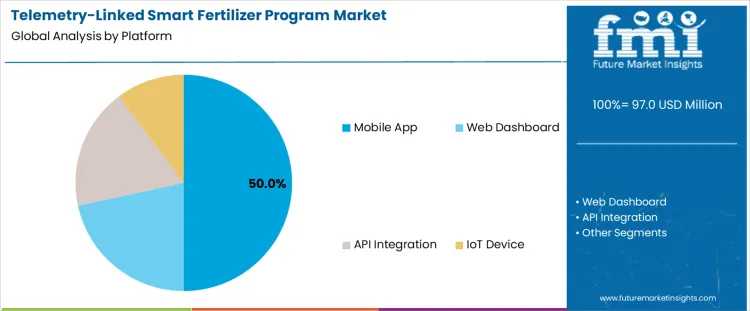
Mobile app platforms account for about 50% of demand because they align directly with how fertilizer decisions are made during field operations. Farmers increasingly use smartphones as their primary management tool, making mobile apps the most accessible interface for telemetry driven recommendations. These platforms allow real time visibility into soil moisture, weather conditions, and applicator performance, supporting immediate adjustments during application windows. Push notifications and simplified dashboards reduce response time when conditions change, which is critical for nitrogen timing and rate control. Offline functionality further supports use in areas with inconsistent connectivity, ensuring continuity of decision making.
Web dashboards and API integrations play important but secondary roles. Web platforms are better suited for historical analysis, planning, and reporting rather than in field execution. API integrations enable data exchange with enterprise farm management systems but are typically invisible to end users. IoT devices serve as data collection points rather than decision platforms. Platform leadership therefore reflects immediacy, accessibility, and operational relevance rather than analytical depth or system integration sophistication.
What Is Driving Leadership by End User in the Telemetry Linked Smart Fertilizer Program Market?
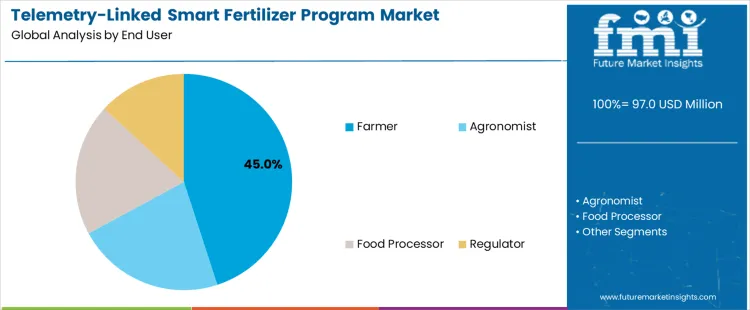
Farmers represent about 45% of demand because they make final decisions on fertilizer timing, rate, and placement. Telemetry linked programs provide farmers with actionable insights that directly affect yield outcomes and input costs. Rising fertilizer prices increase sensitivity to inefficiency, strengthening interest in tools that reduce overapplication and losses. Farmer focused programs prioritize clear recommendations and alerts rather than complex data interpretation, supporting adoption across different operation sizes and technical capabilities.
Agronomists represent secondary demand, using telemetry data to advise multiple clients and monitor field performance remotely. Their role is interpretive rather than operational. Food processors and regulators use aggregated data for traceability, compliance, and sustainability reporting but do not influence daily fertilizer decisions. End user leadership therefore reflects direct control over nutrient application, exposure to economic risk, and need for immediate decision support rather than advisory, procurement, or oversight driven use cases.
How Is the Telemetry-Linked Smart Fertilizer Program Being Applied Across Modern Agriculture?
Use appears in row crops, vegetables, and high-value horticulture where real-time monitoring of soil and crop conditions enables precise nutrient management. Farmers adopt telemetry-linked smart fertilizer programs to integrate sensor data, weather analytics, and IoT-enabled equipment for targeted nutrient application. These programs optimize fertilizer use, reduce environmental losses, and improve yield and quality. Applications reflect operational and agronomic priorities rather than purely cost objectives, with adoption driven by data-driven nutrient efficiency, crop performance, and sustainable farming practices.
What Operational and Material Conditions Support Adoption of Telemetry-Linked Smart Fertilizer Programs?
Selection aligns with compatible fertilizer formulations, sensors, and irrigation or spreading equipment capable of real-time adjustment. Nutrient solutions are optimized for solubility, concentration, and delivery precision to match telemetry-driven recommendations. Farmers monitor soil moisture, temperature, nutrient status, and crop growth through IoT platforms to ensure uniform application. Quality control evaluates nutrient composition, sensor accuracy, and system integration to comply with agronomic and regulatory standards. These conditions emerge from operational efficiency, data-driven nutrient performance, and sustainability priorities in precision agriculture workflows.
Which Practical Considerations Limit Wider Use of Telemetry-Linked Smart Fertilizer Programs?
Higher initial investment in equipment, software, and connectivity can restrict adoption in small-scale or low-margin farms. Compatibility between sensors, fertilizers, and irrigation systems must be validated. Training, maintenance, and data analysis are required for accurate operation. Regulatory approvals for nutrient formulations and digital systems differ by region. These factors lead to selective deployment where nutrient precision, yield optimization, and environmental compliance justify incremental cost and technical management in telemetry-driven fertilization workflows.
What is the Demand for Telemetry Linked Smart Fertilizer Programs by Country?
.webp "Top Country Growth Comparison Telemetry Linked Smart Fertilizer Program Market Cagr (2026 2036)")
| Country | CAGR (%) |
|---|---|
| USA | 16.9% |
| Germany | 15.4% |
| India | 17.8% |
| China | 15.9% |
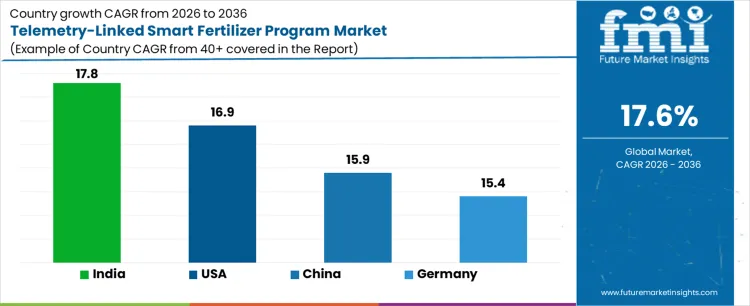
The demand for telemetry linked smart fertilizer programs is expanding rapidly across major agricultural economies, driven by real time nutrient monitoring, data based decision making, and pressure to improve fertilizer efficiency. India leads with a 17.8% CAGR, supported by fast adoption of digital agriculture platforms, increasing smartphone penetration among farmers, and government backed precision farming initiatives. The USA follows at 16.9%, reflecting strong uptake of telemetry enabled equipment, integration with farm management software, and widespread use in large scale row crop operations. China records 15.9%, shaped by state supported digital agriculture programs, mechanization, and efforts to reduce fertilizer overuse. Germany grows at 15.4%, supported by advanced precision agriculture practices, strict nutrient runoff regulations, and high adoption of sensor linked nutrient management systems.
How are telemetry-linked smart fertilizer programs expanding adoption in the United States?
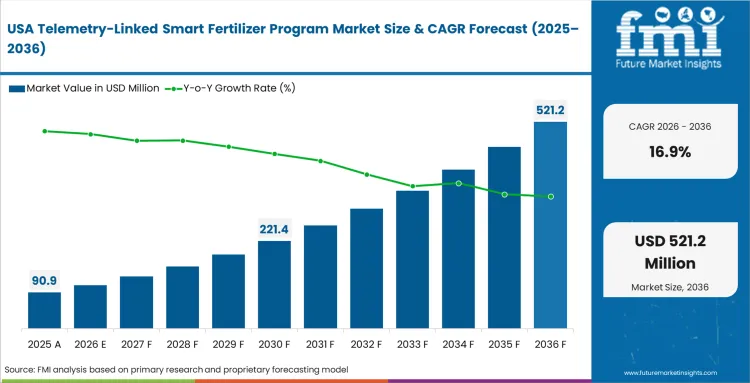
In the United States, the telemetry-linked smart fertilizer program market is growing at a CAGR of 16.9% through 2036, driven by widespread adoption of precision agriculture, integration of IoT-enabled monitoring, and demand for optimized nutrient management. Farmers are using telemetry-linked systems to monitor soil and crop conditions in real time, deliver variable nutrient doses, and improve nitrogen-use efficiency. Demand is concentrated in irrigated row crop regions, high-value horticultural areas, and industrial farming hubs. Compared to China, adoption emphasizes regulatory compliance, precision monitoring, and integration with advanced planting systems. Domestic suppliers provide high-performance, connected fertilizer solutions suitable for recurring seasonal applications.
- Irrigated row crop regions, horticultural areas, and industrial farming hubs drive adoption
- Systems enable real-time monitoring and variable nutrient delivery
- Domestic suppliers provide high-performance, connected solutions
- Recurring seasonal applications sustain adoption
How are digital agriculture and precision nutrient management driving growth in Germany?
In Germany, revenue is growing at a CAGR of 15.4% through 2036, supported by precision agriculture adoption, strict EU nutrient management regulations, and demand for environmentally sustainable farming practices. Farmers are integrating telemetry-linked smart fertilizer programs to optimize nutrient application, reduce runoff, and maintain crop quality. Demand is concentrated in high-value crop regions, irrigated agricultural zones, and industrial farming hubs. Compared to India, adoption emphasizes compliance with environmental standards and precision application rather than large-scale volume. Domestic suppliers provide EU-certified, high-performance smart fertilizer solutions suitable for recurring seasonal operations.
- High-value crop regions, irrigated agricultural zones, and industrial hubs drive adoption
- Systems optimize nutrient application and reduce runoff
- Domestic suppliers provide EU-certified, high-performance solutions
- Recurring seasonal operations sustain adoption
How are precision agriculture and high-value crop production driving adoption in India?
In India, the market is expanding at a CAGR of 17.8% through 2036, fueled by growing adoption of telemetry-enabled fertilization, high-value horticultural production, and government incentives for nutrient efficiency. Farmers are using smart fertilizer programs to deliver variable-rate nutrients, monitor crop and soil conditions, and increase yield while reducing environmental impact. Demand is concentrated in irrigated horticultural zones, industrial crop regions, and mechanized farming hubs. Compared to Germany, adoption emphasizes large-scale deployment and rapid integration across diverse crop types. Domestic suppliers provide high-performance, connected fertilizer solutions suitable for recurring seasonal applications.
- Irrigated horticultural zones, industrial crop regions, and mechanized hubs drive adoption
- Systems deliver variable-rate nutrients and monitor crop conditions
- Domestic suppliers provide high-performance, connected solutions
- Recurring seasonal applications sustain adoption
How are IoT adoption and nutrient optimization driving growth in China?
In China, the market is growing at a CAGR of 15.9% through 2036, supported by precision agriculture, government programs promoting nutrient efficiency, and widespread mechanized crop production. Farmers are integrating telemetry-linked smart fertilizer systems to optimize nutrient application, improve nitrogen-use efficiency, and enhance crop growth. Demand is concentrated in irrigated cereal regions, industrial agricultural zones, and high-intensity farming clusters. Compared to India, adoption emphasizes high-volume deployment and integration with large-scale mechanized operations. Domestic suppliers provide cost-effective, high-performance connected fertilizers suitable for recurring seasonal applications.
- Irrigated cereal regions, industrial agricultural zones, and high-intensity clusters drive adoption
- Systems optimize nutrient application and improve nitrogen-use efficiency
- Domestic suppliers provide cost-effective, high-performance connected solutions
- Recurring seasonal applications sustain adoption
Which Strategic Factors Shape Competition in the Telemetry Linked Smart Fertilizer Program Market under Real Time Decision and Accountability Requirements?
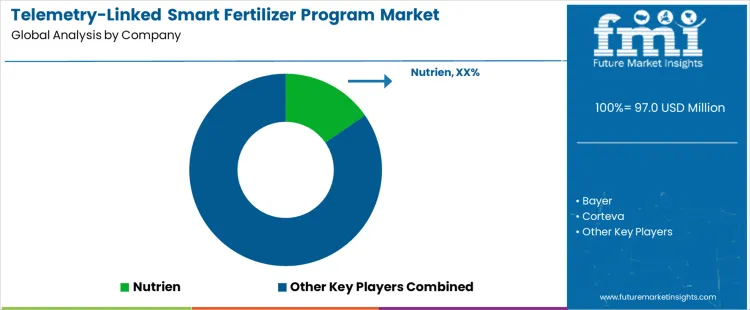
Competition in telemetry-linked smart fertilizer programs is shaped by how effectively nutrient decisions are converted into verified field actions. Nutrien and Yara International structure their strategies around closed loop systems that connect sensor data, application equipment, and nutrient products. Their focus is on translating telemetry signals such as soil moisture, canopy status, and growth stage into actionable rate and timing adjustments. Trimble plays a central role by enabling data capture, equipment synchronization, and execution tracking, making fertilizer programs auditable rather than advisory. Adoption depends on reliability of data flow, clarity of recommendations, and confidence that automated adjustments reflect agronomic reality in the field.
Input technology firms apply complementary competitive approaches. Bayer, Corteva, and Syngenta integrate smart fertilizer programs within broader digital crop systems, linking nutrient decisions to seed genetics, crop protection timing, and yield analytics. Their strategies emphasize decision coherence rather than isolated optimization. Across the market, competitive advantage is built through system trust, data consistency across seasons, and proof that telemetry driven programs reduce variability without increasing operational complexity. Success depends on execution fidelity, measurable outcomes, and the ability to align digital insight with real world nutrient delivery.
Key Players in the Telemetry-Linked Smart Fertilizer Program Market
- Nutrien
- Bayer
- Corteva
- Syngenta
- Yara International
- Trimble
Scope of the Report
| Metric | Value |
|---|---|
| Quantitative Units | USD 114.07 Million to USD 577.10 Million, at a CAGR of 17.6% |
| Market Definition | The telemetry-linked smart fertilizer program market encompasses digital platforms, IoT sensor networks, and agronomic advisory software systems that collect real-time soil nutrient, moisture, and crop health data to gen... |
| Platform Segmentation | Mobile App, Web Dashboard, API Integration, IoT Device |
| End User Segmentation | Farmer, Agronomist, Food Processor, Regulator |
| Regions Covered | North America, Latin America, Europe, East Asia, South Asia, Oceania, Middle East and Africa |
| Countries Covered | India, China, USA, Germany, France, UK, Japan, Brazil, and 40 plus countries |
| Key Companies Profiled | Nutrien Ltd., Bayer AG, Corteva Agriscience, Syngenta Group, Yara International ASA, Trimble Inc. |
| Forecast Period | 2026 to 2036 |
| Approach | Bottom-up methodology applied to segment-level deployment data, cross-validated against publicly reported operator and manufacturer revenue disclosures |
Telemetry-Linked Smart Fertilizer Program Market Segmentation
Platform:
- Mobile App
- Web Dashboard
- API Integration
- IoT Device
End User:
- Farmer
- Agronomist
- Food Processor
- Regulator
Sales Channel:
- Ag-Retailers
- Direct-to-Farmer
- Online Marketplaces
- Cooperatives
Region
- Asia Pacific
- China
- Japan
- South Korea
- India
- Australia & New Zealand
- ASEAN
- Rest of Asia Pacific
- Europe
- Germany
- United Kingdom
- France
- Italy
- Spain
- Nordic
- BENELUX
- Rest of Europe
- North America
- United States
- Canada
- Mexico
- Latin America
- Brazil
- Chile
- Rest of Latin America
- Middle East & Africa
- Kingdom of Saudi Arabia
- Other GCC Countries
- Turkey
- South Africa
- Other African Union
- Rest of Middle East & Africa
Bibliography
- Food and Agriculture Organization of the United Nations. (2025, March). Digital agriculture: Sustainable intensification through precision nutrient management. FAO. https://www.fao.org/digital-agriculture
- European Commission, Directorate-General for Agriculture. (2025, July). Farm to Fork strategy implementation: Digital nutrient management requirements. European Commission. https://ec.europa.eu/food/farm2fork
- Ministry of Agriculture and Rural Affairs, People's Republic of China. (2025, May). Digital agriculture development plan: Smart fertilisation implementation guidelines. MARA. https://www.moa.gov.cn
- United States Department of Agriculture. (2025, September). Precision agriculture: Conservation programme digital documentation requirements. USDA NRCS. https://www.nrcs.usda.gov
- Bundesministerium fuer Ernaehrung und Landwirtschaft. (2025, June). Duengeverordnung compliance reporting: Digital record requirements for fertiliser management. BMEL. https://www.bmel.de
- World Bank Group. (2025, October). Digital agriculture toolkit: Smallholder precision farming adoption pathways. World Bank. https://www.worldbank.org/en/topic/agriculture/digital
This bibliography is provided for reader reference. The full Future Market Insights report contains the complete reference list with primary research documentation.
Frequently Asked Questions
How large is the Telemetry-Linked Smart Fertilizer Program Market in 2026?
The telemetry-linked smart fertilizer program is estimated to be valued at USD 114.07 Million in 2026.
What will the Telemetry-Linked Smart Fertilizer Program Market size be by 2036?
The market is projected to reach USD 577.10 Million by 2036.
What is the expected CAGR for the Telemetry-Linked Smart Fertilizer Program Market between 2026 and 2036?
The market is expected to grow at a CAGR of 17.6% between 2026 and 2036.
Which platform segment leads the Telemetry-Linked Smart Fertilizer Program Market?
Mobile App accounts for 50.0% in 2026 and leads the market due to its broad deployment across primary end-use applications.
Which country is projected to record the fastest growth?
India leads with a 17.8% CAGR through 2036, driven by PM-KISAN digital agriculture mission integrating soil health card data with precision input advisory platforms.
What is driving demand in USA?
USA is advancing at 16.9% CAGR, supported by USDA precision agriculture conservation programme incentives and digital agronomy contract requirements.
Who are the key players in the Telemetry-Linked Smart Fertilizer Program Market?
Key companies include Nutrien Ltd., Bayer AG, Corteva Agriscience, Syngenta Group, Yara International ASA, and others detailed in the competitive landscape section.
What is the incremental opportunity in the Telemetry-Linked Smart Fertilizer Program Market through 2036?
FMI analysts project an incremental market opportunity of USD 463.03 Million over the 2026 to 2036 forecast period.
Preview the report firsthand - request a free sample
Get SampleGet the brochure for pricing and purchase details.
Get PDFTable of Content
- Executive Summary
- Global Market Outlook
- Demand-side Trends
- Supply-side Trends
- Technology Roadmap Analysis
- Analysis and Recommendations
- Market Overview
- Market Coverage / Taxonomy
- Market Definition / Scope / Limitations
- Research Methodology
- Chapter Orientation
- Analytical Lens and Working Hypotheses
- Market Structure, Signals, and Trend Drivers
- Benchmarking and Cross-market Comparability
- Market Sizing, Forecasting, and Opportunity Mapping
- Research Design and Evidence Framework
- Desk Research Programme (Secondary Evidence)
- Company Annual and Sustainability Reports
- Peer-reviewed Journals and Academic Literature
- Corporate Websites, Product Literature, and Technical Notes
- Earnings Decks and Investor Briefings
- Statutory Filings and Regulatory Disclosures
- Technical White Papers and Standards Notes
- Trade Journals, Industry Magazines, and Analyst Briefs
- Conference Proceedings, Webinars, and Seminar Materials
- Government Statistics Portals and Public Data Releases
- Press Releases and Reputable Media Coverage
- Subscription Datasets and Paid Sources
- Social Channels, Communities, and Digital Listening Inputs
- Additional Desk Sources
- Expert Input and Fieldwork (Primary Evidence)
- Primary Modes
- Qualitative Interviews and Expert Elicitation
- Quantitative Surveys and Structured Data Capture
- Blended Approach
- Why Primary Evidence is Used
- Field Techniques
- Interviews
- Surveys
- Focus Groups
- Observational and In-context Research
- Social and Community Interactions
- Stakeholder Universe Engaged
- C-suite Leaders
- Board Members
- Presidents and Vice Presidents
- R&D and Innovation Heads
- Technical Specialists
- Domain Subject-matter Experts
- Scientists
- Physicians and Other Healthcare Professionals
- Governance, Ethics, and Data Stewardship
- Research Ethics
- Data Integrity and Handling
- Primary Modes
- Tooling, Models, and Reference Databases
- Desk Research Programme (Secondary Evidence)
- Data Engineering and Model Build
- Data Acquisition and Ingestion
- Cleaning, Normalisation, and Verification
- Synthesis, Triangulation, and Analysis
- Quality Assurance and Audit Trail
- Market Background
- Market Dynamics
- Drivers
- Restraints
- Opportunity
- Trends
- Scenario Forecast
- Demand in Optimistic Scenario
- Demand in Likely Scenario
- Demand in Conservative Scenario
- Opportunity Map Analysis
- Product Life Cycle Analysis
- Supply Chain Analysis
- Investment Feasibility Matrix
- Value Chain Analysis
- PESTLE and Porter’s Analysis
- Regulatory Landscape
- Regional Parent Market Outlook
- Production and Consumption Statistics
- Import and Export Statistics
- Market Dynamics
- Global Market Analysis 2021 to 2025 and Forecast, 2026 to 2036
- Historical Market Size Value (USD Million) Analysis, 2021 to 2025
- Current and Future Market Size Value (USD Million) Projections, 2026 to 2036
- Y-o-Y Growth Trend Analysis
- Absolute $ Opportunity Analysis
- Global Market Pricing Analysis 2021 to 2025 and Forecast 2026 to 2036
- Global Market Analysis 2021 to 2025 and Forecast 2026 to 2036, By Platform
- Introduction / Key Findings
- Historical Market Size Value (USD Million) Analysis By Platform , 2021 to 2025
- Current and Future Market Size Value (USD Million) Analysis and Forecast By Platform , 2026 to 2036
- Mobile App
- Web Dashboard
- API Integration
- IoT Device
- Mobile App
- Y-o-Y Growth Trend Analysis By Platform , 2021 to 2025
- Absolute $ Opportunity Analysis By Platform , 2026 to 2036
- Global Market Analysis 2021 to 2025 and Forecast 2026 to 2036, By End User
- Introduction / Key Findings
- Historical Market Size Value (USD Million) Analysis By End User, 2021 to 2025
- Current and Future Market Size Value (USD Million) Analysis and Forecast By End User, 2026 to 2036
- Farmer
- Agronomist
- Food Processor
- Regulator
- Farmer
- Y-o-Y Growth Trend Analysis By End User, 2021 to 2025
- Absolute $ Opportunity Analysis By End User, 2026 to 2036
- Global Market Analysis 2021 to 2025 and Forecast 2026 to 2036, By Sales Channel
- Introduction / Key Findings
- Historical Market Size Value (USD Million) Analysis By Sales Channel, 2021 to 2025
- Current and Future Market Size Value (USD Million) Analysis and Forecast By Sales Channel, 2026 to 2036
- Ag-Retailers
- Direct-to-Farmer
- Online Marketplaces
- Cooperatives
- Ag-Retailers
- Y-o-Y Growth Trend Analysis By Sales Channel, 2021 to 2025
- Absolute $ Opportunity Analysis By Sales Channel, 2026 to 2036
- Global Market Analysis 2021 to 2025 and Forecast 2026 to 2036, By Region
- Introduction
- Historical Market Size Value (USD Million) Analysis By Region, 2021 to 2025
- Current Market Size Value (USD Million) Analysis and Forecast By Region, 2026 to 2036
- North America
- Latin America
- Western Europe
- Eastern Europe
- East Asia
- South Asia and Pacific
- Middle East & Africa
- Market Attractiveness Analysis By Region
- North America Market Analysis 2021 to 2025 and Forecast 2026 to 2036, By Country
- Historical Market Size Value (USD Million) Trend Analysis By Market Taxonomy, 2021 to 2025
- Market Size Value (USD Million) Forecast By Market Taxonomy, 2026 to 2036
- By Country
- USA
- Canada
- Mexico
- By Platform
- By End User
- By Sales Channel
- By Country
- Market Attractiveness Analysis
- By Country
- By Platform
- By End User
- By Sales Channel
- Key Takeaways
- Latin America Market Analysis 2021 to 2025 and Forecast 2026 to 2036, By Country
- Historical Market Size Value (USD Million) Trend Analysis By Market Taxonomy, 2021 to 2025
- Market Size Value (USD Million) Forecast By Market Taxonomy, 2026 to 2036
- By Country
- Brazil
- Chile
- Rest of Latin America
- By Platform
- By End User
- By Sales Channel
- By Country
- Market Attractiveness Analysis
- By Country
- By Platform
- By End User
- By Sales Channel
- Key Takeaways
- Western Europe Market Analysis 2021 to 2025 and Forecast 2026 to 2036, By Country
- Historical Market Size Value (USD Million) Trend Analysis By Market Taxonomy, 2021 to 2025
- Market Size Value (USD Million) Forecast By Market Taxonomy, 2026 to 2036
- By Country
- Germany
- UK
- Italy
- Spain
- France
- Nordic
- BENELUX
- Rest of Western Europe
- By Platform
- By End User
- By Sales Channel
- By Country
- Market Attractiveness Analysis
- By Country
- By Platform
- By End User
- By Sales Channel
- Key Takeaways
- Eastern Europe Market Analysis 2021 to 2025 and Forecast 2026 to 2036, By Country
- Historical Market Size Value (USD Million) Trend Analysis By Market Taxonomy, 2021 to 2025
- Market Size Value (USD Million) Forecast By Market Taxonomy, 2026 to 2036
- By Country
- Russia
- Poland
- Hungary
- Balkan & Baltic
- Rest of Eastern Europe
- By Platform
- By End User
- By Sales Channel
- By Country
- Market Attractiveness Analysis
- By Country
- By Platform
- By End User
- By Sales Channel
- Key Takeaways
- East Asia Market Analysis 2021 to 2025 and Forecast 2026 to 2036, By Country
- Historical Market Size Value (USD Million) Trend Analysis By Market Taxonomy, 2021 to 2025
- Market Size Value (USD Million) Forecast By Market Taxonomy, 2026 to 2036
- By Country
- China
- Japan
- South Korea
- By Platform
- By End User
- By Sales Channel
- By Country
- Market Attractiveness Analysis
- By Country
- By Platform
- By End User
- By Sales Channel
- Key Takeaways
- South Asia and Pacific Market Analysis 2021 to 2025 and Forecast 2026 to 2036, By Country
- Historical Market Size Value (USD Million) Trend Analysis By Market Taxonomy, 2021 to 2025
- Market Size Value (USD Million) Forecast By Market Taxonomy, 2026 to 2036
- By Country
- India
- ASEAN
- Australia & New Zealand
- Rest of South Asia and Pacific
- By Platform
- By End User
- By Sales Channel
- By Country
- Market Attractiveness Analysis
- By Country
- By Platform
- By End User
- By Sales Channel
- Key Takeaways
- Middle East & Africa Market Analysis 2021 to 2025 and Forecast 2026 to 2036, By Country
- Historical Market Size Value (USD Million) Trend Analysis By Market Taxonomy, 2021 to 2025
- Market Size Value (USD Million) Forecast By Market Taxonomy, 2026 to 2036
- By Country
- Kingdom of Saudi Arabia
- Other GCC Countries
- Turkiye
- South Africa
- Other African Union
- Rest of Middle East & Africa
- By Platform
- By End User
- By Sales Channel
- By Country
- Market Attractiveness Analysis
- By Country
- By Platform
- By End User
- By Sales Channel
- Key Takeaways
- Key Countries Market Analysis
- USA
- Pricing Analysis
- Market Share Analysis, 2025
- By Platform
- By End User
- By Sales Channel
- Canada
- Pricing Analysis
- Market Share Analysis, 2025
- By Platform
- By End User
- By Sales Channel
- Mexico
- Pricing Analysis
- Market Share Analysis, 2025
- By Platform
- By End User
- By Sales Channel
- Brazil
- Pricing Analysis
- Market Share Analysis, 2025
- By Platform
- By End User
- By Sales Channel
- Chile
- Pricing Analysis
- Market Share Analysis, 2025
- By Platform
- By End User
- By Sales Channel
- Germany
- Pricing Analysis
- Market Share Analysis, 2025
- By Platform
- By End User
- By Sales Channel
- UK
- Pricing Analysis
- Market Share Analysis, 2025
- By Platform
- By End User
- By Sales Channel
- Italy
- Pricing Analysis
- Market Share Analysis, 2025
- By Platform
- By End User
- By Sales Channel
- Spain
- Pricing Analysis
- Market Share Analysis, 2025
- By Platform
- By End User
- By Sales Channel
- France
- Pricing Analysis
- Market Share Analysis, 2025
- By Platform
- By End User
- By Sales Channel
- India
- Pricing Analysis
- Market Share Analysis, 2025
- By Platform
- By End User
- By Sales Channel
- ASEAN
- Pricing Analysis
- Market Share Analysis, 2025
- By Platform
- By End User
- By Sales Channel
- Australia & New Zealand
- Pricing Analysis
- Market Share Analysis, 2025
- By Platform
- By End User
- By Sales Channel
- China
- Pricing Analysis
- Market Share Analysis, 2025
- By Platform
- By End User
- By Sales Channel
- Japan
- Pricing Analysis
- Market Share Analysis, 2025
- By Platform
- By End User
- By Sales Channel
- South Korea
- Pricing Analysis
- Market Share Analysis, 2025
- By Platform
- By End User
- By Sales Channel
- Russia
- Pricing Analysis
- Market Share Analysis, 2025
- By Platform
- By End User
- By Sales Channel
- Poland
- Pricing Analysis
- Market Share Analysis, 2025
- By Platform
- By End User
- By Sales Channel
- Hungary
- Pricing Analysis
- Market Share Analysis, 2025
- By Platform
- By End User
- By Sales Channel
- Kingdom of Saudi Arabia
- Pricing Analysis
- Market Share Analysis, 2025
- By Platform
- By End User
- By Sales Channel
- Turkiye
- Pricing Analysis
- Market Share Analysis, 2025
- By Platform
- By End User
- By Sales Channel
- South Africa
- Pricing Analysis
- Market Share Analysis, 2025
- By Platform
- By End User
- By Sales Channel
- USA
- Market Structure Analysis
- Competition Dashboard
- Competition Benchmarking
- Market Share Analysis of Top Players
- By Regional
- By Platform
- By End User
- By Sales Channel
- Competition Analysis
- Competition Deep Dive
- Nutrien
- Overview
- Product Portfolio
- Profitability by Market Segments (Product/Age /Sales Channel/Region)
- Sales Footprint
- Strategy Overview
- Marketing Strategy
- Product Strategy
- Channel Strategy
- Bayer
- Corteva
- Syngenta
- Yara International
- Trimble
- Nutrien
- Competition Deep Dive
- Assumptions & Acronyms Used


