

- Industry Size (2026)
- USD 218 Mn
- Forecast (2036)
- USD 570.6 Mn
- CAGR (2026 to 2036)
- 10.1%
Salinity-Mitigating Fertilizer Program for Irrigated Farms Market Forecast and Outlook (2026–2036)
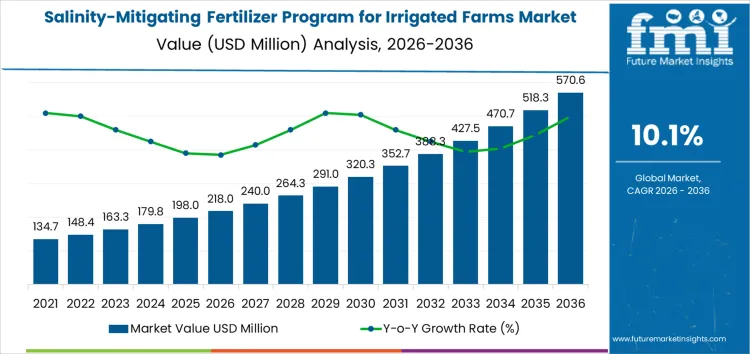
The salinity-mitigating fertilizer program for irrigated farms market is valued at USD 218 million in 2026 and is projected to reach USD 570.6 million by 2036, reflecting a CAGR of 10.1%. Growth during this period is shaped by rising soil salinity, exposure to irrigation water quality constraints, and yield sensitivity in intensive cropping systems. Cost structures are influenced by chemistry selection, application frequency, and compatibility with existing irrigation infrastructure. Programs combining calcium, gypsum, and complementary additives require precise dosing to remain effective. Suppliers offering predictable performance across soil types retain stronger acceptance. Purchasing decisions emphasize yield protection and input reliability rather than nutrient volume expansion.
Between 2026 and 2036, outcomes are driven by grower risk management and long-term soil viability concerns. Adoption advances where programs demonstrate measurable salinity reduction without disrupting crop nutrition plans. Once integrated into irrigation schedules, switching remains limited due to recalibration effort and seasonal exposure risk. Sales channels providing agronomic guidance and monitoring support reinforce repeat use. Entry barriers persist through field validation requirements and regional soil performance variability. Strategic trade offs arise between program intensity and operating cost control. Competitive positioning favors suppliers aligned with sustained irrigated farm productivity rather than short-term corrective treatments.
Quick Stats for Salinity-Mitigating Fertilizer Program for Irrigated Farms Market
- Salinity-Mitigating Fertilizer Program for Irrigated Farms Market Value (2026): USD 218 million
- Salinity-Mitigating Fertilizer Program for Irrigated Farms Market Forecast Value (2036): USD 570.6 million
- Salinity-Mitigating Fertilizer Program for Irrigated Farms Market Forecast CAGR: 10.1%
- Leading Stress in Salinity-Mitigating Fertilizer Program for Irrigated Farms Market: Salinity
- Key Growth Regions in Salinity-Mitigating Fertilizer Program for Irrigated Farms Market: Asia Pacific, North America, Australia
- Top Players in Salinity-Mitigating Fertilizer Program for Irrigated Farms Market: ICL Group, Haifa Group, Nutrien, Yara International, EuroChem, UPL
What Is the Growth Forecast for Salinity Mitigating Fertilizer Program for Irrigated Farms Market through 2036?
Between 2026 and 2031, the salinity mitigating fertilizer program for irrigated farms market is projected to expand from USD 218 million to USD 317 million, representing an absolute increase of USD 99 million. Year over year growth during this phase follows a steady progression, with values rising from USD 136 million to USD 218 million. Historical adoption was driven by localized salinity correction and reactive soil management in high irrigation zones. Forward growth in this period reflects increasing awareness of yield losses linked to salt accumulation, gradual integration of mitigation programs into fertigation schedules, and wider use across vegetables, orchards, and cash crops dependent on intensive irrigation. Growth remains incremental and program based rather than volume led.
From 2031 to 2036, the market is expected to grow from USD 317 million to USD 570.6 million, adding USD 264 million and accounting for the larger share of total forecast expansion. Annual values advance from USD 347 million to USD 570.6 million, indicating accelerating year over year momentum. Earlier growth focused on corrective applications in severely affected fields, while future expansion reflects preventive, season long salinity management embedded within standard nutrient programs. Wider adoption across commercial irrigated acreage, improved program reliability, and consistent yield stabilization outcomes support stronger annual gains, positioning this period as the primary driver of overall market growth.
Salinity Mitigating Fertilizer Program for Irrigated Farms Market Key Takeaways
| Metric | Value |
|---|---|
| Market Value (2026) | USD 218 million |
| Forecast Value (2036) | USD 570.6 million |
| Forecast CAGR (2026 to 2036) | 10.1% |
What Is Driving Demand in the Salinity-Mitigating Fertilizer Program for Irrigated Farms Market?
Demand for salinity-mitigating fertilizer programs on irrigated farms arises from soil and water conditions that limit crop performance rather than from general fertilizer needs. Irrigation water, especially in arid and semi-arid regions, often contains dissolved salts that accumulate in the root zone over repeated irrigation cycles. Growers observed that elevated salinity reduced nutrient uptake, stunted growth, and lowered yield potential even when soil nutrient tests indicated adequate fertility. Traditional fertilizer programs did not address the chemical imbalance caused by salt buildup, leading operators to seek blends and applications that counteract salinity effects. Salinity-mitigating programs combine nutrient formulations with amendments that support osmotic regulation, ion balance, and enhanced root zone conditions, helping crops maintain growth under saline stress.
Future growth in this market will be shaped by increasing pressure on water resources, documented soil health metrics, and integration with precision agronomy practices rather than incremental formulation changes alone. Water scarcity and competition for quality water supplies are driving more frequent use of lower-quality irrigation sources, making salinity management a routine agronomic challenge rather than an isolated issue. Soil monitoring technologies and in-field sensors give producers real-time data on salinity trends, enabling targeted application of tailored fertilizer blends that include gypsum, potassium balance adjustments, and organic materials that improve soil structure and leaching efficiency. Regulatory and sustainability frameworks increasingly focus on reducing soil degradation and groundwater salinity impacts, encouraging adoption of programs that document measurable improvements in salinity profiles and crop response.
What Factors Are Affecting the Demand for Salinity Mitigating Fertilizer Program for Irrigated Farms Market in Terms of Stress and Chemistry?
The salinity mitigating fertilizer program market for irrigated farms is driven by rising soil salinization, intensive irrigation practices, and declining crop response to conventional fertilization. Demand centers on fertilizer programs that correct ionic imbalance and protect root function under saline conditions. Adoption depends on stress prevalence, water quality, and compatibility with irrigation systems. Market leadership reflects effectiveness under recurring salinity stress rather than broad spectrum stress management claims.
What Is Driving Leadership by Stress in the Salinity Mitigating Fertilizer Program Market?
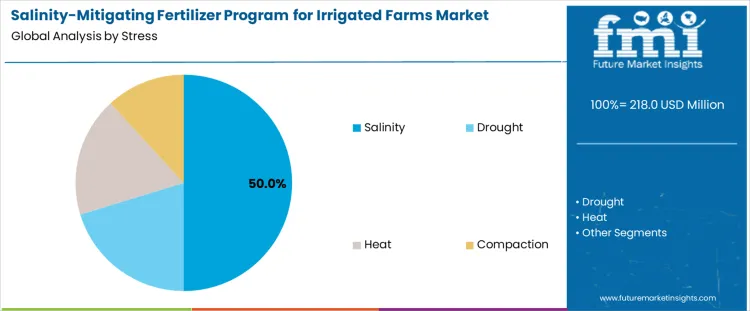
Salinity accounts for about 50% of demand because it is the most persistent and yield limiting stress in irrigated agricultural systems. Continuous irrigation with marginal quality water leads to salt accumulation in the root zone, reducing water uptake and nutrient availability. Salinity stress directly interferes with crop establishment, root growth, and nutrient transport, making mitigation essential for maintaining productivity. Fertilizer programs targeting salinity focus on restoring ionic balance and improving soil structure to enhance leaching of excess salts. Growers in arid and semi-arid regions prioritize salinity mitigation because damage accumulates season after season if left unaddressed. Yield losses linked to salinity are predictable and measurable, supporting investment in targeted programs.
Drought, heat, and compaction contribute secondary demand but are often episodic or managed through irrigation scheduling and tillage. Salinity stress persists even under adequate moisture, making it a structural constraint rather than a seasonal event. Stress leadership therefore reflects chronic impact on irrigated soils, repeatability across seasons, and direct linkage to nutrient inefficiency rather than intensity of short term crop stress alone.
What Is Driving Leadership by Chemistry in the Salinity Mitigating Fertilizer Program Market?
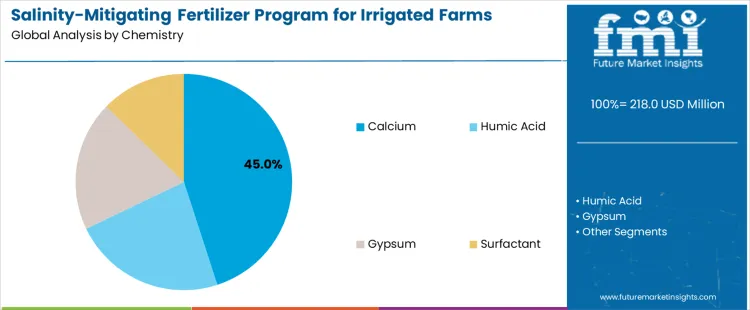
Calcium based chemistries account for about 45% of demand because calcium plays a central role in displacing sodium ions from soil exchange sites. In saline and sodic soils, excess sodium disrupts soil aggregation and reduces permeability. Calcium amendments improve soil structure by restoring cation balance, enabling better water infiltration and salt leaching. Fertilizer programs using calcium nitrate, calcium chloride, or similar sources integrate effectively with fertigation and drip systems common in irrigated farming. These chemistries provide both structural remediation and nutritional benefit, supporting crop recovery under saline conditions.
Humic acids, gypsum, and surfactants serve complementary roles. Humic acids improve soil buffering and root resilience but act gradually. Gypsum supplies calcium but requires sufficient water movement for effectiveness. Surfactants enhance water penetration but do not correct ionic imbalance. Calcium based solutions therefore dominate because they deliver direct, measurable remediation and integrate smoothly into irrigation based fertilizer programs. Chemistry leadership reflects functional relevance to salinity mechanisms rather than versatility across multiple stress types.
How Is the Salinity-Mitigating Fertilizer Program Being Applied Across Irrigated Farms?
Use appears in row crops, vegetables, and orchards where saline irrigation water or salt-affected soils reduce nutrient uptake and crop performance. Farmers adopt salinity-mitigating fertilizer programs combining balanced NPK, micronutrients, and soil amendments to offset salt stress and maintain productivity. Application through fertigation, drip irrigation, or broadcasting allows precise nutrient delivery while improving soil structure and leaching excess salts. These applications reflect operational and agronomic priorities rather than purely cost objectives, with adoption driven by crop resilience, yield optimization, and sustainable soil management.
What Operational and Material Conditions Support Adoption of Salinity-Mitigating Fertilizer Programs?
Selection aligns with formulations compatible with irrigation systems, soil type, and crop nutrient requirements, incorporating gypsum, potassium, or other salt-buffering additives. Fertilizers are optimized for solubility, stability, and controlled nutrient release to maintain root-zone availability and mitigate salinity effects. Farmers monitor soil electrical conductivity, moisture, and nutrient levels to adjust application rates effectively. Quality control evaluates nutrient composition, salt mitigation performance, and crop response to comply with agronomic and environmental standards. These conditions emerge from operational efficiency, nutrient management, and soil health priorities in structured irrigation workflows.
Which Practical Considerations Limit Wider Use of Salinity-Mitigating Fertilizer Programs?
Higher cost per hectare and specialized irrigation equipment may restrict adoption in small or low-margin farms. Soil type, water quality, and crop species influence program effectiveness. Compatibility with other fertilizers, amendments, and irrigation schedules must be validated. Regulatory approvals and environmental standards vary by region. These factors lead to selective deployment where salt stress mitigation, crop productivity, and operational efficiency justify incremental cost, monitoring, and careful management of fertilizer application in irrigated systems.
What is the Demand for Salinity Mitigating Fertilizer Programs for Irrigated Farms by Country?
| Country | CAGR (%) |
|---|---|
| India | 14.6% |
| USA | 12.7% |
| Australia | 13.4% |
| China | 12.9% |
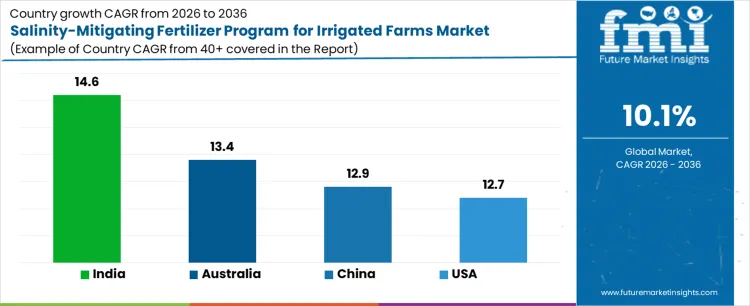
The demand for salinity mitigating fertilizer programs for irrigated farms is increasing across regions facing soil salinization and water quality constraints. India leads with a 14.6% CAGR, driven by extensive irrigated acreage, rising groundwater salinity, and adoption of nutrient programs designed to manage sodium accumulation and root zone stress. Australia follows at 13.4%, reflecting widespread salinity challenges in irrigated cropping zones and strong adoption of soil amendment based fertility strategies. China records 12.9%, shaped by intensive irrigation practices, regional soil degradation, and policy focus on sustaining long term land productivity. The USA grows at 12.7%, supported by adoption in arid and semi-arid regions where salinity management is critical for maintaining yield stability and irrigation efficiency.
How are salinity-mitigating fertilizer programs expanding adoption for irrigated farms in India?
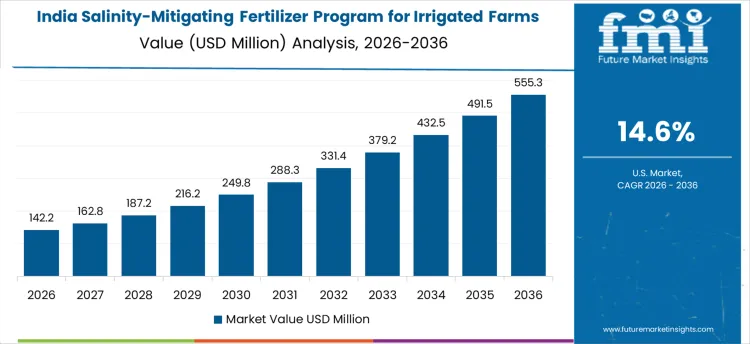
In India, the salinity-mitigating fertilizer program for irrigated farms market is growing at a CAGR of 14.6% through 2036, driven by increasing soil salinity challenges in high-value crop regions, adoption of precision irrigation, and government support for sustainable nutrient management. Farmers are using these programs to improve soil health, enhance nutrient availability, and boost crop yields while mitigating salinity stress. Demand is concentrated in irrigated horticultural zones, industrial crop regions, and precision farming clusters. Compared to the USA, adoption emphasizes rapid deployment across diverse crop types and large-scale irrigation systems. Domestic suppliers provide high-performance, chemically stable solutions suitable for recurring seasonal applications.
- Irrigated horticultural zones, industrial crop regions, and precision farming clusters drive adoption
- Fertilizers mitigate soil salinity and enhance nutrient availability
- Domestic suppliers provide high-performance, chemically stable solutions
- Recurring seasonal applications sustain adoption
How are environmental management and precision agriculture driving adoption in the United States?
In the United States, revenue is growing at a CAGR of 12.7% through 2036, supported by precision nutrient management, environmental compliance initiatives, and adoption of drip and sprinkler irrigation systems. Farmers are integrating salinity-mitigating fertilizers to reduce sodium accumulation, maintain soil fertility, and enhance crop growth in irrigated row crops and high-value vegetables. Demand is concentrated in irrigated corn, wheat, and vegetable regions, industrial farming hubs, and high-value horticultural zones. Compared to India, adoption emphasizes compliance with environmental regulations and integration with precision application technologies. Domestic suppliers provide high-performance, environmentally safe fertilizers suitable for recurring seasonal applications.
- Irrigated corn, wheat, and vegetable regions drive adoption
- Fertilizers reduce sodium accumulation and maintain fertility
- Domestic suppliers provide high-performance, environmentally safe solutions
- Recurring seasonal applications sustain adoption
How are industrial agriculture and soil health management driving growth in Australia?
In Australia, the market is expanding at a CAGR of 13.4% through 2036, fueled by adoption of irrigated high-value crops, government initiatives for soil sustainability, and precision agriculture practices. Farmers are using salinity-mitigating fertilizers to improve nutrient efficiency, prevent soil degradation, and enhance crop yield under saline conditions. Demand is concentrated in irrigated horticultural zones, industrial crop regions, and large-scale farm clusters. Compared to China, adoption emphasizes adaptation to arid climates and saline-prone soils. Domestic suppliers provide high-performance, chemically compatible fertilizers suitable for recurring seasonal applications.
- Irrigated horticultural zones, industrial crop regions, and large-scale farm clusters drive adoption
- Fertilizers improve nutrient efficiency and prevent soil degradation
- Domestic suppliers provide high-performance, chemically compatible solutions
- Recurring seasonal applications sustain adoption
How are precision irrigation and large-scale crop production driving adoption in China?
In China, the market is growing at a CAGR of 12.9% through 2036, supported by high-intensity irrigated crop production, government programs for sustainable agriculture, and adoption of precision nutrient management systems. Farmers are integrating salinity-mitigating fertilizers to reduce soil salt accumulation, enhance nutrient uptake, and improve early crop growth in irrigated cereals and vegetables. Demand is concentrated in high-intensity agricultural regions, industrial farming zones, and mechanized planting clusters. Compared to Australia, adoption emphasizes integration with large-scale mechanized operations and high-volume fertilization programs. Domestic suppliers provide cost-effective, high-performance fertilizers suitable for recurring seasonal applications.
- High-intensity agricultural regions, industrial farming zones, and mechanized clusters drive adoption
- Fertilizers reduce soil salinity and enhance nutrient uptake
- Domestic suppliers provide cost-effective, high-performance solutions
- Recurring seasonal applications sustain adoption
Which Strategic Factors Shape Competition in the Salinity Mitigating Fertilizer Program Market for Irrigated Farms?
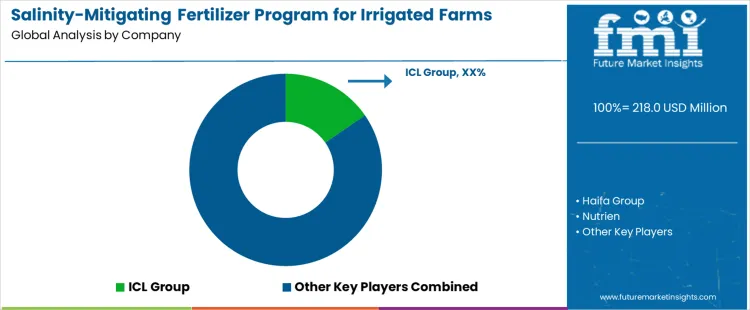
Competition in salinity mitigating fertilizer programs is shaped by how effectively suppliers manage sodium accumulation and osmotic stress without disrupting irrigation routines. ICL Group and Haifa Group focus on formulations that improve ion balance in the root zone, emphasizing calcium availability, controlled nutrient ratios, and compatibility with fertigation systems. Their strategies prioritize steady crop response under saline water inputs and variable evapotranspiration. Nutrien positions salinity mitigation within integrated nutrient programs, reinforcing adoption through field diagnostics and timing guidance. Grower decisions depend on consistent yield protection, reduced leaf burn risk, and predictable behavior under continuous irrigation cycles rather than short term corrective effects.
Program scalability and regional agronomy further influence competitive positioning. Yara International emphasizes nutrient formulations that support root function and water uptake efficiency in saline conditions, aligning products with crop stage needs. EuroChem competes through robust blends designed to remain stable during storage and transport in irrigated regions. UPL integrates salinity mitigation into broader crop management programs, linking nutrient strategy with stress management practices. Across the market, competitive advantage is built through compatibility with irrigation infrastructure, repeatable field performance, and clear guidance that fits routine farm operations.
Key Players in the Salinity-Mitigating Fertilizer Program for Irrigated Farms Market
- ICL Group
- Haifa Group
- Nutrien
- Yara International
- EuroChem
- UPL
Scope of the Report
| Items | Values |
|---|---|
| Quantitative Units | USD million |
| Stress | Salinity, drought, heat, compaction |
| Chemistry | Calcium-based formulations, humic acid additives, gypsum-based amendments, surfactant-supported blends |
| Application | Root-zone salinity mitigation, fertigation-based salinity control, preventive salinity management in irrigated cropping systems |
| End Users | Irrigated farm operators, commercial row crop producers, horticulture and orchard growers, intensive irrigated agriculture systems |
| Regions Covered | Asia Pacific, Europe, North America, Latin America, Middle East & Africa |
| Countries Covered | India, United States, Australia, China, and other irrigated agriculture economies |
| Key Companies Profiled | ICL Group, Haifa Group, Nutrien, Yara International, EuroChem, UPL |
| Additional Attributes | Dollar by sales across stress type and chemistry, program-based adoption linked to irrigation water quality and soil salinity exposure, performance dependence on calcium-driven ion exchange and sodium displacement, integration with fertigation and drip irrigation systems, field validation based on soil electrical conductivity monitoring, repeat-use driven by yield stabilization outcomes |
Salinity-Mitigating Fertilizer Program for Irrigated Farms Market Segmentation
Stress:
- Salinity
- Drought
- Heat
- Compaction
Chemistry:
- Calcium
- Humic Acid
- Gypsum
- Surfactant
Sales Channel:
- Ag-Retailers
- Direct-to-Farmer
- Online Marketplaces
- Cooperatives
Region
- Asia Pacific
- China
- Japan
- South Korea
- India
- Australia & New Zealand
- ASEAN
- Rest of Asia Pacific
- Europe
- Germany
- United Kingdom
- France
- Italy
- Spain
- Nordic
- BENELUX
- Rest of Europe
- North America
- United States
- Canada
- Mexico
- Latin America
- Brazil
- Chile
- Rest of Latin America
- Middle East & Africa
- Kingdom of Saudi Arabia
- Other GCC Countries
- Turkey
- South Africa
- Other African Union
- Rest of Middle East & Africa
Frequently Asked Questions
How big is the salinity-mitigating fertilizer program for irrigated farms market in 2026?
The global salinity-mitigating fertilizer program for irrigated farms market is estimated to be valued at USD 218.0 million in 2026.
What will be the size of salinity-mitigating fertilizer program for irrigated farms market in 2036?
The market size for the salinity-mitigating fertilizer program for irrigated farms market is projected to reach USD 570.6 million by 2036.
How much will be the salinity-mitigating fertilizer program for irrigated farms market growth between 2026 and 2036?
The salinity-mitigating fertilizer program for irrigated farms market is expected to grow at a 10.1% CAGR between 2026 and 2036.
What are the key product types in the salinity-mitigating fertilizer program for irrigated farms market?
The key product types in salinity-mitigating fertilizer program for irrigated farms market are salinity, drought, heat and compaction.
Which chemistry segment to contribute significant share in the salinity-mitigating fertilizer program for irrigated farms market in 2026?
In terms of chemistry, calcium segment to command 45.0% share in the salinity-mitigating fertilizer program for irrigated farms market in 2026.
Preview the report firsthand - request a free sample
Get SampleGet the brochure for pricing and purchase details.
Get PDFTable of Content
- Executive Summary
- Global Market Outlook
- Demand-side Trends
- Supply-side Trends
- Technology Roadmap Analysis
- Analysis and Recommendations
- Market Overview
- Market Coverage / Taxonomy
- Market Definition / Scope / Limitations
- Market Background
- Market Dynamics
- Drivers
- Restraints
- Opportunity
- Trends
- Scenario Forecast
- Demand in Optimistic Scenario
- Demand in Likely Scenario
- Demand in Conservative Scenario
- Opportunity Map Analysis
- Product Life Cycle Analysis
- Supply Chain Analysis
- Investment Feasibility Matrix
- Value Chain Analysis
- PESTLE and Porter’s Analysis
- Regulatory Landscape
- Regional Parent Market Outlook
- Production and Consumption Statistics
- Import and Export Statistics
- Market Dynamics
- Global Market Analysis 2021 to 2025 and Forecast, 2026 to 2036
- Historical Market Size Value (USD Million) Analysis, 2021 to 2025
- Current and Future Market Size Value (USD Million) Projections, 2026 to 2036
- Y-o-Y Growth Trend Analysis
- Absolute $ Opportunity Analysis
- Global Market Pricing Analysis 2021 to 2025 and Forecast 2026 to 2036
- Global Market Analysis 2021 to 2025 and Forecast 2026 to 2036, By Stress
- Introduction / Key Findings
- Historical Market Size Value (USD Million) Analysis By Stress , 2021 to 2025
- Current and Future Market Size Value (USD Million) Analysis and Forecast By Stress , 2026 to 2036
- Salinity
- Drought
- Heat
- Compaction
- Salinity
- Y-o-Y Growth Trend Analysis By Stress , 2021 to 2025
- Absolute $ Opportunity Analysis By Stress , 2026 to 2036
- Global Market Analysis 2021 to 2025 and Forecast 2026 to 2036, By Chemistry
- Introduction / Key Findings
- Historical Market Size Value (USD Million) Analysis By Chemistry, 2021 to 2025
- Current and Future Market Size Value (USD Million) Analysis and Forecast By Chemistry, 2026 to 2036
- Calcium
- Humic Acid
- Gypsum
- Surfactant
- Calcium
- Y-o-Y Growth Trend Analysis By Chemistry, 2021 to 2025
- Absolute $ Opportunity Analysis By Chemistry, 2026 to 2036
- Global Market Analysis 2021 to 2025 and Forecast 2026 to 2036, By Sales Channel
- Introduction / Key Findings
- Historical Market Size Value (USD Million) Analysis By Sales Channel, 2021 to 2025
- Current and Future Market Size Value (USD Million) Analysis and Forecast By Sales Channel, 2026 to 2036
- Ag-Retailers
- Direct-to-Farmer
- Online Marketplaces
- Cooperatives
- Ag-Retailers
- Y-o-Y Growth Trend Analysis By Sales Channel, 2021 to 2025
- Absolute $ Opportunity Analysis By Sales Channel, 2026 to 2036
- Global Market Analysis 2021 to 2025 and Forecast 2026 to 2036, By Region
- Introduction
- Historical Market Size Value (USD Million) Analysis By Region, 2021 to 2025
- Current Market Size Value (USD Million) Analysis and Forecast By Region, 2026 to 2036
- North America
- Latin America
- Western Europe
- Eastern Europe
- East Asia
- South Asia and Pacific
- Middle East & Africa
- Market Attractiveness Analysis By Region
- North America Market Analysis 2021 to 2025 and Forecast 2026 to 2036, By Country
- Historical Market Size Value (USD Million) Trend Analysis By Market Taxonomy, 2021 to 2025
- Market Size Value (USD Million) Forecast By Market Taxonomy, 2026 to 2036
- By Country
- USA
- Canada
- Mexico
- By Stress
- By Chemistry
- By Sales Channel
- By Country
- Market Attractiveness Analysis
- By Country
- By Stress
- By Chemistry
- By Sales Channel
- Key Takeaways
- Latin America Market Analysis 2021 to 2025 and Forecast 2026 to 2036, By Country
- Historical Market Size Value (USD Million) Trend Analysis By Market Taxonomy, 2021 to 2025
- Market Size Value (USD Million) Forecast By Market Taxonomy, 2026 to 2036
- By Country
- Brazil
- Chile
- Rest of Latin America
- By Stress
- By Chemistry
- By Sales Channel
- By Country
- Market Attractiveness Analysis
- By Country
- By Stress
- By Chemistry
- By Sales Channel
- Key Takeaways
- Western Europe Market Analysis 2021 to 2025 and Forecast 2026 to 2036, By Country
- Historical Market Size Value (USD Million) Trend Analysis By Market Taxonomy, 2021 to 2025
- Market Size Value (USD Million) Forecast By Market Taxonomy, 2026 to 2036
- By Country
- Germany
- UK
- Italy
- Spain
- France
- Nordic
- BENELUX
- Rest of Western Europe
- By Stress
- By Chemistry
- By Sales Channel
- By Country
- Market Attractiveness Analysis
- By Country
- By Stress
- By Chemistry
- By Sales Channel
- Key Takeaways
- Eastern Europe Market Analysis 2021 to 2025 and Forecast 2026 to 2036, By Country
- Historical Market Size Value (USD Million) Trend Analysis By Market Taxonomy, 2021 to 2025
- Market Size Value (USD Million) Forecast By Market Taxonomy, 2026 to 2036
- By Country
- Russia
- Poland
- Hungary
- Balkan & Baltic
- Rest of Eastern Europe
- By Stress
- By Chemistry
- By Sales Channel
- By Country
- Market Attractiveness Analysis
- By Country
- By Stress
- By Chemistry
- By Sales Channel
- Key Takeaways
- East Asia Market Analysis 2021 to 2025 and Forecast 2026 to 2036, By Country
- Historical Market Size Value (USD Million) Trend Analysis By Market Taxonomy, 2021 to 2025
- Market Size Value (USD Million) Forecast By Market Taxonomy, 2026 to 2036
- By Country
- China
- Japan
- South Korea
- By Stress
- By Chemistry
- By Sales Channel
- By Country
- Market Attractiveness Analysis
- By Country
- By Stress
- By Chemistry
- By Sales Channel
- Key Takeaways
- South Asia and Pacific Market Analysis 2021 to 2025 and Forecast 2026 to 2036, By Country
- Historical Market Size Value (USD Million) Trend Analysis By Market Taxonomy, 2021 to 2025
- Market Size Value (USD Million) Forecast By Market Taxonomy, 2026 to 2036
- By Country
- India
- ASEAN
- Australia & New Zealand
- Rest of South Asia and Pacific
- By Stress
- By Chemistry
- By Sales Channel
- By Country
- Market Attractiveness Analysis
- By Country
- By Stress
- By Chemistry
- By Sales Channel
- Key Takeaways
- Middle East & Africa Market Analysis 2021 to 2025 and Forecast 2026 to 2036, By Country
- Historical Market Size Value (USD Million) Trend Analysis By Market Taxonomy, 2021 to 2025
- Market Size Value (USD Million) Forecast By Market Taxonomy, 2026 to 2036
- By Country
- Kingdom of Saudi Arabia
- Other GCC Countries
- Turkiye
- South Africa
- Other African Union
- Rest of Middle East & Africa
- By Stress
- By Chemistry
- By Sales Channel
- By Country
- Market Attractiveness Analysis
- By Country
- By Stress
- By Chemistry
- By Sales Channel
- Key Takeaways
- Key Countries Market Analysis
- USA
- Pricing Analysis
- Market Share Analysis, 2025
- By Stress
- By Chemistry
- By Sales Channel
- Canada
- Pricing Analysis
- Market Share Analysis, 2025
- By Stress
- By Chemistry
- By Sales Channel
- Mexico
- Pricing Analysis
- Market Share Analysis, 2025
- By Stress
- By Chemistry
- By Sales Channel
- Brazil
- Pricing Analysis
- Market Share Analysis, 2025
- By Stress
- By Chemistry
- By Sales Channel
- Chile
- Pricing Analysis
- Market Share Analysis, 2025
- By Stress
- By Chemistry
- By Sales Channel
- Germany
- Pricing Analysis
- Market Share Analysis, 2025
- By Stress
- By Chemistry
- By Sales Channel
- UK
- Pricing Analysis
- Market Share Analysis, 2025
- By Stress
- By Chemistry
- By Sales Channel
- Italy
- Pricing Analysis
- Market Share Analysis, 2025
- By Stress
- By Chemistry
- By Sales Channel
- Spain
- Pricing Analysis
- Market Share Analysis, 2025
- By Stress
- By Chemistry
- By Sales Channel
- France
- Pricing Analysis
- Market Share Analysis, 2025
- By Stress
- By Chemistry
- By Sales Channel
- India
- Pricing Analysis
- Market Share Analysis, 2025
- By Stress
- By Chemistry
- By Sales Channel
- ASEAN
- Pricing Analysis
- Market Share Analysis, 2025
- By Stress
- By Chemistry
- By Sales Channel
- Australia & New Zealand
- Pricing Analysis
- Market Share Analysis, 2025
- By Stress
- By Chemistry
- By Sales Channel
- China
- Pricing Analysis
- Market Share Analysis, 2025
- By Stress
- By Chemistry
- By Sales Channel
- Japan
- Pricing Analysis
- Market Share Analysis, 2025
- By Stress
- By Chemistry
- By Sales Channel
- South Korea
- Pricing Analysis
- Market Share Analysis, 2025
- By Stress
- By Chemistry
- By Sales Channel
- Russia
- Pricing Analysis
- Market Share Analysis, 2025
- By Stress
- By Chemistry
- By Sales Channel
- Poland
- Pricing Analysis
- Market Share Analysis, 2025
- By Stress
- By Chemistry
- By Sales Channel
- Hungary
- Pricing Analysis
- Market Share Analysis, 2025
- By Stress
- By Chemistry
- By Sales Channel
- Kingdom of Saudi Arabia
- Pricing Analysis
- Market Share Analysis, 2025
- By Stress
- By Chemistry
- By Sales Channel
- Turkiye
- Pricing Analysis
- Market Share Analysis, 2025
- By Stress
- By Chemistry
- By Sales Channel
- South Africa
- Pricing Analysis
- Market Share Analysis, 2025
- By Stress
- By Chemistry
- By Sales Channel
- USA
- Market Structure Analysis
- Competition Dashboard
- Competition Benchmarking
- Market Share Analysis of Top Players
- By Regional
- By Stress
- By Chemistry
- By Sales Channel
- Competition Analysis
- Competition Deep Dive
- ICL Group
- Overview
- Product Portfolio
- Profitability by Market Segments (Product/Age /Sales Channel/Region)
- Sales Footprint
- Strategy Overview
- Marketing Strategy
- Product Strategy
- Channel Strategy
- Haifa Group
- Nutrien
- Yara International
- EuroChem
- UPL
- ICL Group
- Competition Deep Dive
- Assumptions & Acronyms Used
- Research Methodology


