

- Industry Size (2026)
- USD 3081.8 Mn
- Forecast (2036)
- USD 8626.8 Mn
- CAGR (2026 to 2036)
- 10.8%
Demand for Digital Power Conversion in the UK 2026 to 2036
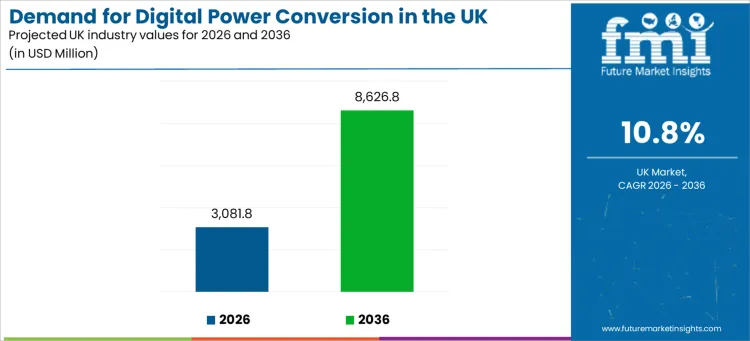
Demand for digital power conversion in the UK is expected to be valued at USD 3,081.8 million in 2026 and is projected to reach USD 8,626.8 million by 2036, reflecting a 10.8% CAGR. This demand is shaped by the growing need for precise, software-driven control of electrical power across data-intensive, automated, and energy-transition systems. Power management has shifted from static regulation toward adaptive control aligned with efficiency, reliability, and visibility requirements.
Digital power conversion adoption is driven by operating environments where load conditions change rapidly and tolerance for instability is low. Data centers, telecom networks, and automated production lines rely on converters capable of real-time adjustment, fault detection, and performance reporting. Engineers prioritize systems that maintain voltage accuracy, reduce thermal stress, and support predictive maintenance without interrupting operations. These attributes position digital converters as core infrastructure components rather than peripheral upgrades.
Investment decisions reflect long asset lifecycles and integration depth. Buyers evaluate compatibility with existing power architectures, firmware stability, and telemetry access that supports centralized oversight. Renewable energy integration and electrified equipment add further pressure for flexible conversion stages that respond to variable input conditions. Demand growth is anchored in operational control, energy efficiency gains, and system resilience rather than incremental replacement of analog hardware.
Quick Stats for Digital Power Conversion Industry in the UK
- Digital Power Conversion Industry Value (2026): USD 3,081.8 million
- Digital Power Conversion Industry Forecast Value (2036): USD 8,626.8 million
- Digital Power Conversion Industry Forecast CAGR 2026 to 2036: 10.8%
- Leading Product Type by Demand Share: AC/DC Power Conversion
- Fastest-Growing Regions: England, Scotland, Wales, Northern Ireland
- Key Industry Participants: Infineon Technologies, Texas Instruments, STMicroelectronics, ON Semiconductor, Mitsubishi Electric, ABB Ltd.
Digital Power Conversion Industry in the UK Key Takeaways
| Metric | Value |
|---|---|
| Industry Value (2026) | USD 3,081.8 million |
| Industry Forecast Value (2036) | USD 8,626.8 million |
| Forecast CAGR (2026 to 2036) | 10.8% |
Why is the UK Building Steady Demand for Digital Power Conversion?
Demand for digital power conversion in the UK grows as energy efficiency becomes central to industrial and infrastructure planning. Organizations across manufacturing, data centres and utilities seek tighter control over power systems to reduce losses and support performance metrics. Digital converters provide precision in voltage regulation and adaptive responses that improve uptime and cut operational costs relative to legacy analog solutions.
Adoption is visible in sectors where load variability and power quality matter. Data centres in the UK require converters that manage rapid shifts in demand while protecting sensitive electronics. Industrial facilities deploying robotics and automation look for converters that integrate diagnostics and real-time monitoring, enabling predictive maintenance and smoother production cycles. These capabilities align with operational priorities for reliability and lower lifecycle costs.
Energy transition strategies within the UK provide additional impetus. Renewable sources such as wind and solar introduce variability that calls for advanced conversion and grid interfacing technologies. Digital power converters play a role in handling these dynamics with programmable control schemes and analytics integration. Buyers see value in systems that deliver performance insights and flexibility, making digital power conversion part of broader infrastructure modernization.
How is Digital Power Conversion Demand Segmented by Product, Application, and Control Type in the UK?
Demand for digital power conversion in the UK reflects how system designers balance efficiency control, thermal discipline, and adaptability across fast-changing electrical loads. Segmentation follows equipment density, precision requirements, and tolerance for dynamic operating conditions across deployment environments.
Why does AC/DC power conversion lead product-level demand?
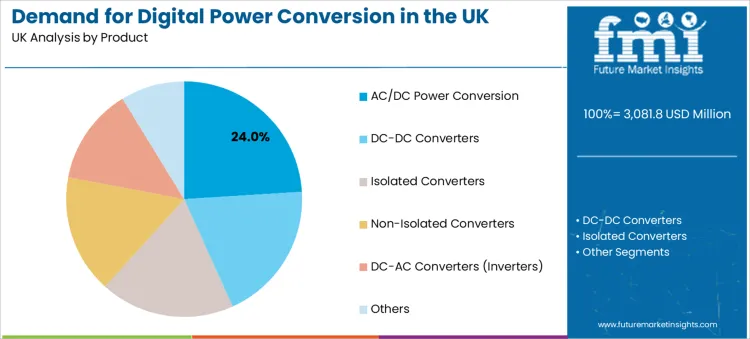
AC/DC power conversion holds a 24.0% share, positioning it as the most utilized product category. This dominance reflects its role as the primary interface between grid supply and downstream electronic systems. Equipment across data processing, communications, and industrial control relies on stable DC output derived from AC inputs, placing AC/DC stages at the core of power architecture design.
Design teams favour digitally managed AC/DC units due to tighter voltage regulation, adaptive load response, and fault visibility. These attributes support higher power density installations where space constraints and energy losses influence system reliability and operating cost discipline.
What sustains IT and telecommunications as the leading application area?
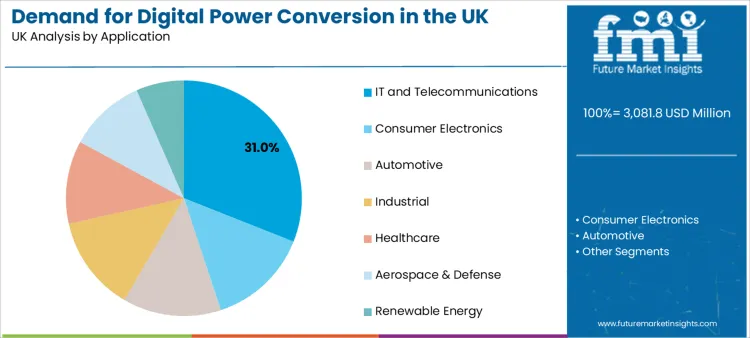
IT and telecommunications represent a 31.0% share, reflecting sustained infrastructure build-out and refresh cycles. Digital power conversion supports servers, base stations, edge nodes, and network equipment that operate under fluctuating loads and continuous uptime expectations. Precise control improves energy utilization while enabling remote monitoring and predictive maintenance across distributed assets.
System operators rely on digitally controlled converters to manage efficiency across partial loads, which reduces thermal stress and supports longer component life in densely packed installations.
Why does digital control dominate control type preference?
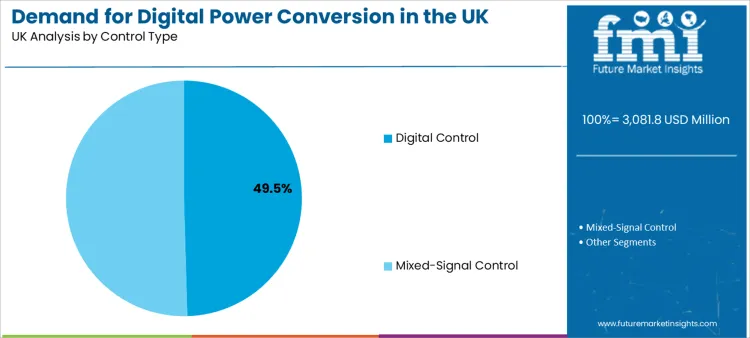
Digital control accounts for a 49.5% share, indicating preference for programmability, telemetry access, and closed-loop optimization. Digital controllers allow engineers to fine-tune performance parameters, implement protection logic, and adapt behaviour through software updates. This control approach supports integration with broader system management platforms where power performance data feeds operational decision-making and reliability assurance.
What are the Key Dynamics in Demand for Digital Power Conversion in the UK?
Demand for digital power conversion in the UK is driven by increasing electrification across industrial, data centre, renewable energy and transportation sectors that require highly efficient and flexible power management. Digital power converters replace analog controls with software-driven regulation, improving system responsiveness and reducing energy loss. UK energy policy encouraging decarbonisation and grid resilience has intensified interest in technologies that optimise power conversion in DC fast charging, microgrids, industrial drives and uninterruptible power supplies (UPS).
How do industry electrification and efficiency targets shape uptake?
Uptake of digital power conversion systems in the UK is influenced by targets to reduce electrical losses and improve operational efficiency in mission-critical loads. Data centres, which are expanding capacity to support cloud and AI workloads, adopt digitally controlled rectifiers and DC-DC converters that deliver tighter voltage regulation and adaptive load balancing, lowering energy spend and cooling demand. Renewable energy installations, including solar farms and battery storage sites, integrate digital converters to manage variable generation, bidirectional flows and grid services participation, ensuring stability under fluctuating supply. In industrial settings, digital drives and power modules are applied to maintain torque and speed control in motor systems with minimal power waste.
How do cost considerations and technical integration requirements influence demand patterns?
Adoption of digital power conversion in the UK is affected by cost considerations and the complexity of integrating software-enabled power electronics into existing plants and systems. Digital converters command a premium over traditional analog units because of their embedded sensing, advanced control algorithms, and firmware update capability, which can present a barrier for SMEs with constrained capital budgets. Integration efforts tend to be higher where legacy power systems require custom communication interfaces or extensive commissioning to support digital control and data telemetry, slowing deployment in facilities without in-house power electronics expertise. Lifecycle cost analysis that accounts for energy savings, predictive maintenance and reduced downtime influences investment decisions in sectors with heavy electricity use.
How is Digital Power Conversion Demand Evolving across Key Regions in the UK?
Demand for digital power conversion across the UK advances as data-intensive infrastructure, electrified systems, and efficiency targets shape equipment design. Regional variation reflects deployment scale, system complexity, engineering capability, and how operators integrate digitally controlled power stages to improve reliability, monitoring, and dynamic load management.
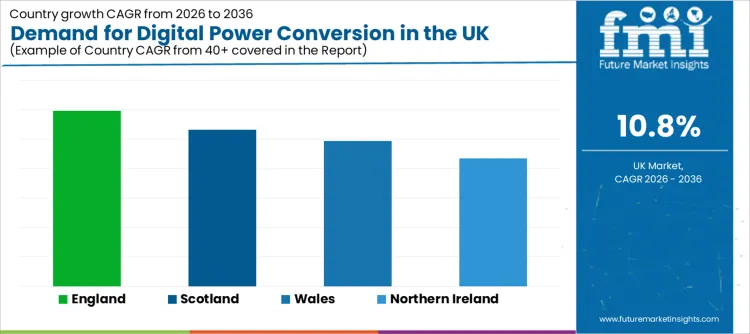
| Region | CAGR 2026 to 2036 |
|---|---|
| England | 11.9% |
| Scotland | 10.6% |
| Wales | 9.9% |
| Northern Ireland | 8.7% |
Why is England leading expansion through infrastructure scale and system complexity?
England grows at 11.9%, supported by large-scale deployment across data centres, telecom networks, industrial automation, and transport electrification. Demand rises where operators require digitally controlled power supplies to manage variable loads, improve efficiency, and enable remote monitoring. Engineering teams prioritize solutions that support fast response, software-defined control, and integration with complex system architectures spanning multiple sites.
How is Scotland progressing through targeted adoption in energy and industrial systems?
Scotland expands at 10.6%, shaped by focused use in renewable energy integration, industrial equipment, and advanced manufacturing. Demand builds where digital power conversion supports precise voltage regulation, adaptive efficiency, and system diagnostics. Buyers value architectures that align with harsh operating conditions and support predictive maintenance while fitting controlled deployment scopes and specialized engineering environments.
What is shaping Wales as adopters balance performance gains with implementation discipline?
Wales advances at 9.9%, driven by selective adoption among manufacturers and infrastructure operators upgrading legacy power systems. Demand strengthens when digital conversion delivers measurable efficiency improvement and control flexibility without extensive redesign. Decision-making centres on ease of integration, firmware stability, and compatibility with existing power electronics platforms and qualification processes.
Why is Northern Ireland showing measured growth tied to defined application use cases?
Northern Ireland records 8.7% growth, reflecting deployment within clearly defined applications such as communications equipment, industrial controls, and specialized electronics. Adoption progresses where digital power conversion offers clear benefits in monitoring, fault response, and energy optimization. Demand improves when suppliers provide dependable support, validated designs, and consistent performance across limited yet critical installations.
What Defines the Competitive Landscape for Digital Power Conversion in the UK?
Demand for digital power conversion in the UK is driven by electrification of transport, data center expansion, renewable energy integration, and industrial automation upgrades. Buyers assess conversion efficiency, power density, thermal performance, and digital control capabilities enabling real-time monitoring and adaptive load management. Evaluation also includes compliance with UK grid codes, reliability under variable operating conditions, cybersecurity readiness for digitally controlled systems, and lifecycle support. Procurement behavior favors suppliers with proven reference designs, long-term component availability, and strong local engineering presence. Trend in the UK industry reflects migration from analog to digitally controlled power architectures supporting energy efficiency targets and smart infrastructure deployment.
Infineon Technologies AG holds strong positioning in the UK through wide adoption of digitally controlled power semiconductors across industrial, automotive, and energy applications. Texas Instruments maintains relevance via digital power management ICs and control platforms embedded in telecom, data center, and industrial equipment. STMicroelectronics supports demand with integrated digital power solutions aligned with electrification and renewable energy systems. ABB Ltd. influences the industry through digital power conversion deployed within grid, charging, and industrial automation projects. Mitsubishi Electric Corporation and ON Semiconductor participate by supplying high-reliability power modules and control technologies suited for industrial and infrastructure-grade deployments.
Key Industry Participants
- Texas Instruments
- Infineon Technologies AG
- STMicroelectronics
- ON Semiconductor (onsemi)
- Mitsubishi Electric Corporation
- ABB Ltd.
Scope of Report
| Items | Values |
|---|---|
| Quantitative Units | USD million |
| Product | AC/DC Power Conversion; DC-DC Converters; Isolated Converters; Non-Isolated Converters; DC-AC Converters (Inverters); Others |
| Application | IT and Telecommunications; Consumer Electronics; Automotive; Industrial; Healthcare; Aerospace & Defense; Renewable Energy |
| Control Type | Digital Control; Mixed-Signal Control |
| Regions Covered | England; Scotland; Wales; Northern Ireland |
| Key Companies Profiled | Texas Instruments; Infineon Technologies AG; STMicroelectronics; ON Semiconductor (onsemi); Mitsubishi Electric Corporation; ABB Ltd. |
Digital Power Conversion Demand in the UK by Segments
Product:
- AC/DC Power Conversion
- DC-DC Converters
- Isolated Converters
- Non-Isolated Converters
- DC-AC Converters (Inverters)
- Others
Application:
- IT and Telecommunications
- Consumer Electronics
- Automotive
- Industrial
- Healthcare
- Aerospace & Defense
- Renewable Energy
Control Type:
- Digital Control
- Mixed-Signal Control
By Region
- England
- Scotland
- Wales
- Northern Ireland
Bibliography
- Department for Energy Security and Net Zero. (2023). Powering up Britain: Energy security and efficiency strategy. UK Government.
- Department for Energy Security and Net Zero. (2024). Electricity networks and system flexibility in a decarbonised UK energy system. UK Government.
- Office for National Statistics. (2024). Energy consumption and efficiency trends in UK industry and data infrastructure. UK Government.
- International Energy Agency. (2023). Power electronics and energy efficiency in modern electricity systems. IEA Publications.
- She, X., Huang, A. Q., & Burgos, R. (2023). Review of advanced power conversion technologies for data centers and electrified systems. CPSS Transactions on Power Electronics and Applications, 8(2), 89-103.
Frequently Asked Questions
How big is the demand for digital power conversion in the uk in 2026?
The demand for digital power conversion in the uk is estimated to be valued at USD 3,081.8 million in 2026.
What will be the size of digital power conversion in the uk in 2036?
The market size for the digital power conversion in the uk is projected to reach USD 8,626.8 million by 2036.
How much will be the demand for digital power conversion in the uk growth between 2026 and 2036?
The demand for digital power conversion in the uk is expected to grow at a 10.8% CAGR between 2026 and 2036.
What are the key product types in the digital power conversion in the uk?
The key product types in digital power conversion in the uk are ac/dc power conversion, dc-dc converters, isolated converters, non-isolated converters, dc-ac converters (inverters) and others.
Which application segment is expected to contribute significant share in the digital power conversion in the uk in 2026?
In terms of application, it and telecommunications segment is expected to command 31.0% share in the digital power conversion in the uk in 2026.
Preview the report firsthand - request a free sample
Get SampleGet the brochure for pricing and purchase details.
Get PDFTable of Content
- Executive Summary
- UK Market Outlook
- Demand-side Trends
- Supply-side Trends
- Technology Roadmap Analysis
- Analysis and Recommendations
- Market Overview
- Market Coverage / Taxonomy
- Market Definition / Scope / Limitations
- Market Background
- Market Dynamics
- Drivers
- Restraints
- Opportunity
- Trends
- Scenario Forecast
- Demand in Optimistic Scenario
- Demand in Likely Scenario
- Demand in Conservative Scenario
- Opportunity Map Analysis
- Product Life Cycle Analysis
- Supply Chain Analysis
- Investment Feasibility Matrix
- Value Chain Analysis
- PESTLE and Porter’s Analysis
- Regulatory Landscape
- Regional Parent Market Outlook
- Production and Consumption Statistics
- Import and Export Statistics
- Market Dynamics
- UK Market Analysis 2021 to 2025 and Forecast, 2026 to 2036
- Historical Market Size Value (USD Million) Analysis, 2021 to 2025
- Current and Future Market Size Value (USD Million) Projections, 2026 to 2036
- Y-o-Y Growth Trend Analysis
- Absolute $ Opportunity Analysis
- UK Market Pricing Analysis 2021 to 2025 and Forecast 2026 to 2036
- UK Market Analysis 2021 to 2025 and Forecast 2026 to 2036, By Product
- Introduction / Key Findings
- Historical Market Size Value (USD Million) Analysis By Product , 2021 to 2025
- Current and Future Market Size Value (USD Million) Analysis and Forecast By Product , 2026 to 2036
- AC/DC Power Conversion
- DC-DC Converters
- Isolated Converters
- Non-Isolated Converters
- DC-AC Converters (Inverters)
- Others
- AC/DC Power Conversion
- Y-o-Y Growth Trend Analysis By Product , 2021 to 2025
- Absolute $ Opportunity Analysis By Product , 2026 to 2036
- UK Market Analysis 2021 to 2025 and Forecast 2026 to 2036, By Application
- Introduction / Key Findings
- Historical Market Size Value (USD Million) Analysis By Application, 2021 to 2025
- Current and Future Market Size Value (USD Million) Analysis and Forecast By Application, 2026 to 2036
- IT and Telecommunications
- Consumer Electronics
- Automotive
- Industrial
- Healthcare
- Aerospace & Defense
- Renewable Energy
- IT and Telecommunications
- Y-o-Y Growth Trend Analysis By Application, 2021 to 2025
- Absolute $ Opportunity Analysis By Application, 2026 to 2036
- UK Market Analysis 2021 to 2025 and Forecast 2026 to 2036, By Control Type
- Introduction / Key Findings
- Historical Market Size Value (USD Million) Analysis By Control Type, 2021 to 2025
- Current and Future Market Size Value (USD Million) Analysis and Forecast By Control Type, 2026 to 2036
- Digital Control
- Mixed-Signal Control
- Digital Control
- Y-o-Y Growth Trend Analysis By Control Type, 2021 to 2025
- Absolute $ Opportunity Analysis By Control Type, 2026 to 2036
- Market Structure Analysis
- Competition Dashboard
- Competition Benchmarking
- Market Share Analysis of Top Players
- By Regional
- By Product
- By Application
- By Control Type
- Competition Analysis
- Competition Deep Dive
- Texas Instruments
- Overview
- Product Portfolio
- Profitability by Market Segments (Product/Age /Sales Channel/Region)
- Sales Footprint
- Strategy Overview
- Marketing Strategy
- Product Strategy
- Channel Strategy
- Infineon Technologies AG
- STMicroelectronics
- ON Semiconductor (onsemi)
- Mitsubishi Electric Corporation
- ABB Ltd.
- Texas Instruments
- Competition Deep Dive
- Assumptions & Acronyms Used
- Research Methodology


