

Humidifier Market Size and Share Forecast Outlook 2025 to 2035
The humidifier market is witnessing rapid growth driven by increasing consumer demand for improved indoor air quality, health benefits, and energy-efficient humidity control solutions. Market leaders such as Honeywell, Dyson, and Boneco dominate with 45% market share, leveraging advanced technology such as smart humidification, IoT-enabled controls, and air purification integration. Second-tier players like Vicks, Levoit, and Crane hold 25% of the market, focusing on affordability and user-friendly, portable solutions. Emerging brands including Pure Enrichment, TaoTronics, and Aircare account for 20%, emphasizing niche innovations in ultrasonic and hybrid humidifiers. Niche vendors, such as Stadler Form, Objecto, and Beurer, represent 10%, addressing specialized needs like aromatherapy humidification, luxury design, and medical-grade applications.
Global Market Share by Key Players in Residential, Industrial, and Healthcare Humidifier Segments (2025)
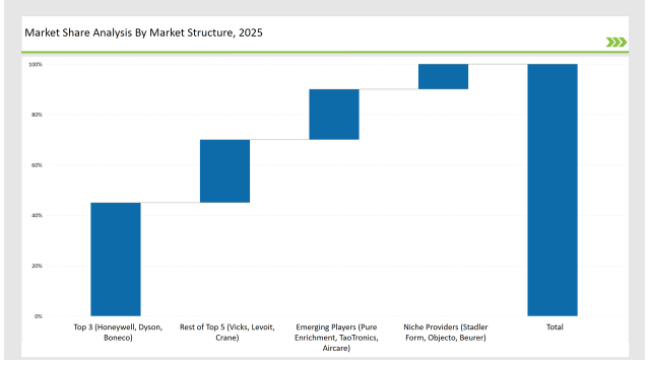
| Category | Industry Share (%) |
|---|---|
| Top 3 (Honeywell, Dyson, Boneco) | 45% |
| Rest of Top 5 (Vicks, Levoit, Crane) | 25% |
| Emerging Players (Pure Enrichment, TaoTronics, Aircare) | 20% |
| Niche Providers (Stadler Form, Objecto, Beurer) | 10% |
Market Concentration (2025 Assessment)
The humidifier market is moderately consolidated, with top players holding 60-70% market share. Leading brands like Honeywell and Dyson set product innovation and pricing trends, while high R&D costs and regulatory standards create moderate entry barriers for new competitors.
Segment Analysis
By Humidifier Type
The humidifier industry is segmented into Warm Mist Humidifiers, Cool Mist Humidifiers, Ultrasonic Humidifiers, and Others.
- Ultrasonic Humidifiers lead the market with 40% share, offering silent operation, energy efficiency, and precise humidity control. Dyson and Levoit are key players in this category.
- Cool Mist Humidifiers account for 30%, favored for pediatric and allergy relief applications. Honeywell and Vicks dominate this segment.
- Warm Mist Humidifiers hold 20%, primarily used in winter months and medical applications. Crane and Boneco excel in this space.
- Others (Hybrid and Evaporative Humidifiers) make up 10%, catering to specialized consumer needs.
By Installation Type
The market is further segmented into Fixed Humidifiers and Portable Humidifiers.
- Portable Humidifiers dominate with 70% share, driven by demand for home-use convenience and affordability. Dyson, Levoit, and Pure Enrichment lead this segment.
- Fixed Humidifiers account for 30%, primarily used in commercial, healthcare, and industrial applications. Honeywell and Aircare focus on advanced whole-house and industrial humidification solutions.
Who Shaped the Year? (2024)
- Honeywell introduced AI-powered smart humidification with real-time air quality monitoring and energy-efficient regulation.
- Dyson expanded its multifunctional humidifier-purifier range, integrating advanced HEPA filtration and connected device features.
- Boneco launched health-focused humidifiers with UV-C sterilization and antimicrobial filters for medical-grade air quality.
- Levoit led the affordable segment with app-controlled, ultrasonic cool mist humidifiers for urban households.
- Vicks strengthened its dominance in healthcare humidification, integrating aromatherapy and medical vaporizer technology.
Key Highlights from the Forecast
Key Trends Shaping the Future of the Humidifier Market
Smart & AI-Driven Humidification - For Better Air Quality & for Better Energy Efficiency
Manufacturers are embedding AI and IoT into humidifiers to calibrate humidity levels dynamically and enhance smart home connectivity. Intelligent AI-enabled Sensors automatically assess ambient air quality, temperature and weather conditions in the surroundings to bring the humidity to an automatic level ensuring comfort and energy efficiency. Smart humidifiers integrate with voice assistants, such as Alexa and Google Assistant, enabling humidity levels to be adjusted remotely.
Top brands are now working on AI-driven sensor technology that is capable of improving humidity accuracy as well as energy saving with better Indoor Air Quality. Consumers increasingly prefer low-maintenance, energy-efficient humidifiers that automatically adapt to environmental conditions. With increasing concerns around air quality impacting cities, smart humidifiers are starting to take off by controlling humidity levels for individuals while helping consumers to be more energy efficient.
Increasing Adoption of Hybrid & Ultrasonic Humidifiers
Ultrasonic humidifiers operate silently, consume less water, and consume less power. These models use high-frequency vibrations to turn water into a fine mist, making them an ecological and efficient option for adjusting indoor humidity. Their whisper-quiet operation makes them optimal for bedrooms, nurseries and offices, and helped boost their popularity even further.
In order to cater this growing consumer demand for premium and high performance solutions manufacturers are launching hybrid humidifiers which combines ultrasonic and evaporative technologies. These types maintain humidity more evenly and are more efficient, with less mineral deposits, than a standalone ultrasonic or evaporating unit. The best balance of performance and energy savings - and a growing choice for consumers even in those regions in the country where the climate can go from freezing to scorching overnight.
The increasing demand for portable and aesthetically pleasing humidifiers
Such consumers now desire small, sleek, and functional humidifiers that fit right into the contemporary home interior. Manufacturers are introducing sleek, minimalist designs that complement home décor while effectively controlling humidity.
Luxury brands such as the Swiss company Stadler Form and the New York-based Objecto are going after upscale consumers by marketing designer humidifiers, utilizing materials like stainless steel and involving stylish aesthetics. Decorative yet functional, these models attract users looking for an actual humidifier that also does double duty as decoration. Also, portable humidifiers with a USB-powered system are gaining popularity among travelers and office workers who require humidity management while on the road.
Humidification Solutions for Health & Medical-Grade Use
Medical-grade humidifiers with air-purifying and antibacterial properties are being demanded by healthcare institutions, allergy-sensitive consumers, and pediatric care facilities. These models are in high demand and are perfect for respiratory health as consumers actively seek humidifiers that reduce allergens and improve air quality.
Others are adding UV-C sterilization, HEPA filtration, and antibacterial water tanks to destroy bacteria, mold, and allergens. Newer high-end humidifiers now come with these advanced filtration systems to deliver cleaner, safer air to users suffering from asthma, allergens or respirational ailments. On the consumer front, humidifiers with inbuilt air purification technologies are becoming more popular as more consumers are focusing on health and indoor air quality.
Sustainability Initiatives & Regulatory Compliance
Governments have started enforcing stringent air quality regulations and sustainability mandates, thereby making it compelling for manufacturers to develop eco-friendly, BPA-free, and energy efficient humidifiers. In an effort to minimise environmental harm without sacrificing safety, regulators are encouraging the use of alternative, safer and lower-emission technologies for humidification.
In pursuit of global sustainability goals, companies are investing in recyclable materials, water-efficient humidification technology and energy-saving components. Manufacturers are engineering humidifiers that maximize moisture spread and minimize water waste. Brands which acknowledge green technologies and sustainability are thus able to outperform their competition.
Tier-Wise Company Classification (2025)
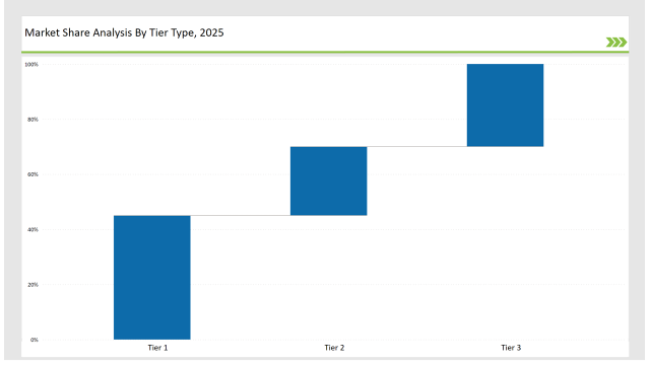
| Tier | Tier 1 |
|---|---|
| Vendors | Honeywell, Dyson, Boneco |
| Consolidated Market Share (%) | 45% |
| Tier | Tier 2 |
|---|---|
| Vendors | Vicks, Levoit, Crane |
| Consolidated Market Share (%) | 25% |
| Tier | Tier 3 |
|---|---|
| Vendors | Pure Enrichment, TaoTronics, Aircare, Stadler Form, Objecto, Beurer |
| Consolidated Market Share (%) | 30% |
Key Company Initiatives
| Vendor | Key Focus |
|---|---|
| Honeywell | AI-driven air quality monitoring and energy-efficient humidification. |
| Dyson | Multifunctional humidifier-air purifiers with IoT and smart home integration. |
| Boneco | UV-C sterilization and antimicrobial filtering for healthcare applications. |
| Vicks | Medical-grade vaporizers with aromatherapy features. |
| Levoit | Affordable ultrasonic humidifiers with app-based controls. |
| Pure Enrichment | Compact, portable humidifiers for small-space and travel use. |
| TaoTronics | Hybrid humidifiers with customizable mist settings. |
Recommendations for Vendors
- Expand AI & IoT Capabilities: Implement AI-driven humidity sensors for automated indoor air quality optimization.
- Enhance Portable & Energy-Efficient Models: Focus on battery-operated, low-energy consumption humidifiers for cost-conscious consumers.
- Strengthen Healthcare Integration: Develop medical-grade humidifiers with HEPA filters and UV-C technology.
- Promote Sustainability: Introduce biodegradable filters, BPA-free materials, and water-saving mechanisms.
- Increase Smart Home Integration: Improve compatibility with Amazon Alexa, Google Assistant, and Apple HomeKit for seamless user control.
Future Roadmap
AI-based predictive maintenance will enable consumers to be notified in real-time when replacing filter and changing humidity level.
It also ensures checks for quality of the air at places some humidifiers are at through blockchain tracking.
Emerging market growth: there are opportunities for growth in Asia-Pacific and Latin America where urbanization and increasing disposable incomes result in greater demand for air quality solutions.
Forming collaborations with healthcare institutions: Vendors should collaborate with hospitals, wellness clinics, and allergy research centers to design for medical-grade humidifiers.
Frequently Asked Questions
Which companies hold the largest market share in the humidifier industry?
Honeywell, Dyson, and Boneco control 45% of the market.
What is the market share of emerging players?
Emerging players hold 20%, with brands like Pure Enrichment and TaoTronics leading.
How is market concentration assessed?
Market concentration is categorized as medium, with the top 10 players controlling 70% of the market.
Preview the report firsthand - request a free sample
Get SampleGet the brochure for pricing and purchase details.
Get PDFTable of Content
- Executive Summary
- Market Overview
- Competitive Landscape
- Market Concentration
- Segment Analysis
- Who Shaped the Year
- Key Highlights from the Forecast
- Tier-Wise Company Classification
- Key Company Initiatives
- Recommendations for Vendors
- Future Roadmap
- Frequently Asked Questions


