

- Industry Size (2026)
- USD 13.4 Mn
- Forecast (2036)
- USD 19.8 Mn
- CAGR (2026 to 2036)
- 4%
Demand for Box Liners in South Korea Forecast and Outlook 2026 to 2036
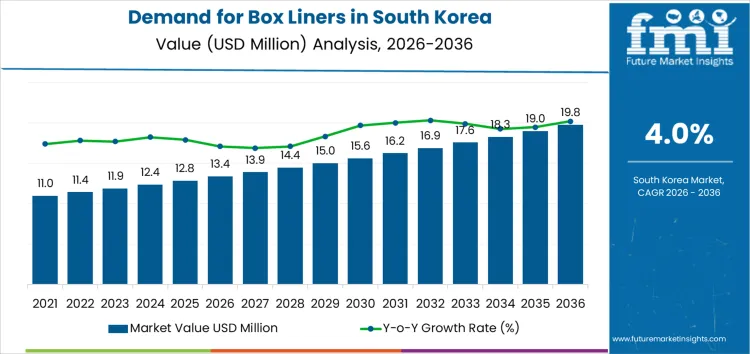
The demand for box liners in South Korea is projected at USD 13.4 million in 2026 and is expected to grow to USD 19.8 million by 2036, reflecting a 4% CAGR. Commercial performance will be shaped by a tight pricing environment, where buyers are increasingly leveraging bulk purchasing power to negotiate lower prices. With raw material costs and production overheads being key constraints, suppliers will face challenges in maintaining margins while meeting cost-sensitive buyer demands.
Volume predictability will be another challenge, as demand can fluctuate based on packaging cycle timelines, making long-term agreements harder to secure. This results in a fragmented supply chain, where procurement teams prioritize flexibility over long-term supplier commitments. Seasonal demand variations will impact inventory management, making it difficult for producers to accurately forecast and stabilize production output. In this context, commercial leaders must balance cost control with the agility to meet shifting buyer expectations.
Quick Stats for the Demand for Box Liners in South Korea
- Box Liners in South Korea Value (2026): USD 13.4 million
- Box Liners in South Korea Forecast Value (2036): USD 19.8 million
- Box Liners in South Korea Forecast CAGR (2026 to 2036): 4%
- Box Liners in South Korea Leading Segment: 3-6 Mil Thinness (42.1%)
- Key Growth Regions of Box Liners in South Korea: Jeju (leading CAGR ~4.8%)
- Top Players of Box Liners in South Korea: Plascon Group, Thrace Group, Champion Plastics, IMPAK CORPORATION, Mettcover
What is the Growth Forecast for the Demand for Box Liners in South Korea through 2036?
The demand for box liners in South Korea follows a relatively smooth trajectory, with consistent year-on-year growth that reflects stable industrial adoption. The peak-to-trough analysis highlights a moderate fluctuation in the growth rate, with the market growing from USD 13.4 million in 2026 to USD 19.8 million by 2036. While growth remains steady overall, occasional periods of slower growth may occur due to external factors such as shifts in industrial production cycles or changes in packaging preferences.
Despite these minor fluctuations, the overall trend remains upward. The demand for box liners is expected to continue rising as South Korea's logistics, manufacturing, and food sectors become more efficient in their packaging practices. In particular, industries seeking to balance packaging cost with environmental impact will continue adopting box liners, leading to predictable growth. The demand curve maintains a moderate slope, indicating steady and reliable increases, without sharp peaks or troughs, reflecting the sustained importance of these products in the South Korean packaging ecosystem.
Key Takeaways for Demand for Box Liners in South Korea
| Metric | Value |
|---|---|
| Industry Sales Value (2026) | USD 13.4 million |
| Industry Forecast Value (2036) | USD 19.8 million |
| Industry Forecast CAGR (2026 to 2036) | 4% |
Why is the Demand for Box Liners Growing in South Korea?
Demand for box liners in South Korea is rising as manufacturers and logistics providers seek packaging solutions that protect goods during transport, storage, and handling while meeting operational and regulatory requirements. Box liners, typically made from plastic, paper, or biodegradable films, serve as internal barriers that shield products from moisture, dust, contamination, and abrasion. South Korean industries such as food processing, electronics, automotive parts, and pharmaceuticals rely on box liners to maintain product quality from the factory floor to the point of sale.
In food applications, liners help preserve freshness and prevent spoilage by providing an additional layer between product and outer carton, which is especially important for perishable and hygroscopic goods. In durable goods and components supply chains, liners cushion items and reduce the risk of surface damage, lowering return rates and enhancing customer satisfaction. Procurement specialists favour liners that are compatible with automated packing systems and that align with inventory turnover practices.
Looking ahead, several factors are likely to sustain and expand demand for box liners across South Korea’s distribution and manufacturing networks. Growth in e commerce continues to put pressure on packaging to protect a wider variety of products through more complex logistics pathways, making internal protection solutions like liners increasingly necessary. Retailers and brand owners also scrutinize packaging for sustainability attributes, which influences liner selection toward materials that are recyclable or derived from renewable resources.
Regulatory emphasis on waste reduction and material reuse encourages supply chain planners to choose liners that integrate with recycling systems, reducing environmental impact without compromising performance. Advances in liner materials, such as enhanced tear resistance and barrier properties, broaden their applicability and can improve cost effectiveness by reducing damage related losses. These technical improvements, combined with increasing shipment volumes, evolving customer expectations, and tighter quality control standards, contribute to continued uptake of box liners in South Korea’s packaging ecosystem.
What Shapes the Demand for Box Liners in South Korea?
The demand for box liners in South Korea is driven by product type and thinness. PEP (polyethylene plastic) liners dominate the market with a 33% share, while the 3-6 mil thickness range holds a 42.1% share. These two segments form the core of South Korea's box liner consumption, reflecting packaging preferences in industries such as food, chemicals, and logistics. The combination of product type and thickness drives market trends and influences how box liners are selected for specific applications across the country.
Why Does PEP Hold the Largest Share in Box Liner Demand?
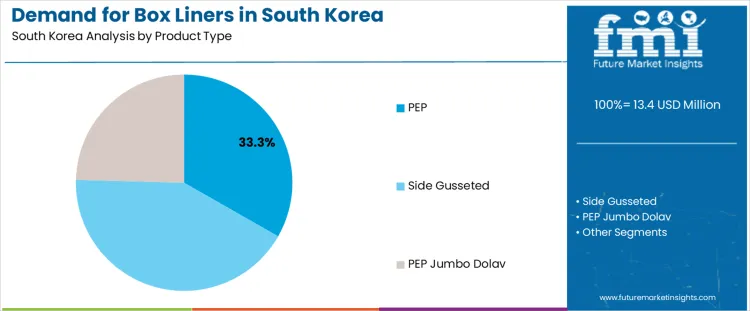
PEP (polyethylene plastic) box liners make up 33% of the total demand in South Korea, driven by their durability, flexibility, and cost-effectiveness. PEP liners are widely used in packaging applications where high strength, moisture resistance, and ease of use are crucial. The food industry, in particular, relies on PEP liners for food-grade packaging, where sanitary conditions and reliability during transportation and storage are essential. Their resistance to punctures and tears ensures product protection during handling, making them ideal for bulk storage in warehouses and distribution centers.
Additionally, PEP liners are easily customizable to fit a range of box sizes, improving the efficiency of the packaging process. Industries that focus on bulk shipments of non-perishable goods or industrial products benefit from PEP liners' versatility and strength. As South Korea continues to grow its e-commerce, logistics, and manufacturing sectors, PEP box liners are expected to maintain their market dominance due to their performance reliability and cost advantages across various industries.
Why Does the 3-6 Mil Thinness Range Lead Box Liner Demand?
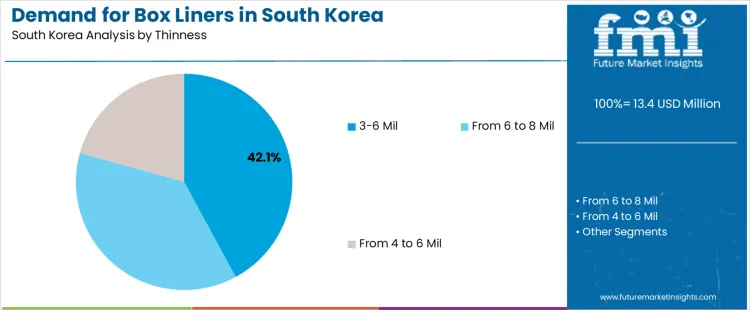
The 3-6 mil thickness range accounts for 42.1% of the box liner market in South Korea, reflecting its widespread application in both industrial and consumer sectors. Box liners in this thickness range offer the perfect balance of strength and flexibility, making them suitable for a variety of applications, including food storage, chemicals, pharmaceuticals, and general industrial packaging. The 3-6 mil liners are thick enough to prevent leaks, tears, and punctures, while still being lightweight enough to handle easily and store efficiently.
This thickness is particularly favored for packaging items that need to be protected from moisture, dirt, and contaminants during shipping and storage. In industries such as logistics, construction, and food packaging, the 3-6 mil box liners are commonly used due to their versatile properties. As companies continue to seek cost-effective and reliable packaging solutions, this thickness range will remain central to the box liner market in South Korea. The combination of durability, ease of use, and efficiency makes 3-6 mil box liners the preferred choice for many sectors.
What Is the Current Demand for Box Liners in South Korea?
Demand for box liners in South Korea is sustained by growth in packaging needs for logistics, food and beverage, e commerce, and industrial goods. Box liners, which include plastic film, paper, and woven materials placed inside corrugated cartons or bulky containers, support product protection, contamination control, and moisture resistance. Procurement levels reflect activity in domestic manufacturing and export sectors, particularly where supply chains require secondary containment. The expansion of online retail and cold chain distribution has contributed to steady uptake of robust and tailored box liner solutions across segments.
What Factors Are Driving Demand for Box Liners in South Korea?
Several factors support demand for box liners in South Korea. Growth in the e commerce sector increases requirements for protective inner packaging that prevents damage during transit and handling. The food processing and cold chain logistics industries drive uptake of liners that maintain hygiene and temperature control for perishable products, fresh produce, and frozen items. Industrial users specify box liners for bulk shipments of chemicals, minerals, and powders to prevent contamination and leakage. Regulatory emphasis on consumer safety and packaging compliance encourages adoption of qualified liner materials. Evolving supply chain standards and retailer specifications further influence procurement of liners with tailored barrier properties and strength.
What Are the Constraints on Demand for Box Liners in South Korea?
Several constraints influence box liner demand in South Korea. Price sensitivity among small and medium sized enterprises affects uptake of higher performance liner grades, especially when alternatives such as standard pallets or protective wraps are available. Competitive pressure from other packaging formats, including rigid inserts, molded pulp, and foam cushioning, can limit liner penetration in specific applications where dimensional stability is critical. Supply chain cost volatility, particularly for resin based films, influences liner pricing and ordering patterns. Environmental concerns and municipal initiatives to reduce single use plastics also shape preferences and may constrain use of certain polymer based liners unless recycling or compostable options are available.
What Trends Are Emerging in South Korea’s Box Liner Market?
Emerging trends in South Korea’s box liner market reflect shifts in material innovation and sustainability focus. There is increasing demand for recyclable and compostable liner materials that align with broader environmental targets and waste reduction initiatives in packaging. Manufacturers are developing liners with enhanced barrier properties to support moisture, odor, and puncture resistance, responding to requirements from food and pharmaceutical sectors. Growth in automated packing systems encourages adoption of liners compatible with high speed filling and sealing equipment. Additionally, customization of liner dimensions and strength grades to match diverse product profiles is gaining traction, particularly among major brands and logistics service providers seeking to optimize protection while reducing overall packaging weight.
What is the Regional Outlook for the Demand for Box Liners in South Korea?
The demand for box liners in South Korea varies across its regions, driven by packaging needs in industries such as food and beverage, chemicals, agriculture, and retail. Jeju shows the highest growth potential, followed by South Gyeongsang, South Jeolla, and North Jeolla. The growing emphasis on packaging sustainability, combined with regional industry expansions and packaging innovations, is driving the demand for box liners. These liners provide crucial protection and integrity for products during storage and transportation, particularly in sectors that require moisture-proof and durable packaging solutions.
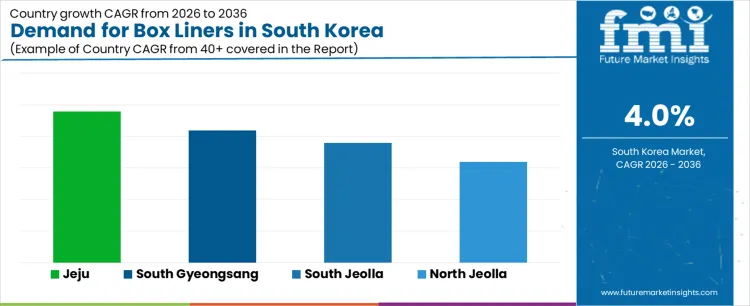
| Province | CAGR (2026–2036) |
|---|---|
| South Gyeongsang | 4.2% |
| North Jeolla | 3.2% |
| South Jeolla | 3.8% |
| Jeju | 4.8% |
What drives the demand for Box Liners in South Gyeongsang?
South Gyeongsang is projected to experience a CAGR of 4.2% in box liner demand from 2026 to 2036. The province’s strong industrial and agricultural base, particularly in food production, manufacturing, and logistics, is a major factor driving this demand. Box liners are essential for protecting goods during transport, and as industries expand, so does the need for robust packaging solutions. South Gyeongsang is a key player in South Korea’s agricultural export industry, with significant volumes of perishable goods requiring moisture-resistant packaging. Additionally, South Gyeongsang’s growing manufacturing and e-commerce sectors create demand for packaging solutions that ensure product safety during storage and transportation. The ongoing focus on sustainability in packaging further contributes to the increasing adoption of box liners, which offer eco-friendly options for businesses looking to meet environmental standards.
What influences the demand for Box Liners in North Jeolla?
North Jeolla is expected to see a moderate CAGR of 3.2% in box liner demand from 2026 to 2036. The region’s industrial base, including food processing, chemicals, and pharmaceuticals, relies on box liners for effective packaging solutions. North Jeolla’s agricultural production, which supplies both domestic and export markets, also boosts the demand for box liners in the packaging of fruits, vegetables, and other perishable items. The region’s manufacturing and logistics sectors increasingly adopt box liners to ensure products reach their destinations in optimal condition. With the growing focus on reducing packaging waste, North Jeolla’s industries are turning to sustainable box liners, which are seen as an effective solution for enhancing product integrity while meeting environmental regulations. Despite its smaller industrial base compared to other regions, the steady adoption of eco-friendly packaging technologies continues to drive demand.
What drives the demand for Box Liners in South Jeolla?
South Jeolla’s demand for box liners is projected to grow at a CAGR of 3.8% from 2026 to 2036. The province’s strong presence in agriculture and food processing, along with expanding manufacturing activities, significantly drives demand for packaging solutions. South Jeolla is known for its production of agricultural goods, including fruits and vegetables, which require protective packaging during transportation. The use of box liners ensures the preservation of product quality, reducing spoilage and improving shelf-life. Additionally, South Jeolla’s growing focus on sustainability in packaging, supported by governmental incentives for green packaging initiatives, accelerates the adoption of eco-friendly box liners. The region’s increasing investments in infrastructure and logistics, particularly in export-oriented activities, further reinforce the need for box liners in the agricultural and manufacturing sectors.
Why is Jeju projected to have the highest demand growth for Box Liners?
Jeju is expected to see the highest demand growth for box liners, with a projected CAGR of 4.8% from 2026 to 2036. The region’s expanding tourism and hospitality sectors, combined with growing infrastructure projects, drive the demand for high-quality packaging solutions. As Jeju continues to develop as a major tourist destination, packaging for food, beverages, and retail products becomes a priority, especially for items that require safe transportation and storage. The island's increasing adoption of sustainable packaging solutions, particularly in its hospitality and retail sectors, further boosts the demand for box liners. Jeju’s logistics and transport infrastructure, coupled with a rising focus on environmental sustainability, ensures that box liners will be in high demand as industries look for eco-friendly packaging alternatives. As the region's economy diversifies, box liners will continue to play a crucial role in maintaining product quality and meeting consumer expectations for environmentally responsible packaging.
How are Competitors Differentiating in the Box Liner Market in South Korea?
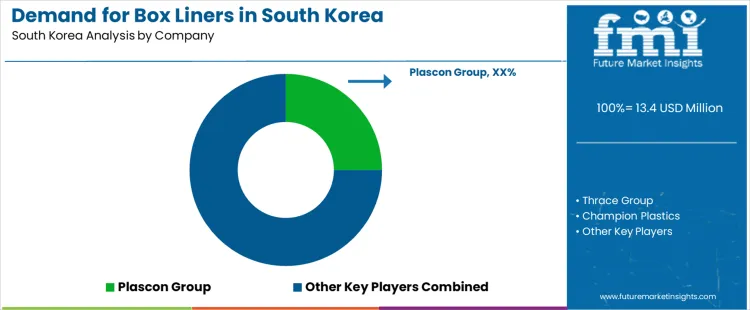
The demand for box liners in South Korea is driven by industries such as food, chemicals, and e-commerce, where durable and versatile packaging solutions are essential for product protection during storage and transportation. Plascon Group, the leading player, focuses on producing high-quality, customizable box liners designed for various industrial applications. Their emphasis on strength, flexibility, and eco-friendly materials has helped them secure a strong presence in the market. Thrace Group differentiates itself by offering a broad range of tailored liner solutions, highlighting advanced barrier properties and a focus on high-performance films for sensitive goods like food and pharmaceuticals. Champion Plastics competes by providing durable liners that offer high resistance to punctures, tears, and moisture, catering to customers who prioritize protective packaging in logistics.
Companies like IMPAK CORPORATION and Mettcover also target specific market niches. IMPAK CORPORATION focuses on creating liners with superior sealing capabilities, ensuring products remain secure and intact during transportation. Mettcover differentiates through the use of advanced polymer materials that offer superior strength and thermal stability, making their liners ideal for heavy-duty applications and extreme conditions. To communicate their value, these companies rely heavily on product brochures, which highlight key features such as custom sizes, materials, and specialized barrier properties. These brochures allow customers in South Korea to easily evaluate their offerings against specific performance requirements, driving sales in this competitive market.
Key Players of the Demand for Box Liners in South Korea
- Plascon Group
- Thrace Group
- Champion Plastics
- IMPAK CORPORATION
- Mettcover
Scope of the Report
| Items | Values |
|---|---|
| Quantitative Units (2026) | USD Million |
| Product Type | PEP, Side Gusseted, PEP Jumbo Dolav |
| Thinness | 3-6 Mil, From 6 to 8 Mil, From 4 to 6 Mil, Others |
| Material Type | HDPE, LDPE, LLDPE |
| Companies | Plascon Group, Thrace Group, Champion Plastics, IMPAK CORPORATION, Mettcover |
| Region Covered | South Korea |
| Provinces Covered | South Gyeongsang, North Jeolla, South Jeolla, Jeju |
| Additional Attributes | Dollar sales by product type, thinness, and material type. Demand is driven by packaging flexibility, cost-effectiveness, and durability, with preference for HDPE and LLDPE materials in industrial applications and PE-based liners gaining traction for bulk storage. |
Demand for Box Liners in South Korea
Product Type:
- PEP
- Side Gusseted
- PEP Jumbo Dolav
- Other
Thinness:
- 3-6 Mil
- From 6 to 8 Mil
- From 4 to 6 Mil
- Other
Material Type:
- HDPE
- LDPE
- LLDPE
- Other
Provinces:
- South Gyeongsang
- North Jeolla
- South Jeolla
- Jeju
Bibliography
- Korea Environmental Industry & Technology Institute (KEITI). (2023). Environmental standards and packaging waste reduction strategies in South Korea. Korea Environmental Industry & Technology Institute (KEITI).
- Korea Ministry of Environment (MOE). (2023). Regulations on packaging waste management and recycling standards in South Korea. Ministry of Environment, Republic of Korea.
- Korea Packaging Association. (2023). Packaging industry development, trends, and regulatory updates for packaging materials in South Korea.
- USA Environmental Protection Agency (EPA). (2023). Sustainable packaging initiatives, material choice, and recycling strategies. USA Environmental Protection Agency.
- European Union Environment Agency (EEA). (2023). Packaging waste management policies and material recycling in Europe. European Environment Agency.
Frequently Asked Questions
How big is the demand for box liners in south korea in 2026?
The demand for box liners in south korea is estimated to be valued at USD 13.4 million in 2026.
What will be the size of box liners in south korea in 2036?
The market size for the box liners in south korea is projected to reach USD 19.8 million by 2036.
How much will be the demand for box liners in south korea growth between 2026 and 2036?
The demand for box liners in south korea is expected to grow at a 4.0% CAGR between 2026 and 2036.
What are the key product types in the box liners in south korea?
The key product types in box liners in south korea are pep, side gusseted and pep jumbo dolav.
Which thinness segment is expected to contribute significant share in the box liners in south korea in 2026?
In terms of thinness, 3-6 mil segment is expected to command 42.1% share in the box liners in south korea in 2026.
Preview the report firsthand - request a free sample
Get SampleGet the brochure for pricing and purchase details.
Get PDFTable of Content
- Executive Summary
- South Korea Market Outlook
- Demand-side Trends
- Supply-side Trends
- Technology Roadmap Analysis
- Analysis and Recommendations
- Market Overview
- Market Coverage / Taxonomy
- Market Definition / Scope / Limitations
- Market Background
- Market Dynamics
- Drivers
- Restraints
- Opportunity
- Trends
- Scenario Forecast
- Demand in Optimistic Scenario
- Demand in Likely Scenario
- Demand in Conservative Scenario
- Opportunity Map Analysis
- Product Life Cycle Analysis
- Supply Chain Analysis
- Investment Feasibility Matrix
- Value Chain Analysis
- PESTLE and Porter’s Analysis
- Regulatory Landscape
- Regional Parent Market Outlook
- Production and Consumption Statistics
- Import and Export Statistics
- Market Dynamics
- South Korea Market Analysis 2021 to 2025 and Forecast, 2026 to 2036
- Historical Market Size Value (USD Million) Analysis, 2021 to 2025
- Current and Future Market Size Value (USD Million) Projections, 2026 to 2036
- Y-o-Y Growth Trend Analysis
- Absolute $ Opportunity Analysis
- South Korea Market Pricing Analysis 2021 to 2025 and Forecast 2026 to 2036
- South Korea Market Analysis 2021 to 2025 and Forecast 2026 to 2036, By Product Type
- Introduction / Key Findings
- Historical Market Size Value (USD Million) Analysis By Product Type , 2021 to 2025
- Current and Future Market Size Value (USD Million) Analysis and Forecast By Product Type , 2026 to 2036
- PEP
- Side Gusseted
- PEP Jumbo Dolav
- PEP
- Y-o-Y Growth Trend Analysis By Product Type , 2021 to 2025
- Absolute $ Opportunity Analysis By Product Type , 2026 to 2036
- South Korea Market Analysis 2021 to 2025 and Forecast 2026 to 2036, By Thinness
- Introduction / Key Findings
- Historical Market Size Value (USD Million) Analysis By Thinness, 2021 to 2025
- Current and Future Market Size Value (USD Million) Analysis and Forecast By Thinness, 2026 to 2036
- 3-6 Mil
- From 6 to 8 Mil
- From 4 to 6 Mil
- 3-6 Mil
- Y-o-Y Growth Trend Analysis By Thinness, 2021 to 2025
- Absolute $ Opportunity Analysis By Thinness, 2026 to 2036
- South Korea Market Analysis 2021 to 2025 and Forecast 2026 to 2036, By Material Type
- Introduction / Key Findings
- Historical Market Size Value (USD Million) Analysis By Material Type, 2021 to 2025
- Current and Future Market Size Value (USD Million) Analysis and Forecast By Material Type, 2026 to 2036
- HDPE
- LDPE
- LLDPE
- Others
- HDPE
- Y-o-Y Growth Trend Analysis By Material Type, 2021 to 2025
- Absolute $ Opportunity Analysis By Material Type, 2026 to 2036
- Market Structure Analysis
- Competition Dashboard
- Competition Benchmarking
- Market Share Analysis of Top Players
- By Regional
- By Product Type
- By Thinness
- By Material Type
- Competition Analysis
- Competition Deep Dive
- Plascon Group
- Overview
- Product Portfolio
- Profitability by Market Segments (Product/Age /Sales Channel/Region)
- Sales Footprint
- Strategy Overview
- Marketing Strategy
- Product Strategy
- Channel Strategy
- Thrace Group
- Champion Plastics
- IMPAK CORPORATION
- Mettcover
- Plascon Group
- Competition Deep Dive
- Assumptions & Acronyms Used
- Research Methodology


