

- Industry Size (2026)
- USD 43 Mn
- Forecast (2036)
- USD 66.2 Mn
- CAGR (2026 to 2036)
- 4.4%
Demand for Box Liners in United Kingdom Forecast and Outlook 2026 to 2036
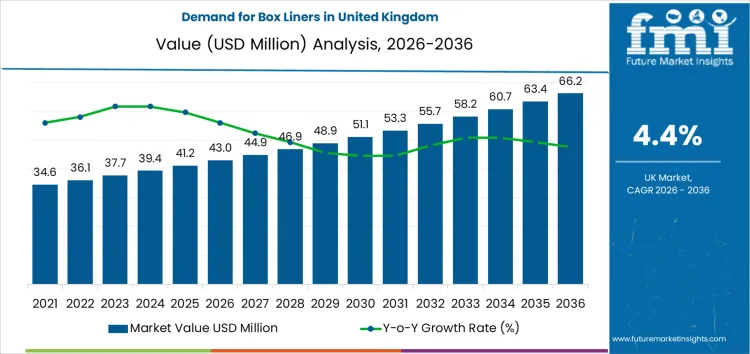
The box liners market in the United Kingdom is projected to grow from USD 43 million in 2026 to USD 66.2 million by 2036, at a CAGR of 4.4%. The commercial realities within this space are shaped by several key factors. Pricing discipline will remain a significant challenge, as rising raw material costs and fluctuating demand may force vendors to adjust prices, potentially straining customer relationships. Buyer leverage is expected to grow as purchasing power consolidates among large-scale distributors, putting pressure on suppliers to maintain competitive pricing without sacrificing quality.
Volume predictability remains a concern, as seasonality and varying demand across sectors such as food packaging and industrial applications create inconsistent purchasing patterns. Suppliers will need to manage inventory efficiently while balancing cost containment and flexibility. Success in this market will depend on the ability to navigate these constraints and build solid, long-term relationships with key buyers.
Quick Stats for the Demand for Box Liners in United Kingdom:
- Box Liners in United Kingdom Value (2026): USD 43 million
- Box Liners in United Kingdom Forecast Value (2036): USD 66.2 million
- Box Liners in United Kingdom Global Forecast CAGR (2026 to 2036): 4.4%
- Box Liners in United Kingdom Leading Segment: Thinness 3-6 Mil (40% share)
- Key Growth Regions of Box Liners in United Kingdom: England
- Top Players of Box Liners in United Kingdom: Plascon Group, Thrace Group, Champion Plastics, IMPAK CORPORATION, Mettcover
What is the Growth Forecast for Box Liners in United Kingdom through 2036?
The demand for box liners in the United Kingdom is projected to rise from USD 43 million in 2026 to USD 66.2 million by 2036, reflecting a compound annual growth rate (CAGR) of 4.4%. Between 2026 and 2031, the box liners industry in United Kingdom will experience steady growth, with values increasing from USD 43 million to USD 53.3 million. From 2031 to 2036, the growth will continue, reaching USD 66.2 million by the end of the forecast period.
The peak-to-trough analysis highlights the consistent upward trend in demand, with no significant downturns expected during the forecast period. The box liners industry in United Kingdom will experience minor fluctuations, with growth steadily increasing in response to demand from industries requiring packaging solutions. The box liners industry in United Kingdom's overall trajectory will follow a predictable, stable growth pattern, driven by factors such as packaging needs, e-commerce growth, and industry-specific packaging requirements.
Key Takeaways for Demand for Box Liners in United Kingdom
| Metric | Value |
|---|---|
| Industry Sales Value (2026) | USD 43 million |
| Industry Forecast Value (2036) | USD 66.2 million |
| Industry Forecast CAGR (2026 to 2036) | 4.4% |
Why is Demand for Box Liners in United Kingdom Growing?
Demand for box liners in the United Kingdom has risen from historical levels as industries and logistics operations sought improved product protection and handling efficiency. Historically, box liners were used primarily in food and beverage supply chains to prevent contamination and manage moisture within bulk boxes and cartons. Use expanded into sectors such as pharmaceuticals, chemicals, and consumer goods where liners provided a barrier against dust, humidity, and leakage during storage and transit. Growth in e commerce activity increased the volume of packaged goods moving through national and international distribution networks, creating greater reliance on protective liners to maintain product integrity. Retailers and logistics providers adopted liners to reduce claims related to damaged goods and to improve packaging performance in varied handling environments. In addition, expansion in automated packing lines in UK warehouses supported wider integration of box liners that could be quickly fitted into diverse box formats. These operational drivers supported a consistent rise in demand over recent years.
Looking ahead, demand for box liners in the United Kingdom is expected to continue advancing as supply chain and packaging requirements evolve. Producers and distributors will seek solutions that enhance product protection while contributing to material efficiency goals. Requirements for hygienic packaging in sectors such as food, healthcare, and personal care goods will maintain demand for liner solutions that support contamination control. Continued growth of online retail will sustain pressure on packaging systems to deliver secure transport performance across multi modal freight. Innovation in liner materials that combine strength with reduced weight may attract wider use as industries prioritize cost control and waste reduction. Changing regulatory expectations around packaging and waste could influence liner selection and usage patterns, reinforcing the role of box liners in UK logistics and distribution activities.
What Are the Key Segments in the Demand for Box Liners in the United Kingdom?
Demand for box liners in the United Kingdom is driven by product type and thinness. PEP liners lead the product type segment with a 32% market share, while 3-6 mil thickness dominates with 40% of the box liners industry in United Kingdom. Other product types, such as side gusseted and PEP jumbo Dolav, along with varying thickness categories, also play a role. These segments cater to industries requiring durable and customizable packaging solutions for storage, transportation, and protection.
What Is the Product Type Segment of Demand for Box Liners in the United Kingdom?
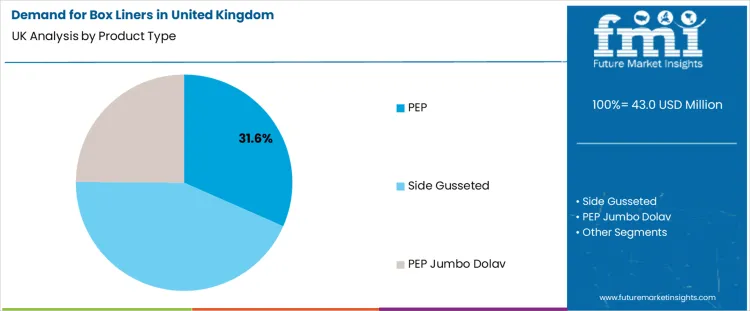
The product type segment for box liners in the United Kingdom is primarily led by PEP liners, which hold a 32% share of the industry. PEP (polyethylene) liners are favored for their flexibility, strength, and resistance to moisture, making them ideal for a wide range of applications in industries such as food processing, chemicals, and agriculture. PEP liners provide an effective solution for protecting products during transportation and storage, ensuring they remain clean and safe from contamination. The versatility of PEP liners also makes them highly adaptable to different packaging needs, including bulk packaging and specialized products.
Side gusseted box liners, while representing a smaller portion of the box liners industry in United Kingdom, are important for applications requiring additional volume and expandability. The gusset allows these liners to hold larger quantities, which is useful for packing larger or bulkier items. PEP jumbo Dolav liners cater to the industrial and agricultural sectors, where large containers are used to store and transport goods. These jumbo liners are specifically designed to fit Dolav containers, which are commonly used for bulk material handling. As the demand for efficient and cost-effective packaging solutions increases, PEP liners continue to dominate the box liners industry in United Kingdom, while other types like side gusseted and jumbo Dolav liners serve niche needs in specific industries.
What Is the Thinness Segment of Demand for Box Liners in the United Kingdom?
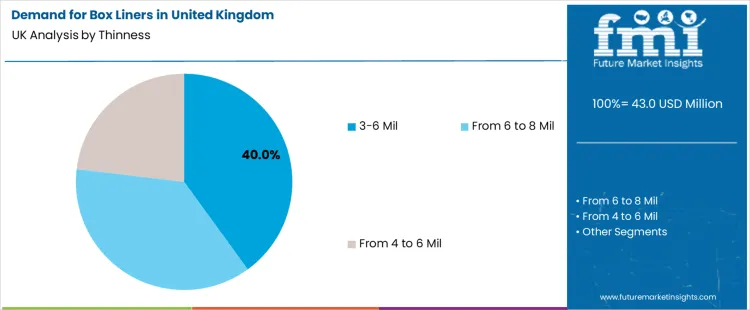
The thinness segment for box liners in the United Kingdom is primarily dominated by the 3-6 mil thickness, which accounts for 40% of the box liners industry in United Kingdom share. This thickness range offers a balance of durability and flexibility, making it suitable for a wide range of applications. Box liners in the 3-6 mil thickness are commonly used for general-purpose packaging, providing sufficient strength to protect products during transportation and storage while remaining cost-effective.
The demand for this thickness range is particularly high in industries such as food, pharmaceuticals, and retail, where protection from moisture, dirt, and damage is essential. The 3-6 mil thickness also offers adequate puncture resistance and is preferred for packaging items that require moderate protection. Box liners with a thickness from 6 to 8 mil follow as another important segment, catering to applications requiring more heavy-duty protection. These liners are used in industries such as chemicals and agriculture, where the need for extra strength and puncture resistance is critical. The 4-6 mil thickness category, often used for larger containers like Dolav liners, also serves industrial applications where larger quantities need to be stored or transported with additional protection. As businesses continue to prioritize product safety and packaging efficiency, the demand for box liners in varying thicknesses is expected to grow, with the 3-6 mil range maintaining its dominance due to its versatility.
What are the Key Dynamics in the Demand for Box Liners in the United Kingdom?
Demand for box liners in the United Kingdom is linked to the packaging and logistics sectors where protective and containment solutions are essential. Box liners are used to protect goods, contain loose material, and improve hygiene during storage and transport. Volume movement in food and beverage, pharmaceuticals, chemicals, and industrial goods influences procurement of box liners. Regulatory standards for food safety and containment of hazardous materials also shape demand patterns. Growth in e commerce and distribution activity supports ongoing need for liners that reduce contamination risks and maintain product integrity throughout the supply chain.
What are the Key Drivers for Box Liner Demand in the United Kingdom?
Several factors drive demand for box liners in the United Kingdom. Expansion of e commerce and parcel delivery increases the need for protective packaging components to secure goods during handling and transport. Stringent food safety regulations compel manufacturers and packers to use liners that meet hygiene requirements for direct and indirect food contact. The chemicals and industrial sectors require liners that offer containment for powders, granules, and bulk materials, reinforcing use in intermediate bulk containers and corrugated boxes. Supply chain emphasis on damage reduction and return cost avoidance also supports liner adoption across multiple end use segments.
What are the Restraints on Box Liner Demand in the United Kingdom?
Despite steady consumption, the box liner market in the United Kingdom encounters restraints. Price fluctuations in polymer resins, the primary raw material for many liners, affect manufacturing costs and can suppress procurement volumes when end users reduce inventory. Alternative containment solutions, including reusable rigid inserts and moulded fibre options, limit growth where sustainability goals outweigh single use liner utility. Regulatory compliance requirements for material recyclability and waste management add complexity to product selection. In sectors with limited packaging budgets, cost sensitivity can delay upgrades to higher performance liner solutions.
What are the Key Trends in Box Liner Demand in the United Kingdom?
Key trends influencing box liner demand in the United Kingdom include a shift toward recyclable and compostable liner materials as businesses respond to environmental policies and consumer pressure for reduced packaging waste. Innovations in barrier properties and strength enable liners to protect against moisture, dust, and chemical exposure while using thinner material profiles to reduce overall weight. Customisation of liner dimensions and features for specific products enhances fit and performance in transport and storage. The integration of traceability features, such as printed codes and identification markers, supports quality assurance and inventory management through increasingly complex supply chains.
What is the Country-Wise Demand for Box Liners in the United Kingdom?
The country-wise demand for box liners in the United Kingdom demonstrates varied growth across its regions. England leads the industry, driven by the large packaging, logistics, and e-commerce sectors that heavily rely on box liners for protecting goods during transport and storage. Scotland, Wales, and Northern Ireland also exhibit steady demand, supported by the expanding retail and manufacturing sectors, where box liners are increasingly used for packaging fragile or sensitive products. As the demand for sustainable packaging solutions grows, the industry for box liners is expected to increase across all regions, with England remaining the dominant market while the other regions follow with steady growth.
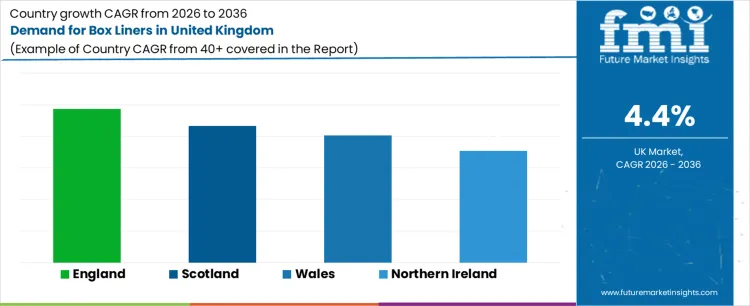
| Country | CAGR (2026 to 2036) |
|---|---|
| England | 4.9% |
| Scotland | 4.3% |
| Wales | 4.0% |
| Northern Ireland | 3.5% |
What is Driving the Demand for Box Liners in England?
The demand for box liners in England is projected to grow at a CAGR of 4.9% from 2026 to 2036. England’s market remains the largest, driven by the expanding packaging and logistics industries. Box liners are critical in protecting goods, especially in the transport of fragile or sensitive products such as electronics, food, and pharmaceuticals. The rise of e-commerce and the expansion of retail packaging needs are significantly contributing to this demand. Additionally, the increasing focus on sustainability in packaging, as well as regulatory pressures to reduce plastic use, is further driving the adoption of eco-friendly box liners made from recyclable and biodegradable materials. The ongoing need for protective packaging in logistics, coupled with the growing preference for sustainable alternatives, is expected to maintain strong demand for box liners in England over the next decade.
How is the Demand for Box Liners Performing in Scotland?
In Scotland, the demand for box liners is expected to grow at a CAGR of 4.3% from 2026 to 2036. The country’s growing retail and manufacturing sectors, particularly in the transport of fragile and valuable goods, are key contributors to this demand. As more Scottish businesses focus on improving their packaging solutions, the adoption of box liners to protect products during shipping and storage is becoming more widespread. Additionally, Scotland’s push toward sustainable packaging materials is boosting the demand for eco-friendly options. Companies are increasingly opting for recyclable and biodegradable box liners in response to both consumer preferences and regulatory guidelines. The steady growth of e-commerce in Scotland, alongside efforts to meet environmental targets, will continue to drive demand for box liners in the region.
What Are the Growth Drivers for Box Liners in Wales?
The demand for box liners in Wales is projected to grow at a CAGR of 4.0% through 2036. The retail, logistics, and manufacturing sectors in Wales are key drivers of this demand, as businesses increasingly recognize the need for protective packaging during transport and storage. Box liners are widely used in the e-commerce and food industries, where products need to be protected from moisture, dust, and damage. As Welsh industries seek to improve packaging efficiency, the demand for box liners is expected to rise. Furthermore, the growing emphasis on sustainable packaging solutions in Wales is contributing to the adoption of eco-friendly box liners. This trend, along with the expansion of local and regional retail operations, is expected to ensure continued demand for box liners in Wales over the forecast period.
What is the Outlook for Box Liners Demand in Northern Ireland?
Northern Ireland’s demand for box liners is expected to grow at a CAGR of 3.5% from 2026 to 2036. While Northern Ireland’s market is smaller compared to other parts of the United Kingdom, demand is steadily increasing, particularly in sectors such as logistics, food packaging, and manufacturing. As more businesses in Northern Ireland focus on improving packaging efficiency and product protection during transit, the adoption of box liners is expected to rise. Additionally, the region’s growing focus on sustainability and environmentally friendly packaging solutions is driving the demand for recyclable and biodegradable box liners. While the industry in Northern Ireland remains relatively small, the steady increase in e-commerce and retail packaging requirements will contribute to the continued growth of box liner demand in the region.
What is the Competitive Landscape for Demand for Box Liners in the United Kingdom?
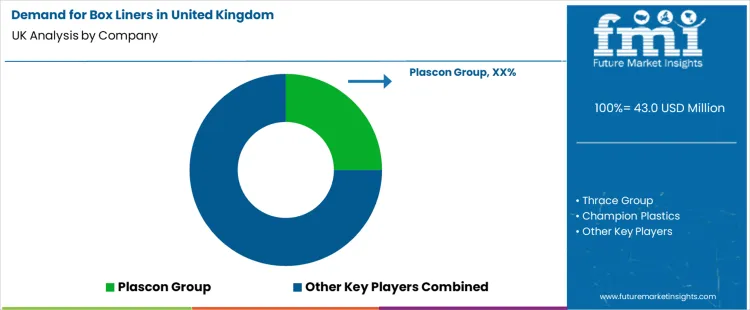
Demand for box liners in the United Kingdom is shaped by requirements across food packaging, waste management, industrial containment, and retail packaging segments. Box liners are specified to protect contents from moisture, contamination, and mechanical stress during storage and transit. Procurement activity from logistics operators, packaging converters, and retail chains supports steady demand, with specification reviews focusing on liner material grades, tensile strength values, and barrier properties. Plascon Group is positioned as a leading supplier, with product brochures detailing gauge options, printable surfaces, and recommended handling guidelines.
Technical sheets are consulted by packaging engineers and purchasing teams to ensure compatibility with container sizes and end use environments. Thrace Group participates with industrial and retail liner solutions supported by documented attributes on polymer composition, puncture resistance, and environmental disposal notes. Champion Plastics offers box liner grades described in literature that lists strength metrics under defined load conditions and storage temperature recommendations, aiding specification alignment during tender processes. IMPAK CORPORATION is active with a range of flexible liner products, and brochures from IMPAK describe grade specifications, certified food contact compliance, and handling instructions that inform buyer evaluations. Mettcover’s product documentation outlines liner thickness options, tested tear resistance values, and recommended applications for industrial packaging, providing reference data used by procurement professionals.
Selection of box liner suppliers in the United Kingdom is influenced by performance metrics and supply commitments. Buyers compare material properties such as modulus of elasticity, elongation at break, and moisture vapor transmission that are documented in supplier materials. Lead times and delivery terms are outlined in official brochures and sales literature, with details on minimum order quantities and regional distribution options. Procurement teams assess environmental compliance data supplied by manufacturers to align with waste management and recycling policies.
Demand from contract packaging operations is scheduled against documented supplier capacity and quality standards. Specification reviews for food grade liners reference certifications and barrier performance values. Orders are issued through formal channels where technical documentation is retained for traceability and quality assurance. Seasonal fluctuations in packaging throughput influence demand cycles, with supplier literature consulted to match liner grades to anticipated volume requirements. Competitive activity is grounded in documented product attributes and supply performance, providing clarity to buyers during evaluation.
Key Players of the Demand for Box Liners in United Kingdom
- Plascon Group
- Thrace Group
- Champion Plastics
- IMPAK CORPORATION
- Mettcover
Scope of the Report
| Items | Values |
|---|---|
| Quantitative Units (2026) | USD Million |
| Product Type | PEP, Side Gusseted, PEP Jumbo Dolav, Others |
| Thinness | 3-6 Mil, From 6 to 8 Mil, From 4 to 6 Mil |
| Material Type | HDPE, LDPE, LLDPE, Others |
| Companies | Plascon Group, Thrace Group, Champion Plastics, IMPAK CORPORATION, Mettcover |
| Regions Covered | United Kingdom |
| Countries Covered | England, Scotland, Wales, Northern Ireland |
| Additional Attributes | Dollar by sales by product type, thinness, material type, and region. Includes market trends towards packaging efficiency, cost-effectiveness, and the role of box liners in various industrial applications. |
Demand for Box Liners in United Kingdom
Product Type:
- PEP
- Side Gusseted
- PEP Jumbo Dolav
Thinness:
- 3-6 Mil
- From 6 to 8 Mil
- From 4 to 6 Mil
- Others
Material Type:
- HDPE
- LDPE
- LLDPE
- Others
Countries:
- England
- Scotland
- Wales
- Northern Ireland
Bibliography
- United Kingdom Department for Business, Energy & Industrial Strategy. (2022). Box liners market analysis and forecast: Demand and trends in the UK (2026 to 2036). London: BEIS.
- European Packaging Organization. (2023). Packaging solutions and sustainability: Impact of box liners in meeting EU recycling regulations. Brussels: EPO.
- International Packaging Association. (2023). Global trends in packaging efficiency and cost-effectiveness: Role of box liners in industrial applications. Geneva: IPA.
- Plascon Group. (2023). Box liners for industrial and retail applications: Product specifications, material grades, and handling guidelines.
- Thrace Group. (2023). Polyethylene box liners for packaging and logistics: Technical sheets and environmental disposal notes.
Frequently Asked Questions
How big is the demand for box liners in United Kingdom in 2026?
The demand for box liners in United Kingdom is estimated to be valued at USD 43.0 million in 2026.
What will be the size of box liners in United Kingdom in 2036?
The market size for the box liners in United Kingdom is projected to reach USD 66.2 million by 2036.
How much will be the demand for box liners in United Kingdom growth between 2026 and 2036?
The demand for box liners in United Kingdom is expected to grow at a 4.4% CAGR between 2026 and 2036.
What are the key product types in the box liners in United Kingdom?
The key product types in box liners in United Kingdom are pep, side gusseted and pep jumbo dolav.
Which thinness segment is expected to contribute significant share in the box liners in United Kingdom in 2026?
In terms of thinness, 3-6 mil segment is expected to command 40.0% share in the box liners in United Kingdom in 2026.
Preview the report firsthand - request a free sample
Get SampleGet the brochure for pricing and purchase details.
Get PDFTable of Content
- Executive Summary
- UK Market Outlook
- Demand-side Trends
- Supply-side Trends
- Technology Roadmap Analysis
- Analysis and Recommendations
- Market Overview
- Market Coverage / Taxonomy
- Market Definition / Scope / Limitations
- Market Background
- Market Dynamics
- Drivers
- Restraints
- Opportunity
- Trends
- Scenario Forecast
- Demand in Optimistic Scenario
- Demand in Likely Scenario
- Demand in Conservative Scenario
- Opportunity Map Analysis
- Product Life Cycle Analysis
- Supply Chain Analysis
- Investment Feasibility Matrix
- Value Chain Analysis
- PESTLE and Porter’s Analysis
- Regulatory Landscape
- Regional Parent Market Outlook
- Production and Consumption Statistics
- Import and Export Statistics
- Market Dynamics
- UK Market Analysis 2021 to 2025 and Forecast, 2026 to 2036
- Historical Market Size Value (USD Million) Analysis, 2021 to 2025
- Current and Future Market Size Value (USD Million) Projections, 2026 to 2036
- Y-o-Y Growth Trend Analysis
- Absolute $ Opportunity Analysis
- UK Market Pricing Analysis 2021 to 2025 and Forecast 2026 to 2036
- UK Market Analysis 2021 to 2025 and Forecast 2026 to 2036, By Product Type
- Introduction / Key Findings
- Historical Market Size Value (USD Million) Analysis By Product Type , 2021 to 2025
- Current and Future Market Size Value (USD Million) Analysis and Forecast By Product Type , 2026 to 2036
- PEP
- Side Gusseted
- PEP Jumbo Dolav
- PEP
- Y-o-Y Growth Trend Analysis By Product Type , 2021 to 2025
- Absolute $ Opportunity Analysis By Product Type , 2026 to 2036
- UK Market Analysis 2021 to 2025 and Forecast 2026 to 2036, By Thinness
- Introduction / Key Findings
- Historical Market Size Value (USD Million) Analysis By Thinness, 2021 to 2025
- Current and Future Market Size Value (USD Million) Analysis and Forecast By Thinness, 2026 to 2036
- 3-6 Mil
- From 6 to 8 Mil
- From 4 to 6 Mil
- 3-6 Mil
- Y-o-Y Growth Trend Analysis By Thinness, 2021 to 2025
- Absolute $ Opportunity Analysis By Thinness, 2026 to 2036
- UK Market Analysis 2021 to 2025 and Forecast 2026 to 2036, By Material Type
- Introduction / Key Findings
- Historical Market Size Value (USD Million) Analysis By Material Type, 2021 to 2025
- Current and Future Market Size Value (USD Million) Analysis and Forecast By Material Type, 2026 to 2036
- HDPE
- LDPE
- LLDPE
- Others
- HDPE
- Y-o-Y Growth Trend Analysis By Material Type, 2021 to 2025
- Absolute $ Opportunity Analysis By Material Type, 2026 to 2036
- Market Structure Analysis
- Competition Dashboard
- Competition Benchmarking
- Market Share Analysis of Top Players
- By Regional
- By Product Type
- By Thinness
- By Material Type
- Competition Analysis
- Competition Deep Dive
- Plascon Group
- Overview
- Product Portfolio
- Profitability by Market Segments (Product/Age /Sales Channel/Region)
- Sales Footprint
- Strategy Overview
- Marketing Strategy
- Product Strategy
- Channel Strategy
- Thrace Group
- Champion Plastics
- IMPAK CORPORATION
- Mettcover
- Plascon Group
- Competition Deep Dive
- Assumptions & Acronyms Used
- Research Methodology


