

- Industry Size (2026)
- USD 1.3 Bn
- Forecast (2036)
- USD 2.1 Bn
- CAGR (2026 to 2036)
- 5.00%
High-Purity Phosphoric Acid Market Forecast and Outlook 2026 to 2036
The high-purity phosphoric acid market is projected to reach from USD 1.3 billion in 2026 and to USD 2.1 billion by 2036, at a CAGR of 5.00%. Market performance is shaped less by volume expansion and more by procurement discipline tied to purity assurance and regulatory compliance. Purchasing decisions are typically governed by impurity thresholds, audit readiness, and documentation depth, rather than unit pricing. High buyer risk aversion is observed, as contamination events can disrupt semiconductor yields, invalidate pharmaceutical batches, or trigger compliance failures.
Supplier qualification cycles are therefore extended, and once approval is secured, vendor lock-in is commonly established. Switching costs are elevated due to revalidation requirements, process recalibration, and regulatory reapproval, particularly in electronics and life sciences. Pricing leverage is retained by suppliers with proven purification infrastructure and traceable quality systems. Over the forecast period, value capture is expected to concentrate among incumbents embedded in long-term supply agreements, while new entrants face structural barriers despite growing end-market demand.
Quick Stats for High-Purity Phosphoric Acid Market
- High-Purity Phosphoric Acid Market Value (2026): USD 1.3 Billion
- High-Purity Phosphoric Acid Market Forecast Value (2036): USD 2.1 Billion
- High-Purity Phosphoric Acid Market Forecast CAGR 2026 to 2036: 5.00%
- Leading Grade in High-Purity Phosphoric Acid Market: Electronics-Grade Phosphoric Acid (40% share)
- Key Growth Regions in High-Purity Phosphoric Acid Market: Asia Pacific, Europe, North America, Latin America, Middle East & Africa
- Top Key Players in High-Purity Phosphoric Acid Market: Prayon Group, Innophos Holdings, Nutrien Ltd., OCP Group, Arkema SA, Mosaic Company, Solvay SA, ICL Group Ltd., Hubei Xingfa Chemicals Group, Aditya Birla Chemicals
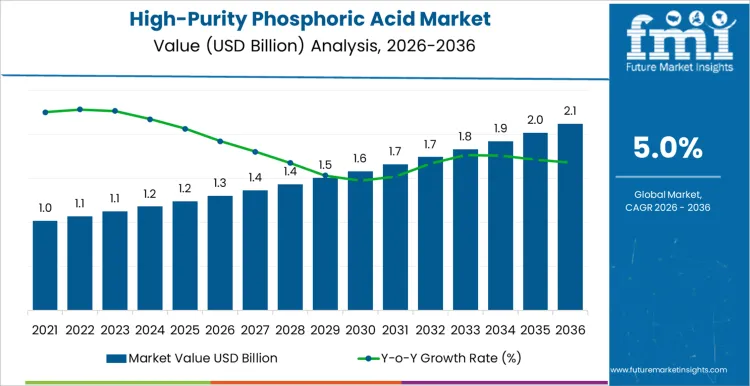
High-Purity Phosphoric Acid Market Key Takeaways
| Metric | Value |
|---|---|
| High-Purity Phosphoric Acid Market Value (2026) | USD 1.3 Billion |
| High-Purity Phosphoric Acid Market Forecast Value (2036) | USD 2.1 Billion |
| High-Purity Phosphoric Acid Market Forecast CAGR 2026 to 2036 | 5.00% |
How are Purity Requirements in Electronics, Batteries, and Life Sciences Driving the High-Purity Phosphoric Acid Market?
The high-purity phosphoric acid market is expanding as downstream industries demand tighter control over chemical purity and trace metal contamination. In applications such as semiconductor fabrication, lithium-ion battery materials, and pharmaceutical processing, even minute impurities can compromise performance, yield, or safety. High-purity phosphoric acid is used in etching, surface treatment, electrolyte preparation, and pH control, where consistency and reproducibility are critical. Growth in electronics manufacturing, advanced energy storage, and regulated life science applications is reinforcing demand for acid grades that meet stringent purity specifications.
End users place strong emphasis on impurity profiles, process stability, and supply reliability when selecting high-purity phosphoric acid. Buyers evaluate products based on metal ion content, particle levels, and compatibility with ultra-clean processing environments. In battery and electronics applications, phosphoric acid must support controlled reactions without introducing contaminants that affect electrode performance or device reliability. Producers are investing in advanced purification technologies, closed-loop production systems, and rigorous quality control protocols to meet evolving technical requirements across multiple high-value end uses.
Regulatory oversight and scaling of high-tech manufacturing are further supporting market growth. Compliance with pharmaceutical, food safety, and electronics industry standards is increasing the need for certified, traceable supply chains. At the same time, expansion of semiconductor fabs and battery manufacturing facilities is driving demand for consistent, high-volume deliveries of ultra-pure acids. For suppliers, competitive advantage increasingly depends on purification expertise, documentation and compliance capabilities, and long-term partnerships with end users positioning high-purity phosphoric acid as a critical input in precision-driven industrial applications.
How is the High-Purity Phosphoric Acid Market Structured by Grade and Application?
The high-purity phosphoric acid market is segmented by grade and application, reflecting how impurity control and end-use sensitivity determine product demand. By grade, electronics-grade phosphoric acid leads the market, as it meets stringent purity requirements for advanced manufacturing processes. Other grades include food and pharma grade and additional high-purity variants formulated for regulated or precision-driven uses. By application, semiconductor and electronics manufacturing represents the largest demand segment, followed by food and beverage processing, pharmaceutical and nutraceutical applications, and other specialized uses where contamination control and consistency are critical.
Why Does Electronics-Grade Phosphoric Acid Lead Grade Adoption In The High-Purity Phosphoric Acid Market?
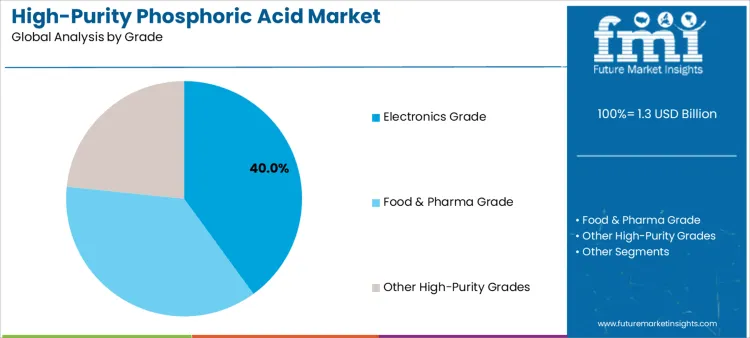
Electronics-grade phosphoric acid accounts for 40% share of the high-purity phosphoric acid market because semiconductor and electronics manufacturing requires extremely low levels of metallic and particulate impurities. This grade is widely used in wafer cleaning, surface treatment, and etching processes where even trace contamination can impact device yield and reliability. Manufacturers favor electronics-grade material due to its consistent concentration, tight quality control, and compatibility with advanced process nodes. High wafer throughput in logic, memory, and power semiconductor fabs sustains steady consumption. These precision-driven and volume-intensive requirements explain why electronics-grade phosphoric acid remains the leading grade.
Why Does Semiconductor And Electronics Manufacturing Dominate Application Demand In The High-Purity Phosphoric Acid Market?
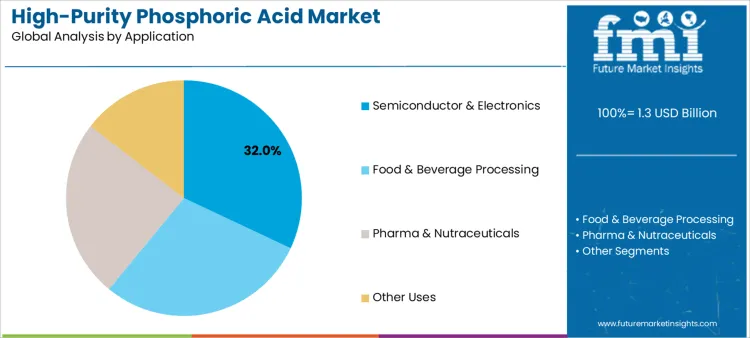
Semiconductor and electronics applications hold 32% share of the high-purity phosphoric acid market because phosphoric acid plays a critical role in multiple fabrication and finishing steps. It is used for oxide removal, surface conditioning, and selective etching across integrated circuit and electronic component production. Continuous fab operations and repeated chemical usage per wafer amplify overall demand. As device complexity increases, process sensitivity to chemical purity also rises, reinforcing reliance on high-grade acids. These high-frequency usage patterns and stringent performance requirements explain why semiconductor and electronics manufacturing remains the dominant application segment.
What are the Key Dynamics of the High-Purity Phosphoric Acid Market?
The high-purity phosphoric acid market is driven by increasing demand from electronics, semiconductor manufacturing, specialty fertilizers, pharmaceuticals, and food-grade applications that require stringent impurity control and consistent chemical performance. High-purity phosphoric acid is used in wafer cleaning, surface treatment, electrolyte formulations, and precision chemical synthesis, where trace metal contamination can affect yield and reliability. For chemical producers and end users, purity level, batch-to-batch consistency, and compliance with application-specific standards are key factors influencing procurement and long-term supplier relationships. Expanding use in advanced manufacturing and regulated industries continues to support steady market growth.
How Do Application Trends and Industry Requirements Shape This Market?
Application trends and industry requirements are shaping the high-purity phosphoric acid market as end users demand tighter impurity specifications and reliable supply chains. In semiconductor and electronics applications, high-purity phosphoric acid is critical for etching and cleaning processes that require precise control to avoid defects. Pharmaceutical and food-grade uses require adherence to stringent regulatory standards and documentation, influencing production and quality assurance practices. In specialty fertilizer and battery-related applications, consistent chemical performance and compatibility with downstream formulations are essential. Suppliers that invest in advanced purification technologies and quality control systems strengthen their position across these high-value segments.
Why Do Production Complexity and Cost Constraints Restrain Market Growth?
Production complexity and cost constraints restrain growth in the high-purity phosphoric acid market due to the technical requirements associated with achieving and maintaining ultra-low impurity levels. Advanced purification processes, including multiple filtration and refining stages, increase capital and operating costs. Maintaining contamination-free production environments and ensuring secure logistics further adds to cost pressures. Fluctuations in raw material prices and energy costs affect production economics. Lengthy qualification cycles and audits, particularly in semiconductor and pharmaceutical sectors, extend timelines for supplier approval and slow market entry for new producers.
How is the High-Purity Phosphoric Acid Market Growing across Key Countries?
The high-purity phosphoric acid market is expanding steadily as demand rises from electronics, specialty chemicals, pharmaceuticals, food processing, and advanced material manufacturing. High-purity grades are required where strict impurity control, consistency, and traceability are essential, particularly in semiconductor processing, lithium-ion battery materials, and precision chemical synthesis. Country-wise growth varies depending on expansion of electronics manufacturing, battery value chains, and specialty chemical production. High-growth markets benefit from scaling of downstream manufacturing capacity, while mature regions emphasize quality compliance, long-term supply reliability, and process validation.
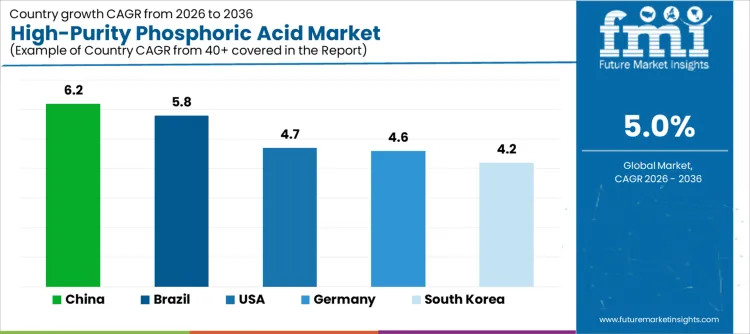
| Country | CAGR (%) |
|---|---|
| China | 6.2% |
| Brazil | 5.8% |
| United States | 4.7% |
| Germany | 4.6% |
| South Korea | 4.2% |
Why is China Leading the High-Purity Phosphoric Acid Market?
China’s high-purity phosphoric acid market is expanding at a CAGR of 6.2% during 2026 to 2036, driven by strong growth in electronics manufacturing, lithium-Ion battery materials, and specialty chemical production. High-purity phosphoric acid is widely used in semiconductor etching and cleaning processes, battery precursor synthesis, and precision chemical formulations. China’s dominant position in battery cell and cathode material manufacturing continues to generate sustained demand. Chinese buyers prioritize phosphoric acid with ultra-low metallic impurities, stable concentration control, and reliable batch consistency. Domestic producers benefit from integrated upstream phosphate resources and growing investments in purification technologies, enabling competitive supply at scale. Adoption is strongest in battery materials, electronic chemicals, and industrial specialty applications. Procurement decisions emphasize purity certification, supply reliability, and alignment with downstream manufacturing specifications.
Why is Brazil Seeing Strong Growth in High-Purity Phosphoric Acid Demand?
Brazil’s high-purity phosphoric acid market is growing at a CAGR of 5.8% during 2026 to 2036, supported by rising demand from food processing, pharmaceuticals, specialty chemicals, and emerging battery-related applications. While industrial-grade phosphoric acid dominates volumes, demand for higher-purity grades is increasing as manufacturers move toward more controlled and regulated end uses. Brazilian buyers value consistency, regulatory compliance, and suitability for food and pharma applications. Growth is strongest in food additives, beverage processing, and pharmaceutical excipients, with gradual adoption in battery materials and specialty chemicals. Cost-performance balance remains an important consideration. Procurement decisions often favor suppliers with local production or regional distribution and strong quality documentation. Market growth is supported by expansion of regulated industries, improving quality standards, and gradual diversification of phosphoric acid applications beyond fertilizers.
What is Driving Demand for High-Purity Phosphoric Acid in the United States?
The United States high-purity phosphoric acid market is expanding at a CAGR of 4.7% during 2026 to 2036, driven by demand from pharmaceuticals, food processing, electronics, and specialty chemicals. High-purity phosphoric acid is used in drug formulation, pH control, semiconductor processing, and battery material preparation. USA. buyers emphasize strict impurity control, regulatory compliance, and long-term supply reliability. Demand is strongest in pharmaceutical manufacturing, electronic chemicals, and high-specification industrial applications. Adoption is quality-driven rather than volume-driven. Procurement decisions prioritize supplier credibility, validated purification processes, and compliance with FDA and industrial standards. Market growth is reinforced by steady pharmaceutical output, electronics manufacturing activity, and increasing investment in advanced materials.
How is Germany Supporting Growth in the High-Purity Phosphoric Acid Market?
Germany’s high-purity phosphoric acid market is growing at a CAGR of 4.6% during 2026 to 2036, supported by demand from specialty chemicals, pharmaceuticals, and advanced industrial manufacturing. German manufacturers emphasize precision chemistry, traceability, and reproducible quality, driving steady consumption of high-purity grades. Buyers prioritize phosphoric acid with controlled impurity profiles and consistent performance in regulated applications. Demand is concentrated in pharma excipients, specialty formulations, and electronic-related uses. Procurement decisions favor suppliers with certified quality systems, detailed analytical documentation, and long-term supply assurance. Market growth is reinforced by Germany’s focus on high-value chemical production and stringent quality standards.
How is South Korea Expanding Use of High-Purity Phosphoric Acid?
South Korea’s high-purity phosphoric acid market is expanding at a CAGR of 4.2% during 2026 to 2036, driven by strong demand from semiconductor manufacturing, battery materials, and electronics production. High-purity phosphoric acid is used in wafer processing, cleaning applications, and preparation of battery-related intermediates. Buyers emphasize ultra-high purity, low metal content, and compatibility with precision manufacturing processes. Adoption is strongest in export-oriented electronics and battery supply chains. Procurement decisions are influenced by supplier technical capability, quality consistency, and alignment with global electronics manufacturing standards. Market growth is supported by continued investment in semiconductors, batteries, and advanced materials manufacturing.
How are Companies Competing in the High-Purity Phosphoric Acid Market?
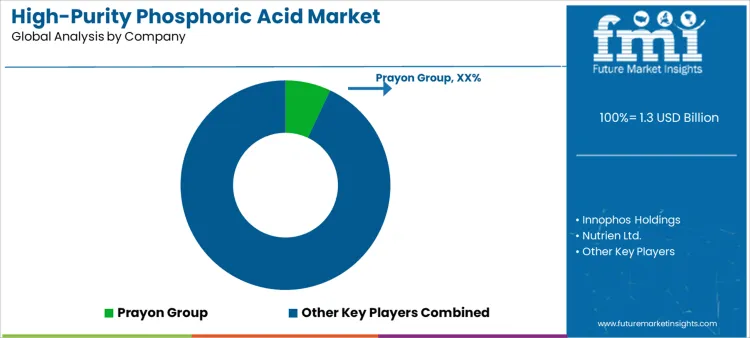
Competition in the high-purity phosphoric acid market is driven by impurity control, consistent supply quality, and compliance with stringent end-use specifications across food, beverage, specialty chemicals, pharmaceuticals, and electronic etchants. High-purity phosphoric acid (HPPA) must meet tight limits for trace metals, chloride, sulfate, and organics, and manufacturers differentiate through production processes, purification technologies, and analytical validation frameworks.
Prayon Group positions itself on controlled purification routes that ensure ultra-low impurity levels and batch-to-batch consistency, appealing strongly to food-grade and beverage applications. Its product materials emphasize stringent analytical traceability and compliance with international purity standards. Innophos Holdings competes through HPPA grades tailored for sensitive applications such as pharmaceutical intermediates and nutritional products, with documentation focused on stringent impurity limits and reliable supply.
Agricultural and diversified chemical groups expand competitive breadth. Nutrien Ltd. and OCP Group leverage large feedstock access and integrated processing to supply high-purity streams backed by robust quality systems. Arkema SA and Solvay SA differentiate through specialized purification technologies and global quality control programs suited for industrial and food sectors.
Other integrated producers and regional suppliers broaden the competitive landscape. Mosaic Company and ICL Group Ltd. provide traceable HPPA with certifications aligned to diverse end uses. Hubei Xingfa Chemicals Group and Aditya Birla Chemicals compete on regional supply strength and cost-effective purity solutions. Across the market, competitive advantage is defined by verified impurity profiles, consistent quality assurance, and compliance with regulatory standards rather than pricing alone.
Key Players in High-Purity Phosphoric Acid Market
- Prayon Group
- Innophos Holdings
- Nutrien Ltd.
- OCP Group
- Arkema SA
- Mosaic Company
- Solvay SA
- ICL Group Ltd.
- Hubei Xingfa Chemicals Group
- Aditya Birla Chemicals
Scope of Report
| Attribute | Details |
|---|---|
| Market Size Unit | USD Billion |
| Grade Covered | Electronics Grade, Food & Pharma Grade, Other High-Purity Grades |
| Application Covered | Semiconductor & Electronics, Food & Beverage Processing, Pharma & Nutraceuticals, Other Uses |
| Countries Covered | China, Japan, South Korea, India, Australia & New Zealand, ASEAN, Rest of Asia Pacific, Germany, United Kingdom, France, Italy, Spain, Nordic, BENELUX, Rest of Europe, United States, Canada, Mexico, Brazil, Chile, Rest of Latin America, Kingdom of Saudi Arabia, Other GCC Countries, Turkey, South Africa, Other African Union, Rest of Middle East & Africa |
| Regions Covered | Asia Pacific, Europe, North America, Latin America, Middle East & Africa |
| Key Companies Profiled | Prayon Group, Innophos Holdings, Nutrien Ltd., OCP Group, Arkema SA, Mosaic Company, Solvay SA, ICL Group Ltd., Hubei Xingfa Chemicals Group, Aditya Birla Chemicals |
| Additional Attributes | Dollar sales of high-purity phosphoric acid are analyzed by grade and end-use application across electronics manufacturing, food processing, and pharmaceutical production. The scope evaluates impurity control, metal ion content, consistency of purity levels, and compliance with food, pharma, and semiconductor standards. Country-level analysis reflects growth in semiconductor fabrication capacity, expansion of food and pharmaceutical processing industries, tightening quality regulations, and investments in high-purity chemical production infrastructure. |
High-Purity Phosphoric Acid Market by Key Segments
Grade:
- Electronics Grade
- Food & Pharma Grade
- Other High-Purity Grades
Application:
- Semiconductor & Electronics
- Food & Beverage Processing
- Pharma & Nutraceuticals
- Other Uses
Region:
- Asia Pacific
- China
- Japan
- South Korea
- India
- Australia & New Zealand
- ASEAN
- Rest of Asia Pacific
- Europe
- Germany
- United Kingdom
- France
- Italy
- Spain
- Nordic
- BENELUX
- Rest of Europe
- North America
- United States
- Canada
- Mexico
- Latin America
- Brazil
- Chile
- Rest of Latin America
- Middle East & Africa
- Kingdom of Saudi Arabia
- Other GCC Countries
- Turkey
- South Africa
- Other African Union
- Rest of Middle East & Africa
Bibliography
- National Institute of Standards and Technology. (2024). Measurement and control of trace impurities in semiconductor process chemicals. USA. Department of Commerce.
- USA. Department of Energy. (2023). Critical materials for lithium‑ion battery supply chains. DOE Office of Energy Efficiency and Renewable Energy.
- Food and Agriculture Organization of the United Nations. (2024). Specifications for food additives: Compendium of food additive specifications. FAO.
- International Organization for Standardization. (2024). ISO 17025: General requirements for the competence of testing and calibration laboratories. ISO.
- Kim, H., & Park, J. (2024). Purification and analytical control of high‑purity acids for electronic and pharmaceutical applications. Industrial & Engineering Chemistry Research, 63(6), 2154-2166.
Frequently Asked Questions
How big is the high-purity phosphoric acid market in 2026?
The global high-purity phosphoric acid market is estimated to be valued at USD 1.3 billion in 2026.
What will be the size of high-purity phosphoric acid market in 2036?
The market size for the high-purity phosphoric acid market is projected to reach USD 2.1 billion by 2036.
How much will be the high-purity phosphoric acid market growth between 2026 and 2036?
The high-purity phosphoric acid market is expected to grow at a 5.0% CAGR between 2026 and 2036.
What are the key product types in the high-purity phosphoric acid market?
The key product types in high-purity phosphoric acid market are electronics grade, food & pharma grade and other high-purity grades.
Which application segment to contribute significant share in the high-purity phosphoric acid market in 2026?
In terms of application, semiconductor & electronics segment to command 32.0% share in the high-purity phosphoric acid market in 2026.
Preview the report firsthand - request a free sample
Get SampleGet the brochure for pricing and purchase details.
Get PDFTable of Content
- Executive Summary
- Global Market Outlook
- Demand-side Trends
- Supply-side Trends
- Technology Roadmap Analysis
- Analysis and Recommendations
- Market Overview
- Market Coverage / Taxonomy
- Market Definition / Scope / Limitations
- Market Background
- Market Dynamics
- Drivers
- Restraints
- Opportunity
- Trends
- Scenario Forecast
- Demand in Optimistic Scenario
- Demand in Likely Scenario
- Demand in Conservative Scenario
- Opportunity Map Analysis
- Product Life Cycle Analysis
- Supply Chain Analysis
- Investment Feasibility Matrix
- Value Chain Analysis
- PESTLE and Porter’s Analysis
- Regulatory Landscape
- Regional Parent Market Outlook
- Production and Consumption Statistics
- Import and Export Statistics
- Market Dynamics
- Global Market Analysis 2021 to 2025 and Forecast, 2026 to 2036
- Historical Market Size Value (USD Million) Analysis, 2021 to 2025
- Current and Future Market Size Value (USD Million) Projections, 2026 to 2036
- Y-o-Y Growth Trend Analysis
- Absolute $ Opportunity Analysis
- Global Market Pricing Analysis 2021 to 2025 and Forecast 2026 to 2036
- Global Market Analysis 2021 to 2025 and Forecast 2026 to 2036, By Grade
- Introduction / Key Findings
- Historical Market Size Value (USD Million) Analysis By Grade, 2021 to 2025
- Current and Future Market Size Value (USD Million) Analysis and Forecast By Grade, 2026 to 2036
- Electronics Grade
- Food & Pharma Grade
- Other High-Purity Grades
- Electronics Grade
- Y-o-Y Growth Trend Analysis By Grade, 2021 to 2025
- Absolute $ Opportunity Analysis By Grade, 2026 to 2036
- Global Market Analysis 2021 to 2025 and Forecast 2026 to 2036, By Application
- Introduction / Key Findings
- Historical Market Size Value (USD Million) Analysis By Application, 2021 to 2025
- Current and Future Market Size Value (USD Million) Analysis and Forecast By Application, 2026 to 2036
- Semiconductor & Electronics
- Food & Beverage Processing
- Pharma & Nutraceuticals
- Other Uses
- Semiconductor & Electronics
- Y-o-Y Growth Trend Analysis By Application, 2021 to 2025
- Absolute $ Opportunity Analysis By Application, 2026 to 2036
- Global Market Analysis 2021 to 2025 and Forecast 2026 to 2036, By Region
- Introduction
- Historical Market Size Value (USD Million) Analysis By Region, 2021 to 2025
- Current Market Size Value (USD Million) Analysis and Forecast By Region, 2026 to 2036
- North America
- Latin America
- Western Europe
- Eastern Europe
- East Asia
- South Asia and Pacific
- Middle East & Africa
- Market Attractiveness Analysis By Region
- North America Market Analysis 2021 to 2025 and Forecast 2026 to 2036, By Country
- Historical Market Size Value (USD Million) Trend Analysis By Market Taxonomy, 2021 to 2025
- Market Size Value (USD Million) Forecast By Market Taxonomy, 2026 to 2036
- By Country
- USA
- Canada
- Mexico
- By Grade
- By Application
- By Country
- Market Attractiveness Analysis
- By Country
- By Grade
- By Application
- Key Takeaways
- Latin America Market Analysis 2021 to 2025 and Forecast 2026 to 2036, By Country
- Historical Market Size Value (USD Million) Trend Analysis By Market Taxonomy, 2021 to 2025
- Market Size Value (USD Million) Forecast By Market Taxonomy, 2026 to 2036
- By Country
- Brazil
- Chile
- Rest of Latin America
- By Grade
- By Application
- By Country
- Market Attractiveness Analysis
- By Country
- By Grade
- By Application
- Key Takeaways
- Western Europe Market Analysis 2021 to 2025 and Forecast 2026 to 2036, By Country
- Historical Market Size Value (USD Million) Trend Analysis By Market Taxonomy, 2021 to 2025
- Market Size Value (USD Million) Forecast By Market Taxonomy, 2026 to 2036
- By Country
- Germany
- UK
- Italy
- Spain
- France
- Nordic
- BENELUX
- Rest of Western Europe
- By Grade
- By Application
- By Country
- Market Attractiveness Analysis
- By Country
- By Grade
- By Application
- Key Takeaways
- Eastern Europe Market Analysis 2021 to 2025 and Forecast 2026 to 2036, By Country
- Historical Market Size Value (USD Million) Trend Analysis By Market Taxonomy, 2021 to 2025
- Market Size Value (USD Million) Forecast By Market Taxonomy, 2026 to 2036
- By Country
- Russia
- Poland
- Hungary
- Balkan & Baltic
- Rest of Eastern Europe
- By Grade
- By Application
- By Country
- Market Attractiveness Analysis
- By Country
- By Grade
- By Application
- Key Takeaways
- East Asia Market Analysis 2021 to 2025 and Forecast 2026 to 2036, By Country
- Historical Market Size Value (USD Million) Trend Analysis By Market Taxonomy, 2021 to 2025
- Market Size Value (USD Million) Forecast By Market Taxonomy, 2026 to 2036
- By Country
- China
- Japan
- South Korea
- By Grade
- By Application
- By Country
- Market Attractiveness Analysis
- By Country
- By Grade
- By Application
- Key Takeaways
- South Asia and Pacific Market Analysis 2021 to 2025 and Forecast 2026 to 2036, By Country
- Historical Market Size Value (USD Million) Trend Analysis By Market Taxonomy, 2021 to 2025
- Market Size Value (USD Million) Forecast By Market Taxonomy, 2026 to 2036
- By Country
- India
- ASEAN
- Australia & New Zealand
- Rest of South Asia and Pacific
- By Grade
- By Application
- By Country
- Market Attractiveness Analysis
- By Country
- By Grade
- By Application
- Key Takeaways
- Middle East & Africa Market Analysis 2021 to 2025 and Forecast 2026 to 2036, By Country
- Historical Market Size Value (USD Million) Trend Analysis By Market Taxonomy, 2021 to 2025
- Market Size Value (USD Million) Forecast By Market Taxonomy, 2026 to 2036
- By Country
- Kingdom of Saudi Arabia
- Other GCC Countries
- Turkiye
- South Africa
- Other African Union
- Rest of Middle East & Africa
- By Grade
- By Application
- By Country
- Market Attractiveness Analysis
- By Country
- By Grade
- By Application
- Key Takeaways
- Key Countries Market Analysis
- USA
- Pricing Analysis
- Market Share Analysis, 2025
- By Grade
- By Application
- Canada
- Pricing Analysis
- Market Share Analysis, 2025
- By Grade
- By Application
- Mexico
- Pricing Analysis
- Market Share Analysis, 2025
- By Grade
- By Application
- Brazil
- Pricing Analysis
- Market Share Analysis, 2025
- By Grade
- By Application
- Chile
- Pricing Analysis
- Market Share Analysis, 2025
- By Grade
- By Application
- Germany
- Pricing Analysis
- Market Share Analysis, 2025
- By Grade
- By Application
- UK
- Pricing Analysis
- Market Share Analysis, 2025
- By Grade
- By Application
- Italy
- Pricing Analysis
- Market Share Analysis, 2025
- By Grade
- By Application
- Spain
- Pricing Analysis
- Market Share Analysis, 2025
- By Grade
- By Application
- France
- Pricing Analysis
- Market Share Analysis, 2025
- By Grade
- By Application
- India
- Pricing Analysis
- Market Share Analysis, 2025
- By Grade
- By Application
- ASEAN
- Pricing Analysis
- Market Share Analysis, 2025
- By Grade
- By Application
- Australia & New Zealand
- Pricing Analysis
- Market Share Analysis, 2025
- By Grade
- By Application
- China
- Pricing Analysis
- Market Share Analysis, 2025
- By Grade
- By Application
- Japan
- Pricing Analysis
- Market Share Analysis, 2025
- By Grade
- By Application
- South Korea
- Pricing Analysis
- Market Share Analysis, 2025
- By Grade
- By Application
- Russia
- Pricing Analysis
- Market Share Analysis, 2025
- By Grade
- By Application
- Poland
- Pricing Analysis
- Market Share Analysis, 2025
- By Grade
- By Application
- Hungary
- Pricing Analysis
- Market Share Analysis, 2025
- By Grade
- By Application
- Kingdom of Saudi Arabia
- Pricing Analysis
- Market Share Analysis, 2025
- By Grade
- By Application
- Turkiye
- Pricing Analysis
- Market Share Analysis, 2025
- By Grade
- By Application
- South Africa
- Pricing Analysis
- Market Share Analysis, 2025
- By Grade
- By Application
- USA
- Market Structure Analysis
- Competition Dashboard
- Competition Benchmarking
- Market Share Analysis of Top Players
- By Regional
- By Grade
- By Application
- Competition Analysis
- Competition Deep Dive
- Prayon Group
- Overview
- Product Portfolio
- Profitability by Market Segments (Product/Age /Sales Channel/Region)
- Sales Footprint
- Strategy Overview
- Marketing Strategy
- Product Strategy
- Channel Strategy
- Innophos Holdings
- Nutrien Ltd.
- OCP Group
- Arkema SA
- Mosaic Company
- Solvay SA
- ICL Group Ltd.
- Hubei Xingfa Chemicals Group
- Aditya Birla Chemicals
- Prayon Group
- Competition Deep Dive
- Assumptions & Acronyms Used
- Research Methodology


